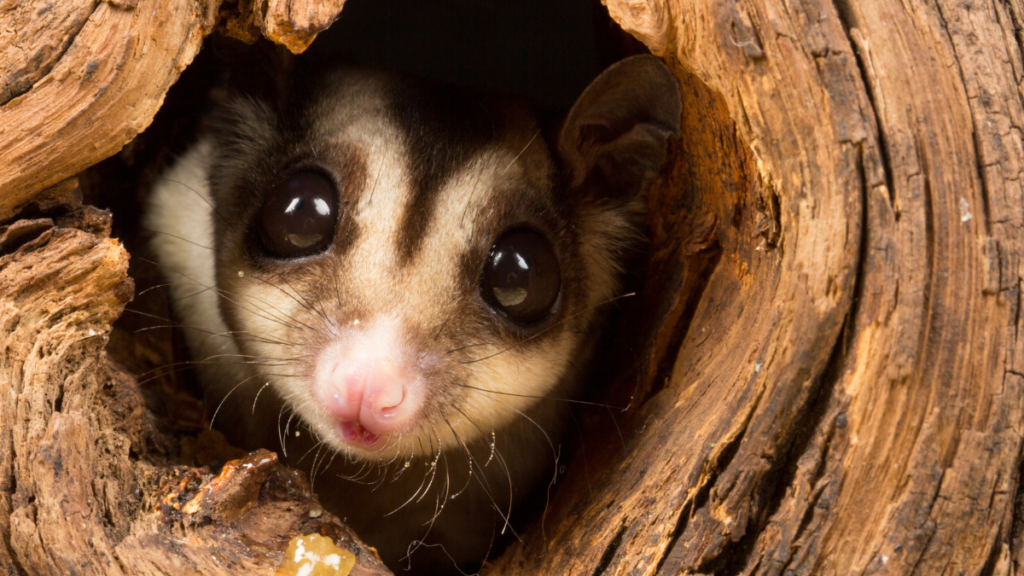
The first sugar glider I met landed on my shoulder in a spare bedroom at a friend’s house. He bred ball pythons professionally, and reptile racks lined one wall. An African grey parrot judged me from a stand by the window. A barn owl blinked at me from the next room. Every animal came with a permit, which mattered to him.
He talked for hours while two blue-grey faces watched us from a tall cage.
Then I moved to Australia. Five years on, I still have not found one in the wild. This article closes the gap between the animal I handled and the one living in these forests.
Below are the 12 things I wish I had known that night. The biology, the 2020 taxonomy shake-up, and the parts of the pet trade nobody advertises.
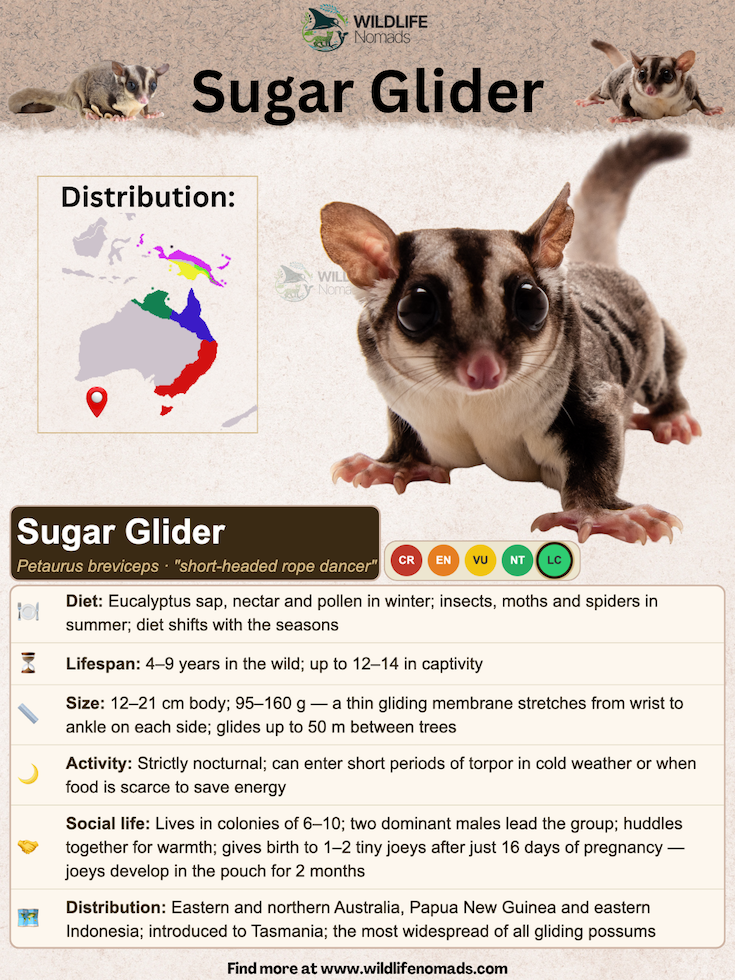
1. The Sugar Glider Is Now Three Species, Not One
For two centuries, biologists treated every one of these animals as a single species. A 2020 paper in a zoological journal ended that. Teigan Cremona’s team examined more than 300 specimens, including a 150-year-old skin held in London.
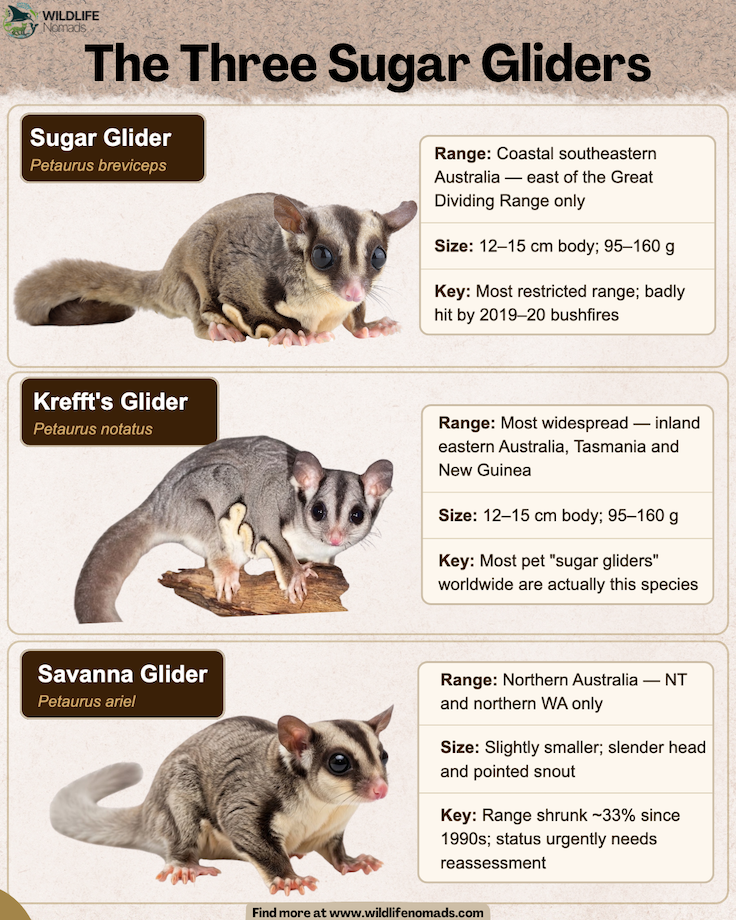
Their genetics revealed three distinct species. The sugar glider scientific name Petaurus breviceps now covers only coastal southern Queensland and New South Wales. Krefft’s glider (Petaurus notatus) holds the inland southeast. The savanna glider (Petaurus ariel) belongs to the tropical north.
Three species, one former name. That change rewrote the conservation maths overnight.
2. “Sugar Bat” Is a Nickname, Not a Family Tree
People call them sugar bats, flying squirrels and pocket possums. Every one of those names misleads.
They are not bats. They are not squirrels either, despite resembling a North American flying squirrel almost exactly. That likeness is convergent evolution in characteristics between rodents (squirrels) and these marsupials, two unrelated lineages solving one problem the same way.
Their real kin are other gliders in the family Petauridae. The squirrel glider, the mahogany glider and Leadbeater’s possum all qualify, and all are arboreal marsupials. The genus arose across Australia and New Guinea roughly 18 to 24 million years ago.
3. The Gliding Membrane Turns a 120-Gram Body Into an Aircraft
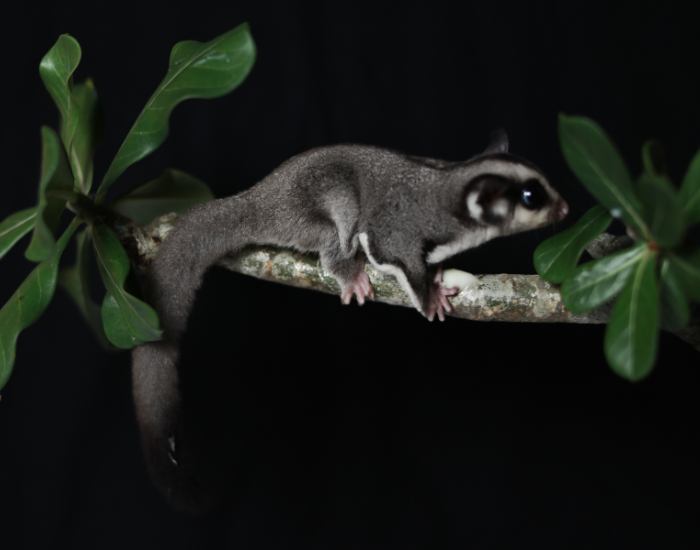
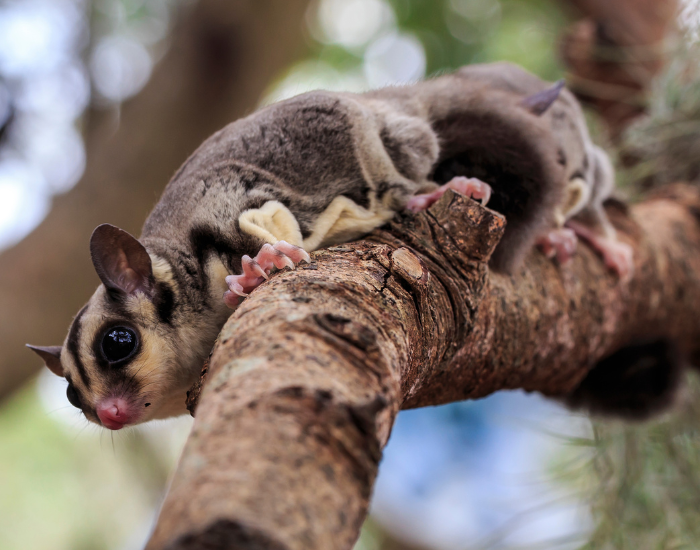
The gliding membrane extends from the fifth finger to the ankle on each side. This patagium is the most important of all sugar glider adaptations.
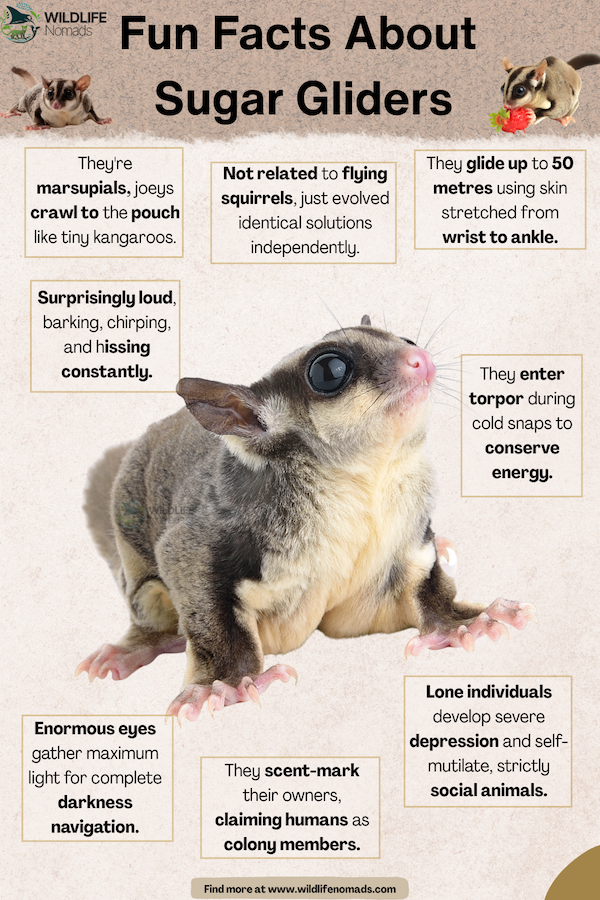
One adult can glide up to 50 metres between trees, according to the Australian Museum. They launch from a tree trunk, steer with their limbs, and use the bushy tail as a rudder. Landing means flaring upward and gripping bark with all four feet.
Fifty metres beats an Olympic pool. That range lets them cross large expanses of canopy without touching ground.
4. Where Sugar Gliders Live Is Smaller Than the Old Maps Said
After 2020, P. breviceps occupies a narrow band of eastern Australia. Picture southeast Queensland running down through coastal New South Wales.
Ask where does a sugar glider live, and the answer is tall wet forest, dry sclerophyll forests, and coastal regions with a shrubby understorey. They climb to 2,000 metres in elevation. So where are sugar gliders native to? Eastern Australia, with close relatives covering the rest.
Krefft’s glider takes the western side of the Great Dividing Range and reaches South Australia. Savanna gliders hold northern Australia. That redrawn sugar glider distribution matters, because small ranges are easy to lose.

5. No Tree Hollows, No Gliders
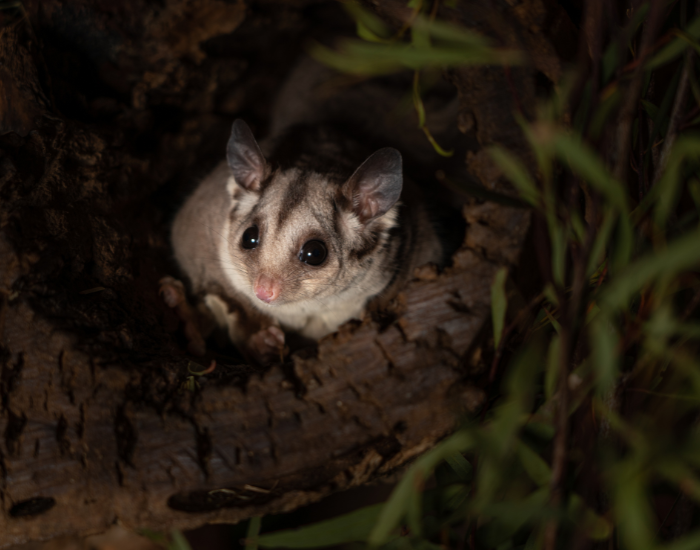
The sugar glider environment is built from old eucalyptus trees. Groups nest in tree hollows lined with leaves, rotating between several dens across a territory. Habitat assessments typically look for three to five hollow-bearing trees per hectare.
A usable hollow takes a century to form. Logging and cleared land strip them out far faster than the forest replaces them. Habitat loss is therefore the biggest single threat, and nest boxes only patch the gap.
Any map of sugar gliders habitat is really a map of old trees. The 2019–2020 megafires burned straight through the coastal habitat sugar gliders depend on, taking den trees and residents together.
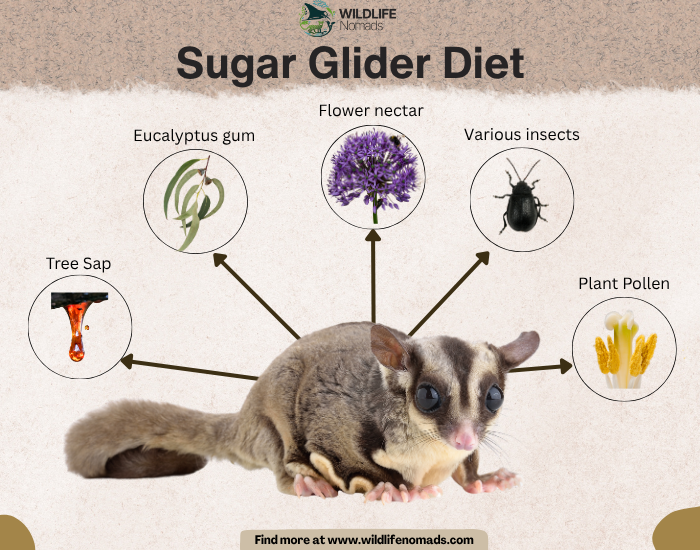
6. Tree Sap, Nectar and 200 Kilos of Beetles
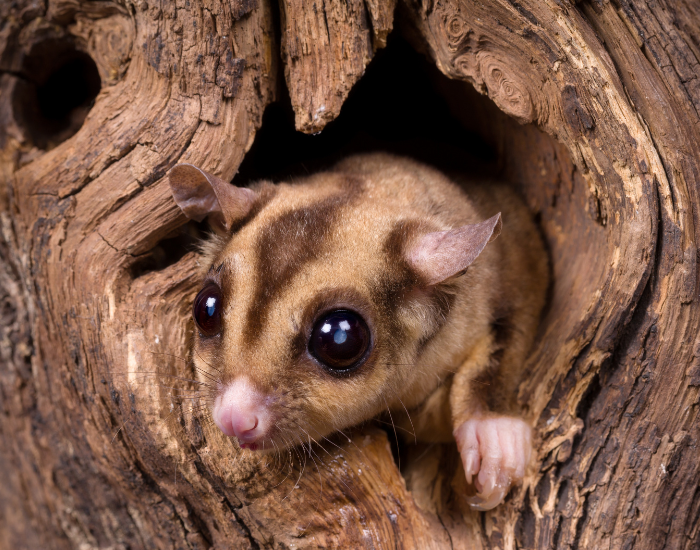
The sweet tooth is real. Gliders gouge the bark of acacias and eucalypts, then return to drink the flowing tree sap. Nectar and honeydew round out the sugary food sources.
However, they turn carnivorous the moment they can. Insects supply most of the protein, and one colony eats an estimated 200 kilograms a year, Christmas beetles included. Small birds and their nestlings are fair game too.
Captive food is where most owners fail. Gliders need a calcium-to-phosphorus ratio near 2:1 and roughly 11 grams of dry food daily. Get it wrong and the hind legs weaken first.
7. They Drop Their Body Temperature to Conserve Energy
Sap runs dry and cold nights burn calories a 120-gram mammal cannot spare. As a result, gliders enter torpor, letting body temperature and metabolism crash for hours at a time.
Australian wildlife research at the University of New England recorded something striking. Gliders survived a cyclone, then used deeper and longer torpor across the ground afterwards. Sitting still and cold is how they conserve energy when the food disappears.
8. Family Groups of Up to Seven Adults, Bonded by Smell
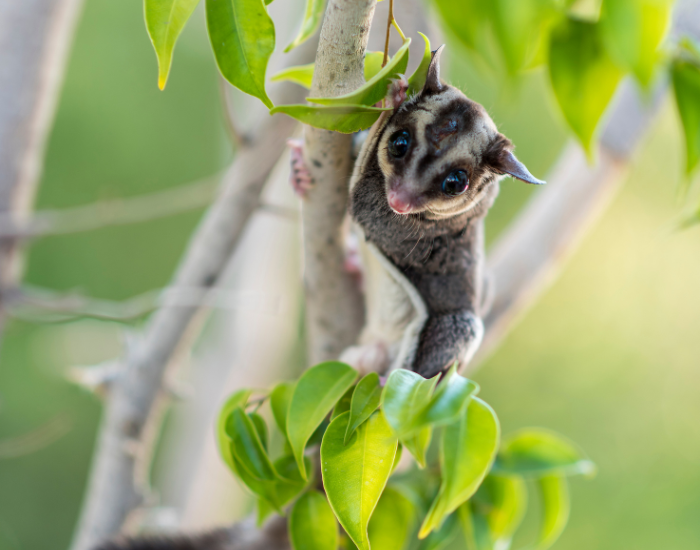
These are intensely social animals. Wild family groups hold up to seven adults plus that season’s young, all sleeping in one warm heap.
Dominant males carry scent glands on the forehead and chest, separate glands for each site. The scent produced there gets rubbed onto all group members, creating a shared colony odour. Intruders and other animals lacking that smell get driven off, sometimes brutally.
Males also provide real parental care, huddling with young while the other parent forages. Barks, chatters and hisses handle the rest of the conversation.

9. The Pouch Is the Whole Marsupial Story
Female sugar gliders carry a forward-opening pouch with four teats, though twins are the norm. A newborn weighs 0.2 grams, less than a grain of rice. It crawls unaided into the pouch and fuses to a teat for about 40 days.
Young sugar gliders leave the pouch near day 70 and stay in the nest hollow afterwards. Females reach sexual maturity around eight months, males a little later.
A short pregnancy followed by a long external one, that is what defines a marsupial sugar glider.
10. In Tasmania, the Glider Is the Invader
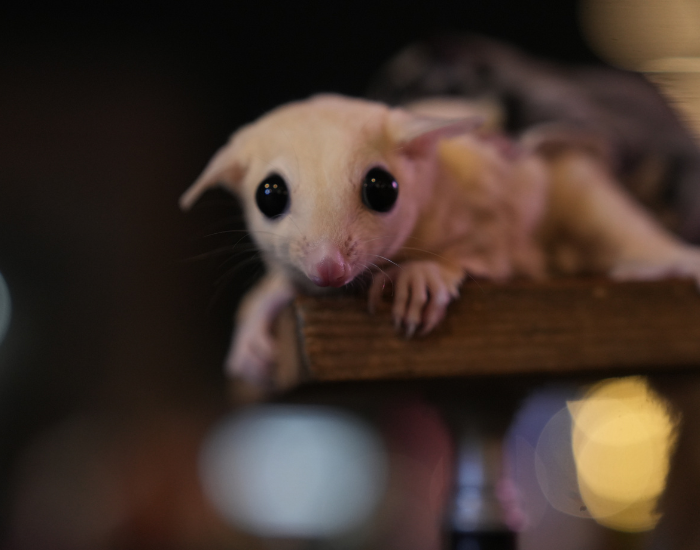
Here the cute-animal story breaks down. Gliders are not native to Tasmania. Genetic and archival work published in 2018 traced the island population to animals shipped from Victoria around 1835.
They now raid hollows used by the critically endangered swift parrot. Dejan Stojanovic’s team found gliders killing roughly half the nesting females at some mainland Tasmanian sites.
Blaming the glider misses the cause. Logging removed the mature forest that once kept parrots out of reach.
11. Keeping One Is Harder Than My Friend Made It Look
The exotic trade sells them beside African hedgehogs and prairie dogs (Cynomys spp.) as easy pocket pets. They are nothing of the sort.
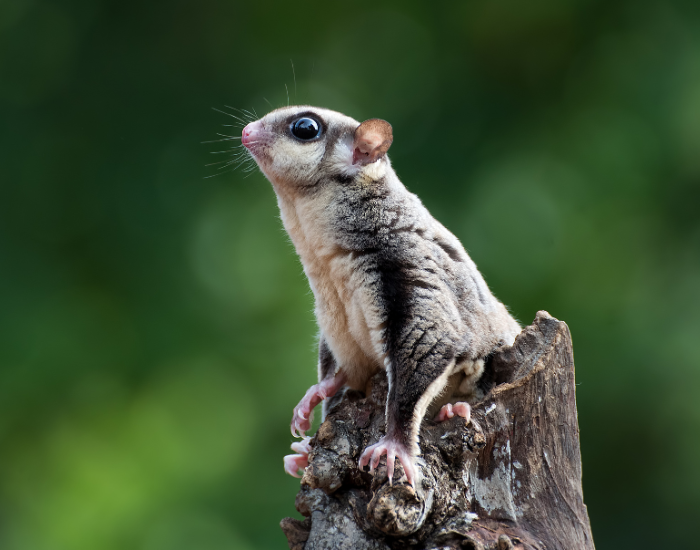
These are nocturnal marsupials. Bonding and handling happen after dark, every night, for the 12 to 14 years they live in captivity. Like most nocturnal animals, they turn loud and destructive when bored.
They need a tall cage with bar spacing under one inch, climbing branches and constant enrichment. They must live in pairs, because isolation triggers stress and self-mutilation. Only an exotics vet who knows marsupial critical care procedures can treat them properly.
12. “Least Concern” Hides a More Complicated Picture
The IUCN Red List still ranks the sugar glider as Least Concern. That assessment describes the old lumped range, not the narrow one left after the split.
Australian conservationists increasingly treat P. breviceps as vulnerable in practice. Its population ecology is now the story of a coastal remnant hit by clearing and fire. Federally, the Environment Protection and Biodiversity Conservation Act 1999 governs protected native wildlife and its export. Each state layers its own rules on top.
A conservation label is only as good as the taxonomy beneath it.
Frequently Asked Questions
Yes. Female sugar gliders have a forward-opening pouch containing four teats. Newborns weigh about 0.2 grams and crawl in immediately after birth, then attach to a teat for roughly 40 days. Joeys emerge near 70 days old. Males have no pouch.
Its closest relatives are other gliders in the genus Petaurus. The squirrel glider and mahogany glider sit nearest, alongside Krefft’s glider and the savanna glider since the 2020 split. Slightly further out is Leadbeater’s possum, a non-gliding cousin in the family Petauridae.
In most of the country, yes. New South Wales, Queensland, Western Australia, Tasmania and the ACT prohibit them as household pets. Victoria, South Australia and the Northern Territory allow keeping under a wildlife licence. Elsewhere, permits generally go only to licensed carers and researchers.
Yes, and to New Guinea and nearby islands, depending on the population. Confirmed sugar glider locations for P. breviceps now sit in coastal eastern Australia only. Tasmania’s population is introduced. Anyone asking where sugar gliders live should picture hollow-rich eucalypt forest along the east coast.
What I Would Tell My Younger Self
The animal in that spare bedroom was real, but the story attached to it was incomplete. A sugar glider is not a pocket pet that happens to be Australian. It is a hollow-dependent, sap-feeding, torpor-using marsupial bound entirely to old trees.
I am still chasing my first wild sighting. If you live along the east coast, take a red torch into a eucalypt patch after dark. Listen for that yapping bark, it carries much further than you expect.
Have you seen one glide in the wild? Tell me where in the comments. For more on this lineage, read our guides to Australia’s animals and what makes a mammal a marsupial.
Sugar Glider: Test Yourself 🐾
Eight multiple-choice questions on the little glider everyone gets wrong. Go back and change any answer before you score.
References:
Campbell, C. D., Sarre, S. D., Stojanovic, D., Gruber, B., Medlock, K., Harris, S., MacDonald, A. J., & Holleley, C. E. (2018). When is a native species invasive? Incursion of a novel predatory marsupial detected using molecular and historical data. Diversity and Distributions, 24(6), 831–840. https://doi.org/10.1111/ddi.12717
Cremona, T., Baker, A. M., Cooper, S. J. B., Montague-Drake, R., Stobo-Wilson, A. M., & Carthew, S. M. (2021). Integrative taxonomic investigation of Petaurus breviceps (Marsupialia: Petauridae) reveals three distinct species. Zoological Journal of the Linnean Society, 191(2), 503–527. https://doi.org/10.1093/zoolinnean/zlaa060
Legge, S., Woinarski, J. C. Z., Scheele, B. C., Garnett, S. T., Lintermans, M., Nimmo, D. G., … Whiterod, N. S. (2022). Rapid assessment of the biodiversity impacts of the 2019–2020 Australian megafires. Diversity and Distributions, 28(3), 571–591. https://doi.org/10.1111/ddi.13428
Nowack, J., Rojas, A. D., Körtner, G., & Geiser, F. (2015). Snoozing through the storm: Torpor use during a natural disaster. Scientific Reports, 5, 11243. https://doi.org/10.1038/srep11243
Stojanovic, D., Webb, M. H., Alderman, R., Porfirio, L. L., & Heinsohn, R. (2014). Discovery of a novel predator reveals extreme but highly variable mortality for an endangered migratory bird. Diversity and Distributions, 20(10), 1200–1207. https://doi.org/10.1111/ddi.12214