Very few people alive have seen a live oarfish, and I’m not one of them. I’ve dived with hammerheads, lemon sharks and wobbegongs. In Baja California, a gray whale once eased her calf toward our boat at arm’s length. The ocean has never shown me this fish, though.
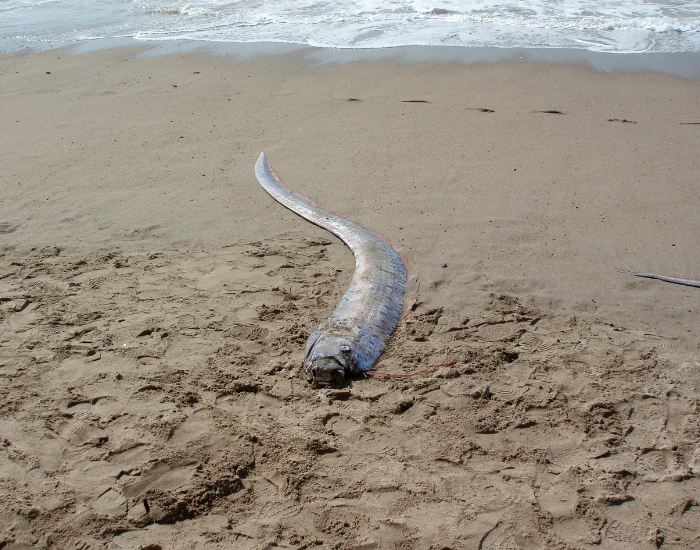
So when a clip of a “doomsday fish” swimming onto a Baja California Sur beach went viral in February 2025, I watched it over and over. Within days, videos claimed the fish carried an ancient prophecy. If it came ashore, they said, earthquakes and tsunamis would follow.
The doomsday fish is the oarfish, the longest bony fish on Earth. It’s real, it’s strange, and it’s far more interesting than the myth. Here’s what scientists actually know about how it lives, eats and swims, and where that earthquake legend comes from. Spoiler: the data doesn’t support the prophecy. The animal itself is the real wonder.
1. The Giant Oarfish Is the World’s Longest Bony Fish
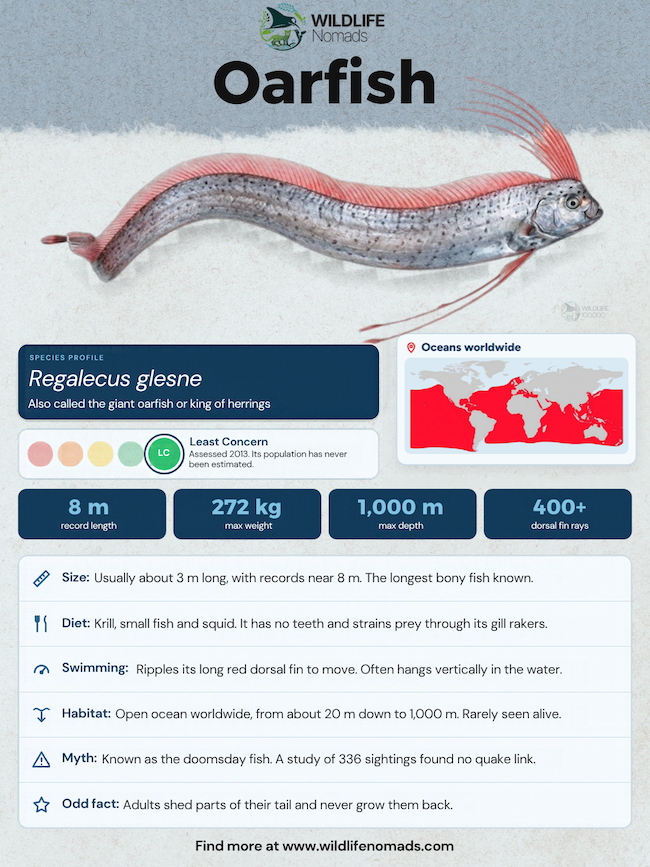
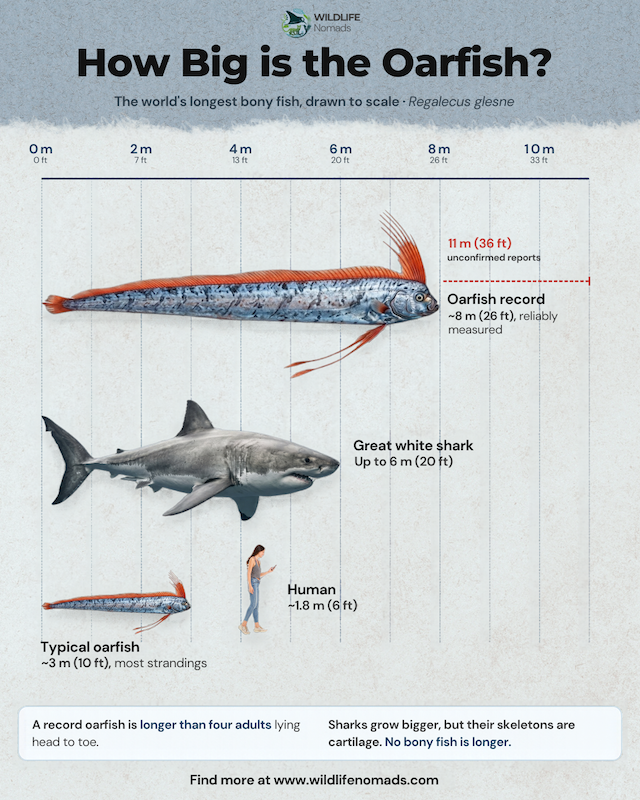
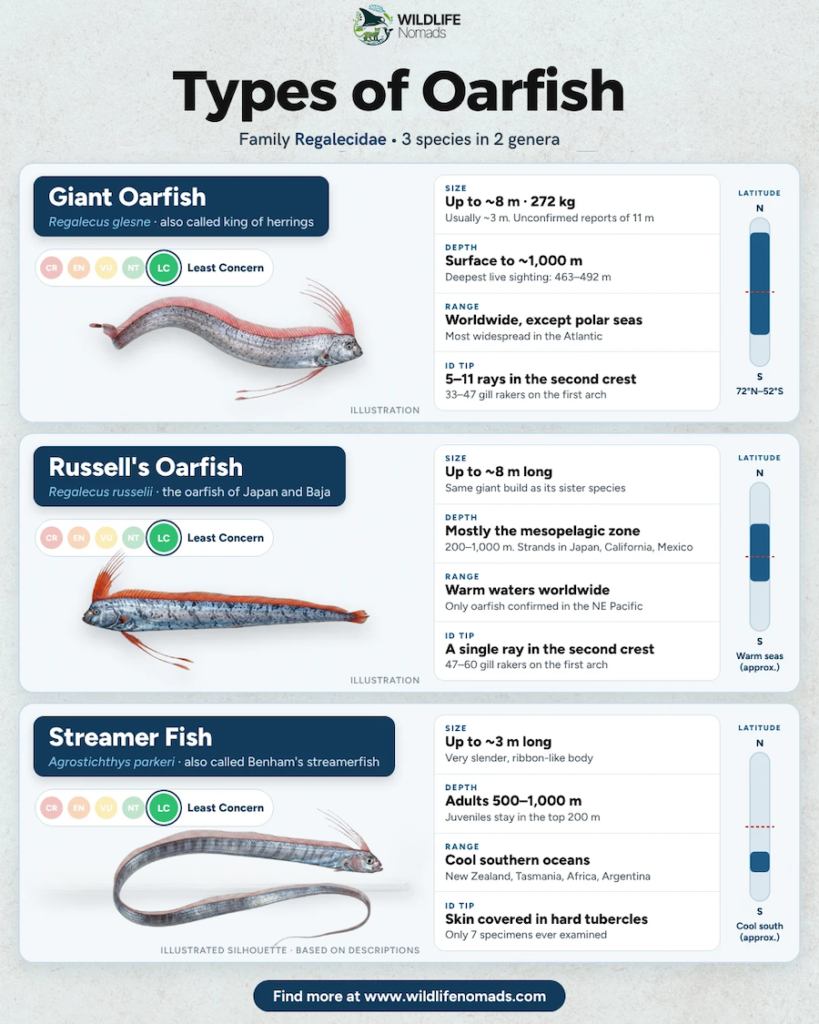
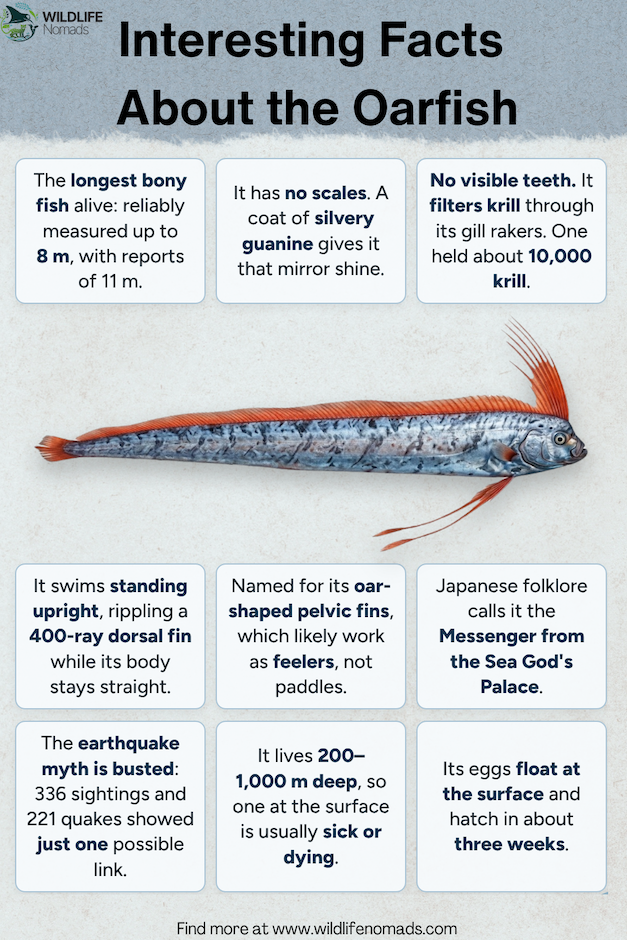
The giant oarfish (Regalecus glesne) holds the title of the world’s longest bony fish. Reliably measured specimens reach about 8 m (26 ft). Unconfirmed reports describe animals of 11 m (36 ft) weighing around 270 kg. Most specimens that wash up, however, measure closer to 3 m.
That distinction matters. Sharks and rays grow larger, but their skeletons are cartilage, not bone. Among fish with true bony skeletons, nothing alive matches the oarfish’s entire length. If you want to picture it against a bus or a blue whale, our animal size comparison tool puts it in perspective.
2. The “Doomsday Fish” Name Comes From Japanese Folklore
In Japan, oarfish are called Ryūgū-no-tsukai, the “Messenger from the Sea God’s Palace.” According to folklore, they rise from the deep to warn people that an earthquake is coming. That story is the root of every “doomsday fish” headline you’ve seen.
The legend gained huge traction after 2011. In late 2009 and 2010, around 20 oarfish stranded on Japanese shores. Then, in March 2011, the Tōhoku earthquake and tsunami struck. People connected the two events after the fact, and some began calling oarfish “earthquake fish.”
I understand the pull. When something rare appears before a tragedy, our brains stitch a story together. That said, the “doomsday fish” label reflects cultural belief, not any ecological threat the fish poses.
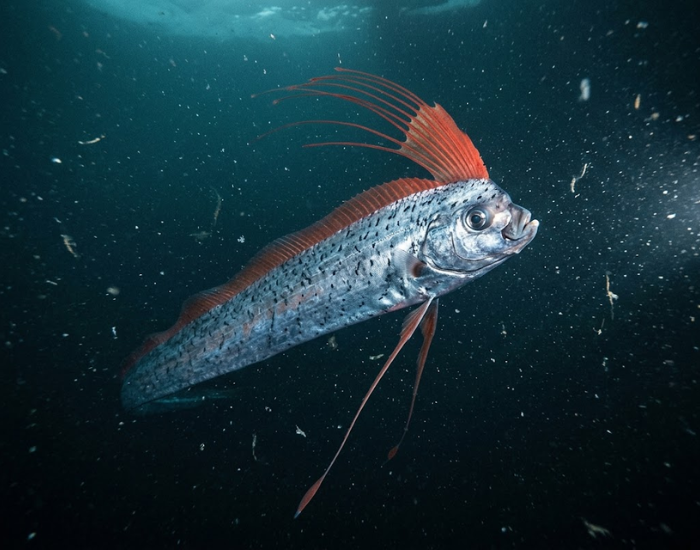
3. Scientists Tested the Doomsday Fish Prophecy
In 2019, Japanese researchers put the folklore to a proper test. They compiled records of deep sea fish sightings in Japan from 1928 to 2011. Then they compared those sightings with earthquakes that struck nearby within the following weeks.
Out of 336 fish appearances and 221 earthquakes, only one event showed a plausible link. The authors concluded the belief rests on an illusory correlation. In other words, we remember the hits and forget the thousands of misses.
California offers a fresh example. An oarfish washed up at Grandview Beach in November 2024, and a magnitude 7.0 quake hit offshore a month later. Social media called it proof. However, earthquakes happen along that coast constantly, while the fish have no known way to sense them in advance.
4. The Oarfish Family Has Two Genera and Several Common Names
The oarfish family, Regalecidae, contains two genera. The oceanic oarfish genus Regalecus includes the giant oarfish and the Pacific oarfish, Regalecus russelii. The second genus, Agrostichthys, holds a single rare species, Agrostichthys parkeri, known as the streamer fish.
These animals collect names wherever they turn up. Fishermen in the North Atlantic called them “king of herrings,” likely because they appeared near herring schools. People also call them ribbonfish, oar fish and occasionally rooster fish, after the red crest. In Finnish, the oarfish is airokala.
Here’s a detail most viral videos miss. Studies of California strandings found that only Regalecus russelii has been confirmed in the northeastern Pacific, including Mexico. So the famous Baja “doomsday fish” was most likely a Pacific oarfish, not Regalecus glesne.
5. Oar-Shaped Pelvic Fins Gave It Its Name
The name comes from the pelvic fins. Each one is a single long ray ending in a slightly flattened tip, like the blade of an oar. Early naturalists imagined the fish rowing itself through the sea.
In reality, those pelvic fins probably act as sensory feelers rather than paddles. The small pectoral fins sit low on the body, just behind the head. Neither pair does much of the heavy swimming.
6. A Dorsal Fin That Runs the Entire Length of the Body
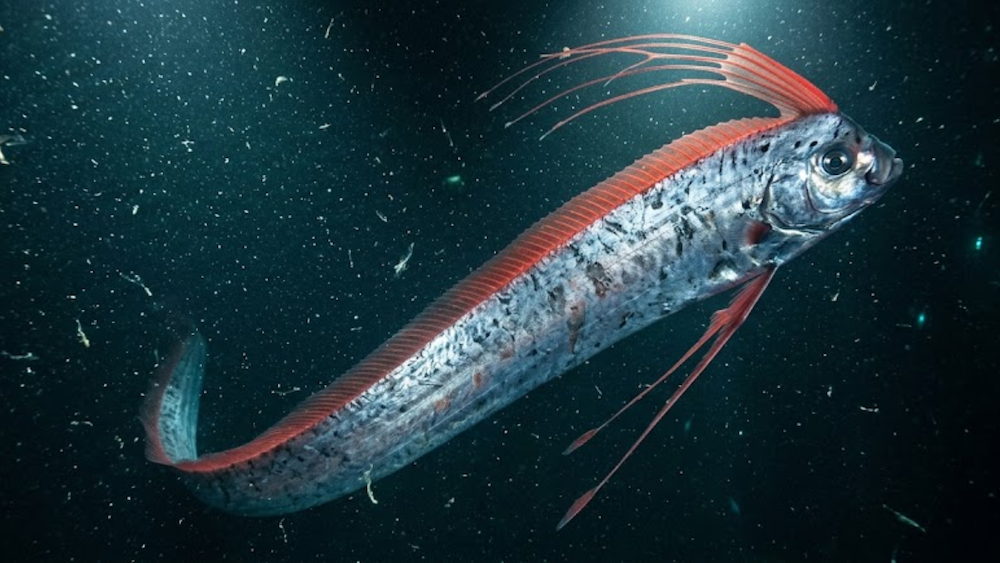
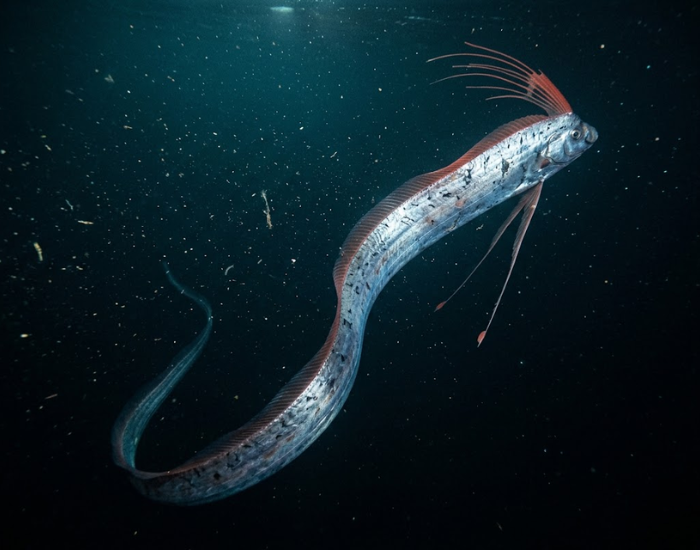
The oarfish’s signature feature is its crimson dorsal fin. It holds up to around 400 rays. The dorsal fin originates on the head, where the first rays stretch long to form a trailing crest. From there, it runs the full length of the ribbon-like body.
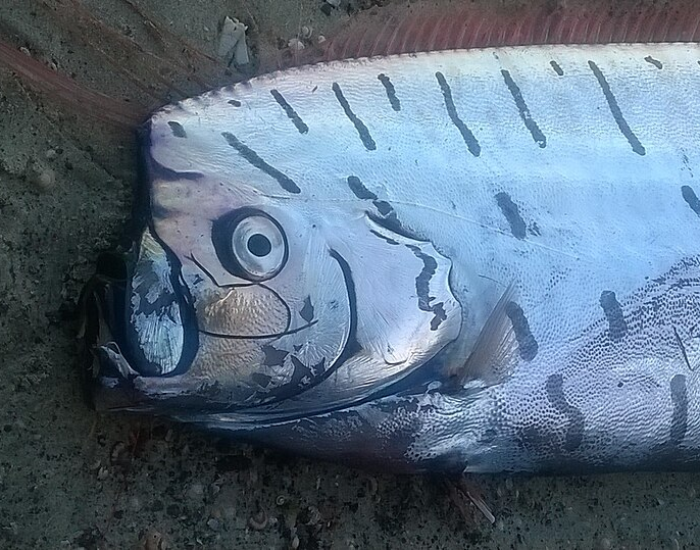
The silver skin carries dark streaks, spots and wavy markings, while the fins flush red. Behind the head, the elongated body keeps tapering to a fine point. Interestingly, adults lack an anal fin entirely, and the caudal fin is tiny or absent. Many specimens are found with the caudal tip missing, possibly lost to predators such as sharks.
7. No Scales, No Visible Teeth, and a Filter Feeder’s Diet
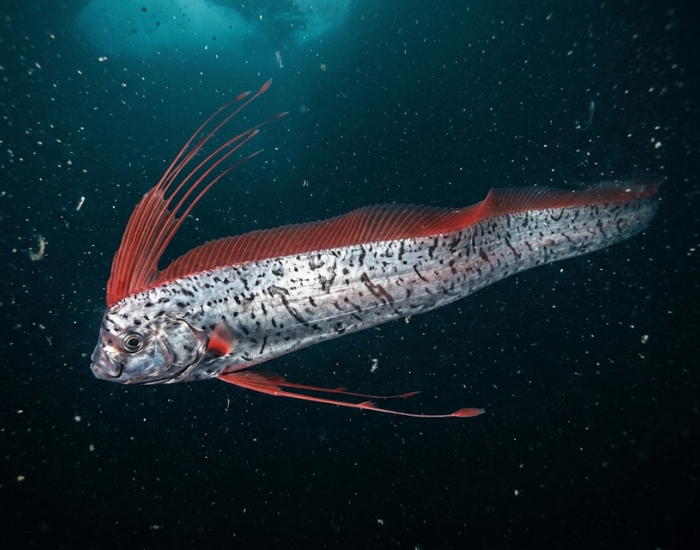
Oarfish have no scales. Instead, a layer of silvery guanine covers the skin, which explains that mirror-like shimmer in the viral clips. The flesh is gelatinous and reportedly unpalatable, so the fish has no commercial value and fishers rarely target it.
The head ends in a small protrusible mouth with no visible teeth. Oarfish are filter feeders. They strain prey through comb-like gill rakers, which number roughly 33 to 47 in the giant oarfish. Stomach contents show a diet dominated by krill and other small crustaceans, plus plankton, squid and the occasional small fish.
One frequently cited specimen reportedly held around 10,000 krill in its gut. So what do oarfish eat? Mostly tiny animals, in staggering numbers. By contrast with the monster of legend, this is a gentle grazer of the water column.
8. Oarfish Behavior: Swimming in a Vertical Position
When researchers finally filmed healthy oarfish in the wild, they saw something unexpected. The fish hung in a vertical position, head up, long body trailing below. From 2008 to 2011, remotely operated vehicles recorded five live oarfish this way in the Gulf of Mexico.
To move, an oarfish ripples its dorsal fin in waves while keeping its body fairly rigid. Scientists think this vertical orientation helps it spot prey silhouetted against faint light from above. As a result, it may drift and wait rather than chase.
Oddly, for such a large fish, the giant oarfish has relatively small eyes. Many deep sea fish have large eyes to catch every photon, like the barreleye fish. The oarfish seems to rely on other cues, which remains one of the open questions about its biology.
9. Where Oarfish Live in the Deep Sea
Oarfish live mainly in the mesopelagic zone, roughly 200 to 1,000 m deep. Records place them anywhere from about 15 m to 1,000 m, though most observations come from 20 to 200 m. The deepest verified live sighting sits at around 463 to 492 m.
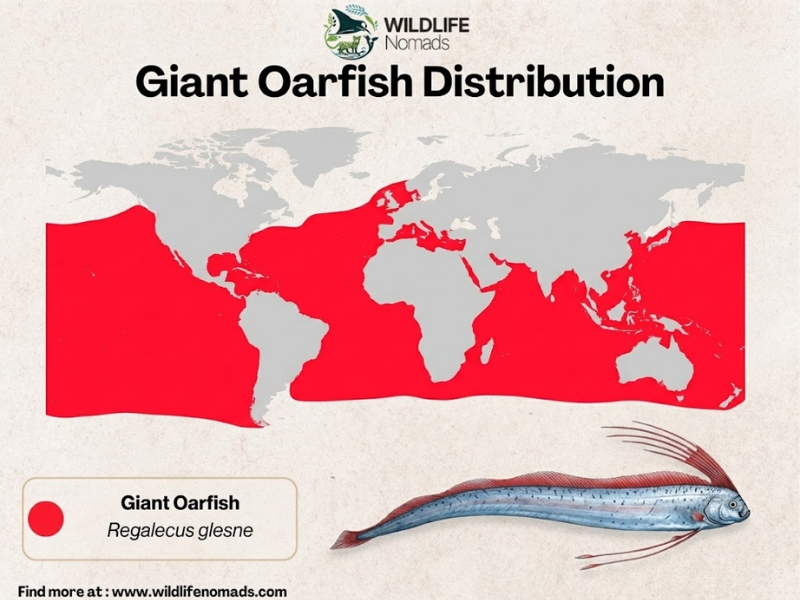
They are widely distributed and probably cosmopolitan, found in every ocean except the polar regions. In the Atlantic, they range across a huge area, including the Mediterranean. Here in Queensland, a reef guide filmed a juvenile oarfish, only about 35–40 cm long, while snorkelling on Opal Reef off Port Douglas in 2022.
This deep water habitat explains why oarfish are rarely seen. Humans spend almost no time in the twilight zone alongside the anglerfish, gulper eels and the cookiecutter shark, and oarfish rarely leave this zone.
ZONETWILIGHT
200–1,000 m Interactive · Deep Sea Dive Dive into the twilight zone to meet the giant oarfish Scroll from the surface to the Mariana Trench and log 61 ocean animals on the way. →
10. Why Doomsday Fish Appear Near the Surface
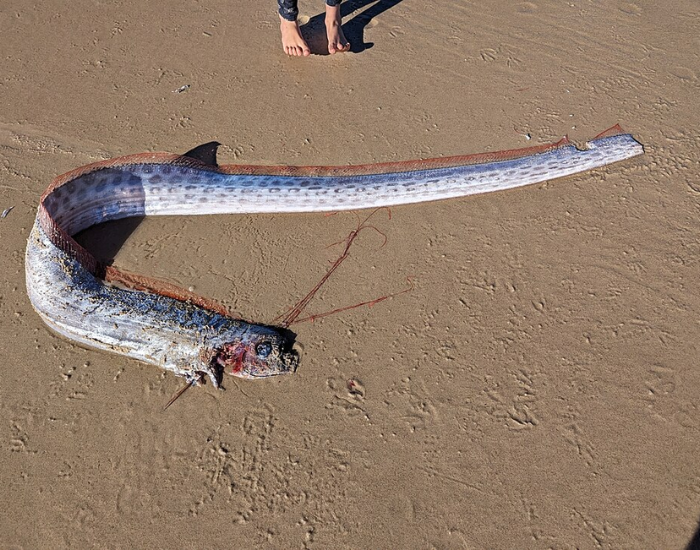
When an oarfish reaches the water’s surface, something has usually gone wrong. Illness, injury or disorientation from strong ocean currents can push one upward. That’s why most specimens found near the surface are dying or already dead.
Climate patterns may also play a role. Some researchers link California strandings to El Niño years, when warm surface water shifts the prey oarfish follow. For example, three oarfish washed up in California during 2024. Before that, scientists had recorded only 19 strandings along that coast since 1901.
This is why scientists value each sighting. Specimens help them study deep sea species’ behavior and responses to changing oceans. Unusual strandings can hint at broader shifts in ocean health, much like the patterns described in our look at how climate change threatens animals.
11. Spawning, Floating Eggs and Miniature Larvae
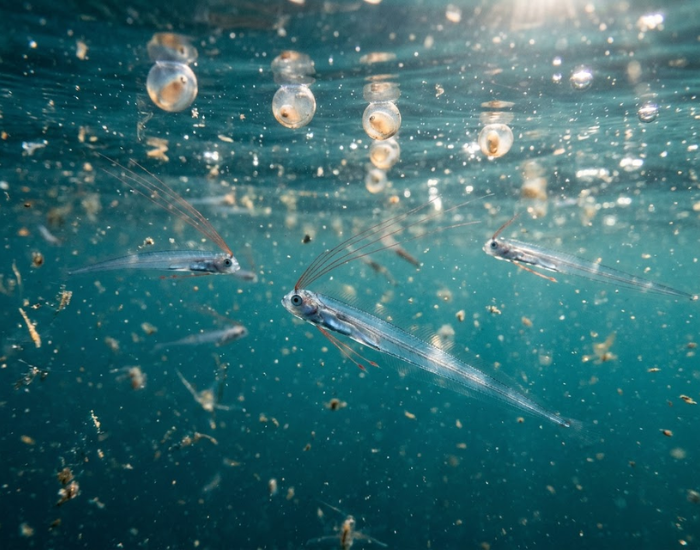
Oarfish spawn between July and December in several regions, releasing eggs into open water. The eggs measure about 2 to 4 mm across. Fertilised eggs float near the surface until they hatch.
In 2020, Japanese aquarium scientists achieved something remarkable. They fertilised eggs from a recently dead pair of Pacific oarfish and watched them develop. The eggs hatched after 18 days at around 21 °C, so wild incubation of about three weeks is plausible.
The larvae looked like other lampridiform larvae. Oddly, they hung head-down in the water, the opposite of the adults. They never fed, and died four days after hatching. Oarfish may live up to 30 years, although nobody has confirmed that figure. Most of their life cycle simply happens where we can’t watch.
12. Conservation Status: Least Concern, but Barely Known
The IUCN lists the giant oarfish as Least Concern. It has a wide range and faces no targeted fishery. That rating, however, rests on limited data, because oarfish populations are not well studied.
Nobody knows how many oarfish exist or whether their numbers are changing. Deep sea ecosystems face growing pressure from warming, deoxygenation and ocean pollution. For an animal this hard to count, “Least Concern” really means “not obviously in trouble yet.”
Frequently Asked Questions
The closest real-life match is the giant oarfish, Regalecus glesne. It’s the longest bony fish alive, with reliable records around 8 m and unconfirmed reports of 11 m. No true sea serpents exist, so the oarfish is the best candidate. Like the coelacanth, it’s a real animal that sounds like a legend
No. Oarfish have no visible teeth, feed on krill and small crustaceans, and pose no threat to people. Contrary to the myth, they don’t predict earthquakes either.
People rarely try. The flesh is gelatinous and described as unpalatable, and the species has no commercial fishery.
The doomsday fish is no omen
It’s a silver, scaleless giant that hangs upright in the twilight zone, straining krill through its gill rakers. Every viral stranding is a sick animal far from home, not a warning from the sea god.
What I love about the oarfish is that it keeps its mystery without needing a prophecy. We still don’t know how long it lives, how many exist, or exactly how it finds food in the dark. If you ever see one, photograph it and report it to a local museum or university, because scientists learn from every sighting.
For more oddities from the deep, explore our list of the weirdest fish in the world or other weird animal species. Or specific species like the ancient Greenland shark and ocean sunfish. Have you ever seen an oarfish? Tell me in the comments.
Wildlife Nomads Challenge
The Sea Serpent Challenge
Ten questions on prophecies, record lengths and the fish that swims standing up. Some are myth-or-fact. Instant feedback after every answer.
References:
Benfield, M. C., Cook, S., Sharuga, S., & Valentine, M. M. (2013). Five in situ observations of live oarfish Regalecus glesne (Regalecidae) by remotely operated vehicles in the oceanic waters of the northern Gulf of Mexico. Journal of Fish Biology, 83(1), 28–38. https://doi.org/10.1111/jfb.12144
Feeney, R. F., & Lea, R. N. (2018). California records of the oarfish, Regalecus russelii (Cuvier, 1816) (Actinopterygii: Regalecidae). Bulletin, Southern California Academy of Sciences, 117(3), 169–179. https://doi.org/10.3160/3294.1
Forsgren, K. L., Jamal, H., Barrios, A., & Paig-Tran, E. W. M. (2017). Reproductive morphology of oarfish (Regalecus russellii). The Anatomical Record, 300(9), 1695–1704. https://doi.org/10.1002/ar.23605
Oka, S., Nakamura, M., Nozu, R., & Miyamoto, K. (2020). First observation of larval oarfish, Regalecus russelii, from fertilized eggs through hatching, following artificial insemination in captivity. Zoological Letters, 6. https://doi.org/10.1186/s40851-020-00156-6
Orihara, Y., Kamogawa, M., Noda, Y., & Nagao, T. (2019). Is Japanese folklore concerning deep-sea fish appearance a real precursor of earthquakes? Bulletin of the Seismological Society of America, 109(4), 1556–1562. https://doi.org/10.1785/0120190014
Smith-Vaniz, W. F. (2015). Regalecus glesne (errata version published in 2017). The IUCN Red List of Threatened Species 2015: e.T190378A115316206. https://www.iucnredlist.org/species/190378/115316206