The first time I saw footage of a barreleye drifting through pitch-black water, I thought someone had edited the video. A creature with a completely transparent head? Bright green lenses glowing inside a see through skull? It looked like something from a sci-fi film.
Back when I studied marine biology in Sweden, one of our professors devoted an entire lecture to Macropinna microstoma. That class rewired my brain. I already loved animals in the deep sea, but this fascinating fish pushed my obsession further. After years writing about giant squid and anglerfish, the barreleye still tops my “weirdest fish alive” list. Here are 12 facts that explain why.
1. The Barreleye Has a Completely Transparent Dome Over Its Brain
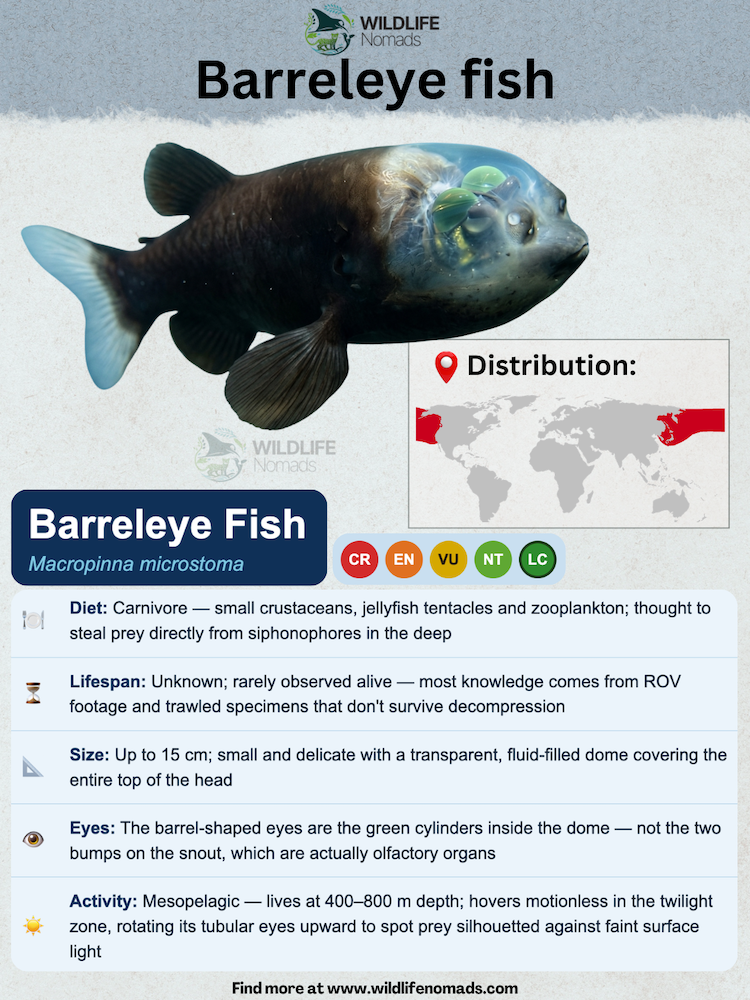
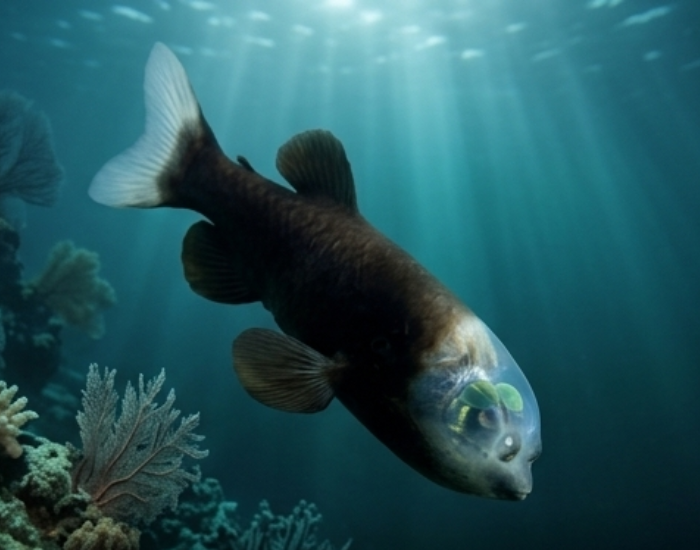
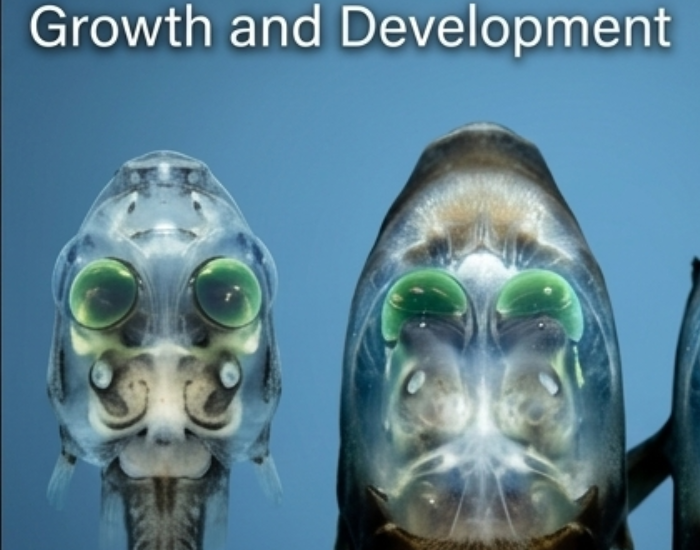
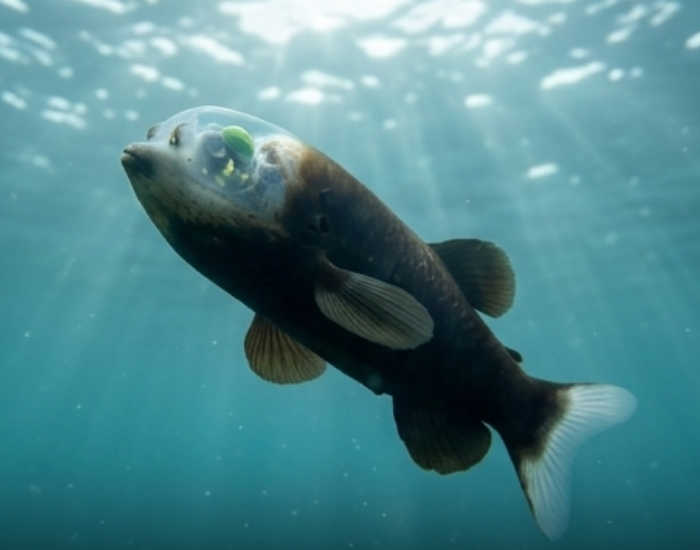
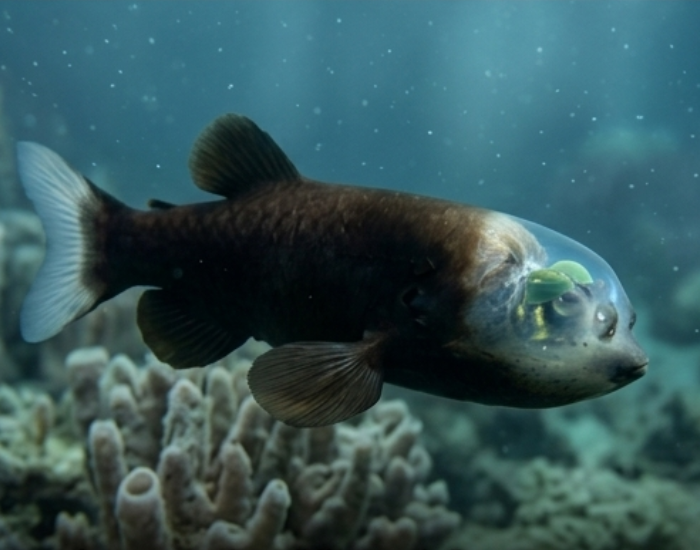
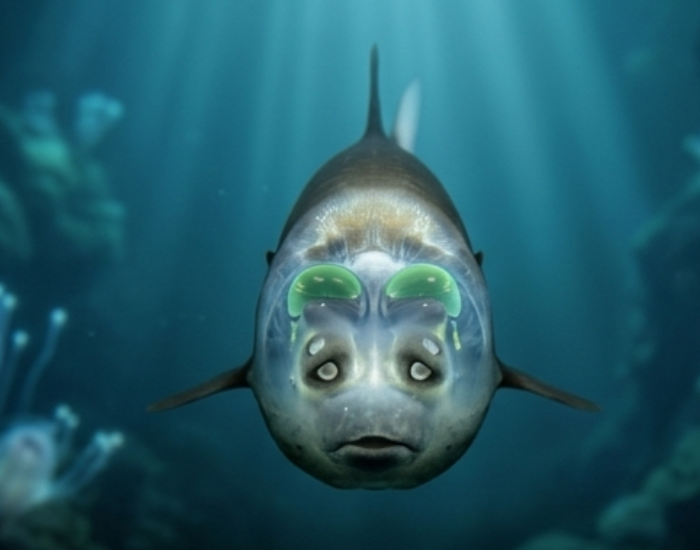
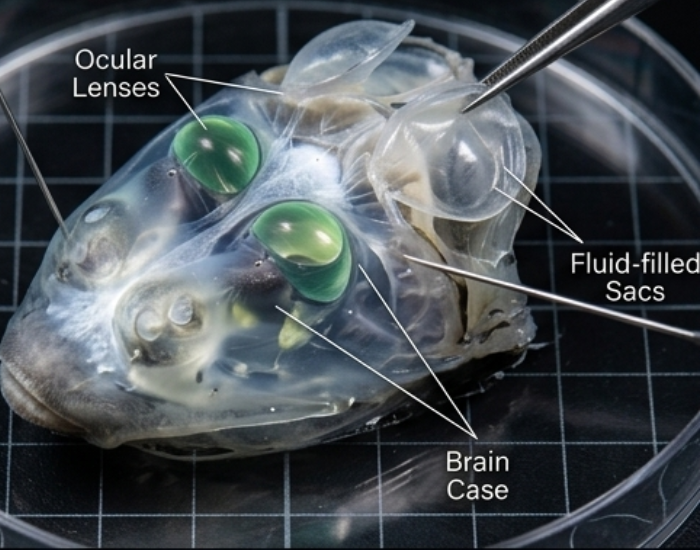
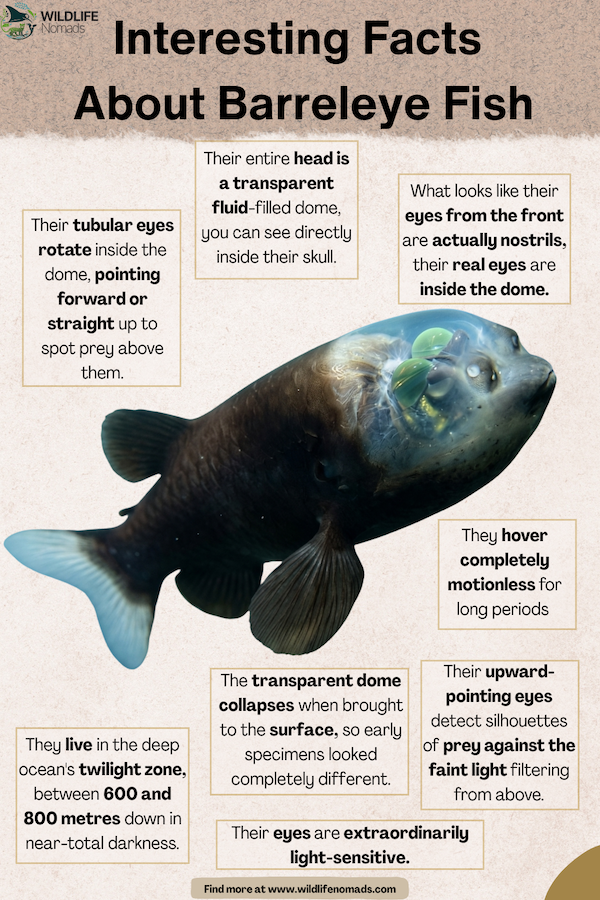
This is the fact that stops everyone mid-scroll. Macropinna microstoma possesses a fluid filled shield covering its cranium, a dome of transparent tissue that functions like a biological cockpit window. The transparent fluid filled shield stretches from just above the mouth to the top of the skull. Inside this see through head, you can literally watch the tubular eyes rotate in real time.
No other known animal has anything quite like this. The covering is soft and flexible, not glass or hard material. For decades, scientists never even knew the gelatinous casing existed. Every specimen pulled up in nets arrived with the delicate dome destroyed. Only when researchers observed a living barreleye at depth did the full picture emerge.

2. Those Green Eyes Actually Point Upward, Inside the Dome
Here is where things get properly strange. While most fish look where they are swimming, Macropinna microstoma spends its life looking at where it isn’t. Inside that pellucid canopy, the tubular eyes are fixed in a vertical position by default.
The fish’s tubular eyes point upward by default, scanning the faint shimmer of light filtering from above. At depths of 2,000 to 2,600 feet, almost no sunlight penetrates. As the last trace of light from the surface fades, the barreleye hovers motionless, eyes point upward, watching for silhouettes of small prey overhead. The eyes beneath that clear dome give it a permanent skyward stare.
3. Its Eyes Can Rotate Forward… Solving a 70-Year Mystery
Scientists described Macropinna microstoma back in 1939. For nearly seven decades, researchers assumed the barreleye had a serious design flaw. If the eyes point upward all the time, how does it eat? The fish’s mouth points forward and slightly downward. Tunnel vision aimed straight up would make feeding impossible.
In 2008, MBARI researchers Bruce Robison and Kim Reisenbichler cracked the puzzle. Using a remotely operated vehicle off central California, they filmed the barreleye rotating its tubular eyes from upward-facing to eyes forward. The creature can pivot them roughly 90 degrees. When it spots prey above, it tilts its body and shifts its gaze to track the target. This discovery, published in Copeia, changed everything we understood about how this deep sea species hunts.
4. The Bright Green Lenses Work Like Built-In Sunglasses
The bright green lenses capping those tubular eyes are not just for show. They contain green pigments that act as a sophisticated light-filtering system, biological sunglasses fine-tuned for the ocean’s twilight zone.
At the depths where the barreleye lives, two types of light compete. There is residual sunlight filtering from the surface. And there is blue-green bioluminescence produced by other creatures. The lenses filter out broad-spectrum sunlight while letting bioluminescent signals pass through. This gives the barreleye the ability to distinguish between background light and the glow of food. Those lenses essentially work as a built-in targeting display.
5. It Steals Food From Jellyfish-Like Creatures
The barreleye has one of the most audacious feeding strategies in the ocean. Rather than chasing prey, it positions itself beneath siphonophores, massive, colonial jellyfish-like organisms that trail stinging tentacles through the water column. Small animals and zooplankton get trapped. The barreleye then moves in to steal food directly off these trailing structures.
This is extraordinarily risky. Siphonophore tentacles carry stinging cells that can paralyze small prey on contact. The transparent shield likely guards those sensitive eyes from accidental stings. The fish’s mouth is tiny and precise, designed for picking off individual morsels. Among the barreleye’s favorite prey are small crustaceans, zooplankton, and comb jellies caught in siphonophore webs.
6. Macropinna microstoma Inhabits the Ocean’s Twilight Zone
The barreleye lives in one of the most mysterious habitats on Earth: the mesopelagic zone, commonly known as the twilight zone. This deep sea fish favors between 600 and 800 meters, approximately 2,000 to 2,600 feet beneath the surface.
Sunlight barely registers here. The water is cold, dark, and under immense pressure. The barreleye’s range spans the north pacific, from the Bering Sea through waters off California to Japan. Some specimens have turned up as far south as Baja California. This deep sea fish shares its habitat with other remarkable creatures I have written about, including gulper eels and bioluminescent organisms that make the ocean feel like outer space.
DEPTH765
m Interactive · Deep Sea Dive Dive 765 m down to meet the barreleye Scroll from the surface to the Mariana Trench and log 61 ocean animals on the way. →

7. It Hovers Motionless Like an Underwater Helicopter
Most animals down here keep moving. The barreleye barely does. Researchers observed that the fish hovers nearly motionless in the water column, hanging suspended with remarkable stability. It achieves this through its large fins, which spread wide and make constant micro-adjustments, like a helicopter maintaining a precise altitude.
This behavior makes perfect sense for a predator that hunts by looking up. The fish’s eyes — extremely light sensitive eyes aimed upward, scan for the faint outlines of prey or the bioluminescent glow of siphonophores above. Movement would create vibrations and attract predators. Stillness is survival. When the barreleye does need to reposition beneath a siphonophore’s stinging tentacles, those flat fins provide surprisingly agile maneuverability.
8. Scientists Only Photographed It Alive in 2004
Macropinna microstoma was first described by W.M. Chapman in 1939. Scientists knew this species existed for 65 years before anyone saw a living specimen with its transparent head intact. Every barreleye hauled up in trawl nets arrived damaged. The fragile dome collapsed during pressure changes.
Everything changed in 2004, when a remotely operated vehicle from the Monterey Bay Aquarium Research Institute (MBARI) captured the first footage of a living specimen. Scientists had logged over 27,600 hours of underwater video, and barreleyes appeared only nine times. The MBARI ROV footage revealed the glowing green eyes, the transparent tissue covering, and the gentle hovering behavior that no preserved specimen could show.
9. Only Two Specimens Have Survived in Captivity, For Just Several Hours
In 2007 and 2008, the bay aquarium research institute team captured live barreleyes using specialized midwater nets. They transported specimens in pressure-controlled tanks. At least two survived for a few hours, long enough to observe the eye rotation mechanism directly.
Those brief captive observations confirmed what ROV cameras had suggested. The fish’s visual organs could indeed rotate from their default upward position to a forward-facing angle. Scientists watched them pivot as the creature changed orientation. These observations provided the complete picture of how Macropinna microstoma actually functions.
10. What You Think Are Its Nostrils Are Closer to Human Nostrils Than Its Eyes
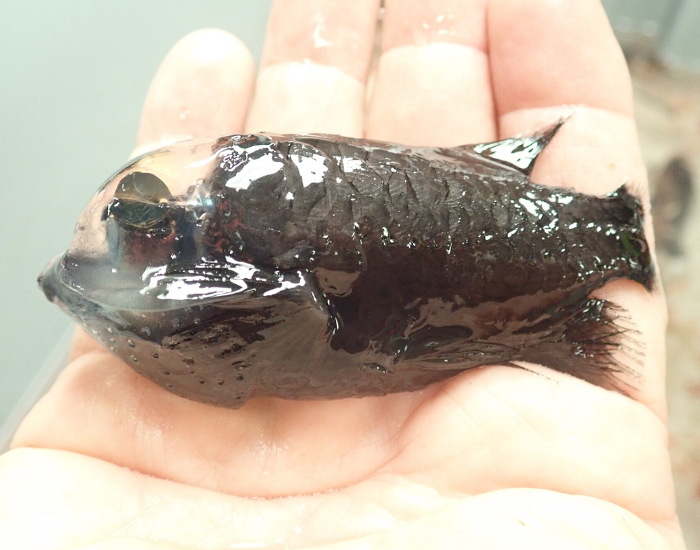
This might be my favorite piece of barreleye trivia. Those two dark spots above the mouth that look like eyes? They are olfactory organs, the equivalent of human nostrils. Most people see a photograph of Macropinna microstoma and assume they are looking at a normal face. The “face” is essentially a nose with a mouth beneath it.
The actual eyes are the large green structures behind those olfactory organs, enclosed within the dome. We are hardwired to read faces, and the barreleye’s layout breaks every rule. Imagine if your nostrils sat where your eyes are, and your actual eyes floated in fluid on top of your skull.
11. There Are Actually Several Species of Barreleye — Not Just One
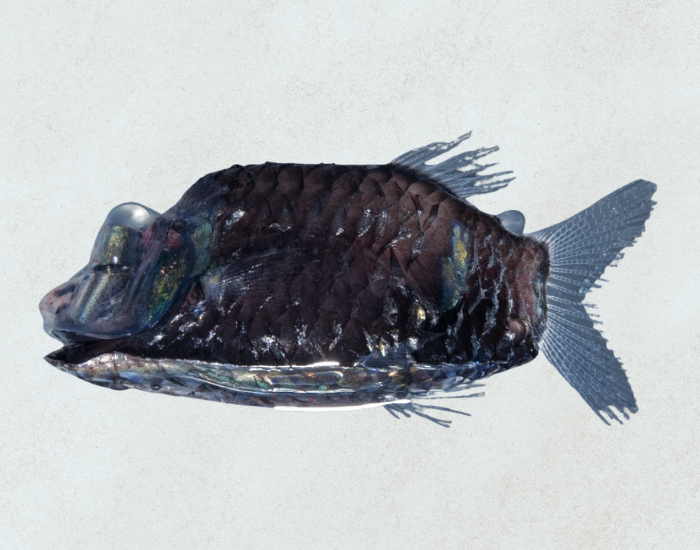
When most people hear “barreleye,” they picture Macropinna microstoma. Fair enough, it is the most famous. But the barreleye family (Opisthoproctidae) actually includes multiple species spread across different genera. A 2016 study doubled the known number of sole-bearing opisthoproctids and resurrected the genus Monacoa. This changes all the time but it is estimated that 16 species are distributed across approximately 8 different genera
Not all barreleyes have that iconic transparent dome. Some have tubular eyes pointing in different directions. What unites them is the basic tubular eye design, elongated, barrel-shaped structures optimized for gathering maximum light. These creatures remind me of how sea cucumbers also represent a wildly diverse group that most people think is just one thing.
12. The Barreleye’s Eyes Contain Zero Cone Cells
The eyes contain only rod cells, the photoreceptors responsible for detecting light in dim conditions. Zero cone cells means Macropinna microstoma has no color vision whatsoever. It perceives its world in shades of gray and green, filtered through those green eyes.
What it lacks in color, it makes up for in raw power. The rod cells pack an exceptionally high density of rhodopsin, the light-detecting pigment. This gives the barreleye sensitive eyes capable of detecting even the faintest bioluminescence in near-total darkness. Every structural choice, the tubular shape, the rod-only retina, the lenses, the dome above, works together to squeeze every possible photon from an environment where light barely exists. As a biologist, this kind of evolutionary engineering fascinates me more than almost anything else in nature.
Frequently Asked Questions About the Barreleye
Because they live at such extreme depths, their specific predators aren’t well-documented. However, it is widely believed that larger deep-sea predators like squid and certain sharks are their primary threats. Their stillness is likely a defense mechanism to avoid creating vibrations that these predators could sense.
Despite looking like a massive “alien” in footage, Macropinna microstoma is actually quite small. They typically reach a maximum length of only 15 centimeters (about 6 inches).
Like many deep-sea creatures, they have a high concentration of a molecule called TMAO (trimethylamine N-oxide) in their cells. This acts as a chemical “anchor” that prevents their proteins and cell membranes from collapsing under the weight of the water.
This remains one of the greatest mysteries of the species. Scientists believe they are pelagic spawners, meaning they release eggs and sperm directly into the water, where fertilization happens by chance. The larvae then drift in shallower currents until they mature and sink to the twilight zone.
Currently, there is no official data on how long a barreleye lives in the wild. Because they cannot be kept in captivity for more than a few hours, studying their aging process has been impossible for marine biologists so far.
A Creature That Rewires How You Think About Vision
The barreleye represents one of evolution’s most creative solutions to an impossible problem: how to hunt in near-total darkness while avoiding getting stung by your food source. Every feature, the transparent head, the rotating eyes, the motionless hover, the precise small mouth, works as part of an integrated system millions of years in the making. As a biologist, I find this creature endlessly compelling because it challenges our assumptions about what life can look like.
If the barreleye grabbed your attention, check out my deep dives into other alien-like ocean creatures. My posts on anglerfish and animals in the deep sea cover more from the twilight zone. Drop a comment below, which ocean creature do you think is even stranger?
References:
Partridge, J. C., Douglas, R. H., Marshall, N. J., Chung, W. S., Jordan, T. M., & Wagner, H. J. (2014). Reflecting optics in the diverticular eye of a deep-sea barreleye (Rhynchohyalus natalensis). Proceedings of the Royal Society B, 281(1782), 20133223. https://doi.org/10.1098/rspb.2013.3223
Poulsen, J. Y., Byrkjedal, I., Willassen, E., Rees, D., Takeshima, H., Satoh, T. P., Shinohara, G., Nishida, M., & Miya, M. (2016). Preservation obscures pelagic deep-sea fish diversity: Doubling the number of sole-bearing opisthoproctids and resurrection of the genus Monacoa. PLOS ONE, 11(8), e0159762. https://doi.org/10.1371/journal.pone.0159762
Robison, B. H., & Reisenbichler, K. R. (2008). Macropinna microstoma and the paradox of its tubular eyes. Copeia, 2008(4), 780–784. https://doi.org/10.1643/CG-07-082
Robison, B. H. (2004). Deep pelagic biology. Journal of Experimental Marine Biology and Ecology, 300(1–2), 235–272. https://doi.org/10.1016/j.jembe.2004.01.012
Warrant, E. J., & Locket, N. A. (2004). Vision in the deep sea. Biological Reviews, 79(3), 671–712. https://doi.org/10.1017/S1464793103006420
Wagner, H. J., Douglas, R. H., Frank, T. M., Roberts, N. W., & Partridge, J. C. (2009). A novel vertebrate eye using both refractive and reflective optics. Current Biology, 19(2), 108–114. https://doi.org/10.1016/j.cub.2008.11.061