
The deep sea is filled with creatures so strange they seem born from science fiction, and few are as bizarre as the gulper eel. Also known as the pelican eel, this deep-sea fish lives thousands of meters below the surface, where sunlight never reaches and pressure could crush a submarine. With a body built for survival in the abyss, from its balloon-like mouth to its glowing tail, the gulper eel is a master of adaptation and mystery. Its exaggerated jaw and unusual facial features give it a distinctly muppet-like appearance, making it one of the most visually striking creatures in the ocean.
Let’s dive into 12 fascinating facts about this elusive predator of the deep, one of the most unusual eel species found in the deep sea.
1. The Gulper Eel’s Scientific Name Is Eurypharynx pelecanoides
First, a little bit of evolutionary history and taxonomy: The gulper eel belongs to the family Eurypharyngidae and its scientific name, gulper eel Eurypharynx pelecanoides, literally means “broad throat like a pelican.”
Scientists have identified nine species within this family, and Eurypharynx pelecanoides remains the most studied and photographed. Its long dorsal fin, marked by a distinctive white line or groove, helps researchers recognize it in the deep sea. Many confuse it with other deep-sea eels, but its enormous expandable mouth and whip-like tail make it unmistakable.
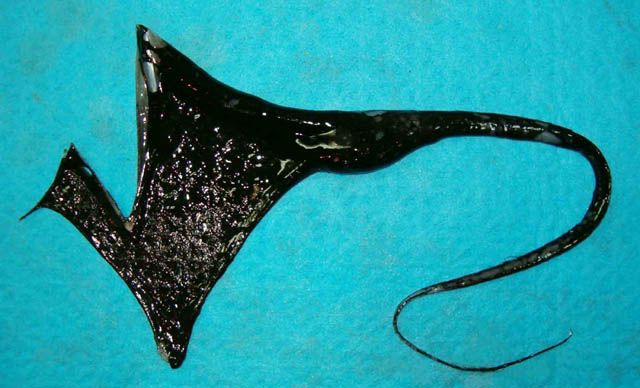
2. They Are Also Known as Pelican Eels or Umbrella Mouth Gulpers
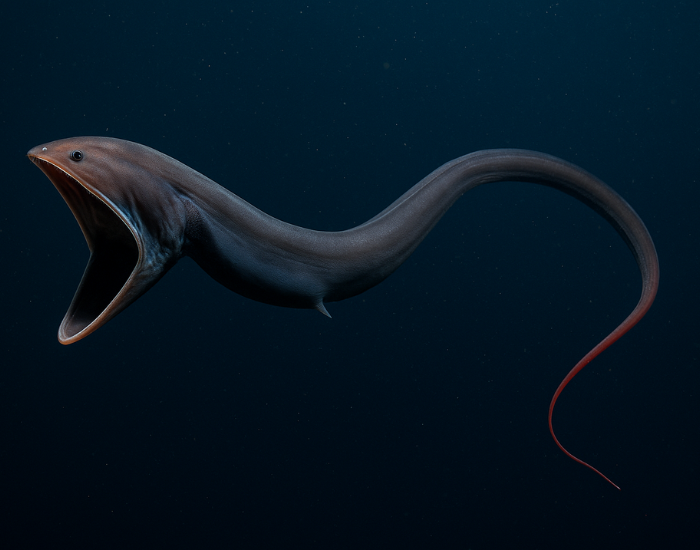
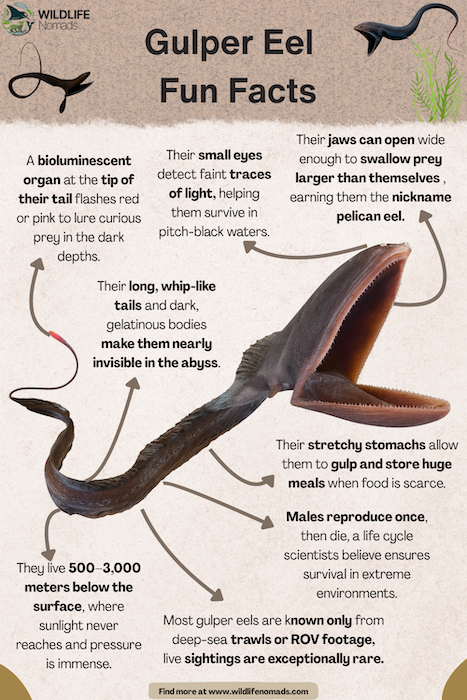
The gulper eel’s alternative names, including umbrella mouth gulper, come from its oversized jaw, which can expand like an umbrella. This pouch like mouth allows it to scoop up prey much larger than itself, a crucial advantage in the deep ocean, where food is scarce. When it opens wide, it looks more like a pelican and giving the appearance of a pelican’s bill, which is how it earned the nickname pelican gulper.

3. Gulper Eels Live in Extreme Depths
These deep-sea fish inhabit the mesopelagic and bathypelagic zones, typically between 500 and 3,000 meters (1,600–10,000 feet) below the surface.
They’ve been recorded in oceans worldwide, including the North Atlantic, the Davis Strait, and near the Hawaiian Islands, particularly in the Papahānaumokuākea Marine National Monument, one of the largest marine protected areas on Earth. In these lightless zones, gulper eels navigate using faint bioluminescent signals and a finely tuned sense of smell.

4. They Have Tiny Eyes but Huge Mouths
Despite their massive jaws, gulper eels have very small eyes, an adaptation to the low-light environment of the deep sea. These eyes evolved primarily to detect faint light signals rather than to form images. Their eyes are not adapted to form detailed images, but rather to sense faint traces of bioluminescence, helping them locate prey and potential mates. The large mouth, by contrast, can open wide enough to engulf prey whole, forming a pouch-like cavity reminiscent of a pelican’s bill.
5. Their Tail Glows Like a Deep-Sea Lantern
The eel’s long, whip-like tail, often referred to as its long tail, ends in a bioluminescent organ, which can flash red or pink light. This long tail is crucial for the eel’s movement and also plays a key role in bioluminescent communication in the dark ocean environment. Scientists believe this glowing appendage is an adaptation for finding food in the deep sea, as it helps the eel lure small crustaceans, shrimp, and fish, similar to the lure of an anglerfish.
Occasional red flashes have also been observed, possibly used to communicate with other eels or confuse predators.
6. Gulper Eels Can Grow Up to Three Feet Long
A full-grown gulper eel can reach lengths of about three feet (one meter), though its body is extremely thin and lightweight. Most of its mass is concentrated in its large head and mouth. Despite the intimidating size, these eels are harmless to humans and rarely encountered due to their deep-sea habitat.

7. They Swallow Prey Whole — Sometimes Larger Than Themselves
The gulper eel’s most famous feature is its ability to take a big gulp with its expandable mouth, consuming large prey items. During feeding, the gulper eel balloons its jaw pouch, a behavior often observed in deep-sea explorations. This extraordinary adaptation allows the eel to do just that: inflate its mouth to swallow larger prey, much like a pelican. Thanks to its loosely hinged jaw and expandable stomach, it can ingest a large amount of prey and water at once, devouring creatures several times its own size and coping with food scarcity in the deep sea.
Its diet includes:
- Small crustaceans
- Squid and shrimp
- Tiny fish and invertebrates
- Large fish
- Other crustaceans
- Other small invertebrates
The gulper eel can scoop up large groups of shrimp or other crustaceans with its wide-open mouth. Its adaptations allow it to consume large meals and a wider variety of prey, including small invertebrates and larger prey than itself.
Unlike surface-dwelling predators, gulper eels rarely chase prey. Instead, they rely on stealth and ambush, using their glowing tails as bait and then swallowing prey in one massive gulp.
8. They Inadvertently Swallow Large Amounts of Water
When a gulper eel captures its prey, it often engulfs a huge volume of water along with it. The water is slowly expelled through the gill slits, leaving behind the meal.
Its tiny teeth suggest that it doesn’t rely on biting but rather on trapping and swallowing, a feeding method perfectly suited to an environment where every calorie counts.
9. Males Undergo Strange Changes as They Mature
As gulper eels reach sexual maturity, the males undergo remarkable transformations. Their teeth disappear, and they develop large olfactory organs, believed to help them detect pheromones released by females.
This suggests that mating in the deep sea depends largely on chemical cues rather than sight. Once mating occurs, it’s believed the eels die shortly after, similar to the life cycle of certain deep-sea squid.
10. They Reproduce Only Once
Scientists believe that gulper eels are semelparous, meaning they reproduce only once before dying. Based on available evidence, many researchers believe that gulper eels die shortly after reproducing.
Scientists have caught sexually mature males with enlarged gonads and atrophied jaws, which indicates they reproduce only once. Females release eggs into open water, and fertilization happens externally.
11. Gulper Eels Are Occasionally Caught in Fishing Nets
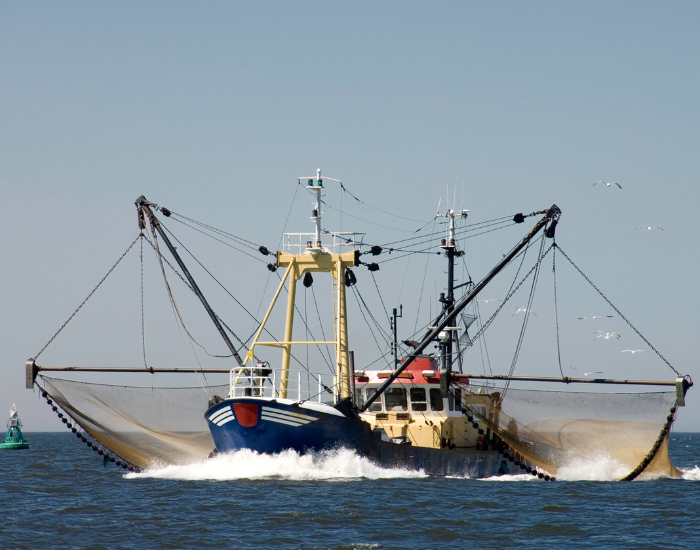
Although not targeted commercially, gulper eels are sometimes inadvertently caught in deep-sea fishing nets. These accidental captures are among the few opportunities scientists have to study them.
Because they live at extreme depths, most gulper eels brought to the surface don’t survive the pressure change, leaving much of their behavior unknown.
12. They’re Part of a Much Larger Deep-Sea Ecosystem
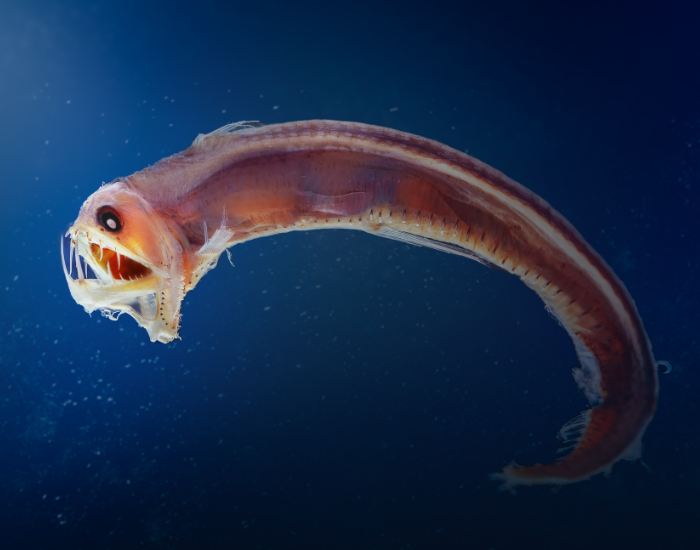
Gulper eels play an important role in the deep-sea food web, feeding on smaller crustaceans and invertebrates while serving as prey for larger predators like deep-sea sharks and other fish. They are also preyed upon by lancetfish and other deep-sea predators, highlighting their position within the complex predator-prey relationships of the ocean depths.
Their existence reminds us of the interconnected nature of deep-ocean life, where every species, no matter how strange, contributes to the balance of the ecosystem.
Habitat and Distribution at a Glance
Gulper eels inhabit a remarkably wide geographic range across the world’s oceans. In the North Atlantic Ocean, these deep-sea fish dwell between 500 and 3,000 meters, with notable populations documented in the Davis Strait. Meanwhile, Central Pacific waters host gulper eels at slightly shallower depths, typically ranging from 700 to 2,500 meters, particularly near the Hawaiian Islands.
The Papahānaumokuākea Marine National Monument represents one of the most significant habitats for these creatures. Scientists using remote-operated vehicles have observed gulper eels at depths between 1,000 and 3,000 meters within this protected area. Additionally, tropical oceans worldwide harbor gulper eel populations, though sightings remain infrequent due to their extreme depth preferences and elusive nature.
How Gulper Eels Differ from Pelican Eels
The term pelican eel is often used interchangeably with gulper eel, but technically, the pelican eel refers to Eurypharynx pelecanoides specifically. The broader group of gulper eels includes several related species within the same family.
In short: all pelican eels are gulper eels, but not all gulper eels are pelican eels.
Gulper Eel vs. Other Deep-Sea Predators
The deep sea hosts numerous bizarre predators, each with unique survival adaptations. The gulper eel distinguishes itself through its expandable mouth and glowing tail, allowing it to swallow large prey whole at depths between 500 and 3,000 meters. In contrast, the anglerfish employs a bioluminescent lure and exhibits one of nature’s strangest reproductive strategies, parasitic mating, while dwelling even deeper, from 1,000 to 4,000 meters.
The viperfish presents yet another approach to deep-sea hunting. Armed with long, needle-like fangs and multiple photophores, this predator executes lightning-fast attacks on prey at depths ranging from 200 to 2,000 meters. Meanwhile, the giant oarfish, the world’s longest bony fish, inhabits relatively shallower waters between 200 and 1,000 meters, earning its fearsome nickname “doomsday fish” from maritime folklore and superstitions surrounding its rare appearances near the surface.
Are Gulper Eels Rare?
Yes, though they are found globally, gulper eels are rarely seen alive. Most of what we know comes from deep-sea trawls or remote-operated vehicle (ROV) footage.
Their rarity adds to the fascination surrounding them; each sighting reveals a little more about life in one of the planet’s least-explored realms.
Conservation Status
The IUCN Red List currently classifies the gulper eel as a species of Least Concern, mainly because deep-sea fishing doesn’t yet target them directly. However, as deep-sea mining and trawling expand into deeper regions, their habitats could face disturbance.
Further research is needed to assess population trends and understand how climate-driven ocean changes affect their survival.
FAQ: Everything You Want to Know About Gulper Eels
They grow up to 3 feet (about 1 meter) long, though most of that length is their tail.
They feed on shrimp, squid, small fish, and crustaceans — basically anything small enough to fit inside their huge mouth. Their large, extendable lower jaw allows them to swallow prey much larger than themselves, a key adaptation for deep-sea feeding.
Yes, the terms are used interchangeably. The species Eurypharynx pelecanoides is commonly called the pelican eel.
They inhabit temperate and tropical oceans worldwide, usually between 500 and 3,000 meters deep.
Gulper eels do not have a swim bladder, which means they lack the buoyancy control found in many other fish. Instead, they rely on undulating movements to navigate the deep-sea environment.
Their lifespan is unknown, but scientists believe they may live for several years before reproducing once and dying
What Gulper Eels Teach Us About Life in the Abyss
The gulper eel might look like a creature from a nightmare, but it’s a perfect example of evolution’s ingenuity. In the most inhospitable part of our planet, it has adapted to find light, food, and mates in near total darkness. Studying species like the gulper eel reminds us just how little we know about the deep sea — and how many wonders still wait in the dark.
Further Reading
- 13 Fascinating Facts About the Angler Fish: Nature’s Deep-Sea Predator
- Scary but Gentle: 12 Amazing Facts About the Wolf Eel
- Top 12 Facts About Trigger Fish That Will Surprise You
- 12 Fascinating Facts About Lampreys: Ancient Fish with a Dark Side
- The Giant Squid: 12 Fascinating Facts