I have watched a lot of animals decide whether to trust me. Only one made that decision for her baby too.
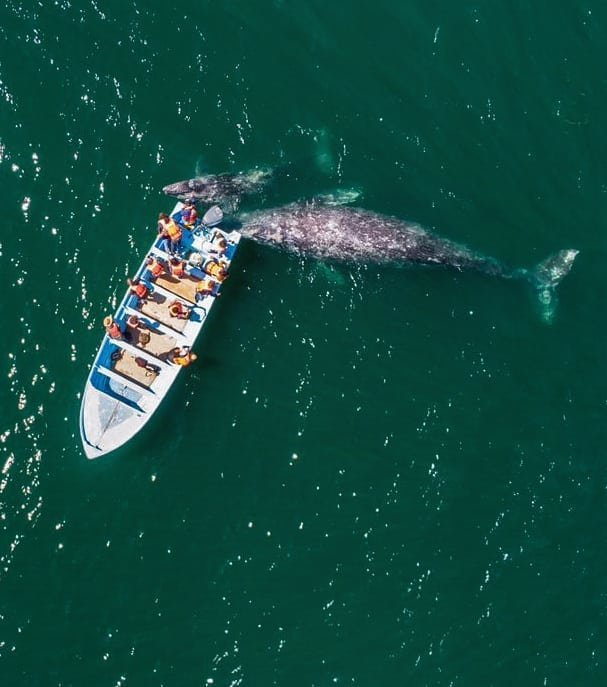
Baja California, final semester of my undergrad. Our small boat sat in a calving lagoon with the engine off. A female gray whale surfaced alongside us, took her time, then eased her calf toward the hull. Close enough to touch. Nobody spoke. A friend of mine cried.
I wrote up that day here: From the Brink of Extinction. What follows is everything I have learned about the species since, cut down to the parts that actually matter.
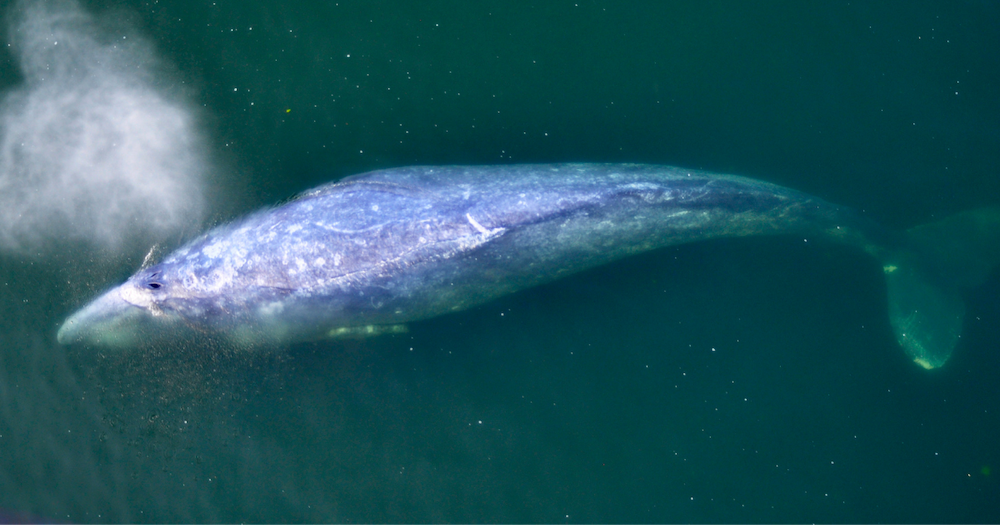
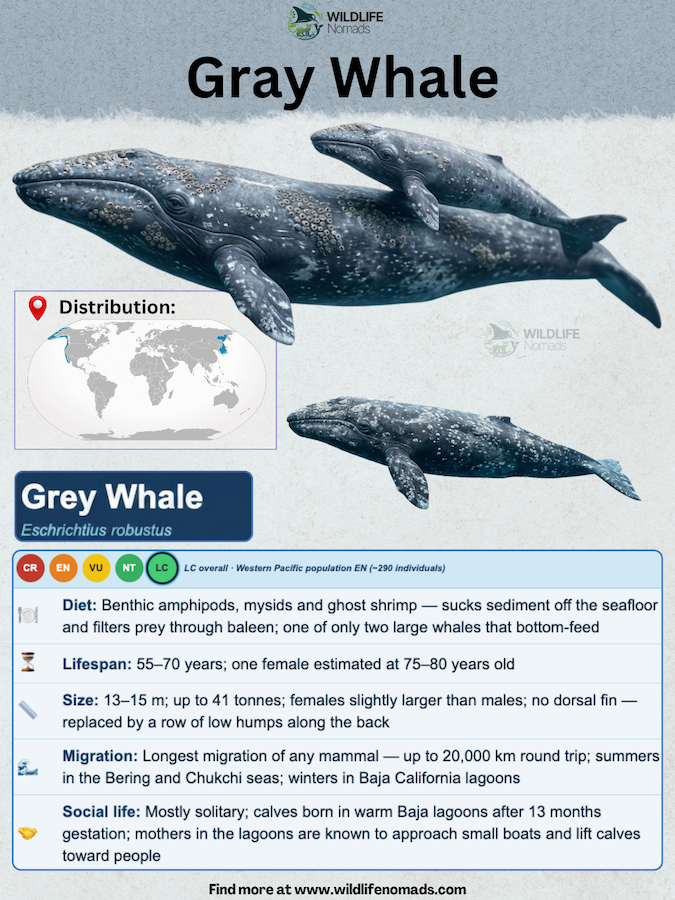
The Pacific gray whale, Eschrichtius robustus, is the only living member of its family. No close relatives. Nothing else quite does what it does. Seeing one up close really puts their massive size into perspective, if you want to see how they measure up against other marine giants, explore our Whale Size Comparison Tool, or compare them against all kinds of terrestrial giants using our general Animal Size Comparison Tool.
Today they survive in the North Pacific Ocean and nowhere else. Here are the twelve things worth knowing about them.
1. They Are the Only Baleen Whales That Plough the Sea Floor
Most baleen whales strain prey from open water. Gray whales go to the bottom instead.
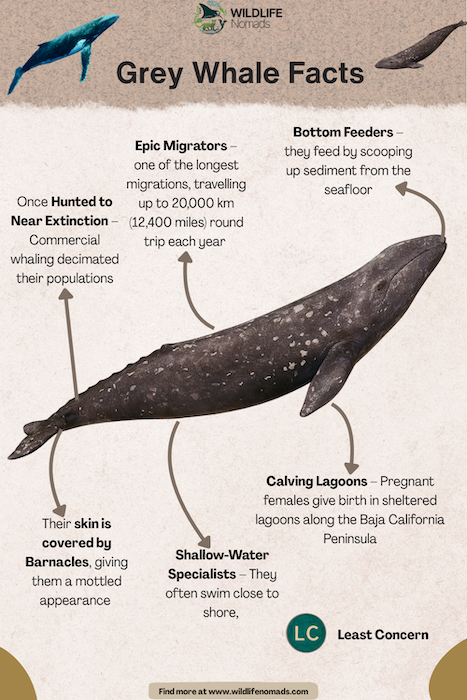
They dive, roll onto one side, and scoop sediment off the sea floor with a narrow, arched upper jaw. Then they push the mud back out through 130 to 180 coarse baleen plates per side. What stays behind is dinner.
Mostly benthic crustaceans, amphipods above all, plus polychaete worms and other invertebrates. An adult can take in around 1.3 tons of food a day during the feeding season.
Each mouthful leaves a scar. Feeding pits on the ocean floor typically measure about three by six feet.

2. That Feeding Habit Makes Them Ecosystem Engineers
Multiply those pits across thousands of animals over one Arctic summer. You get serious sediment turnover.
Gray whales lift buried nutrients back into the water column and reshape benthic habitat as they go. Roman and colleagues made the case that whales function this way across marine systems generally. Gray whales do it more literally than any of them.
They are also opportunists. Observed feeding along the migration route includes mysids, crab larvae and herring roe. When the Arctic underperforms, some whales switch prey and switch grounds entirely.
3. Their Migration Is the Endurance Record of the Mammal World
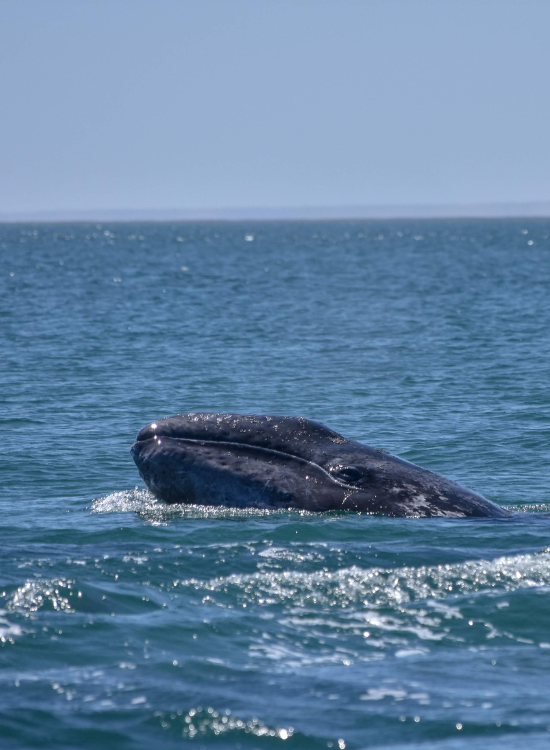
The eastern route runs 8,000 to 11,000 kilometres each way. Round trip, that is 10,000 to 14,000 miles, or up to about 22,500 km.
One tracked female from Sakhalin Island covered 22,511 km in 172 days. That is the longest documented mammal migration on record.
The calendar barely varies:
- December to April — breeding and calving in the Baja California lagoons
- Late February to May — northbound migration for eastern gray whales
- June to October — summer feeding grounds in the Bering Sea, the Chukchi seas and the Arctic Ocean
- October to December — southbound along the pacific coast of North America
December is prime viewing from the California coast. Want to know where they are this month? Our gray whale migration tracker maps the full year.
December is prime viewing from the California coast. Where are they this month? I mapped the whole year so you can see for yourself, and it opens on today’s date.
4. Pregnant Females Do It Without Eating
This is the part that still floors me. Pregnant gray whales fast for months while migrating and nursing. They run the entire round trip on blubber laid down in the Arctic the previous summer.
That single fact explains why the arctic feeding grounds decide everything. A poor feeding season in the Bering Sea shows up as dead calves in Mexico eight months later.
They travel alone or in small, loose groups. No coordinated pods like you see in dolphin species or pilot whales.
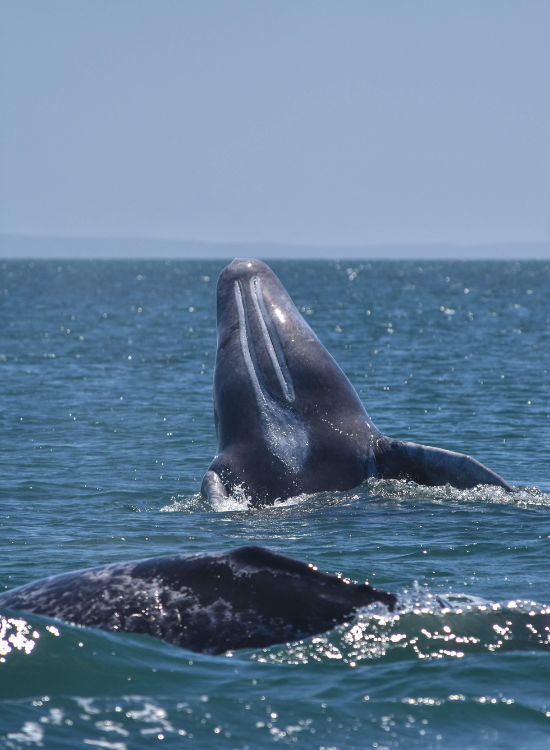
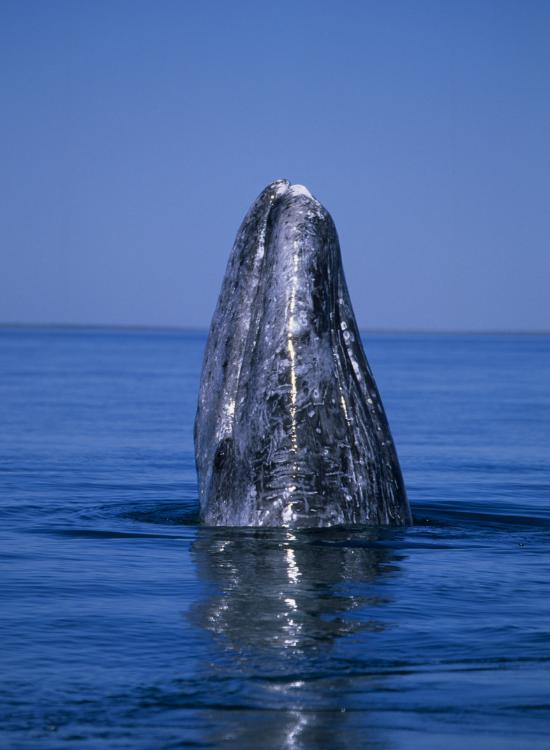
For a fasting animal they are surprisingly playful. Spyhopping and breaching are common along the whole route. One female was aged at 75 to 80 years, so a single whale may make that trip fifty times.
5. No Dorsal Fin… That Is Your Field Mark
Adults reach 42 to 49 feet, or up to about 15 metres. Weight runs 30 to 40 tons on average, up to roughly 90,000 pounds. Females are slightly larger than males.
From shore, ignore all of that and look at the back:
- No dorsal fin. A low dorsal hump sits about two-thirds of the way down
- Six to twelve knuckles run from that hump to the flukes
- Off-white baleen, 5 to 25 cm long, short compared with other baleen whales
- A heart-shaped, bushy blow, usually 3 to 4 metres high
Humpback whales, fin whales and sperm whales all show a fin. A grey whale shows knuckles.
6. Most of Their “Grey” Is Not Skin
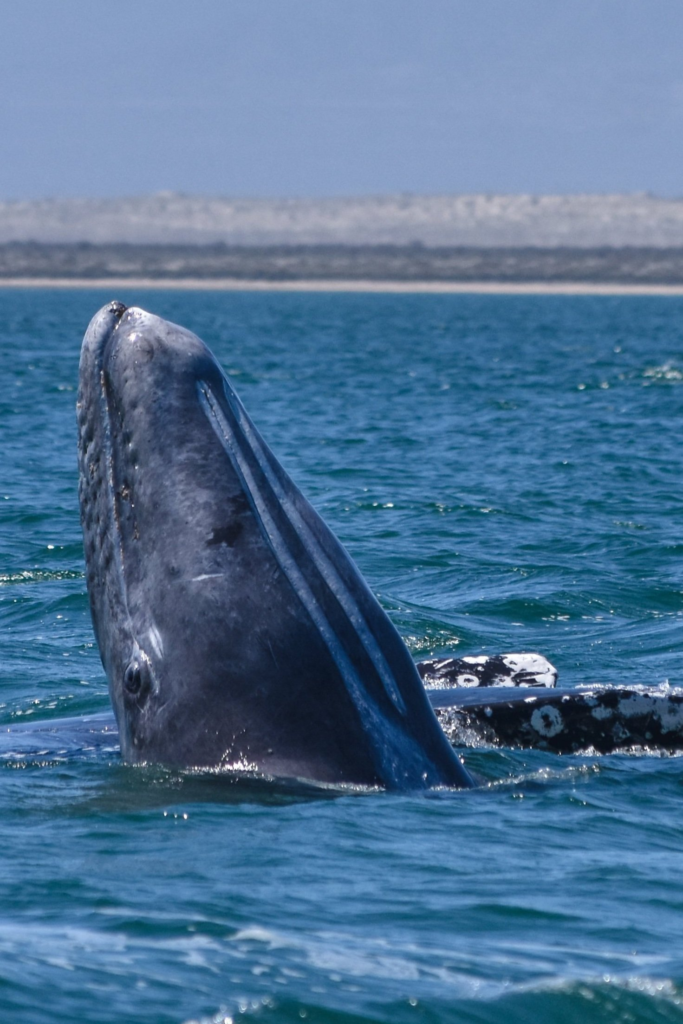
The mottled body with pale patches is largely passengers.
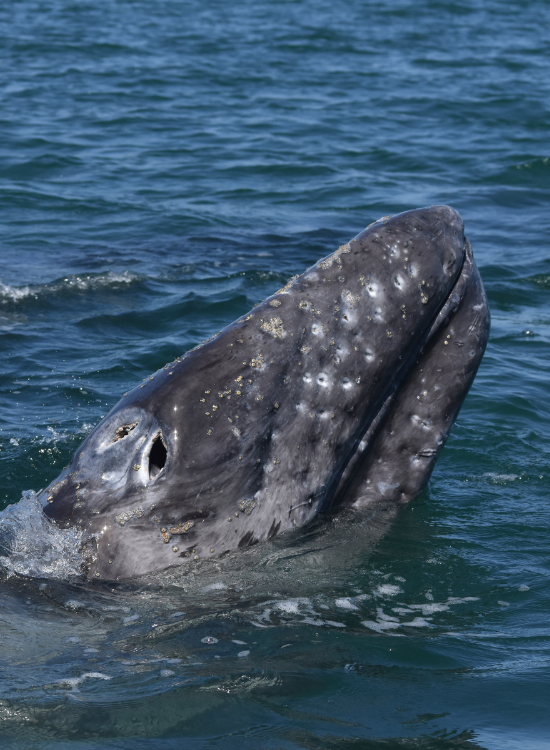
Barnacles and whale lice cluster on the head, jaw and tail. Every adult carries thousands of them. Up close in the lagoon you can see the crust. The whale wears it without apparent concern.
Researchers use those patterns to recognise the same whale at points thousands of kilometres apart.

7. Whalers Called Them Devil Fish
Not for the reason most people assume.
Gray whales are coastal. They live in shallow coastal waters, often under 60 metres deep. That made them the easiest large whale to find and kill. They were hunted for oil and for baleen, hard in the 1850s and again in the early twentieth century.
The nickname came from the mothers. Harpoon a calf in a Baja lagoon and the female fought back, hard enough to wreck boats. Commercial whaling crews meant it as a warning, not a compliment.
8. The Atlantic Population Is Gone, and One Came Back Anyway
Atlantic gray whales were extirpated by the early 18th century. Their presence in the Atlantic Ocean had spanned tens of thousands of years, confirmed by bones and ancient DNA. Early whaling ended it in a few generations.
Then, in March 2024, researchers photographed a gray whale off Nantucket. Roughly 200 years after the north atlantic population vanished.
It was almost certainly a lost Pacific animal that came through the Northwest Passage. Reduced sea ice now opens that route in some summers. Alter and colleagues modelled this exact scenario a decade before it happened.
The atlantic populations are not coming back on their own. But climate change has quietly reopened a door that shut three centuries ago.
9. There Are Two Pacific Ocean Populations, and Only One Recovered
The eastern population is the conservation win. Protection arrived in stages. International measures came in the 1930s and 1940s. The Marine Mammal Protection Act followed in 1972, then the Endangered Species Act. The International Whaling Commission’s commercial hunting ban took effect in the mid-1980s.
It worked. The population climbed from roughly 2,000 animals to over 20,000, and in 1994 it came off the endangered species list. Very few large whale species have managed that. Whale watching also made a live whale worth more than a dead one, which mattered more than any single law.
The western population got none of it. Roughly 220 to 270 whales feed off Sakhalin Island and Kamchatka each summer, fewer than 300 in total. It is listed as endangered under the Endangered Species Act, and Endangered by the IUCN. The IUCN rates the species as Least Concern globally.
Even delisted, gray whales remain threatened wildlife under multiple instruments. A single animal can cross Mexican, US, Canadian and Russian waters in one year. Protection only works when four countries agree.
10. The 2026 Count Went Up, and Scientists Do Not Fully Trust It
NOAA Fisheries put the eastern North Pacific gray whale population at about 17,750 whales for 2025/2026. The credible range is 15,930 to 20,530.
That is a big jump from roughly 12,890 the year before. It is also bigger than gray whales can physically reproduce in a year.
Only 85 calves were estimated in 2025 — the lowest figure on record. NOAA scientists have said the increase may partly reflect changed migration behaviour, not real growth. Some assumptions inside the survey model may no longer hold.
The honest summary: the population is not in freefall, and it is not confirmed to be recovering either.
11. Not All of Them Go to the Arctic
A subgroup called the Pacific Coast Feeding Group skips the last leg. These whales stop between Northern California and Vancouver Island. They feed there all summer, in British Columbia, Washington and Oregon waters.
Drone photogrammetry turned up something unexpected. Bierlich and colleagues measured them against whales making the full Arctic trip. The stay-at-home whales are measurably shorter.
Different feeding ground, different body. It is one of the clearest examples I know of habitat shaping an animal within a single population.
The eastern Pacific picture is messier than the textbooks suggest. Satellite tags have also caught western whales crossing to Mexico. Mate and colleagues tracked Sakhalin animals into eastern Pacific waters, which blurs the line between the two stocks.
12. They Are Starving, and the Arctic Is the Reason
Stewart and colleagues tied gray whale boom-bust cycles directly to Arctic conditions. Three mortality events since the 1980s each removed 15 to 25 percent of the population. Per capita benthic crustacean biomass has fallen steeply over five decades.
Less sea ice sounds like it should help a whale. It does not. Sea ice coverage drives how much carbon reaches the seafloor, which drives how many amphipods are down there to eat.
Strandings have climbed back into unusual mortality event territory, and many of those whales were emaciated. NOAA Fisheries has not declared a new event, because the cause looks persistent rather than new. That is not reassuring.
Ship strikes, entanglement in fishing gear, ocean noise and pollution all still kill gray whales along the west coast. None of them come close to the food problem.
The knock-on effects reach people too. García-Castañeda and colleagues modelled the whale watching economy in Bahía Magdalena. Fewer whales means fewer trips, and the towns that stopped whaling for tourism carry that risk directly.
Protecting the migration corridor protects a long strip of marine life along the coast of North America. That is the argument for treating gray whales as an umbrella species, not just a charismatic one.
Stewart’s 2025 review calls gray whales ecosystem sentinels for the Pacific Arctic. Their body condition is a readout on a food web most of us will never see.
Frequently Asked Questions
Yes, by a wide margin. Gray whales reach 42 to 49 feet and around 90,000 pounds. Orcas top out near 32 feet and 22,000 pounds. A large gray whale outweighs a large orca roughly four to one. Orcas still hunt gray whale calves, usually by separating them from their mother during migration. If orcas are what you want, see our guide to the best destinations to see killer whales.
About 17,750 in the eastern North Pacific, based on NOAA Fisheries’ 2025/2026 survey. Fewer than 300 remain in the western North Pacific, which is listed as endangered. The eastern figure rose sharply from 12,890 the previous year. Scientists caution that some of that jump may reflect survey assumptions, not real growth. Calf production hit a record low of 85 in 2025.
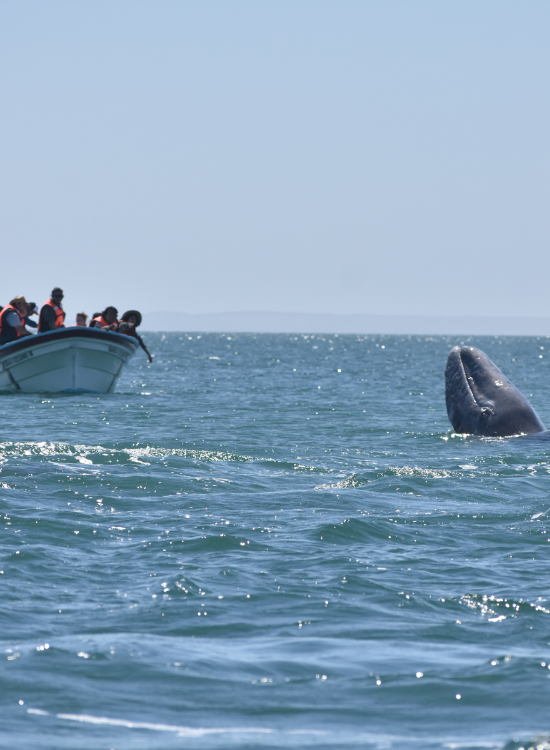
Under the Marine Mammal Protection Act, touching or harassing marine mammals in US waters is prohibited. Contact stresses the animal, disrupts feeding and nursing, and can transfer pathogens both ways. Mexico’s lagoons run on permitted whale watching rules where whales may approach boats, but people may not initiate contact. The distinction matters: the whale decides.
Female gray whales calve every two to three years. They reach sexual maturity between 6 and 12 years old, averaging around 8 or 9. Gestation runs about 12 to 13 months, with some estimates closer to 13.5. Newborn calves measure 14 to 16 feet, around 4.5 to 5 metres, and weigh roughly 2,000 pounds. They nurse about seven months on milk that is over half fat.
Understanding Is Caring
The grey whale is the species I point to when someone says conservation does not work. It came back from the brink because people wrote laws and enforced them.
It is also the species I point to when someone says the job is done. Calf production is at a record low. Stranded whales are starving. The Arctic that feeds them is changing faster than they can adapt.
Both are true at once. That is the useful part.
Go to Baja between January and April. Take a permitted operator, keep your hands inside the boat, and let the whale make the first move. She will.
Gray Whale Challenge 🐋
Ten questions on the ocean’s great bottom-feeder and record-breaking migrant — first a fact-or-fiction round, then multiple choice. How many can you get?
References:
Alter, S. E., et al., (2015). Climate impacts on transocean dispersal and habitat in gray whales from the Pleistocene to 2100. Molecular Ecology, 24(7), 1510–1522. https://doi.org/10.1111/mec.13121
Bierlich, K. C., et al., (2023). Downsized: Gray whales using an alternative foraging ground have smaller morphology. Biology Letters, 19(8), 20230043. https://doi.org/10.1098/rsbl.2023.0043
García-Castañeda, O., et al., (2024). Climate change stands as the new challenge for whale watching and North Pacific gray whales (Eschrichtius robustus) in Bahía Magdalena, Mexico, after their recovery from overexploitation. Frontiers in Conservation Science, 5, 1397204. https://doi.org/10.3389/fcosc.2024.1397204
Lang, A. R., Eguchi, T., & Weller, D. W. (2026). Abundance of eastern North Pacific gray whales 2025/2026 (NOAA Technical Memorandum NMFS-SWFSC-737). U.S. Department of Commerce. https://doi.org/10.25923/yk4w-dd52
Stewart, J. D., Grebmeier, J. M., Tinker, M. T., Calambokidis, J., & Moore, S. E. (2025). What gray whales are telling us about ecosystem change in the Pacific Arctic. ICES Journal of Marine Science, 82(11), fsaf196. https://doi.org/10.1093/icesjms/fsaf196