Few creatures are as recognizable as the animal armadillo. With that tough armor, a snuffling nose, and a very comical walk, this small mammal resembles a big armored guinea pig crossed with a medieval knight. However, behind that quirky exterior lies one of nature’s most fascinating evolutionary stories.
The armadillo (Spanish for “little armored one”) belongs to the order Cingulata. These mammals are closely related to sloths and anteaters, not rodents. Armadillos have roamed the Americas for millions of years, evolving specialized traits that make them unlike any other animal on Earth. From rolling into perfect spheres to giving birth to genetically identical quadruplets, armadillos are creatures full of surprises.
1. Armadillos Are Among the Only Living Mammals with True Armor
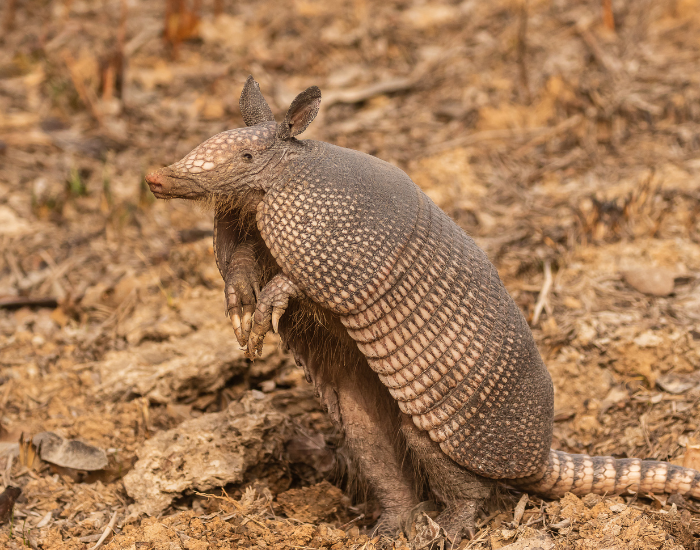
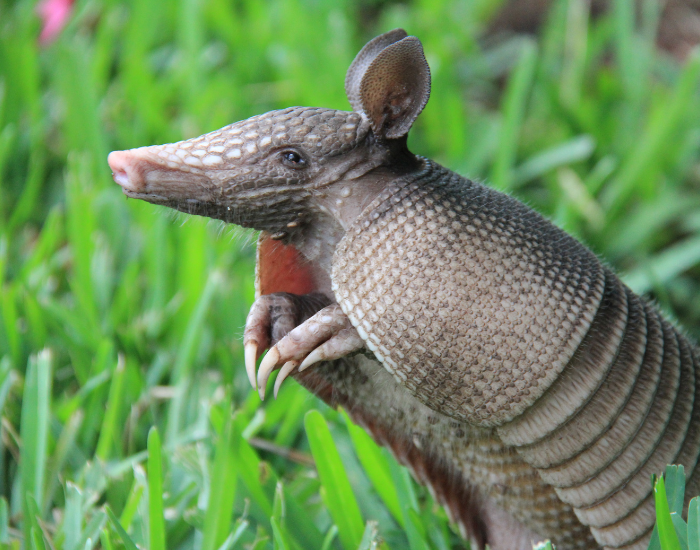
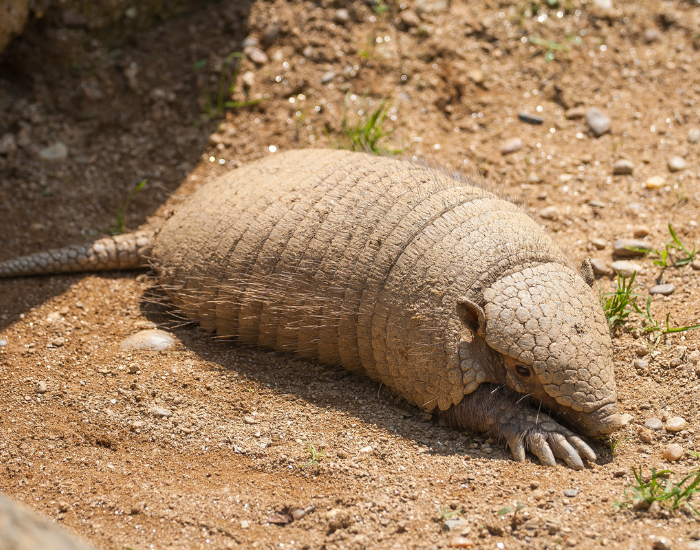
What makes the armadillo animal world-famous is its shells. The armadillo shell, called a carapace, consists of bony plates covered in keratin, the same material as human fingernails. This flexible shield covers the back, head, tail, and short legs, offering protection from natural predators like coyotes, bobcats, cougars, and even domestic dogs.
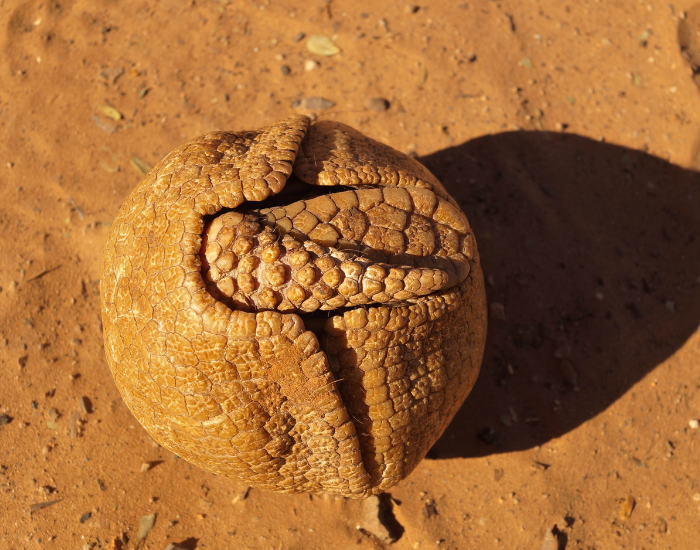
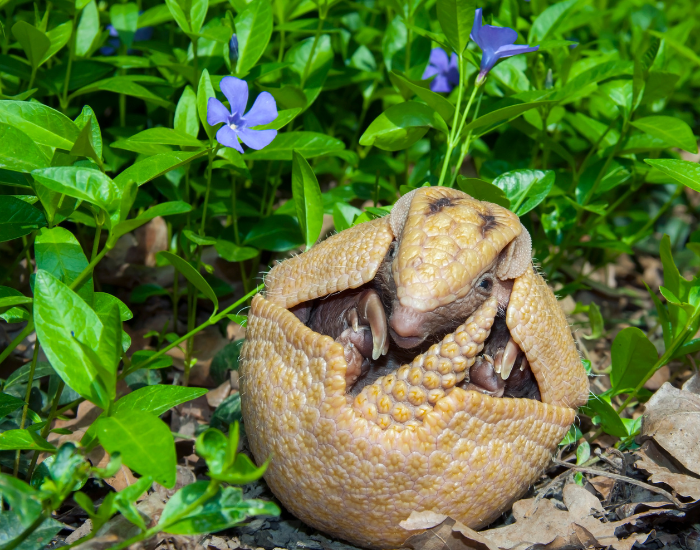
Different armadillo species have different armor styles. For example, the nine-banded armadillo features tough, segmented bands. Meanwhile, the three-banded armadillo sports a perfectly rounded dome that allows it to curl into a tight ball when threatened. This makes them look like an armored pig defending itself.
Recent research has revealed that armadillos are not completely alone in the mammalian world of natural armor. A 2023 study published discovered that African spiny mice (genus Acomys) also produce tiny bony plates, known as osteoderms, beneath the skin of their tails, a feature previously thought unique to armadillos. While these structures are far less developed, the finding highlights fascinating evolutionary parallels in mammalian armor design.
2. Armadillos Are Native to the New World
When it comes to habitat, armadillos are true New World natives. Where are armadillos native to? They originally evolved in South America and gradually expanded northward through Central and South America into the southeastern United States.
Today, where are armadillos found? Most armadillo species inhabit Central America and South America, preferring warm, moist environments like rainforests, savannas, and grasslands. The nine-banded armadillo (Dasypus novemcinctus) is the only species found in the U.S. This adaptable mammal has made its way as far north as Nebraska and Illinois.
Scientists believe armadillo populations began their range northward after the Great American Biotic Interchange. This occurred when the Isthmus of Panama connected the two continents roughly three million years ago. As a result, armadillos expanded their home range significantly across the New World.
In Texas, armadillos are particularly common. In fact, the nine-banded armadillo is the state small mammal of Texas, symbolizing resilience and adaptability throughout the southeastern United States.

3. There Are Around 21 Species of Armadillos
Although they may look similar, there isn’t just one armadillo species. Scientists recognize around 21 species of armadillo across the Americas. These include:
Nine-banded armadillo (Dasypus novemcinctus) – The most widespread species, found from Argentina to the southern United States.
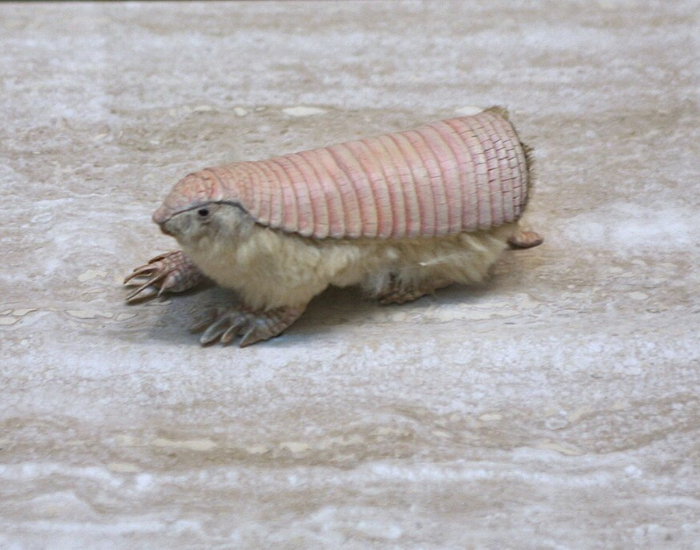
Pink fairy armadillo (Chlamyphorus truncatus) – The tiniest species, measuring just 13 cm in total length and native to Argentina.
Giant armadillo (Priodontes maximus) – The largest species, weighing up to 60 kg and found in the Amazon Basin of South America.
Three-banded armadillo (Tolypeutes matacus) – Famous for its ability to curl into a perfect ball.
Screaming hairy armadillo (Chaetophractus vellerosus) – Named for its loud vocalizations when threatened.
From the arid deserts of Argentina to the wetlands of Brazil, these animals showcase incredible adaptability. However, most armadillos prefer habitats with loose soil for easier digging and burrow construction.

4. Armadillos Eat Mainly Insects and Other Invertebrates
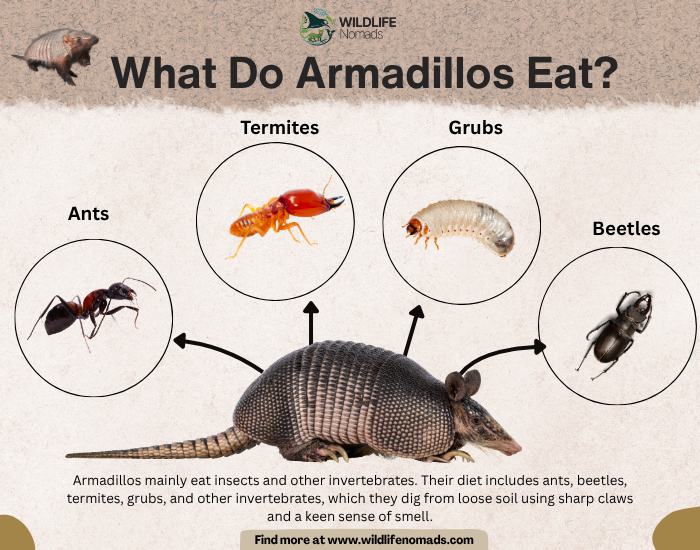
What do armadillos eat? Despite their pig-like snouts, most armadillos aren’t omnivores, they’re insectivores. This means they mainly eat insects and other invertebrates. Their diet includes ants, beetles, termites, grubs, and other invertebrates, which they dig from loose soil using sharp claws and a keen sense of smell.
The animal armadillo uses sticky tongues to lap up prey from deep within ant nests, much like anteaters do. Some species, such as the giant armadillo, are prolific diggers that can dig into termite mounds with incredible force. Therefore, they leave behind massive holes in the earth while foraging for food.
However, armadillos are opportunistic feeders. In addition to insects, they’ll also eat plants, fruits, small reptiles, and even armadillo meat (carrion) when available. This flexible diet helps them survive in various habitats across North and South America.
5. They Have a Unique Reproductive Strategy with Identical Quadruplets
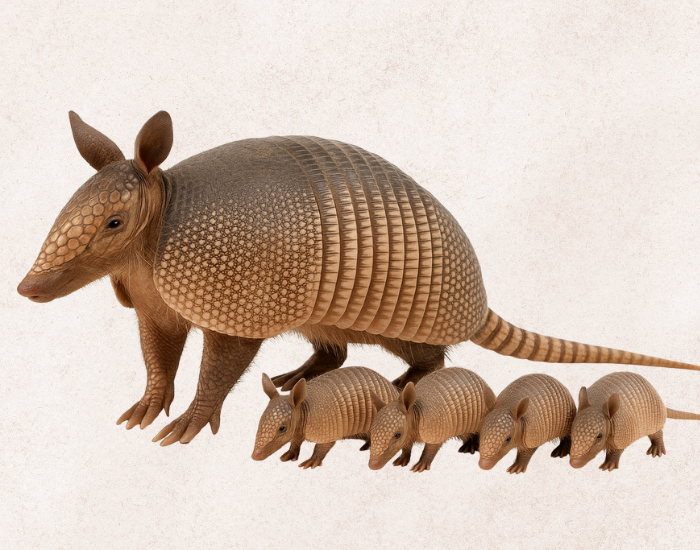
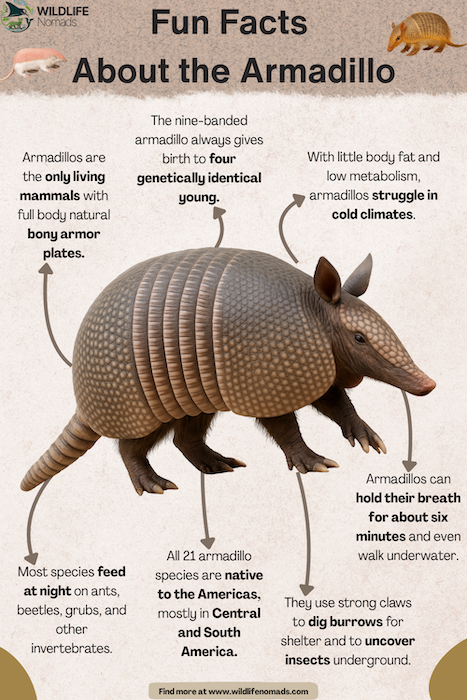
Among mammals, few have reproductive systems as peculiar as the armadillo animal. The nine-banded armadillo is the only mammal known to always give birth to genetically identical quadruplets. Four identical young develop from a single egg through a process called polyembryony.
This remarkable adaptation allows for reproductive efficiency and genetic consistency. In addition, females can delay implantation, pausing embryo development until conditions are favorable. This ensures survival in unpredictable environments where finding food and suitable burrows might be challenging.
Most armadillos breed during the warmer months. However, the delayed implantation means breeding occurs separately from actual birth timing. This unique reproductive strategy gives most armadillos a survival advantage in harsh climates and helps maintain stable populations.
6. Armadillos Are Prolific Diggers and Surprisingly Good Swimmers
Where do armadillos live? Most species prefer habitats with loose soil, which makes digging easier. They use sharp claws and strong forelimbs to dig and excavate complex burrows up to five meters long. Their digging behavior is remarkable, some species can dig through hard soil in seconds.
These abandoned armadillo burrows serve multiple purposes. They provide shelter from predators and extreme cold weather conditions. Moreover, burrows help armadillos regulate body temperature during hot days. Interestingly, abandoned armadillo burrows often become homes for other species, including snakes, owls, and skunks. Therefore, armadillos function as essential ecosystem engineers.
Digging isn’t their only skill, however. Armadillos are surprisingly good swimmers. They can hold their breath for up to six minutes and even walk underwater to cross streams. This ability helps them expand their range northward and access new habitats across water barriers in North America.

7. Armadillos Are Solitary and Mostly Nocturnal Animals
Despite their armored appearance, armadillos are shy creatures. They lead mostly solitary lives, coming together only during breeding season for mating.
Most species are nocturnal, foraging for insects and grubs at night using their exceptional sense of smell and keen sense of hearing. Their poor eyesight (very poor eyesight, actually) doesn’t hold them back—long snouts and acute olfactory senses make them expert insect hunters in the dark. This is why armadillos rarely fall victim to predators while finding food.
During the day, armadillos retreat into their burrows to rest and regulate body temperature. This behavior helps them avoid both predators and midday heat. In regions with extreme cold weather, armadillos may become less active or seek deeper burrows for warmth. Most armadillos cannot tolerate cold weather well due to their low body fat.
8. Armadillos Have Surprisingly Soft Bellies Under Their Shells
Underneath that tough shell lies a vulnerable spot, the armadillo’s underside. Unlike the rest of their body, their belly is covered with soft skin and sparse hair. Therefore, they’re susceptible to attacks if flipped onto their backs by predators.
Natural predators such as coyotes and domestic dogs often try to catch armadillos off guard or flip them over to access this weak point. To counter this threat, species like the three-banded armadillo curl up completely. In addition, they form an impenetrable sphere where no predator can reach their tender underside.
This defensive behavior showcases the armadillo’s remarkable evolutionary adaptation. While most armadillos can’t run fast on their short legs, their armor and ability to curl up or dig quickly provide excellent protection against natural predators.
9. Armadillos Play an Important Ecological Role in Their Habitats
Like most animals, armadillos serve a vital function in their ecosystems. As prolific diggers and insect predators, they help control pest populations, especially ants, beetles, and termites that could otherwise damage plants and soil.
Their digging behavior aerates the soil, improves nutrient cycling, and creates habitats for other wildlife. In short, they’re ecosystem engineers, much like prairie dogs, beavers, or earthworms. This makes them crucial for maintaining healthy habitats across Central and South America.
In addition, their burrows can become lifelines for smaller mammals seeking shelter from extreme heat or floods. This is another reminder of how every species contributes to the balance of nature. Without armadillos, many ecosystems would face increased insect populations and reduced soil quality, affecting overall habitat health.

10. Some Armadillo Species Are Endangered
Are armadillos extinct? Not yet, but some species face serious threats. The giant armadillo, native to South America’s Amazon Basin, is listed as Endangered on the IUCN Red List. Habitat loss, hunting, and deforestation have caused declining populations in recent years.
The pink fairy armadillo, though still surviving, is extremely rare and classified as Near Threatened. Agricultural disruption of its sandy loose soil habitat poses the main threat to this tiny species of armadillo.
Meanwhile, the nine-banded armadillo, often seen in the southeastern United States, is considered a species of Least Concern. Its populations remain stable and are even expanding their range northward into new territories across North America.
11. Armadillos Can Carry Leprosy But Pose Minimal Risk to Humans
One lesser-known fact about the animal armadillo is its connection to Hansen’s disease, commonly known as leprosy. The nine-banded armadillo is one of the few animals known to carry the bacterium Mycobacterium leprae according to this study. This can occasionally be transmitted to humans through close contact or consumption of undercooked armadillo meat.
However, such cases are extremely rare. Modern health authorities, including the CDC, emphasize that casual contact with armadillos poses virtually no risk to humans. Observing armadillos in the wild is generally safe.
Still, experts recommend avoiding handling wild armadillos or keeping them as pets. This precaution helps minimize any potential health risks while allowing people to appreciate these unique mammals from a safe distance in their natural habitats.
12. The Armadillo Is a Cultural Icon From the “Hoover Hog” Era to Today
Beyond biology, armadillos have left their mark on human culture across the Americas. In Texas, the nine-banded armadillo holds special status as the state small mammal. It’s a quirky symbol of resilience and curiosity throughout the region.
Armadillos appear in folklore across Latin America, often representing protection, patience, or persistence. In parts of the southern U.S., the nickname “poor man’s pork” or “Hoover hog” dates back to the Great Depression. During that difficult time, some communities relied on armadillo meat for food when other resources were scarce.
Today, the armadillo remains a symbol of the American South. It serves as a reminder of nature’s ingenuity and the remarkable diversity of New World mammals that call this region home.
FAQs About Armadillos
Armadillos are mammals, not rodents. They belong to the order Cingulata, sharing ancestry with sloths and anteaters, not mice or rats. This makes them unique among small mammals in the Americas and distinguishes them from any armored pig or rodent species.
Armadillos are most common in Texas, Florida, Louisiana, and Oklahoma throughout the southeastern United States. However, populations are expanding their range northward into states like Missouri, Nebraska, and Illinois. The nine-banded armadillo is the only species found in North America.
Wild armadillos are shy, solitary, and non-aggressive toward humans. They’re not suitable pets and prefer to avoid human contact in their natural habitats. However, they pose no threat to humans if left alone. Most armadillos will simply dig quickly or curl up defensively if encountered.
Armadillos have very poor eyesight because they rely primarily on their keen sense of smell for finding food. Their long snouts contain powerful olfactory receptors that help them locate insects underground in loose soil.
Conservation and Coexistence
Protecting armadillos means preserving the ecosystems they depend on, wetlands, grasslands, and tropical forests with suitable loose soil for digging. Supporting sustainable land use, reducing deforestation, and avoiding hunting are simple but effective steps for conservation.
If you live in the southern United States, you can help by not disturbing burrows or using harmful pesticides that affect their insect prey. In addition, avoid using poisons or traps that might harm these prolific diggers. Reporting sightings to local wildlife organizations also helps researchers track armadillo populations and their expanding range northward.
Armadillos might not be the flashiest animals, but they’re quietly essential. These resilient survivors function as ecological allies and living reminders of Earth’s biological creativity. Their role as ecosystem engineers benefits countless other species across their native habitats.
The Armored Wonders of the Americas
From the soft sands of Argentina to the backyards of Texas, the animal armadillo has endured through time as one of evolution’s most unusual success stories. Its combination of toughness and adaptability, from its armored shells to its unique reproductive strategy, speaks volumes about nature’s inventiveness.
Understanding and protecting these mammals helps ensure their survival for generations to come. After all, every armadillo animal tells a story, one of survival, resilience, and the extraordinary diversity of life on our planet. Whether you encounter them in Central America, South America, or the southeastern United States, armadillos deserve our respect and protection as remarkable New World natives.
References:
Chen, I. H., Kiang, J. H., Correa, V., Lopez, M. I., Chen, P.-Y., McKittrick, J., & Meyers, M. A. (2011). Armadillo armor: Mechanical testing and micro-structural evaluation. Journal of the Mechanical Behavior of Biomedical Materials, 4(5), 713–722. https://doi.org/10.1016/j.jmbbm.2010.12.013
Enders A. C. (2002). Implantation in the nine-banded armadillo: how does a single blastocyst form four embryos?. Placenta, 23(1), 71–85. https://doi.org/10.1053/plac.2001.0753
Maden, M., Polvadore, T., Polanco, A., Barbazuk, W. B., & Stanley, E. (2023). Osteoderms in a mammal the spiny mouse Acomys and the independent evolution of dermal armor. iScience, 26(6), 106779. https://doi.org/10.1016/j.isci.2023.106779
Oliveira, I. V. P. M., Deps, P. D., & Antunes, J. M. A. P. (2019). Armadillos and leprosy: from infection to biological model. Revista do Instituto de Medicina Tropical de Sao Paulo, 61, e44. https://doi.org/10.1590/S1678-9946201961044
Romero-Alvarez, D., Garzon-Chavez, D., Jackson, M., Avanzi, C., & Peterson, A. T. (2023). Mycobacterium leprae in Armadillo Tissues from Museum Collections, United States. Emerging infectious diseases, 29(3), 622–626. https://doi.org/10.3201/eid2903.221636
Superina, M., Desbiez, A., Di Blanco, Y., Smith, P., De Thoisy, B. & Earl, E. (2025) Priodontes maximus. The IUCN Red List of Threatened Species 2025: e.T18144A244101181. https://dx.doi.org/10.2305/IUCN.UK.2025-1.RLTS.T18144A244101181.en.
Wible, J. (2017). Armadillo identical quadruplets every time. Carnegie Museum of Natural History. https://carnegiemnh.org/armadillo-identical-quadruplets-every-time/
Woodburne M. O. (2010). The Great American Biotic Interchange: Dispersals, Tectonics, Climate, Sea Level and Holding Pens. Journal of mammalian evolution, 17(4), 245–264. https://doi.org/10.1007/s10914-010-9144-8