The first nudibranchs I ever saw were ghost-white.
It was a marine biology field trip in Sweden. We spent the day sampling rocky shores and shallow waters from a small research boat. Seaweed and sediment went into jars and sieves. Among it all were a few sea slugs, translucent and frilled, barely there.
Under the microscope back in the lab they came alive. Fine textures, delicate frilled edges. We found a tardigrade that day too, which you can find here.
Years later I met their tropical cousins on reefs in the Philippines. Nothing ghost-white about those. It takes a dozen passes before your eye adjusts. Then you see them everywhere: on sponges, on bare rock, louder than anything around them.
Most beachgoers never notice a single one. These nudibranch facts should help you change that. Slow down and you can find a nudibranch on the coral in my 3D reef dive.
What Are Nudibranchs? Understanding These Sea Slugs
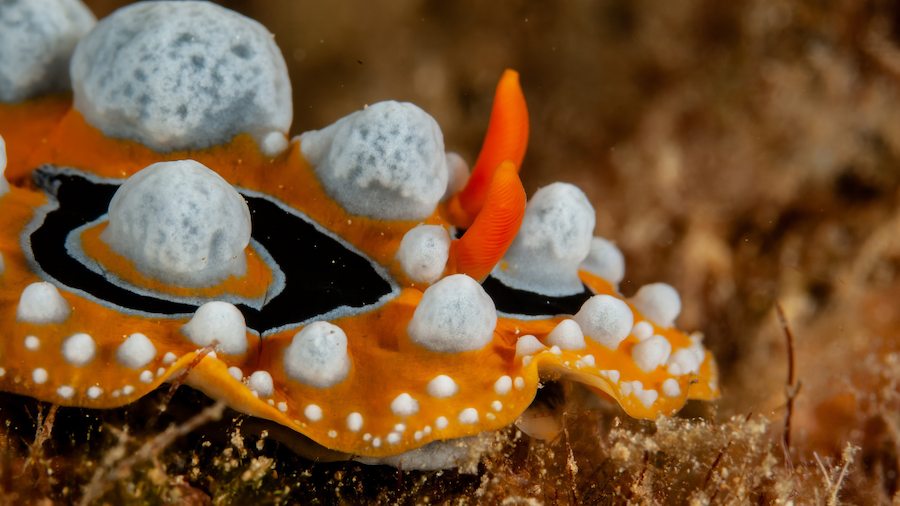
Nudibranchs are soft-bodied sea slugs. All sea slugs belong to the phylum Mollusca and class Gastropoda, the same group as snails. Divers know them by a dozen common names, from sea dragons to clowns.
Not all sea slugs are nudibranchs, though. Many sea slugs, like sea hares and sap-sucking sacoglossans, are only distant cousins. The most closely related group is the side-gilled pleurobranchs. To see where nudibranchs fit among the molluscs, try my phylum explorer.
The word nudibranch comes from Latin and Greek and means “naked gills”. Unlike snails, nudibranchs drop their shells after the larval stage and live the rest of their lives without one. Around 3,000 species are known.

Two Body Plans
For years, scientists split nudibranchs into two big groups, and divers still use both names.
Dorid nudibranchs wear a ring of feathery gill plumes on the back, near the tail. Many can pull those branchial plumes, and their horn-like rhinophores, into pockets in the skin for protection.
The other group includes the aeolids. They carry cerata instead, finger-like outgrowths that handle breathing, digestion and defence all at once.
In 2025, a major revision went a step further. It moved the dorids into an order of their own, Doridida, and kept the name Nudibranchia for the rest. Not every scientist or database has followed yet, and divers still call both groups nudibranchs. For now, so will this guide.
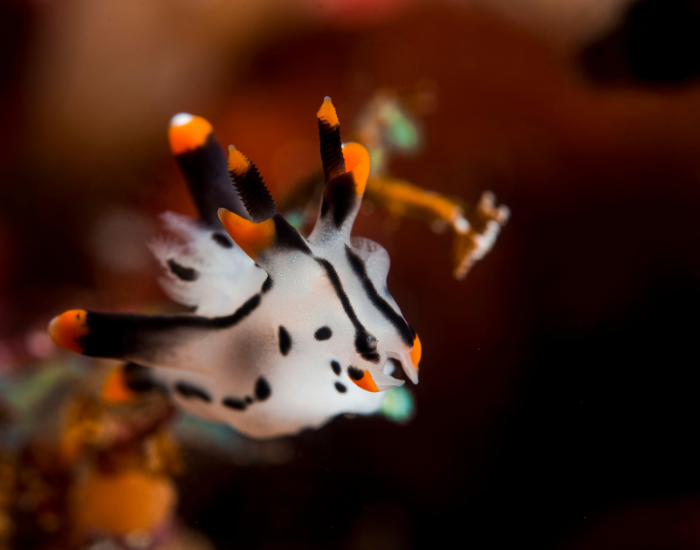
How They Sense the World
They see very little. Their simple eyes register only light and dark.
Instead, they rely on two rhinophores on the head. These chemical-sensing tentacles pick up odours in the water, leading a nudibranch to food or to a mate.
Most nudibranchs are benthic, gliding over the bottom on a single muscular foot. Only a few species break the rule. The Spanish dancer swims, and the blue dragon floats at the ocean surface.
Nudibranchs live in every one of the world’s oceans, from tropical reefs to polar seas. You find them on coral reefs, sandy areas, rocky shallows and even shipwrecks. Adults range from a few millimetres to around 40 cm.
12 Types of Nudibranch Molluscs You Should Know
Some species turn up on almost every reef dive. Others have been recorded only a handful of times, which makes each sighting special. Here are twelve worth knowing, from the open ocean to cold northern kelp.
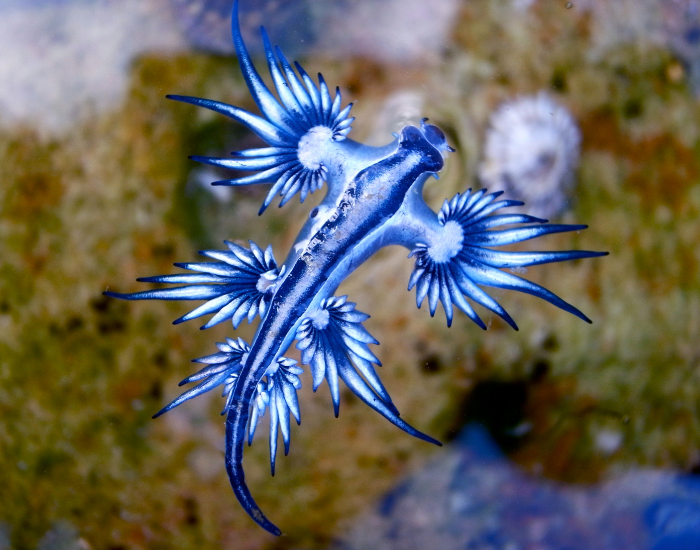
1. Blue Dragon (Glaucus atlanticus): The Pelagic Hunter
The blue dragon lives upside down at the very top of the water column. A swallowed bubble of air keeps it afloat. Its silver-blue underside faces the sky, and its pale back faces the deep. It is counter-shaded from both directions.
It feeds on the Portuguese man o’ war, the bluebottle of Australian beaches. As it eats, it keeps the unfired stinging cells and moves them into the tips of its cerata. Touch one and you get stung with the bluebottle’s own weapons, concentrated at the tips
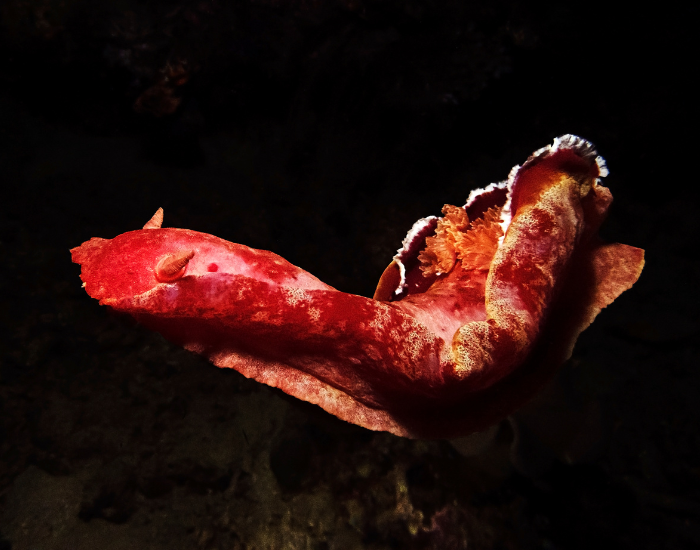
2. Spanish Dancer (Hexabranchus sanguineus): The Ocean’s Ballet
The Spanish dancer is one of the largest nudibranchs in the world. Most reach around 25 cm, with Red Sea animals reported up to 40.
It earns its name when it swims. The red mantle flexes and the edges ripple like a flamenco skirt. Look for it on Indo-Pacific reefs, often at night. Its red egg ribbons, coiled like roses, are almost as striking as the animal.
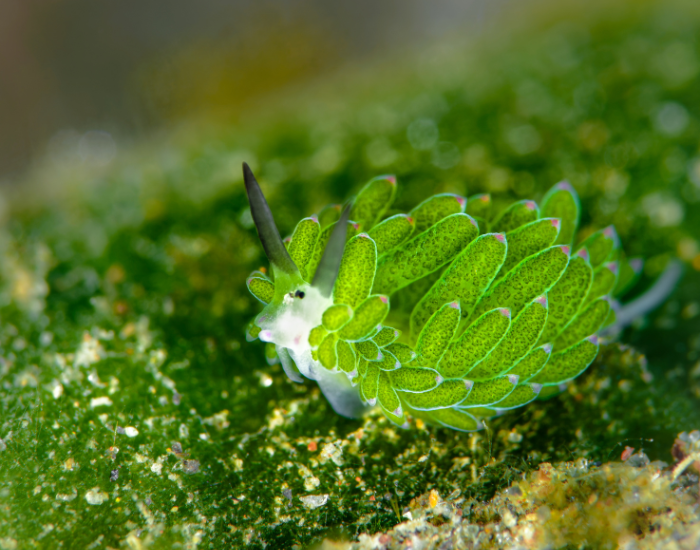
3. Leaf Sheep (Costasiella kuroshimae): The Photosynthetic Wonder
Strictly speaking, the leaf sheep is not a nudibranch at all. It is a sacoglossan, a separate group of sea slugs. But it is too good to leave off any list. Tiny, green, with two dark eyes and a face like a cartoon sheep.
It feeds on Avrainvillea algae and keeps the chloroplasts alive inside its own cells, a trick called kleptoplasty. Those chloroplasts photosynthesise for a while. They also double as a food store, helping it ride out spells without eating.
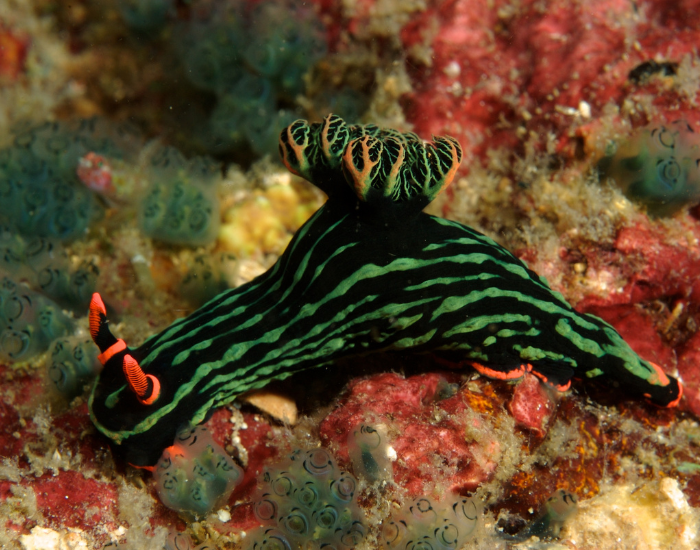
4. Dusky Nembrotha (Nembrotha kubaryana): The Toxic Beauty
Also called the variable neon slug, this Indo-Pacific species glows with fluorescent green and orange markings on a dark body. It feeds on sea squirts and keeps their chemical defences for itself.
Those colours are a warning, and reef fish learn to read them. Photographers learn too, because finding one feels like finding treasure.
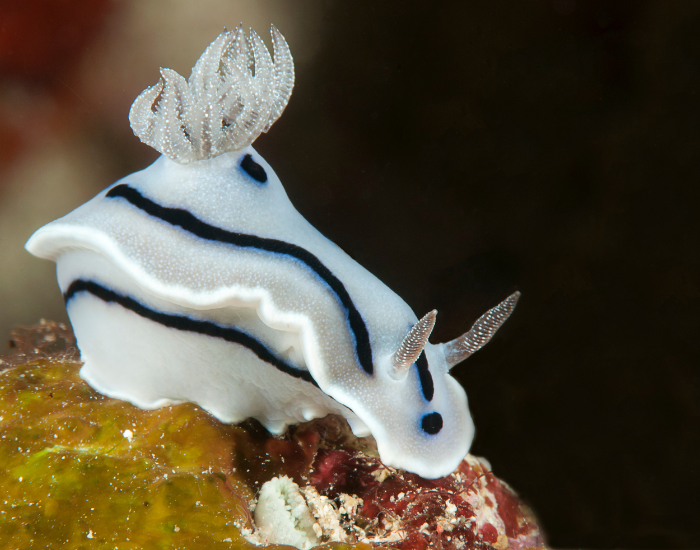
5. Willan’s chromodoris (Chromodoris willani): The Royal Classic
Pale blue with crisp black lines and a white frilled edge. Divers meet this dorid nudibranch across coral gardens in Indonesia, the Philippines and Papua New Guinea.
It is one of the commonest blue nudibranchs in the region. It is also one of the easiest to confuse with its relatives. Count the black lines and check the edge of the mantle.
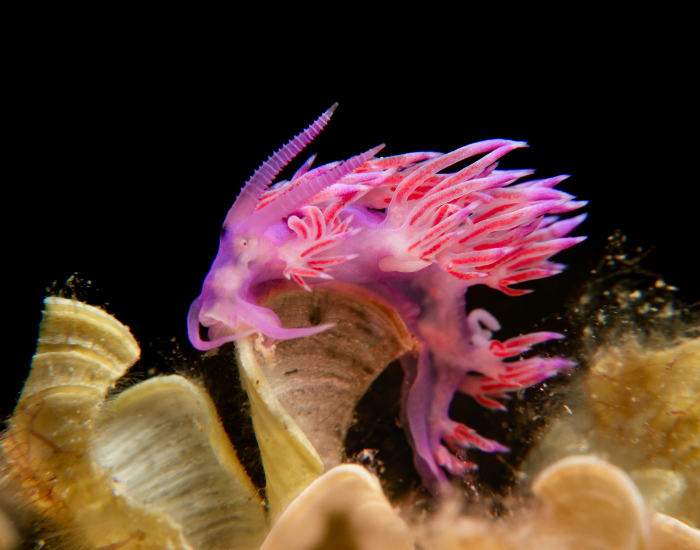
6. Mediterranean Violet Aeolid (Flabellina affinis)
Violet from end to end, with bunches of translucent purple cerata that shimmer in sunlight. It feeds almost entirely on Eudendrium hydroids growing over rocks.
It lives across the Mediterranean and the eastern Atlantic, from Portugal down to Ghana and the Canary Islands. This is temperate water, not cold, and some of Europe’s easiest nudibranch diving.
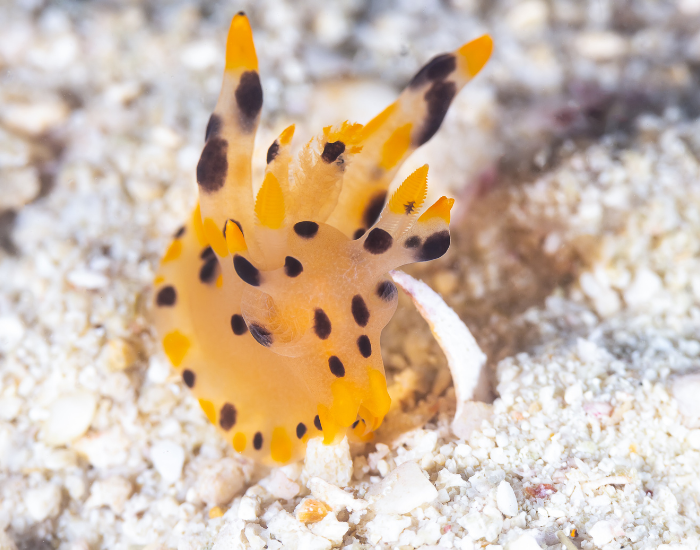
7. The Pokémon Nudibranch (Thecacera pacifica)
Bright yellow, with blue-tipped rhinophores sticking up like ears. Divers nicknamed it the Pikachu nudibranch, and the internet did the rest.
It is small, found on Indo-Pacific reefs, and a good reminder that a tiny animal can still capture people’s imagination. Few sea slugs have done more for public interest in the group.
8. Doughnut Doto (Doto greenamyeri) Living Glass
Described only in 2015, from Papua New Guinea, and since recorded in Indonesia. It reaches about 15 mm.
The body is nearly transparent, with a brown stripe down the back. Each ceras carries raised rings, like a stack of tiny doughnuts. It lives on feathery hydroids and blends into them so well that few divers ever spot it. It is camouflage on the level of the cuttlefish, done with no colour change at all.

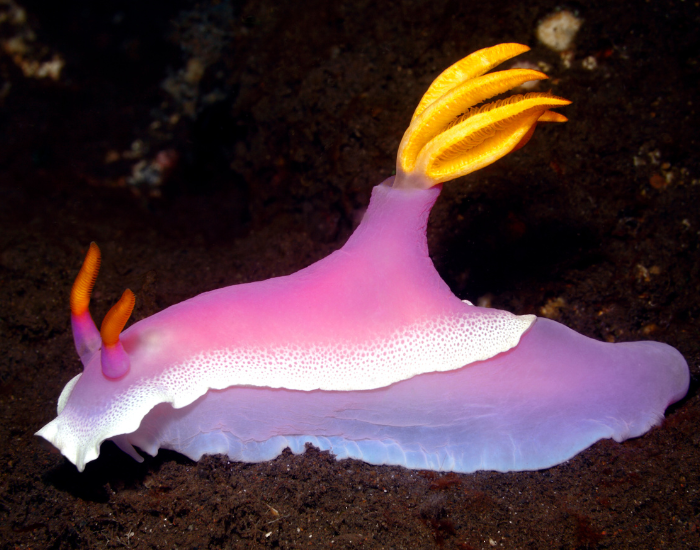
9. Giant Hypselodoris (Hypselodoris apolegma) – The Photographer’s Dream
A vivid violet body, an orange-rimmed mantle and white gills. Few nudibranchs photograph better.
The Philippines hosts abundant populations of this species, according to reports, but new records are showing it more widely distributed. It ranks among the most photographed nudibranchs anywhere, and divers travel specifically to find it.
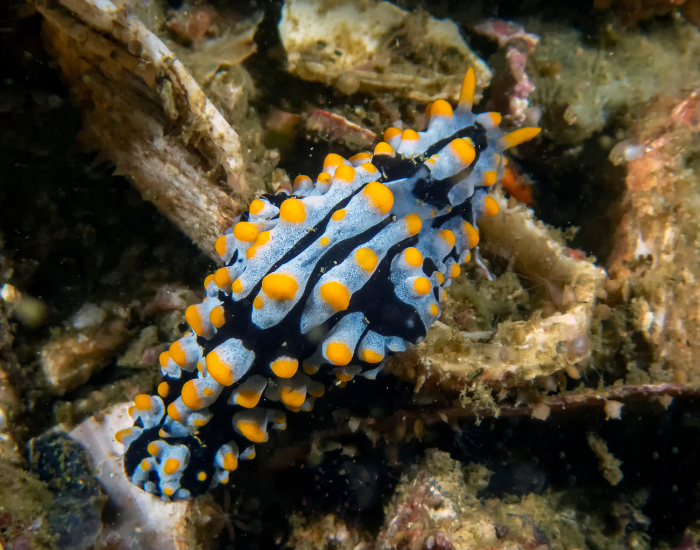
10. Varicose Wart Slug (Phyllidia varicosa) – The Toxic Armored Defender
Black ridges and blue-grey warty bumps cover the whole back. It looks like it was built to be left alone, and it was.
When disturbed, Phyllidia varicosa releases defensive compounds that reef fish learn to avoid fast. It joins a long list of toxic animals that advertise rather than hide. The tough, ridged skin adds a second layer of protection.
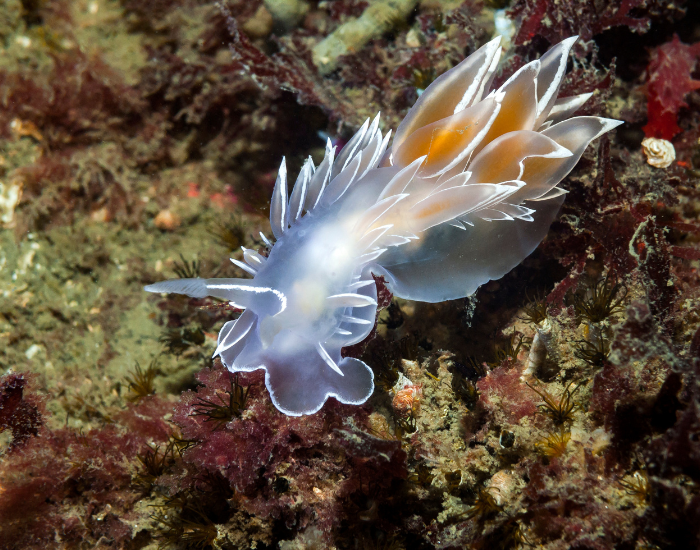
11. White-lined Dirona (Dirona albolineata) – The Cold-Water Beauty
This one belongs to the North Pacific, from Alaska down to California. Divers off British Columbia commonly meet it.
The body is translucent, and each flattened ceras is edged in fine white. It suits the cool green water of the northern kelp forests. This is a quieter kind of beautiful than the tropical species above.
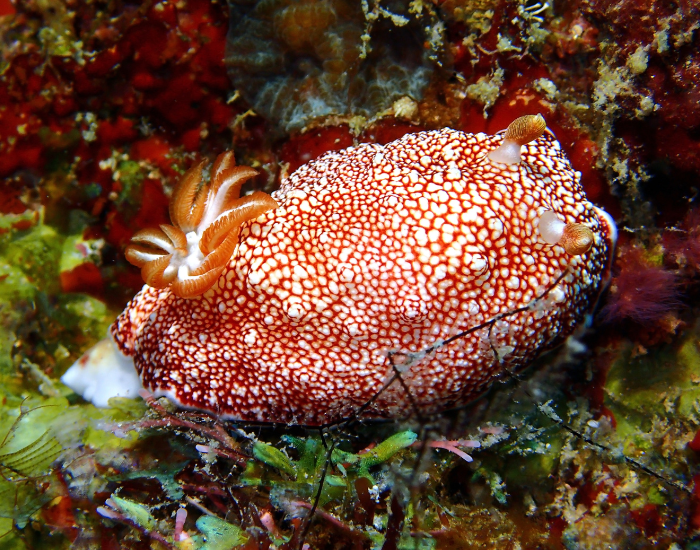
12. Reticulated Goniobranchus (Chromodoris reticulata)
A net of red lines spreads across a pale body, which is where the name reticulatus comes from. It was moved from Chromodoris to Goniobranchus in 2012.
That name hides a puzzle. Recent work suggests several look-alike species sit inside it, each with slightly different colour patterns. Underwater photographers still rank it among the most striking sea slugs on Indo-Pacific reefs.
What Do Nudibranchs Eat?
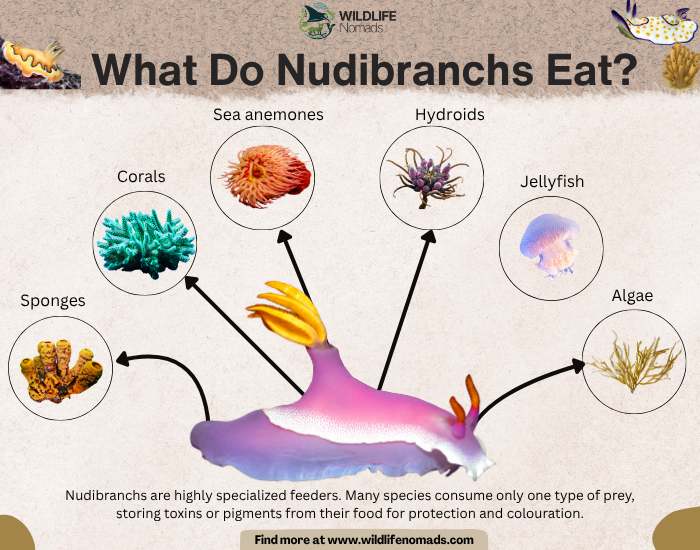
All known nudibranchs are carnivores, and most are fussy ones. Many species eat a single kind of prey for their whole lives.
Sponges are the staple for many dorid nudibranchs. Aeolids go for stinging cnidarians: hydroids, sea anemones and soft corals. Others eat bryozoans, sea squirts, eggs, and even other sea slugs, including other nudibranchs.
That pickiness matters. By cropping sponges, hydroids and other animals fixed to the rocks, nudibranchs stop any one of them from taking over. They are small, but they help keep a reef’s marine life in balance.
Diet often shapes their colour too. Pigments and chemicals from their prey end up in their skin. That is why one species can look different from reef to reef.
How Nudibranchs Defend Themselves
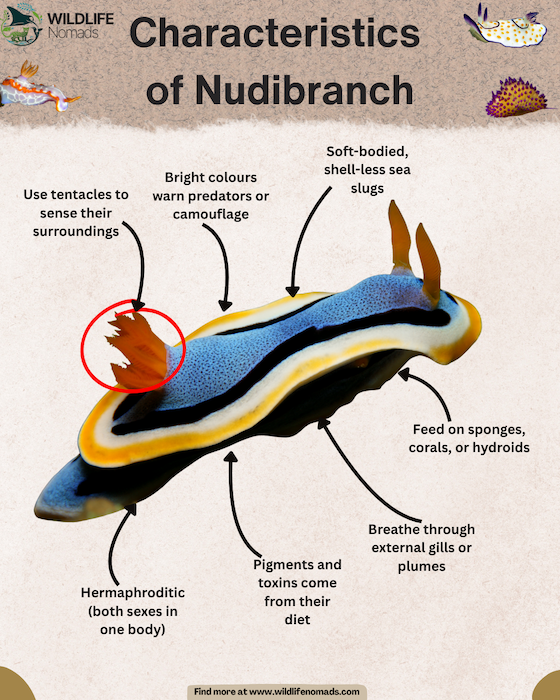
Nudibranch molluscs have no shell, no speed and no bite worth mentioning. They survive anyway, and they do so by borrowing from what it eats.
Bright Colours That Warn
Many nudibranchs are brightly coloured on purpose. To a fish, that orange or blue usually means toxic or terrible-tasting. Biologists call this aposematism, and predators learn it fast.
It is not always a bluff. Several different species can share one warning pattern, but their real toxicity varies widely behind it. To a fish, they all look equally dangerous, and that protects every one of them. These warning colours are among the reef’s most effective adaptations.
Chemical Defences
Many species pull toxins from the sponges or soft corals they eat and store them in their own bodies. When attacked, certain species release noxious mucus or acidic secretions that irritate a predator’s mouth.
The varicose wart slug in our list is a good example. So is the dusky nembrotha, which borrows its defences from sea squirts.
Stolen Stinging Cells
This is the cleverest trick of all. When aeolid nudibranchs eat hydroids, anemones or jellyfish relatives, mucus and a protected gut stop the stinging cells from firing.
Then they keep them. The unfired nematocysts travel through the gut into small sacs at the tips of the cerata. A fish that bites gets stung by the prey’s own weapons. The blue dragon takes this further than any other species, stocking its cerata with bluebottle stingers.
How Nudibranchs Mate and Lay Eggs
All nudibranchs are hermaphrodites, with both male and female reproductive organs. They cannot fertilise themselves, though. Every nudibranch needs a partner.
Mating can start with a slow, circling courtship lasting several minutes. The pair then line up side by side and swap sperm. Their reproductive openings sit together on the right side of the body.
Both partners usually go on to lay eggs. The egg ribbons are gelatinous spirals glued to coral, rock or seaweed, often pink, orange or white. Depending on the species, a single mass holds anything from a few eggs to millions.
The larvae hatch with tiny shells and drift in the plankton. When they find the right habitat, usually near their future food, they settle and lose the shell for good. Most nudibranchs live from a few weeks to about a year, and a few larger tropical species longer.

Where to Find Nudibranchs
Spotting nudibranchs takes patience and slow swimming. Many live in shallow waters and sandy areas, so you can find them snorkelling as well as diving. Check sponges, hydroids and rocky ledges rather than open reef. Booking a dive trip with a local guide helps enormously.
Indonesia and the Philippines sit at the heart of the Coral Triangle, home to the highest nudibranch diversity on Earth. Divers here still find species that have no name yet.
Australia is excellent too. Byron Bay, Rottnest Island and Ningaloo Reef together hold hundreds of species, across temperate and tropical water.
The Mediterranean is home to temperate species like Flabellina affinis, and some of the most accessible diving in Europe.
California and British Columbia have rich cool-water fauna, including Dirona and Janolus, in rocky shallows and kelp forests. Spring and summer give the best diving in the US for spotting them.
FAQs About Nudibranch Molluscs
Yes. Nudibranch molluscs belong to the phylum Mollusca and the class Gastropoda. That makes them relatives of snails, clams and even octopuses.
Many sea slug species carry toxins from their diet. A few, like the blue dragon, can sting humans if handled carelessly. Never touch nudibranch molluscs directly.
Most nudibranch species fail in captivity. These sea slugs require constant supplies of specific prey. They don’t adapt to aquarium conditions. Dedicated enthusiasts sometimes succeed with hardy species.
Tiny specimens measure just 3 millimeters. The Spanish Dancer reaches 60 centimeters. Most sea slug species occupy the middle ground, ranging 1-5 centimeters.
These sea slugs serve as reef health indicators. Population changes signal environmental stress. Studying nudibranch molluscs reveals coral reef conditions before obvious damage appears.
Over 3,000 nudibranch species inhabit Earth’s oceans. The Indo-Pacific region hosts the highest diversity. Sea slugs thrive from tropical reefs to cold polar waters.
Slow Down and Look
Every nudibranch you spot is the end point of millions of years of evolution. Shell lost, colours turned into warnings, stolen weapons put to work.
Next time you slip under the water, slow right down. Look at the sponges, the hydroids, the rock between the corals. Somewhere in there, a living masterpiece is crawling along, waiting for your eye to adjust.
Wildlife Nomads Challenge
Name That Nudibranch
Twelve photos, all from this article. Name each sea slug, then scroll back up to meet it properly.
References:
Andrimida, A., & Hermawan, R. (2019). Diversity and distribution of sea slugs (Gastropods: Heterobranchia) in Sempu Strait, Indonesia. IOP Conference Series: Earth and Environmental Science, 391(1), 012073. https://doi.org/10.1088/1755-1315/391/1/012073
Bonomo, L., Soong, G. Y., Reimer, J., & Gosliner, T. (2022, August). 50 shades of red: The red-reticulate group of Goniobranchus (Heterobranchia: Nudibranchia: Chromodorididae). Spixiana, 30A, 156.
Hagadone, M. R., Burreson, B. J., Scheuer, P. J., Finer, J. S., & Clardy, J. (1979). Defense allomones of the nudibranch Phyllidia varicosa Lamarck 1801. Helvetica Chimica Acta, 62(7), 2484-2494. https://doi.org/10.1002/hlca.19790620742
Prieto-Baños, S., & Layton, K. K. S. (2025). Tracing the evolution of key traits in dorid nudibranchs. PloS one, 20(4), e0317704. https://doi.org/10.1371/journal.pone.0317704
Korshunova, T., Fletcher, K., & Martynov, A. (2025), Zoological Journal of the Linnean Society, 204(4), https://doi.org/10.1093/zoolinnean/zlaf057