
During my master’s in conservation biology in Sydney, I hit a semester break and convinced a fellow biologist to explore Tasmania. We spotted wallabies bounding through scrubland and watched dozens of wombats waddle across Maria Island. Echidnas shuffled through the leaf litter like spiny little tanks. Then I did something completely unrelated to biology. I signed up for a Vipassana meditation retreat. Ten days of total silence. No phone, no books, no exercise, no distractions of any kind. The retreat sat on a humble property bordering national parks, and our only permitted activity outside meditation was a daily silent walk through the grounds.
That part was beautiful. I saw wildlife everywhere. But one evening, something moved on a tree branch that stopped me cold. A bird I had never seen before, stocky, wide-mouthed, perfectly blended against the bark. I couldn’t identify it, couldn’t photograph it, couldn’t ask anyone. A few days passed with no second sighting. Then, the day before the retreat ended, I found it again on the same tree. I had to wait until I returned to Sydney to learn I had been staring at tawny frogmouths. That image is still burned into my memory, sharper than any photo.
These Australian native birds are among the most misunderstood species on the continent. Most people call them owls. They are not. What follows are 12 facts about tawny frogmouths that will change how you see these remarkable birds.
1. Tawny Frogmouths Are Not Owls
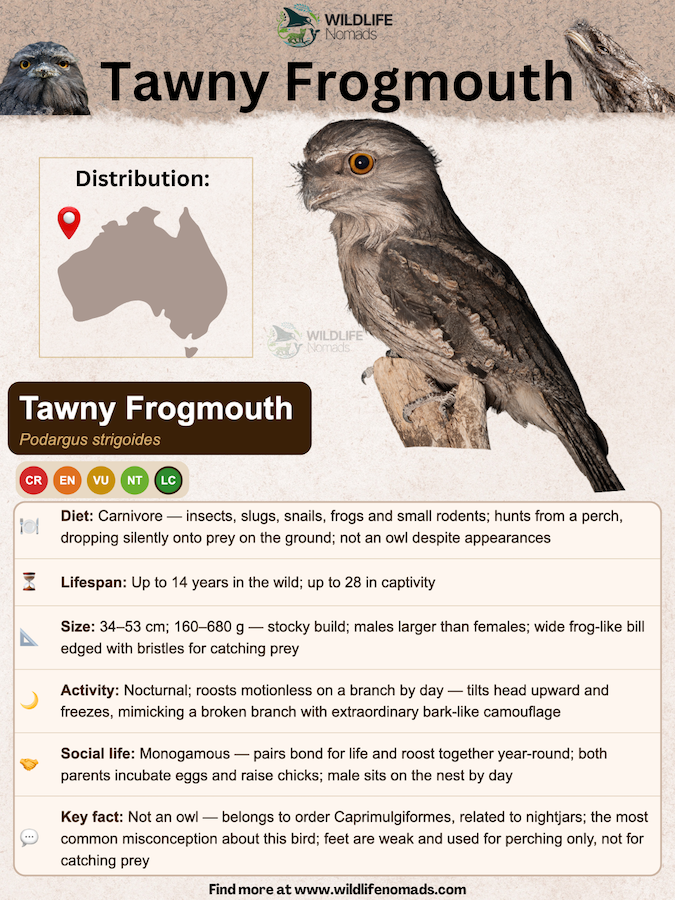
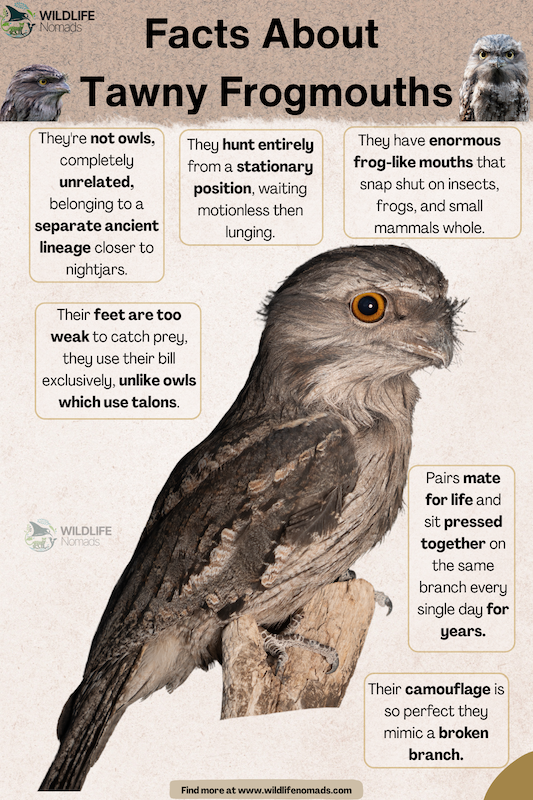
Let me settle this right away. The tawny frogmouth (Podargus strigoides) is not an owl. People call them a “frog mouthed owl,” a “frog faced owl,” or even a “wide mouth owl,” but every one of those names is wrong. Tawny frogmouths belong to the order Caprimulgiformes, which makes them far more closely related to nightjars than to any owl species.
Owls belong to the order Strigiformes. The two groups share a nocturnal habit and forward-facing eyes, which is where the confusion starts. However, the similarities end there. Unlike owls, tawny frogmouths have weak feet and short legs. Owls use powerful curved talons to snatch prey mid-flight. The tawny frogmouth’s feet could never do that. Their toes lack the grip strength to grab prey the way raptors do.
The scientific name Podargus strigoides actually translates to something like “gouty, owl-like”, even the taxonomists who named this species acknowledged it only resembles owls. So if you have been calling these birds a “tawny frog mouthed owl,” consider this your friendly correction.
2. Their Camouflage Is Among the Best in the Bird World
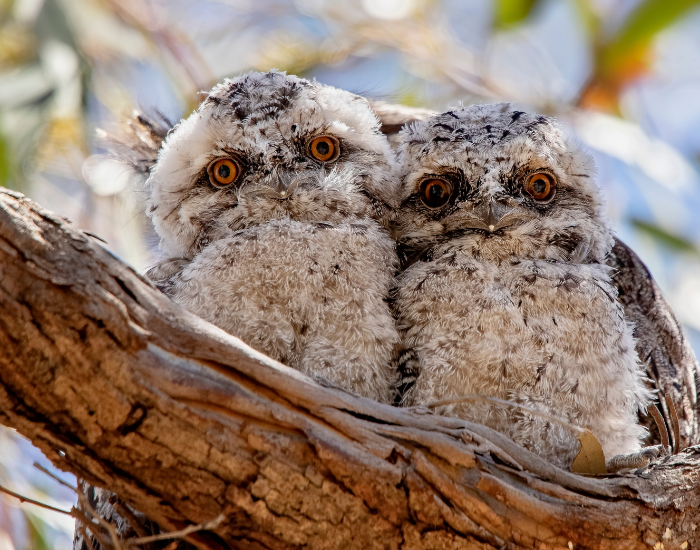
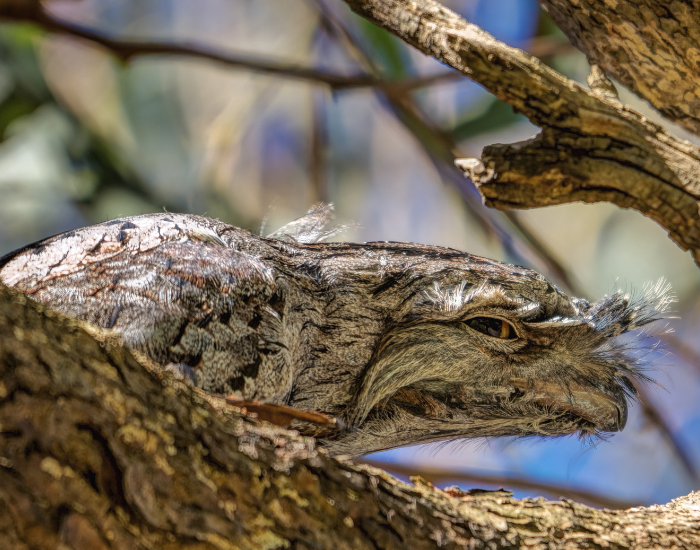
Tawny frogmouths do not rely on speed or strength to survive. They rely on becoming invisible. Their plumage — a mottled mix of olive grey, silver, and brown with black streaks and subtle white barring — mimics tree bark so precisely that most predators walk right past them.
When a tawny frogmouth senses danger, it does not fly. It freezes. The bird closes its eyes, tilts its beak skyward, and stiffens its entire body. In this posture, it looks exactly like a broken tree branch. They can remain perfectly still for hours. I have stared directly at a tree holding a tawny frogmouth and nearly missed it. Their excellent camouflage is not a backup plan. It is their primary survival strategy, and it works against predators far larger and faster than they are.
This camouflage is so effective that researchers studying the species sometimes struggle to locate tagged individuals on trees they know the birds frequent.
3. That Wide Beak Is Their Most Important Tool
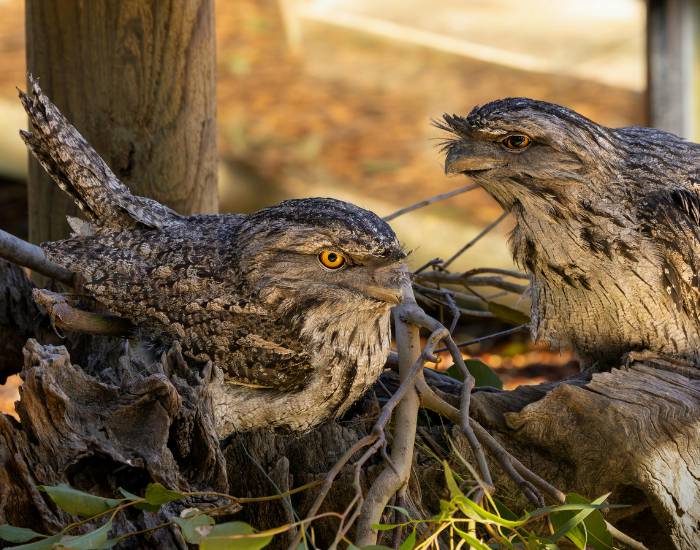
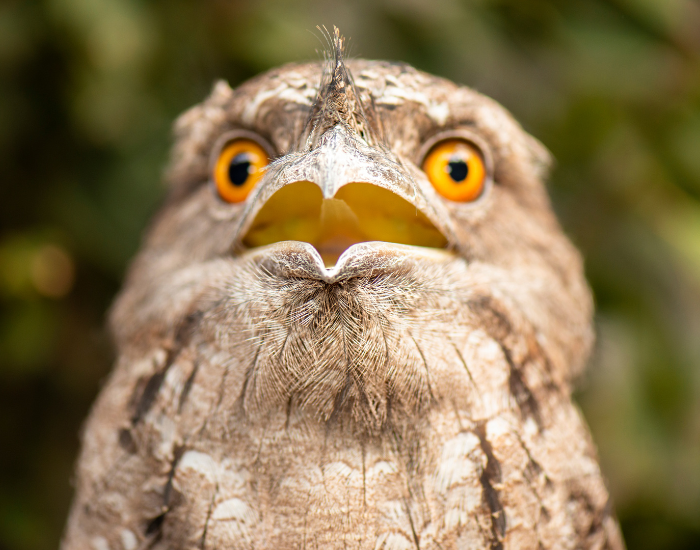
The name frogmouth comes from one obvious feature: their enormous, wide beak. It is broad, flat, and fringed with stiff rictal bristles that act like a funnel. When the bird opens that beak, it creates a gaping trap perfectly designed for scooping up insects.
Unlike owls, whose beaks are hooked for tearing flesh, the tawny frogmouth’s beak is built for a completely different feeding style. Those stout bills snap shut on prey with surprising speed. The beak is the defining feature of every frogmouth species, it is what separates the entire family from owls, nightjars, and everything else.
The rictal bristles lining the beak likely serve a sensory function too. They may help the bird detect prey through physical contact in low-light conditions, essentially acting as whiskers.
4. They Hunt Nothing Like Owls Do
Here is a fact that surprises most people: tawny frogmouths are not very good fliers. They have rounded wings and long wings relative to body size, but they lack the silent flight that owls are famous for. Owls have specialized feather edges that muffle sound. Without silent flight, tawny frogmouths would alert every prey item within earshot if they tried aerial hunting.
Instead of hunting on the wing, the tawny frogmouth uses a sit-and-wait strategy. It perches on a tree branch or other elevated perch and watches the ground. When prey wanders close enough — insects, frogs, small mammals, or reptiles — the bird drops down, snatches the prey in its beak, and flies back up. They capture prey with their mouth, not their feet. This is the fundamental difference.
Their diet includes flying insects, nocturnal insects, and even larger prey like frogs and small mammals. Tawny frogmouths are also known for chasing insects illuminated by streetlights and porch lights in suburban areas. This behavior brings them dangerously close to roads… but more on that later.
5. The Tawny Frogmouth’s Diet Is Surprisingly Varied
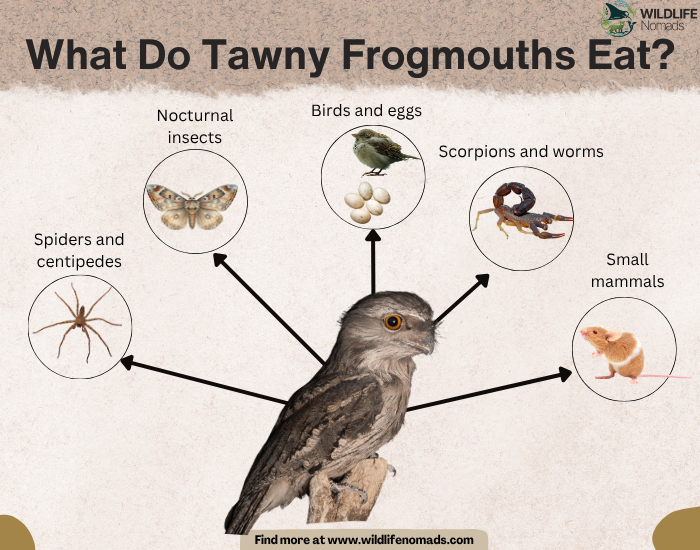
The tawny frogmouth’s diet goes well beyond insects. While moths, beetles, and crickets make up the bulk of what they eat, these birds also take frogs, small mammals, reptiles, and even small birds on occasion. Slugs, snails, and worms round out the menu.
They catch prey opportunistically. A tawny frogmouth will eat almost anything that fits in that massive beak. Larger prey items like frogs and mice get bashed against a branch before swallowing. Smaller insects simply disappear into the gape.
Interestingly, the tawny frogmouth’s diet shifts with the seasons. During warmer months when insects are abundant, invertebrates dominate. In cooler months, they switch to larger prey, small mammals, reptiles, and frogs become more important. This dietary flexibility helps explain why the species thrives across such a wide range of habitats.
6. They Live in Almost Any Habitat Type
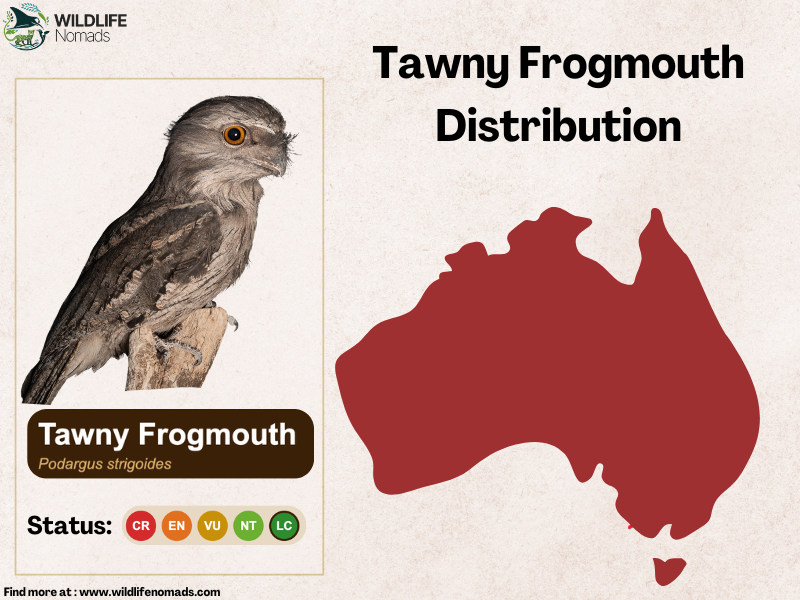
Tawny frogmouths occupy almost any habitat type across mainland Australia and Tasmania. Eucalyptus woodland, open forest, suburban parks, farmland with scattered trees, arid areas with enough tree cover, they adapt to all of it. The only places you will not find them are treeless deserts and dense tropical rainforest.
This adaptability makes the Australian tawny frogmouth one of the most widespread native birds on the continent. They occupy the same territory year after year, showing strong site fidelity. A pair that claims a patch of woodland will defend that same territory for their entire lives, which can span over 14 years.
Their presence in suburban areas surprises many Australians. These birds roost in backyard trees, on fence posts, and on any other elevated perch that offers decent camouflage. You may have tawny frogmouths living in your neighborhood without ever knowing it.
7. Breeding Season Reveals Their Softer Side
Tawny frogmouths are monogamous. Pairs bond for life and return to the same nest site each breeding season. In most of Australia, the breeding season runs from August through December, though timing shifts depending on rainfall and habitat type.
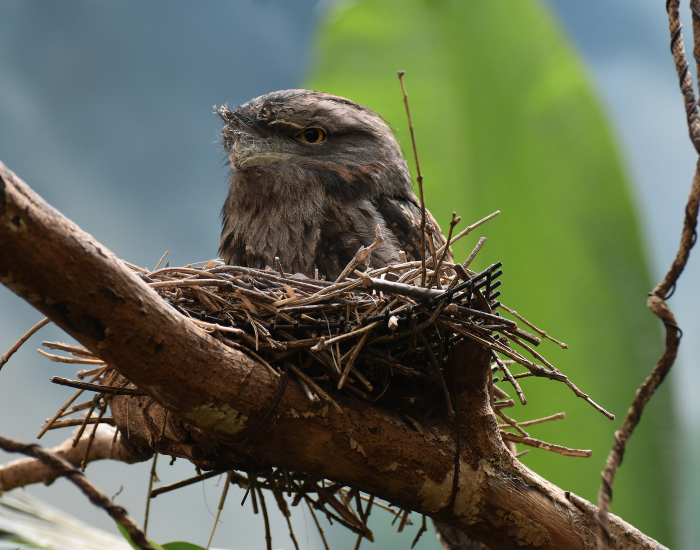
The nest itself is laughably flimsy, a loose platform of sticks wedged into a tree fork. It looks like it could collapse at any moment. The female lays one to three eggs, and then both sexes incubate. The male sits on the nest during the day, relying on his olive grey plumage to keep the eggs hidden from predators. The female takes turns incubating at night. The eggs are white and oval, surprisingly small for a bird frogmouth of this size. If eggs fall from the flimsy nest platform, the pair may attempt a second clutch.
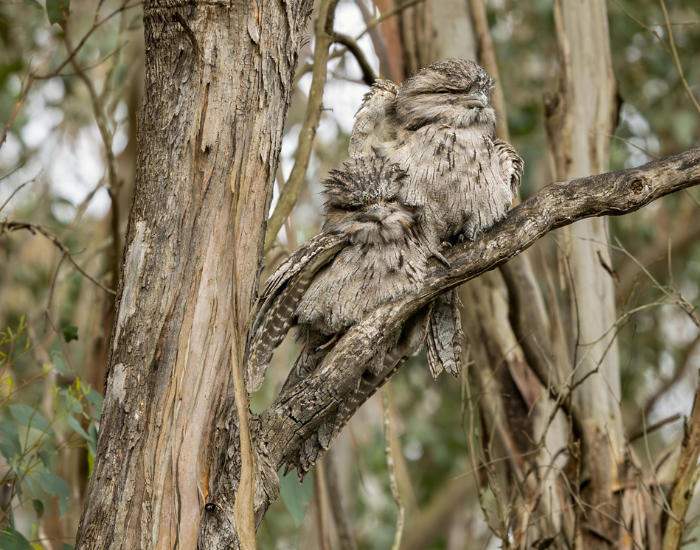
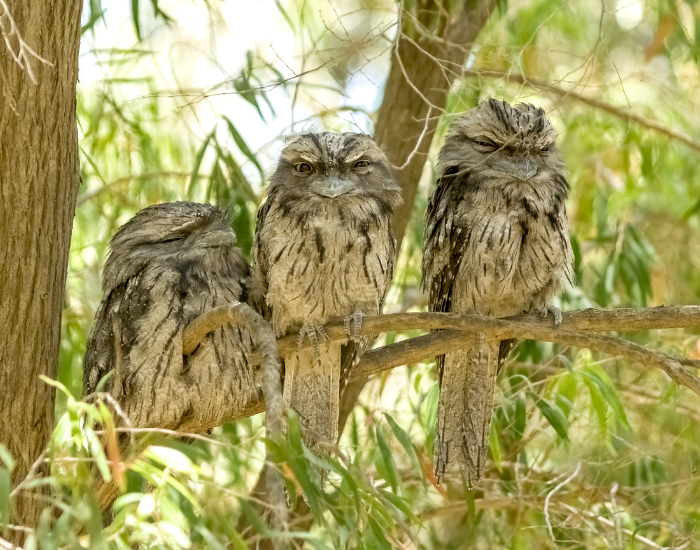
Both parents brood the chicks after hatching. Baby birds stay in the nest for about 25 to 35 days. Young birds remain dependent on their parents for several weeks after fledging, gradually learning to hunt on their own. During this period, the family group roosts together on the same tree branch — a sight that melts even the most hardened biologist.
8. Their Sounds Are Nothing Like an Owl’s Hoot
Forget hooting. Frogmouths are nocturnal birds with a completely different vocal repertoire. Their primary call is a deep, repetitive “oom-oom-oom” that pulses through the night like a low engine. It carries far but is so subtle that many people mistake it for distant machinery.
When tawny frogmouths feel threatened, they produce a loud hissing noise, a startling, aggressive sound that can scare off predators much larger than themselves. Breeding pairs also communicate with soft clacking sounds made by snapping their beaks together.
These vocalizations serve as territorial markers. Frogmouths are nocturnal, and in darkness, sound replaces visual displays. A male calling from his perch is essentially drawing a line around his territory that rival males can hear from hundreds of meters away.
9. Cars and Poison Are Their Biggest Killers
Here is where the story gets grim. The single greatest threat to tawny frogmouths in urban and suburban areas is being hit by cars. Because these birds spend their nights chasing insects illuminated by artificial lights near roads, they frequently swoop low across traffic. They also sit on warm asphalt at night. The result: tawny frogmouths are hit by cars at staggering rates. Wildlife rehabilitation centers across Australia report that vehicle strikes are the number one reason tawny frogmouths are admitted for care.
The second major killer is rodent poisons. When people use anticoagulant baits to control mice and rats, the poisoned rodents become easy prey. A tawny frogmouth that eats a poisoned mouse ingests the toxin too. This secondary poisoning — where the rodent poisons accumulate up the food chain — kills thousands of native birds each year. The tawny frogmouth is a frequent target animal in secondary poisoning studies.
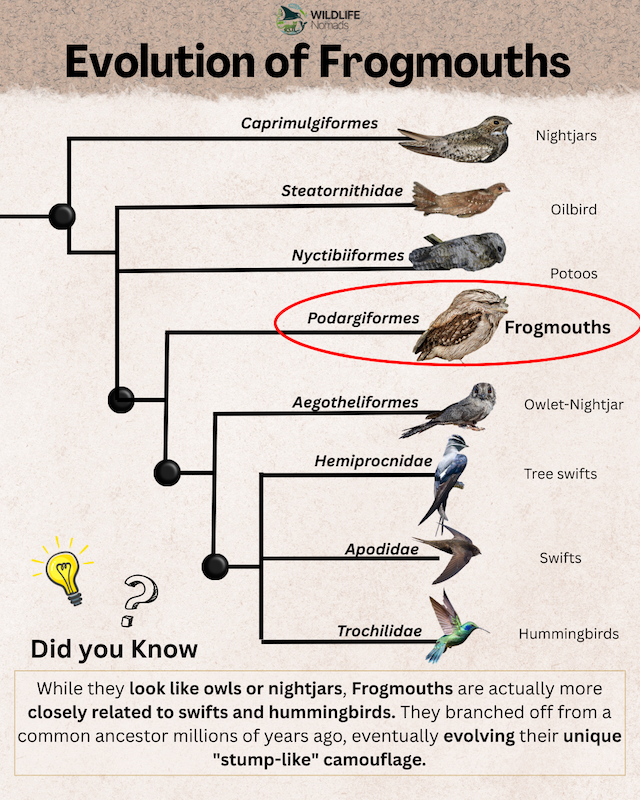
10. They Are Closely Related to Nightjars… and Distant Cousins of Potoos
Tawny frogmouths sit within the family Podargidae, which contains about 16 species worldwide. They are closely related to nightjars, owlet-nightjars, and other members of the Caprimulgiformes order. The Papuan frogmouth (Podargus papuensis), found in northern Australia and New Guinea, is among their closest relatives.
People often ask whether tawny frogmouths are closely related to potoos, those wide-eyed, meme-famous birds of Central and South America. The answer is yes, loosely. Potoos belong to the same broader order, making them distant cousins. Both families evolved similar hunting strategies and camouflage independently, a textbook example of convergent evolution.
The Papuan frogmouth is noticeably larger than the tawny bird, with a heavier beak and darker plumage. A third Australian species, the marbled frogmouth, inhabits tropical rainforest in Queensland. Together, these three species represent the entire frogmouth diversity on the continent.
11. Conservation Status: Good News, With Caveats
The tawny frogmouth’s conservation status is currently listed as Least Concern by the IUCN. Population numbers appear stable across most of Australia. Their ability to adapt to suburban areas and almost any habitat type has buffered them against the habitat loss that devastates more specialized species.
However, “Least Concern” does not mean “no concern.” Localized declines have been documented near major roads and in areas with heavy pesticide use. The compounding threats of being hit by cars, secondary poisoning from rodent poisons, and predation by cats and foxes, the most significant introduced predator in Australia, all take a toll.
Climate change adds another layer of risk. Longer droughts reduce prey availability in arid areas. More frequent intense bushfires destroy the mature trees these birds need for nesting and roosting. Unlike antarctic birds or migratory species that can shift ranges, tawny frogmouths are sedentary. They stay put, which means they absorb whatever their habitat throws at them.
12. Tawny Frogmouths Are Surprisingly Tolerant of Humans
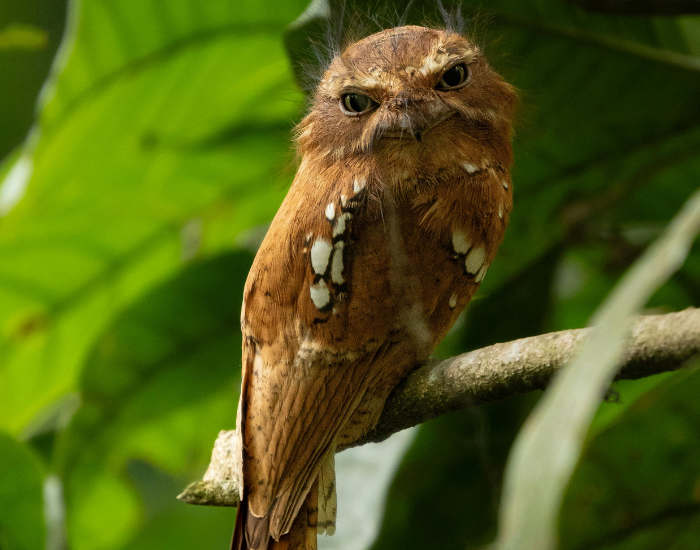
One of the most charming things about tawny frogmouths is how unfazed they seem by people. Because their survival strategy is camouflage rather than flight, they often roost in trees directly above footpaths, driveways, and picnic areas. They simply freeze and trust their disguise.
This tolerance has led some people to ask: are tawny frogmouths friendly? The short answer is that they are not aggressive and will tolerate close human presence. However, approaching roosting birds causes stress even if they do not fly away. Their stillness is a fear response, not comfort.
In my experience, the best way to observe tawny frogmouths is to find a known roosting tree and watch from a respectful distance. Once you learn to spot their outline against the tree bark, you start seeing them everywhere. That is the magic of these birds, they have been there all along, hiding in plain sight.
Frequently Asked Questions
No. Tawny frogmouths (Podargus strigoides) belong to the order Caprimulgiformes, making them more closely related to nightjars than to owls. They resemble owls due to their large eyes and nocturnal habit, but unlike owls, they have weak feet, lack curved talons for hunting, and catch prey with their beak instead of their claws.
Not exactly. Tawny frogmouths and nightjars are closely related — both belong to the order Caprimulgiformes. However, frogmouths sit in the family Podargidae, while nightjars belong to Caprimulgidae. Nightjars catch insects in flight using their wide beak, while tawny frogmouths are more sedentary hunters that pounce from a perch.
Absolutely. The tawny frogmouth is a real species found throughout mainland Australia and Tasmania. Their camouflage is so effective that many Australians live alongside them without ever noticing. With around 16 frogmouth species worldwide, these birds are well-documented by ornithologists.
A Bird Hiding in Plain Sight
Tawny frogmouths challenge everything most people assume about nocturnal birds. They are not owls, they do not hunt like owls, and they survive not through power but through patience and the art of disappearing. Every time I walk through Australian bushland, or even a suburban park, I check the trees differently now. That one encounter on a silent walk in Tasmania rewired my brain.
If you want to dive deeper into Australia’s incredible wildlife, explore our guide to types of birds or learn about some of the continent’s deadliest animals. And next time you are outside after dark, listen for that low “oom-oom-oom.” You might have a tawny frogmouth closer than you think.
References:
Adlard, R. D., & Calver, M. C. (2021). Secondary poisoning of owls and frogmouths by anticoagulant rodenticides in Australia: A growing concern. Wildlife Research, 48(7), 589–598. https://doi.org/10.1071/WR20188
Oddone Aquino, A. G. H. E., & Nkomo, S. L. (2021). Spatio-Temporal Patterns and Consequences of Road Kills: A Review. Animals : an open access journal from MDPI, 11(3), 799. https://doi.org/10.3390/ani11030799
Taylor-Brown, A., Booth, R., Gillett, A., Mealy, E., Ogbourne, S. M., Polkinghorne, A., & Conroy, G. C. (2019). The impact of human activities on Australian wildlife. PloS one, 14(1), e0206958. https://doi.org/10.1371/journal.pone.0206958
Winarni, N. L., Jones, D. N., & Sherley, G. H. (2020). Causes of admission of tawny frogmouths (Podargus strigoides) to wildlife rehabilitation centers in southeast Queensland. Journal of Wildlife Rehabilitation, 40(1), 7–14.