
The first time I knowingly spotted a Baltimore Oriole, I was hiking through pine-oak forest in Puebla, Mexico, with a birder friend. A flash of fire-orange cut across the canopy and froze us mid-conversation. You really cannot mistake this bird. Its color is so saturated against green foliage that the eye locks on instantly.
As a biologist, I have crossed paths with the Baltimore Oriole in hedgerows along the southern coast of Mexico, in suburban gardens, and in the high branches of old trees. Every winter, these orioles slip down from the eastern United States into Central America, where they join mixed flocks and brighten the dry season. I once filled a memory card with crisp photos of a male feeding on papaya, then promptly lost the card on a long bus ride. That hurt. But the bird itself stayed easy to find.
Let me walk you through 12 things I have learned about this striking yellow bird, facts that go beyond the field guide entry.
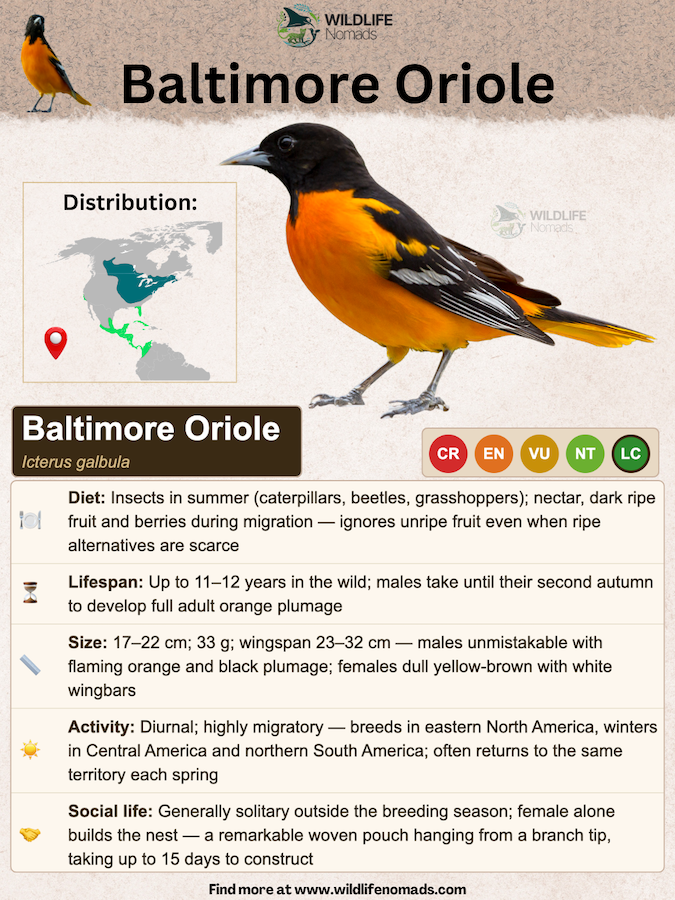
1. The Baltimore Oriole Was Named After a Coat of Arms
The Baltimore Oriole carries serious historical baggage. Early colonists thought the male’s plumage matched the heraldic crest of Lord Baltimore, the English nobleman who founded the Maryland colony. The orange and black of his family arms mirrored the bird’s bright orange and jet-black feathers almost perfectly. The name stuck.
That is also why the Baltimore Oriole is the official state bird of Maryland and inspired the name of the city’s baseball team. Few North American birds carry such a tangled cultural identity. Most species are named after the person who shot one first, but Baltimore Orioles earned their name through genuine visual admiration.

2. Its Scientific Name Hints at Its Glowing Color
The Baltimore Oriole scientific name is Icterus galbula. The genus Icterus comes from a Greek word meaning yellow bird, an old reference to the belief that looking at a yellow bird could cure jaundice. The species name galbula — sharing roots with the Latin aureolus — means “golden” or yellowish orange.
So the icterus bird is, quite literally, the golden yellow / orange bird of its family. Among the 33 world orioles, Icterus galbula is one of the most recognizable orioles in the Americas.
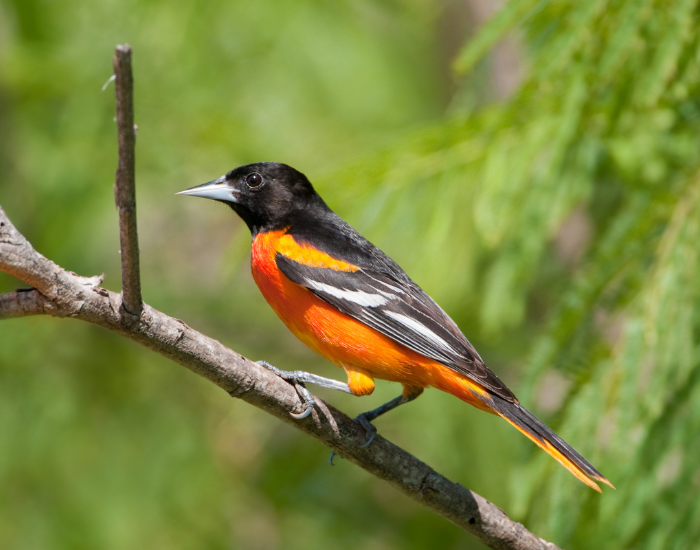
3. The Adult Male Looks Like a Tropical Postcard
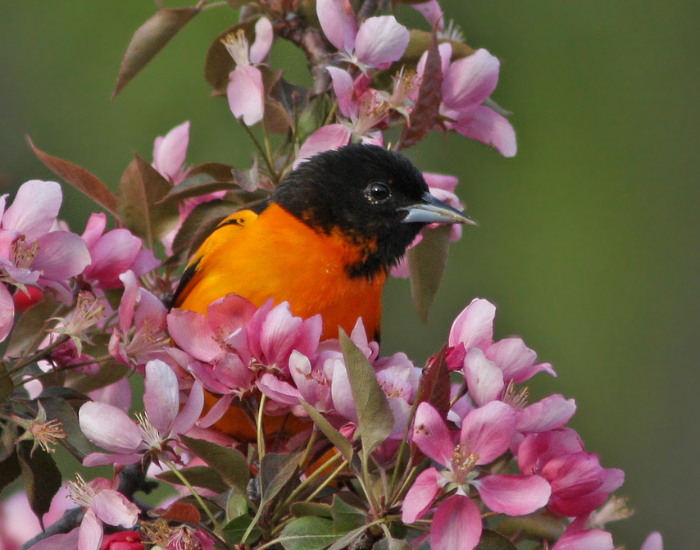
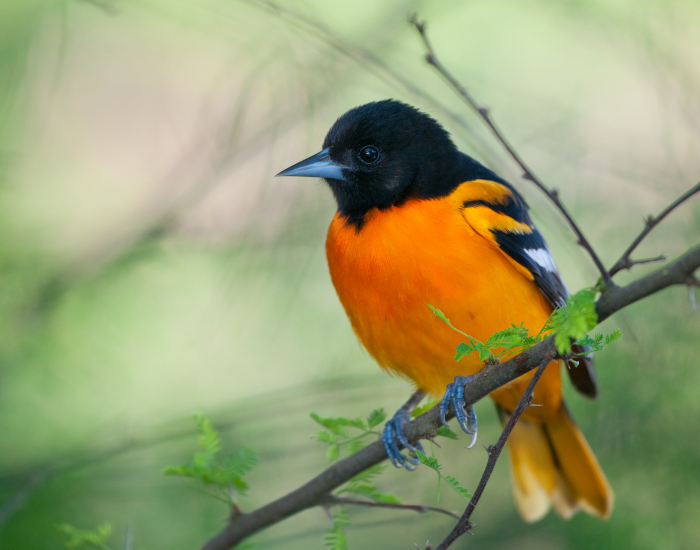
The adult male is impossible to confuse. His head, back, and tail are jet black, while his chest, belly, and rump burn bright orange. Crisp white wing bars cut across the wings like racing stripes. A closed bill ends in a sharp, dagger-like point, perfect for stabbing into ripe fruit or snatching insects from foliage.
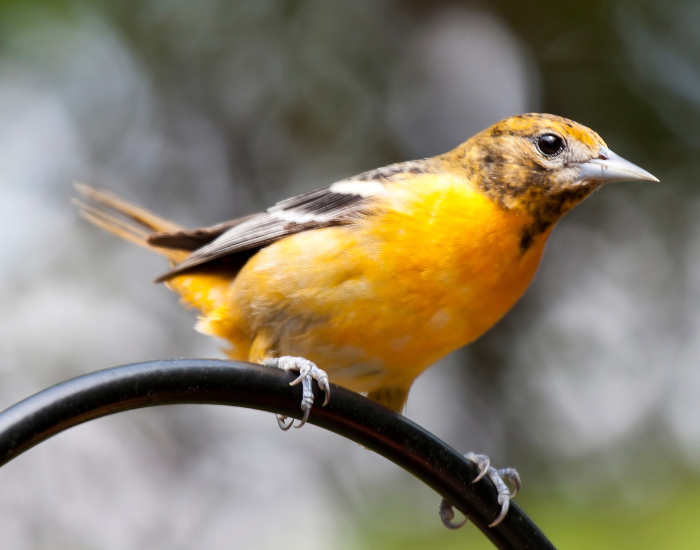
The female Baltimore Oriole is more muted but still beautiful. Females wear a yellowish orange chest, pale gray to brown wings, and softer tones overall. Young birds and young males resemble females during their first year, which trips up plenty of new birders. The adult male takes about two years to reach his deeper orange and full black hood, while young males often show a patchy mix.
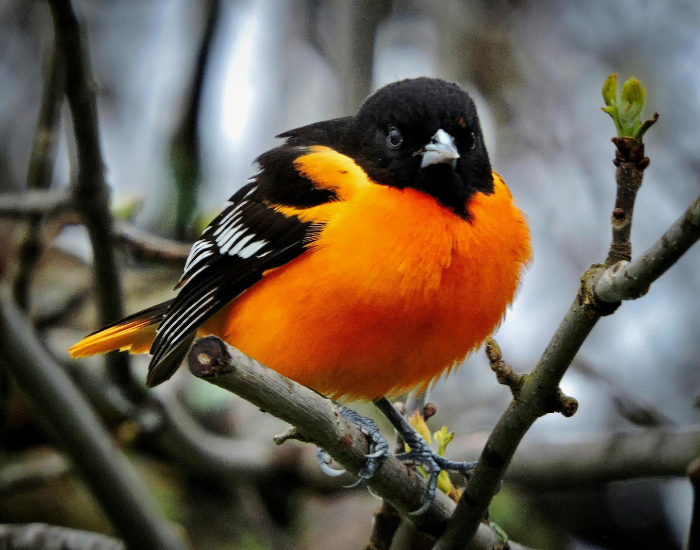
4. Color Intensity Varies With Diet
Here is something that fascinates me. Some adult male Baltimore Orioles glow with a deeper orange than others, and the difference comes from food. Birds that eat darkest mulberries, deepest purple grapes, and reddest cherries during molt produce more vivid plumage. The carotenoid pigments in these dark-colored fruits accumulate in feather tissue.
By contrast, orioles that lean on paler foods grow less saturated color. Studies tracking fruit eating birds have shown this pattern across multiple oriole populations. The male you see at your feeder is, in a real sense, wearing what he ate.
5. Baltimore Orioles Build Nests Like Master Weavers
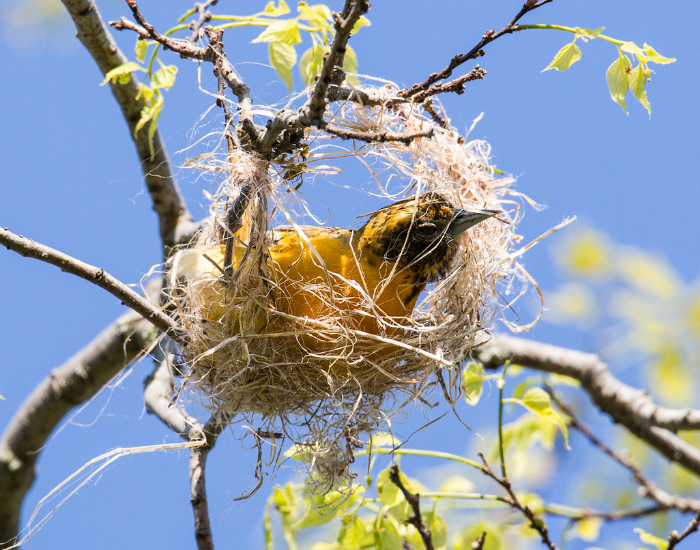
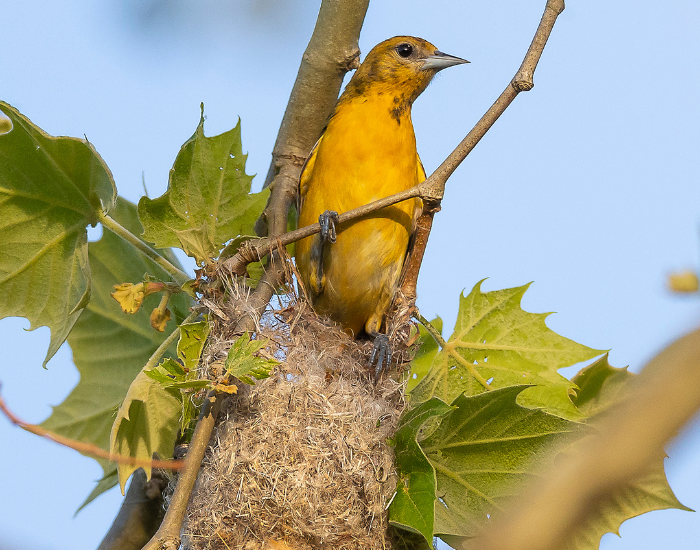
The Baltimore Oriole nest is a marvel of avian engineering. Females construct a hanging pouch suspended from the tip of a slender branch, often in American elms, cottonwoods, or maples. The structure is tightly woven from plant fibers, horsehair, grasses, and sometimes string pilfered from porches.
A typical nest takes about a week to weave and can survive winter storms intact. The nest site is usually 25 to 30 feet up, hidden among foliage at the forest edge or in mature suburban landscapes. I have watched a female stitch one of these pouches for hours, working her bill like a sewing needle. It is one of the most underrated construction jobs among North American birds.
6. Eggs Are Bluish White With Inky Scribbles
A female lays three to seven eggs per clutch, usually four or five. Each egg is bluish white, marked with dark spots and squiggly lines that almost look like ancient handwriting. She incubates the eggs alone for about two weeks while the male defends the territory and the surrounding trees.
The hatchlings are naked, pink, and helpless. Both parents feed them an exhausting parade of caterpillars, beetles, and other soft-bodied insects. You can read more about the prey they hunt in my guide to the types of beetles. Within two weeks of hatching, the young birds fledge and start trailing their parents through the trees, begging loudly.
7. Their Diet Shifts With the Seasons
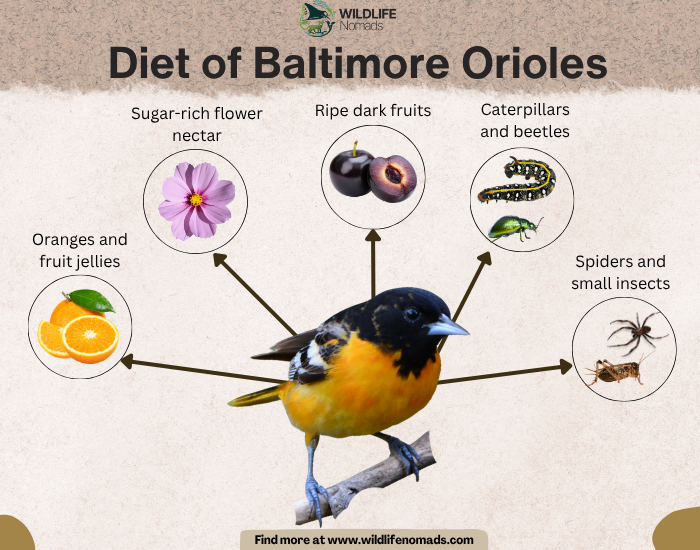
Baltimore Oriole birds eat a flexible menu. In spring and early summer, they hunt insects relentlessly — caterpillars are a favorite, and they will tear into webworm tents that other birds avoid. They also catch insects mid-flight when conditions allow.
In late summer and fall, orioles pivot hard toward fruit and nectar. They love soft fruits: ripe oranges, dark cherries, and figs (in tropical regions). Curiously, orioles seek the deepest colors and tend to ignore green grapes and unripe fruit entirely. They seem hardwired to prefer the boldest pigments.
8. Range: Eastern United States in Summer, Tropics in Winter
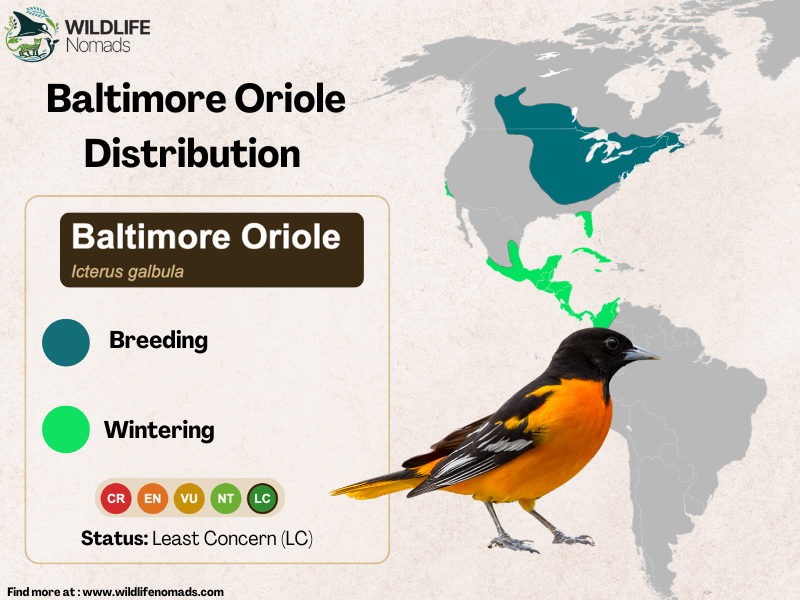
Baltimore Orioles breed across the eastern United States, from the Great Plains east to New England and north into southern Canada. In summer, they prefer open woodland, river corridors, parks, and suburban landscapes with mature shade trees. The Great Plains is roughly where their range bumps into that of their western cousin.
Come fall, these orioles migrate south to Central America, the Caribbean, and Mexico. This is when I see them most often. They winter from the southern coast of Mexico to northern South America, where they join mixed flocks with tropical species. Their migration timing roughly overlaps with that of the Rufous Hummingbird and the Ruby-throated Hummingbird, two long-distance migrants that share parts of the oriole’s tropical wintering range.
9. They Were Once Lumped With Bullock’s Oriole
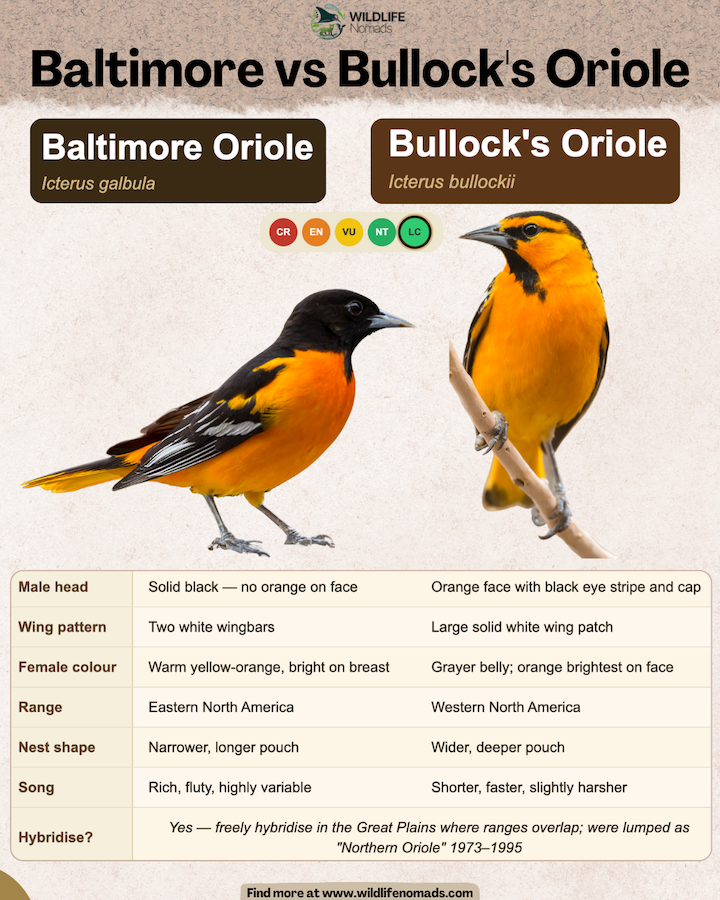
For a couple of decades, ornithologists treated the Baltimore Oriole and Bullock’s Oriole as a single species called the northern oriole. The two species interbreed where their ranges overlap on the Great Plains, which fueled the lumping.
DNA evidence and behavioral studies later split them back into two species. The difference between a western yellow Oriole and a Baltimore Oriole often comes down to which species you are looking at. Bullock’s males show a yellow-orange face with a black eye-line and large white wing patches, while male Baltimore Orioles wear a solid black hood. The split is now firmly accepted by the Cornell Lab of Ornithology.
10. Predators and Threats Are Real
Adult orioles face hawks, falcons, and other birds of prey in the air. Eggs and nestlings face a tougher gauntlet of predators — squirrels, snakes, raccoons, grackles, blackbirds, and even crows. You can read more about corvid behavior in my piece on types of crows. Where I have worked, magpies and ravens sometimes raid nests at the forest edge, and even wrens have been recorded puncturing eggs of other species.
Climate change presents a slower, harder problem. Warming springs throw off the timing between oriole arrival and caterpillar emergence. Habitat loss in tropical wintering grounds and the loss of mature American elms in suburban landscapes also push populations down. Long-term data from the Michigan Museum and the Cornell Lab show modest but steady declines in some regions.
11. How to Attract Baltimore Orioles to Your Yard
If you want to attract Baltimore Orioles, the recipe is simple. Set out halved oranges, grape jelly in a shallow dish, and sugar water in oriole-specific feeders with orange ports. Plant native trees that produce ripe fruit, and avoid heavy pesticide use so caterpillars can thrive.
Orioles seek bright color, so feeders painted orange work best. These orioles visit feeders most reliably in late spring, right after migration, when wild fruit is still scarce. I have watched a single oriole drain a jelly dish three times in one morning. Sugar water also helps during cold snaps, when insects and fruit are hard to find.
12. The Oldest Recorded Baltimore Oriole Lived Over a Decade
The Baltimore Oriole lifespan in the wild averages around five to seven years, but the oldest recorded Baltimore Oriole was banded and recaptured at over 11 years old. That is remarkable for a small songbird that migrates thousands of miles every year.
Captive individuals can live slightly longer, but most wild Baltimore Orioles die from predators, window strikes, or the brutal physical demands of migration. Each surviving adult is a small triumph of timing, navigation, and luck. Starlings competing for nest cavities in nearby trees do not affect orioles directly, these birds nest in hanging pouches rather than holes, but they share habitat in suburban landscapes.
Frequently Asked Questions
Baltimore Orioles are not rare at all, just often missed. They spend most of their time high in trees, foraging quietly among the foliage. They are slightly larger than a warbler and unmistakable when seen, but their preference for high branches keeps them off many backyard lists. Set up feeders with orange slices or grape jelly in May, and your chances jump dramatically.
These orioles breed across most of the eastern United States — from Maine and New England south to Georgia, west through the Midwest, and into the eastern Great Plains. Maryland, Pennsylvania, Ohio, Michigan, and New York all host strong breeding populations of Baltimore Orioles. In winter, most leave the country entirely for Mexico, Central America, and northern South America.
Orioles seek the darkest, ripest fruits because deeper colors usually signal higher sugar content and more carotenoid pigments. Their visual preferences co-evolved with the fruiting plants they help disperse. Yellow cherries and green grapes simply do not register as ripe to an oriole’s eye.

Finding the Fire in the Canopy
Watching a male Baltimore Oriole catch insects in the canopy or weave a hanging pouch from a thread of plant fiber reminds me how much detail hides in plain sight. These orioles are common across the eastern United States and obvious in color, yet most people walk past them without ever looking up.
Spend a spring morning under a row of mature trees, listen for the rich whistled song, and you will likely meet one. If you enjoyed this, take a look at my pieces on Rufous Hummingbirds and Ruby-throated Hummingbirds, two more long-distance migrants that share parts of the oriole’s tropical wintering range. Drop a comment if you have spotted a Baltimore Oriole in your own yard — I love hearing where readers find them.
References:
Bay, R. A., Harrigan, R. J., Underwood, V. L., Gibbs, H. L., Smith, T. B., & Ruegg, K. (2018). Genomic signals of selection predict climate-driven population declines in a migratory bird. Science, 359(6371), 83-86. https://doi.org/10.1126/science.aan4380
Rising, J. D., & Flood, N. J. (2020). Baltimore Oriole (Icterus galbula), version 1.0. In Birds of the World (P. G. Rodewald, Editor). Cornell Lab of Ornithology, Ithaca, NY. https://doi.org/10.2173/bow.balori.01
Rosenberg, K. V., Dokter, A. M., Blancher, P. J., Sauer, J. R., Smith, A. C., Smith, P. A., Stanton, J. C., Panjabi, A., Helft, L., Parr, M., & Marra, P. P. (2019). Decline of the North American avifauna. Science, 366(6461), 120-124. https://doi.org/10.1126/science.aaw1313
Suh, Y. H., Ligon, R. A., & Rohwer, V. G. (2022). Revisiting the Baltimore-Bullock’s Oriole hybrid zone reveals changing plumage colour in Bullock’s Orioles. Royal Society open science, 9(12), 221211. https://doi.org/10.1098/rsos.221211
Wilson, S., LaDeau, S. L., Tøttrup, A. P., & Marra, P. P. (2011). Range-wide effects of breeding- and nonbreeding-season climate on the abundance of a Neotropical migrant songbird. Ecology, 92(9), 1789-1798. https://doi.org/10.1890/10-1757.1