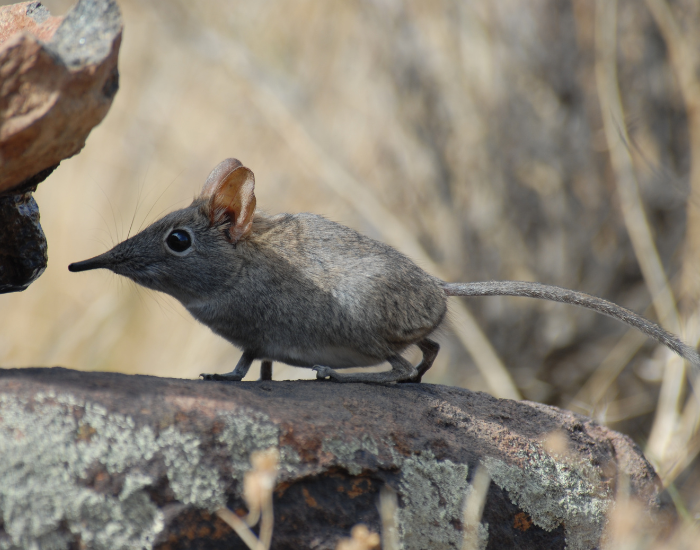
Have you ever come across an animal whose name makes you do a double-take? The elephant shrew is exactly that kind of creature. This tiny mammal with a long, flexible snout, which closely resembles an elephant’s trunk, has fascinated wildlife enthusiasts and scientists alike for decades.
Despite what the name suggests, elephant shrews aren’t true shrews at all. They’re not miniature elephants either. However, that peculiar trunk-like nose gives us a clue about something far more interesting. These small creatures hold one of the most remarkable secrets in the mammalian world.
The elephant shrew, also called a sengi, represents a fascinating paradox in nature. It’s small enough to fit in your palm, yet it shares an ancient evolutionary lineage with some of the planet’s largest animals. That distinctive flexible snout isn’t just for show. It’s a highly specialized tool used with incredible dexterity to probe the forest floor and leaf litter for food.
Let’s dive into the world of these cute creatures. Stay to uncover 12 mind-blowing facts about this elusive member of the mammalian order Macroscelidea.
1. The Evolutionary Revelation – Closely Related to Elephants
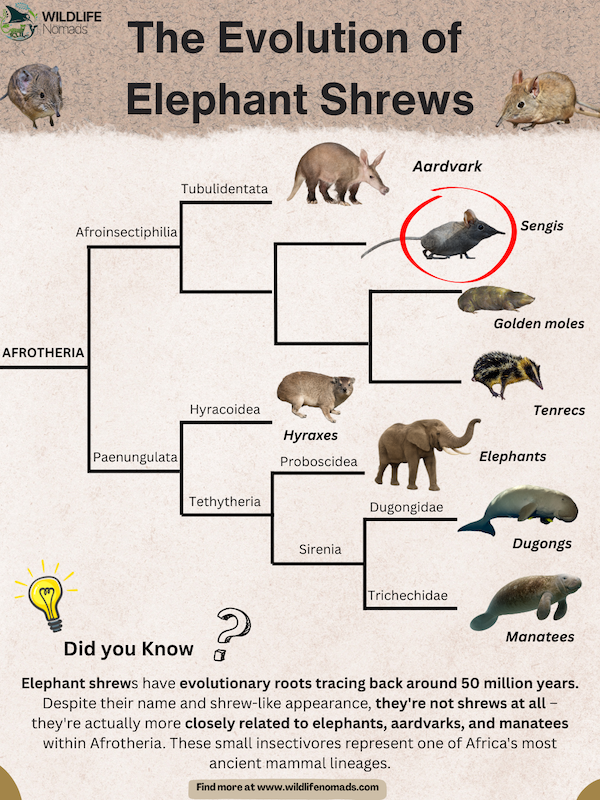
This is the question that hooked me years ago when I saw it on a class: Are elephant shrews actually related to elephants? Well, the answer is an unequivocal and astonishing yes.
Forget the simple shrews you might find in your garden. The elephant shrew belongs to the superorder Afrotheria. This major group of mammals originated in Africa. Therefore, it includes some of the world’s most recognizable giants.
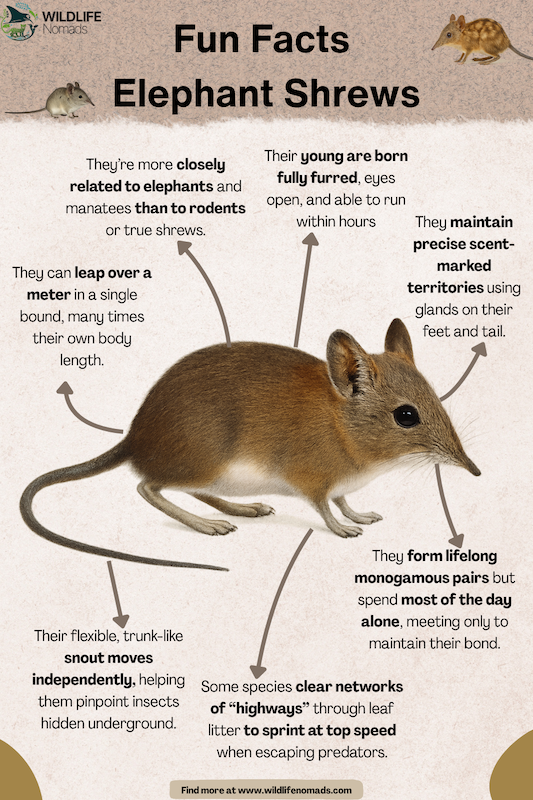
Elephants, manatees, Dugongs, hyraxes, and aardvarks all share this lineage. That little jumper scurrying through leaf litter is a distant cousin to the largest land animal on Earth. In fact, elephants and elephant shrews share more genetic similarities than many scientists initially suspected.
Their family, Macroscelididae, represents one of the earliest branches of this ancient group. This discovery came through genetic sequencing. It completely rearranged the mammalian family tree. The research proved that physical size means nothing in the face of shared DNA.
Elephants diverged from their smaller relatives millions of years ago. Nevertheless, both groups retain distinctive features from their common ancestor. The trunk-like snout is one such remarkable parallel.
2. Not a Shrew, and Not a Rat: Understanding the Name
Is an elephant shrew a rat? How are elephant shrews different from true shrews? These are common questions that deserve clear answers.
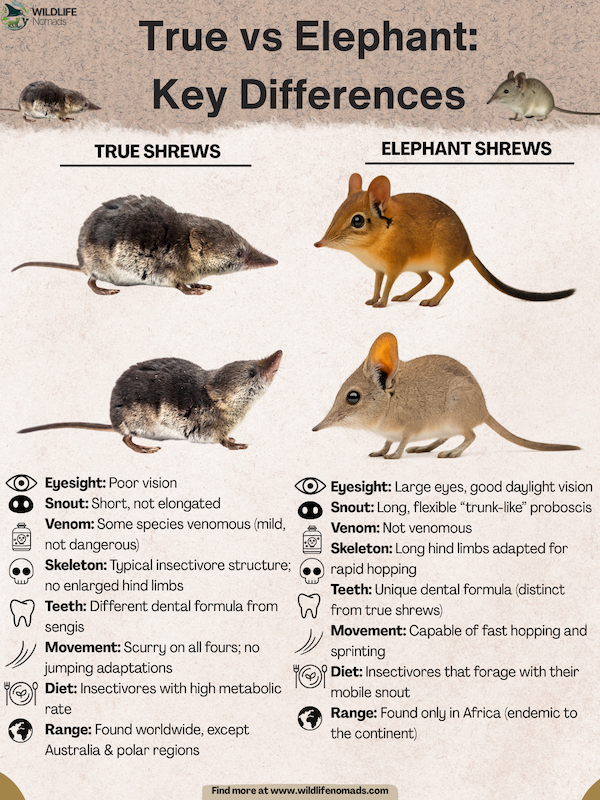
Let’s be clear: the elephant shrew is neither a rat nor a true shrew. True shrews belong to the order Soricomorpha. Elephant shrews exist in their own distinct order, Macroscelidea. This is why many scientists prefer to call them sengis (pronounced SEN-gees).
The term derives from an African language. It helps avoid confusion with other small mammals.
True Shrews characteristics:
- Insectivores with poor eyesight
- No elongated snout
- Often venomous (though not dangerous to humans)
- Different skeletal structure
Elephant Shrews (Sengis) characteristics:
- Better eyesight than true shrews
- Highly developed hind legs for jumping
- Iconic flexible snout resembling elephant’s trunk
- Not venomous
- Unique dental formula
Within the elephant shrew family, soft furred elephant shrews are a distinct group known for their smaller size and softer, finer fur compared to other types.
The use of “shrew” in the common name is an unfortunate historical misnomer. The confusion likely arose from their small size and insectivorous diet. However, genetic studies have confirmed they are completely separate species with distinct evolutionary histories.
3. The Incredible Snout – Why They’re Called Elephant Shrews
The most distinguishing feature is their proboscis-like nose. This elephant’s trunk resemblance is key to their foraging success.
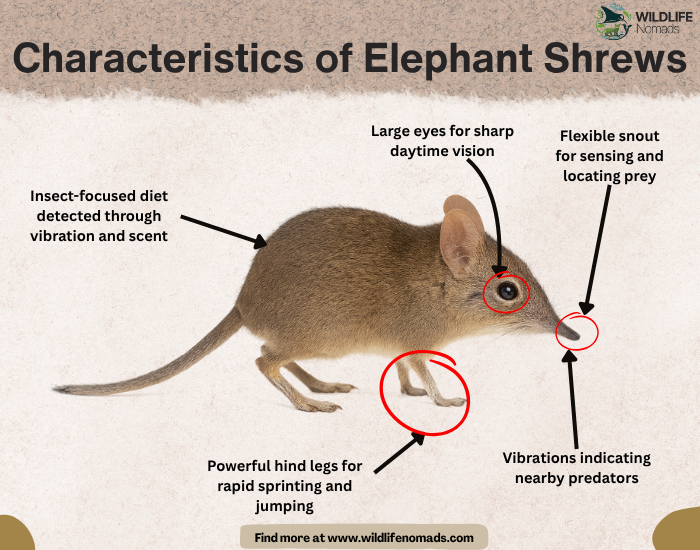
Why are they called elephant shrews? The answer is kind of obvious, it lies in this long, highly flexible snout that twitches constantly. They use it like a biological metal detector to probe the forest floor. It searches through leaf litter for small insects and other invertebrates.
The flexible snout contains thousands of sensory receptors. These allow the animal to detect minute vibrations and chemical signals. Once they locate food, their snout flicks out of the way. Then a long, slender tongue snatches up the meal with lightning speed.
This adaptation is central to their survival. It’s a prime example of evolutionary refinement over millions of years. The snout’s flexibility rivals that of an elephant’s trunk, albeit on a much smaller scale.
Different species have varying snout lengths. Larger species like the giant elephant shrew have proportionally longer snouts. This allows them to probe deeper into soil and rotting wood.
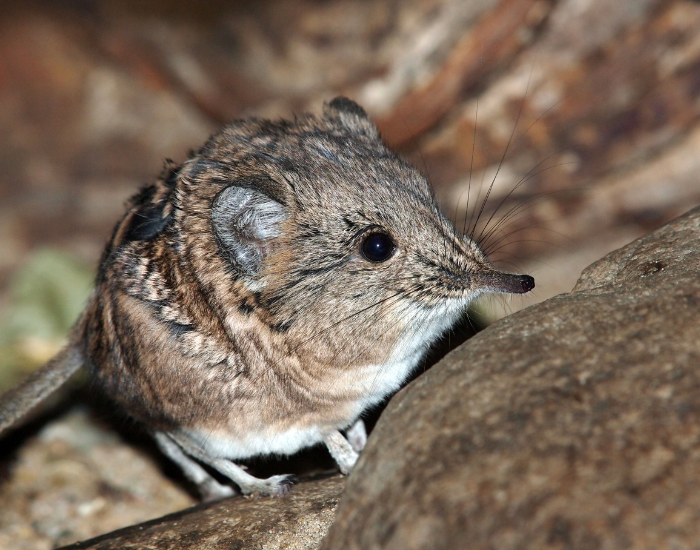
4. Built for Speed – The Jumping Champions
Can shrews jump high? Elephant shrews certainly can! Their long legs and exceptionally powerful hind legs are adapted for specialized locomotion. Scientists call this saltatorial locomotion, essentially jumping and bounding.
When startled, they can leap several times their body length. This helps them escape predators instantly. The strategy works remarkably well. Combined with unpredictable, zigzag running patterns, they become incredibly difficult targets.
Predators such as snakes, birds of prey, and larger mammals struggle to catch them. The long hind legs provide explosive power for quick getaways.
It’s an actionable strategy in the wild: When in doubt, outrun it! This speed serves another purpose too. Many species clear network trails through undergrowth. These paths allow them to reach maximum velocity when fleeing danger.
5. Diet Secrets – What Elephant Shrews Eat
What does an elephant shrew eat? What is their favorite food? Understanding their diet reveals their ecological importance.
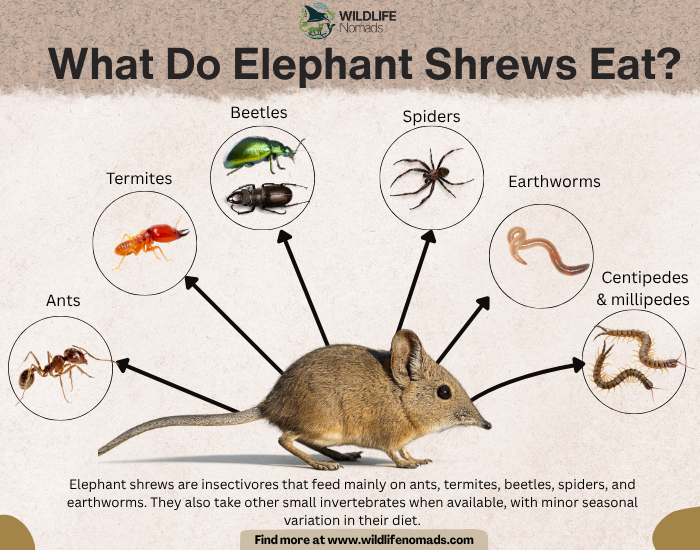
The elephant shrew is primarily an insectivore. Their diet is dominated by invertebrates. This includes ants, termites, beetles, spiders, and earthworms. Their focus on eating insects means they play a vital role in controlling insect populations within their habitats.
Sometimes they supplement their diet with seeds, fruits, and other plant matter. However, their existence revolves around hunting for arthropods. They spend most active hours constantly foraging. This is necessary given their high metabolic rate.
I once spent an hour observing a round-eared elephant shrew meticulously excavating a termite mound. Its snout twitched furiously. It located individual insects with surgical precision. The display perfectly showcased their unique hunting method.
Small insects make up the bulk of their daily intake. A single elephant shrew may consume hundreds of small insects each day. This voracious appetite helps control pest populations in their native ecosystems.
6. Home Sweet Home – Diverse Habitats Across Africa
The 19 living species of elephant shrew are found exclusively in Africa. They occupy a remarkable range of ecosystems across the continent.
Where does the elephant shrew live? The answer varies dramatically by species:
Dry forests and lowland forests support several species. These areas provide ample leaf litter and invertebrate prey. The humid conditions encourage insect populations that sustain these mammals.
Stone deserts and semi-arid scrublands are home to the round-eared elephant shrew. These harsh environments seem unlikely habitats. However, certain species have adapted remarkably well to arid conditions.
Savannas and grasslands across East Africa host multiple species. The open country provides different challenges and opportunities. Here, speed becomes even more critical for survival.
Montane forests shelter species like the giant elephant shrew. These high-altitude environments offer cooler temperatures and unique prey species.
This adaptability is remarkable. While one species might be perfectly camouflaged in brown fur among dry grass, another flaunts bright, distinctive coloration in coastal forests. Some of the softer, smaller species have tan or brown fur, which helps them blend into their environment and avoid predators.
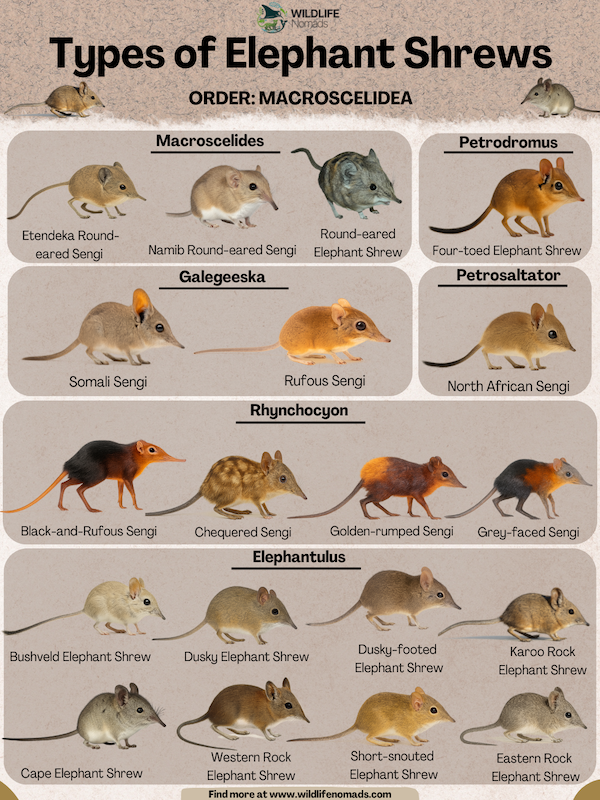
7. The Giant Among Sengis
While the name “giant” might sound impressive, it’s relative to other elephant shrews. How big do elephant shrews get? The answer depends on the species.
The largest species is the giant elephant shrew (genus Rhynchocyon). These are the heavyweights of family Macroscelididae. They can weigh up to 1.5 pounds and reach body lengths of up to 12 inches. Add a tail of similar length, and they’re impressively sized for “shrews.”
Size comparison:
- Largest species: Giant elephant shrew reaches 1.5 pounds
- Smaller species: Typically weigh less than 2 ounces
- Body length variation: From under 4 inches to 12 inches
This size variation is significant. It allows different species to occupy different ecological niches in the African wildlife ecosystem. Larger species can tackle bigger prey and defend larger territories. Meanwhile, smaller species can hide more effectively from predators.
The giant elephant species are among the most visually striking. They often display colorful fur patterns that help with species recognition.
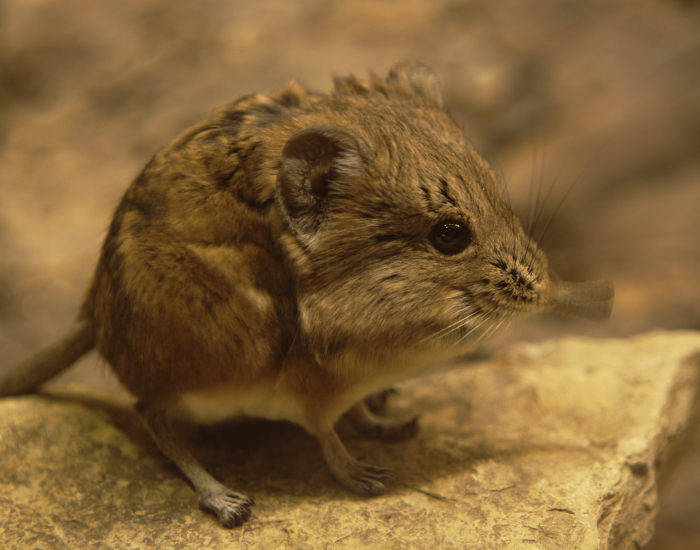
8. Endangered Beauties – Conservation Concerns
Many of the largest species face significant threats. Some of the most striking sengis are in serious trouble.
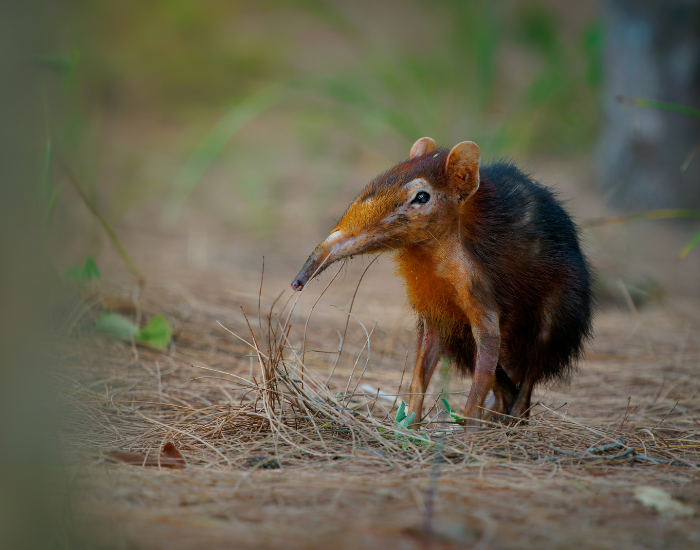
The Golden-Rumped Elephant Shrew (Rhynchocyon chrysopygus) is easily recognizable. It sports a patch of dense, golden-yellow fur on its rump. Unfortunately, it’s classified as Endangered by conservation authorities.
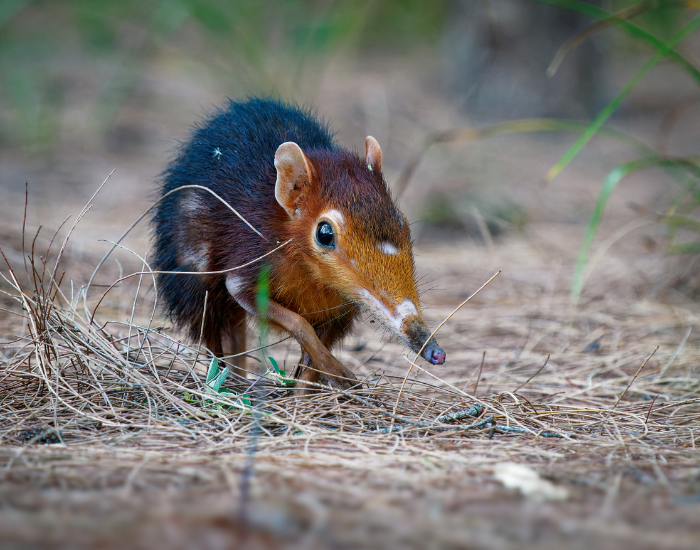
Another notable species is the black-and-rufous elephant shrew, which stands out for its striking black and reddish-brown coloration. Like the golden-rumped, the black-and-rufous elephant shrew also faces conservation concerns due to habitat loss and fragmentation.
Its population is experiencing population decline due to aggressive habitat loss. Habitat fragmentation has isolated remaining groups. This is predominantly caused by increasing human activity in coastal forests of Kenya.
Agriculture, logging, and infrastructure development continue to threaten their forest home. As lowland forests disappear, so do the elephant shrews that depend on them.
The African Wildlife Foundation and local conservation groups play critical roles. They work to protect the last remaining forest strongholds. These efforts are essential for preserving these remarkable creatures.
Other threatened species include certain isolated populations across Central Africa. Climate change adds another layer of threat to these sensitive mammals.
9. Monogamy and Territory – A Life of Structured Solitude
Most elephant shrews live solitary lives. They are primarily active during daylight hours (diurnal). However, their social structure is more complex than simple solitude suggests.
A fascinating aspect of their behavior is that most species form monogamous pairs. They share a defined home range and often a nest site. Yet they spend very little time together. Each individual is responsible for its own foraging. They meet only occasionally to reinforce their bond or for mating.
They clearly mark their territory using scent markings. Black-and-rufous elephant shrews use scent marking as a key method to establish territory and attract mates. Glands on their feet or tail deposit chemical signals. They will actively defend their boundaries against intruders of the same sex.
This balance of cohabitation and independence is quite unusual among small mammals. The system seems to work well for these species. It provides reproductive security while maintaining foraging efficiency.
Territory size varies by species and habitat quality. In resource-rich environments, territories may be smaller. In harsh stone deserts, individual ranges expand considerably.
10. Born Ready – The Precocial Young Advantage
The reproductive strategy of elephant shrews reflects their unique evolutionary path. It differs markedly from many other small mammals.
They typically give birth to one or two precocial young per litter. “Precocial” means they are born relatively mature. They emerge fully furred, with eyes open, and able to run within hours of birth.
Reproductive characteristics:
- Young elephant shrews reach sexual maturity within weeks to months after birth
- Gestation: Varies by species but typically 6-8 weeks
- Parental care: Minimal after initial nursing period
The mother nurses the young for a short period. Then she leaves them to fend for themselves. This rapid development is likely an adaptation to high-predation environments.
Some elephant shrew species exhibit menstrual cycles similar to those of human females, highlighting a unique aspect of their reproductive biology.
It maximizes the chance of survival in dangerous habitats. Young that can flee predators immediately have better survival odds than helpless infants.
This strategy contrasts with many rodents that produce altricial young. Those babies are born hairless, blind, and completely dependent.

11. Human Activity – The Greatest Threat
As I mentioned before, the biggest threat to elephant shrews isn’t a snake or large bird. It’s human beings and our expanding footprint.
The pressures facing certain species are immense:
Habitat loss tops the list of threats. Clearing lowland forests and tropical forests for farming destroys their homes. As forests vanish, so do the insects they depend on.
Habitat fragmentation creates isolated pockets of suitable environment. This prevents gene flow between populations. Small, isolated groups are vulnerable to local extinction from disease or environmental changes.
Human activity in general increases disturbance. Roads fragment territories. Domestic animals introduce new predators and diseases. Climate change alters rainfall patterns that affect insect populations.
The challenge we face is significant. These animals are small and often unnoticed. They’re difficult to study in the wild. We must champion conservation of entire ecosystems. Only this approach ensures creatures like the rufous elephant shrew and short-eared elephant shrews don’t disappear before we fully understand them.
12: Sensory Superpowers – Navigation and Survival
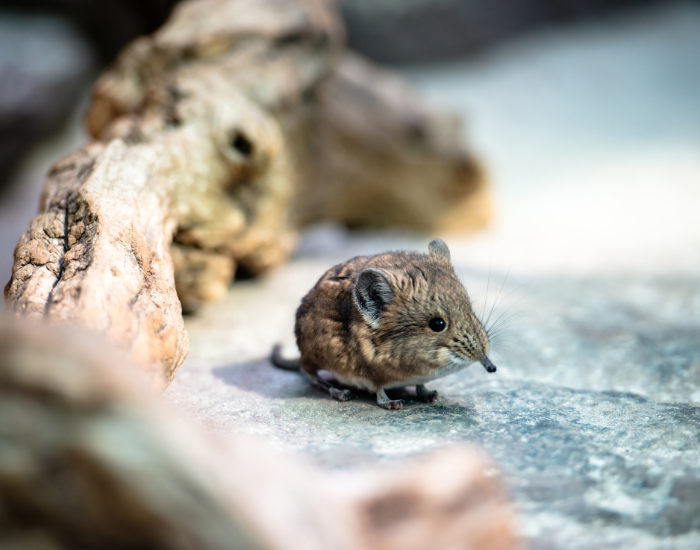
The flexible snout serves multiple purposes beyond food detection. It’s a sensory powerhouse used for navigation and detecting danger.
In some species, elephant shrews clear networks of paths through undergrowth. They often sweep away leaf litter with their feet. These clear trails allow them to run at top speed when escaping predators.
When moving along these routes, their long noses constantly twitch. They taste the air and ground simultaneously. It’s a biological GPS that allows them to move with total confidence through complex terrain.
The snout can detect:
- Chemical signals from other elephant shrews
- Vibrations indicating nearby predators
- Temperature gradients leading to prey
- Air currents that help with navigation
This sophisticated sensory system evolved over millions of years ago. It represents one of the most refined adaptations in small mammals.
Different species rely on their snouts to varying degrees. Those in dense forests depend heavily on olfactory cues. Species in open country use visual cues more but still rely on their sensitive noses.
Research and Conservation Efforts – Science and Hope for the Future
The survival of endangered species like the golden-rumped elephant shrew depends on dedicated conservation efforts. Organizations such as the African Wildlife Foundation lead initiatives to protect these small mammals and their habitats.
Most species inhabit environments rich in leaf litter where they can hunt insects. However, expanding agriculture and logging continue to threaten their existence. Female elephant shrews ensure species survival, with some researchers discovering they can store food in cheek pouches to nourish their young.
Studies confirm their ancient lineage and connection to elephants. Their specialized long noses help them survive as insectivores across diverse African landscapes.
Conservation initiatives focus on habitat preservation and education. Supporting these efforts helps secure a future for genus Elephantulus and all remarkable elephant shrew species that enrich our planet’s biodiversity.
FAQ Section: Your Questions Answered
Yes. They belong to the superorder Afrotheria. This group includes elephants, manatees, and aardvarks. They share an ancient evolutionary past dating back millions of years.
Their long noses (proboscis), incredible speed, and powerful hind legs make them distinctive. They’re also known for their unique evolutionary relationship to much larger mammals like elephants.
Currently, 19 species are recognized across Africa. They belong to family Macroscelididae and are divided among several genera.
No. They are not rodents or true shrews. They belong to their own unique mammalian order called Macroscelidea. This makes them a distinct group entirely.
No. Unlike some true shrews, elephant shrews are not venomous. They pose no threat to humans.
No. They are wild animals with complex needs. They have extremely fast metabolisms and shy temperaments. They are not suited for captivity as pets and should be protected in the wild.
A Story Worth Telling
As I reflect on my field time observing these creatures, I realize their story carries profound meaning. The elephant shrew reminds us of the incredible depth of Earth’s animal diversity web.
The discovery that these tiny mammalian species are closely related to elephants is remarkable. They also share ancestry with sea cows and other large mammals. Animals so different in every visible way share deep genetic connections. This is a triumph of science and a humbling lesson.
Every time we discuss habitat protection, we’re saving more than rhinos and lions. We’re saving elephant shrews, four-toed elephant shrews, and short-eared elephant shrews. We’re preserving small pieces of the puzzle that tell the grand story of life on Earth.
It’s up to us to ensure these fascinating creatures continue their ancient existence. They deserve to thrive in the African sun, twitching their elephant-like snouts, leaping through undergrowth, and playing their vital role in the ecosystem.
Further Reading:
- The Truth About Hippopotamuses
- Everything You Didn’t Know About the Binturong
- The Cost Of Ivory: The Deadly Price Behind A Beautiful Lie