Step into the most biodiverse ecosystems on Earth and the first thing that hits you is sound. Calls layered over calls, most of them from birds you will never see. Tropical rainforests hold more bird species than any other habitat, and the tropical birds that live there did not get stunning plumage by accident.
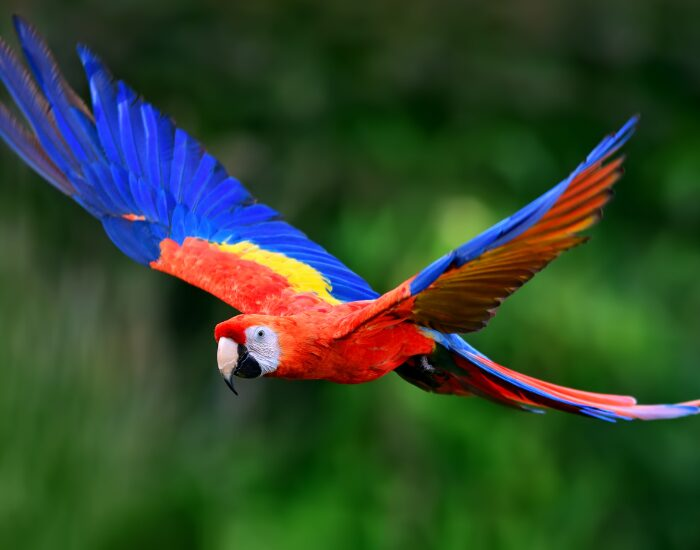
Growing up in Mexico I was surrounded by birds without thinking about it: parakeets chattering in city parks, something bright crossing a road in the countryside. That changed in the jungles of Chiapas. The first scarlet macaw I saw flying free went over the canopy like a thrown ember, red against green, and I stood there longer than I needed to. Years later in Sumatra I watched a hornbill glide between trees with a silhouette that looked borrowed from another era. My first hornbill at close range came earlier, in Langkawi, Malaysia, in April 2024: an Oriental pied sitting on a beach sign on my third day there, at eye level, entirely unbothered.
Here are 13 stunning birds that define rainforests across three continents, from Central and South America to the Congo Basin and the islands of Southeast Asia.
From the harpy eagle in the emergent layer to the cassowary on the forest floor, you can see where each bird lives in my climb through the layers of the rainforest.

1. Scarlet Macaw (Psittacus macao)
No bird carries the Amazon’s reputation quite like the scarlet macaw. Striking plumage in red, yellow and blue, a wingspan near 33 inches, and loud calls that arrive before the bird does. These are among the largest parrots in the world at up to 2.2 pounds.
The plumage is not the interesting part. Scarlet macaws pair for life, travel in pairs or small family groups, and spend years teaching young birds where the food is. They regularly reach 30 to 40 years, and the 80-year figure you see repeated belongs to exceptional captive birds rather than the wild.
They work the tall canopy near rivers and clearings across Brazil, Peru, Colombia and Ecuador, in tropical South America, eating fruits, nuts and seeds, and gathering at riverbank clay licks for minerals. Deforestation and the pet trade have pushed several macaw species toward endangered status. More in my guide to the types of macaws and the wider article on types of parrots.
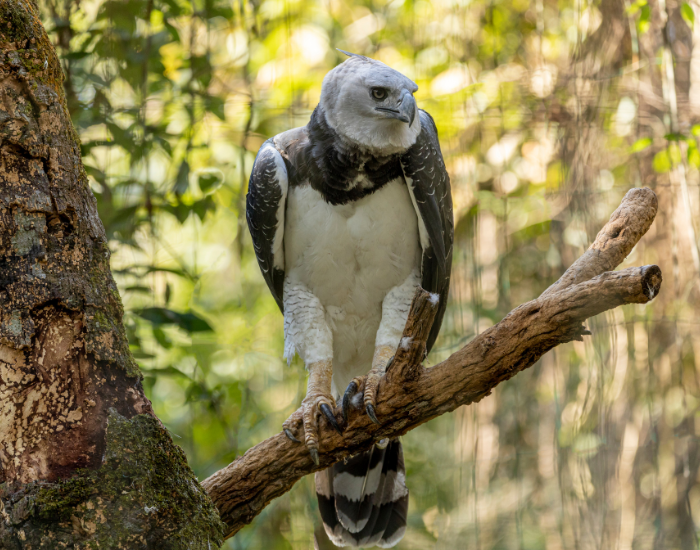
2. Harpy Eagle (Harpia harpyja) – The Amazon’s Apex Predator
Over a metre tall, a two-metre wingspan, legs like forearms, and a blackish-grey double crest. Harpies erect crests when alert or interested, which is the moment every photographer waits for. Females reach 20 pounds, and the talons are larger than a grizzly bear’s claws.
Broad wings let harpies manoeuvre inside the canopy rather than above it, which is how an eagle this size takes sloths and monkeys out of trees. The IUCN moved them from Near Threatened to Vulnerable in 2021, and research by Miranda and colleagues explains why: harpy eagles need at least 50% forest cover to raise a chick to independence, landscapes cleared beyond 70% held no nests at all, and across the Amazon’s Arc of Deforestation roughly a third of the region can no longer support breeding pairs. Eaglets in the worst areas starved.
Many Indigenous communities treat a harpy sighting as good fortune. They are also a straightforward indicator species: if harpy eagles are breeding, the forest around them is still intact.
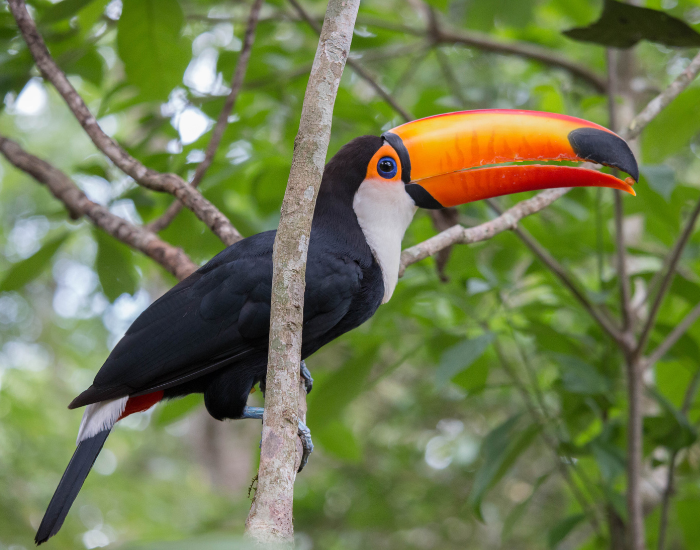
3. Toco Toucan (Ramphastos toco) – The Rainforest’s Most Recognizable Bill
The bill runs up to a third of the bird’s total length and weighs almost nothing: a honeycomb of bone struts wrapped in keratin, strong enough for hard fruit and light enough to carry on a thin branch. That is the point. Toucans reach fruit on branches that will not hold their weight.
It also works as a radiator, dumping heat through the bill’s blood supply the way other animals pant, and beak size and colour feed into mating displays on top of that.
Toucan species matter ecologically because they swallow fruit whole and move the seed, which makes them among the most important fruit eating birds in the Neotropics. Populations across the Amazon Basin are generally stable, though habitat loss is the long-term concern.
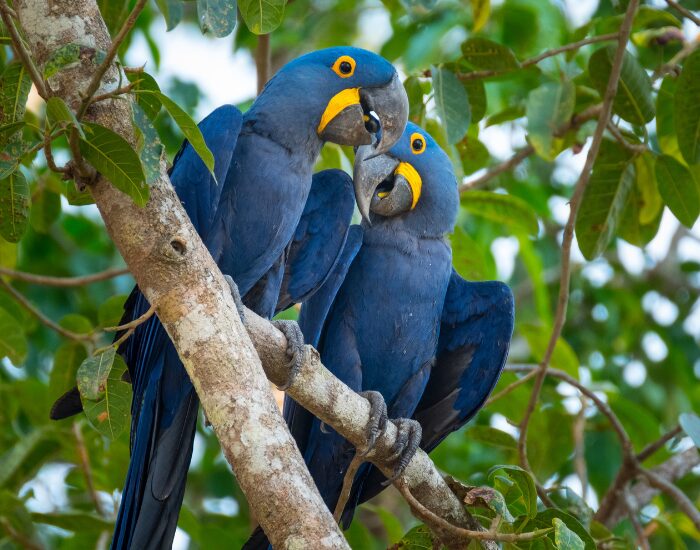
4. Hyacinth Macaw (Anodorhynchus hyacinthinus) – The Gentle Giant
The largest parrot in the world at up to 40 inches, cobalt blue, with bare yellow skin around the eye and jaw. For a bird that size they are remarkably easy-going.
The specialisation is the catch. Hyacinths live mainly on palm nuts, and even among parrots with powerful beaks theirs is exceptional, splitting shells that defeat every other bird. That ties them to specific palms and the plant life around them. Around 4,300 remain in the wild. Habitat loss, the illegal pet trade and limited food supply are the pressures, and conservation efforts around nest boxes and palm protection have lifted bird populations well above the lows of the 1980s. It is one of the better conservation stories among endangered birds.
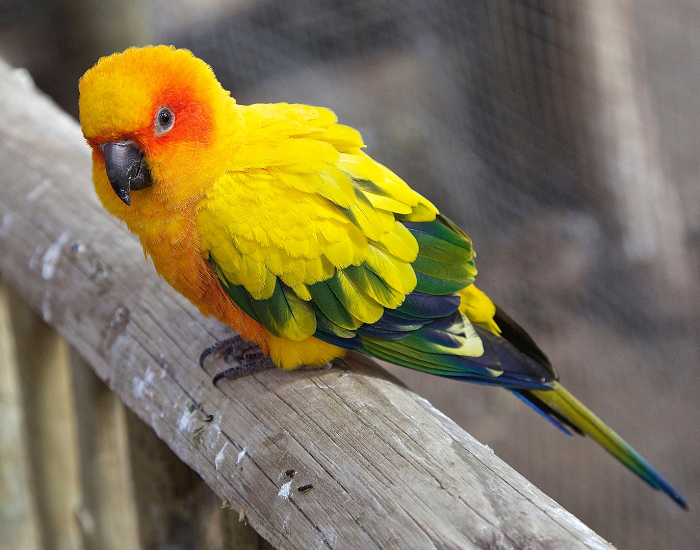
5. Sun Parakeet (Aratinga solstitialis) – The Golden Jewel of the Canopy
Appropriately named. Almost no green, almost no deep red, just brilliant gold with an orange flush across the head and face.
Sun parakeets are canopy specialists. They form large flocks of 20 to 50 and nest in tree cavities they often have to fight other species for. They are loud enough to locate from a long way off, and they eat fruits, flowers and young leaves across a wide range of trees. That gold plumage, conspicuous to us, disappears into sun-dappled leaves.
Their range is limited to intact forest in northern Brazil and Guyana. At the height of the illegal pet trade, hundreds of thousands were taken from the wild, and fewer than 2,500 mature individuals are now thought to remain. The IUCN Red List has them as Endangered.
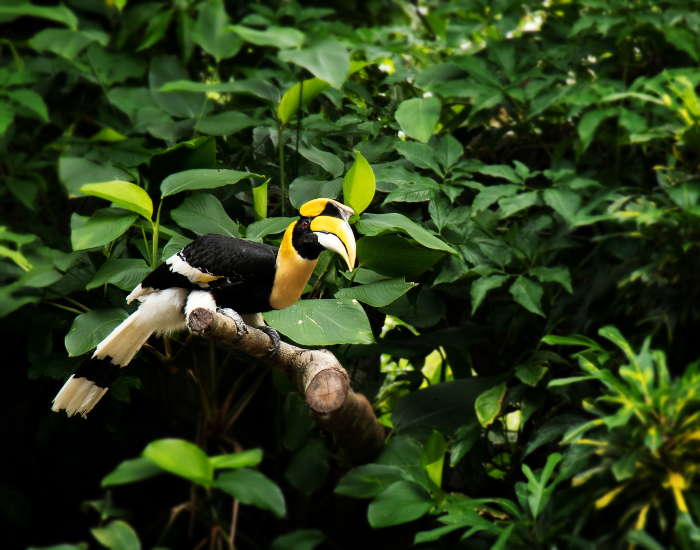
6. Great Hornbill (Buceros bicornis) – Asia’s Rainforest Giant
Up to four feet long and 6.6 pounds, one of the largest birds in Asian forests. The hollow casque on top of the bill still has no settled explanation: display and species recognition are well supported, resonance and thermoregulation less so.
The breeding behaviour is the extraordinary part. The female seals herself inside a tree cavity with mud and droppings, leaving a slit, and the male feeds her and the chicks through it for 38 to 40 days of incubation and roughly three months beyond.
Hornbills are long-distance seed dispersers, and Naniwadekar and colleagues showed they do more than move seeds: they shape where large-seeded trees end up growing across a forest. Lose the hornbills and the forest’s composition shifts. More in facts about hornbill birds and 14 types of hornbills.
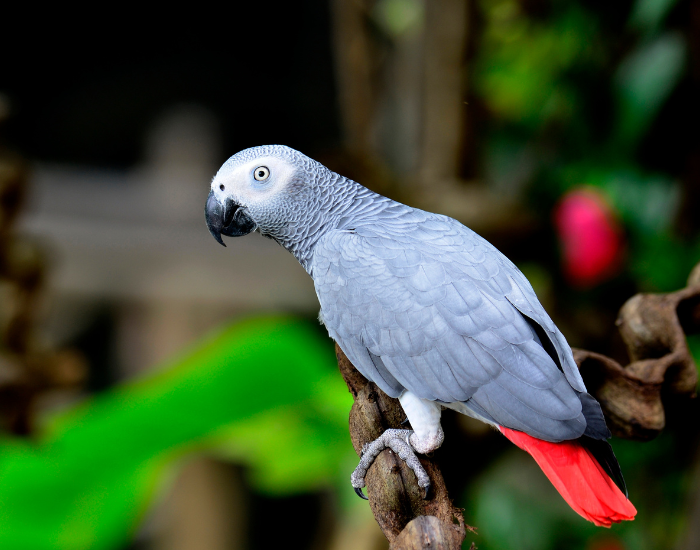
7. African Grey Parrot (Psittacus erithacus) – The Congo’s Einstein
Grey plumage, deep red tail, and the best-documented mind and intelligence of any bird. African greys live in large flocks through the Congo Basin canopy, with social structures researchers are still mapping.
The famous vocabulary claims need tightening. Alex, the grey parrot Irene Pepperberg worked with for 30 years, used around 100 labels, but used them in context, counted, grasped the concept of zero and answered questions about categories. That is a far more interesting result than a long word list. More recently, Brucks and von Bayern found African greys will voluntarily hand tokens to a partner so the partner can get food, with no benefit to themselves, and seven of eight did it on the very first trial. Spontaneous helping, previously documented mainly in primates.
The trade has gutted them. CITES records show over 1.5 million wild-caught grey parrots in reported international trade between 1975 and 2013, and work by Annorbah, Collar and Marsden found Ghana’s population had fallen by 90 to 99% since 1992, with encounter rates roughly 15 times lower than the early 1990s. The species is now Endangered and commercial trade is banned.
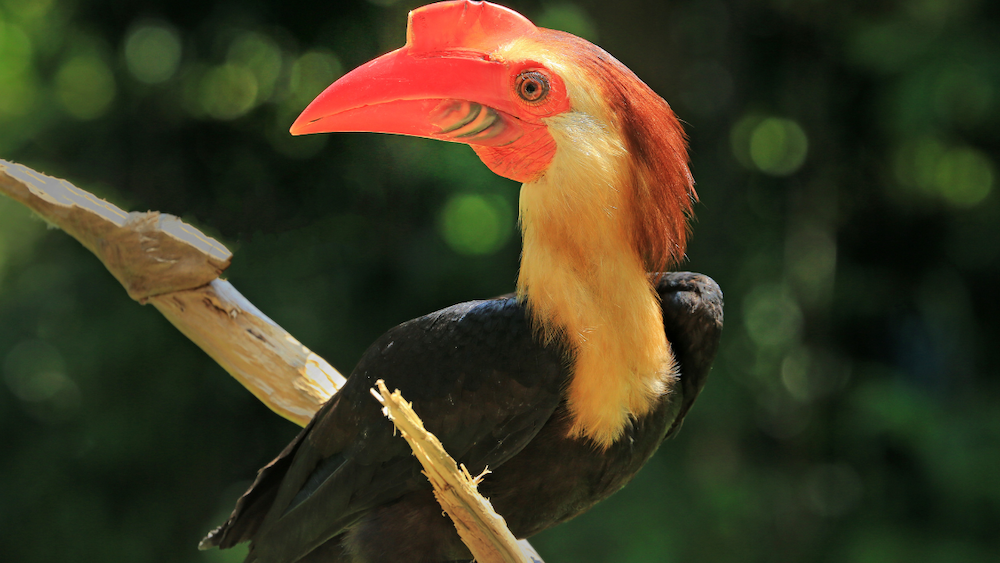
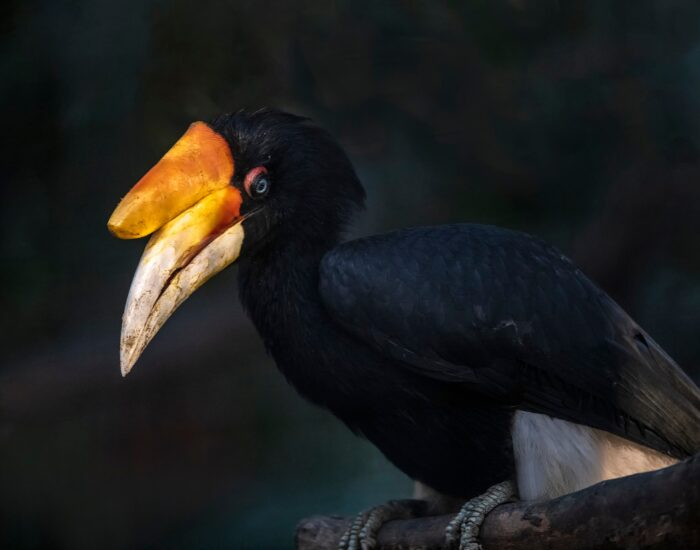
8. Rhinoceros Hornbill (Buceros rhinoceros) – Indonesia’s State Bird
Named for the upswept casque, and sacred to the Dayak people of Borneo, who read it as a symbol of strength and a link to the forest. It appears throughout their wood carving and ceremonial work, and conservation campaigns across Indonesia, Malaysia and Brunei have leaned on that standing.
Ecologically it is a frugivore that prefers large, lipid-rich fruit and carries seeds considerable distances. The problem is nesting: rhinoceros hornbills need big old-growth trees with cavities, and those are the first trees logging takes.
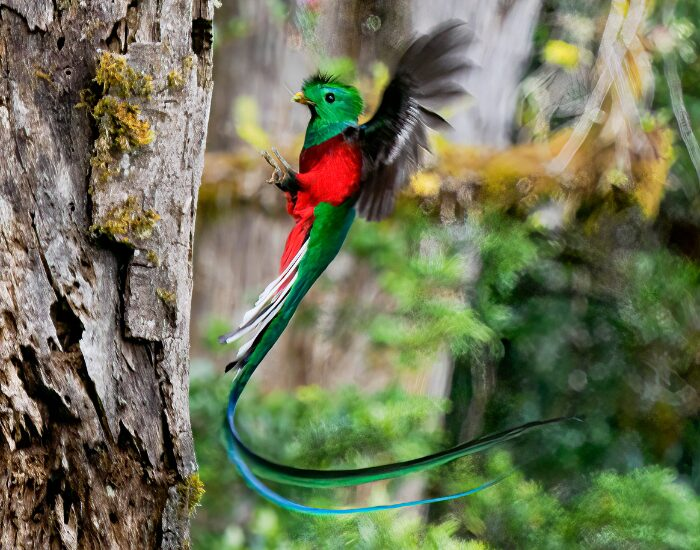
9. Quetzal (Pharomachrus mocinno) – The Sacred Bird of Central America
Technically the quetzal is a cloud forest bird rather than a lowland rainforest one, and worth the asterisk. The Maya and Aztec treated this Central American icon as sacred, and killing one carried the death penalty. It is the national bird of Guatemala and appears on the flag and the currency, which bears its name.
Breeding males grow long tails unmatched in the cloud forest, with coverts extending up to three feet past the body. Emerald green back, crimson belly, and all of it in the half-light of a cloud forest between roughly 4,000 and 10,000 feet. They specialise in wild avocados and other large-seeded fruit, excavate nest holes in rotting trees and often reuse them, and move seasonally as fruit comes into season.
Climate change is the real threat here. Warming pushes suitable habitat upslope, and on a mountain there is a point past which upslope runs out.
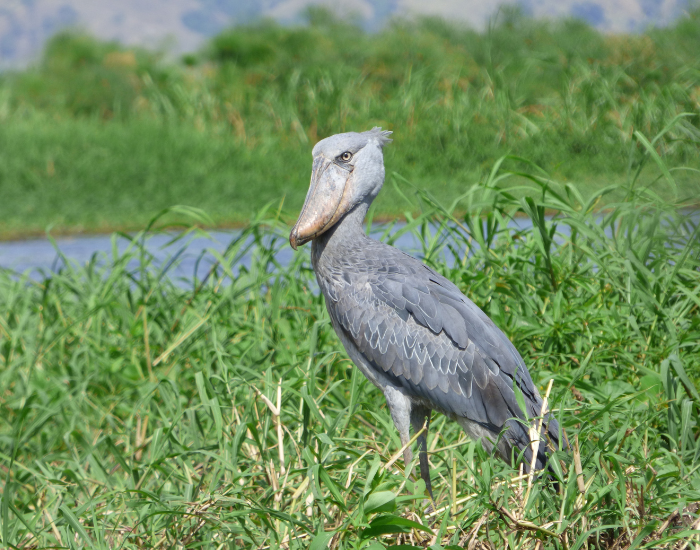
10. Shoebill (Balaeniceps rex) – The Congo’s Prehistoric Giant
Five feet tall, with long necks and a bill shaped like a wooden clog built for one job: catching lungfish. Shoebills live in the swamps and wetlands around central Africa’s forests rather than inside them.
They hunt by standing still. Not for minutes, for hours, waiting on a fish to surface, then collapsing forward onto it with their whole body. The vocal repertoire is bill-clattering like a machine gun and a low bovine bellow. Pairs usually lay two eggs and usually raise one. Between 3,300 and 5,300 remain, listed as Vulnerable, and they depend on intact wetland that is steadily being drained.
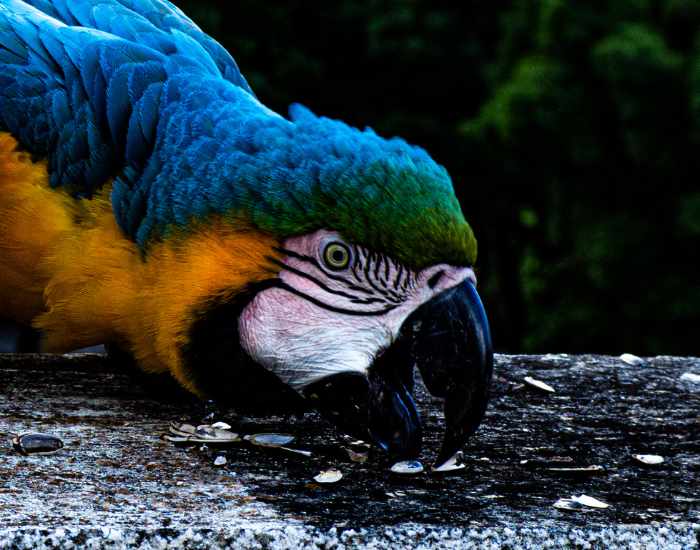
11. Blue-and-Yellow Macaw (Ara ararauna) – The Amazon’s Gentle Giant
Azure wings, golden underparts, and more flexibility than most of its relatives. Blue-and-yellow macaws handle a range of forest types and altitudes, eat well over 100 plant species, and cope with people better than any species tied to one particular palm.
Young birds spend years learning foraging technique from adults. They live roughly 30 to 35 years in the wild; the 60 to 80 year figures in circulation come from captivity, and sit at the top end even there. Stable populations have made them the face of rainforest conservation in more documentaries than any other parrot, and in the Peruvian Amazon they rank among the most colourful birds you will see, alongside scarlet, green-winged and chestnut-fronted macaws. More in animals of the Peruvian Amazon.
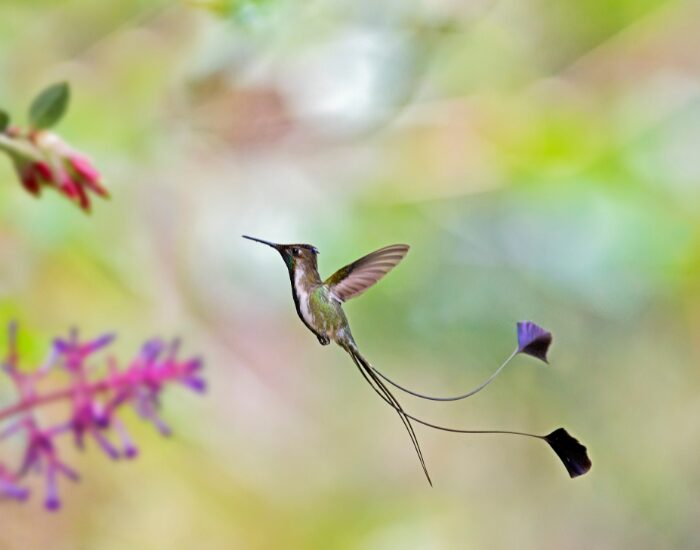
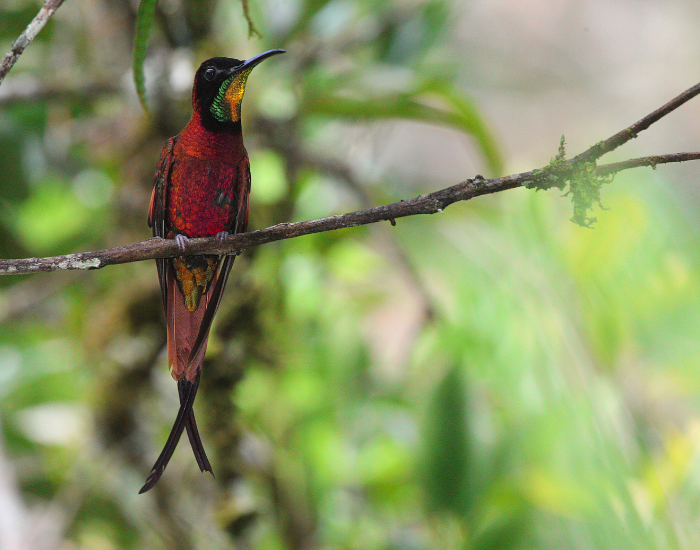
12. Crimson Topaz (Topaza pella)
Small, and arguably the most spectacular bird here. Among the largest hummingbirds in the world (or the americas), the crimson topaz works the Amazon understory, throwing off red, orange and iridescent bronze between flowers. Males carry a glittering crimson throat, an orange-red crown and crossed tail feathers.
The physiology is extreme. Heart rates reach 1,260 beats per minute, and the bird must take in half its body weight in nectar daily to fund hovering, backwards flight and brief inverted flight. They defend feeding territories aggressively because they cannot afford not to.
Hummingbirds are among the most efficient pollinators in the tropics, and some rainforest plants have co-evolved flowers that only a specific bill shape can reach. There are over 360 species, all of them confined to the Americas.
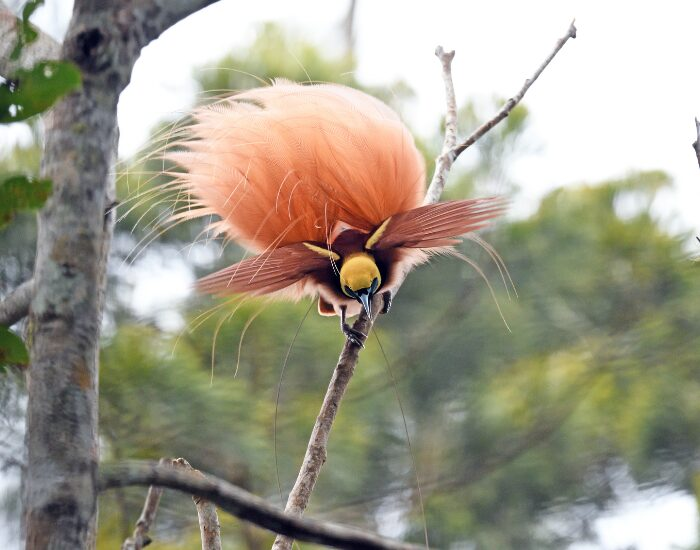
13. Greater Bird-of-Paradise (Paradisaea apoda) – The Rainforest’s Dancer
Birds of Paradise are endemic to the lowland and hill forests of New Guinea and the Aru Islands. Males carry cascades of golden flank plumes, white tail wires and an emerald throat, and they use all of it.
Dozens gather at traditional display sites called leks, each performing a routine that involves hanging upside down, fanning the plumes and calling at a pitch that carries. Females watch, compare and choose: sexual selection in plain sight. Their feathers were traded into Asia and Europe for centuries and still feature in Papuan ceremonial headdresses.
As fruit eaters they disperse seed through the forest they depend on. Not currently endangered, but deforestation, fragmentation and hunting all press on them.
The Jungle Birds Nobody Puts on Lists
Some of the most interesting rainforest birds never make a top ten.
The common potoo spends the day impersonating a broken branch, eyes shut to slits, and only at night becomes what it is: a sit-and-wait insectivore working the canopy edge. Insectivorous birds do a quiet enormous amount of pest control in tropical forests.
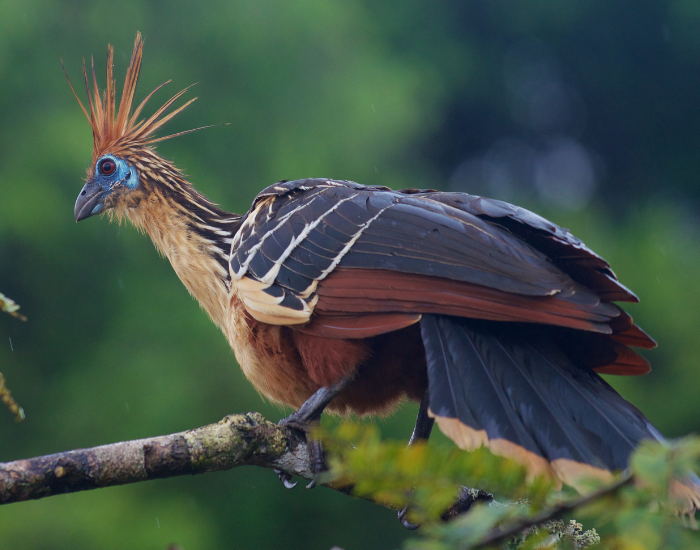
The hoatzin of the Amazon ferments leaves in an enlarged crop, the only bird known to digest the way a cow does, and smells accordingly. Megapodes across Australasia skip incubation altogether and bury their eggs in mounds of rotting vegetation, letting compost heat do the work. And on the rainforest floor of northern Queensland and New Guinea, the southern cassowary, unmistakable with its brilliant blue facial skin and neck, swallows fruit whole and deposits seeds, intact and fertilised, kilometres from the parent tree. Dozens of rainforest tree species depend on it almost exclusively.
From the harpy eagle in the emergent layer to the cassowary on the forest floor, you can see where each bird lives in my climb through the layers of the rainforest.
Where Jungle Birds Live
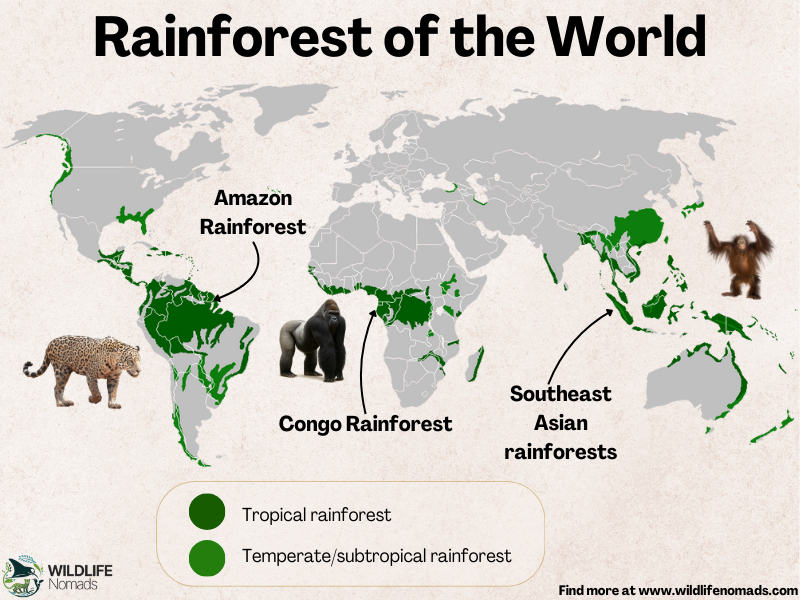
Three continents hold almost all of it.
South America. The Amazon crosses nine countries and shelters more bird species than anywhere else. Peru alone has over 1,900 species, Loreto department accounts for around 1,040, and Pacaya Samiria National Reserve holds 527. December to May is the window if you are planning a trip. The cloud forest belt further north holds quetzals and the Andean cock-of-the-rock, and Brazil’s Atlantic Forest hides native species found nowhere else.
Africa. The Congo Basin is the second-largest rainforest on Earth, with grey parrots and hornbills through the canopy and shoebills in the wetlands at its margins.
Southeast Asia and New Guinea. Borneo, Sumatra and the Malay Peninsula hold rhinoceros hornbills and great argus pheasants. New Guinea has the birds-of-paradise.
🌿Rainforest LayersClimb down the Amazon, Congo, Borneo and Daintree rainforests, from the emergent treetops to the river, and meet 63 animals.Start the climb →Within any of these the forest sorts birds by layer. Macaws and toucans dominate the canopy, eagles hunt from above it, and the floor belongs to shy tinamous, antbirds and camouflaged nightjars. A single 220-acre patch of good Amazonian forest can hold 250 bird species. More on how the layers work in my guide to rainforest animals.
FAQs About Jungle Birds
There are roughly 11,000 bird species worldwide, and tropical forests hold more of them than any other biome. The Amazon alone accounts for over 1,300 species, and Peru’s national list passes 1,900. The often-repeated claim that 10,000 species live in rainforests would mean almost every bird on Earth lives in one, which is not the case.
The harpy eagle, by predatory standards: over a metre tall, a two-metre wingspan and up to 20 pounds in females. Hyacinth macaws are the largest parrots at around 40 inches long.
Most are resident year-round, because food is available in all seasons. Many make altitudinal or local movements instead, following fruiting trees. Quetzals move up and down mountains seasonally rather than between continents.
Habitat loss and the pet trade, roughly in that order. Birds tied to one food plant or one nesting tree are the most exposed, which is why specialists like hyacinth macaws and rhinoceros hornbills suffer faster than generalists like blue-and-yellow macaws.
Go and Listen
Pick a trail, start before dawn, and stop walking. Most rainforest birds are heard long before they are seen, and the people who find them are the ones standing still.
Thirteen species is a sample of thousands. Learn three calls before you go and the forest stops being noise.
References:
Annorbah, N. N. D., Collar, N. J., & Marsden, S. J. (2016). Trade and habitat change virtually eliminate the Grey Parrot Psittacus erithacus from Ghana. Ibis, 158(1), 82–91. https://doi.org/10.1111/ibi.12332
Bello, C., Galetti, M., Pizo, M. A., Magnago, L. F. S., Rocha, M. F., Lima, R. A. F., Peres, C. A., Ovaskainen, O., & Jordano, P. (2015). Defaunation affects carbon storage in tropical forests. Science Advances, 1(11), e1501105. https://doi.org/10.1126/sciadv.1501105
Brucks, D., & von Bayern, A. M. P. (2020). Parrots voluntarily help each other to obtain food rewards. Current Biology, 30(2), 292–297. https://doi.org/10.1016/j.cub.2019.11.030
Dale, J., Dey, C. J., Delhey, K., Kempenaers, B., & Valcu, M. (2015). The effects of life history and sexual selection on male and female plumage colouration. Nature, 527(7578), 367–370. https://doi.org/10.1038/nature15509
Miranda, E. B. P., Peres, C. A., Carvalho-Rocha, V., Miguel, B. V., Lormand, N., Huizinga, N., Munn, C. A., Semedo, T. B. F., Ferreira, T. V., Pinho, J. B., Piacentini, V. Q., Marini, M. Â., & Downs, C. T. (2021). Tropical deforestation induces thresholds of reproductive viability and habitat suitability in Earth’s largest eagles. Scientific Reports, 11, 13048. https://doi.org/10.1038/s41598-021-92372-z
Naniwadekar, R., Mishra, C., Isvaran, K., & Datta, A. (2021). Gardeners of the forest: Hornbills govern the spatial distribution of large seeds. Journal of Avian Biology, 52(11), jav.02748. https://doi.org/10.1111/jav.02748