
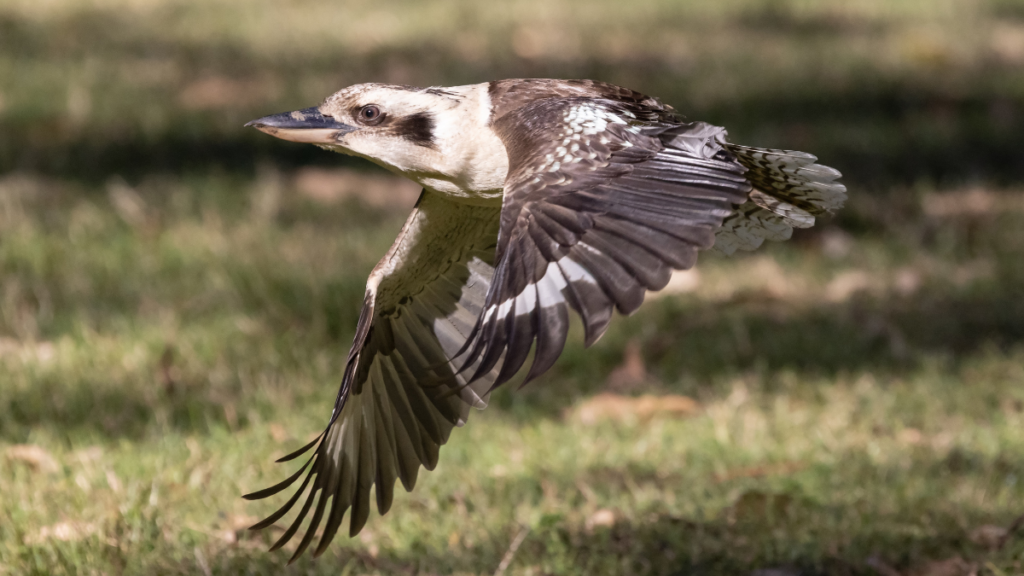
When I first arrived in Australia, I didn’t expect my introduction to its birdlife to come from what sounded like a monkey. I was in a quiet suburb of Sydney: North Ryde. I’d already seen rainbow lorikeets and galahs during my very first week in the country. Then a wild, laughing call echoed through the trees.
It was so strange that I stopped in my tracks. Anyone who’s heard a kookaburra knows exactly what I mean. That unmistakable cackling chorus feels both comical and haunting at once. But the reality is that this “monkey sound” came from one of Australia’s most iconic birds: the Laughing Kookaburra.
Twelve years and thousands of field hours later, kookaburras still stop me. Here you’ll find what the science actually says about them, their anatomy, their strange family structure, their diet, and the quiet decline nobody talks about. I’ve folded in the field stories that changed how I read this bird. And if you want to have a look on how they compare in size with other animals, visit our interactive tool.
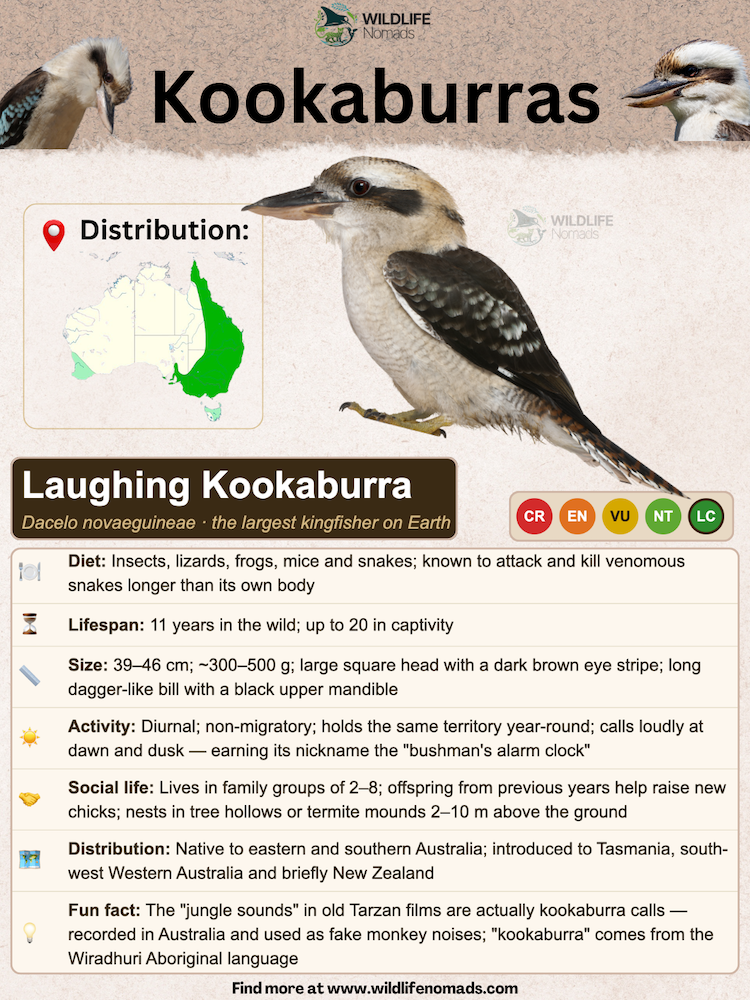
1. The Laughing Kookaburra Is the Largest Kingfisher on Earth
Dacelo novaeguineae holds the record for the biggest member of the kingfisher family. Adults measure about 45 cm in length and weigh roughly 0.5 kg but typical average mass is 300–490 g (0.3–0.49 kg) depending on sex (females are heavier). That’s a serious bird to have staring down at you from a gum tree.
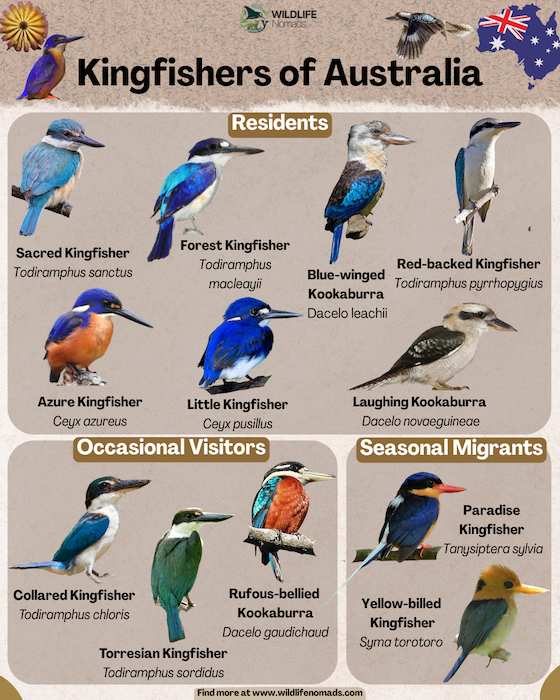
The name confuses people constantly. Kookaburras belong to a group called terrestrial tree kingfishers, they hunt on dry land, not water. Their closest relatives include the jewel-toned river specialists and, further out, the bee eaters. If you want the full picture of the group, I’ve written about the kingfishers of Australia in detail.
2. What Kookaburras Look Like Up Close
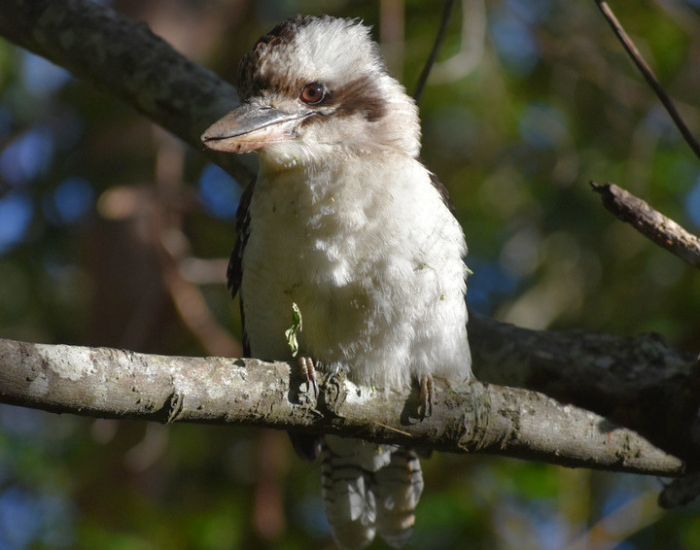
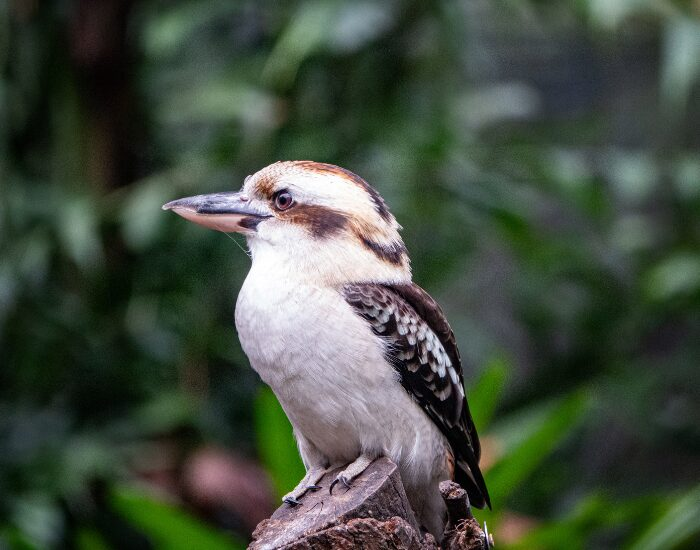
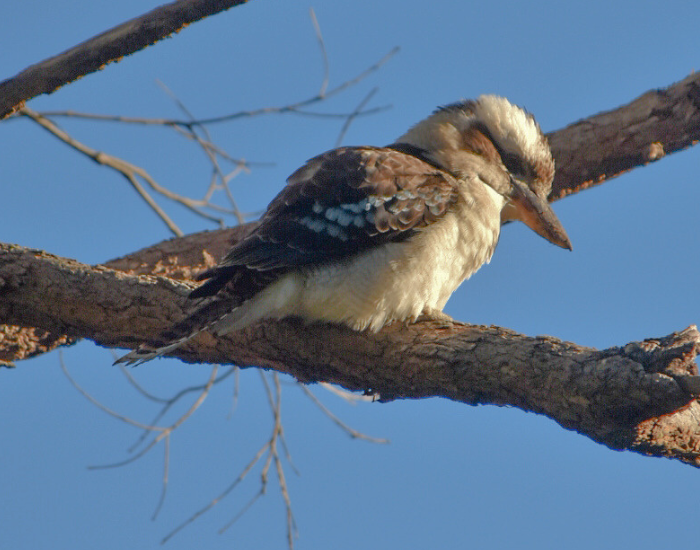
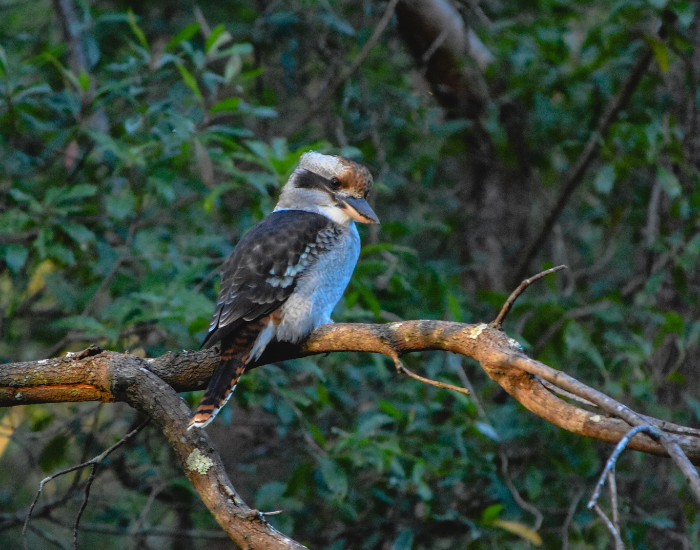
Most people picture a brown-and-cream blur. Get closer and the detail is much better. Laughing kookaburras are generally off-white below with brown wings, and a conspicuous dark brown eye-stripe running across the face like a bandit mask.
The tail is the giveaway. It’s rufous with broad black barring, and it flashes when the bird drops off a perch. Look at the head and you’ll notice the proportions are almost cartoonish, a large head, prominent brown eyes, and a strong beak that can reach 10 cm.
Sexes look nearly identical. However, males often show a wash of blue across the wing feathers near the rump. I use that as my quick field check on a breeding pair.
3. The Laugh Is a Territorial Call, Not a Joke
The famous chorus is a boundary marker. One bird starts with a low, hiccuping chuckle, and the sound builds into ringing laughter. Then the whole family piles in, and the volume becomes genuinely raucous laughter across the canopy.
Neighbouring groups answer within seconds. Listening to it feels like eavesdropping on an argument between a rival tribe and your local mob. Dawn and dusk are peak hours, which is why hearing kookaburras became my unofficial alarm clock in Sydney.
Kookaburras communicate using a variety of calls beyond the famous one, soft chuckles, squawks, and a squeaky begging note from young chicks. The full laugh, though, is territorial business. It says this gum tree is taken.
4. They Live from Cape York to Cape Otway… and Beyond
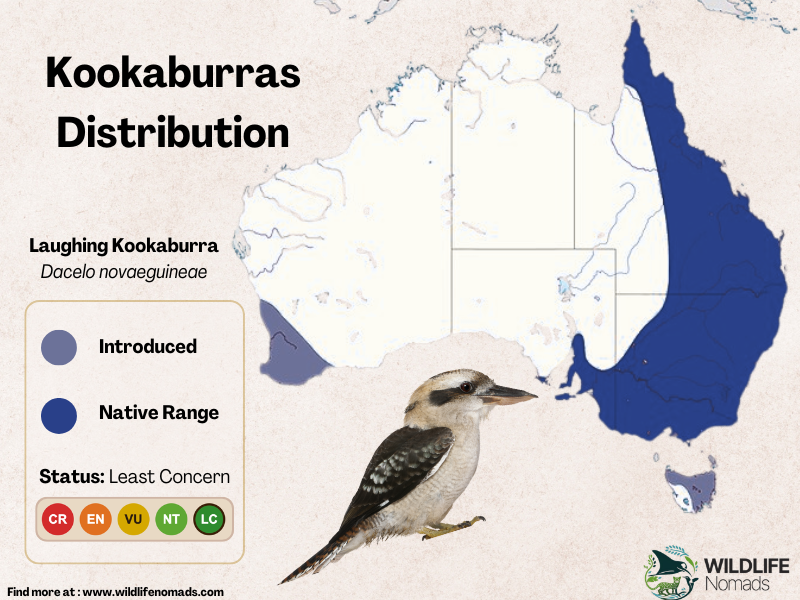
Kookaburras primarily inhabit open eucalyptus forests and woodlands. Or as locals call it: the australian bush. Dry eucalypt forest is the classic habitat, but they can live in a variety of habitats well beyond forested country. Their range extends from Cape York Peninsula in the north down through New South Wales to Cape Otway in Victoria.
Where do laughing kookaburras live outside that natural range? Humans moved them. They’ve been introduced to Tasmania, to the south west corner of Western Australia, and to New Zealand. Those introductions succeeded because the birds are so adaptable.
I’ve spotted them from Sydney to the Sunshine Coast, coastal reserves, dry ridgelines, farm edges, and a dozen national parks in between. I now live in the Northern Rivers, and they’re still part of my daily soundtrack. Few Australian birds cover such a large range so comfortably.
5. Suburbia Suits Them, If the Big Trees Survive
Kookaburras have adapted well to suburban environments with mature trees. You’ll find them in urban parks and gardens, in city parks, and on powerlines outside shopping centres. The species tolerates people better than almost any other large native predator.
During my conservation master’s at Macquarie University, I walked the same route to campus every day. Right out the front of where I lived, there were always kookaburras. Echidnas turned up occasionally, kangaroos grazed the edges, but the kookaburras were permanent residents.
That said, tolerance has a hard limit. They prefer habitats with suitable trees for nesting, and large trees with hollows take a century to form. Clear the old growth and the birds vanish, no matter how green the lawns look.
6. Kookaburras Mate for Life and Raise Chicks as a Team
Kookaburras are monogamous and mate for life. Genetic work by Legge and Cockburn found no extra-group parentage in 140 nestlings, remarkable faithfulness for a bird. A breeding pair typically keeps the same partner year after year.
They live in loose family groups, and this is where it gets interesting. Family groups can include up to five non-breeding offspring from previous seasons. Those grown offspring help parents raise younger chicks instead of leaving to breed themselves.
Legge’s research revealed a twist, though. As group size grows, helpers deliver smaller prey and fewer meals per bird. More helpers doesn’t automatically mean better-fed chicks. Cooperation in kookaburras is real, but it’s not selfless.
7. Some Nest Inside Termite Mounds
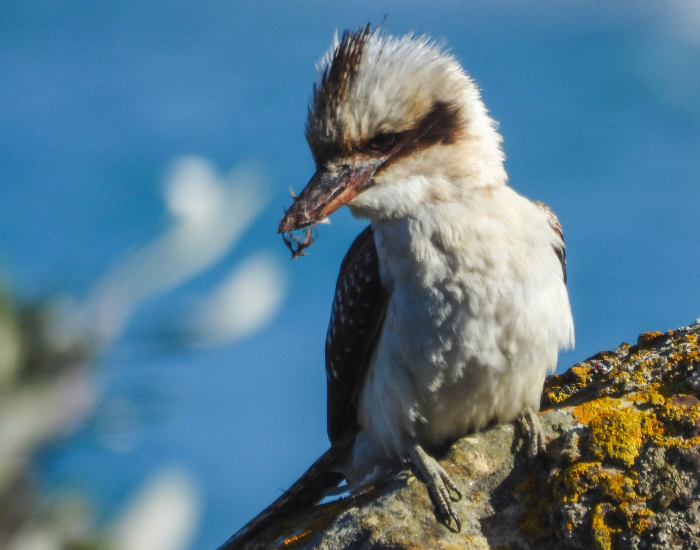
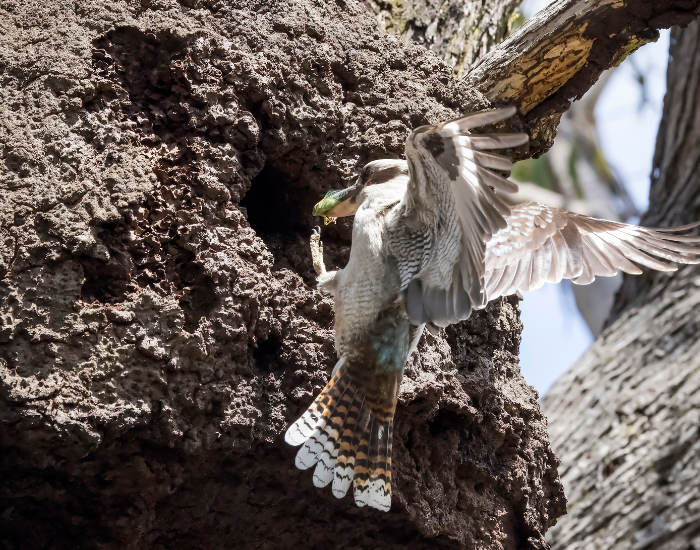
Kookaburras nest in tree hollows or in a burrow excavated directly into an arboreal termite mound. The pair hammers into the mound with that strong beak, and the termites seal off the tunnel walls. It’s free, insulated, climate-controlled real estate.
Breeding season runs from August to January. The female lays three to four white eggs, and both parents share incubation duties. The incubation period runs 24 to 26 days, and chicks fledge between 32 and 40 days after hatching.
Parents defend the nest hollow fiercely. I once watched a pair in the Watagans drive off a goanna twice their body length. Neither bird backed down.
8. They’re Almost Entirely Carnivorous
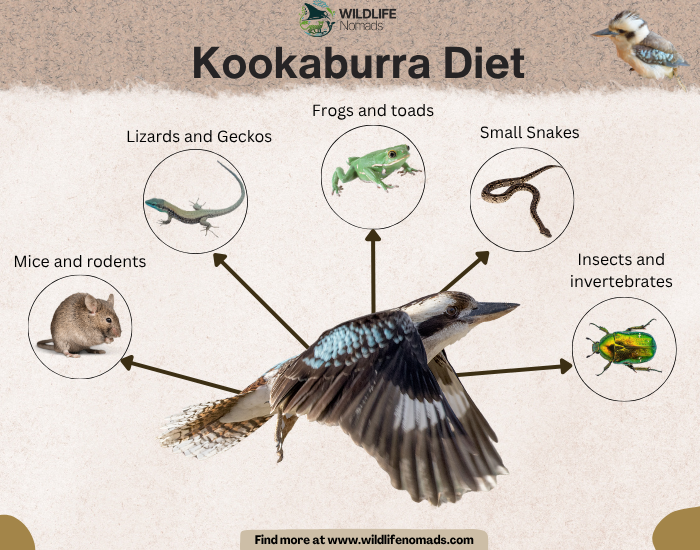
Kookaburras primarily eat insects, worms and crustaceans, and they take plenty of larger prey too. Their menu includes lizards, frogs, small snakes, small mammals, and occasionally the nestlings of other birds.
Hunting is patient work. The bird sits motionless on a branch, watches the ground, then pounces from the perch in one drop. Small prey goes down whole. For larger prey, they return to a tree branch and bash it repeatedly until the bones break.
The snake thing is mostly myth-adjacent. Yes, killing snakes happens, but they target small snakes, not the metre-long browns of folklore. In addition, kookaburras help control pest populations by consuming large quantities of insects and rodents. That’s a real ecological service in farming country.
9. A Kookaburra Almost Never Drinks Water
This one surprises most people. Kookaburras obtain all required moisture from their prey and rarely drink standing water. Flesh, insects and worms carry enough fluid to keep them going.
They will bathe, though. I’ve watched them plunge into shallow creeks and birdbaths, then shake off on a low branch. During heatwaves, they also pant and hold their wings away from the body. Interestingly, that behaviour is a better indicator of heat stress than any thirst signal.
10. Bold, But Not Aggressive, And Yes, They Steal Food
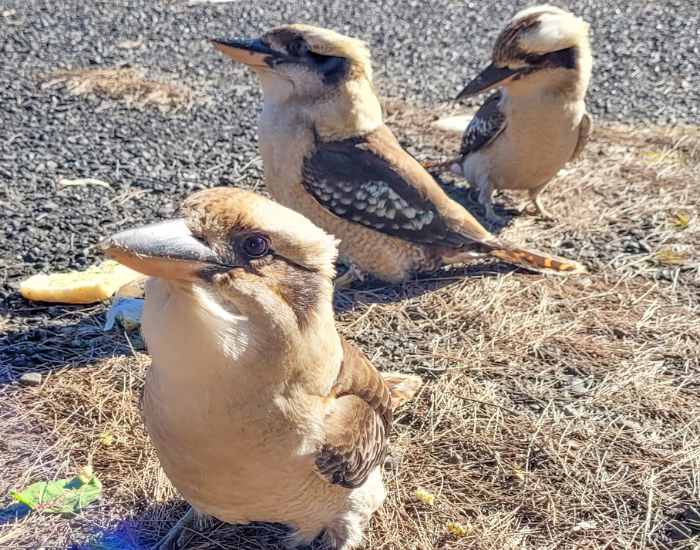
Personality varies enormously between individuals. Fieldwork for my job took me through reserves and national parks across New South Wales, where I met plenty of juveniles. One young bird stole a muesli bar straight out of my open pack. Another took half a sandwich off a picnic table while I was mid-sentence.
I wouldn’t call them aggressive. Bold is the right word. They calculate the risk, decide you’re slow, and commit.
By contrast, other populations are genuinely shy. While housesitting for a dog in the Gold Coast hinterland, the local birds kept a solid twenty metres between us. Never once did they approach. Boldness is learned, not built in, which is exactly why feeding them mince is a bad idea. It’s nutritionally poor and teaches dependence.
11. Meet the Other Kookaburra: The Blue-Winged
Australia has a second species that most visitors never see. The blue winged kookaburra lives across northern Australia, from the Kimberley in north western Australia through central northern country to Cape York. It’s slightly smaller, with pale staring eyes and brilliant cobalt wing panels.
Males carry a striking blue tail; females show a rufous, barred one. The call is the real difference, though. Instead of ringing human laughter, they produce a harsh, screeching cackle that stops abruptly. Locals in the Top End describe it as a barking dog being strangled, and they’re not wrong.

12. The Laugh Is Getting Quieter
On paper, global conservation assessments list the Laughing Kookaburra as “Least Concern,” with raw desktop estimates placing the population at up to 65 million birds. However, field ornithologists widely consider that figure a massive overestimate derived from uniform density modeling rather than real-world surveys.
Dig into the trend data and the picture shifts. Reporting rates across south-eastern Australia fell by roughly half between 2000 and 2019, according to long-term Atlas surveys. Fewer people are recording kookaburras where kookaburras used to be routine. New Zealand’s introduced population is probably fewer than 500 birds.
The likely drivers are hollow loss, land clearing, and increasingly severe fire. Old hollow-bearing trees burn and don’t come back for a century. Meanwhile, displaced birds must fight other kookaburras, parrots, owls and possums for the hollows that remain. Least Concern is a snapshot, not a guarantee.
Frequently Asked Questions
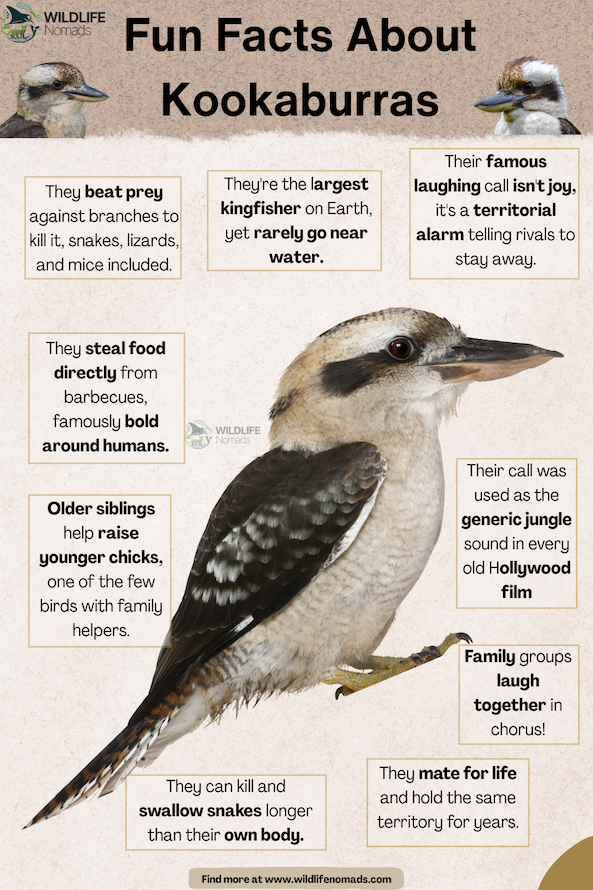
Kookaburras are the largest kingfishers in the world, reaching 45 cm and 0.5 kg. They mate for life and raise chicks with help from grown offspring. Some nest inside termite mounds rather than tree hollows. They almost never drink water, taking all moisture from prey. Finally, their famous laugh is a territorial call, not an expression of joy.
Curiosity and boldness define them. Urban birds will perch a metre away and assess whether your lunch is worth the risk. Kookaburras are also intensely territorial, defending boundaries year-round with group calls. Within the family, they’re cooperative and patient — adult offspring stay home for years to help. Rural populations are noticeably shyer than city park regulars.
Laughing kookaburra habitat centres on open eucalypt forest and woodland across eastern Australia. Introduced populations exist in Tasmania, south west Western Australia, and New Zealand. They also thrive in farmland, city parks and suburban gardens. The non-negotiable requirement is large trees with hollows for nesting.
Go Listen for Them
Twelve years of fieldwork has taught me one thing about this bird: familiarity hides complexity. Kookaburras look like the easy Australian bird, the one on the tea towel, yet they hold territory as tightly as any raptor and raise young through a social system biologists still argue about.
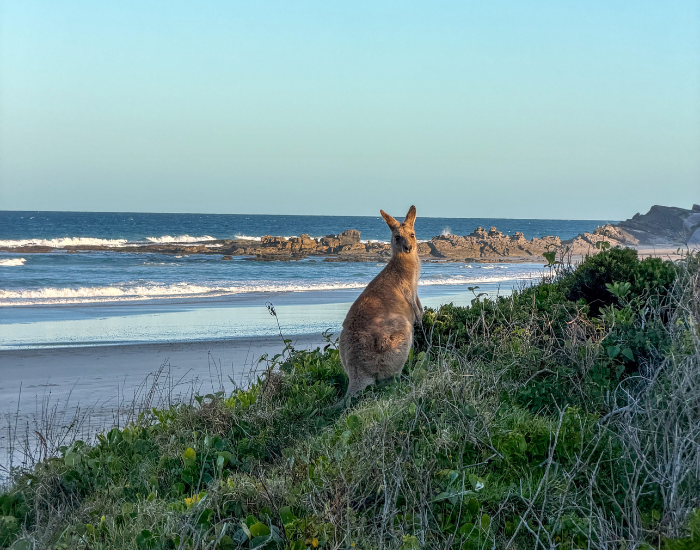
Australia gets famous for its kangaroos and its marsupials. The kookaburra deserves the same attention, particularly now that its reporting rate is sliding.
So here’s my ask. Next time you’re outside at dawn, stand still and wait for the first hiccuping chuckle. Count how many birds join in, that number tells you the size of the family group. Then drop a comment and tell me where you heard them, and whether the laugh is still loud where you live.
References:
Andersen, M. J., McCullough, J. M., Mauck, W. M., Smith, B. T., & Moyle, R. G. (2018). A phylogeny of kingfishers reveals an Indomalayan origin and elevated rates of diversification on oceanic islands. Journal of Biogeography, 45(2), 269–281. https://doi.org/10.1111/jbi.13139
Davis, A., Major, R. E., & Taylor, C. E. (2013). Housing shortages in urban regions: Aggressive interactions at tree hollows in forest remnants. PLOS ONE, 8(3), e59332. https://doi.org/10.1371/journal.pone.0059332
Davis, A., Major, R. E., Taylor, C. E., & Martin, J. M. (2017). Novel tracking and reporting methods for studying large birds in urban landscapes. Wildlife Biology, 2017(1), wlb.00307. https://doi.org/10.2981/wlb.00307
Legge, S. (2000). Helper contributions in the cooperatively breeding laughing kookaburra: Feeding young is no laughing matter. Animal Behaviour, 59(5), 1009–1018. https://doi.org/10.1006/anbe.2000.1382
Legge, S. (2000). The effect of helpers on reproductive success in the laughing kookaburra. Journal of Animal Ecology, 69(4), 714–724. https://doi.org/10.1046/j.1365-2656.2000.00429.x
Legge, S., & Cockburn, A. (2000). Social and mating system of cooperatively breeding laughing kookaburras (Dacelo novaeguineae). Behavioral Ecology and Sociobiology, 47(4), 220–229. https://doi.org/10.1007/s002650050659
Newton, K., Jarman, S., Bunce, M., & Hogg, C. (2022). Home is where the hollow is: Revealing vertebrate tree hollow user biodiversity with eDNA metabarcoding. Environmental DNA, 4(5), 1078–1091. https://doi.org/10.1002/edn3.313