Last week I stood inside London’s Natural History Museum, neck craned, staring up at a giant ground sloth. Nearby loomed the skull of a giant crocodile and a wall of dinosaur bones, including a Triceratops that still stops traffic. I drifted deeper, past the deep-time monsters, until the temperature of the exhibit seemed to drop. I had reached the Ice Age.
That is where the American cave lion caught me off guard. I have spent years tracking big cats across three continents, and I have written before about the saber-toothed cat. Yet a single label beside a massive skull rewired my understanding of what a lion could be. This animal, Panthera atrox, was bigger than any lion alive today. Here are ten things I learned after that visit and weeks of digging into the science.
1. It Was a Lion, Not Really a Cave Dweller
Let’s clear up the name first, because it trips up almost everyone. Scientists formally call this animal Panthera atrox, the American lion. The “cave lion” label comes from its close cousin in Eurasia, and the two get tangled constantly.
The American lion likely did not live in caves at all. It used them as occasional shelters or dens, nothing more. Most of its life played out in the open, under a wide Pleistocene sky. So when you search for the American cave lion, picture a plains hunter, not a cave hermit.
Taxonomy adds another twist. This member of the cat family goes by two labels in the literature. Some researchers call it a separate species, Panthera atrox. Others treat it as an extinct subspecies of the lion, Panthera leo atrox. That two-species debate still simmers, and you will also see it called the North American lion.
2. The Biggest Lion That Ever Lived
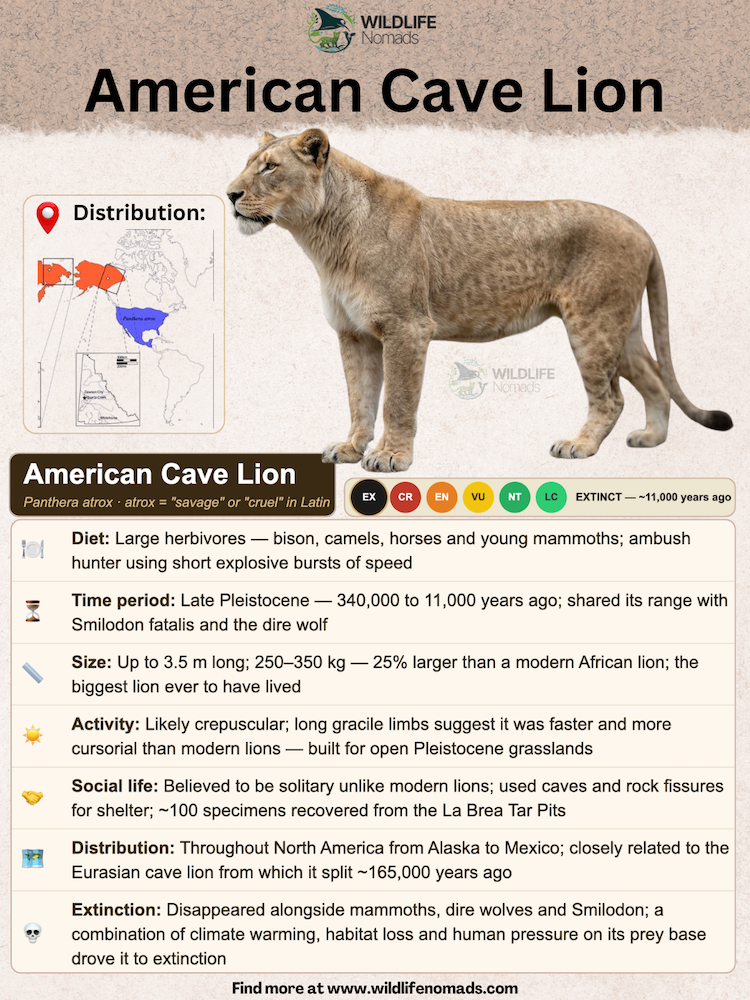
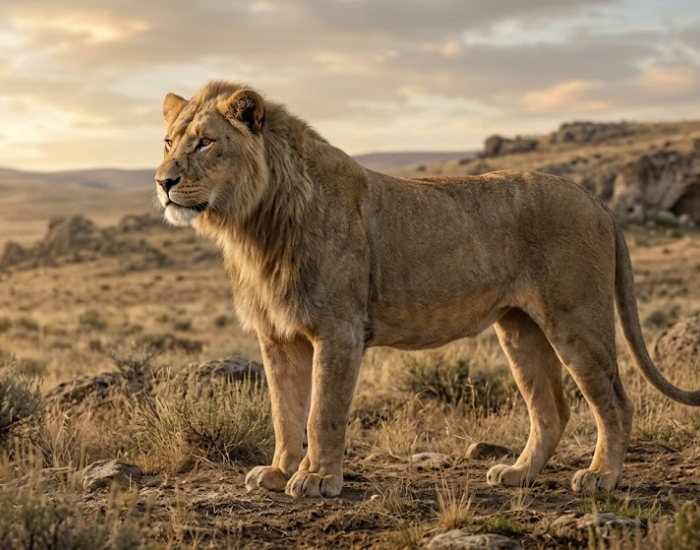
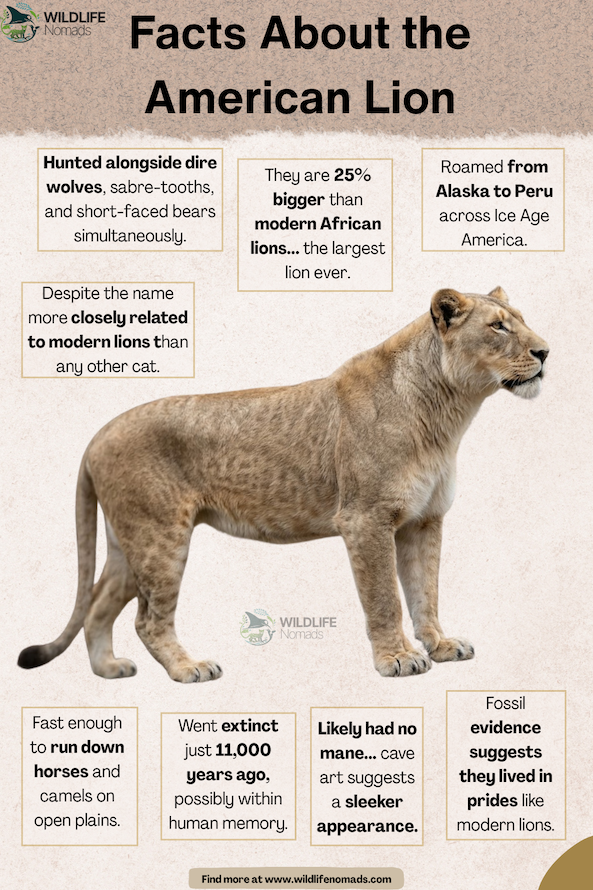
Here is the fact that stopped me at the museum. The American lion was roughly 20 to 25% larger than a modern African lion, considerably larger in almost every dimension. That makes it the largest lion, and one of the largest cats, in the fossil record.
The numbers are staggering. Body length ran from 1.6 to 2.5 meters, not counting the tail. American lion height reached about 1.2 meters at the shoulder. Males weighed between 235 and 523 kilograms, while females averaged 175 to 365 kilograms. Its limbs were roughly 10% longer than a modern lion’s, giving it a taller, rangier frame.
This was also a strongly sexually dimorphic cat. Male American lions carried far more body mass than females, an extreme version of the sexual dimorphism we still see in lions today. By any measure, Panthera atrox was a genuinely large felid.
For scale, even the famously hefty Barbary lion of North Africa, the biggest of the modern subspecies, would look modest beside it. Standing next to that skull, I finally understood why researchers keep reaching for the word “giant.” I have measured living lions in the field, and my mental yardstick simply broke.
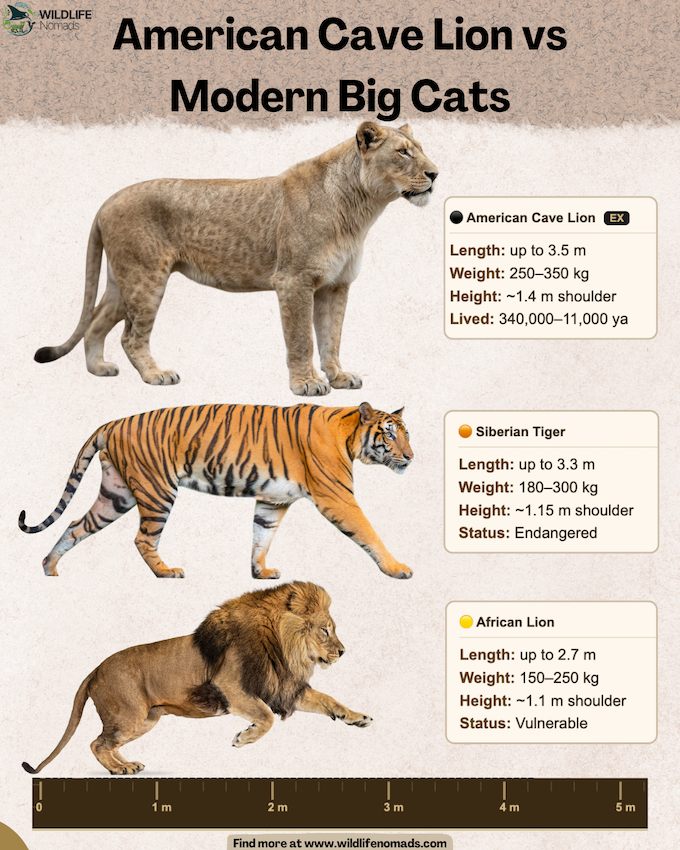
| Credit: Wildlife Nomads
3. Where the American Lion Lived
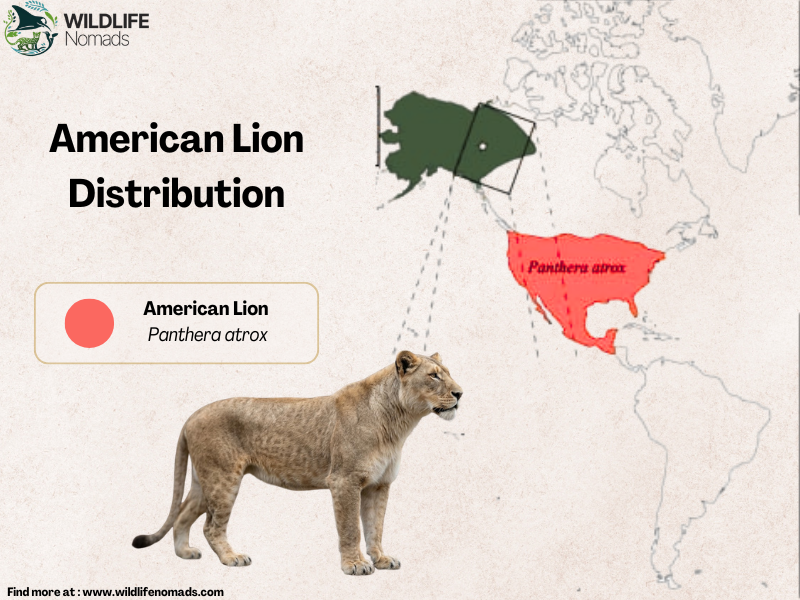
The American lion range was enormous. Fossils turn up from southern Alaska down to Mexico, and from California east to Maryland. In practical terms, it patrolled the continent from central Alberta to southern Mexico.
Where did the American lion live day to day? It favored savannas, grasslands, and sparse forests, the kind of open country that suits a long-legged pursuit hunter. Most fossils cluster along western North America, though one famous American lion fossil site sits far south in Extinction Cave, Belize. Lions in North America were once as much a part of the landscape as bison.
That range blows past anything a living lion could claim. Today’s lions cling to a fraction of Africa, plus a single forest in India. By contrast, Panthera atrox spanned climate zones from subarctic tundra edges to subtropical woodland. Few big predators have ever covered so much ground.
One caveat on the map is worth flagging. Scattered fossil remains from South America, including sites in southern Chile, were once linked to this lion. The fossil record now assigns most of those to the jaguar, Panthera onca. True American lions stayed north, isolated south of the great ice sheets but never reaching the deep south.
4. It Descended From the Eurasian Cave Lion
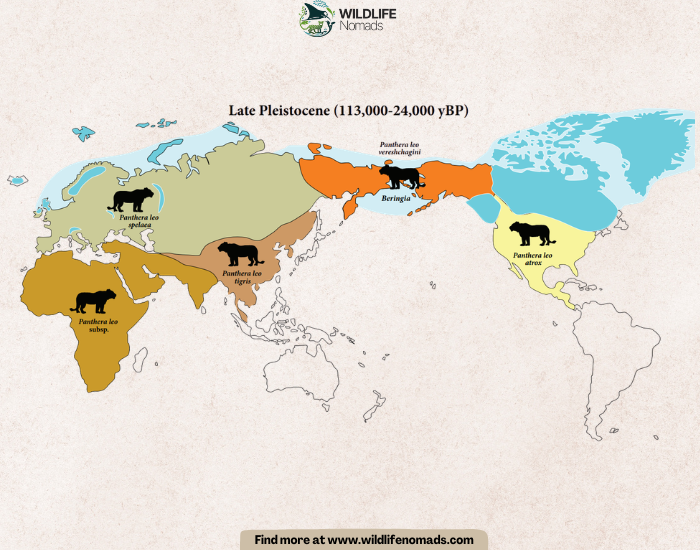
Genetic analysis finally made the naming confusion make sense. Mitochondrial DNA shows the American lion descended from the cave lion, Panthera spelaea, whose range once stretched across Europe and northern Asia. A founding population crossed into North America, then glaciers sealed them off from the rest of the world.
Cut off, they evolved on their own path. The American lion diverged from the cave lion around 340,000 years ago and existed as its own species for roughly 329,000 years. Landmark work published in journals like Molecular Ecology and Scientific Reports traced this link, and later studies confirmed it stayed closely related to other cave lions rather than to African stock. Its closest living relative today is the modern lion, Panthera leo. So this “American cave lion” is family to the big cats still roaming Africa, including the African lion I have watched hunt at dawn.
5. Built for the Chase, Not the Mane
Forget the shaggy Hollywood mane. The American lion was more robust than modern lions and likely lacked a full mane, based on skeletal evidence and its evolutionary link to the Eurasian cave lion. While Paleolithic cave art in Europe depicts its close relatives as maneless, North American fossils show shoulder and neck muscle attachments that line up with a sleeker, unmaned profile.
Coat color is a mystery too. We simply have no pigment evidence, so anyone imagining a rare morph like the modern white lion is guessing as much as I am. Cave paintings hint at plain, tawny cats, but paint fades and artists simplify.
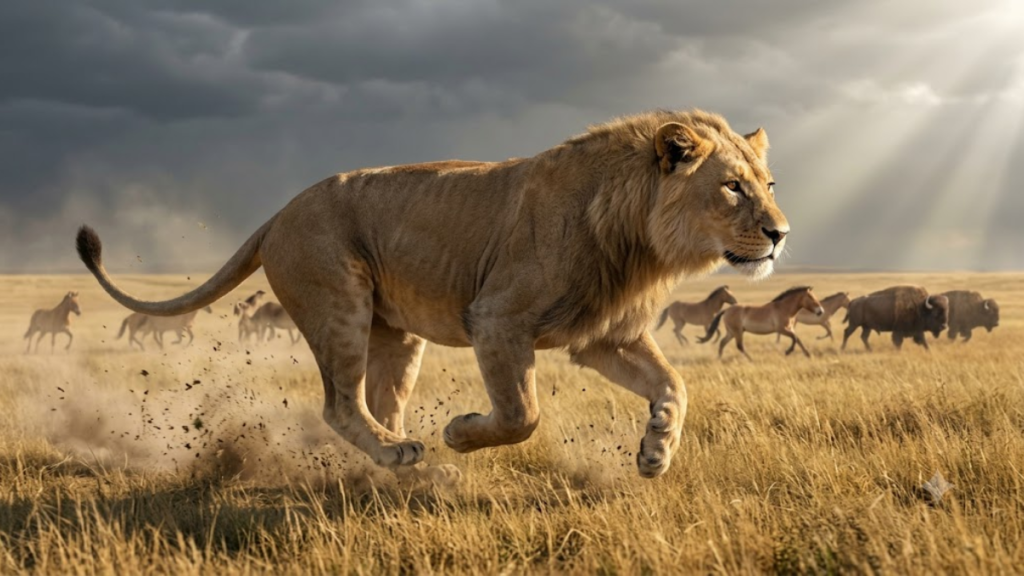
Those long limbs mattered. The American lion possibly had legs adapted for speed across open landscapes, and its muscle attachments suggest a body built for pursuing prey. Some researchers even argue it hunted by day, unlike the mostly nocturnal lions we know. A diurnal apex predator sprinting across Pleistocene grassland is a genuinely thrilling image.
6. A Bite Force to Bring Down Giants
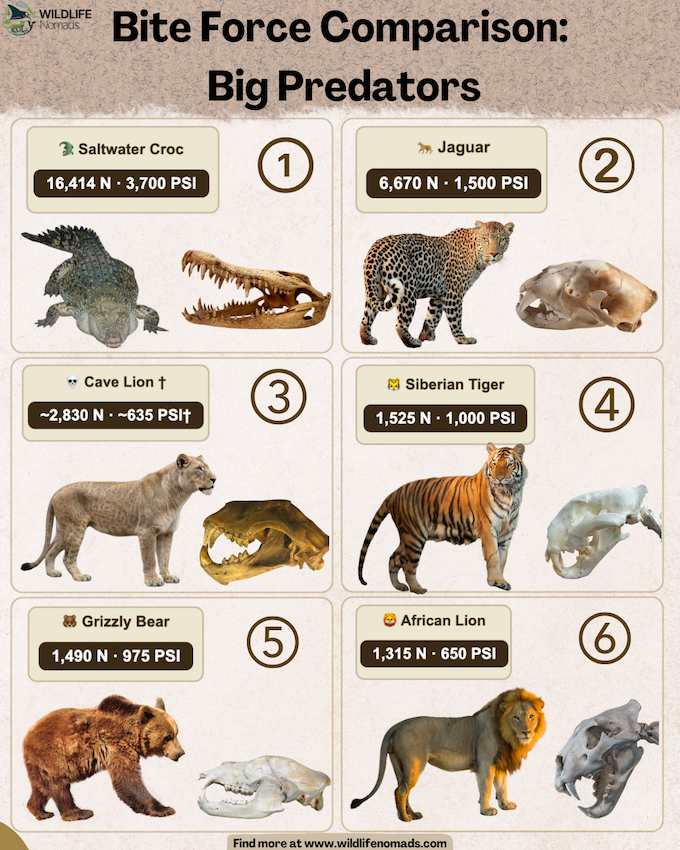
The skull that stopped me was not just big, it was engineered for power. Based on skull dimensions, scientists estimate a 347-kilogram American lion delivered a bite force of about 2,830 newtons. That is a violent bite, stronger than any lion alive today.
To put that into perspective, its jaw strength comfortably outmatched the bone-crushing bite of a grizzly bear and surpassed modern apex big cats like the Siberian tiger. While the jaguar holds the title for the highest bite force relative to its body size, the sheer physical scale of the American lion allowed it to output far greater absolute crushing power.
Its craniomandibular morphology, the geometry of skull and jaw, points to specialization for large prey. Sharp carnassial teeth gave it real bone-shearing ability, slicing through hide and tendon with ease. Paleontologist Blaire Van Valkenburgh has documented high tooth-breakage rates in La Brea carnivores, a sign these cats bit hard and often. This was not a cat picking off rabbits. It was equipped to grip, hold, and kill animals many times a human’s weight.
7. What the American Lion Actually Ate
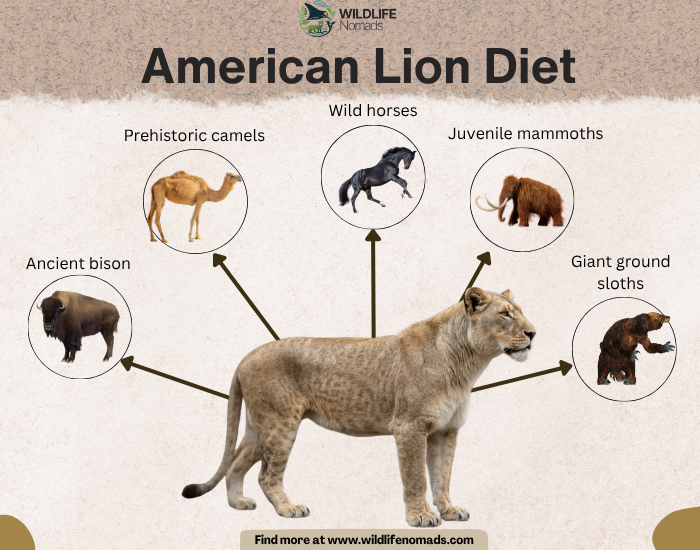
Isotopic analysis of fossil bone tells us what American lions hunted, and the menu was huge. The American lion likely preyed on horses, camels, juvenile mammoths, and above all the American bison. Chemistry locked in their diet, and it reads like a who’s who of Ice Age megafauna.
The American bison connection is worth a pause. What does the American bison eat? Mostly grasses and sedges, which fueled vast herds across the plains. Those herds, in turn, fed predators like the American lion. Interestingly, dental studies suggest these lions ate relatively clean flesh and avoided crunching bone, unlike the hyenas of the same era. That points to a fresh-kill specialist rather than a scavenger.
One popular claim says these cats primarily hunted pronghorn, but the isotopic evidence actually points to large ungulates like bison and horse. The pronghorn story more likely belongs to the North American cheetah, a common mix-up worth flagging. As a biologist, I have learned to double-check these tidy claims, because prehistory rewards skeptics.
8. It Shared the Stage With Saber-Tooths
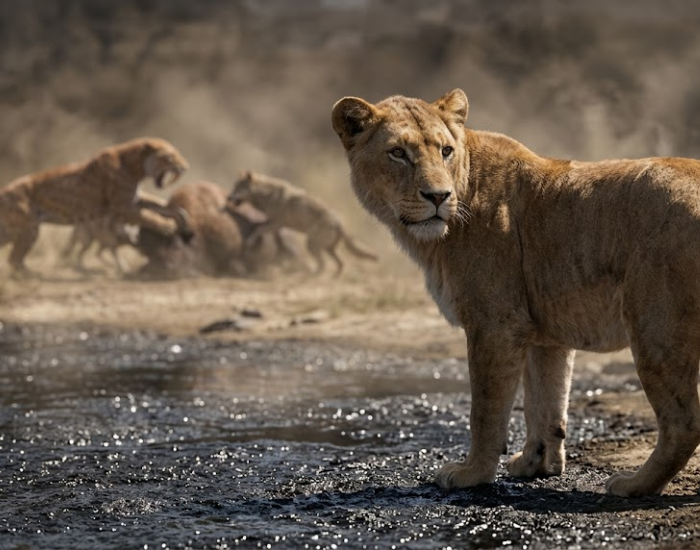
The American lion did not rule alone. It shared its world with the saber-toothed cat, dire wolves, short-faced bears, and the American cheetah. Competition among these large carnivores was fierce, and prey did not come easy. Few other big cats have ever faced such a crowded field of rivals.
The La Brea tar pits in Los Angeles preserve this crowded ecosystem in astonishing detail. Hundreds of American lion bones have emerged from that asphalt, alongside saber-tooths and dire wolves lured in by trapped prey. It is the single richest window we have into these cats.
As a dominant apex predator of Late Pleistocene North America, the American lion played a real ecological role. By regulating herbivore populations, it shaped which plants thrived and where herds could graze. Remove a predator like that, and the whole system wobbles, a lesson I see echoed in every modern reserve I visit.
9. The Prides Question Remains Open
Modern lions are famously social, so did the American lion live in prides? Honestly, we do not know. It is genuinely debated whether Panthera atrox formed social groups like today’s lions.
Some scientists point to the sheer number of individuals pulled from the La Brea tar pits as a hint of group living. Others counter that solitary cats could be trapped just as easily. The fossils tease us without settling the argument. I love that a museum specimen can still hold an unanswered question inside it.
10. Why the American Lion Went Extinct
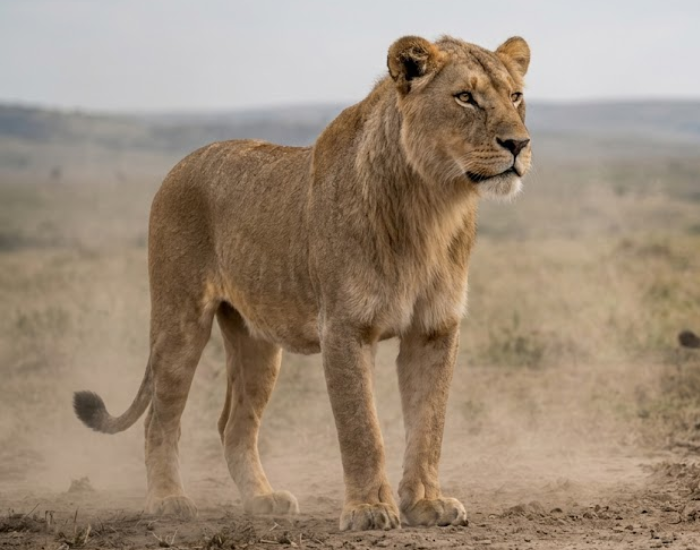
The American lion extinction came at the close of the last Ice Age. The species died out around 13,000 years ago, and the youngest known remains date to roughly 11,355 years ago. That timing was no accident.
Its disappearance coincided with the end-Pleistocene megafaunal extinctions, when mammoths, giant sloths, and saber-tooths all vanished. Climate change and human activity both contributed. Habitat shrank during the Last Glacial Period, prey grew scarcer, and pressure mounted on a specialist that needed big animals to survive. When the giants it hunted collapsed, the giant hunter followed.

Frequently Asked Questions
Yes. Wild lions in North America were real and widespread. The American lion (Panthera atrox) roamed the continent for hundreds of thousands of years, from Alaska to Mexico, before going extinct around 13,000 years ago. Its cousin, the cave lion, ranged across Eurasia at the same time.
Generally, yes. The American lion was about 25% larger than a modern African lion, which puts the biggest males above today’s largest tigers. Estimated weights of up to 523 kilograms exceed the heaviest wild Siberian tigers on record. It ranks among the largest cats ever to have lived.
Yes. Researchers have recovered mitochondrial DNA from American lion fossils. That genetic work revealed it descended from the Eurasian cave lion and split off around 340,000 years ago. DNA also confirmed the modern lion as its closest living relative.
The American lion stood about 1.2 meters at the shoulder, taller than the average modern lion at roughly 1.1 meters. With limbs around 10% longer than living lions, Panthera atrox was the tallest lion species we know of. Standing, a large male would tower over most people.
The Giant Worth Remembering
The American cave lion reminds me that “lion” once meant something far larger and stranger than the cats we film on safari today. This was a taller, heavier, likely maneless hunter that chased bison across an America we would barely recognize. It thrived for over 300,000 years, then vanished when its world unraveled.
Next time you visit a natural history museum, find the Ice Age hall and look for that oversized skull. Stand with it a moment, and you will feel the weight of a lost world. If you want to keep exploring it, wander through my guide to Ice Age animals or meet the giant ground sloth and the monstrous Deinosuchus that shared these deep-time stories. Then tell me in the comments: which extinct giant would you most want to see alive?
The American Lion: Fact or Fiction? 🦁
Twelve statements about the Ice Age giant Panthera atrox — six true, six myths. Can you tell them apart?
Fact or Fiction?
References:
Barnett, R., Mendoza, M. L. Z., Soares, A. E. R., Ho, S. Y. W., Zazula, G., Yamaguchi, N., Shapiro, B., Kirillova, I. V., Larson, G., & Gilbert, M. T. P. (2016). Mitogenomics of the extinct cave lion, Panthera spelaea (Goldfuss, 1810), resolve its position within the Panthera cats. Open Quaternary, 2, 4. https://doi.org/10.5334/oq.24
Barnett, R., Shapiro, B., Barnes, I., Ho, S. Y. W., Burger, J., Yamaguchi, N., Higham, T. F. G., Wheeler, H. T., Rosendahl, W., Sher, A. V., Sotnikova, M., Kuznetsova, T., Baryshnikov, G. F., Martin, L. D., Harington, C. R., Burns, J. A., & Cooper, A. (2009). Phylogeography of lions (Panthera leo ssp.) reveals three distinct taxa and a late Pleistocene reduction in genetic diversity. Molecular Ecology, 18(8), 1668–1677. https://doi.org/10.1111/j.1365-294X.2009.04134.x
Christiansen, P., & Harris, J. M. (2009). Craniomandibular morphology and phylogenetic affinities of Panthera atrox: Implications for the evolution and paleobiology of the lion lineage. Journal of Vertebrate Paleontology, 29(3), 934–945. https://doi.org/10.1671/039.029.0314
Coltrain, J. B., Harris, J. M., Cerling, T. E., Ehleringer, J. R., Dearing, M.-D., Ward, J., & Allen, J. (2004). Rancho La Brea stable isotope biogeochemistry and its implications for the palaeoecology of late Pleistocene, coastal southern California. Palaeogeography, Palaeoclimatology, Palaeoecology, 205(3–4), 199–219. https://doi.org/10.1016/j.palaeo.2003.12.008
DeSantis, L. R. G., Schubert, B. W., Scott, J. R., & Ungar, P. S. (2012). Implications of diet for the extinction of saber-toothed cats and American lions. PLoS ONE, 7(12), e52453. https://doi.org/10.1371/journal.pone.0052453
Stuart, A. J., & Lister, A. M. (2011). Extinction chronology of the cave lion Panthera spelaea. Quaternary Science Reviews, 30(17–18), 2329–2340. https://doi.org/10.1016/j.quascirev.2010.04.023
Wheeler, H. T., & Jefferson, G. T. (2009). Panthera atrox: Body proportions, size, sexual dimorphism, and behavior of the cursorial lion of the North American plains. In Papers on Geology, Vertebrate Paleontology, and Biostratigraphy in Honor of Michael O. Woodburne (Museum of Northern Arizona Bulletin 65, pp. 423–444). Museum of Northern Arizona.