It took one small jar of seawater to silence our entire group.
The morning was cold, the sea air heavy with salt and fog. Our boots crunched over slick rocks as we peered into the shallows, looking for anything alive. Then our instructor lifted the jar.
Inside floated what looked like a drifting petal. Translucent, frilled, impossibly delicate. A nudibranch, he said, a kind of sea slug. Under the lamp its naked gills unfurled like lace, and nobody spoke.
That was the day I learned that beauty in the ocean doesn’t always roar like a whale. Sometimes it crawls quietly across a rock.
What Are Sea Slugs? Understanding These Soft-Bodied Marine Animals
Sea slugs are soft-bodied marine mollusks, creatures with soft bodies and, for the most part, no shell. They belong to the phylum Mollusca and the class Gastropoda. That is the same large group as the snails and limpets on any rocky shore. Most lost their shells over evolutionary time. Some keep a small remnant tucked inside the body. Sea slugs sit on the mollusc branch of my phylum explorer, next to snails, clams and octopuses.
That missing shell is what makes them slug-like, and it is why people confuse them with other animals. Sea cucumbers are the usual mix-up, but those are echinoderms, closer to sea stars than to any slug.
Here is the rule worth remembering. All nudibranchs are sea slugs, but not all sea slugs are nudibranchs. The term also covers sea hares, sacoglossans and the side-gilled pleurobranchs, all closely related groups within the subclass Heterobranchia.
Sea slugs live in every ocean in the world, and their diversity is enormous. You find them on tropical reefs, in temperate kelp forests, in seagrass meadows, and in the deep sea. Their common names tell you how strange their shapes and forms can get. Blue dragon, Spanish dancer, sea bunny.

Types of Sea Slugs Around the World
The diversity of sea slugs rivals that of coral reef fish. Some groups of sea slugs are closely related, sharing evolutionary traits that reflect their common ancestry. Each type displays unique adaptations and behaviors that allow them to thrive in different marine environments.
Nudibranchs
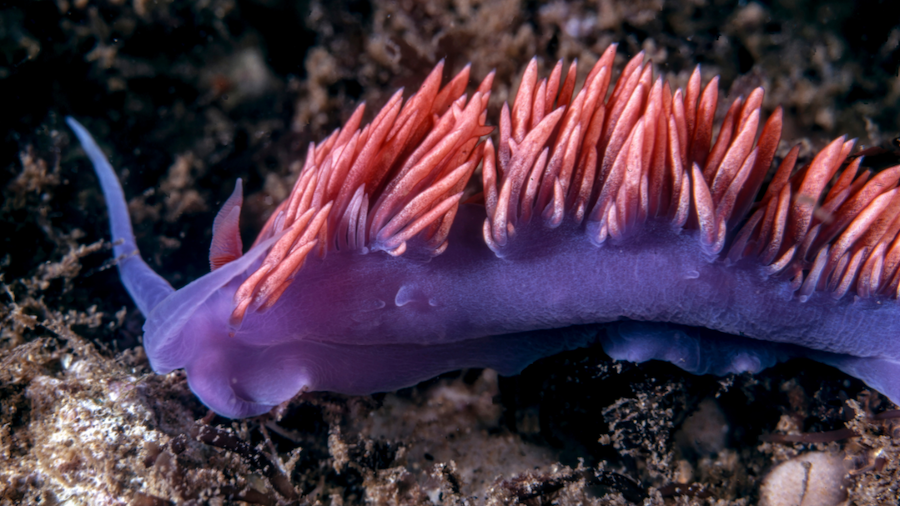
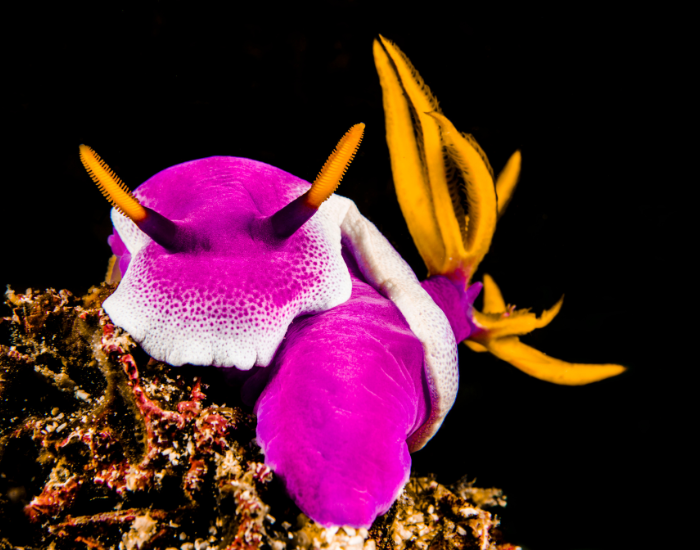
The word nudibranch means “naked gills.” Those feathery gills sit exposed on the back, with no shell to hide them. Nudibranchs belong to their own order, Nudibranchia, and around 3,000 different species have been described.
The first ones I picked out on my own were on reefs in the Philippines. You swim past them a dozen times before your eye adjusts. Then you start seeing them everywhere, on sponges and bare rock, louder in colour than anything around them.
On the head sit two horn-like tentacles called rhinophores. They taste and smell the water, which is how a nudibranch finds food, prey and a mate. Many species also carry cerata on their backs. These finger-like projections of varying lengths help them breathe, and in some they hold weapons.
Sizes run from about an eighth of an inch to roughly 30 cm. The Spanish dancer, Hexabranchus sanguineus, is the giant most divers meet, usually around 25 cm. It swims with a red skirt that ripples like silk. For more of their variety, see my guide to nudibranch species. The blue dragon floats at the surface in my coral reef dive, and finding it is one of the missions.
Sea Hares: Gentle Giants of Shallow Waters
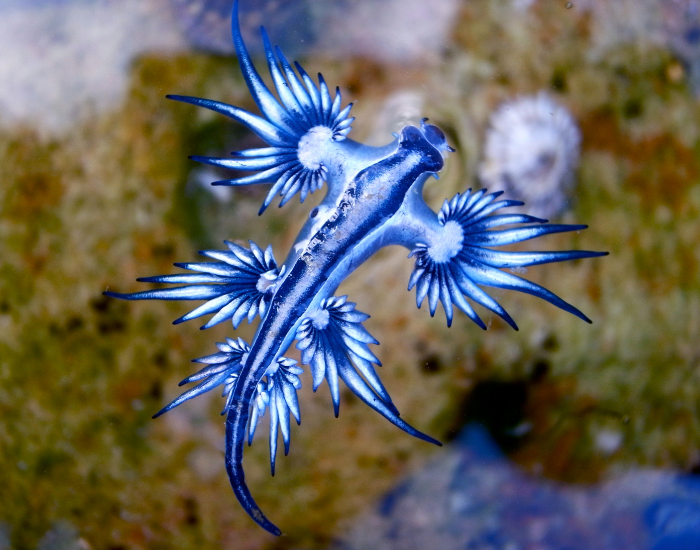
Sea hares are the heavyweights. They graze on algae in shallow waters, and the two long rhinophores on the head give them their name.
The California black sea hare, Aplysia vaccaria, is the largest sea slug on record. The biggest ever measured stretched to about 99 cm and weighed almost 14 kg. No other sea slug comes close.
When threatened, sea hares release a cloud of purple ink from glands in the mantle, much as squid do. Sea hares also changed neuroscience. Their few, giant nerve cells let Eric Kandel watch memories form at single connections. That research earned him a share of the 2000 Nobel Prize.
Sacoglossans: The Solar-Powered Sea Slugs
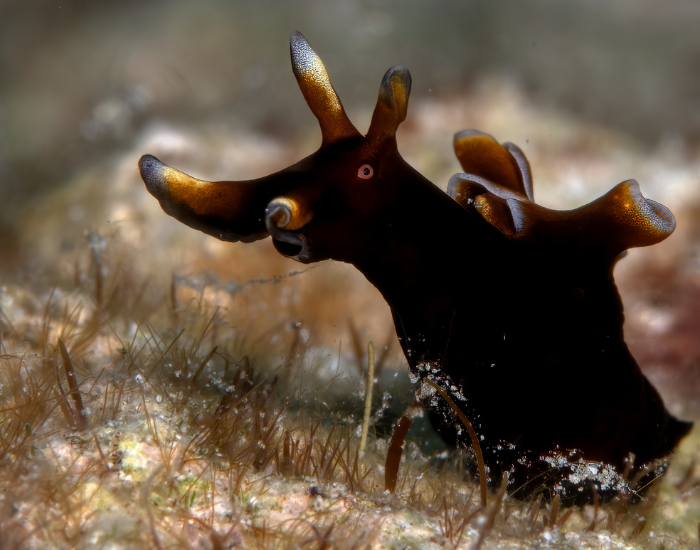
Sacoglossans pierce algae and suck out the contents. Some keep the algae’s chloroplasts alive inside their own cells, a trick called kleptoplasty. In the emerald elysia, Elysia chlorotica, those stolen chloroplasts keep photosynthesising for months.
Whether that actually feeds the slug is still argued over. In one experiment, slugs starved in the dark survived as long as slugs starved in the light. The chloroplasts work. What they contribute is the open question.
Then there is the strangest discovery of all. In 2021, researchers in Japan watched two Elysia species shed their entire body. The head kept crawling and feeding. It began regrowing a heart within a week, and had a new body in about three. Flatworms regrow bodies too, but no other animal with a heart is known to manage it.
Pleurobranchs: The Side-Gilled Slugs
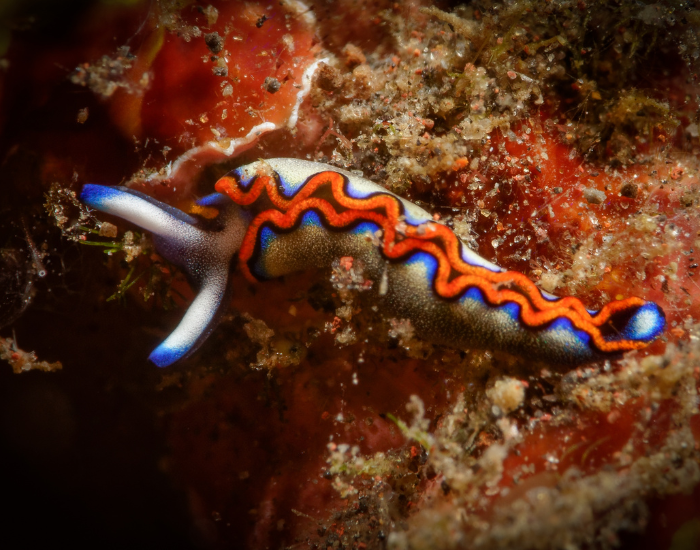
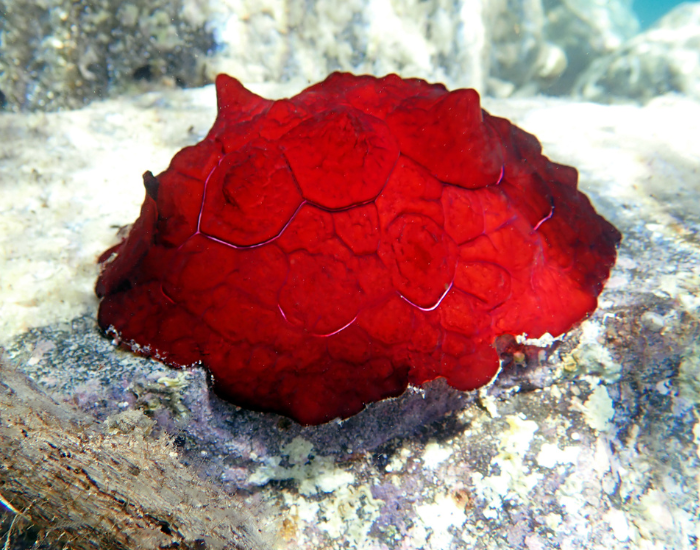
Pleurobranchs keep a single gill tucked along one side of the body. They are less showy than nudibranchs, and many feed on sponges while blending into the rock beneath them.
How Sea Slugs Defend Themselves
With no shell to hide behind, they evolved some of the cleverest defences in the ocean.
Warning Colours
Bright blues, yellows and oranges usually mean one thing to predators: you will regret this. Biologists call it aposematism. Many species feed on toxic sponges, store the toxins in their own tissues, and advertise it.
The warning isn’t always honest in equal measure. Several species can share one colour pattern and look identical to a fish. Yet compared with other species in the group, their actual toxicity varies widely.
Stolen Stinging Cells
Aeolid nudibranchs eat stinging animals like anemones and hydroids without being stung. Mucus and a specialised gut lining stop the stinging cells from firing on the way down.
Then they keep them. The unfired cells travel to sacs at the tips of the cerata and wait there, fully armed.
The blue dragon, Glaucus atlanticus, takes this furthest. It floats upside down at the ocean surface and eats bluebottles, the Portuguese man o’ war. Its sting can raise painful welts on a beachgoer, from an animal no longer than your thumb.

What Do Sea Slugs Eat?
Most sea slugs are carnivores with very specific tastes. Depending on the species, a sea slug eats sponges, hydroids, anemones, bryozoans, jellyfish or other sea slugs. A ribbon of tiny teeth called a radula scrapes food from rock and coral.
Sacoglossans and sea hares are the exceptions. They feed on algae, and in doing so they keep fast-growing seaweed from smothering a reef. A good example of a small animal doing a big job.

How Sea Slugs Mate and Lay Eggs
Most sea slugs carry both male and female reproductive organs at once. Any adult of the same species is a possible partner, and when two meet they usually exchange sperm both ways.
The eggs come out as ribbons and spirals, often glued to rocks or seagrass like a small frilled rose. Larvae hatch within days to weeks, drift with the plankton, then settle on the bottom to begin life as slugs.
What Eats Sea Slugs?
Toxins and colour help, but they still get eaten. Crabs, fish, sea spiders and larger nudibranchs all take them.
So, it turns out, do some corals. In feeding trials, four species of solitary mushroom coral could capture and swallow sacoglossans whole, and smaller slugs went first.
Why Sea Slugs Matter
They are small, but they hold real jobs on a reef. As targeted carnivores, many species crop sponges, hydroids and other fast-growing organisms that could otherwise crowd out coral. In turn they feed fish, crabs and corals, moving energy up the food web. Their waste and their bodies return nutrients to the system.
They also make good early warnings. These animals react quickly to changes in their environment, so conservationists use them to track ecosystem stress. During the 2014 Pacific marine heatwave, researchers collected sightings of 30 nudibranch species along the US coast. Nine turned up further north than ever recorded, one of them in Oregon instead of south of San Francisco. That is climate change showing up in a tide pool.

Quick Facts About Sea Slugs
A few glow. Bathydevius caudactylus, described in 2024 from more than a kilometre down, lights up when threatened. Researchers filmed it drop a glowing finger of its tail as a decoy. Add it to the list of bioluminescent animals.
They have a heart. They carry hemolymph rather than blood. A small heart pumps it through an open circulatory system, bathing the organs directly.
Sea bunnies are real. Jorunna parva looks like a tiny rabbit. The “ears” are rhinophores, and the fluff is a coat of microscopic rods.
Some breathe through their skin. Without a shell, oxygen passes through the body surface as well as the gills. It is one reason they are commonly the first to suffer in poor water.

Why Scientists Are Obsessed with Sea Slug Research
Scientists study sea slugs for multiple compelling reasons—from their neurobiology to their chemical defenses. During scientific expeditions, sea slug specimens are collected from their natural habitats, preserved, and later examined in laboratories or stored in research collections for further study. These research efforts have yielded groundbreaking discoveries about marine life and evolution.
Medical Research Applications
Compounds extracted from sea slugs’ prey have shown antibacterial, antifungal, and even anti-cancer properties in laboratory testing. The Aplysia genus, or sea hares, was pivotal in understanding memory and synaptic plasticity. This research earned Eric Kandel a Nobel Prize and revolutionized neuroscience.
FAQ About Sea Slugs
Most sea slugs are harmless to humans, but some like Glaucus atlanticus can deliver a painful sting. Never handle one without understanding its species first.
It’s best not to touch sea slugs. Oils from human skin can damage their delicate tissues, and some store venom from jellyfish prey. Looking is always better than touching.
While some species of sea hare are eaten in certain cultures, most sea slugs are toxic or unpleasantly flavored. They’re definitely not seafood for the curious traveler.
The Spanish dancer (Hexabranchus sanguineus) can exceed 60 cm in length, making it the largest. By contrast, the tiniest species are just a few millimeters long.
Species like the blue dragon and Glaucilla marginata store venomous stinging cells from jellyfish. Their sting can cause welts but is rarely dangerous to healthy humans.
They help maintain healthy reef ecosystems, recycle nutrients, and serve as bio-indicators for ocean changes. Their presence indicates thriving marine environments.
Look Closer at the Rocks
Sea slugs remind me why I fell for marine biology in the first place. Since that cold morning in Sweden I have found them again and again. Coral gardens across Southeast Asia, volcanic sand in the Pacific, kelp in Norway.
Every time, the colours stop me. They are small, slow, soft and shell-less. They have still found ways to steal stingers, borrow light from plants, and grow a new body from a head.
Next time you snorkel or walk a tide pool, slow right down. Look at the rock, not past it. The ocean’s best work is often crawling just under your hand.
Wildlife Nomads Challenge
The Naked Gills Challenge
Ten questions on stolen stingers, solar-powered slugs and a head that grows a new body. Instant feedback after every answer.
References:
Christa, G., Zimorski, V., Woehle, C., Tielens, A. G. M., Wägele, H., Martin, W. F., & Gould, S. B. (2014). Plastid-bearing sea slugs fix CO2 in the light but do not require photosynthesis to survive. Proceedings of the Royal Society B: Biological Sciences, 281(1774), 20132493. https://doi.org/10.1098/rspb.2013.2493
Churchill, C. K. C., Valdés, Á., & Ó Foighil, D. (2014). Molecular and morphological systematics of neustonic nudibranchs (Mollusca: Gastropoda: Glaucidae: Glaucus), with descriptions of three new cryptic species. Invertebrate Systematics, 28(2), 174–195. https://doi.org/10.1071/IS13038
Goddard, J. H. R., Treneman, N., Pence, W. E., Mason, D. E., Dobry, P. M., Green, B., & Hoover, C. (2016). Nudibranch range shifts associated with the 2014 warm anomaly in the Northeast Pacific. Bulletin of the Southern California Academy of Sciences, 115(1), 15–40. https://doi.org/10.3160/soca-115-01-15-40.1
Kandel, E. R. (2001). The molecular biology of memory storage: A dialogue between genes and synapses. Science, 294(5544), 1030–1038. https://doi.org/10.1126/science.1067020
Mitoh, S., & Yusa, Y. (2021). Extreme autotomy and whole-body regeneration in photosynthetic sea slugs. Current Biology, 31(5), R233–R234. https://doi.org/10.1016/j.cub.2021.01.014
Robison, B. H., & Haddock, S. H. D. (2024). Discovery and description of a remarkable bathypelagic nudibranch, Bathydevius caudactylus, gen. et sp. nov. Deep-Sea Research Part I: Oceanographic Research Papers, 214, 104414. https://doi.org/10.1016/j.dsr.2024.104414
Winters, A. E., Wilson, N. G., van den Berg, C. P., How, M. J., Endler, J. A., Marshall, N. J., White, A. M., Garson, M. J., & Cheney, K. L. (2018). Toxicity and taste: Unequal chemical defences in a mimicry ring. Proceedings of the Royal Society B: Biological Sciences, 285(1880), 20180457. https://doi.org/10.1098/rspb.2018.0457