
Last May, I sat under a flowering jacaranda in Oaxaca, sipping bitter coffee while three different oriole species worked the same tree. A Hooded Oriole hung upside down on a tubular blossom. An Altamira Oriole, bigger and bolder, tore into a half-rotten papaya. Above them, a Streak-backed Oriole flicked through the high branches like a flame against the lavender petals. I forgot my camera was even on.
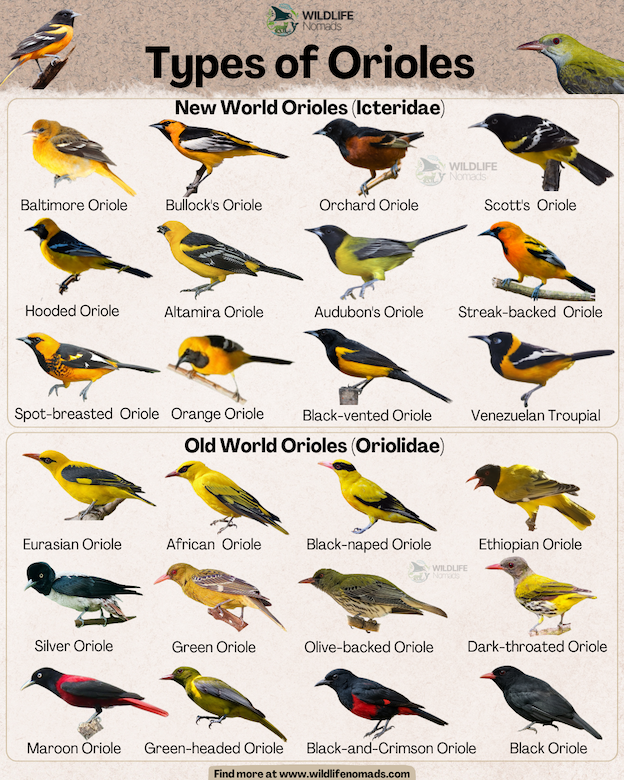
That morning rewired how I think about the oriole. After writing about the Baltimore Oriole last month, readers kept asking the same follow-up: how many other oriole species exist, and which ones actually matter? The answer is bigger than most people expect. New world orioles in the genus Icterus number 33 species. Old world orioles add roughly thirty more in a completely unrelated family. They evolved on separate continents yet wear strikingly similar plumage, a textbook case of convergent evolution. Here are the 15 I think every birder, from Maryland to Malaysia, should learn to recognize.
1. Baltimore Oriole (Icterus galbula)
I will keep this short, since I just wrote a whole post on this fiery bird. The Baltimore Oriole is the most famous of all North American orioles, the state bird of Maryland, and the inspiration for an entire baseball franchise. It nests across the eastern united states and slips into Mexico and Central America each winter. Males blaze orange and black; females wear a softer, dull yellow wash with grayish wings.
Two facts surprise most people. First, this species was once lumped with bullock’s oriole under the same vernacular name — “northern oriole” — before genetic work in the 1990s split them again into two species. Second, the oldest recorded Baltimore Oriole lived more than 11 years in the wild, which is extraordinary for a 30-gram migrant that crosses the Gulf of Mexico twice a year. Icterus galbula is the bird most people picture when they hear the word “oriole.”

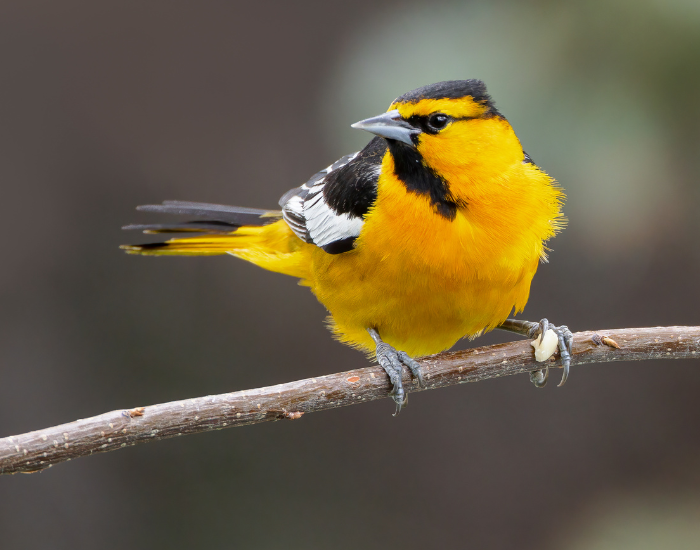
2. Bullock’s Oriole (Icterus bullockii)
Bullock’s Oriole is the western counterpart to the Baltimore. It haunts cottonwood galleries from California to the western Great Plains. Where the two species’ ranges overlap, they still hybridize, which is exactly why mid-century taxonomists merged them. Today they stand again as two species, closely related, but distinct in DNA, song, and face pattern.
The male’s bright orange face and bold white wing patch made identification trivial. He was hammering at a green caterpillar while his mate fed nearby, her plumage closer to gray-yellow than orange. Like the Baltimore, this Oriole readily visits backyard feeders stocked with citrus and sugar water.
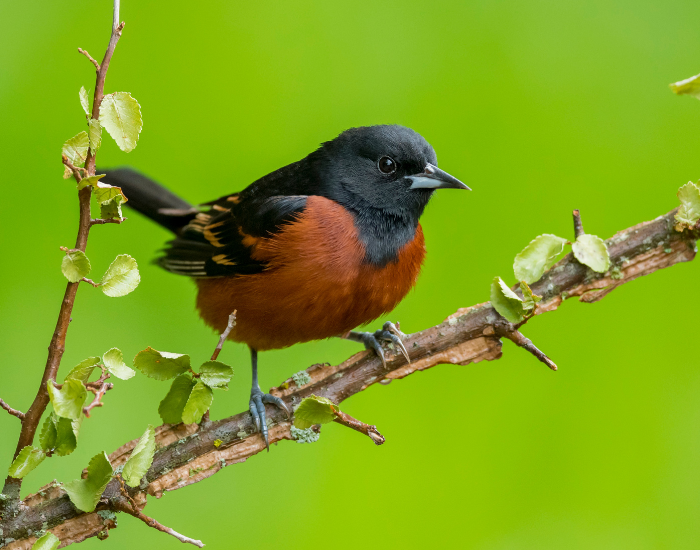
3. Orchard Oriole (Icterus spurius)
The Orchard Oriole is the smallest oriole in North America and easy to misidentify. Adult males are not orange at all, they are a deep chestnut, a much deeper orange than the Baltimore, almost burgundy in low light, with a sharp black hood. Second year first-spring (SY) males throw everyone off. They still look female-yellow but carry a small black bib, fooling even experienced birders.
If you are birding, you may spend a lot of time convinced you are seeing four different species.But you may be looking at one. With orchard orioles, always check the bib before celebrating a rarity.
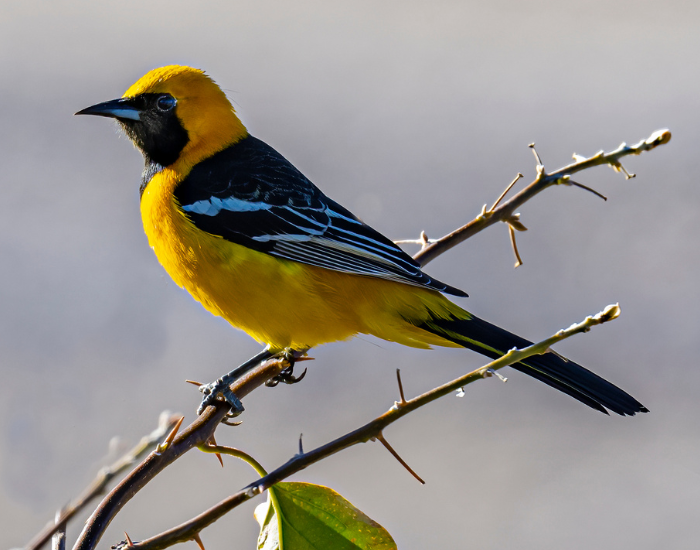
4. Hooded Oriole (Icterus cucullatus)
Hooded Orioles are the orioles of the American southwest, sliding north from Mexico into Texas, Arizona, and southern California each spring. Males wear a flame-colored head and back, with a black mask and bib. Females are a uniform yellowish orange.
This species has a habit that delights backyard birders. Hooded Orioles regularly visit hummingbird feeders, lapping sugar water with a brushy tongue. If you live anywhere from southern Texas to San Diego, swap your hummingbird feeders for ones with larger ports in April and you will likely pull in this species. I have also watched them shred palm fronds to weave a hanging nest. In suburban Los Angeles, the bird has essentially become a palm-tree specialist.
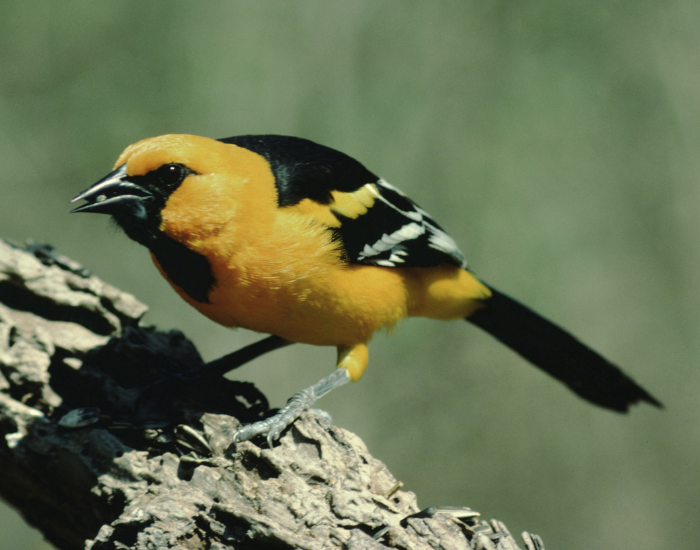
5. Altamira Oriole (Icterus gularis)
If a Baltimore Oriole hit the gym for a year, you would get an Altamira Oriole. Icterus gularis is the largest member of the genus Icterus — heavy-billed, deep-bodied, and noticeably less wary than its smaller cousins. The bird reaches the US only in the lower Rio Grande Valley of southern Texas but is common across eastern Mexico and Central America.
The nest is what stuns people on first sight. I have measured pouches over two feet long, woven from grass and Spanish moss, hanging from a single high branch. Local birders in Tamaulipas told me the bird’s nest used to be sold at markets as a folk charm. Today the Altamira Oriole is one of the easiest tropical orioles to find, often gracing feeding stations stocked with orange halves and a deeper orange variety of mango.
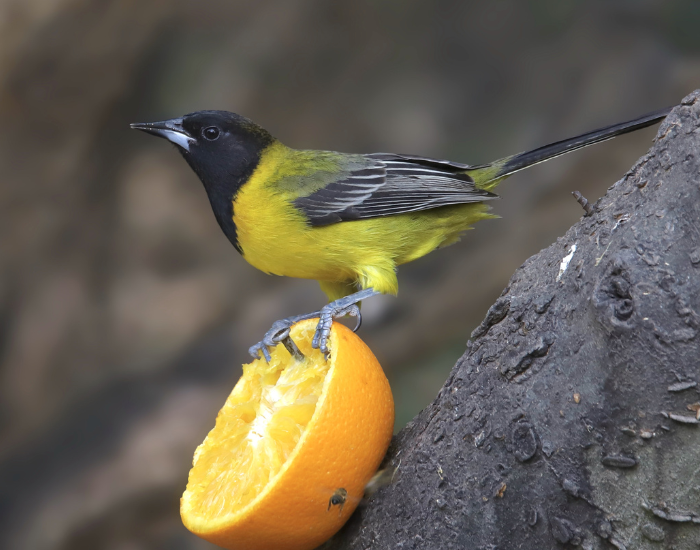
6. Audubon’s Oriole (Icterus graduacauda)
Audubon’s Orioles are shy. While most orioles announce themselves, this species skulks in dense thornscrub along the Texas-Mexico border. Males and females look alike: a clean yellow body, jet black hood, black wings, and notably long tails. The Latin name graduacauda literally means “graduated tail.”
Their song is a slow, mournful whistling song, four or five notes that drift through the brush like someone learning a flute. I tracked one for forty minutes outside Falcon Lake (Falcon State Park) before getting a clean view. The bird never came lower than ten meters off the ground. If you want to find Audubon’s Orioles, learn the song first, then walk the brush silently.
7. Scott’s Oriole (Icterus parisorum)
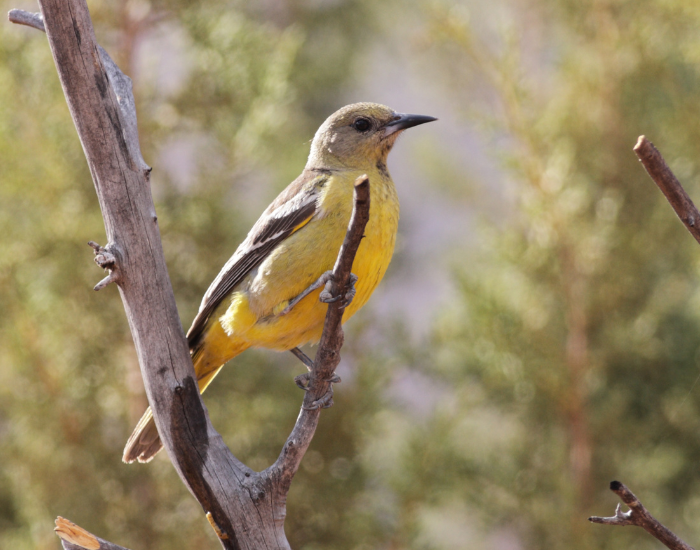
Scott’s Oriole is the desert oriole. Tied to yucca and Joshua tree stands across the American southwest and northern Mexico, it builds its nest by stripping fibers from yucca leaves. Males are lemon-yellow and black; females are a dull yellow with faint streaking.
The song is loud and fluty, more meadowlarks than typical oriole, which makes sense, since meadowlarks belong to the same broader family (Icteridae) and share that ringing, whistled quality.
8. Streak-backed Oriole (Icterus pustulatus)
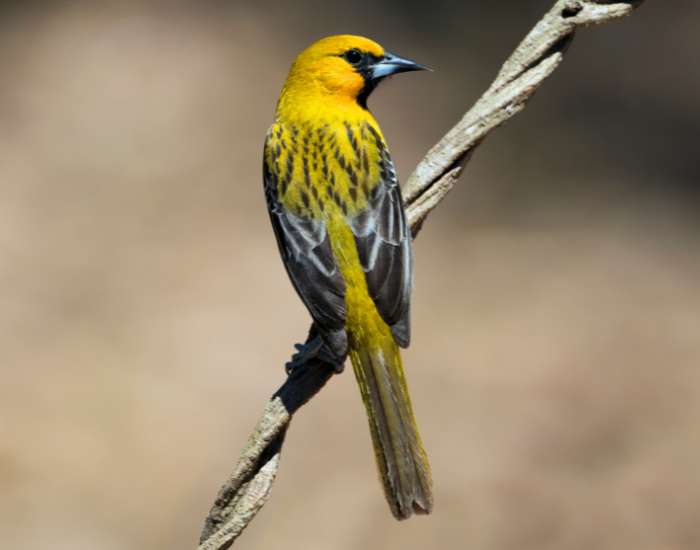
The Streak-backed Oriole is a Pacific slope specialist, ranging from northwest Mexico down into Costa Rica. As the name suggests, the back is streaked with black on orange — diagnostic if you get a decent look. Vagrants occasionally cross into Arizona and California, sparking minor frenzies on birding hotlines.
I have watched streak-backs raid fig trees in the Pacific coast. They feed alongside great-tailed grackles and tropical kingbirds, the orange of their plumage almost neon against unripe green fruit. Their diet leans heavily on soft fruits during the dry season, supplemented by insects when caterpillar booms hit.
9. Spot-breasted Oriole (Icterus pectoralis)
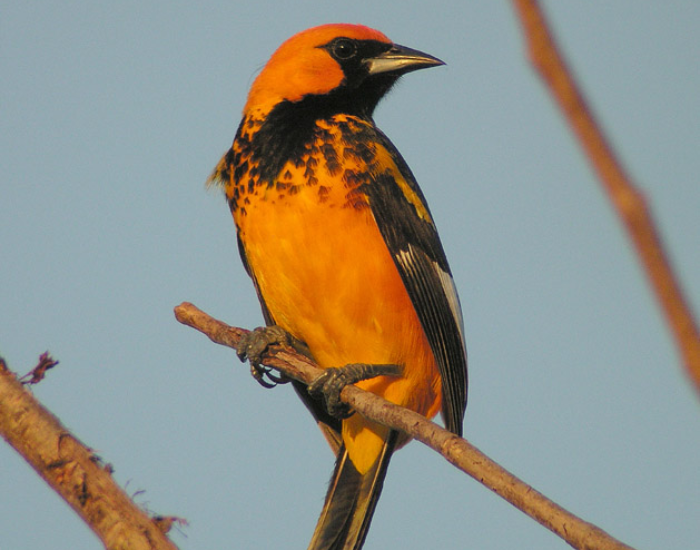
Here is the oddball. The Spot-breasted Oriole is native to the Pacific slope of Central America, but a small introduced population has thrived in south Florida since the 1940s. If you spot an oriole in a Miami yard, this is probably what you are looking at — orange body, black face, and a distinct row of black spots on the breast.
I saw my first one feeding on a banana stalk in a hotel backyard in Chiapas. The staff member had no idea the bird was non-native. To her it was just “the oriole that visits every morning.” Florida birders treat it as a single species worth counting, but its long-term wild status in the Caribbean basin remains debated.
10. Yellow-backed Oriole (Icterus chrysater)
The Yellow-backed Oriole prefers the high branches of montane forest from southern Mexico down through Colombia and Venezuela. Both sexes are clean yellow on the body, black on the wings, tail, and face. There is no orange anywhere — a refreshing change after working through twelve flame-colored species. The Yellow-Backed Oriole song is a soft, paired whistling.
You can often find them in mixed flocks with toucanets and trogons. They forage methodically through dense foliage, more like a warbler than a typical oriole.
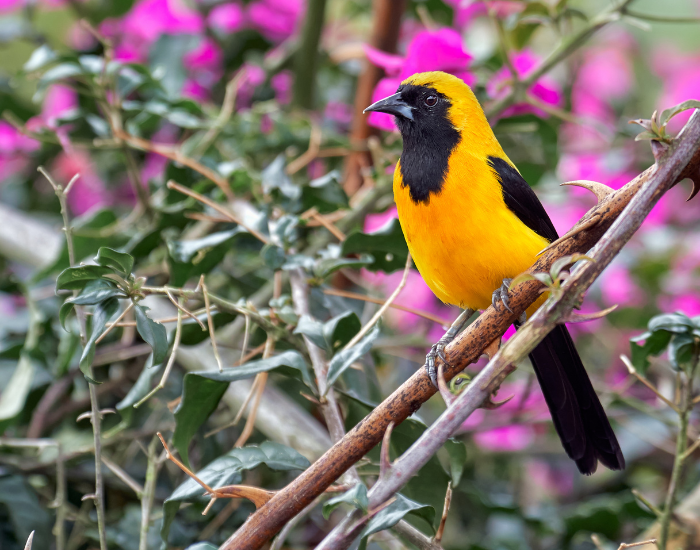
11. Black-vented Oriole (Icterus wagleri)
Wagler’s Oriole, more commonly called the Black-vented Oriole, is a bird of mid-elevation Mexico and Guatemala. Adults are deep orange and black with, as the name promises, a black vent. Younger birds are a softer yellow.
This species drifts into Big Bend National Park in Texas every few years, and twitchers fly in within hours of a confirmed sighting. I missed one in 2019 by a single day. That hurt almost as badly as losing my Mexico photo card.
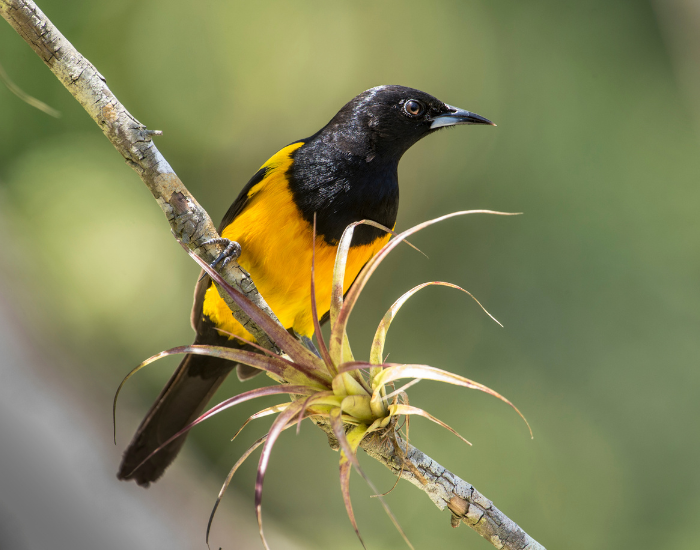
12. Yellow Oriole (Icterus nigrogularis)
The Yellow Oriole of northern South America is unmistakable: bright lemon-yellow body, black throat, black mask, and black wings edged in white. It also reaches the Caribbean islands of Aruba and Curaçao, where it acts as a tame, almost garden-bird species. Locals on Aruba simply call it “trupial cabaye.” Identification is easy, this is the only oriole in its range with that combination of bright yellow body and pitch-black throat.
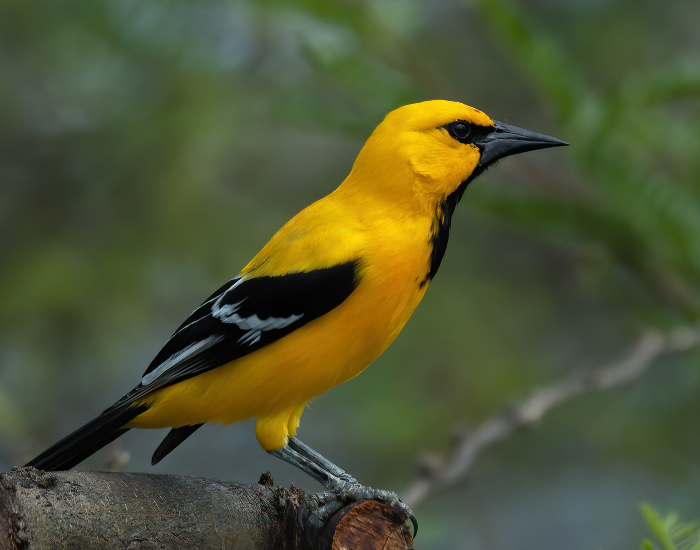
13. Eurasian Golden Oriole (Oriolus oriolus)
Now we cross oceans. The Eurasian Golden Oriole is the most widespread member of the old world orioles in the family Oriolidae. The bird breeds across Europe and western Asia, then migrates to Africa for winter. Males are a brilliant gold and black; females are a softer greenish-yellow.
Here is the wild part. The Eurasian Golden Oriole and the Baltimore Oriole are not closely related at all. The visual resemblance is convergent evolution (like echidnas, porcupines and tenrecs), two separate lineages arriving at the same color scheme because it works in dappled canopy light. The French call this bird loriot d’Europe, and its rolling whistling song is, for many Europeans, the sound of summer. I first heard it in a Croatian beech forest and assumed I was imagining a Baltimore Oriole until my host laughed and corrected me.
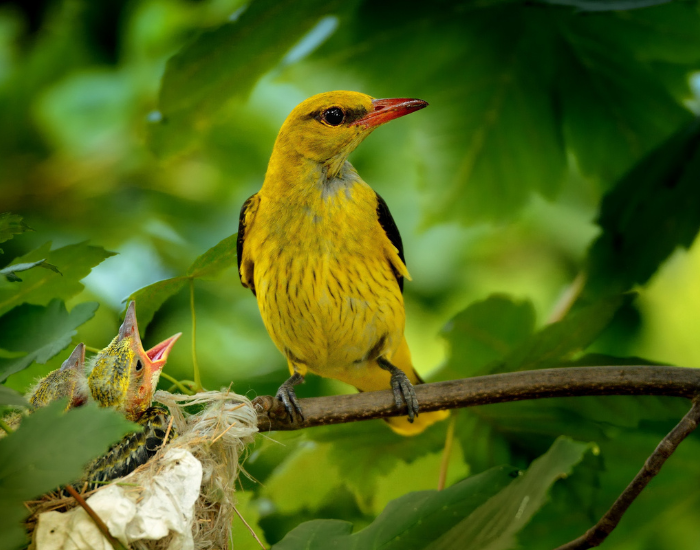
14. African Black-headed Oriole (Oriolus larvatus)
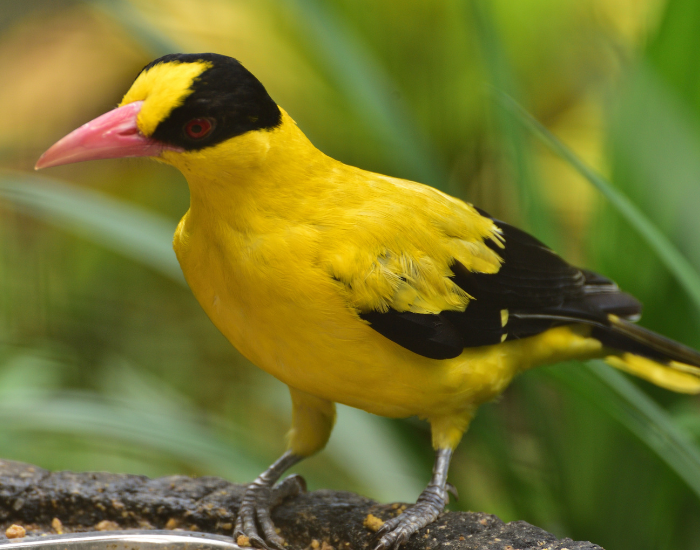
The Black-headed Oriole is the most common oriole across savanna and woodland in eastern and southern Africa. Adults sport a glossy black hood over a vivid yellow body, with a coral-pink, slightly closed bill you can spot from twenty meters off.
I logged dozens of Black-headed Orioles in Kruger National Park, almost always near fruiting figs. The species is listed as Least Concern by BirdLife International, but habitat loss in some regions is starting to thin local populations. They are fruit eating birds at heart, taking figs, mulberries, and other small berries, though they will also take insects and the occasional small lizard.
15. Black-naped Oriole (Oriolus chinensis)
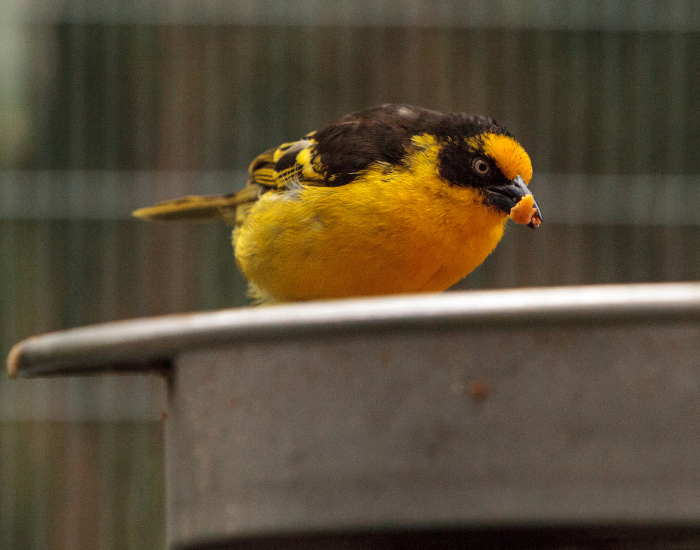
We end in Asia. The Black-naped Oriole ranges from India and Southeast Asia up through eastern China and the Philippines. Males glow almost neon yellow, broken by a thick black eye-band that wraps around the back of the head like a bandana.
I watched a pair raise chicks in a Langkawi, Malaysia, taking turns shuttling caterpillars from a flowering Albizia. Their loud whistling song carries through dense rainforest better than any other call in the area. Like other old world orioles, this species shows a strikingly similar body plan to our American Icterus despite tens of millions of years of independent evolution. The convergence is one of my favorite stories in biology, and a useful reminder that “oriole” is more of a costume than a family.
FAQs about Orioles
Oriole eggs are pale grayish-white to bluish-white, scrawled with dark brown and black markings, particularly heavy at the larger end. A typical clutch holds 3 to 6 eggs. The pattern is so distinctive that many field biologists can identify an oriole nest at first sight, even before the parents arrive.
To attract baltimore orioles, hang halved oranges, offer grape jelly in shallow dishes, and put up dedicated oriole feeders in early spring before migration peaks. Orioles seek the sweetest, ripest produce, they tend to ignore green grapes and gravitate toward dark colored fruit like the darkest mulberries, deepest purple grapes, and reddest cherries. Yellow cherries get sampled but rarely stripped. Pull feeders down in late summer; the birds keep heading south.
Yes. Many orioles enjoy nectar and will visit hummingbird feeders, especially hooded orioles and Bullock’s orioles. Use a feeder with larger ports so the oriole’s closed bill can reach the sugar water. In the tropics, wild orioles drink nectar from balsa, kapok, and Erythrina flowers, often functioning as important pollinators alongside hummingbirds.
The Global Orange-and-Black
What strikes me most after twenty years of chasing these birds is how the orange-and-black uniform shows up on every continent except Antarctica, yet the wearers are not related. That is convergent evolution doing what it does best.
If you have only ever seen a Baltimore oriole at a backyard feeder, treat this list as a travel itinerary. Audubon’s orioles in south Texas, golden orioles in a Spanish olive grove, and black-headed orioles in a South African fig tree are all worth the trip. For more on the broader world of types of birds, or the songbird-rich birds of Canada, I have you covered. And since orioles share their world with hawks, falcons, and other birds of prey, knowing the predators helps you understand why orioles nest so high. Drop a comment below telling me which oriole you have seen — I read every one.
References:
Powell, A. F. L. A., Barker, F. K., Lanyon, S. M., Burns, K. J., Klicka, J., & Lovette, I. J. (2014). A comprehensive species-level molecular phylogeny of the New World blackbirds (Icteridae). Molecular Phylogenetics and Evolution, 71, 94–112. https://doi.org/10.1016/j.ympev.2013.11.009
Jønsson, K. A., Bowie, R. C. K., Moyle, R. G., Christidis, L., Norman, J. A., Benz, B. W., & Fjeldså, J. (2010). Phylogeny and biogeography of Oriolidae (Aves: Passeriformes). Ecography, 33(2), 232–241. https://doi.org/10.1111/j.1600-0587.2010.06167.x
Rising, J. D., & Flood, N. J. (2020). Baltimore Oriole (Icterus galbula). In Birds of the World (P. G. Rodewald, Editor). Cornell Lab of Ornithology. https://doi.org/10.2173/bow.balori.01
Pleasants, B. Y., & Albano, D. J. (2020). Hooded Oriole (Icterus cucullatus). In Birds of the World (A. F. Poole, Editor). Cornell Lab of Ornithology. https://doi.org/10.2173/bow.hooori.01
Winkler, D. W., S. M. Billerman, and I. J. Lovette (2020). Old World Orioles (Oriolidae), version 1.0. In Birds of the World (S. M. Billerman, B. K. Keeney, P. G. Rodewald, and T. S. Schulenberg, Editors). Cornell Lab of Ornithology, Ithaca, NY, USA. https://doi.org/10.2173/bow.orioli1.01
Kondo, B., Peters, J. L., Rosensteel, B. B., & Omland, K. E. (2008). Coalescent analyses of multiple loci support a new route to speciation in birds. Evolution, 62(5), 1182–1191. https://doi.org/10.1111/j.1558-5646.2008.00345.x