The Galápagos Islands have a way of making a biologist feel like a kid in a candy store. Even for those of us who spend time trekking through Scandinavian forests or the Australian bush, there is something primordial about stepping onto those volcanic shores.
Recently, my partner returned from a stint in the archipelago. She recounted stories of wandering past prehistoric tortoises, dodging neon-colored crabs on the rocks, and snorkeling with hammerhead sharks and playful sea lions. But one afternoon, while resting on a white-sand beach, she looked up and saw a silhouette that looked less like a bird and more like a prehistoric pterodactyl.
It was a lone magnificent frigatebird, suspended in the thermal updrafts, its deeply forked tail twitching like a rudder. Didn’t flap at all. It just… existed, effortlessly, in the air.
I’ve always been fascinated by “extremists”—species that push the boundaries of what is evolutionarily possible. Whether it’s the resilient desert wildlife that thrives in blistering heat or the specialized animals of the arctic who are creatures that survive the impossible in sub-zero voids, I love a good underdog story. Frigatebirds are the ultimate avian version of these extremists. They are the only seabirds that are essentially allergic to the sea, yet they spend months at a time flying over it, defying the standard rules of marine biology.
Here are 12 facts about frigatebirds that will make you look at tropical skies very differently.

1. There Are Five Species — Not Just One
When we talk about frigatebirds, we are talking about the family Fregatidae. There is only one genus, Fregata, which contains five extant species. Sailors used to call them “Man-o’-War” birds, a nod to the fast naval frigates used by pirates. It’s a fitting name for a bird that makes its living through speed, maneuverability, and a bit of light robbery.
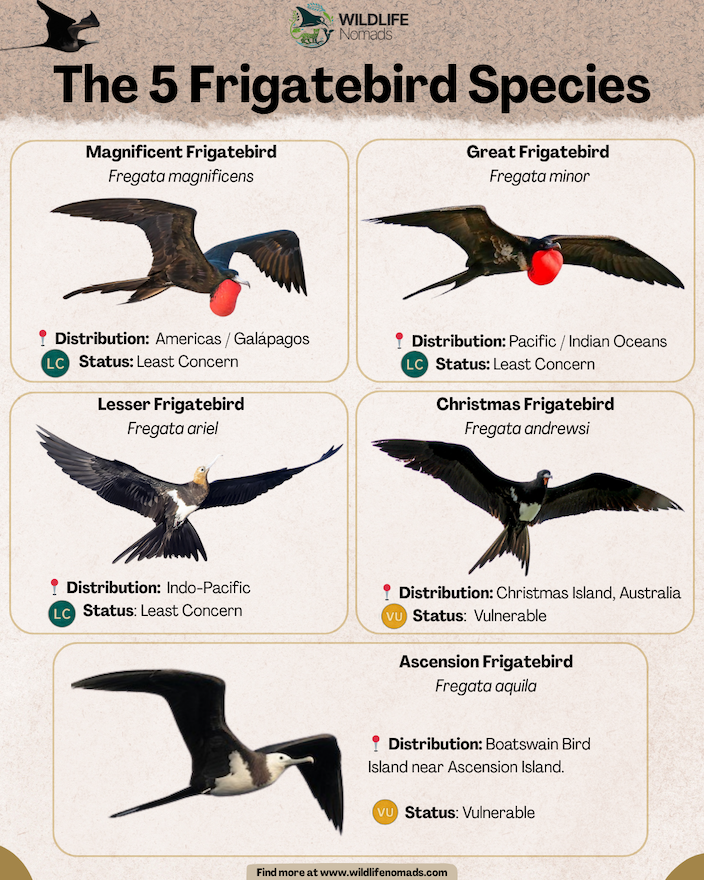
The Five Species of Frigatebirds
While they all share a similar “V-shape” silhouette, the species are distinct:
- Magnificent Frigatebird (Fregata magnificens): The giant of the Americas.
- Great Frigatebird (Fregata minor): Found across the Pacific and Indian Oceans.
- Lesser Frigatebird (Fregata ariel): The smallest of the bunch.
- Ascension Frigatebird (Fregata aquila): Found only on Boatswain Bird Island near Ascension Island.
- Christmas Frigatebird (Fregata andrewsi): An endangered species endemic to Christmas Island.
Recent phylogenetic findings suggest that while they look nearly identical to the untrained eye, these species diverged millions of years ago, adapting to specific tropical oceans and subtropical oceans across the globe.
2. They Can’t Get Wet — Despite Being Seabirds
This is the central paradox of the frigatebird. Almost every other seabird—from penguins to auks—has preen glands that produce waterproof oils. Frigatebirds do not.
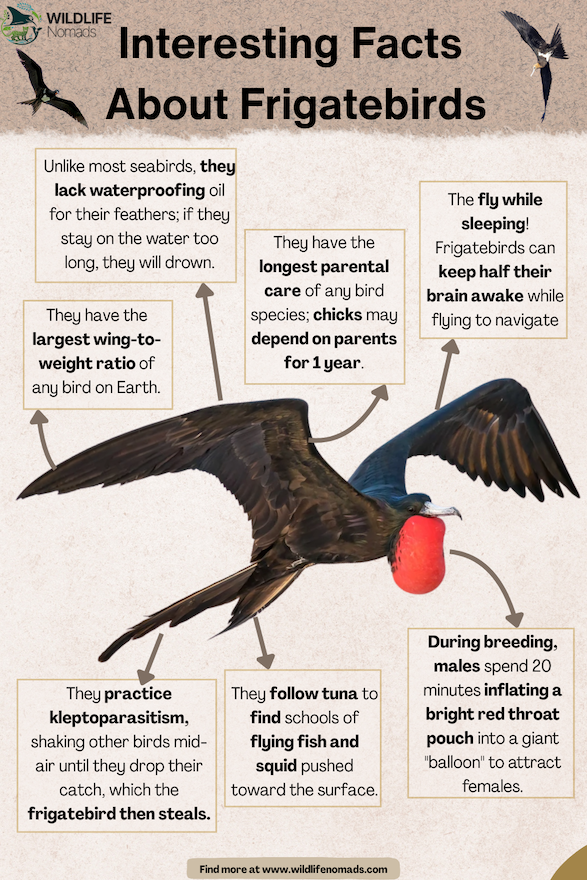
If a frigatebird lands on the water’s surface, its feathers become waterlogged. Because their legs are tiny and their wings are massive, they cannot take off from the water. If they stay in the sea for more than a few minutes, they will drown.
This “flaw” has forced them to become the most skilled pilots in the sky. They must catch prey (like small fish and flying fish) without ever touching the water. They use their hooked beaks to snatch food from the surface with surgical precision.
3. The Magnificent Frigatebird Has the Largest Wing-to-Weight Ratio of Any Bird
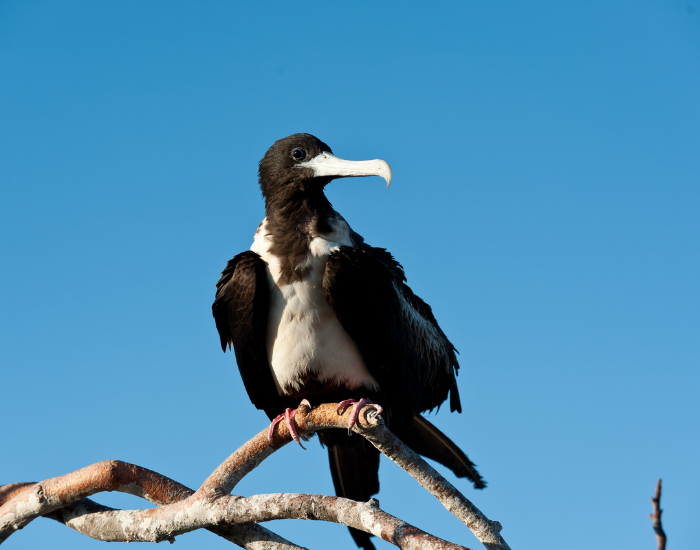
The magnificent frigatebird (Fregata magnificens) is the largest of all five species. It boasts a wingspan of up to 2.44 metres — nearly eight feet — while weighing only 1.1 to 1.6 kilograms. That is roughly the weight of a bag of sugar, attached to wings wider than a full-grown adult is tall.
This extraordinary wing-area-to-body-weight ratio — the highest of any bird on Earth — allows frigatebirds to stay aloft for weeks at a time. They ride thermal updrafts like masters, climbing to altitudes above 2,000 metres and gliding for enormous distances without burning significant energy. To put it plainly: they are the most efficient fliers alive.
4. They Are Sky Pirates — Kleptoparasitism Is Their Superpower
In biology, stealing food from other animals is called kleptoparasitism. Frigatebirds have elevated it to an art form.
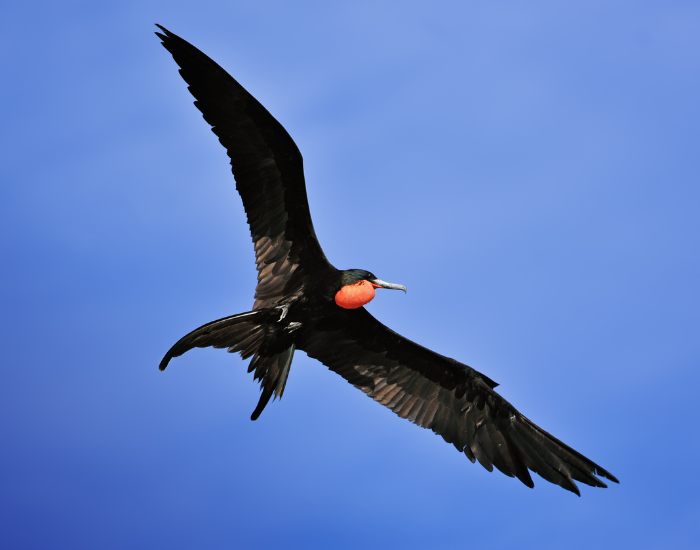
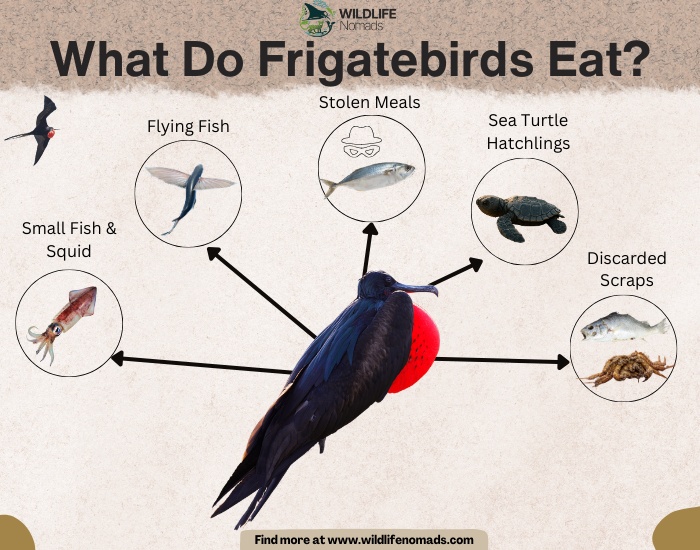
A frigatebird will target another seabird — a booby, a tern, even a smaller frigatebird — carrying a fresh catch. It then uses its deeply forked tail and angular wings to outmanoeuvre its target in the air. It grabs the other bird by the tail feathers and shakes it violently until the victim regurgitates its meal. The frigatebird dives, catching the stolen fish before it hits the water.
Interestingly, juveniles have been observed practising this behaviour by chasing each other with sticks in their mouths — a form of play that prepares them for adult piracy. However, research suggests kleptoparasitism accounts for only around five percent of their total diet. Most of their food comes from snatching flying fish and squid directly from the water’s surface mid-flight.
5. They Sleep While Flying
For a long time, this seemed like a biologist’s campfire myth. In 2016, a landmark study published in Nature Communications confirmed it. Researchers attached EEG devices to frigatebirds and recorded their brain activity during long oceanic flights.
The results were extraordinary. Frigatebirds use “unihemispheric slow-wave sleep” — one hemisphere of the brain shuts down while the other stays alert to navigate. Even more remarkable, both hemispheres sometimes shut down simultaneously for short bursts while the bird soars in rising air. During long ocean crossings, frigatebirds survive on less than an hour of sleep per day. When they return to land, however, they compensate with up to 12 hours of rest.
6. Males Have an Inflatable Red Throat Pouch
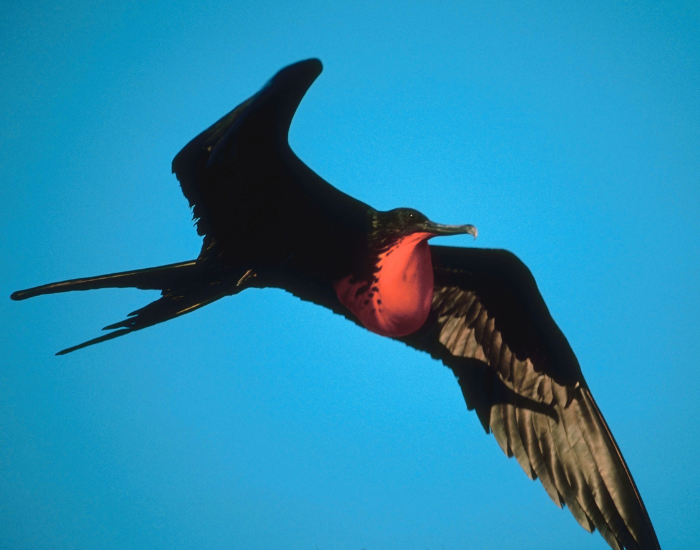
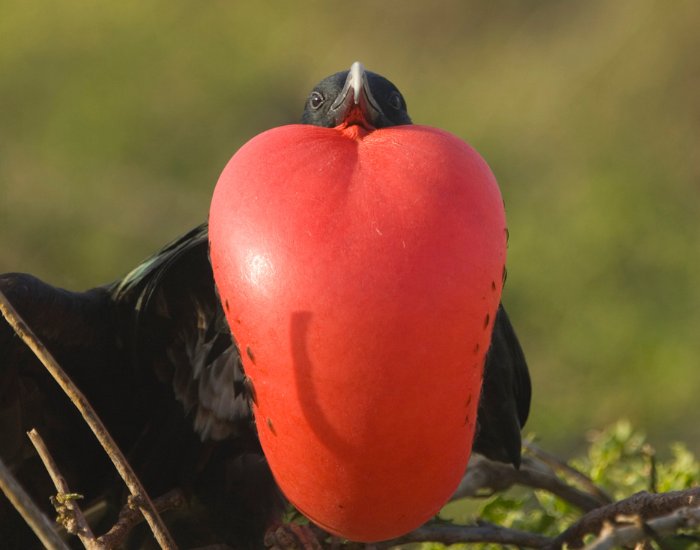
The male magnificent frigatebird’s gular sac is one of the most dramatic courtship displays in the natural world. During the breeding season, the male inflates this bright red pouch — which sits beneath his bill — into a balloon-like structure the size of a football. It takes him roughly 20 minutes to inflate it fully.
Males gather in nesting colonies, spreading their angular wings and vibrating them while pointing their bills skyward at passing females. Breeding colonies in the Galápagos Islands look, from a distance, like trees decorated with enormous red Christmas ornaments. Adult males are almost entirely black, with a distinctive purplish sheen on their back feathers when sunlight hits them. Great frigatebirds, by contrast, show a green sheen — a useful field distinction.
7. Females Look Completely Different
The Adult Male
The adult males are the showstoppers. They are almost entirely black with a purplish sheen on their feathers when the light hits them just right. But their claim to fame is the gular sac (or throat pouch). During the breeding season, this bright red balloon inflates to an incredible size to attract females.
The Adult Female
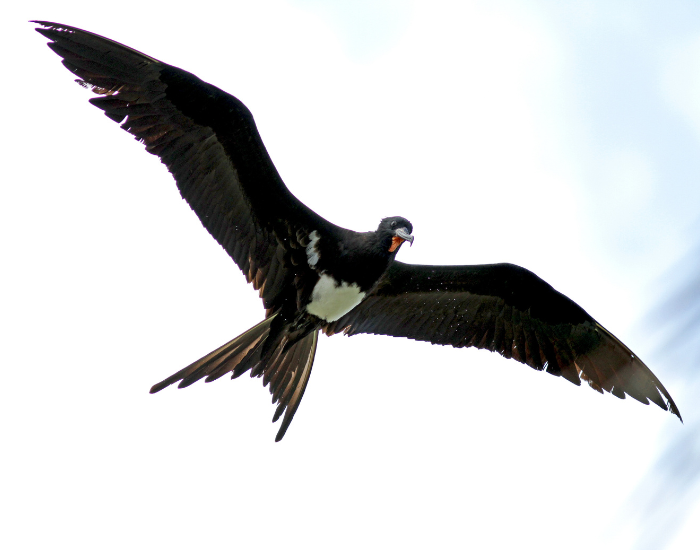
Females are actually slightly larger than males but lack the red pouch. Instead, an adult female features a distinct white chest or white breast patch. If you see females flying overhead, look for that bright white contrast against their dark underparts.
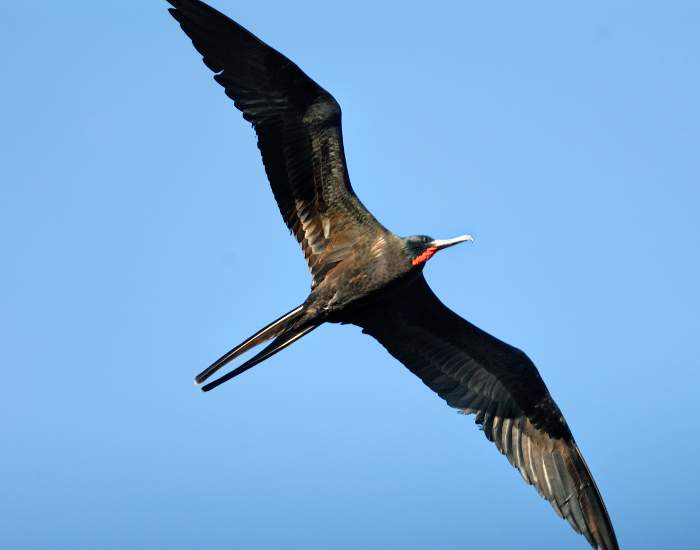
8. Juvenile Birds Can Confuse Even Experienced Birders
Young birds or juveniles are the easiest to confuse with other types of bird. They typically have a white head and white underparts, which can lead novice birders to mistake them for certain other seabirds or even small albatrosses (though they are not related).
The key to identifying juveniles is the overall shape: long, narrow angular wings forming a distinctive “W” silhouette in flight, and that signature deeply forked tail opening and closing like scissors. No other bird in tropical oceans has quite this combination. Size helps too — they are large seabirds, significantly bigger than any gull or tern sharing the same airspace.
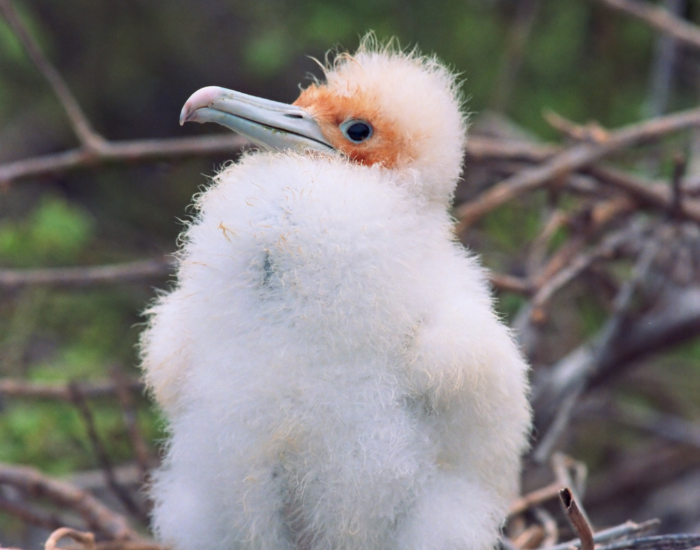
9. They Breed in Noisy, Chaotic Colonies
Frigatebirds prefer specific breeding habitat: wind-swept ridges, mangrove trees, and low shrubs on offshore islands and coastal areas where launching into the air is easy. They cannot walk well on land — their legs are too small — so a good take-off point is non-negotiable.
Nesting colonies are dense, loud, and fascinating. Females build the nest from sticks and twigs brought to them by the males they select. Both parents share incubation duties initially, but the male departs after a few months. The female remains to feed and protect the chick. The single egg takes approximately 55 days to hatch. After hatching, the chick depends entirely on its mother for food.
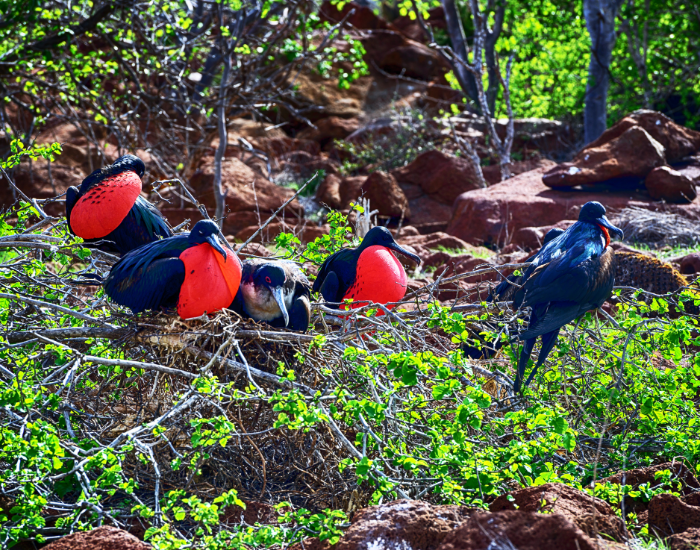
10. They Have the Longest Parental Care of Any Bird
Frigatebirds lay only a single egg per breeding season. However, what makes their reproduction extraordinary is what happens after hatching. The male stays for roughly 90 days post-hatch. The female then takes over, continuing to feed and guard the juvenile for up to nine more months.
In total, frigatebird parental care extends to around a year — the longest recorded for any bird species on Earth. This extremely slow reproductive rate means populations recover slowly from any disturbance to their breeding habitat. A pair that loses a nest to an invasive predator or a storm cannot simply try again that same season.
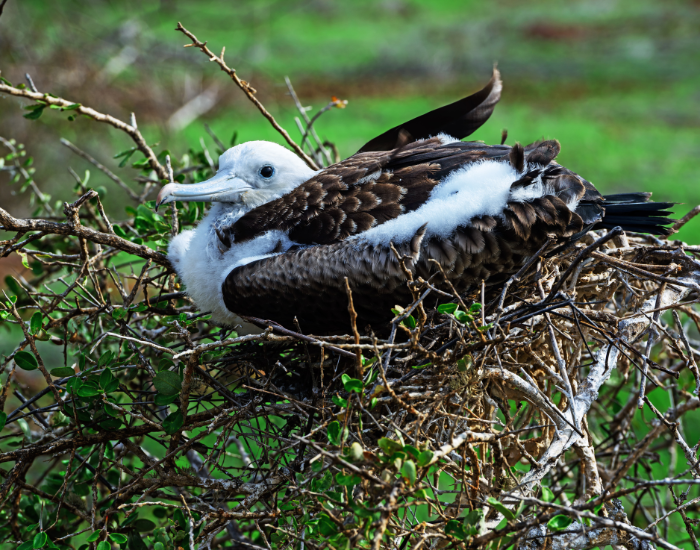
11. They Use Predatory Fish to Find Their Own Prey
Frigatebirds are intelligent hunters. Rather than scanning the ocean surface randomly, they watch for large predatory fish — particularly tuna — hunting below the surface. When tuna drive schools of small fish upward toward the surface, flying fish and squid leap into the air to escape. Frigatebirds position themselves directly above these feeding frenzies, snatching prey from the air or from the very top of the water’s surface.
This is why you often spot frigatebirds in groups over apparently empty ocean. They are tracking tuna. It is a beautiful example of inter-species dependency — and one reason why overfishing directly threatens frigatebird food availability across tropical oceans.
12. Two Species Are Endangered — And All Five Face Growing Threats
The magnificent frigatebird is currently listed as Least Concern by the IUCN. However, the Christmas Frigatebird (Fregata andrewsi) is listed as Vulnerable, restricted to a single island. The Ascension Frigatebird (Fregata aquila) is also Vulnerable, with its entire breeding population on one small island.
The precarious nature of these birds has led to urgent conservation efforts. As of 2025, researchers from the School of Biological Sciences have launched an active monitoring project on Christmas Island to track nesting pairs during the peak breeding season. This project utilizes Remotely Piloted Aircraft (RPAS)—drones—to conduct aerial surveys over key colonies like the golf course and cemetery.
Beyond historical threats like coastal development and invasive predators (rats and cats), two modern crises have taken center stage:
- Avian Disease: There is a major risk regarding the potential incursion of Highly Pathogenic Avian Influenza (HPAI H5N1), which could devastate concentrated nesting colonies.
- Climate Change: Shifting prey distributions in tropical oceans continue to force these birds to travel further for food, threatening the survival of their chicks.
Where to See Frigatebirds in the Wild
The magnificent frigatebird is the species most visitors encounter. The Galápagos Islands offer some of the best viewing in the world, particularly on Española and North Seymour islands, where massive breeding colonies gather. The Caribbean, Florida coastline, and coastal areas of Central and South America are also reliable places to spot them soaring overhead.
For the great frigatebird, look to Hawaii, the Maldives, and islands across the Pacific. The Christmas Frigatebird requires a trip to Christmas Island itself — one of the most remote wildlife destinations on Earth.
Here is a list of 3 wildlife tours where you can seefrigatebirds in the wild. As a biologist, I only recommend tours that follow strict ethical guidelines to ensure we don’t disturb wildlife. These are the three tours/ partners I trust most based on their conservation records:
FAQs you may Know
Their feathers lack waterproofing oils found in most other seabirds. Waterlogged plumage, combined with tiny feet and massive wings, makes taking off from water impossible. They would drown.
Primarily fish and squid, caught from the surface mid-flight. They also steal food from other seabirds through kleptoparasitism, and occasionally take crustaceans, jellyfish, newly hatched sea turtles, and even the eggs or chicks of other birds.
Estimates suggest 10 to 30 years, though precise longevity data is difficult to gather given how much time they spend over open ocean.
Individual tagged birds have completed transoceanic flights spanning thousands of kilometres. One great frigatebird tracked from the Mozambique Channel was later found in the Maldives — over 4,400 kilometres away.
Three of the five species are of Least Concern. However, the Christmas Frigatebird is Endangered, and the Ascension Frigatebird is Vulnerable. All five face ongoing threats from habitat loss, invasive species, and climate change.
References:
Charostad, J., Rezaei Zadeh Rukerd, M., Mahmoudvand, S., Bashash, D., Hashemi, S. M. A., Nakhaie, M., & Zandi, K. (2023). A comprehensive review of highly pathogenic avian influenza (HPAI) H5N1: An imminent threat at doorstep. Travel Medicine and Infectious Disease, 55, 102638. https://doi.org/10.1016/j.tmaid.2023.102638
Clarke, R. (2025). Christmas Island Frigatebird Monitoring [Research Project]. School of Biological Sciences, Monash University. https://research.monash.edu/en/projects/christmas-island-frigatebird-monitoring/
Hennicke, J. C., James, D. J., & Weimerskirch, H. (2015). Sex-specific habitat utilization and differential breeding investments in Christmas Island frigatebirds throughout the breeding cycle. PLOS ONE, 10(6), Article e0129437. doi: 10.1371/journal.pone.0129437.
IUCN Red List. (2022). Fregata andrewsi: The IUCN Red List of Threatened Species. https://www.iucnredlist.org/species/22697742/210923623
Rattenborg, N. C., Voirin, B., Cruz, S. M., Mullers, R. H., Wikelski, M., & Vyssotski, A. L. (2016). Evidence that birds sleep in mid-flight. Nature Communications, 7, Article 12468. https://doi.org/10.1038/ncomms12468
Sebastiano, M. (2024). Adults determine the success of kleptoparasitism in frigatebirds. Waterbirds, 46(2-4), 132-138. https://doi.org/10.1675/063.046.0404
This blog is reader-supported. When you buy experiences through links listed on this site, we may earn an affiliate commission.