

Three years ago, the Wildlife nomads team went o Galapagos. We waded out from a rocky headland on San Cristóbal Island with a snorkel and a half-formed plan to photograph sea lions. The Galapagos islands had drawn us back for the usual lineup: giant tortoises lumbering on the trails, sea lions sprawled on every bench, marine iguanas glaring from black lava. What we did not expect, on my third breath at the surface, was to lift my head and find three blue footed booby birds drifting beside me, calm as ducks on a pond.
Earlier that same day we had spotted my first one waddling along the esplanade, feet so vivid they looked photoshopped onto the bird. A few waved albatross had cruised overhead while we snorkeled, and we had already shared the reef with a pair of green sea turtles. But meeting a booby at eye level in the water rewrote everything we thought I knew about this species.
This article shares 12 facts about blue footed booby birds that still surprise seasoned biologists, plus the field stories that bring the science to life.
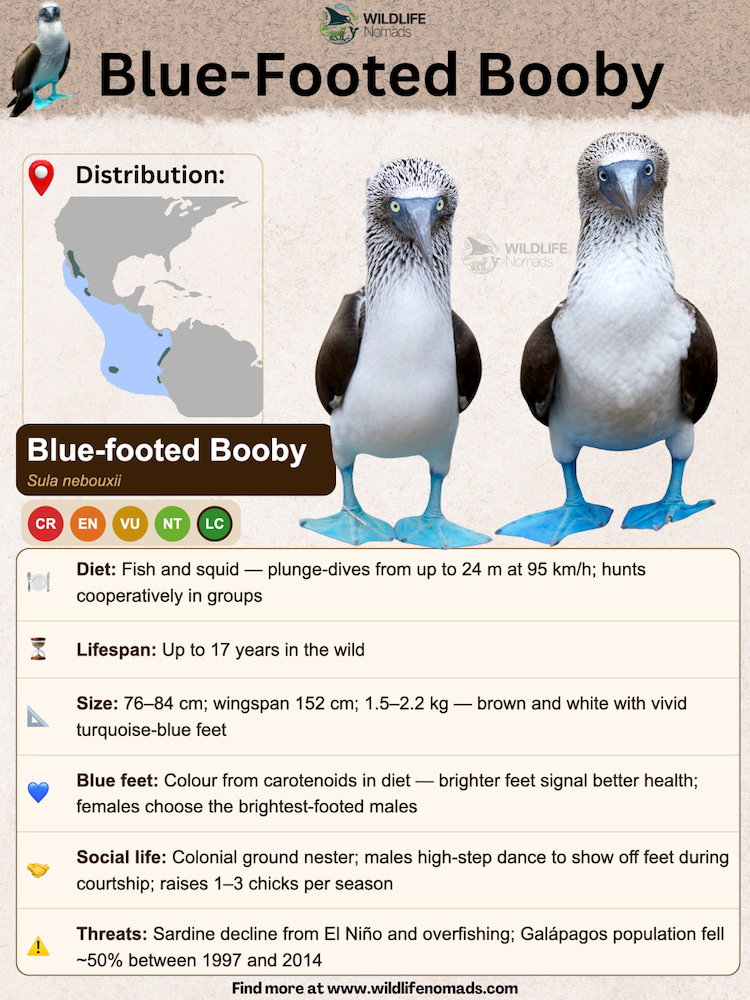
1. Their Name Is Basically a Spanish Insult
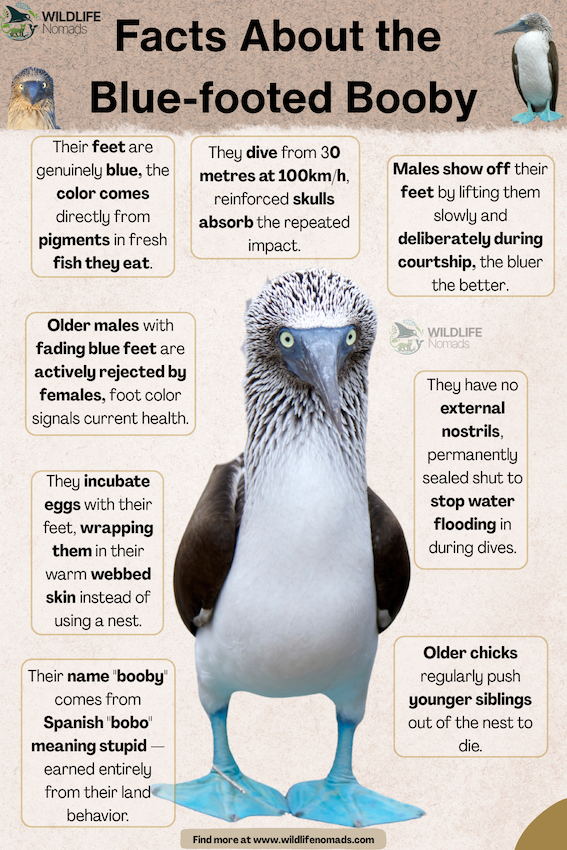
The “booby” in blue footed booby comes from the Spanish word “bobo,” which translates to fool or clown. Sailors who first encountered these birds in the 16th century watched them waddle across ship decks, completely unbothered by humans, and decided the name fit. The Spanish word bobo stuck for a reason.
That tameness is not stupidity, however. These birds evolved on remote islands and rocky coasts where land predators were nonexistent. A creature with no reason to fear has no reason to flee. When we stood three feet from one on San Cristóbal, it tilted its head, blinked once, and went back to preening, exactly the behavior that earned the species its name and, sadly, made it easy prey for early sailors looking for dinner.
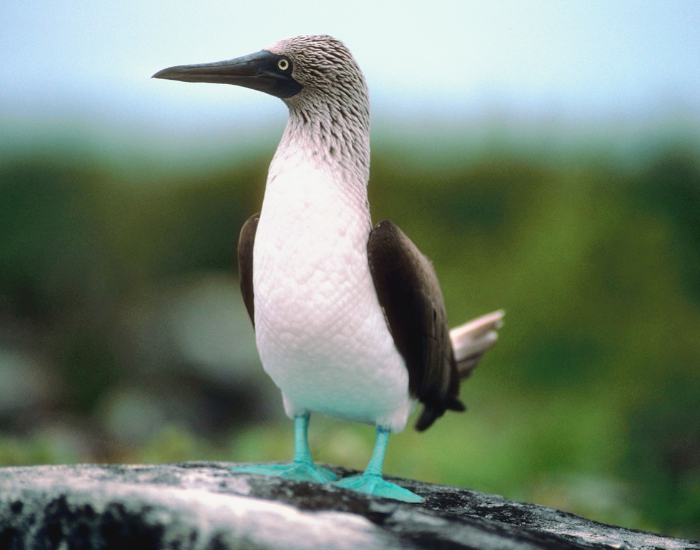
2. Their Bright Blue Feet Are a Literal Report Card
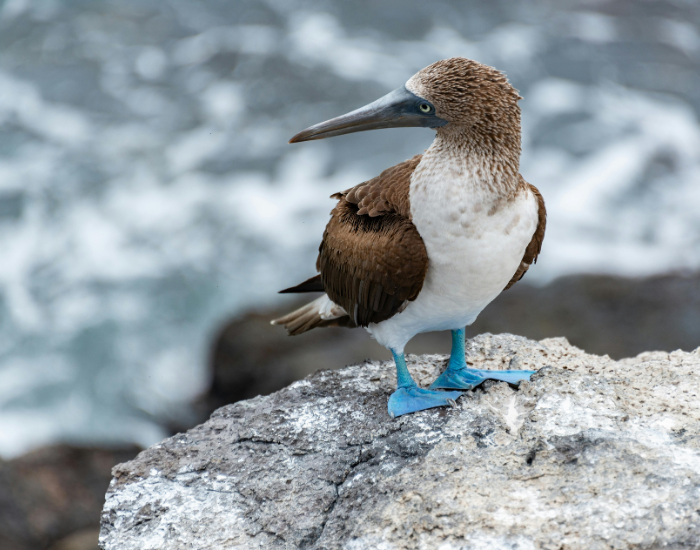
The blue color of a booby’s feet is not a fixed trait, it is a real-time health report. The vibrant blue feet get their pigment from carotenoids in fresh fish, the same antioxidants that turn flamingos and roseate spoonbills pink. A bird eating well shows off bright blue feet; a bird struggling to find food fades fast.
This matters because diet plays a direct role in reproduction. A female blue footed booby inspects a male’s foot color before deciding whether to breed with him. Brighter feet signal genetic fitness and current health to attract mates. Researchers have shown that within 48 hours of a poor diet, vibrant feet dim measurably. Females notice, and males with duller feet get rejected.
So those distinctive blue feet are not just decoration. They are a billboard advertising whether this booby has been catching fresh fish or scraping by, the most striking feature of the entire species.
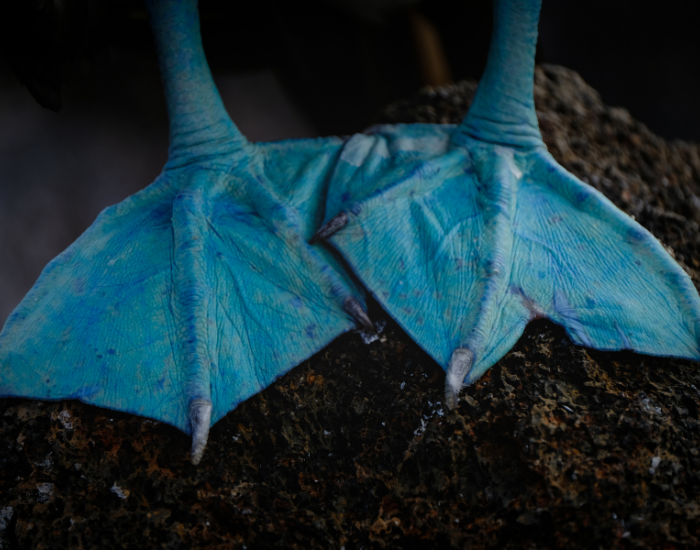
3. The Courtship Dance Has to Be Seen to Be Believed
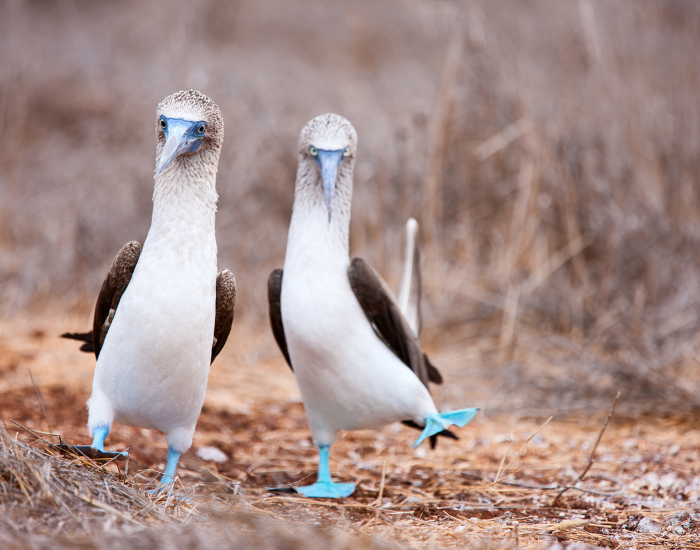
When mating season arrives, male blue footed boobies perform one of the most absurd, charming rituals in the bird world. The male lifts his brilliant blue feet alternately, slow and exaggerated, like he is showing off new shoes. Then he sky-points, beak straight up, wings spread, whistling, before bowing and offering a small stick to his potential mate.
She watched this courtship dance on Española Island during a research stop, and I cannot describe how seriously the bird takes it. The mating ritual can stretch for an hour. The female evaluates every step. If his iconic blue feet are not vivid enough, or if his small stick offering is half-hearted, she walks away.
This mating dance is the foundation of pair bonding in this species, and younger males often perform clumsy versions before they get the choreography right.
4. They Live Across a Much Bigger Range Than the Galápagos
Most people associate them with the Galápagos islands, and the islands do hold roughly half of the global breeding population. But this is not a Galápagos endemic. Galapagos blue footed boobies share the species with colonies stretching along the western coasts of central and south america, from Mexico’s Gulf of California down through Peru and parts of Chile.
You will find them on rocky coasts and small subtropical islands throughout the eastern Pacific Ocean. The pacific coast of mainland Ecuador and the offshore islets of the Peruvian booby’s range overlap with theirs. Tropical regions, and subtropical and tropical regions of South America in general, host steady colonies year-round.
So while the Galápagos islands provide the most photographed backdrop, the species ranges across thousands of miles of pacific ocean coastline.

5. They Dive Like Missiles
Watching a blue footed booby hunt is one of the great spectacles in marine bird biology. They cruise on long wings 30 to 80 feet above the water surface, scanning for small schooling fish. When they spot a target, they fold their wings and plunge, hitting the surface at speeds up to 60 miles per hour.
This plunge diving sends them several meters below the surface in a single dive. A small fish that thought it was safe at depth suddenly has a torpedo of feathers and beak coming straight at it.
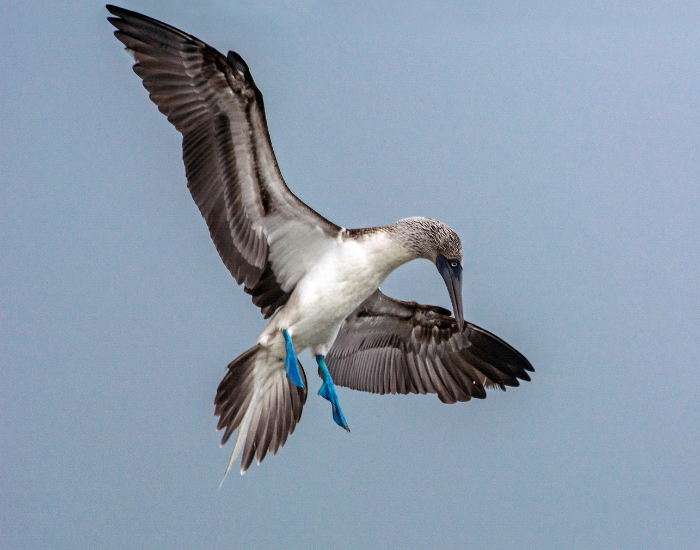
6. Special Air Sacs Save Them From the Impact
Plunging from height into water at 60 mph is, biomechanically, a problem. The enormous pressure on impact would crush most birds. Blue footed booby adaptations solved this with a unique trick: special air sacs distributed across the face and skull that act as crumple zones.
These air sacs cushion the brain and internal organs during impact. A pair of small bones around the nostrils slams shut on entry, preventing water from forcing into the airway. This striking feature of their anatomy is studied by aerospace engineers, the architecture is genuinely remarkable.
Without those air sacs, the species could not exploit its primary food source. They are not optional plumbing; they are the reason the entire diving lifestyle works.
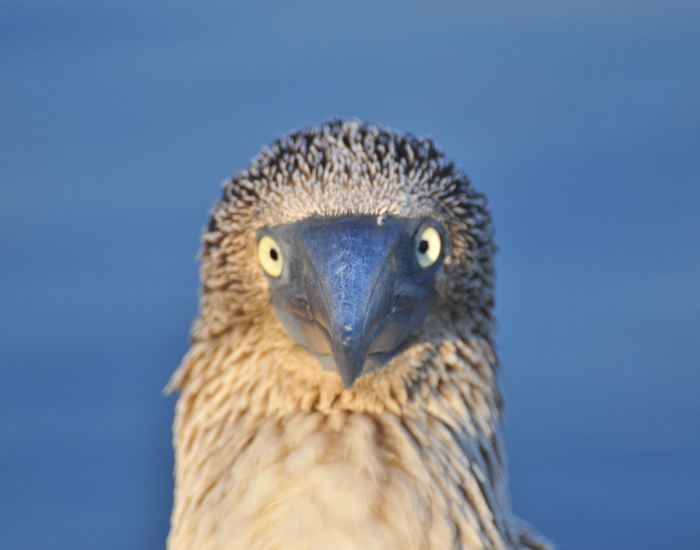
7. Their Diet Is Built Almost Entirely on Small Fish
Blue footed boobies eat sardines, anchovies, mackerel, and flying fish, small schooling fish that travel in dense bait balls. They also take squid when available. Their natural habitat sits directly above productive cold-water upwellings, which is why colonies cluster where they do.
When sardine populations collapse, as they do periodically along the pacific coast, the boobies feel it within weeks. Studies during El Niño years have documented sharp declines in successful breeding when small fish abundance drops.
This is one of the cleanest examples in ornithology of a species tied tightly to a single food web. Watching a flock work a school of flying fish offshore is also one of the easiest ways to find tuna, the predators below drive bait to the surface, where the boobies finish the job.

8. Females Are Larger and Run the Show
A female blue footed booby is slightly larger than her mate, about 30 percent heavier on average. She also has a darker, deeper voice, while males produce a high-pitched whistle. Sit in a colony for an hour and you can identify each bird’s sex by call alone.
This size difference is not cosmetic. It allows the pair to specialize. The larger female can hunt deeper and bring back bigger prey, while the smaller, more agile male specializes in fast, shallow dives. Together, breeding pairs cover a wider feeding range than two birds of the same size could.
The males’ feet, on average, also tend to run a touch brighter than the females’. Brightly colored feet matter more for males because they invest more heavily in attracting potential mates.
9. They Lay Their Eggs on Bare Ground
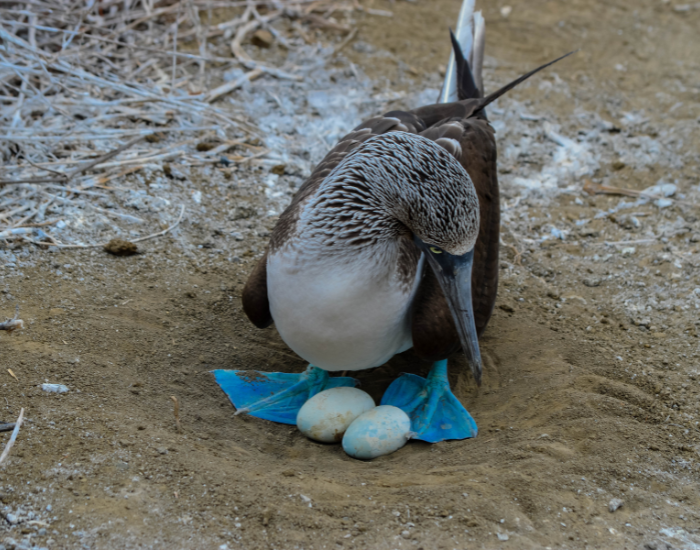
There is no nest. A blue footed booby pair lays its eggs directly on bare ground, usually a small scrape ringed by guano. The breeding grounds sit exposed under tropical sun, and the parents have no woven cup or twigs to insulate.
Instead, they incubate with their feet. Their large webbed feet are unusually rich in blood vessels, which keeps the eggs warm during incubation. Both parents share duties, swapping every few hours. Those webbed feet act as a living incubator pad.
Two or three eggs is the typical clutch, though many breeding pairs produce just one to three eggs depending on food availability. The natural habitat for nesting is generally rocky coasts and flat island terraces with good ocean views, practical real estate for a bird that hunts at sea.
10. The First Chick Sometimes Kills the Second
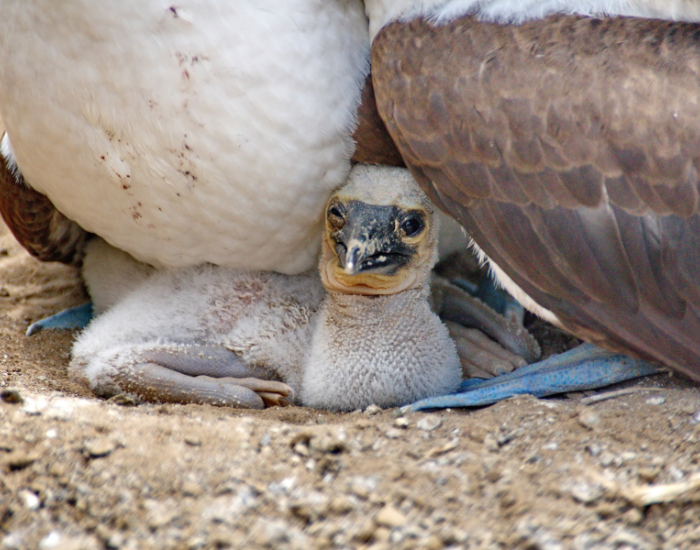
This is the part of blue footed booby biology that disturbs people most. The eggs hatch asynchronously, several days apart. If food is scarce, the older chick will harass, push, and sometimes peck the younger sibling out of the scrape.
About half of second chicks in lean years do not survive, depending on the colony and the food supply. Biologists call this facultative siblicide, and it is brutal but evolutionarily efficient: rather than splitting limited food evenly and losing both, the parents tolerate the older chick consolidating resources.
When food is abundant, both chicks fledge. When small schooling fish populations crash, the parents effectively delegate the hard decision. It is unsentimental biology, and unlike many other birds, it works for this species.
11. The Galápagos Population Is Genetically Distinct
Genetic studies have shown that galapagos blue footed boobies are slightly distinct from mainland populations. The isolation of the galápagos islands, particularly española island and the smaller western islets, has produced subtle differences in body size, behavior, and call structure.
These birds belong to the genus Sula, which contains six species worldwide, including the brown booby, masked booby, red-footed booby, peruvian booby, and Nazca booby. Walk a Galápagos colony and you will often see two or three booby species nesting in different microhabitats on the same island, boobies sorting themselves by terrain.
The blue footed booby remains the most photographed of the bunch, mostly because nothing else in the seabird world looks remotely like those iconic blue feet.
12. Their Numbers Have Been Quietly Declining for Decades
Despite their fame, this species is in trouble. The Animal Diversity Web and the IUCN Red List both flag ongoing population declines, particularly in the Galápagos, where the breeding population has dropped by more than half since the 1960s. The cause appears to be reduced sardine abundance, when their primary prey thins out, breeding fails.
We have walked colonies that elders described as crowded twenty years ago and counted only a handful of breeding pairs. The most striking thing about the decline is how quiet it has been. There is no oil spill, no dramatic crash, just fewer pairs each season, less courtship, fewer chicks.
For a marine bird this charismatic, the slow erosion is almost worse than a sudden disaster. It happens out of sight, on islands most people never see.
Frequently Asked Questions
Blue footed booby birds live along the western coasts of central and south america, from Mexico’s Gulf of California down through Peru. Their most famous breeding grounds are the Galapagos islands, especially Española Island, but you will also see colonies on rocky coasts of mainland Ecuador and offshore islets in the eastern Pacific Ocean.
The species is not technically rare, global estimates suggest around 80,000 individual birds — but populations are declining, particularly in the Galápagos, where breeding pairs have dropped sharply since the 1960s. Reduced sardine availability is the main driver, and animal diversity web records track the trend year by year.
No. About half of the world population breeds in the Galápagos islands, but blue footed boobies range throughout subtropical and tropical regions of the eastern Pacific Ocean. You will find them along the pacific coast of Mexico, Ecuador, Peru, and even parts of southern California during certain years.
Yes, and they fly extremely well. Their long wings are built for soaring efficiently over open ocean while scanning the water surface for small fish. They can travel dozens of miles offshore daily during the breeding season. They are highly aerial seabirds, not flightless.
No. Despite the comparable comedic charm, blue footed booby birds are not related to penguins. They belong to the genus Sula in the family Sulidae, alongside gannets and other birds in the booby group. Penguins are flightless; boobies fly long distances daily and dive from the air, not from the water surface.
The Future of the Blue-Footed Booby
The blue footed booby’s vivid feet are not just a quirky aesthetic, they are a window into how diet, sexual selection, and foraging biology weave together in a single charismatic species. Spend any time with these birds in the field and the cliché of their goofy reputation falls away fast.
If you are planning a trip, dig into our full guide to Galápagos wildlife, our deep dive on frigatebirds (their thieving cousins), and our breakdowns of tortoises, sea lions, seal types, sea turtles, albatrosses, and the world’s penguins. And if you have ever watched a booby dance on a rocky coast, drop your story in the comments — I read every one.
Where to See them?
Here is a list of 4 tours where you can have see them in the wild. As a biologist, I only recommend tours that follow strict ethical guidelines to ensure we don’t disturb wildlife. These are the three tours/ partners I trust most based on their conservation records:
This website is reader-supported. When you buy experiences through links listed on this site, we may earn an affiliate commission.
References:
Anchundia, D., Huyvaert, K. P., & Anderson, D. J. (2014). Chronic lack of breeding by Galápagos blue-footed boobies and associated population decline. Avian Conservation and Ecology, 9(1), 6. https://doi.org/10.5751/ACE-00650-090106
BirdLife International. (2018). Sula nebouxii. The IUCN Red List of Threatened Species 2018: e.T22696683A132588719. https://doi.org/10.2305/IUCN.UK.2018-2.RLTS.T22696683A132588719.en
Castillo-Guerrero, J. A., Lerma, M., Mellink, E., Suazo-Guillén, E., & Peñaloza-Padilla, E. A. (2016). Environmentally mediated flexible foraging strategies in brown boobies in the Gulf of California. Ardea, 104(1), 33–47. https://doi.org/10.5253/arde.v104i1.a3
Torres, R., & Velando, A. (2005). Male preference for female foot colour in the socially monogamous blue-footed booby, Sula nebouxii. Animal Behaviour, 69(1), 59–65. https://doi.org/10.1016/j.anbehav.2004.03.008
Taylor, S. A., Anderson, D. J., & Friesen, V. L. (2013). Evidence for asymmetrical divergence-gene flow of nuclear loci, but not mitochondrial loci, between seabird sister species: blue-footed (Sula nebouxii) and Peruvian (S. variegata) boobies. PloS one, 8(4), e62256. https://doi.org/10.1371/journal.pone.0062256
Velando, A., Beamonte-Barrientos, R., & Torres, R. (2006). Pigment-based skin colour in the blue-footed booby: an honest signal of current condition used by females to adjust reproductive investment. Oecologia, 149(3), 535–542. https://doi.org/10.1007/s00442-006-0457-5
Nelson, J. B. (2005). Pelicans, Cormorants and their Relatives: The Pelecaniformes. Oxford University Press. https://global.oup.com/academic/product/pelicans-cormorants-and-their-relatives-9780198577270
Wingfield, J. C., Ramos-Fernandez, G., Nuñez-de la Mora, A., & Drummond, H. (1999). The effects of an “El Niño” southern oscillation event on reproduction in male and female blue-footed boobies, Sula nebouxii. General and comparative endocrinology, 114(2), 163–172. https://doi.org/10.1006/gcen.1998.7243




_world2.png)