Wildlife Nomads



For decades, biologists told a neat story about ravens and wolves. The wolves hunt, and the ravens tag along. A new study in Science shows the story is wrong, and the truth is far smarter.
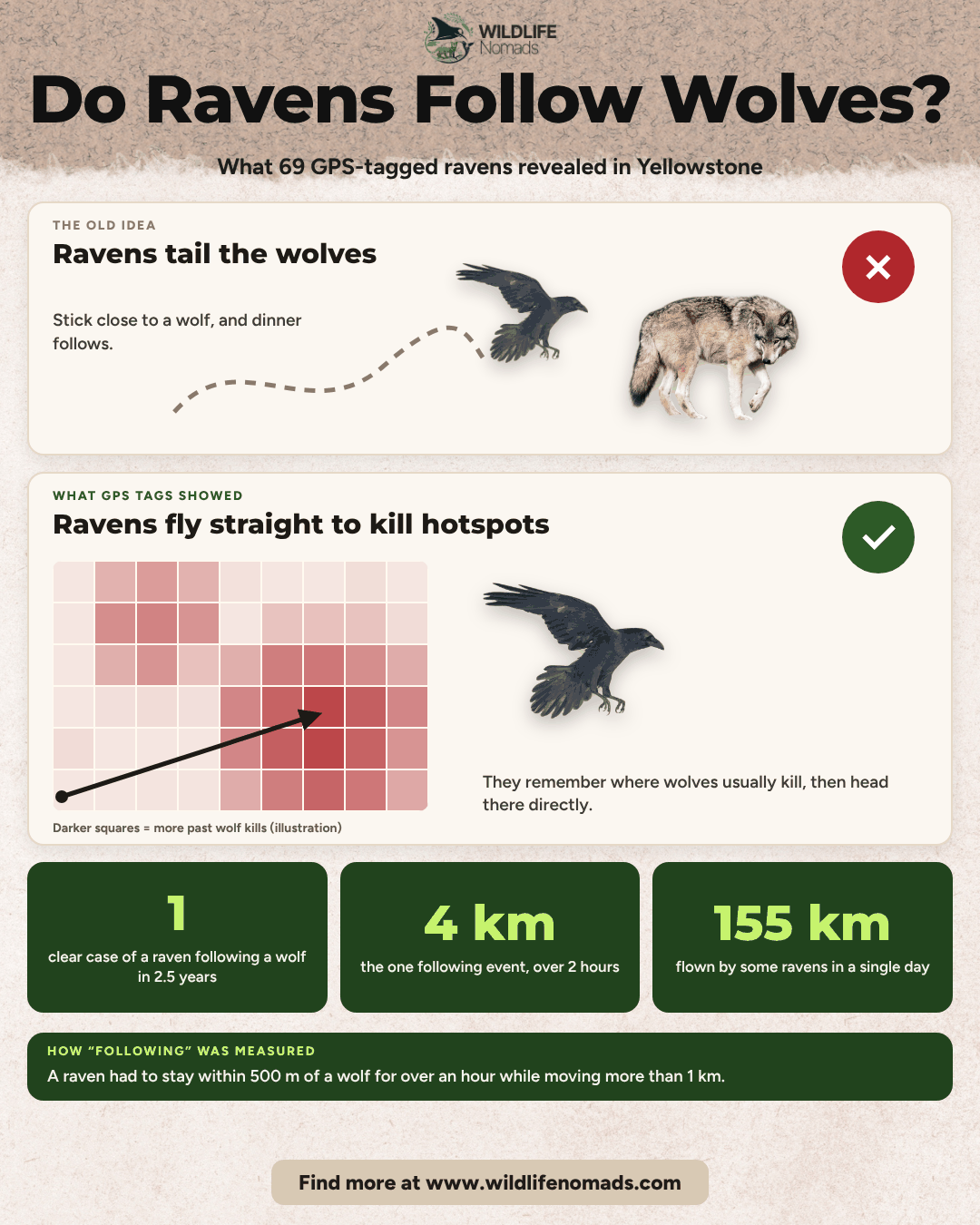
Do ravens follow wolves to their kills? Almost never, it turns out. Ravens remember where wolves usually kill, then fly straight there. Some birds travel up to 155 km in a day to check those spots.
I love this kind of result. It takes something everyone “knew” and turns it into a question about memory, maps and bird brains.
Read the story, then test yourself with 8 quick questions.
Jump to the quiz
Do Ravens Follow Wolves? The Short Answer
- No, not really. In two and a half years, researchers saw only one clear case of a raven tailing a wolf.
- They remember the hotspots. Ravens kept revisiting areas where wolves often make kills.
- They travel far. Some flew up to 155 km in a day, heading straight for likely carcasses.
- They still show up. Ravens reached nearly half of the observed wolf kills within seven days.
- Local clues finish the job. Up close, ravens likely watch wolves or listen for howls.
An Old Partnership in Yellowstone
Ravens and wolves have a long shared history. Ravens follow wolf tracks through snow and respond to howls. After wolves returned to Yellowstone National Park in 1995, ravens were more likely to be near a wolf than anywhere else in the park.
The reason is simple. Wolves kill elk, bison and deer, and they leave scraps behind. For a common raven, a wolf kill is a winter feast. Biologists call this kind of one-sided benefit commensalism.
So everyone assumed the rule was easy. Stick close to the wolves, and dinner follows. Nobody had tested that rule over big distances, though.
How the Study Worked
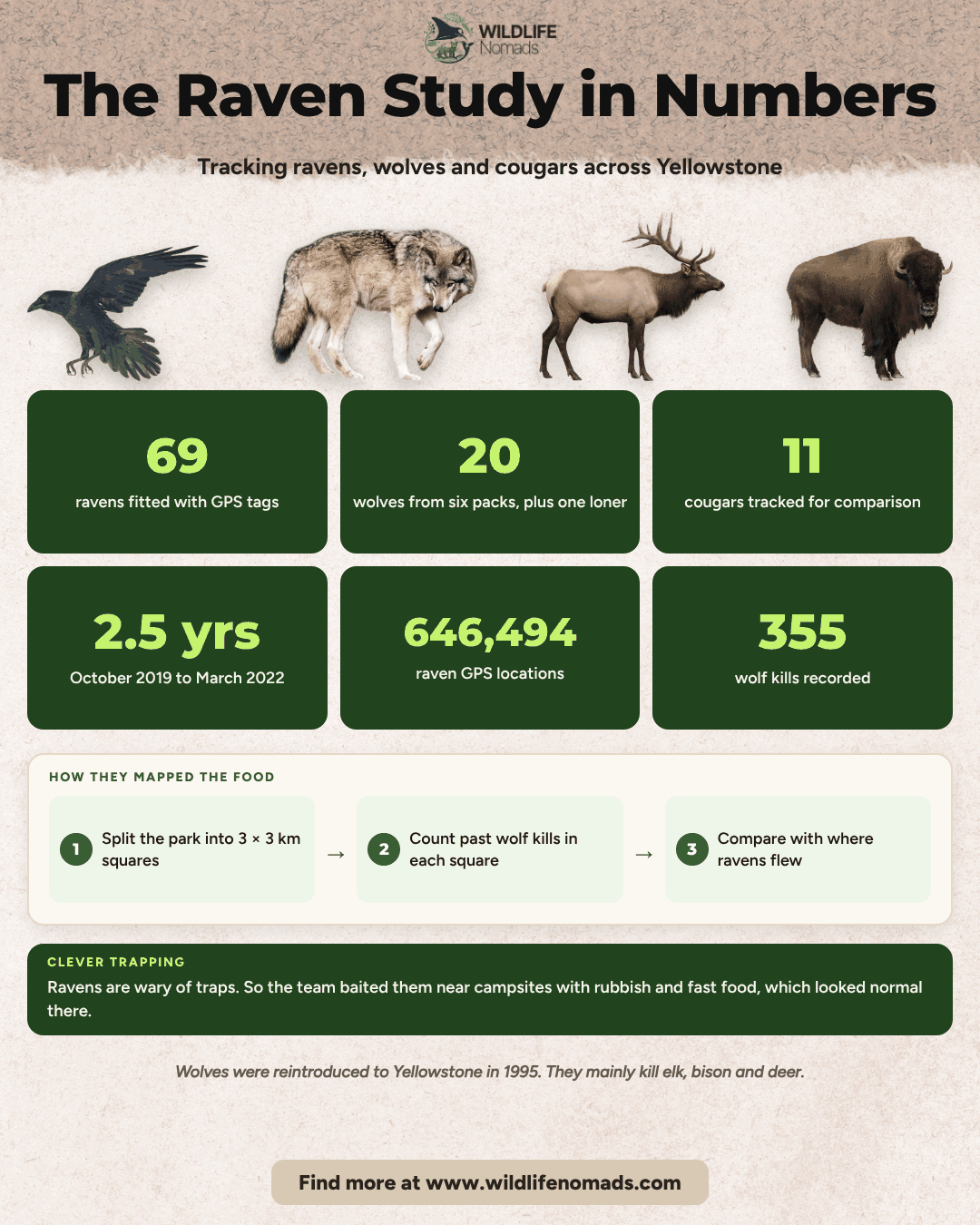
Matthias-Claudio Loretto led the team, from the University of Veterinary Medicine Vienna and the Max Planck Institute of Animal Behavior. They trapped 69 ravens and fitted them with small GPS trackers.
The traps sat near campsites, baited with rubbish and fast food. Ravens are suspicious birds, and junk food looked normal there. Clever, and a little funny.
The team tracked the birds in winter, when ravens spend the most time near wolves. The tags logged each raven’s position up to every 30 minutes. Yellowstone already tracks its wolves with collars, so the team matched the birds with 20 collared wolves. They also tracked 11 cougars.
Then they mapped where wolves made kills. They split the park into 9 km² squares and built a “carcass abundance map”. That showed where kills happen often and where they are rare.
Ravens Don’t Follow. They Remember
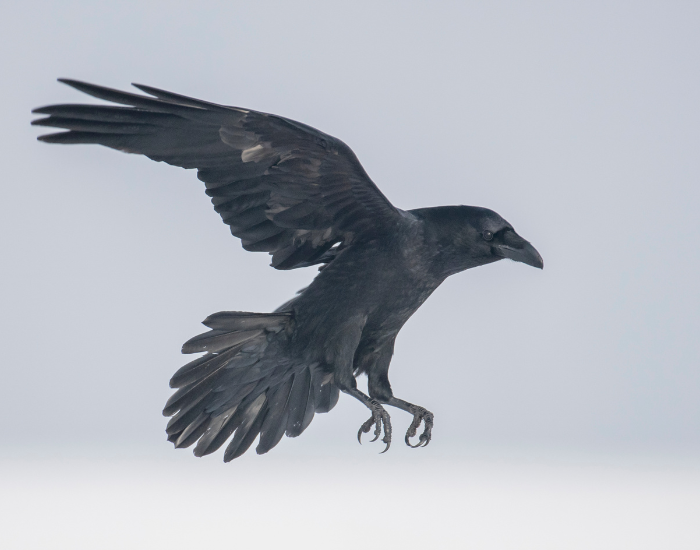
The results surprised the researchers. Ravens almost never followed wolves over long distances. Loretto admitted the team was puzzled at first.
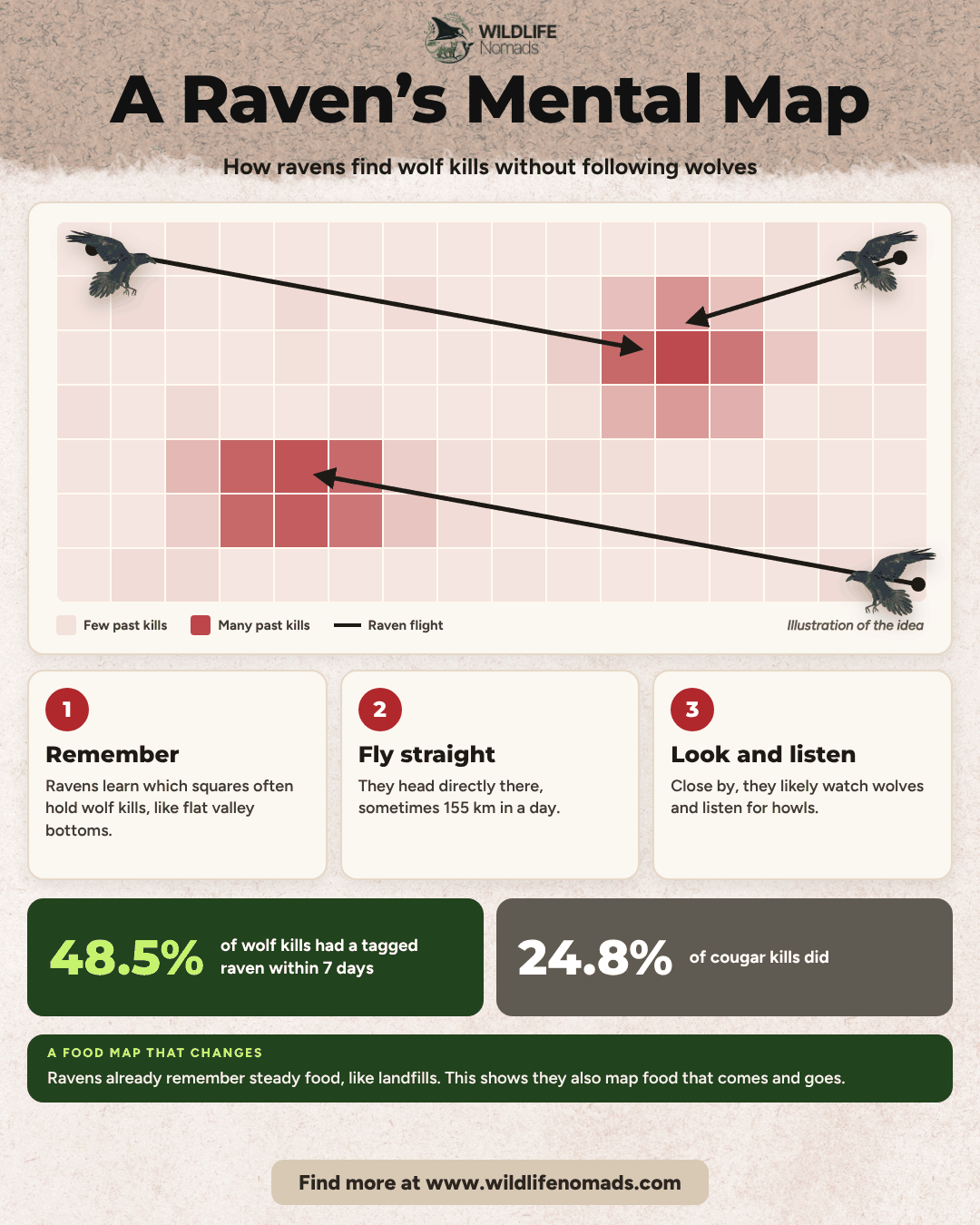
Yet the ravens still found the food. They turned up at nearly half of the observed wolf kills within a week. So how did they do it?
The answer was in the map. Ravens visited squares with lots of past wolf kills far more than squares with few. Wolf kills cluster in places like flat valley bottoms, where wolves hunt well. The ravens seem to learn that pattern.
Their flight paths backed this up. Ravens didn’t wander in search loops. They flew in straight lines toward likely kill sites, sometimes from 155 km away. Loretto says they can fly six hours non-stop, straight to a kill site.
A Mental Map of Food
Scientists already knew ravens remember stable food, like landfills. This study shows something harder. Ravens also remember food that comes and goes, like a wolf kill.
The authors call this a long-term “resource landscape”. Think of it like knowing which streets have the best restaurants. You don’t follow the chef home. You just check the right neighbourhood.
Ravens also fly over common kill areas on the way to other food, including spots where people hunt game. Each trip doubles as a scouting run.
Close to a kill, local cues still matter. Ravens likely watch wolf behaviour and listen for howls. Memory gets them to the right area, and their senses do the rest.
Why This Matters
This finding changes how we think about scavengers. Many animals live off unpredictable food, from vultures to hyenas. If ravens use memory this way, other wide-ranging species might too.
It also shows how one species shapes another. Wolves create a pattern of food across the land. Ravens learn that pattern and build their lives around it. That’s one reason scientists see wolves as a keystone species in Yellowstone. You can explore links like these in our food web tool.
Ravens already rank among the smartest birds alive. Their relatives, from rooks to the birds in our guide to crow species, are famous problem solvers. Now we can add long-range food maps to the list.
What I Take From It
At university in Sweden, I ran a small experiment with friends. We measured how a predator on an open plain changed the time birds spent foraging. Predators usually mean danger for birds, so they eat less and watch more.
Ravens flip that script. For them, a top predator means opportunity. They don’t hide from wolves; they turn wolves into a food delivery service. And they remember the addresses.
Australian ravens show up in several of my campground guides, like Booti Booti National Park. After this study, I look at them differently. That bird on the picnic table might be running a mental map I can only guess at.
FAQs About Ravens and Wolves
Rarely over long distances. A 2026 study tracked 69 ravens in Yellowstone for two and a half years. It found only one clear case of a raven following a wolf for more than 1 km or an hour.
Ravens remember areas where wolves often make kills and return to them. Close to a kill, they likely use local cues, like watching wolves or hearing howls.
Some ravens in the study flew up to 155 km in a day toward likely kill sites. The lead author says they can fly six hours non-stop.
Wolves kill large animals like elk, bison and deer and leave scraps behind. Ravens scavenge those carcasses, especially in winter when food is scarce.
Yes. Ravens are among the most intelligent birds. This study adds strong evidence that they use spatial memory to find food that appears unpredictably.
Follow the Memory, Not the Wolf
Ravens turned a famous animal partnership into a story about memory. They don’t need to shadow wolves across Yellowstone. They know where the wolves will probably eat, and they get there first.
Next time you see a raven, give it a second look. Then dig deeper into raven facts and species, or test yourself below.
References:
Loretto, M.-C., Beck, K. B., Smith, D. W., Stahler, D. R., Walker, L. E., Wikelski, M., Mueller, T., Safi, K., & Marzluff, J. M. (2026). Ravens anticipate wolf kill sites across broad scales. Science, 391(6790), 1151. https://doi.org/10.1126/science.adz9467
Walker, L. E., Marzluff, J. M., Metz, M. C., Wirsing, A. J., Moskal, L. M., Stahler, D. R., & Smith, D. W. (2018). Population responses of common ravens to reintroduced gray wolves. Ecology and Evolution, 8(22), 11158–11168. https://doi.org/10.1002/ece3.4583
University of Washington. (2026, March 12). Instead of tracking wolves to prey, ravens remember and revisit common kill sites. UW News
Max Planck Society. (2026, March 12). Wolves kill, and ravens remember where. MPG News