In Mexico, the city bird I grew up with was the common pigeon. So when I moved to Australia, rainbow lorikeets felt almost unfair. One of the most colourful parrots on Earth was screeching over car parks like it owned them. Pigeons were grey; these were noisy birds made of bright feathers. On the Gold Coast, they became my morning alarm clock.
Then, almost five years in, our lap around Australia handed me a surprise. At Bellingen and Nambucca Heads, I saw my first scaly-breasted lorikeets. I suspect they had been hiding inside rainbow flocks all along.
Researching my rainbow lorikeet facts and Australian parrots guides, I kept tripping over lories I had never heard of. Red lories, chattering lories, even a blue lorikeet from Tahiti. Lories and lorikeets comprise around 60 species, spread from eastern Indonesia to French Polynesia. Here are 17 of them, grouped by region, with what makes each one worth knowing.
Name That LoryRed lory or blue-streaked? Rainbow or coconut lorikeet? Ten birds, four names each. Take the ID quiz at the end ↓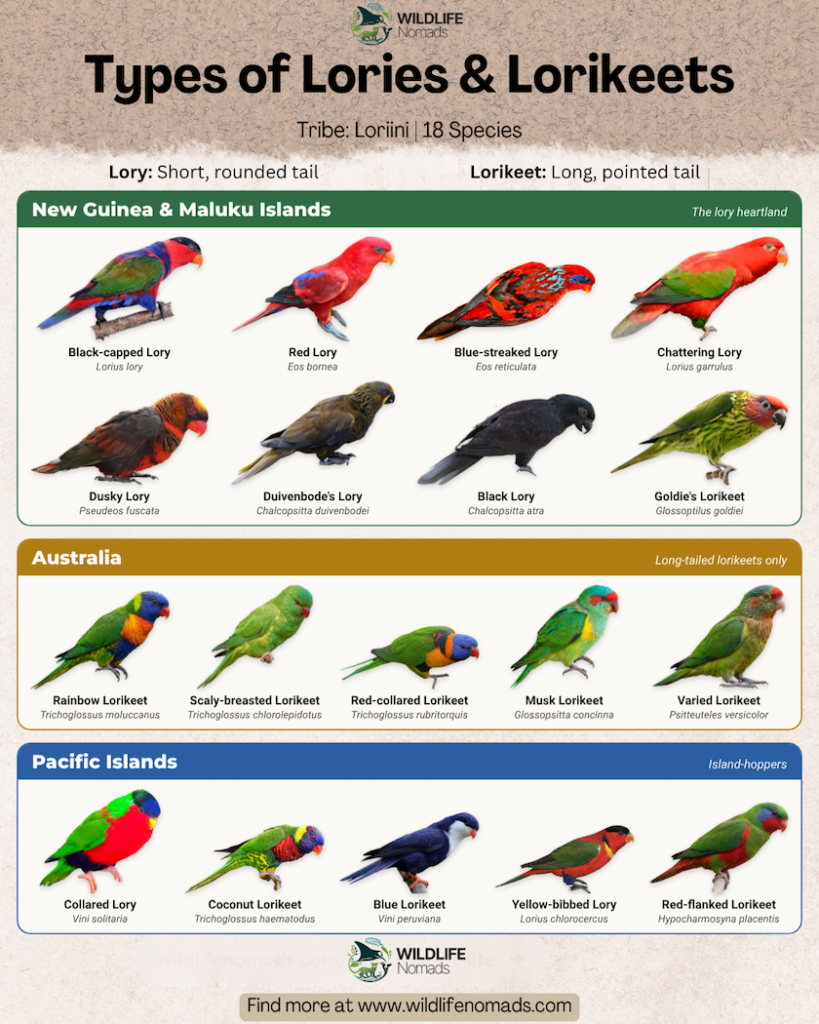
What Makes Lories Different From Other Parrots?
Most parrots crack seeds with a strong beak. Lories, by contrast, collect nectar and pollen with brush-tipped tongues. Tiny papillae on the tongue tip spread out like a mop to soak up each flower. Many also eat fruits, buds and small insects for extra protein. Moving from bloom to bloom, they carry pollen between native plants. As a result, they work as important pollinators across the Pacific.
“Lory” versus “lorikeet” mostly comes down to the tail. Lories are stocky, with short, rounded tails, while lorikeets are slimmer with long, pointed ones. Genetic work suggests the group began in New Guinea about 10 million years ago, then island-hopped outwards. Like other parrots, they have two toes pointing forward and two back. That grip lets them hang upside down from flowers. Interestingly, their closest living relative is the humble budgerigar.
A 2020 revision reshuffled several genera, so older field guides may use different scientific names. I’ve used the updated ones below.
New Guinea and the Maluku Islands
This is lory heartland. The classic “true lories” here are stocky birds with short tails and deep, saturated colours. Most live in lowland and hill rainforest, though some forage in mangroves and coconut plantations. Most lories nest in tree hollows high above the forest floor.
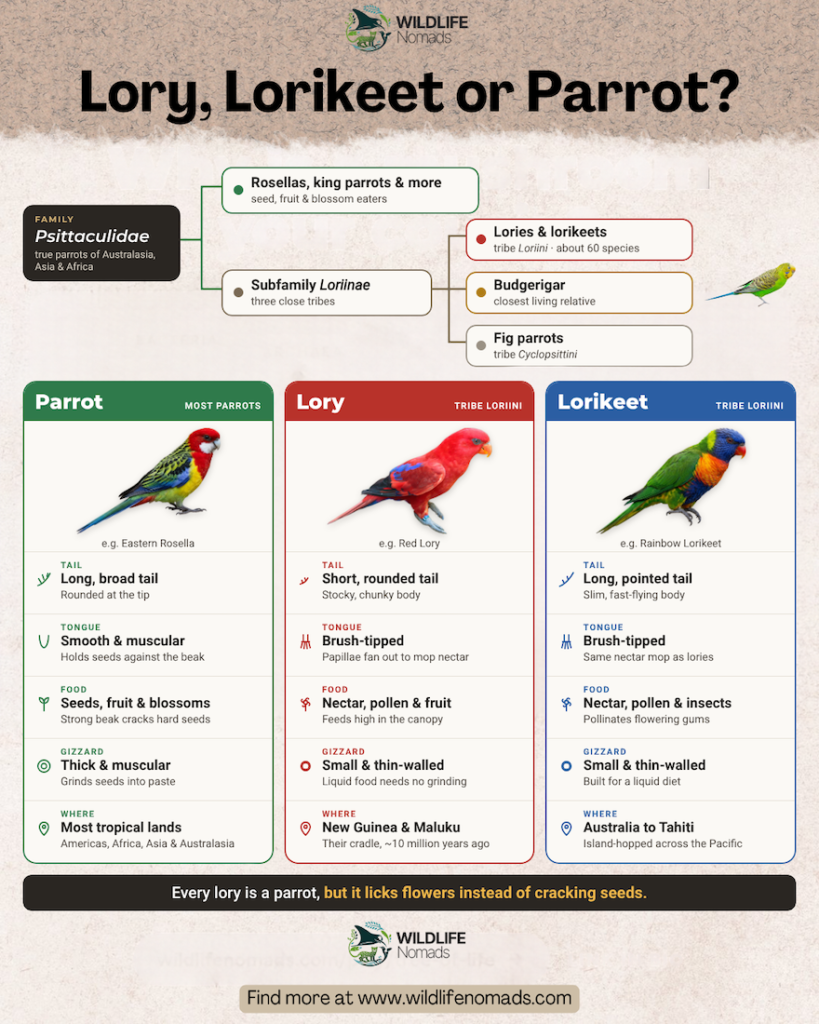
1. Black-capped Lory (Lorius lory)
The black-capped lory wears a black crown, a scarlet face and neck, green wings and a deep blue belly. It lives across New Guinea and its western islands, mostly in lowland forest. Pairs and small groups stay high in the canopy, where their loud calls give them away first.
In aviculture, black-capped lories have a reputation as playful, clownish birds that bond tightly with their keepers.
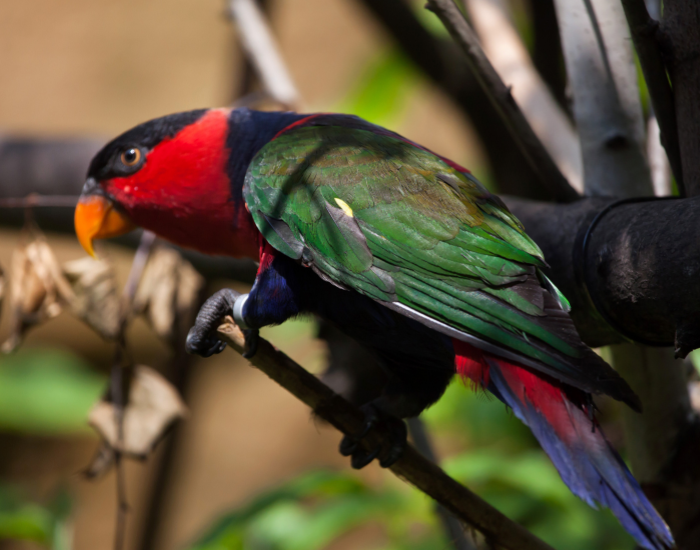
2. Red Lory (Eos bornea)
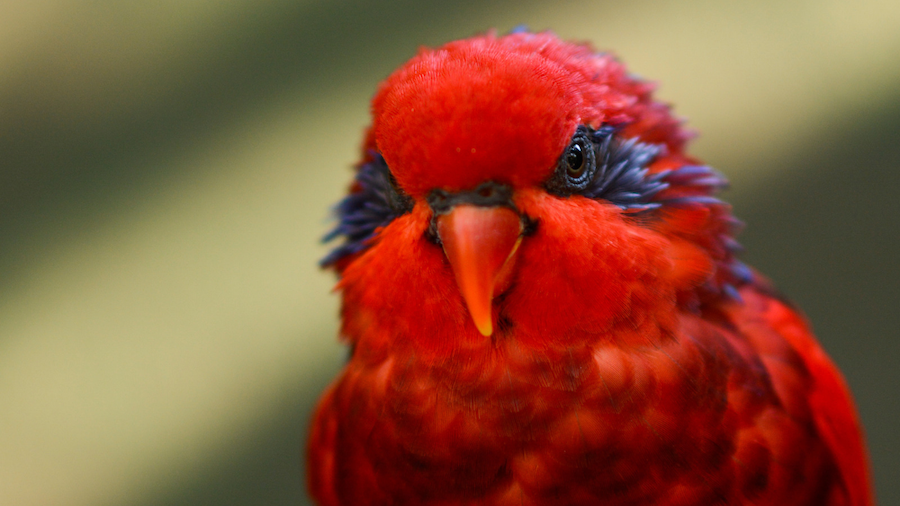
Almost entirely scarlet, the red lory carries blue patches on its wings and under its tail. It lives in the southern Maluku Islands of Indonesia, including Ambon, Seram and Buru. It’s also one of the most widely kept lories in the world.
That popularity has a cost. Trapping for the cage-bird trade has long pressured wild flocks, although the IUCN still lists the species as Least Concern.
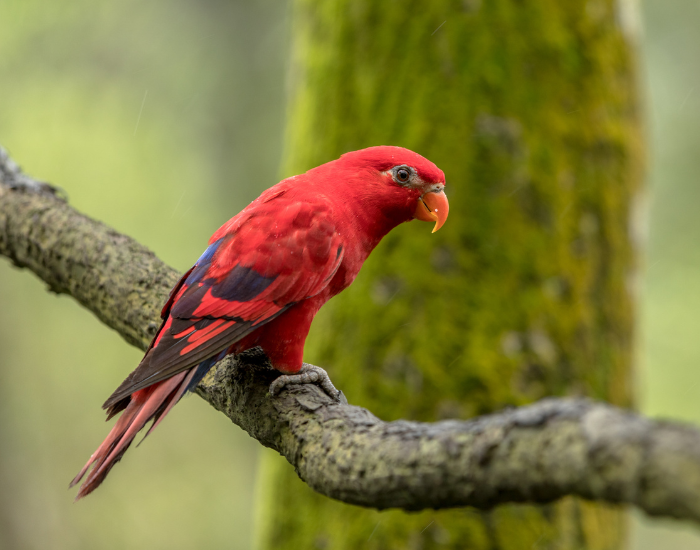
3. Blue-streaked Lory (Eos reticulata)
The blue-streaked lory is the red lory’s close cousin, and it shows. It’s mostly scarlet, about 31 cm long, with electric-blue streaks across the ears and nape. A violet stripe runs from the face down the side of the neck.
It lives only on the Tanimbar Islands and Babar, in Indonesia’s southern Maluku Islands. The IUCN lists it as Near Threatened. Forest clearing and trapping for the pet trade are its main threats.
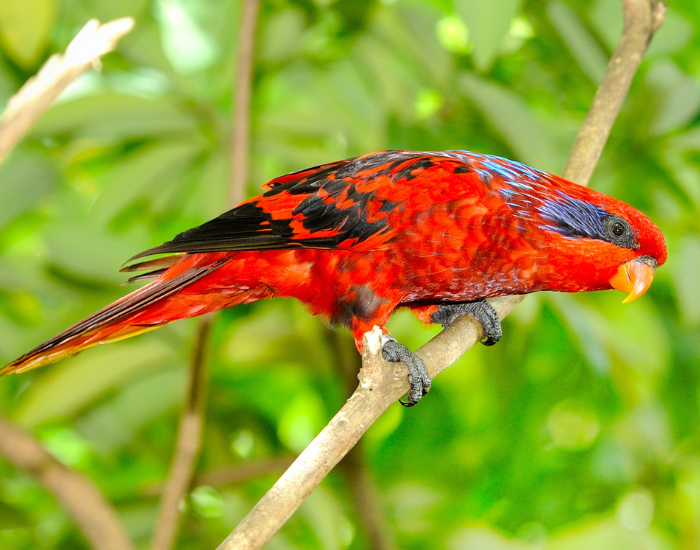
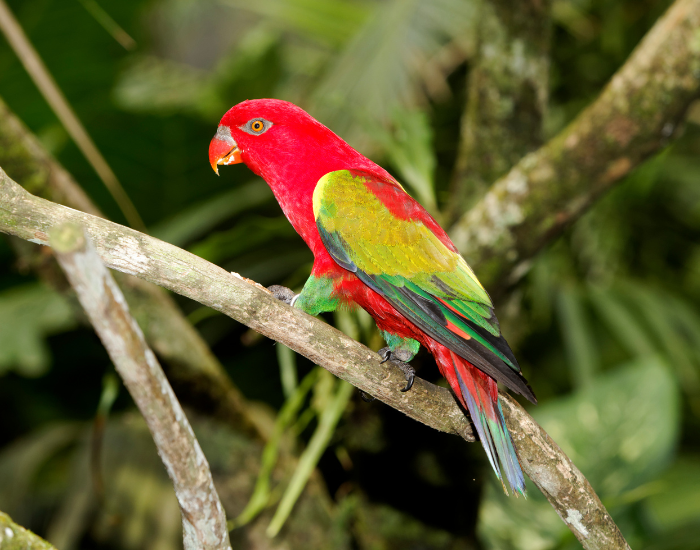
4. Chattering Lory (Lorius garrulus)
Chattering lories are scarlet with green wings and thighs and yellow at the bend of the wing. One subspecies, the yellow-backed lory, adds a bold yellow patch on the mantle. They live only in North Maluku, on islands such as Halmahera, Bacan and Morotai.
The name fits: these birds are loud and rarely quiet. Sadly, BirdLife lists the chattering lory as Vulnerable. Habitat loss and capture for the illegal wildlife trade keep pushing numbers down.
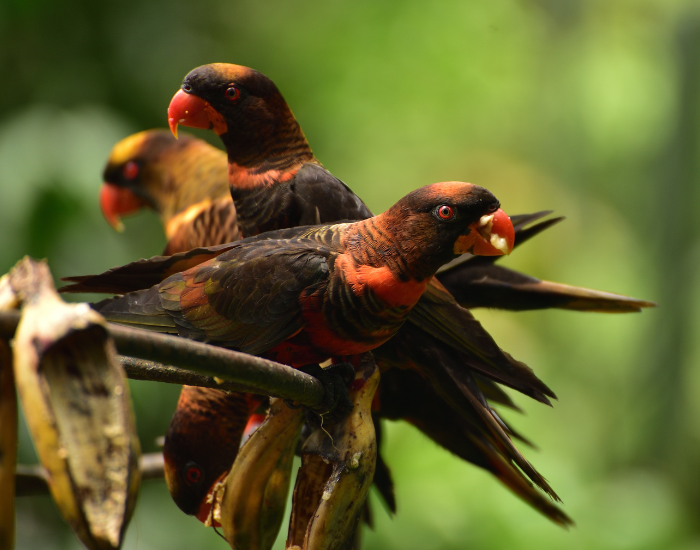
5. Dusky Lory (Pseudeos fuscata)
The dusky lory breaks the bright-red rule. Its body is dark brown, crossed by orange or yellow bands on the chest and belly. Those two colour phases can appear in the same flock.
Dusky lories roam New Guinea in large, noisy flocks, commuting long distances to find food. Many birds share a single roost, then scatter to flowering trees at dawn. They feed on nectar, pollen and soft fruit, often high in the canopy.
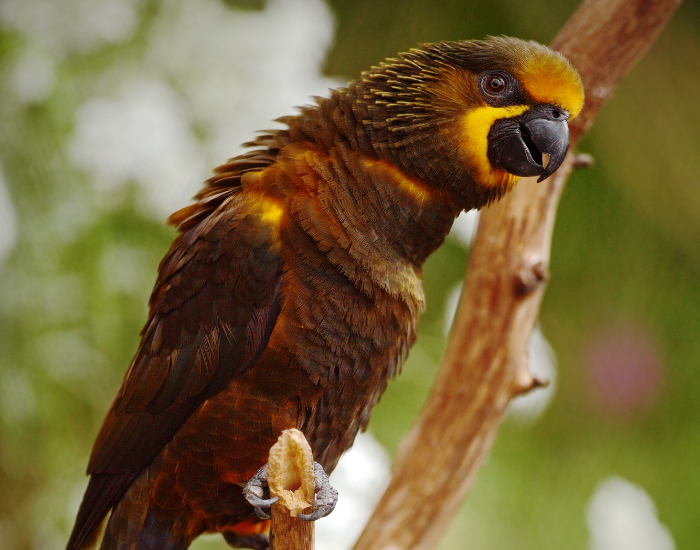
6. Duivenbode’s Lory (Chalcopsitta duivenbodei)
Sometimes called the brown lory, Duivenbode’s lory is dark olive-brown with golden-yellow on the face and shoulders. It lives in the lowland forests of northern New Guinea. In flat light the plumage looks subdued. In sunshine, though, the brown gleams almost bronze.
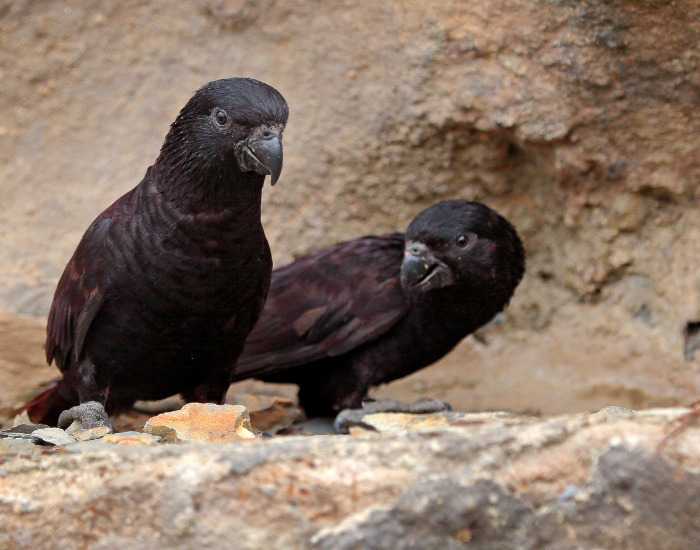
7. Black Lory (Chalcopsitta atra)
At first glance, the black lory looks plain. Good light reveals a purple-blue sheen across its feathers and a red-and-yellow wash under the tail. It lives in far western New Guinea and on islands like Batanta and Misool, in Raja Ampat.
A close cousin worth mentioning is Goldie’s lorikeet (Glossoptilus goldiei), a small, streaky-faced lorikeet of New Guinea’s mountain forests.
Australia’s Lorikeets
Australia has no true lories, only lorikeets. Seven lorikeet species live here, from tropical northern Australia to the cooler woodlands of southern Australia. Long tails, fast flight and noisy flocks make them easy to notice. They push other birds off the best blossoms and compete hard with honeyeaters at every flowering gum.
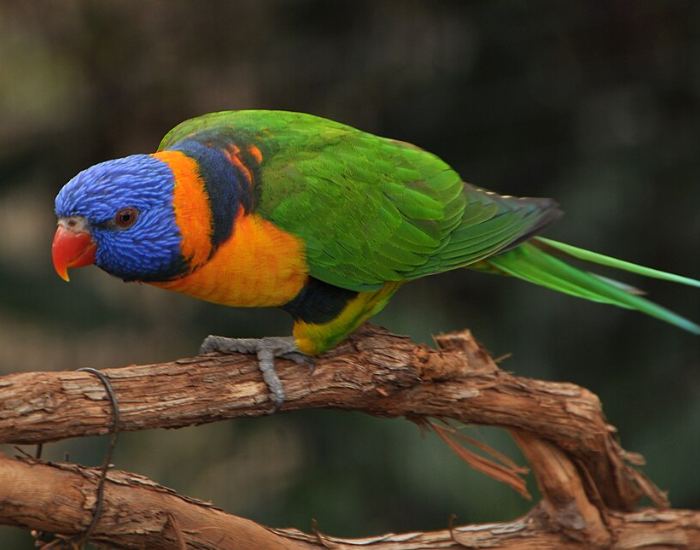
8. Rainbow Lorikeet (Trichoglossus moluccanus)
Blue heads, green wings, an orange-yellow chest and a bright red beak make the rainbow lorikeet unmistakable. Adults measure about 25 to 30 cm. Young birds have dark beaks, which turn into the adults’ bright red beaks as they mature. Rainbow lorikeets live across the coastal regions of northern and eastern Australia, from Cape York to South Australia. A feral population also thrives around Perth in Western Australia.
They adapt brilliantly to urban areas, where rainbow lorikeets feed in flowering native trees across parks and suburban gardens. Rainbow lorikeets love eucalyptus trees in bloom, and they defend nesting sites fiercely. Large trees with hollows are prime real estate. Females usually lay two eggs.
Every warm season, thousands develop lorikeet paralysis syndrome in south-east Queensland and northern New South Wales. Cases run from October to June and peak between December and February. Affected birds can’t fly, and severe cases cannot blink or swallow. Researchers suspect a seasonal plant toxin, but nobody has confirmed the source yet. Feeding lorikeets bread, honey or seed can also make them sick. Planting native flowers helps them far more.

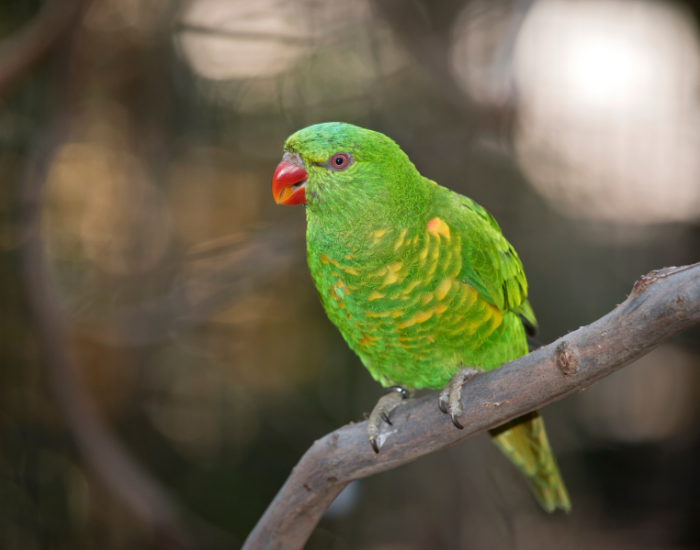
9. Scaly-breasted Lorikeet (Trichoglossus chlorolepidotus)
This is the bird that started this article. Scaly-breasted lorikeets are mostly green, with yellow breast feathers edged in green that look like fish scales. In flight, orange-red underwings flash beneath the green.
They range through eastern Queensland and New South Wales and often feed alongside rainbow lorikeets and other bird species. That habit, I suspect, is why I overlooked them for years. I finally saw them at Bellingen and Nambucca Heads.
10. Red-collared Lorikeet (Trichoglossus rubritorquis)
The red-collared lorikeet is northern Australia’s version of the rainbow. It differs by an orange-red collar across the nape and a darker belly. Once treated as a rainbow subspecies, it now ranks as a full species. Look for it in the Kimberley, the Top End and north-west Queensland. I’m hoping to meet one when our lap reaches the Northern Territory.
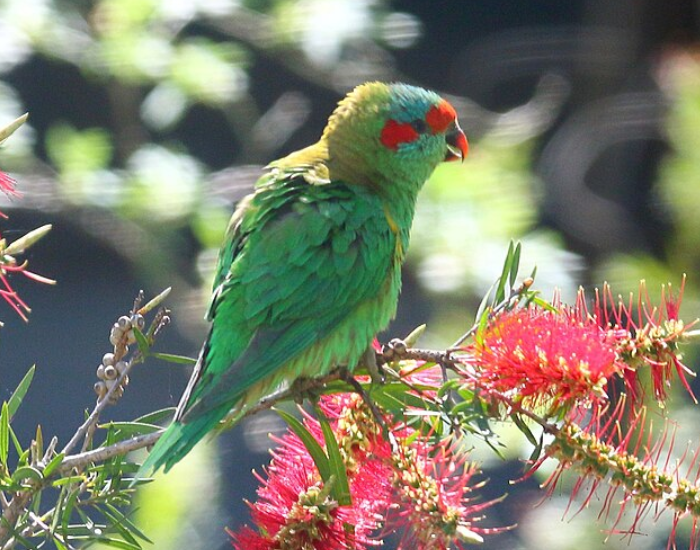
11. Musk Lorikeet (Glossopsitta concinna)
Musk lorikeets are green, with a red forehead and a red band running back from the eye. Their name comes from a musky scent some people notice on the birds. They live in south-eastern Australia, including Victoria, South Australia and Tasmania. Most of the year, they follow flowering eucalyptus trees in fast, screeching flocks, feeding on pollen and nectar.
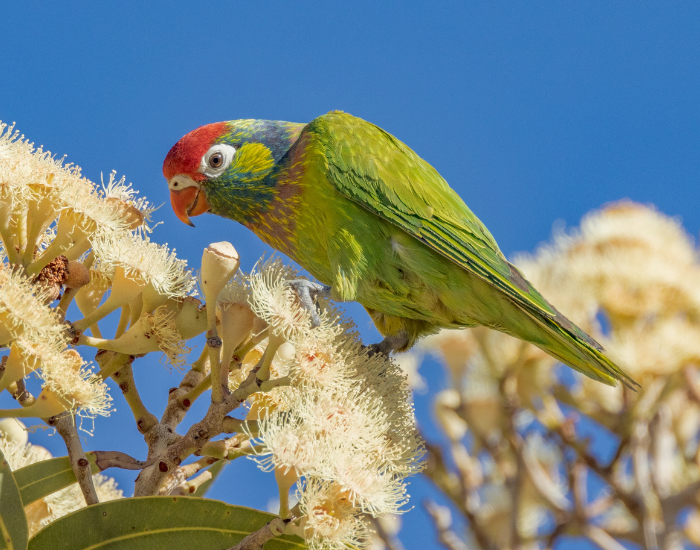
12. Varied Lorikeet (Psitteuteles versicolor)
The varied lorikeet is small and bright green, finely streaked with yellow. Adults show a red cap, a pinkish breast and a bare white ring around the eye. It lives in the tropical woodlands of northern Australia, from the Kimberley to Queensland. Flocks wander widely through this habitat, tracking whichever melaleucas and eucalypts are in flower.
The Pacific Islands
Beyond New Guinea, lories crossed open ocean to reach remote islands. That isolation produced some of the most unusual lories alive. It also left several exposed to introduced rats and cyclones.
13. Collared Lory (Vini solitaria)
Fiji’s only lory has a dark purple crown, a scarlet face and breast, and lime-green wings. You may see it listed as Phigys solitarius. The 2020 revision moved it into the genus Vini. Collared lories are common in Fiji, even in towns, where they feed on coconut flowers and garden blossoms.
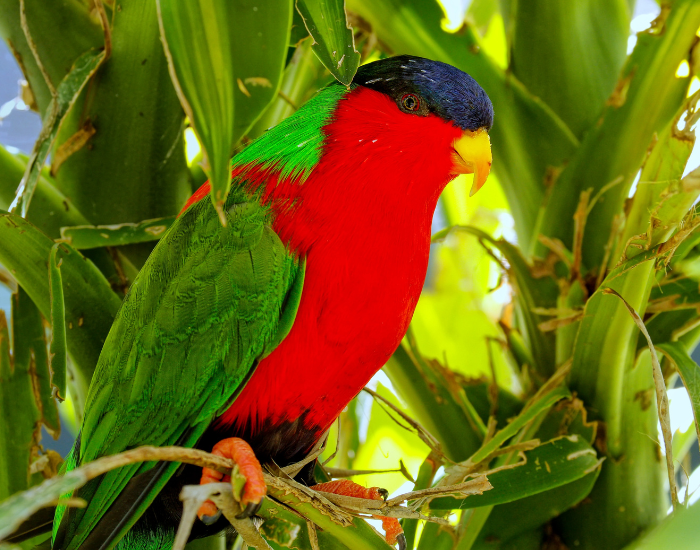
14. Coconut Lorikeet (Trichoglossus haematodus)
The coconut lorikeet looks like a rainbow lorikeet with darker blue on the head and heavier barring on the chest. It ranges across New Guinea, eastern Indonesia, the Solomon Islands, Vanuatu and New Caledonia. Until recent splits, Australia’s rainbow lorikeet was lumped into this species. That’s why some older research still calls Australian birds Trichoglossus haematodus.
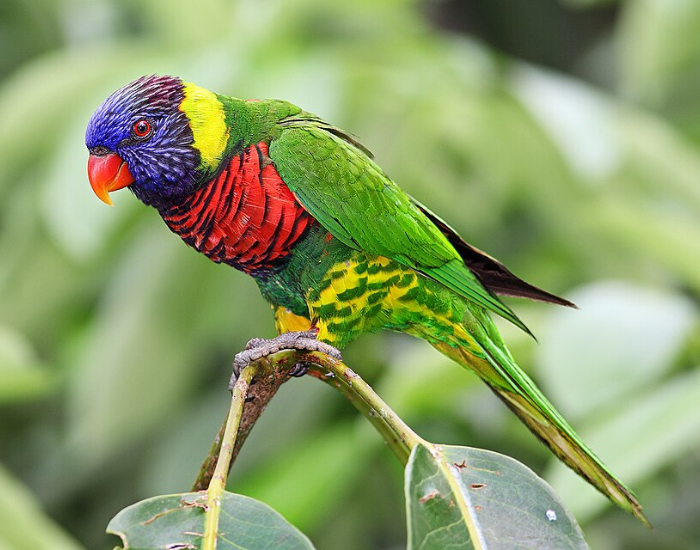
15. Blue Lorikeet (Vini peruviana)
The blue lorikeet is a tiny 18 cm bird, deep violet-blue with a crisp white face and throat. It lives on scattered islands in French Polynesia and the Cook Islands. Blue lorikeets feed on coconut palm nectar and even pick insects from the undersides of leaves. Few other parrots wear such pure blue feathers.
BirdLife lists the species as Vulnerable, with about 5,300 mature birds left. Black rats and severe cyclones are its main threats. Its relative, the ultramarine lorikeet (Vini ultramarina), survives only on Ua Huka in the Marquesas. It is Critically Endangered.
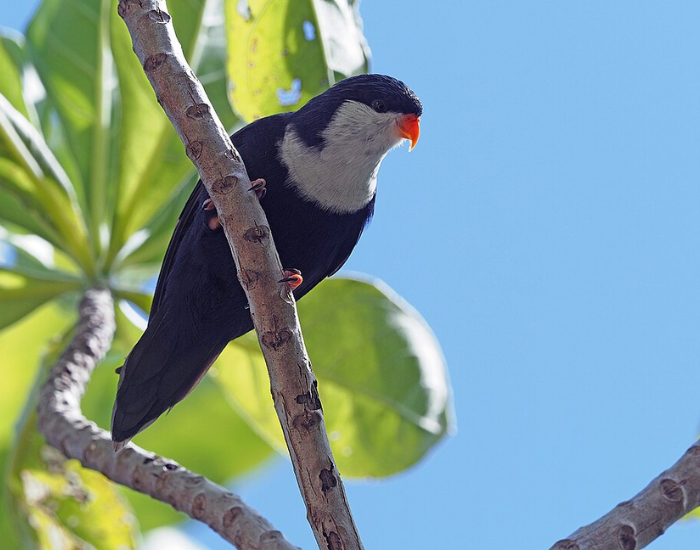
16. Yellow-bibbed Lory (Lorius chlorocercus)
The yellow-bibbed lory proves the Lorius genus reaches well beyond New Guinea. It’s a red, 28 cm bird with a black cap, green wings and a yellow band across the upper chest. That band is the “bib”, and a black crescent sits on each side of the neck.
It lives only in the Solomon Islands, in lowland and hill forest. Unlike its chattering cousin, it remains listed as Least Concern.
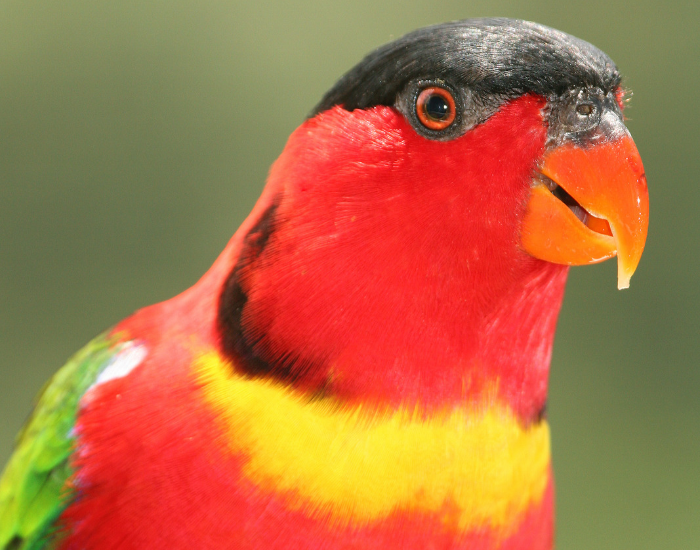
17. Red-flanked Lorikeet (Hypocharmosyna placentis)
The red-flanked lorikeet is a small, bright green bird about 17 cm long. Males show a red face and red flanks, with a blue patch on the cheek. Females are greener, with yellow streaks on the face. It ranges from the Maluku Islands through New Guinea to the Solomon Islands. Older guides place it in Charmosyna.
Lories as Pets: What Owners Should Know
Lories are highly intelligent, acrobatic birds that hang upside down to play. With proper care, they can live 15 to 30 years, and rainbow lorikeets often pass 20. Hand-fed birds bond deeply with their carers and need hours of mental stimulation daily. They can make excellent pets for experienced keepers, but they’re a poor match for first-time bird owners.
Diet is the hardest part. Lories are specialised nectarivores, so captive birds need a commercial lory nectar or powder. Wet nectar spoils fast, so many keepers replace it two to three times a day. Seed mixes and pellets made for seed-eating parrots don’t suit them. Fresh fruit, green vegetables and a little oats make good treats, while citrus can upset digestion.
A liquid diet also means high-moisture, explosive droppings that land well beyond the cage. Keepers watch for sour crop, an infection of the crop, and for feather plucking linked to boredom or anxiety.
Frequently Asked Questions
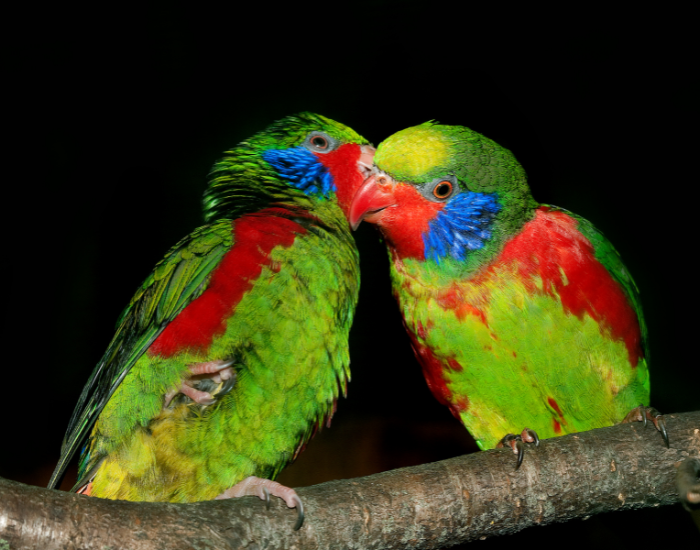
Rainbow lorikeets show affection by preening each other’s head and neck feathers and by feeding their partner. Bonded pairs sit pressed together and travel side by side through large flocks. Pet lorikeets direct the same behaviour at people, nibbling hair and chattering softly close to their owner.
Yes, some lories can learn words and short phrases. Chattering, black-capped and rainbow lorikeets are the best-known mimics. Their speech is usually less clear than an African grey parrot’s, and plenty never talk at all.
Parrots have thick, muscular tongues that turn and hold food against the beak, almost like a finger. Lories add a brush tip covered in papillae that spread open during feeding. That brush soaks up nectar and pollen quickly, then folds flat again.
One Overlooked Bird, Sixty Species
Lories and lorikeets learned to lick flowers instead of cracking seeds. Then they carried that trick across an ocean. The same brush-tipped tongue works a eucalypt on the Gold Coast and a coconut palm in Tahiti.
My own lesson was simpler. I’d walked past scaly-breasted lorikeets for years because I assumed every green flash was a rainbow. Next time flowering trees in your street fill with screeching, stop and check every bird in the wild flock. Then tell me in the comments which lorikeets visit your street.
For more, see my guides to Australian native birds and birding for beginners. You can also follow every species we log on our Australia lap page.
References:
Joseph, L., Merwin, J., & Smith, B. T. (2020). Improved systematics of lorikeets reflects their evolutionary history and frames conservation priorities. Emu – Austral Ornithology, 120(3), 201–215. https://doi.org/10.1080/01584197.2020.1779596
Lacasse, C., Rose, K., Allen, M., Ward, M. P., Pulscher, L. A., Giles, A., Hall, J., & Phalen, D. N. (2021). Investigation into clinicopathological and pathological findings, prognosis, and aetiology of lorikeet paralysis syndrome in rainbow lorikeets (Trichoglossus haematodus). Australian Veterinary Journal, 99(10), 432–444. https://doi.org/10.1111/avj.13107
Schweizer, M., Güntert, M., Seehausen, O., Leuenberger, C., & Hertwig, S. T. (2014). Parallel adaptations to nectarivory in parrots, key innovations and the diversification of the Loriinae. Ecology and Evolution, 4(14), 2867–2883. https://doi.org/10.1002/ece3.1131
Schweizer, M., Wright, T. F., Peñalba, J. V., Schirtzinger, E. E., & Joseph, L. (2015). Molecular phylogenetics suggests a New Guinean origin and frequent episodes of founder-event speciation in the nectarivorous lories and lorikeets (Aves: Psittaciformes). Molecular Phylogenetics and Evolution, 90, 34–48. https://doi.org/10.1016/j.ympev.2015.04.021
Smith, B. T., Mauck, W. M., Benz, B. W., & Andersen, M. J. (2020). Uneven missing data skew phylogenomic relationships within the lories and lorikeets. Genome Biology and Evolution, 12(7), 1131–1147. https://doi.org/10.1093/gbe/evaa113