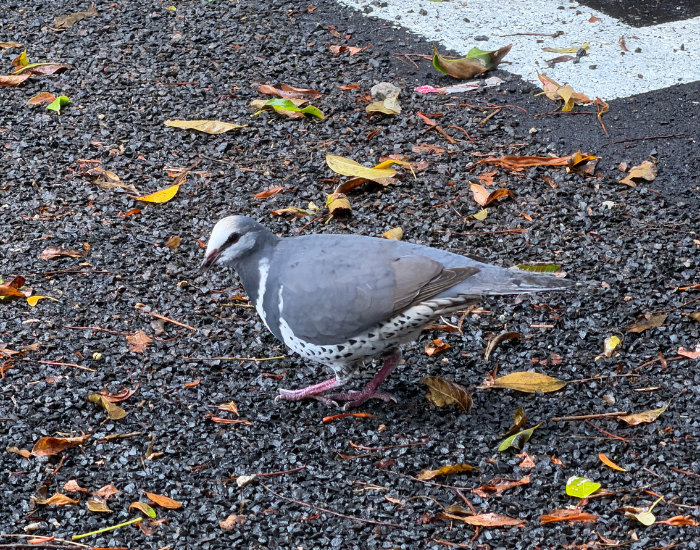
I pulled into Woody Head campground on the NSW north coast with a roof tent and a bad forecast. By mid-morning a wonga pigeon stepped out of the littoral rainforest and started feeding on soaked ground. That was my first one, ever. Australia’s native pigeons had quietly become a list I was collecting without realising it.
I grew up in Mexico, where the common pigeon owns every plaza and church roof. Europe and Egypt looked the same on my last trip: grey birds, crumbs, statues. Australia flips that script completely. Here the loud birds are galahs, rainbow lorikeets, cockatoos and other parrots, plus the kookaburra laughing over the lot.
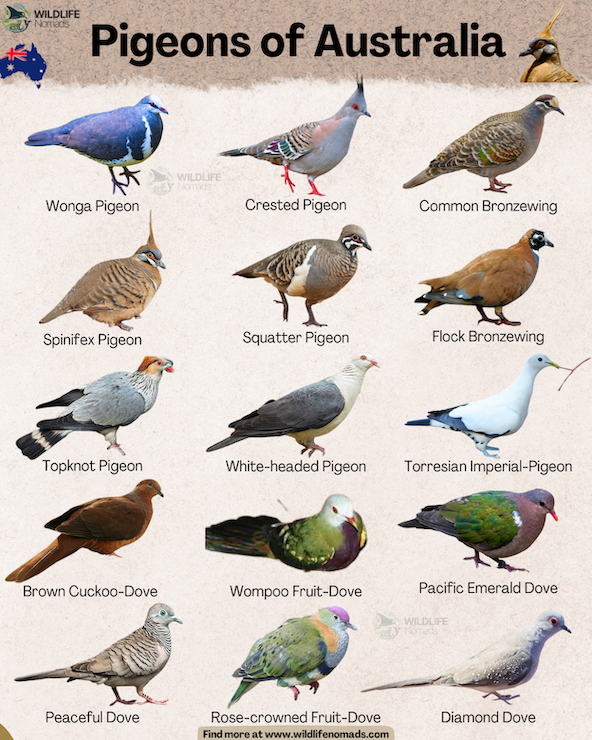
Meanwhile the pigeons hide in plain sight. Australia holds 22 native columbid species, and most people walk straight past them. This guide covers 15, with field marks, habitat, and the tricks I use to separate them.
Pigeons and Doves: One Family, Two Nicknames
Pigeons and doves belong to the same family, Columbidae, with over 300 species worldwide. No taxonomic line divides the two names. In general use, pigeons are the larger, stout bodied birds, while doves are the small, slender ones. That is it. The peaceful dove and the wonga pigeon are closer relatives than either is to a parrot.
Across the pigeon family the body plan barely changes. Compact bodies, short necks, small heads, short legs, and an explosive burst of flight when flushed. Nearly all of them live on plant matter. Most build a flimsy, loose platform of twigs, lay two white eggs, and both sexes share incubation. Both parents produce crop milk, a protein-rich secretion from the crop lining that feeds the squabs. Many species breed year round when conditions allow.
1. Wonga Pigeon (Leucosarcia melanoleuca)
Big, grey, and built like a bowling pin on pink legs. It reaches 38 cm, with a clean white V across the breast and dark flank spots. My Woody Head bird worked the wet leaf litter, picking fallen fruit and grass seeds.
Wongas walk more than they fly, wearing visible trails through the understorey. Listen for a monotonous “woop-woop” that carries up to two kilometres. Once you know that call, you realise how many are around you.
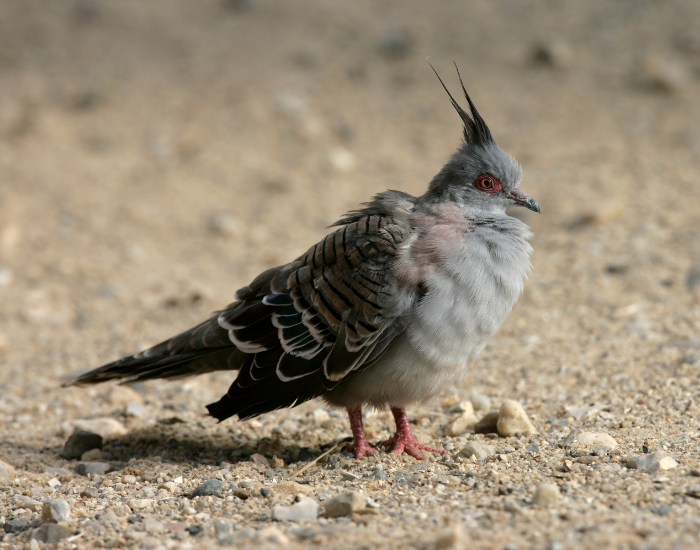
2. Crested Pigeon (Ocyphaps lophotes)
I call this one the punk pigeon, because of that thin black crest standing bolt upright. Grey-brown body, bronze and green iridescence on the wings, red eye-ring, pink legs. This is the pigeon you actually see in urban areas, feeding on lawns and roadside verges.
Here is the part that still impresses me. Its eighth primary feather is modified into a whistle. That takeoff sound works as a real alarm signal for the flock. Other pigeons flee from a startled bird’s whistle, but ignore a relaxed one. It is an alarm call made by feathers, not a voice.
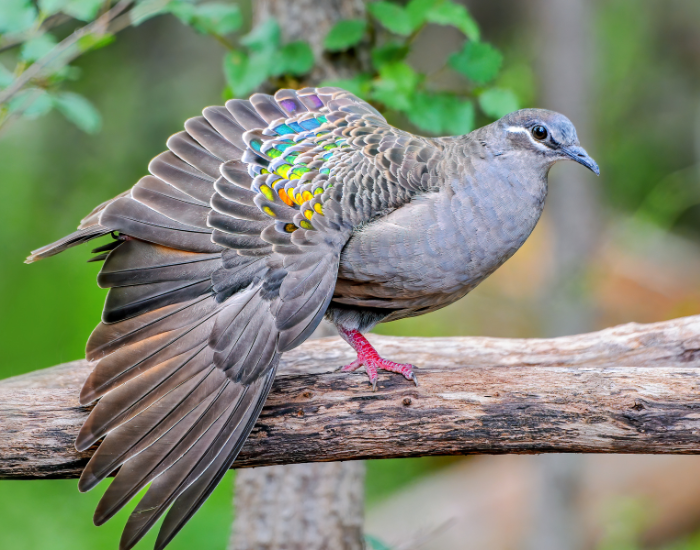
3. Common Bronzewing (Phaps chalcoptera)
Look for a heavy, grey brown pigeon that explodes off a bush track. It flashes green, bronze and copper on the wings. Those iridescent panels are the distinguishing feature, and they shift colour with the light.
Common bronzewings live almost everywhere with trees, from wet coastal forest to mallee. They are dedicated seed eaters, and the diet is mainly seeds from acacias and other legumes. Their call is a deep, repeated “oom” that people mistake for distant machinery.
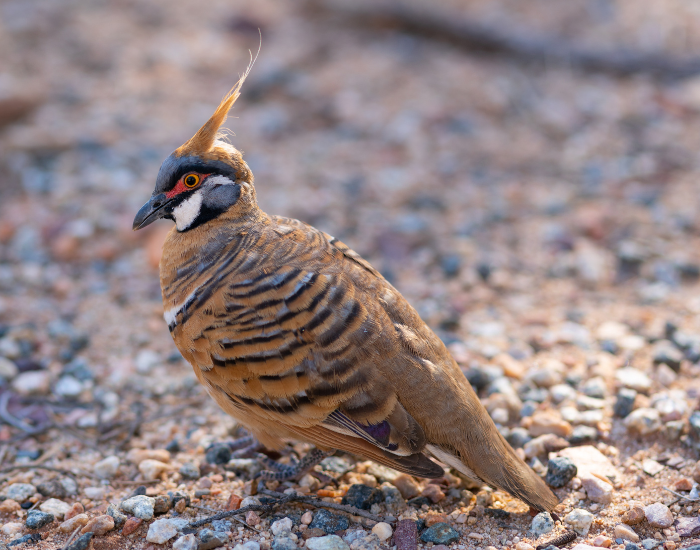
4. Spinifex Pigeon (Geophaps plumifera)
Rusty orange, spiky crest, and a bare red face mask edged in black. Spinifex pigeons look designed rather than evolved. They scuttle across rocky ranges through the arid centre, from the Pilbara to the MacDonnells.
Physiological work shows how tightly they run their water budget in that heat. They still need to drink, so waterholes at dawn are the reliable way to find them. I have watched small parties trot in, drink fast, and vanish into the spinifex within a minute.
5. Squatter Pigeon (Geophaps scripta)
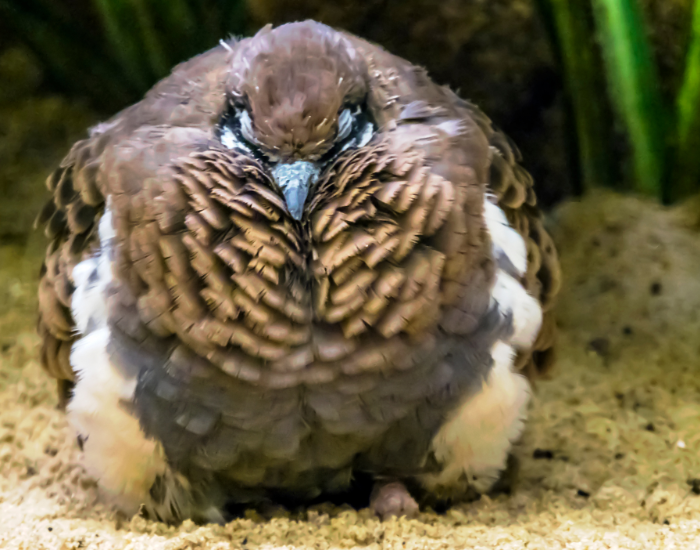
Bold black-and-white facial stripes make this ground pigeon unmistakable in Queensland woodlands. The body is plain grey brown, with wing feathers showing darker centres. Its head does all the identification work.
The southern subspecies is listed as Vulnerable. Grazing pressure, altered fire regimes and habitat loss have driven severe declines through much of its former range. Cattle-country waterpoints now concentrate them, which makes them easier to see and easier to lose.
6. Flock Bronzewing (Phaps histrionica)
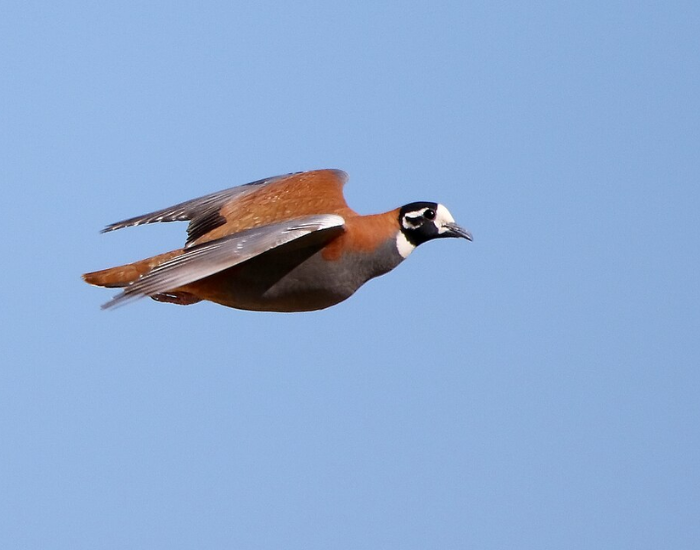
Nineteenth-century accounts describe flocks darkening the sky over inland waterholes. Those numbers are gone. Flock bronzewings suffered severe declines after pastoralism reshaped the arid grasslands, and today they move as nomads chasing rain.
Males wear a crisp black-and-white face pattern that looks painted on. They feed mainly on grass seeds and travel long distances to drink. Finding them takes luck and a good rainfall map.
7. White-headed Pigeon (Columba leucomela)
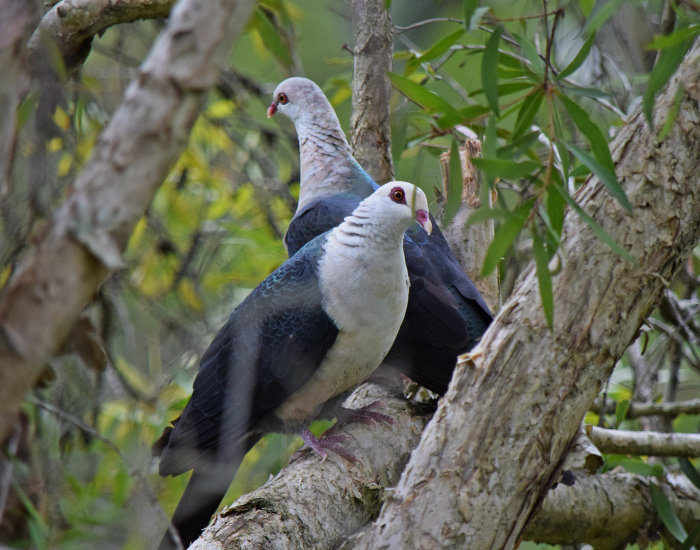
A large pigeon with a glossy blue-black back and a clean white head and breast. It sits high in rainforest edges along the east coast, from Cooktown to the Illawarra. I see them regularly around the Gold Coast hinterland, usually perched dead still on a bare branch.
Interestingly, this species benefited from a weed. Introduced camphor laurel produces heavy fruit crops, and white-headed pigeons exploited it hard, expanding as rainforest was cleared. That is a rare case where human activity accidentally helped a native pigeon.
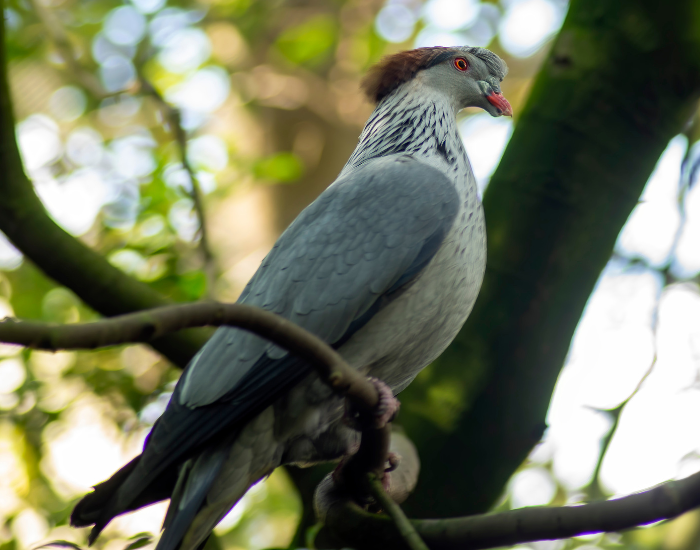
8. Topknot Pigeon (Lopholaimus antarcticus)
At up to 40 – 50 cm, this is the giant of the east-coast rainforest. It carries a double crest, grey in front and rusty behind, which looks like a bad haircut from below. Flocks pour through the canopy, hanging upside down to reach fruit.
Topknots are nomadic, tracking fruiting events up and down the coast. They swallow large fruit whole and move seeds long distances, which makes them serious ecosystem engineers. When fruit starts raining onto the track in front of you, look up.
9. Wompoo Fruit-Dove (Ptilinopus magnificus)
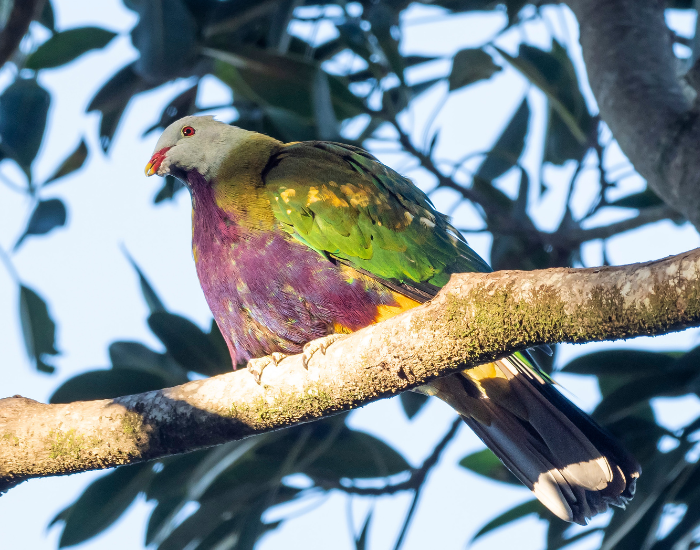
Green above, deep purple below, with a yellow belly and an orange bill. On paper it is gaudy. In a rainforest canopy it becomes invisible, and I have stood underneath calling birds for ten minutes without seeing one.
The call is a resonant “wollack-a-woo” that seems to come from everywhere. Wompoos take fruit almost exclusively, favour figs, and rarely descend to the ground. Habitat loss in lowland rainforest remains their main pressure.
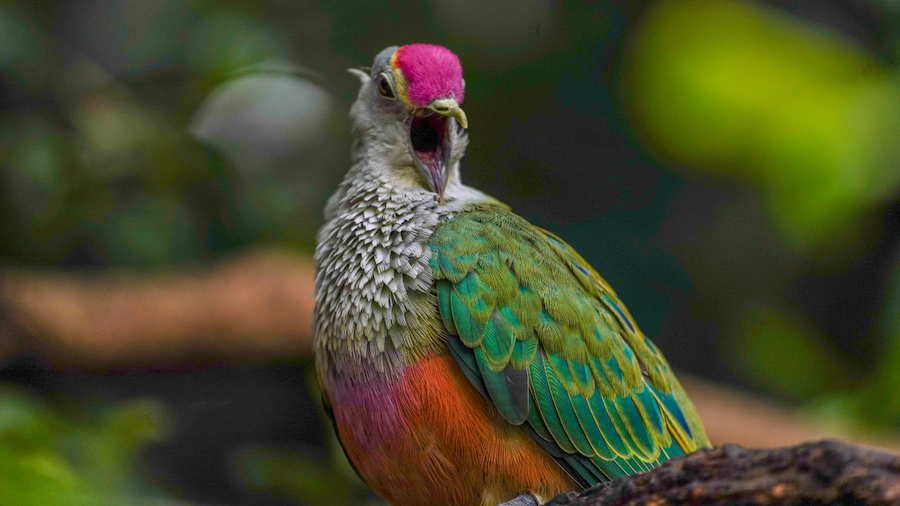
10. Rose-crowned Fruit-Dove (Ptilinopus regina)
Smaller than the wompoo, with a pink cap, grey throat and orange belly. Rose-crowns work coastal rainforest and mangrove edges from the Kimberley across the north and down to the Hunter.
Their call accelerates into a run of fast, popping notes that trails off. Learn that sound and you will detect ten birds for every one you see. They also shift with fruiting seasons, so a patch fills and empties.
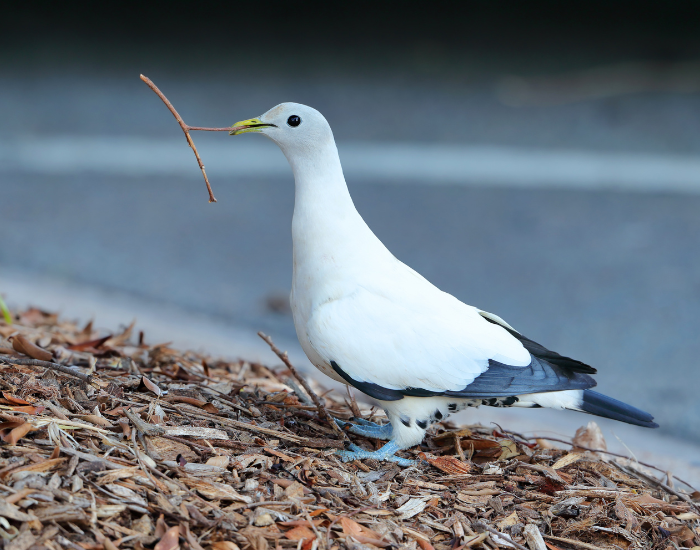
11. Torresian Imperial-Pigeon (Ducula spilorrhoa)
Pure white with black flight feathers, this pigeon looks unreal against tropical green. Large numbers migrate from New Guinea each spring to breed on Queensland’s offshore islands. They then commute to the mainland daily to feed.
Historically, hunting drove heavy losses at island colonies. Protection allowed a strong recovery, and the evening flights back to those islands rank among northern Australia’s best bird spectacles. Some colonies now number in the tens of thousands.
12. Brown Cuckoo-Dove (Macropygia phasianella)
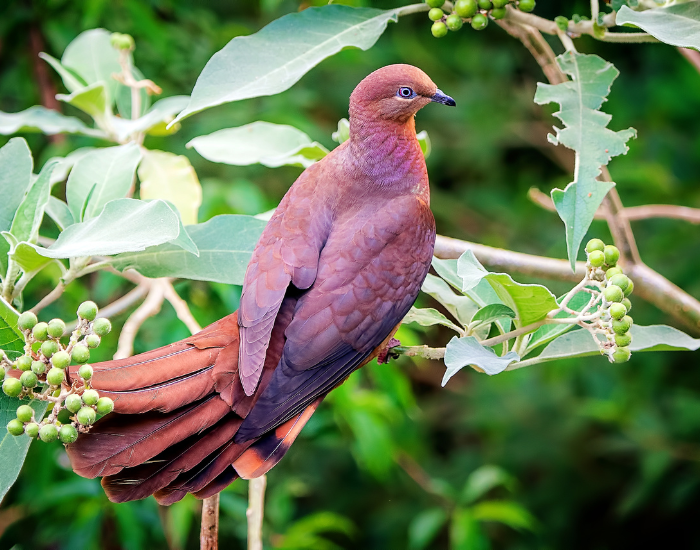
A long-tailed, rufous dove that clambers through regrowth like a small pheasant. The tail is nearly half its total length, which makes it easy to identify even in poor light.
Brown cuckoo-doves thrive along disturbed rainforest edges and weedy tangles of lantana. They are among the few pigeons you regularly see feeding above ground in shrubs. Their call is a rising “whoop-a-whoop” repeated for minutes on end.
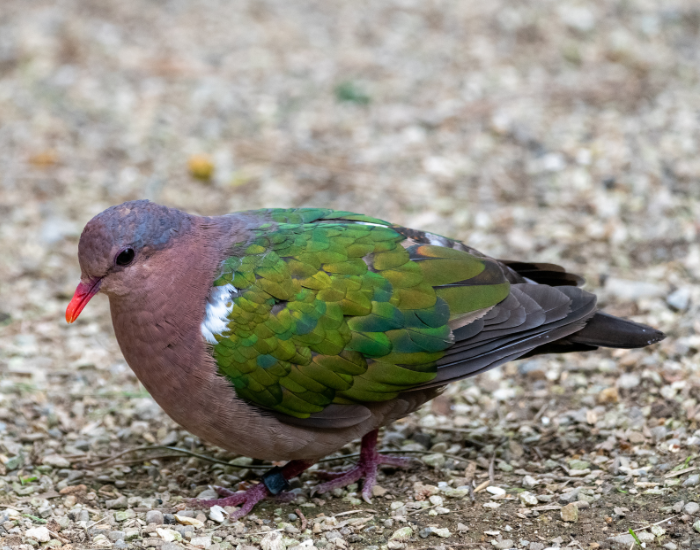
13. Pacific Emerald Dove (Chalcophaps longirostris)
Bronze-green wings, a rufous body, and a habit of flying fast and low along forest tracks. Emerald doves rarely give you more than three seconds. That green flash disappearing around a bend is usually all you get.
They forage on the ground for fallen seeds, fruit and small invertebrates. Look in rainforest down the east coast and across the tropical north.
| Khan Le
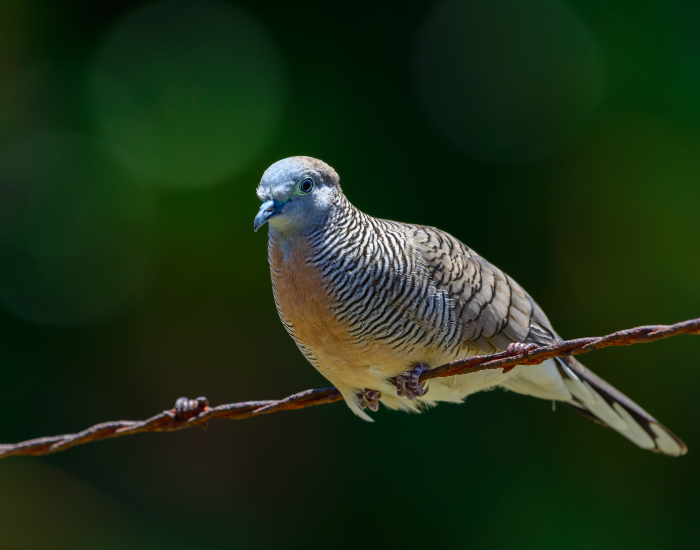
14. Peaceful Dove (Geopelia placida)
Tiny, finely barred, and everywhere. The peaceful dove is one of the most common sight birds of open woodland and country towns. Its “doodle-doo” is a familiar sound across inland Australia, delivered from powerlines and fence wires all day.
Do not confuse it with the bar-shouldered dove, which is larger and shows a bronze-barred hind neck. Peaceful doves take tiny grass seeds and nest in an almost transparent twig platform. I have watched eggs through the bottom of a nest.
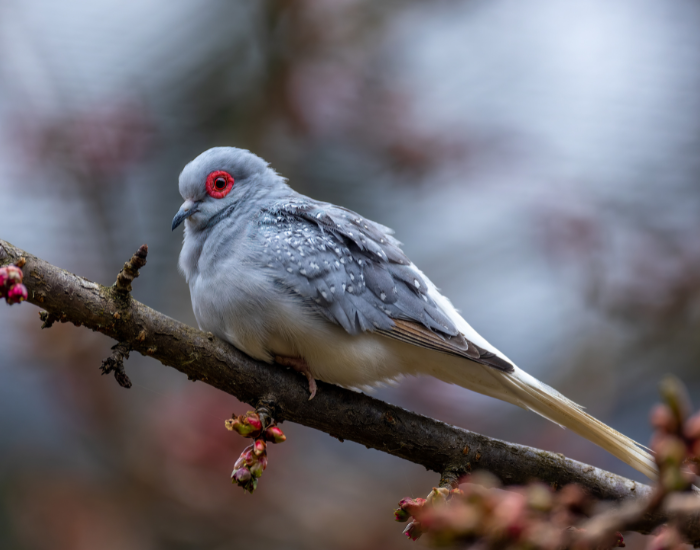
15. Diamond Dove (Geopelia cuneata)
The smallest of Australia’s native doves, weighing about 3.5 kg. Adults are pale grey with a bold red eye-ring and many white spots peppered across the wings. Those white spots give the species its name.
Diamond doves belong to the arid and semi-arid interior, though they wander widely after rain. They drink daily, so they gather at outback troughs and dams in loose flocks. In captivity they are popular, but seeing wild birds shimmer over red sand is an entirely different experience.
The Pigeons in Australia That Are Not Native
Introduced species share the country with the natives. The feral pigeon, or rock pigeon, is Columba livia — descendants of domestic pigeons that people brought with them. The wild rock dove originally nested on sea cliffs and rocky gorges. That is exactly why ledges, bridges and warehouses suit domesticated pigeons so well.
Humans domesticated pigeons over 5,000 years ago for meat and for guano, a valuable fertiliser. Selective breeding produced hundreds of pigeon breeds, from tumblers to fantails. Bred pigeons also carried messages: homing pigeons served through World War II, and 32 received the Dickin Medal. Their navigation runs on a biological compass combined with landmarks and smell.
The spotted dove came from eastern Asia and now thrives in eastern and southern cities. Look for a large black collar covered in many white spots on the hind neck. Both it and the feral pigeon behave as classic feral birds, scavenging food scraps in urban areas.
Turtle doves, collared doves and the stock dove — a bird of hollows and rabbit warrens — never established here. Elsewhere the story ran worse. Over-hunting drove the passenger pigeon to extinction by 1914, and the Socorro dove vanished from the wild by the early 1980s
FAQs About Pigeons and Doves
Yes. Australia has several native doves, including the peaceful dove, diamond dove, bar-shouldered dove and the emerald dove. Introduced doves also occur, most commonly the spotted dove in eastern and southern cities. All of them sit within the same pigeon family as the larger native pigeons.
A female dove or pigeon is a hen, and a male is a cock. Young birds are squabs, and a juvenile racing bird is a squeaker. Pairs are typically monogamous for life and both birds share nest duties.
The crowned pigeons of New Guinea hold that title, and the Victoria crowned pigeon reaches about 4 kg. By contrast, the common ground dove of the Americas weighs roughly 22 g. The Nicobar pigeon is the closest living relative of the dodo, the textbook example of island extinction.
Some are. Roughly 118 columbid species, about 34% of the family, now carry a threatened or near-threatened listing. Island endemics with small ranges face the highest risk, particularly where invasive mammals are present (Cambrone et al., 2023). In Australia, the squatter pigeon and flock bronzewing show what habitat change does to ground-feeding species.
Start Looking Down
Australia’s birds are absurdly diverse, and I have spent years chasing the flashy ones. The pigeons taught me the opposite lesson: the best birds are often the quiet ones eating seeds three metres away. Learning these 15 species changed how I walk through a campground.
Start with the crested pigeon in your own street, then work outward. Once you can pick a bronzewing by its takeoff, the whole continent opens up.
I am driving my lap of Australia right now. Tell me in the comments which pigeons I should chase next.
Can You Name That Australian Pigeon? 🕊️
A 15-photo identification challenge — the wrong answers are deliberately tricky look-alikes from a similar group. Go back and change any answer before you score.
Which pigeon or dove is this?
References:
Cambrone, C., Jean-Pierre, A., Bezault, E., & Cézilly, F. (2023). Identifying global research and conservation priorities for Columbidae: A quantitative approach using random forest models. Frontiers in Ecology and Evolution, 11, 1141072. https://doi.org/10.3389/fevo.2023.1141072
Murray, T. G., Zeil, J., & Magrath, R. D. (2017). Sounds of modified flight feathers reliably signal danger in a pigeon. Current Biology, 27(22), 3520–3525. https://doi.org/10.1016/j.cub.2017.09.068
Murray, G. G. R., Soares, A. E. R., Novak, B. J., Schaefer, N. K., Cahill, J. A., Baker, A. J., … Shapiro, B. (2017). Natural selection shaped the rise and fall of passenger pigeon genomic diversity. Science, 358(6365), 951–954. https://doi.org/10.1126/science.aao0960
Wang, Y., Wang, X., Luo, Y., Zhang, J., Lin, Y., Wu, J., … Li, M. (2023). Spatio-temporal transcriptome dynamics coordinate rapid transition of core crop functions in “lactating” pigeon. PLOS Genetics, 19(5), e1010746. https://doi.org/10.1371/journal.pgen.1010746
Mulhall, S., & Lill, A. (2011). What facilitates urban colonisation by Crested Pigeons Ocyphaps lophotes? Corella, 35(3), 73–81. https://research.monash.edu/en/publications/what-facilitates-urban-colonisation-by-crested-pigeons-ochyphaps-/