A guide in Sumatra once pointed at a tree trunk and said one word: colugo. I saw bark. That is the closest I have come to seeing one in the wild, and I have looked hard.
Sumatra gave me orangutans and gibbons moving through the canopy. Palawan gave me a month of coral, reef fish, and stories about tarsiers. Both times the local guides described colugos with real affection. Both times the animal stayed invisible.
Then I spent weeks writing about convergent evolution: echidnas, porcupines, hedgehogs – and gliding mammals kept surfacing. Sugar gliders. Flying squirrels. And colugos, which do the same job better than anything else with fur.
So I went digging. Below is what genuinely changed how I think about these animals. How far they actually glide. Why their teeth look like combs. Why they are not lemurs at all. And why a “Least Concern” label hides a real problem. You will also get straight answers on whether colugos can be pets and whether colugos fly.
1. Colugos Belong to Their Own Unique Order, Dermoptera
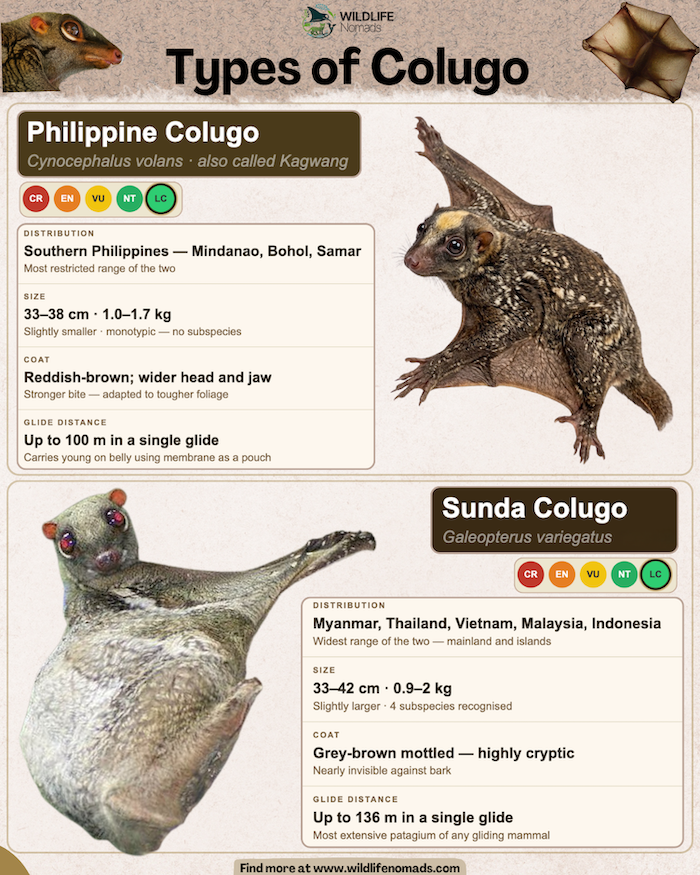
Most mammals sit inside crowded, sprawling families. Colugos do not. They occupy Dermoptera, an order holding a single family and just two living species.
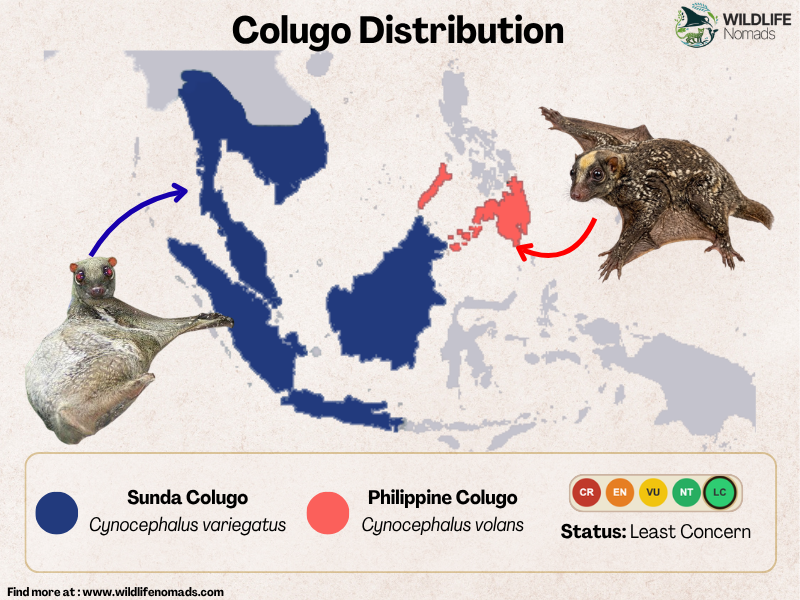
The Sunda flying lemur (Galeopterus variegatus) ranges across Southeast Asia, from southern Myanmar through the Malay Peninsula to Indonesia. The Philippine colugo (Cynocephalus volans) lives only in the southern Philippines. That is the whole order, compare it to rodents, which account for more than 2,000 species.
Even those two species may be an undercount. Genomic work published in Science Advances found deep, hidden lineages inside the Sunda colugo. Therefore the real number of colugo species is probably higher than the textbooks say.
2. They Are Primates’ Closest Living Relatives, Not Lemurs
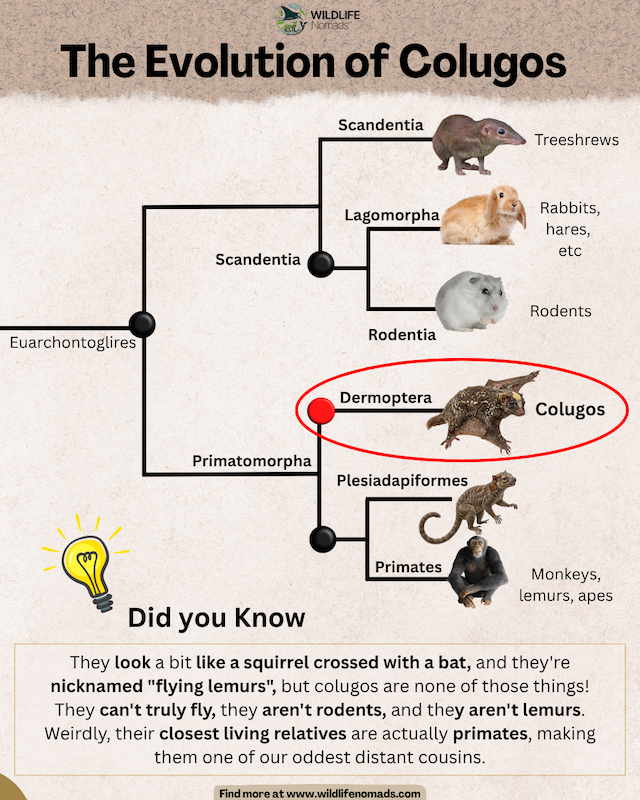
Colugos are still called flying lemurs in most field guides, and the name is wrong twice over. They do not fly, and they are not lemurs. Real lemurs are Madagascan primates; colugos never set foot on Madagascar.
That said, the confusion has a kernel of truth. Molecular and genomic data place colugos as the sister group to primates. Among all other mammals, none sits closer, colugos are the closest living relative primates have. So a colugo sharing a tree with long tailed macaques in Borneo is, evolutionarily, a distant cousin.
You will also see them called “giant flying lemur,” “gliding lemur,” even “bat lemur.” Those names are inventions, not biology. The occasional “hairless colugo” photo is usually a wet adult or a newborn, not a distinct form.
3. The Colugo’s Patagium Is the Largest Gliding Membrane in Any Mammal
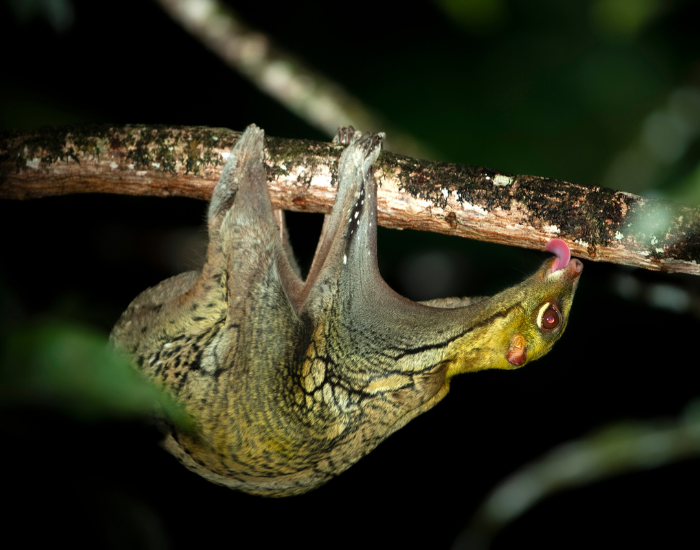
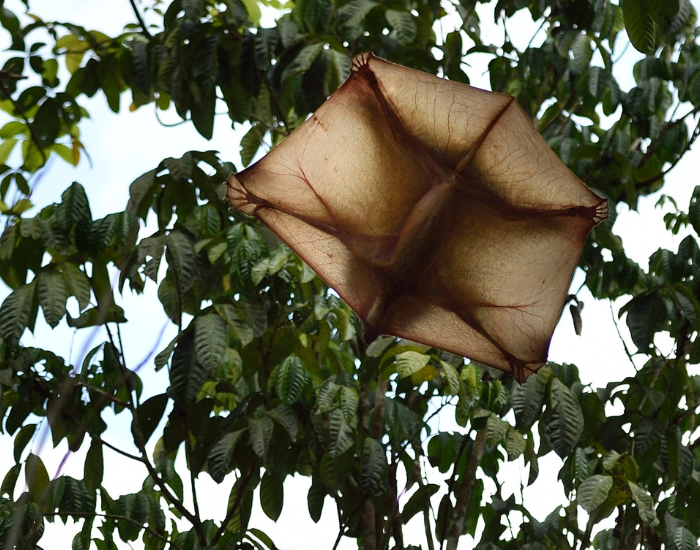
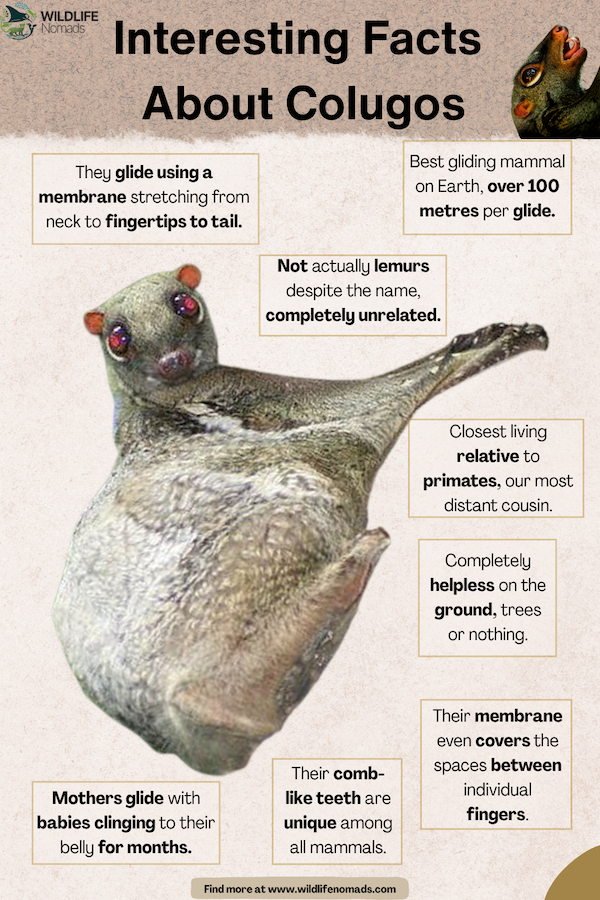
Plenty of gliding mammals exist. What sets colugos apart is sheer coverage of that large membrane. The colugo’s patagium stretches from the neck to the fingertips and out along the long limbs. It then continues down to the toes and the tail tip.
Crucially, the skin runs between the fingers and toes as well. No other gliding mammal webs its digits this way. As a result, a colugo becomes a single continuous aerofoil rather than a rectangle of loose skin.
Flying squirrels leave their hands and tail free. Sugar gliders stop the membrane at the wrist and ankle. Colugos commit completely, which is exactly why they outperform both. No other animals in the canopy come close.
4. Colugos Glide, They Do Not Fly
Unlike birds and bats, a colugo generates no thrust. It cannot flap, and it cannot gain altitude. Every journey is a controlled fall, traded downward height for forward distance.
The numbers still impress. Colugos routinely cross 70 metres between trees, and researchers have recorded a single glide of roughly 150 metres. More telling, colugo gliding loses surprisingly little height over those long distances.
Interestingly, one study of free-ranging Malayan colugos found that gliding saves time rather than energy. Climbing back up a trunk costs plenty. The payoff is speed and safety, not a free lunch. It is a tidy example of convergent evolution solving one problem in unrelated groups.
5. Colugo Teeth Look Like Combs, and That Is Not an Accident
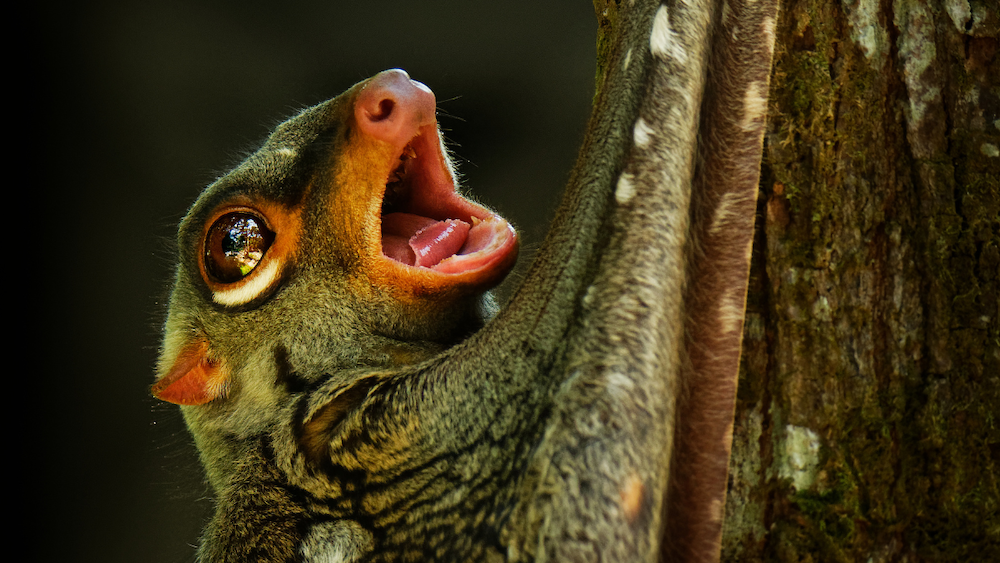
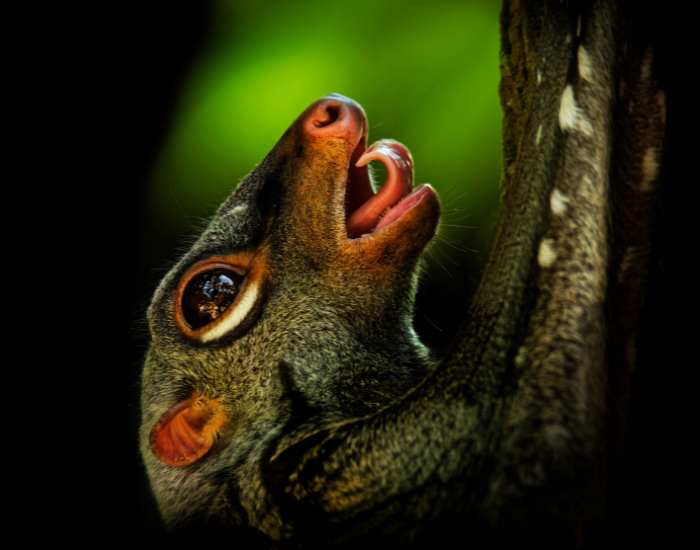
Open a colugo’s mouth and you find something no other mammal has. The lower incisors are split lengthwise into fine prongs, up to 20 tines on a single tooth. Nothing else in the natural world carries a tooth built quite like this.
Biologists argue about the exact function. Grooming is the leading explanation: colugos have a huge surface area of membrane to keep clean and parasite-free. The comb may also strip leaves, working like a plant scraper.
The second upper incisors are odd too. They sit with two roots each, which is unusual among mammals and useful for identifying fossils.
6. Strict Herbivores with a Cow-Like Gut
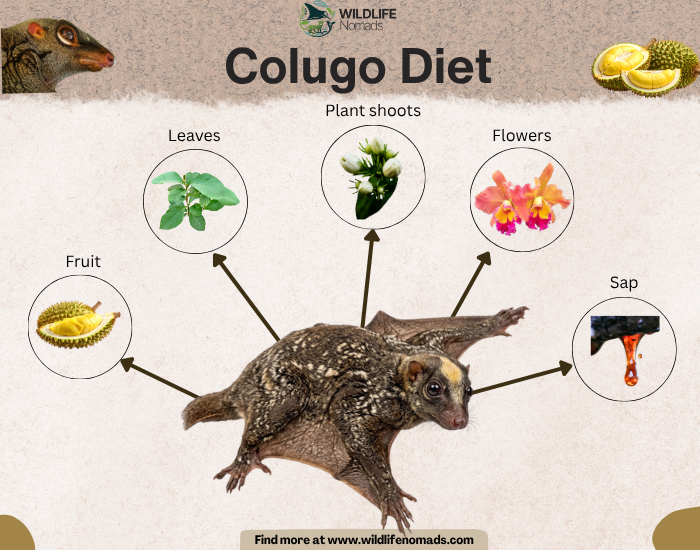
Colugos are strict herbivores. They eat leaves, shoots, flowers, sap and fruit, with a clear preference for young leaves. No insects, no eggs, no opportunistic scavenging.
Leaves are terrible fuel, so the gut compensates. Colugos carry large, chambered stomachs and an extremely long intestine, plus a compartmented caecum packed with cellulose-digesting microbes. Functionally, it resembles a cow’s system shrunk to fit a tree-dweller.
A year-long study in West Java tracked the diet closely. Leaves dominated through the rainy months, then fruit took over during the dry season. This is why colugos move slowly and rest for long stretches, a fibrous diet buys a slow metabolism.
7. Mottled Fur That Erases Them Against Tree Bark
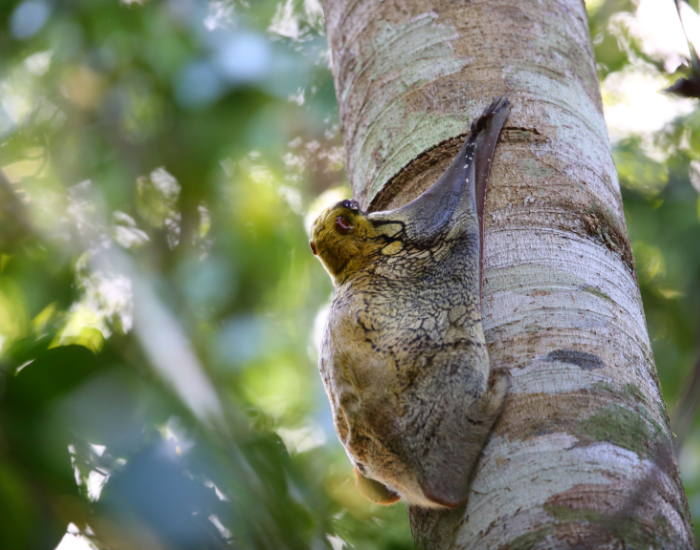
This is why my Sumatran guide had to point twice. Colugo fur blends into lichen-covered tree bark with genuinely uncomfortable accuracy. Greys, rusty reds, and pale flecks break the outline completely.
At first glance a resting colugo reads as a knot or a broken branch. Colugos spend daylight hours pressed flat against a trunk or tucked into tree holes, motionless. Only sharp claws give the game away, and only if you are close.
The camouflage earns its keep. Philippine colugos are a staple prey item for the Philippine eagle, and tree-climbing snakes take them as well. Against predators with that kind of eyesight, stillness beats speed.
8. Large Forward-Facing Eyes Built for the Night
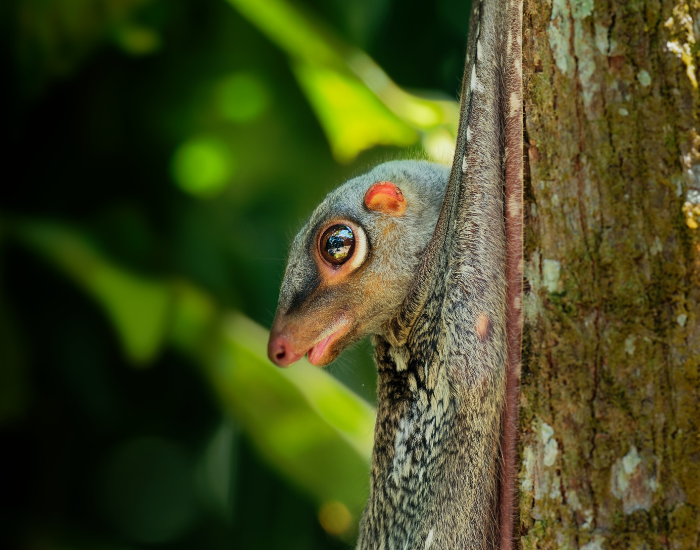
Colugos are nocturnal, and their heads show it. Large eyes sit forward on the face, giving overlapping fields of view and excellent night vision. Depth perception matters enormously when you are aiming a 100-metre glide at a specific trunk in the dark.
Those forward facing eyes are another reason people file colugos alongside their closest relatives, the primates. However, plenty of unrelated mammals evolved the same layout for the same reason.
They become active after dusk and feed through the night. By dawn, they are back on a trunk doing their impression of bark.
9. Mothers Carry Their Young in a Living Hammock
Female colugos give birth after roughly two months, usually to a single, very undeveloped baby. Newborn colugos are essentially marsupial in their helplessness, though colugos are placental mammals.
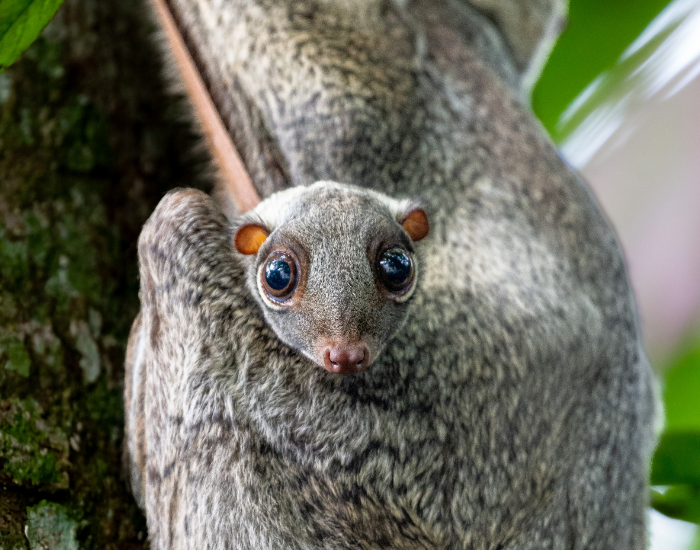
The mother then folds her patagium into a pouch. Young colugos cling to her underside for protection and ride there for around six months, including during glides. I find this the strangest fact of the lot. A baby colugo survives a 100-metre glide before it can walk.
Otherwise, colugos live alone. Life is solitary here, with little interaction beyond mating and motherhood. Several may feed in one tree without forming a real group.
10. Where Colugos Live, and Why They Almost Never Touch the Ground
Colugos inhabit the tropical rainforests of Southeast Asia. You will find them in Malaysia, Thailand, Indonesia, Brunei, Singapore and the Philippines, from lowland forest into plantations and gardens.
They are strictly arboreal. A colugo on the ground is clumsy, slow and badly exposed. For an animal built entirely for hanging, the forest floor is dangerous. So they climb in awkward hops, then glide back out rather than crossing open land.
This is also why forest fragmentation hits them harder than it looks on a map. Colugos need canopy connectivity, not just canopy. A gap wider than a glide is a wall.
“Least Concern” Does Not Mean Safe
The IUCN currently lists both species as Least Concern. That status deserves context. The Philippine flying lemur was classified as vulnerable in 1996. Assessors downgraded it in 2008, once surveys found it persisting in degraded habitat.
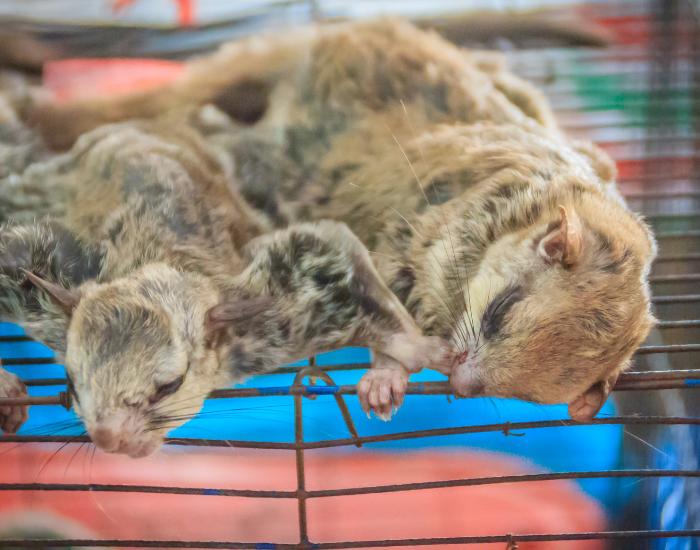
Persisting is not the same as thriving. Rapid deforestation across Southeast Asia removes exactly what colugos depend on, intact, connected forest. Hunting for meat and fur adds pressure in parts of Mindanao and Bohol.
There is a broader argument for caring. Because colugos rely on unbroken canopy, their presence works as an indicator of forest health. They also crop young leaves and eat fruit, feeding into local nutrient cycling and likely some seed dispersal. Lose the colugos and you have almost certainly lost something structural about that forest first.
Frequently Asked Questions About Colugos
No. Colugos make terrible pets and keeping one is illegal across most of their range. Their diet demands specific tropical leaves and sap that no owner can supply. Captive individuals routinely starve or develop gut disease. They also need vertical space measured in tens of metres.
Colugos cannot fly. They glide, using a membrane of skin rather than powered wings, and always lose altitude in the process. Recorded glides reach about 150 metres, with 70 metres being typical between trees. Only bats achieve true powered flight among mammals.
A colugo is not a monkey or any kind of primate. It belongs to Dermoptera, its own separate order of mammals, and forms the sister group to primates, making them our closest living non-primate relatives. Genetic evidence does make colugos the closest living relatives of primates. That is why people confuse them with monkeys and lemurs.
Colugos are strict herbivores. Their diet centres on young leaves, shoots, flowers, sap and fruit, and shifts seasonally as fruit becomes available. A multi-chambered stomach and long intestine let them ferment tough plant material.
Why Colugos Deserve More Attention
Colugos are the clearest evidence I know that evolution rewards commitment. Flying squirrels and sugar gliders hedged. Colugos wrapped skin around everything, fingers included, and now cross gaps nothing else with fur can manage.
I still have not seen one. That bothers me, and it should bother you too. An animal this remarkable sits in accessible forests, and most travellers walk straight past. Next time you are in Borneo or Bohol, ask your guide about colugos before you ask about anything else. Then scan the trunks, not the branches.
Seen one? Tell me where in the comments, I am collecting sightings. If gliding evolution interests you, read our breakdown of convergent species next, or compare colugos with the world’s squirrels.
Colugo Challenge 🦥
Ten questions on the canopy’s champion glider — first a fact-or-fiction round, then multiple choice. How many can you get?
References:
Byrnes, G., Libby, T., Lim, N. T.-L., & Spence, A. J. (2011). Gliding saves time but not energy in Malayan colugos. Journal of Experimental Biology, 214(16), 2690–2696. https://journals.biologists.com/jeb/article/214/16/2690/10373/
Janečka, J. E., Miller, W., Pringle, T. H., Wiens, F., Zitzmann, A., Helgen, K. M., Springer, M. S., & Murphy, W. J. (2007). Molecular and genomic data identify the closest living relative of primates. Science, 318(5851), 792–794. https://doi.org/10.1126/science.1147555
Mason, V. C., Li, G., Minx, P., Schmitz, J., Churakov, G., Doronina, L., Melin, A. D., Dominy, N. J., Lim, N. T.-L., Springer, M. S., Wilson, R. K., Warren, W. C., Helgen, K. M., & Murphy, W. J. (2016). Genomic analysis reveals hidden biodiversity within colugos, the sister group to primates. Science Advances, 2(8), e1600633. https://doi.org/10.1126/sciadv.1600633
Socha, J. J., Jafari, F., Munk, Y., & Byrnes, G. (2015). How animals glide: From trajectory to morphology. Canadian Journal of Zoology, 93(12), 901–924. https://doi.org/10.1139/cjz-2014-0013
Takatsuki, S., Tsuji, Y., Prayitno, B., Widayati, K. A., & Suryobroto, B. (2023). Seasonal changes in dietary compositions of the Malayan flying lemur (Galeopterus variegatus) with reference to food availability. Mammal Research, 68, 77–83. https://doi.org/10.1007/s13364-022-00658-y