The first stink fight I ever watched happened in a zoo, not a rainforest. Two male ring-tailed lemurs squared off across a fallen log. Each one dragged his tail through the scent glands on his wrists, then flicked it forward like a smelly flag. No teeth and no chasing. Just chemistry.
I have been been to all five continents, but Madagascar, embarrassingly, is still on my list. So my direct experience with the different types of lemurs comes from zoos and sanctuaries. That includes a walk-through enclosure on the east coast of Australia, where brown lemurs stepped straight over my boots.
That gap taught me something useful. You can learn an enormous amount about lemur behaviour without a plane ticket, provided you know what to look for. Below are 15 lemur species worth knowing, what makes each one strange, and where they sit on the IUCN Red List.
Fair warning: the conservation numbers in this article are grim! They are also the reason these animals deserve your attention.
What Makes a Lemur a Lemur?
Lemurs are strepsirrhine primates endemic to Madagascar. They exist nowhere else in the wild. Their ancestors likely rafted from mainland Africa on floating vegetation some 60 million years ago. After that, they evolved in isolation for millions of years.
That isolation produced something remarkable. Lemurs are the only primates to fill every niche on a single island. They range from 30-gram insect hunters to bamboo specialists. Over 100 lemur species now live in Madagascar, split across five major taxonomic families: Lemuridae, Indriidae, Cheirogaleidae, Lepilemuridae, and Daubentoniidae.
Most share two features. They have a wet nose and a strong sense of smell, unlike monkeys and apes. They also have a toothcomb, a row of forward-jutting lower teeth used for grooming fur.
No one agrees on the exact number. Taxonomists keep splitting populations into new species using genetic data, so the count climbs most years.
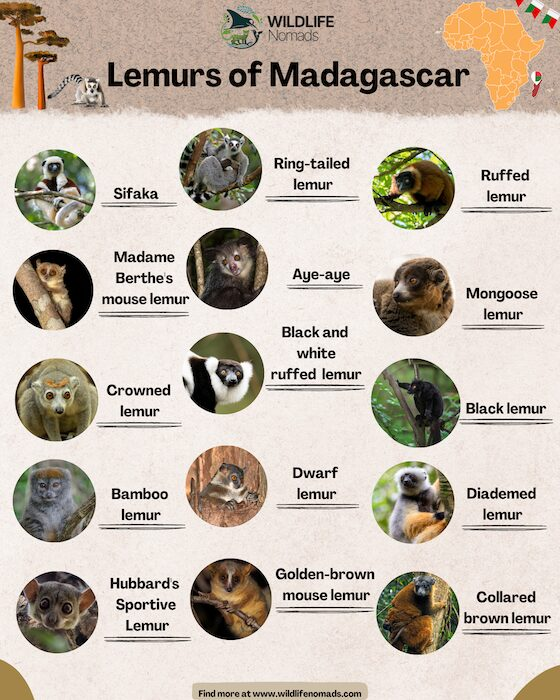
1. Ring-Tailed Lemur (Lemur catta)
Lemur catta is the face of Madagascar, largely thanks to King Julien and one very successful animated film. The scientific name means “cat-like lemur,” and the black and white striped tail is unmistakable.
Ring-tailed lemurs spend far more time on the ground than other lemur species, sometimes a third of their day. Troops run to 30 animals, led by females. Males settle disputes with stink fights, waving scent-soaked tails at rivals until one backs down. I have watched this play out in three separate collections, and it never stops being funny.

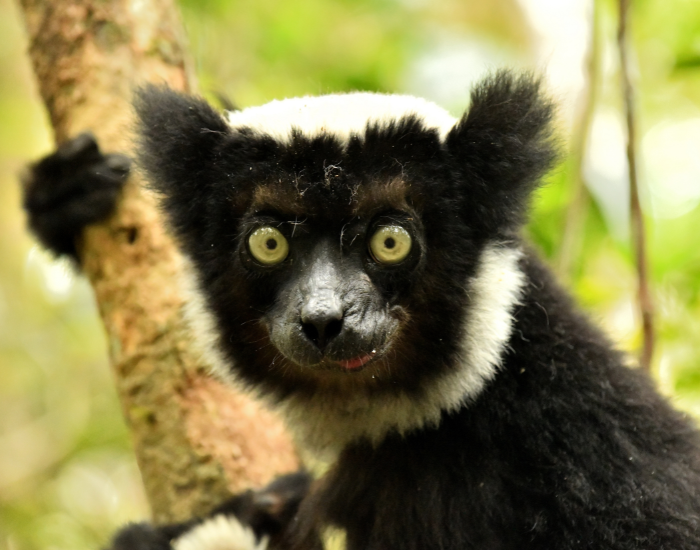
2. Indri (Indri indri)
The indri is the largest living lemur, reaching about 9 kg and standing nearly 70 cm tall. It has almost no tail, which throws people off completely.
Indri lemurs sing. Their distinctive calls carry two kilometres through the rainforest. A 2021 study found they use categorical rhythms, a trait otherwise known mainly from human music. They also clear up to 10 metres between trees in a single leap. Many Malagasy people call the indri babakoto, meaning ancestor, and traditional taboos have protected it for generations.
You will never see an indri in a zoo. They refuse to survive in captivity. Andasibe-Mantadia National Park in eastern Madagascar remains the only realistic place to meet one.
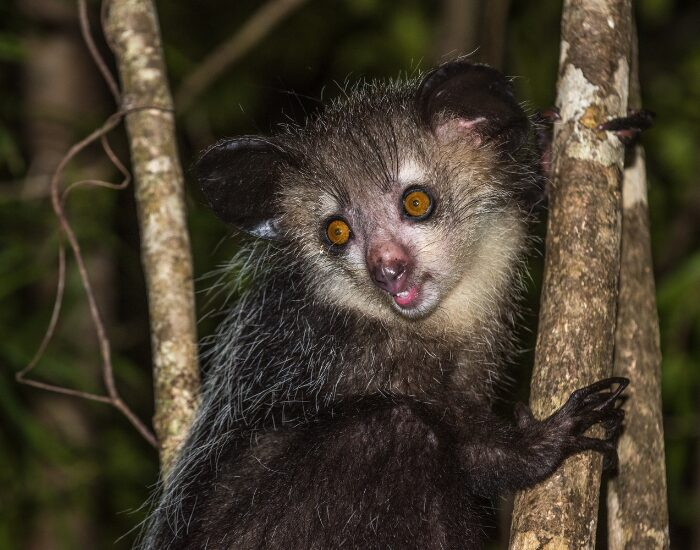
3. Aye-Aye (Daubentonia madagascariensis)
If lemurs have a mascot for weirdness, this is it. The aye-aye is the world’s largest nocturnal primate, with rodent-like incisors that never stop growing and an elongated, skeletal middle finger.
It taps that finger on tree trunks up to eight times per second, listening for hollow chambers. Then it gnaws through the bark and hooks out grubs and insects. Ecologists call this percussive foraging. On an island with no woodpeckers, the aye-aye simply took the job. Sadly, some communities still kill the aye on sight, treating it as an omen of death.
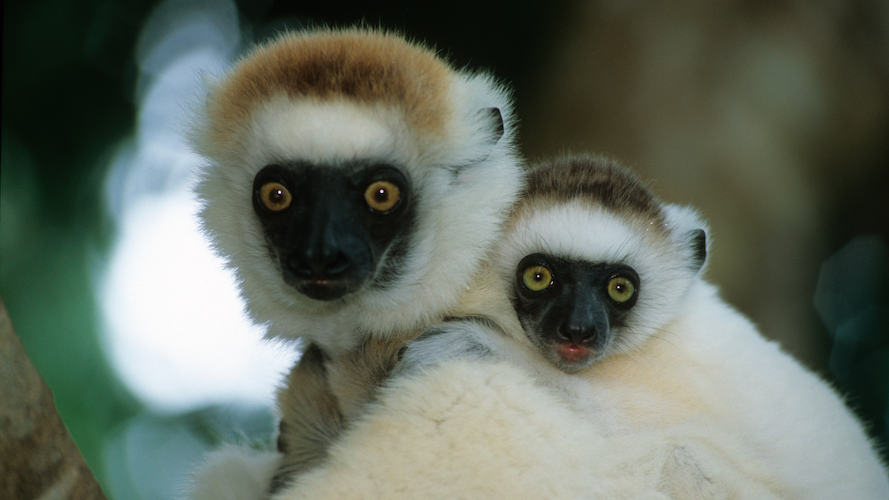
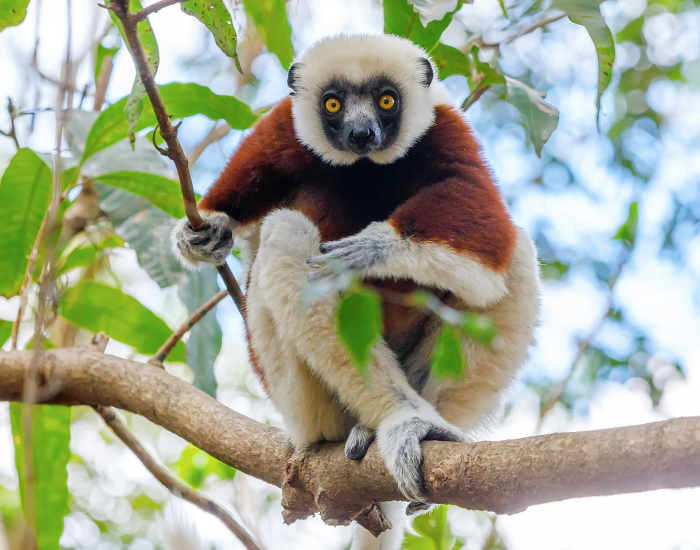
4. Coquerel’s Sifaka (Propithecus coquereli)
Chocolate-brown thighs, white body, startled expression. Coquerel’s sifaka lives in the dry forests of northwestern Madagascar and starred in the children’s series Zoboomafoo.
Sifaka species are famous for vertical clinging and leaping. They launch from a trunk with powerful hind legs and land upright, sometimes 9 metres away. On open ground they cannot walk normally. Instead they bound sideways on two feet, arms outstretched, in a gait tourists inevitably call dancing.
5. Verreaux’s Sifaka (Propithecus verreauxi)
This is the “dancing sifaka” you have seen in documentaries, bouncing across red soil in Berenty Reserve. Verreaux’s sifaka survives in southern Madagascar’s spiny forest, hopping between octopus trees armed with three-inch thorns.
Thick calloused palms let it grab those spines without injury. Groups hold two to twelve animals, and females get feeding priority, as in most lemurs.
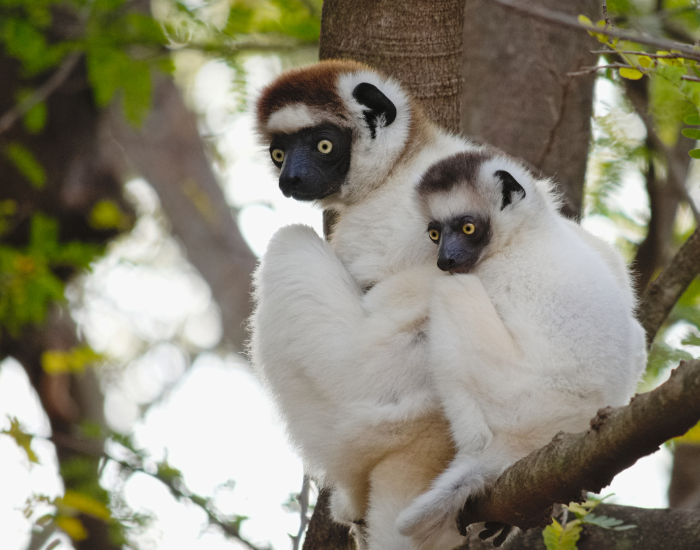
6. Diademed Sifaka (Propithecus diadema)
The diademed sifaka is the heavyweight of the family, rivalling the indri at around 6 to 7 kg. Its coat runs orange, grey, gold and white, which makes it arguably the most beautiful of all lemurs.
It lives only in eastern Madagascar’s remaining rainforest and is considered critically endangered. Eight of the nine sifaka species now sit in that category, which tells you how fast this group is disappearing.

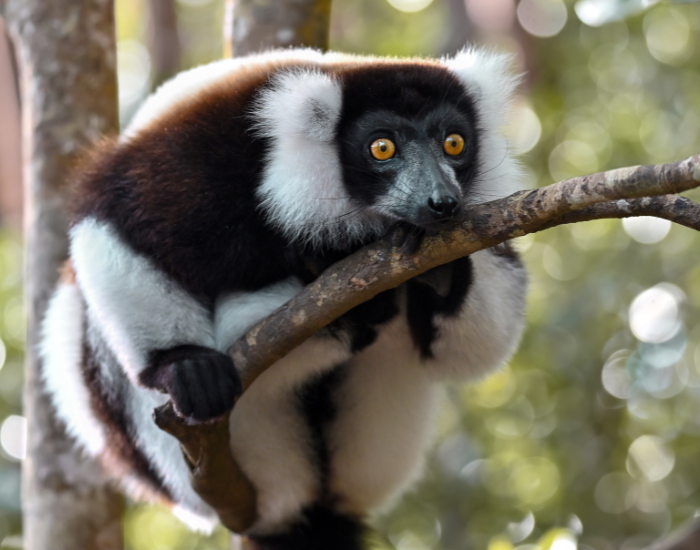
7. Black-and-White Ruffed Lemur (Varecia variegata)
These are loud. A ruffed lemur alarm chorus carries a kilometre through forest. Hearing it indoors at a wildlife park genuinely startles people.
Black-and-white ruffed lemurs are the largest known pollinators among mammals. They push their long snouts into traveller’s palm flowers, collecting pollen on their ruff and carrying it between trees. They also build actual nests for their young, which is unusual among primates.
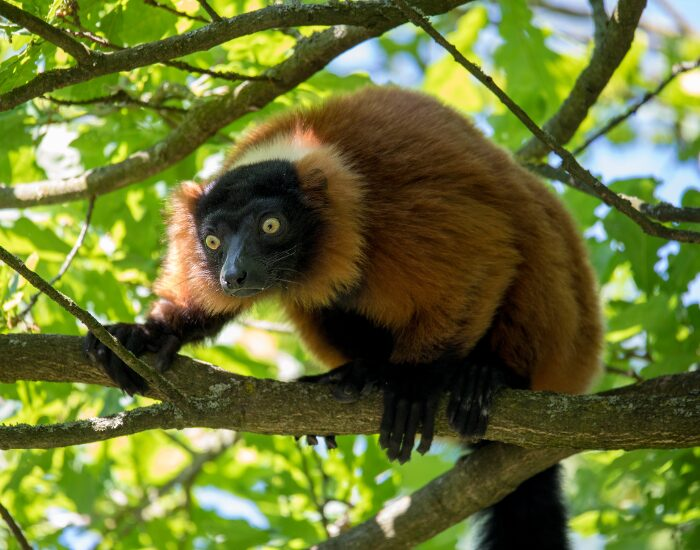
8. Red Ruffed Lemur (Varecia rubra)
The red ruffed lemur holds one of the smallest ranges of any primate, confined to the Masoala Peninsula. Its coat is deep rust-red, offset by a black face and crown.
Females give birth to litters of up to six. Rather than carry them, they park the infants in a nest. Cyclones and logging have hit Masoala hard, and this species is critically endangered.
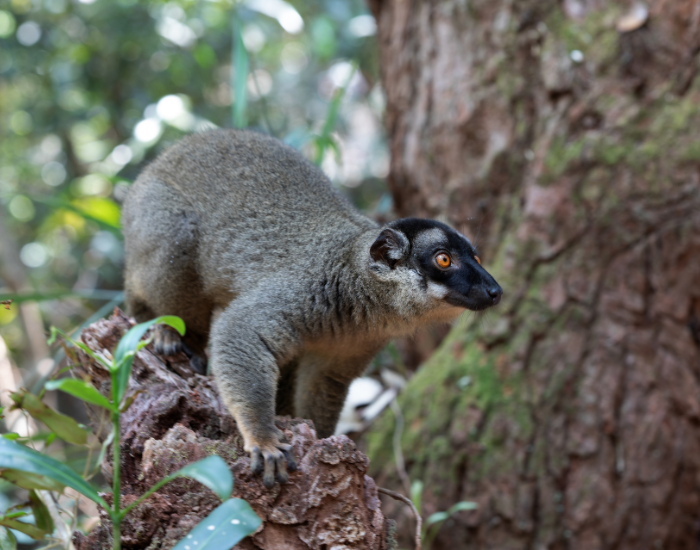
9. Common Brown Lemur (Eulemur fulvus)
Common brown lemurs are the ones most likely to walk right past you at a sanctuary. They are medium sized lemurs, sociable, and live in groups of up to 30 individuals.
Unlike strictly nocturnal relatives, brown lemurs are cathemeral. They are active during the day and at night, adjusting to moonlight and season. In Australia I watched a group work through a pile of fruit with no visible squabbling at all. That is the point. Brown lemur societies run far less despotically than ring-tailed ones.
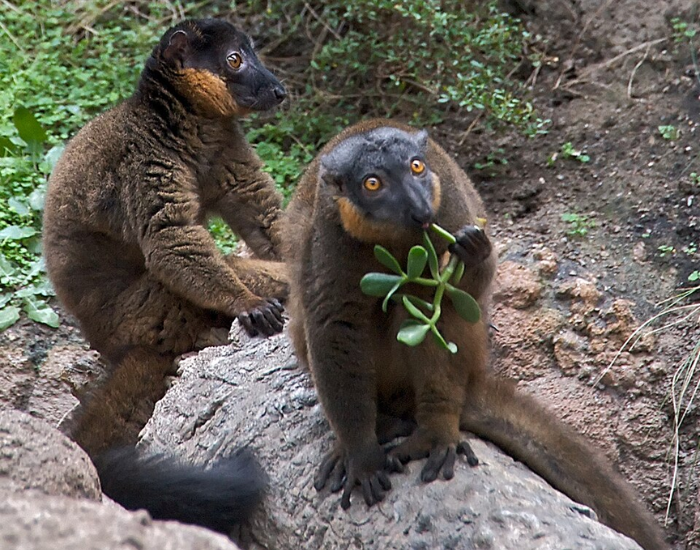
10. Collared Brown Lemur (Eulemur collaris)
The collared brown lemur lives in the fragmented littoral forests of southeastern Madagascar. Males wear rusty cheek beards; females do not.
Research shows it swallows and disperses seeds from dozens of different species of tree. Some of those seeds are too large for any other animal to handle. Lose the lemur and the forest stops regenerating. Few primates hold an entire habitat together so visibly.
11. Grey Mouse Lemur (Microcebus murinus)
Mouse lemurs are the smallest primates on Earth. The grey mouse lemur is the one you will most likely meet on a night walk. It weighs around 60 grams and carries enormous reflective eyes. Unlike their larger cousins in the Indriidae family, these tiny animals breed fast and recover quickly.
During the dry season it enters torpor, dropping its body temperature and living off fat stored in its tail. Genetic work on these tiny animals has driven most of the recent explosion in described lemur species.
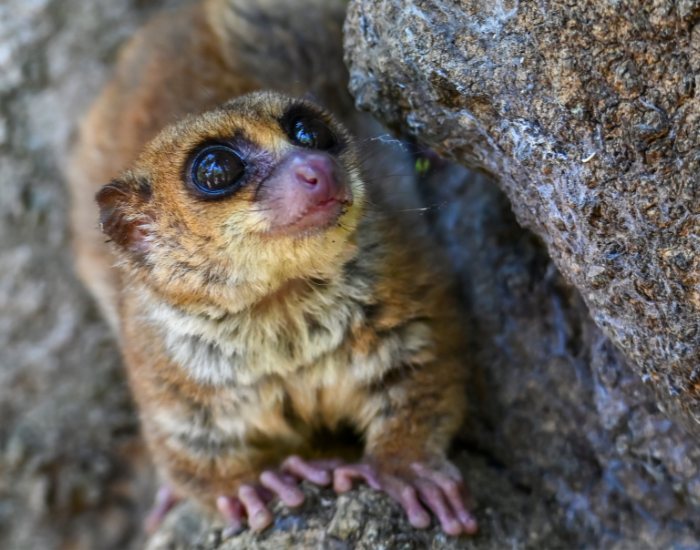
12. Madame Berthe’s Mouse Lemur (Microcebus berthae)
Madame Berthe’s mouse lemur is the smallest primate in the world, weighing as little as 30 grams. That is lighter than a golf ball.
It lives only in the dry forests around Kirindy in western Madagascar. Recent surveys failed to find it where it was once common. Researchers now fear it may already be gone. Very few unique animals have vanished this quietly.
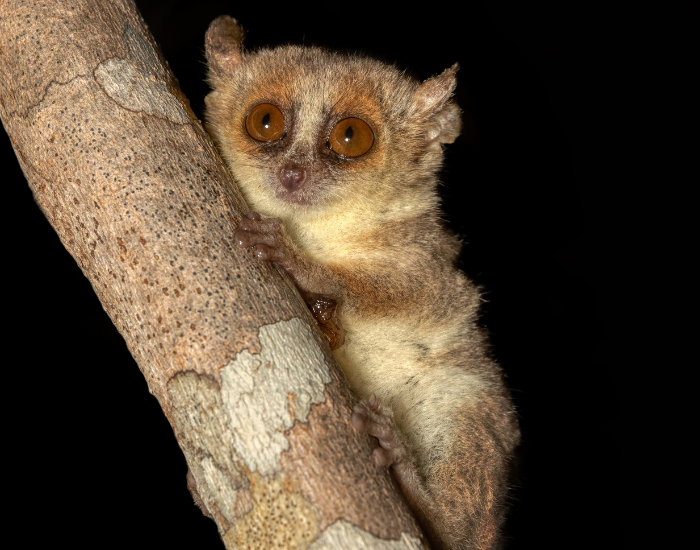
13. Greater Bamboo Lemur (Prolemur simus)
The greater bamboo lemur was presumed extinct until researchers rediscovered it in 1986. Fewer than 1,000 survive today, making it one of the most critically endangered species of primate anywhere.
It eats giant bamboo almost exclusively, using jaw muscles strong enough to crack open woody culms that defeat every other lemur. Ranomafana National Park protects the best-studied population.
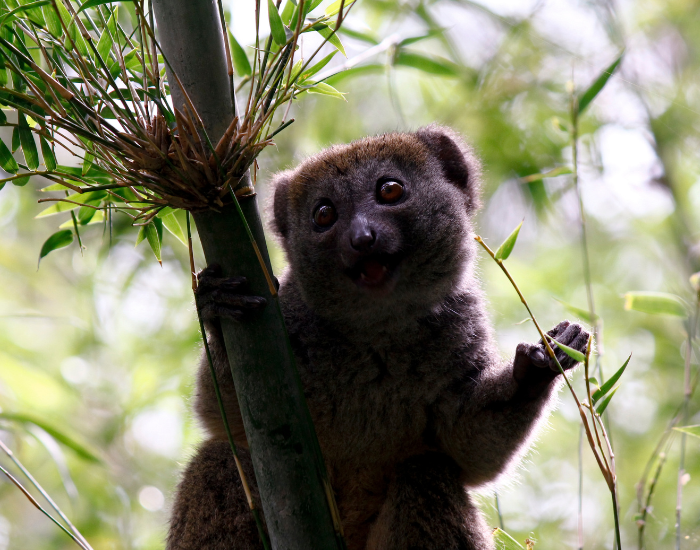
14. Golden Bamboo Lemur (Hapalemur aureus)
Here is my favourite piece of lemur biology. When scientists described this new species in 1987, they discovered it eats bamboo shoots loaded with cyanide.
A golden bamboo lemur swallows roughly twelve times the dose that should kill a mammal its size. It does this daily, with no visible ill effects, and nobody has fully explained how. Its smaller relatives, the grey bamboo lemur and the eastern lesser bamboo lemur, eat less toxic parts of the same plant. That is how three bamboo lemur species share one forest.
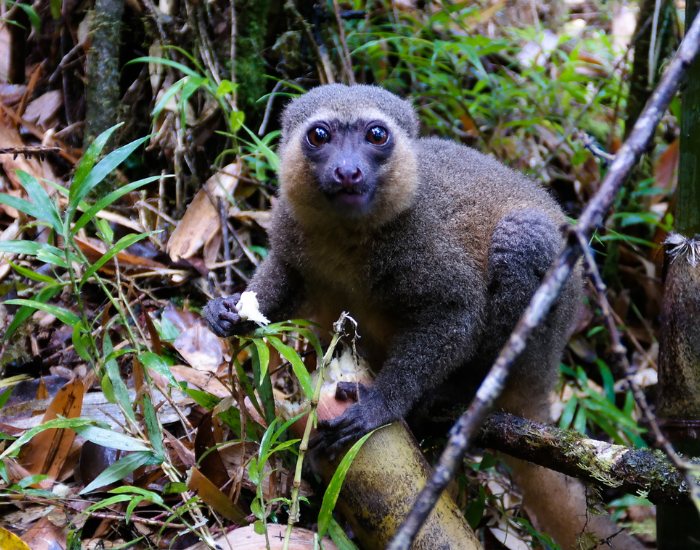
15. Eastern Woolly Lemur (Avahi laniger)
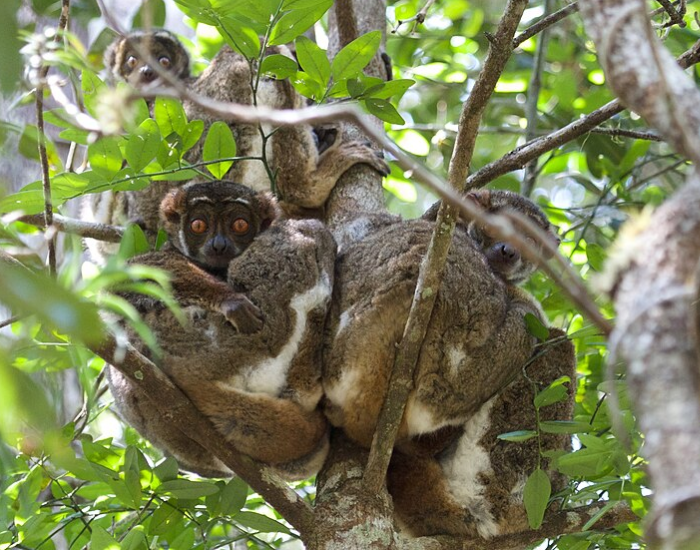
Avahi laniger closes out the list because almost nobody knows it exists. Woolly lemurs are nocturnal, large, dog-like eyes, and covered in dense curly fur that makes them look permanently damp.
They live in monogamous pairs, which is rare among primates, and survive on a low-energy diet of leaves. To cope, they move as little as possible, spending daylight pressed vertically against tree trunks. Three other lemur species deserve a look if this list hooks you: the sportive lemurs, the hairy eared dwarf lemur, and the extinct giant lemurs. One of those giants weighed as much as a male gorilla.
Why Lemurs Are the Most Endangered Mammals on Earth
The International Union for Conservation of Nature updated its lemur assessment in 2020, and the result was brutal. Of 107 assessed lemur species, 103 are threatened with extinction. That is 98%, with 33 species listed as Critically Endangered.
Only four lemur species escaped a threatened conservation status, and three of those are mouse lemurs that science barely knows. Everything else sits somewhere between Vulnerable and one step from gone. Lemurs now rank among the most endangered vertebrates on the planet.
Deforestation is the biggest threat to their survival. Slash-and-burn agriculture, charcoal production and illegal logging have stripped most of the island’s original forest. Habitat loss then fragments what remains into patches too small to hold viable populations. Hunting for bushmeat and capture for the domestic pet trade compound the damage.
That said, humans are also the reason any of this is fixable. Community-managed reserves, reforestation corridors and lemur-focused ecotourism all demonstrably work. If you want to save lemurs, the Lemur Conservation Network lists vetted organisations doing exactly that.
Frequently Asked Questions About Lemurs
Well-known examples include the ring-tailed lemur, indri, aye-aye, Coquerel’s sifaka, Verreaux’s sifaka, diademed sifaka, black-and-white ruffed lemur, red ruffed lemur, common brown lemur, collared brown lemur, grey mouse lemur, Madame Berthe’s mouse lemur, greater bamboo lemur, golden bamboo lemur and eastern woolly lemur.
The ring-tailed lemur is by far the most famous, thanks to its striped tail and its role as King Julien. That animated film made it a global icon. Ironically, it is also one of the more threatened species, with wild numbers estimated in the low thousands.
Madame Berthe’s mouse lemur may now be the rarest, with recent surveys failing to detect it at all. Among larger lemurs, the northern sportive lemur is the rarest, with roughly 50 individuals left in a single forest fragment.
The Real Reason These 15 Types of Lemurs Matter
Every animal on this list is an evolutionary experiment that ran for 60 million years and exists nowhere else. When a lemur species disappears, the forest loses its pollinator, seed disperser or bamboo specialist. Nothing steps in to replace it.
Start where I did, at a good zoo or sanctuary, and watch properly. Notice who eats first, who scent-marks, who leads the troop. Then read up on Madagascar’s lemur ecotourism and conservation, or meet the island’s other oddities. There is the giraffe weevil, the tomato frog, and a wild array of chameleons, all covered in my guide to animals in Madagascar. If the conservation side pulls at you, my piece on how to save endangered animals is the practical follow-up.
Which lemur surprised you most? Tell me in the comments. And if you have heard an indri sing in the wild, I want that story.
Can You Name That Lemur? 🦥
A 15-photo identification challenge — the wrong answers are deliberately tricky look-alikes from a similar group. Go back and change any answer before you score.
Which lemur is this?
References:
De Gregorio, C., Valente, D., Raimondi, T., Torti, V., Miaretsoa, L., Friard, O., Giacoma, C., Ravignani, A., & Gamba, M. (2021). Categorical rhythms in a singing primate. Current Biology, 31(20), R1379–R1380. https://doi.org/10.1016/j.cub.2021.09.032
Herrera, J. P., & Dávalos, L. M. (2016). Phylogeny and divergence times of lemurs inferred with recent and ancient fossils in the tree. Systematic Biology, 65(5), 772–791. https://doi.org/10.1093/sysbio/syw035
Morelli, T. L., et al., (2020). The fate of Madagascar’s rainforest habitat. Nature Climate Change, 10(1), 89–96. https://doi.org/10.1038/s41558-019-0647-x
Ralimanana, H., et al., (2022). Madagascar’s extraordinary biodiversity: Threats and opportunities. Science, 378(6623), eadf1466. https://doi.org/10.1126/science.adf1466