
For years, I lived a bit of a lie as a biologist. I had seen many types of birds, and specifically, thousands of pictures of woodpeckers and high-def images of woodpeckers in textbooks. I could tell you about the specialized hyoid bone that wraps around their skull to protect their brain from impact. However, I hadn’t really met one in the flesh.
It’s a strange phenomenon in our digital age. We feel we know these bird species because of a childhood cartoon or a viral video of a northern flicker pecking at a satellite dish. In addition, we put them in the same “exotic” mental bucket as bengal tigers or penguins, creatures we recognize but don’t expect to share space with.
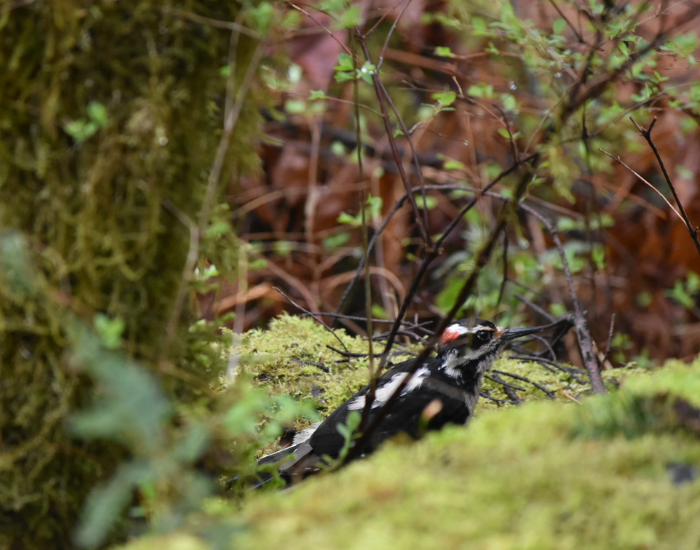
That changed for me a year ago while trekking through the dense, moss-draped cathedrals of Vancouver Island. I heard it first, the rhythmic, jackhammer thrumming against a dead tree. I froze, binoculars ready. When I finally spotted that hairy woodpecker, its crimson nape flashing against the deep green canopy, it hit me: they are the architects of the forest.
Since that trip, I’ve obsessed over the woodpecker bird. This is my deep-dive into the species you need to know, combining my field notes with the hard science of these incredible invertebrate hunters.
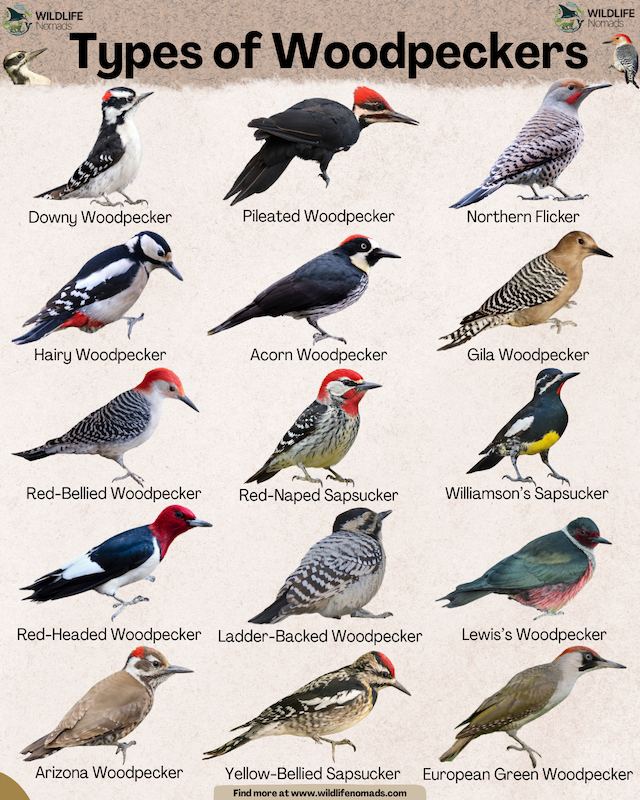
Quick ID Cheatsheet
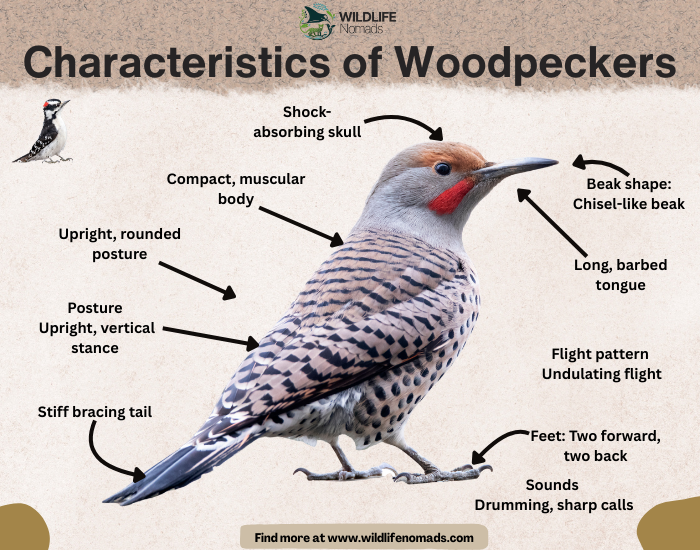
Before we jump into the species list, you need to know what makes a woodpecker distinct. They aren’t just birds that peck wood; they are precision-engineered machines. So I believe that understanding their anatomy helps with proper identification in the wild.
The bill is a chisel, plain and simple. It grows continuously because the tips are constantly being worn down. Most woodpeckers use this specialized bill to excavate nesting sites and forage for insects inside tree bark.
The tail feathers are stiff and act like a third leg, creating a tripod to support woodpeckers against vertical surfaces. This adaptation allows them to climb tree trunks with remarkable stability.
Most birds have three toes forward and one back. Woodpeckers have zygodactyl feet, two forward, two back, giving them a literal “X” grip on bark. This unique foot structure provides superior balance during pecking.
15 Woodpecker Species Every Birder Should Know
1. Downy Woodpecker (Dryobates pubescens)
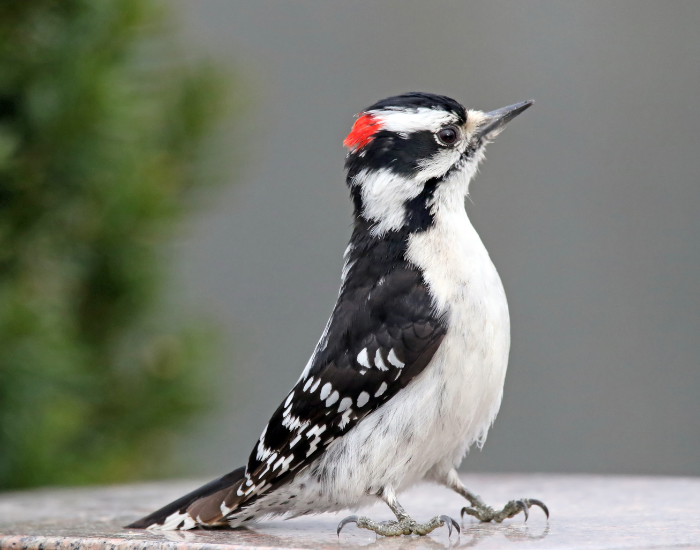
The downy woodpecker is the most common visitor to bird feeders across North America. If you see a small woodpecker in your yard grabbing suet, it’s likely a Downy. These tiny birds measure just 5.5 to 6.7 inches in length, making them the smallest woodpecker species in most regions.
Downy woodpeckers display checkered black and white wings with a bold white stripe down the back. Males have a small red patch on the head that distinguishes them from females. They are incredibly bold birds. In fact, I’ve had them land just a few feet away from me while I was checking roosting holes in winter months. These woodpeckers tend to forage on smaller branches and dead trees where they find beetles and caterpillars.
2. Hairy Woodpecker (Dryobates villosus)
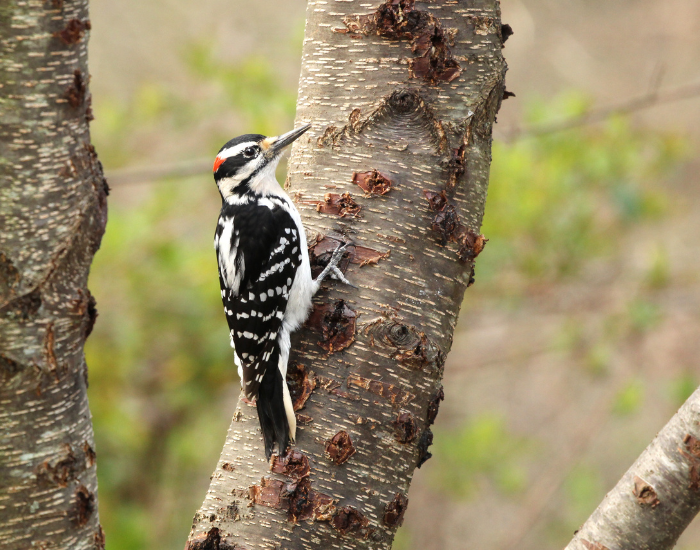
Often confused with the Downy, the hairy woodpecker is essentially the “pro-sized” version. The Hairy is much larger, and its bill is nearly as long as its head, a key identification feature. While downy woodpeckers measure around 6 inches, hairy woodpeckers can reach up to 10 inches in length.
Hairy woodpeckers prefer deeper forests and larger tree trunks than their Downy cousins. They excavate nesting sites in mature woodlands where they hunt for wood-boring beetles and ants. These woodpeckers consume beetles and other insects year-round, making them valuable pest controllers in forest ecosystems.
3. Northern Flicker (Colaptes auratus)
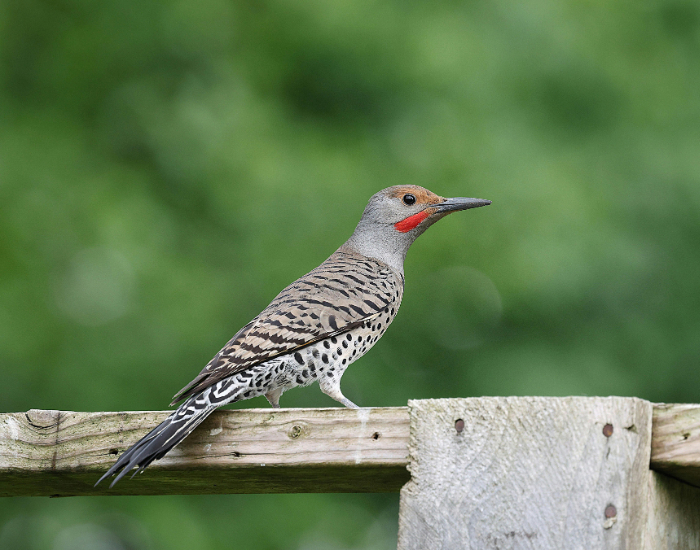
The northern flicker is the rebel of the family. While most woodpeckers stay on trees, Flickers spend considerable time on the ground foraging for food. Their diet consists primarily of ants, and I once watched a flicker in New Mexico consume hundreds of ants in a single sitting using its long, barbed tongue.
Look for the “Yellow-shafted” form in the eastern United States and the “Red-shafted” form in the western regions. Northern flicker birds are common in many habitats, from forests to suburban yards. They create nesting sites in dead trees and old fence posts, and other birds often reuse these cavities after flickers abandon them.
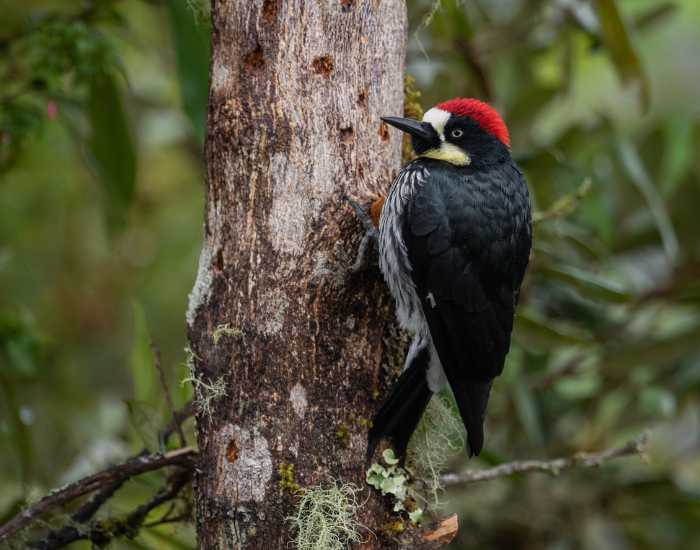
4. Acorn Woodpecker (Melanerpes formicivorus)
These are the socialites of the woodpecker world. The acorn woodpecker lives in complex family groups and creates “granaries”, dead trees riddled with thousands of small holes, each stuffed with an acorn. These granary trees serve as communal food storage for the entire family unit.
Acorn woodpeckers are highly territorial over their acorns and will aggressively defend their stores from other birds. If you hear a “waka-waka” call in an oak grove, you’ve found them. In addition to acorns, these woodpeckers consume beetles, caterpillars, and other insects they find in tree bark.
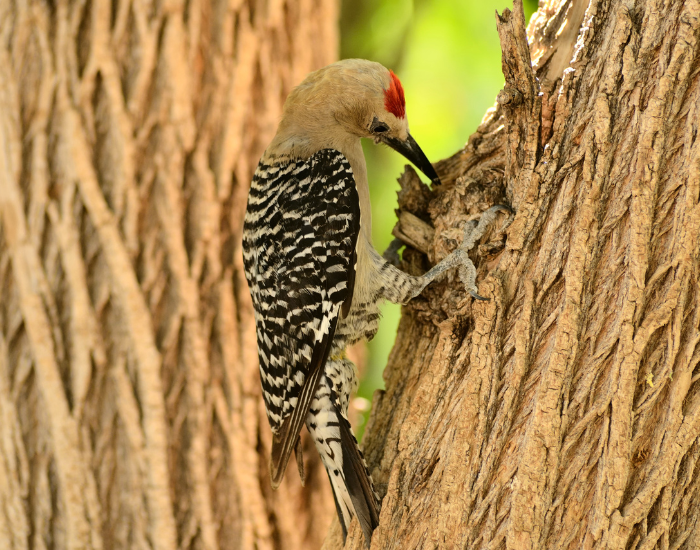
5. Gila Woodpecker (Melanerpes uropygialis)
A true desert specialist, the gila woodpecker is the reason you see holes in giant cacti across the southwestern United States. They excavate cavities in Saguaro cacti for nesting sites, creating homes that are cool inside despite the scorching desert heat.
Once gila woodpeckers move out of these holes, other birds and even owls move in, making them vital architects of the desert ecosystem. These woodpeckers forage for insects, caterpillars, and beetles on cacti and mesquite trees. Their adaptation to harsh desert habitats showcases the remarkable versatility of woodpecker species.
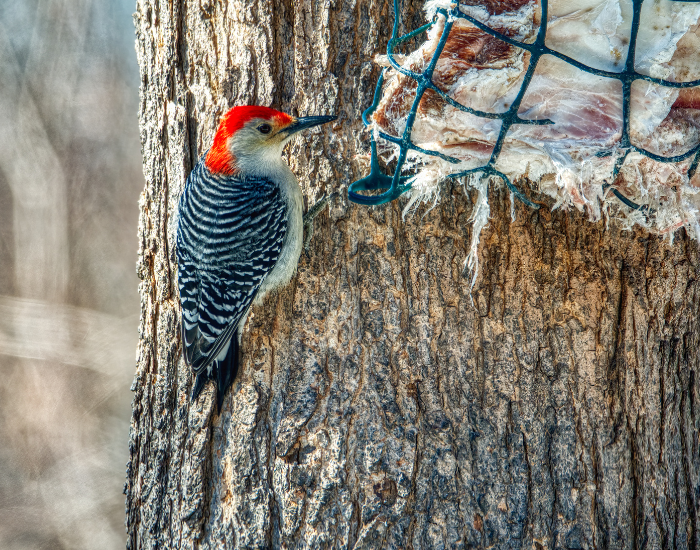
6. Red-Bellied Woodpecker (Melanerpes carolinus)
Don’t let the name fool you. You’ll see plenty of red on the head, but the red on the belly is often just a faint blush. Red bellied woodpeckers are common in the southeastern United States, where they inhabit woodlands, forests, and suburban areas with mature trees.
They have a very diverse diet, eating everything from beetles and caterpillars to nuts and even the occasional lizard. Red bellied woodpeckers frequently visit bird feeders for suet and seeds. Males display a full red cap extending from the bill to the nape, while females show red only on the nape.
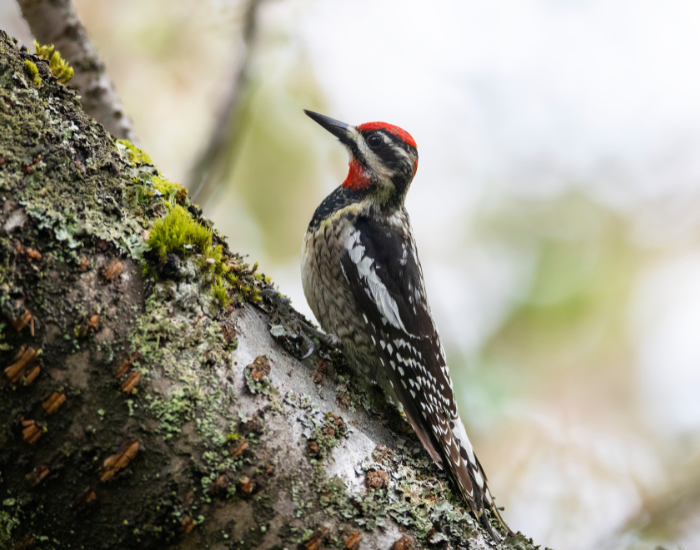
7. Red-Naped Sapsucker (Sphyrapicus nuchalis)
The red naped sapsucker is an artist among woodpeckers. They drill neat rows of sap wells in tree bark to lap up the sugary liquid and the insects stuck in it. These small holes arranged in horizontal lines are a telltale sign of sapsucker activity.
Look for the red throat and the distinctive red patch on the back of the head (the “nape”) for proper identification. Red naped sapsuckers prefer coniferous and mixed forests in western mountain ranges. Many birds, including hummingbirds, benefit from the sap wells created by these woodpeckers.
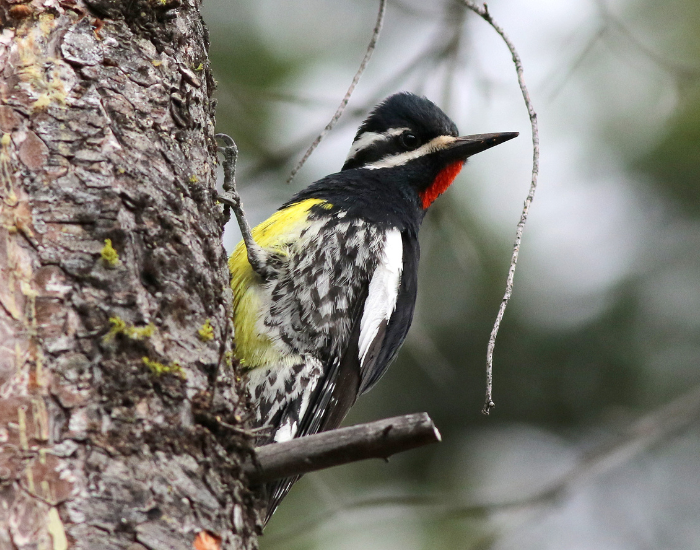
8. Williamson’s Sapsucker (Sphyrapicus thyroideus)
This species actually caused considerable confusion in early ornithology. The male and female look so different that they were originally classified as two distinct species! Williamson’s sapsucker males are velvety black with a bright yellow belly, while females are brown with fine barring, looking more like a flicker.
These woodpeckers inhabit mountain forests in the western United States, where they create the characteristic sap wells for feeding. Therefore, if you find fresh sap wells in coniferous forests at high elevations, williamson’s sapsuckers are likely nearby. They also consume beetles and ants found beneath bark.
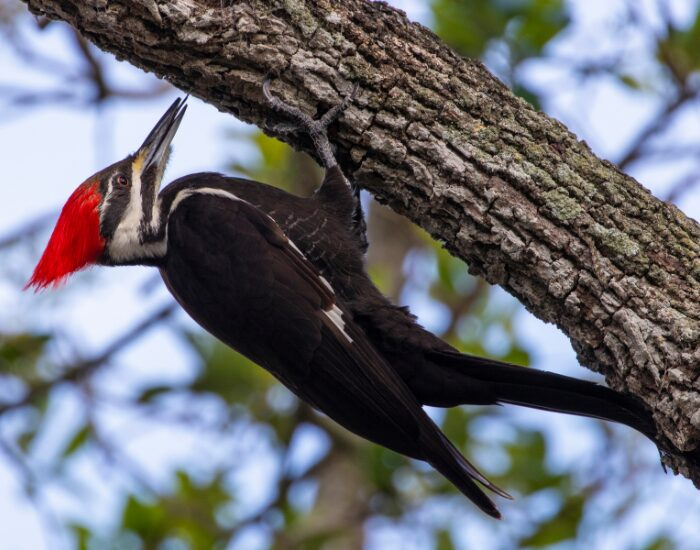
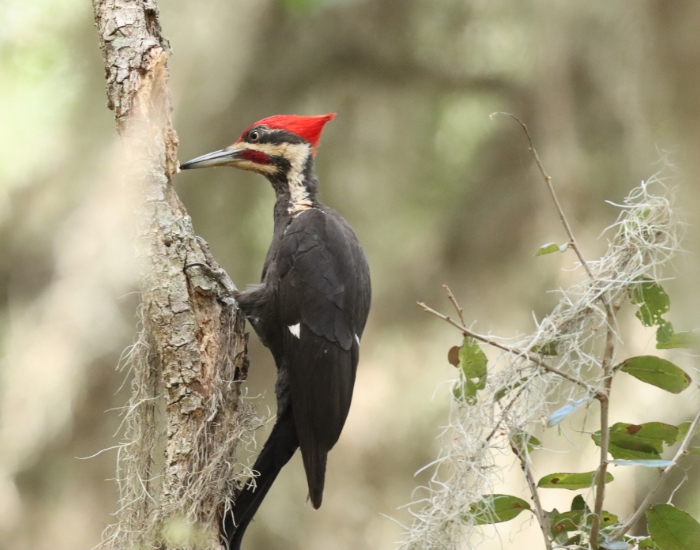
9. Pileated Woodpecker (Dryocopus pileatus)
The “Woody Woodpecker” look-alike. This is a large, conspicuous bird that sounds like a jungle animal when it calls. Pileated woodpeckers are one of the largest woodpecker species in North America, measuring up to 19 inches in length with a wingspan exceeding two feet.
They leave massive rectangular holes in trees while searching for carpenter ants and wood-boring beetles. These excavations can be several inches deep and are easily recognized as pileated woodpecker work. Dead trees with extensive pileated woodpecker damage provide crucial nesting sites for many other bird species and small mammals. Their loud, echoing calls and distinctive flight pattern make them unmistakable in mature forests.
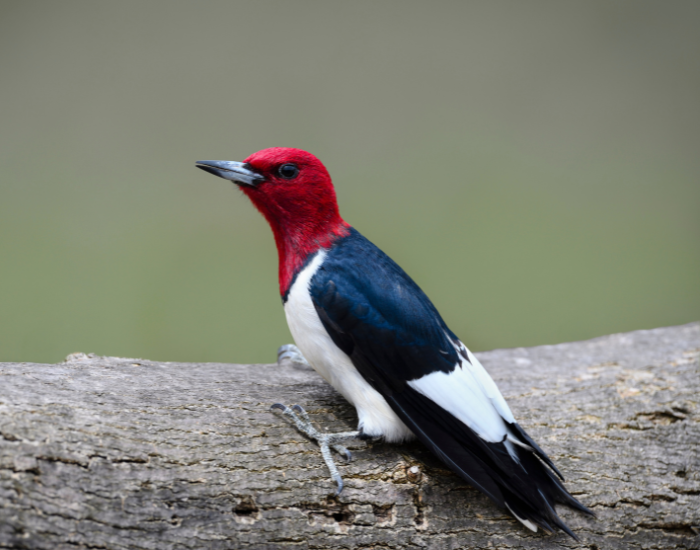
10. Red-Headed Woodpecker (Melanerpes erythrocephalus)
Truly the most stunning picture of a woodpecker you’ll ever see. Their entire head is a deep, velvety crimson that contrasts sharply with their bright white underparts and black wings. Both male and female red headed woodpeckers display this spectacular coloration.
Unfortunately, they are becoming rarer due to loss of habitats, specifically dead trees and open woodlands. Red headed woodpeckers catch insects in mid-air, store food in tree cavities, and excavate nesting sites in dead wood. Conservation efforts focus on preserving dead trees and snags that these birds require for breeding season success.
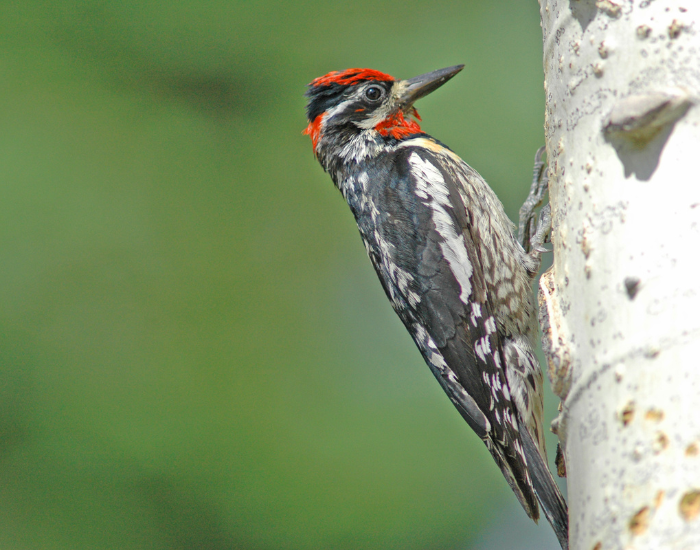
11. Yellow-Bellied Sapsucker (Sphyrapicus varius)
A migratory species that leaves those iconic “grid patterns” on tree trunks across eastern North America. I’ve seen these birds in spring moving through suburban parks as far south as Central America during winter months. Their migration patterns make them one of the most widely distributed sapsucker species.
Yellow bellied sapsuckers drill precise rows of small holes to access sap and the insects attracted to it. Many birds, including hummingbirds and warblers, visit these sap wells for food. Males have a red throat patch, while females have a white throat. Both sexes display the distinctive yellow belly that gives them their name.
12. Ivory-Billed Woodpecker (Campephilus principalis)
The “Lord God” bird. Is it extinct? That is the million-dollar question in the birding world today. The ivory billed woodpecker was once found in old-growth forests of the southeastern United States, where it fed on beetles in dead trees and excavated large nesting cavities.
Listed as Critically Endangered (Possibly Extinct,, there are sporadic, unconfirmed photos and sightings in recent years. However, the extinction debate continues to rage in scientific journals and among conservation organizations. The loss of mature forests and dead trees contributed to the dramatic decline of this magnificent species.
13. Ladder-Backed Woodpecker (Dryobates scalaris)
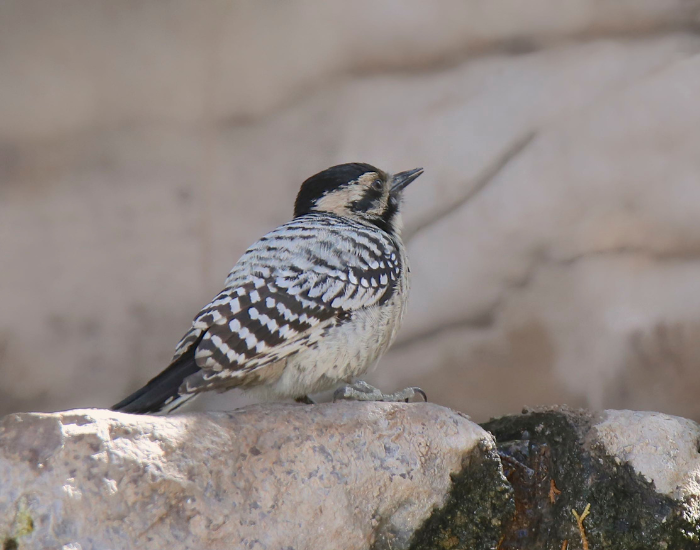
Common in dry, scrubby areas of the southwestern United States and Mexico, ladder backed woodpeckers look like they have a literal ladder painted on their back. This distinctive black-and-white barring pattern makes identification straightforward in desert habitats.
These small woodpeckers forage on cacti, mesquite, and other desert vegetation for beetles, ants, and caterpillars. Males display a red cap on the head, while females have black crowns. Ladder backed woodpeckers excavate nesting sites in dead branches of desert trees and cacti, supporting many other bird species that use these cavities.
14. Lewis’s Woodpecker (Melanerpes lewis)
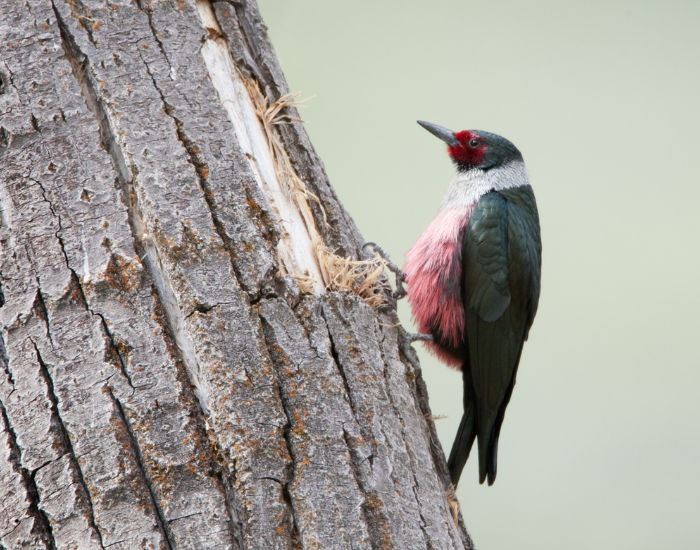
This one flies more like a crow than a woodpecker, with slow, steady wingbeats rather than the typical undulating flight. Lewis’s woodpeckers catch insects in mid-air through a behavior called hawking, rather than just pecking for prey in tree bark like most woodpeckers.
They have a distinctive dark greenish-black back, gray collar, and pinkish-red belly. These woodpeckers prefer open pine forests and burned areas where dead trees provide nesting sites. In addition to flying insects, they consume nuts and acorns, which they store in tree cavities during fall months for winter food.
15. Arizona Woodpecker (Leuconotopicus arizonae)
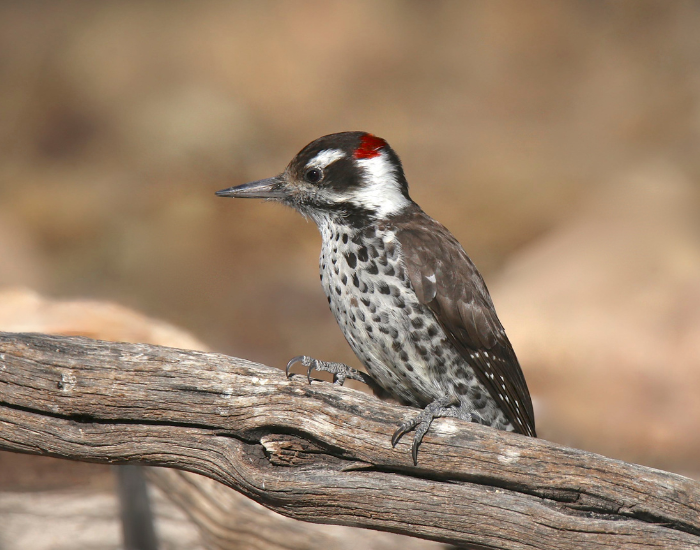
A brown-backed specialty of the “Sky Islands” in the southwestern United States. It’s one of the few woodpeckers that lacks a bold black-and-white pattern, instead displaying solid brown upperparts with white underparts spotted with brown.
Arizona woodpeckers inhabit oak and pine-oak woodlands in mountain ranges of Arizona and New Mexico. Males have a red patch on the nape, while females lack red markings. These woodpeckers forage for beetles and other insects in tree bark and excavate nesting sites in dead branches. Their limited range makes them a sought-after species for birders visiting the region.
FAQ: What You’re Asking About Woodpeckers
Absolutely. Woodpeckers keep your trees healthy by eating wood-boring insects, beetles, and caterpillars. If they are pecking your house, it’s usually because they hear bugs inside the siding or are “drumming” to claim territory during breeding season. Bird feeders with suet can attract woodpeckers to your yard while keeping them away from your home.
Self-explanatory, right? However, the “pecking” isn’t just for food. It’s for communication (drumming), excavating nesting sites, and marking territory. Woodpeckers peck on wood at different rhythms and intensities depending on the purpose, creating distinct patterns that other woodpeckers recognize.
Look at the holes! Sapsuckers drill organized, horizontal rows of shallow holes to access sap. Most other woodpeckers drill deeper, irregular holes to find beetles, ants, and other prey. In addition, sapsuckers tend to return to the same trees repeatedly, creating extensive grid patterns over time.
Not at all. Northern flickers are common across North America, though they are often missed because they spend more time on the ground than other woodpecker species. They forage for ants on lawns, fields, and open ground. Many birds don’t realize flickers are woodpeckers because of their ground-feeding behavior.
The Final Tap-Tap
The next time you hear that rhythmic tap-tap-tap while you’re out for a walk, don’t just walk past. Stop. Look up. You’re witnessing a master class in evolutionary engineering.
Whether it’s a small woodpecker in your garden visiting bird feeders, a williamson’s sapsucker in the high mountains drilling sap wells, or a pileated woodpecker excavating massive holes in dead trees, these birds are a bridge between the nature we see and the complex biological systems that keep our world running.
From the acorn woodpecker storing food for winter to the gila woodpecker creating homes in desert cacti, each species plays a vital role in forest and woodland ecosystems. Many birds depend on the nesting sites woodpeckers create. Therefore, protecting habitats with dead trees and mature forests ensures these remarkable bird species continue to thrive for generations to come.