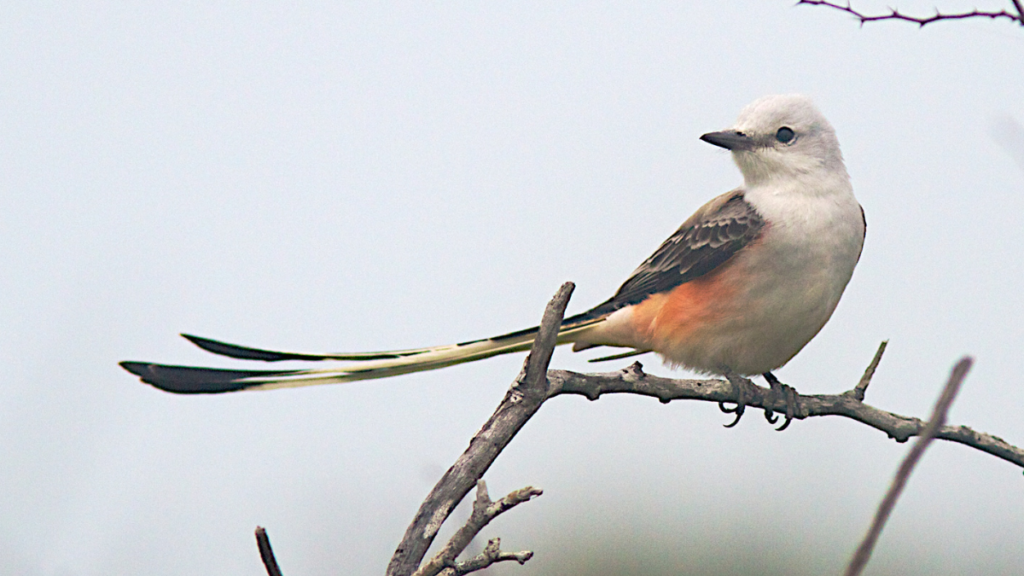
Years ago I was in Veracruz for a marine biology course. One humid afternoon, a birder friend and a few of us ditched the tide pools for a birding adventure inland. Near a dense, forested edge, my friend grabbed my arm and pointed. There it was, a scissor-tailed flycatcher, fanning that impossibly long, forked tail to impress the ladies. You never forget a first look like that.
i learn many things. The scissor-tailed flycatcher is one of the most theatrical fliers in the Americas, and most people who spot one on a fence wire have no idea what they’re looking at. So let’s fix that. Below are ten facts that blend hard science with what I’ve actually seen in the field, from the southern Great Plains to Central America.
By the end, you’ll know why these flycatchers grow such extreme tails, what they eat, where they nest, and how to find one yourself. Let’s get into it.
1. That Long, Forked Tail Is the Whole Point
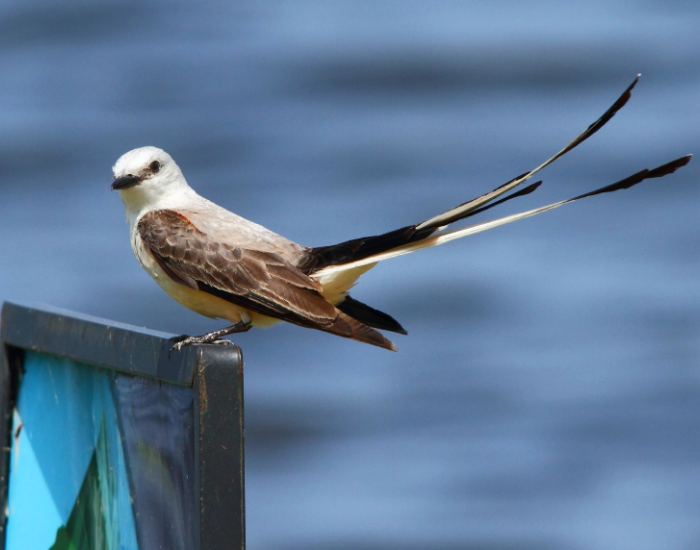
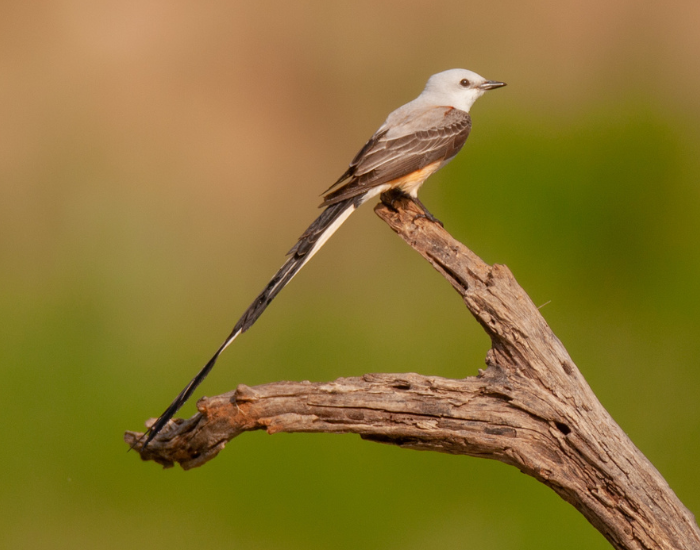
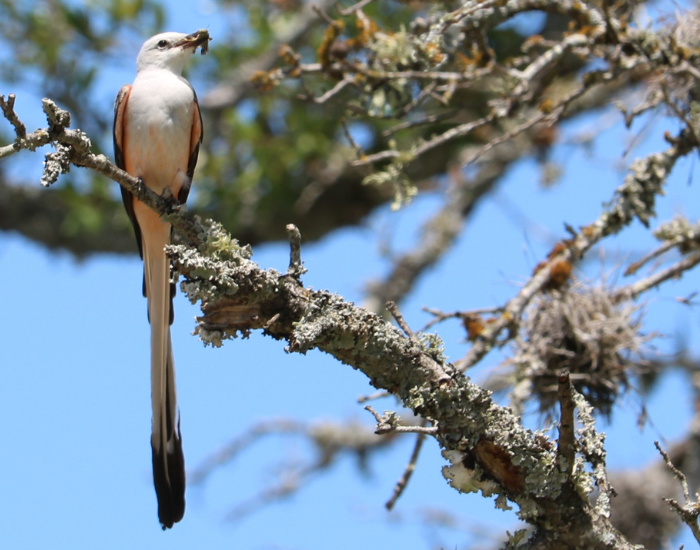
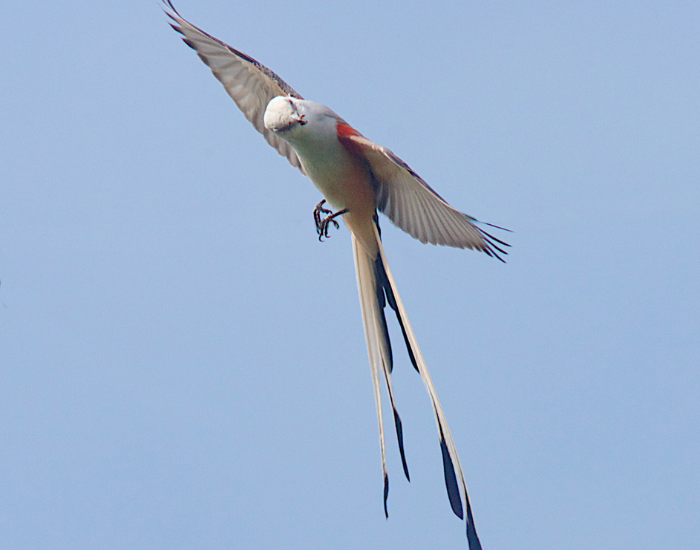
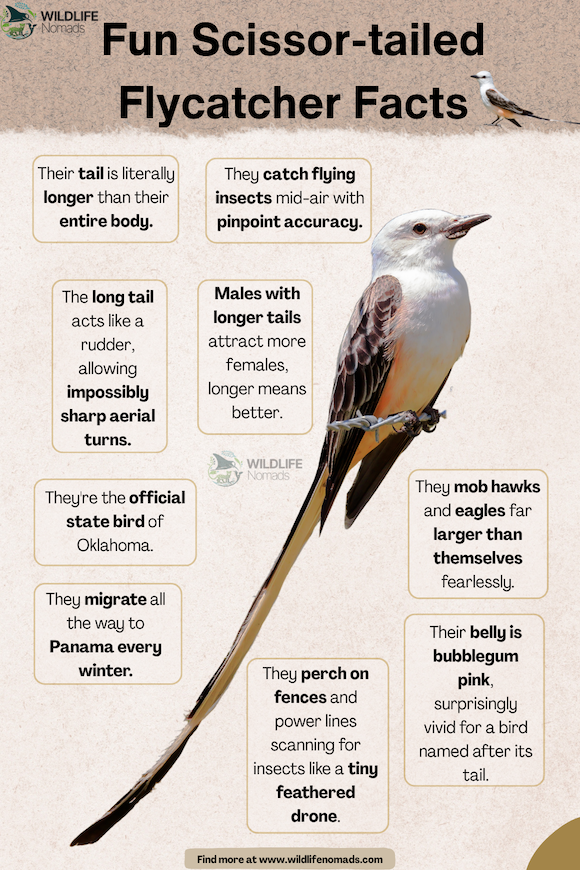
The scissor-tailed flycatcher is famous for one feature: its long, deeply forked tail. On adult males, the two outer tail feathers can reach up to 9 inches, longer than the bird’s body. Fold that into the total length and a male stretches to roughly 13 inches from bill to tail tip.
The tail isn’t just decoration. It works like a rudder and a flag at once. In flight, those streamers help the bird pivot mid-air while chasing insects. On a perch, a male spreads and snaps the tail open like scissors, which is exactly where the name comes from.
Interestingly, the extremely long tail is a sexually selected trait. Longer tail feathers signal fitness, and females tend to prefer males wearing the most impressive streamers. That Veracruz bird knew exactly what he was doing.
2. Females Wear a Shorter Version
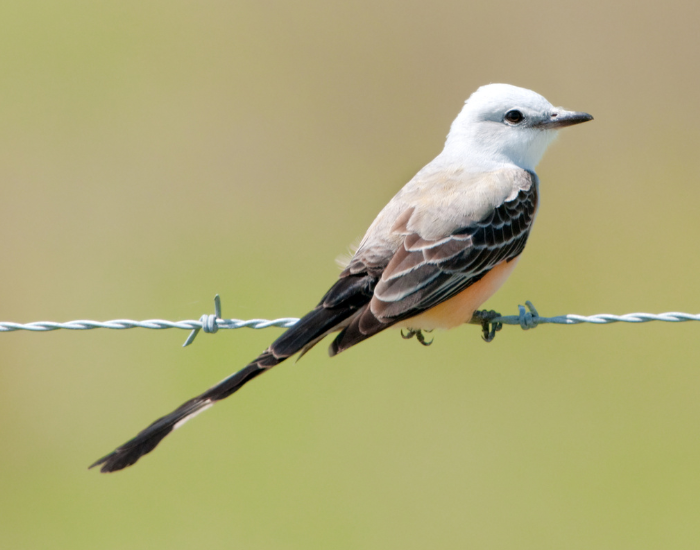
Look closely at a mated couple and you’ll notice the female’s tail is noticeably stubbier. Females have tails roughly 30% shorter than males, so their outer feathers rarely trail as dramatically. The difference is one of the quickest ways to sex these flycatchers in the field.
Immature birds and juveniles wear even shorter tails. A juvenile scissor-tailed flycatcher can look almost blunt-tailed compared to a breeding adult. So if you spot one with a modest tail late in summer, you’re probably looking at a young bird from that season’s brood, not a different species.
3. The Plumage Is Subtler Than the Tail Suggests
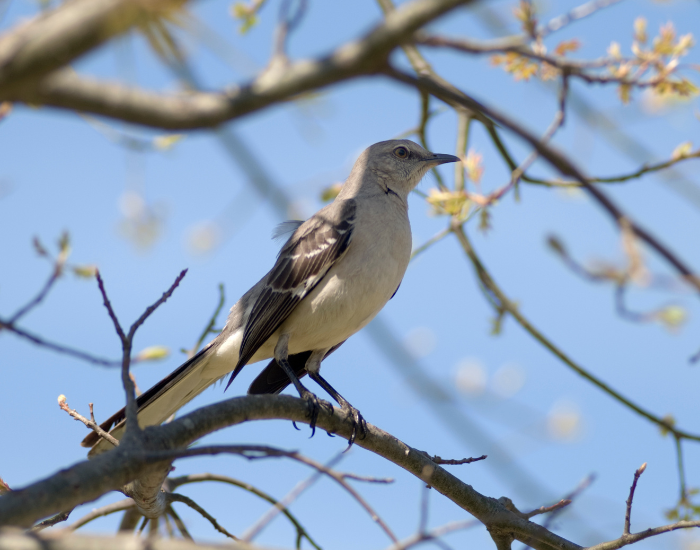
People expect a flashy body to match that flashy tail. Instead, the scissor-tailed flycatcher is elegantly understated. The head and upperparts are pale gray, the wings run darker toward black, and the underparts fade to clean white.
The showstopper hides on the sides. Salmon-pink flanks flash bright when the bird lifts its wings, revealing rich pinkish patches under the black wings. Against a gray Texas sky, that pale gray body with warm flanks is unmistakable once you’ve seen it.
4. They’re Kingbirds in Disguise
Taxonomically, this species sits in the genus Tyrannus: the kingbirds. It’s closely related to the eastern kingbird and the western kingbird, and it shares their fearless streak. Strip away the tail and the body shape gives the family away instantly.
That kinship matters for behavior. Like other kingbirds, the scissor-tailed flycatcher is aggressively territorial. I’ve watched a single bird chase off hawks, crows, and even lumbering turkey vultures that drifted too close to a nest. For a bird that weighs about an ounce and a half, the nerve is remarkable.
5. Grasshoppers Make Up the Bulk of the Diet
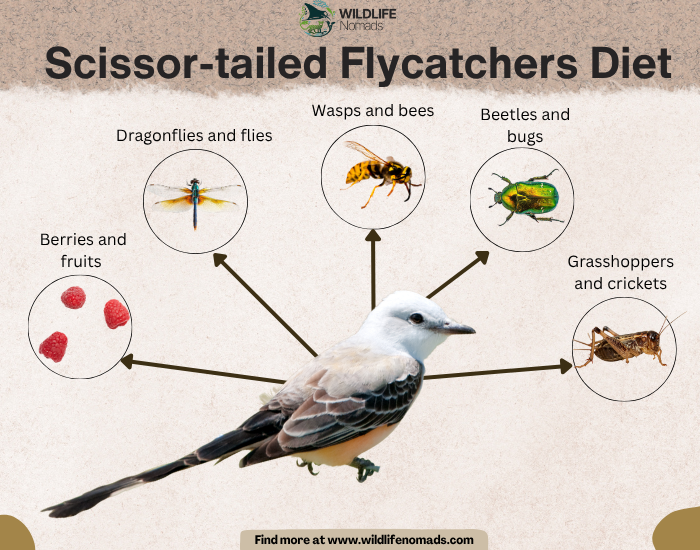
Diet is where these flycatchers earn their keep for farmers. Scissor-tailed flycatchers primarily eat insects, and grasshoppers can comprise over 50% of what they take, often make up a significant portion of their diet. Crickets, beetles, bees, wasps, and other flying insects round out the menu.
Their hunting style is called sallying. The bird perches on a wire, waits, then launches to snatch flying prey from the air or off the ground before returning to the same spot. It’s efficient, and it’s why you so often see one bird using the same fence post for hours.
They aren’t strictly insectivorous, though. In winter, scissor-tailed flycatchers also consume small fruits and berries when insects thin out. Like many flycatchers, they regurgitate the indigestible parts of their food as compact pellets, a tidy trick for a bird that swallows crunchy prey whole.
6. Oklahoma Claimed It as a State Symbol
If you’ve driven through Oklahoma in summer, you’ve shared the road with the official state bird. Oklahoma adopted the scissor-tailed flycatcher in 1951, and it’s hard to argue with the choice, few birds are more identifiable on a utility line.
You’ll see them in Oklahoma from early April to late October, when they arrive to breed and then stage for the trip south. The bird has become a genuine regional emblem across the south-central United States, showing up on license-plate art, signage, and local birding lore.
7. Home Is the Southern Great Plains
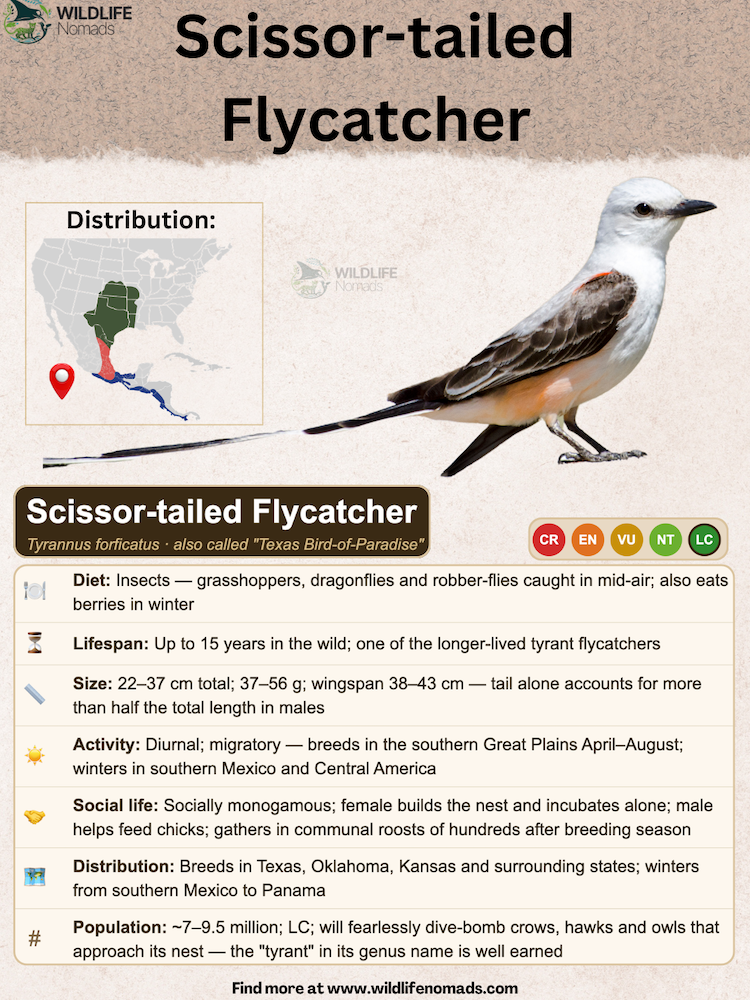
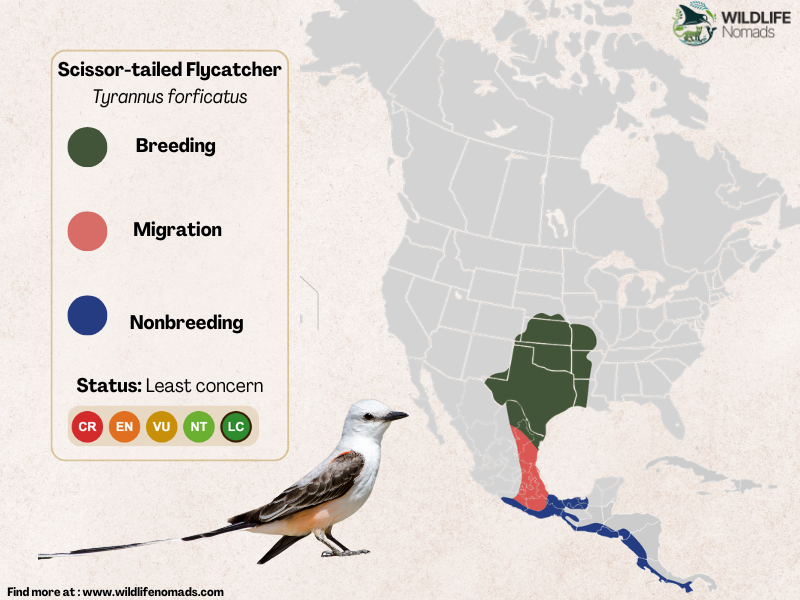
The breeding range centers on the southern Great Plains. Scissor-tailed flycatchers breed across Texas, Oklahoma, and neighboring states, spilling into eastern Colorado, western Louisiana, and up through Nebraska south of the Sandhills, and they stray both east and west of that core. They also nudge into northeastern Mexico. They favor open country, savanna, open grassland, and agricultural land dotted with scattered trees.
These birds need lookout posts, not forest. Isolated trees, isolated groves, fence lines, and utility poles all work, which is why the species has thrived alongside human development. That said, wanderers turn up far outside the core. Vagrants have been sighted as far north as southern Canada, and vagrants appear in southern Florida and southern Texas well outside expectation.
8. Nests Blend Nature and Human Hardware
Nesting is a female’s job, and she’s resourceful. She builds a bulky, open-cup nest from weed stems and plant stems, then lines it with soft materials, sometimes including string, paper, and other human-made scraps she scavenges nearby. Cornell Lab records nests woven with everything from cigarette filters to carpet fuzz.
Placement is flexible. Nests sit 7 to 30 feet up, often saddled on a horizontal limb in an isolated tree. Increasingly, adults also use artificial sites like utility poles and other structures, which has helped them colonize open country with few natural trees.
The clutch runs four to six eggs. Incubation lasts 12 to 14 days before the eggs hatch, and the young birds leave the nest after roughly 14 more days. It’s a fast timeline, tuned to a short northern summer.
9. The Sky Dance Seals the Deal
Courtship is a spectacle worth planning a trip around. In breeding season, males perform a display birders call the “sky dance.” The male climbs high, then tumbles downward in a series of zigzags and backward somersaults, tail streaming, often calling the whole way down.
It’s not random showing-off. The flight advertises stamina and coordination, and those long tail streamers exaggerate every move. When I finally watched a full sky dance over an eastern Colorado pasture, it looked less like a bird and more like a kite that had learned to fight gravity.
They also defend territory as a team. A bonded pair will jointly harass intruders, working to protect the nest against anything from other flycatchers to raptors many times their size.
10. They Migrate at Night in Huge Numbers
These are true Neotropical migrants. Scissor-tailed flycatchers winter from southern Mexico through Central America to Panama, and they’re common winter visitors to Guatemala below about 5,000 feet. When the days shorten, the whole population drains south.
Migration happens at night; the birds rest and refuel during the day. Before departure, they gather in spectacular pre-migratory roosts, flocks that can number up to 1,000 birds packed into a stand of trees. Come spring, they reverse the trip and flood back north to breed.
Watching fall migration build is one of my favorite September rituals. Large flocks assemble on power lines at dusk, all those streamers hanging in the same direction, and then one morning they’re simply gone.
Frequently Asked Questions
Long tails serve two jobs: flight control and courtship. The extra length improves maneuverability when the bird sallies after fast insects. More importantly, it’s a sexually selected signal — females prefer males with longer tail feathers, so the trait keeps getting exaggerated over generations.
Plenty of species sport dramatic tails. Familiar examples include the scissor-tailed flycatcher, the fork-tailed flycatcher, barn swallows, magpies, mockingbirds, pheasants, and the resplendent quetzal. A long tail can aid flight, display, or both, depending on the species.
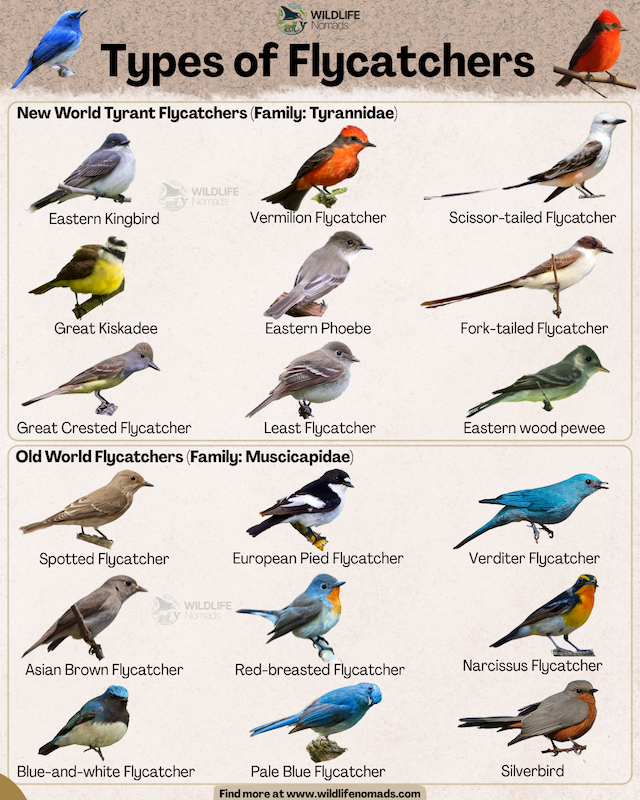
Flycatchers are perching birds that hunt insects on the wing. In the Americas, the tyrant flycatchers form a huge family that includes kingbirds, phoebes, pewees, and the scissor-tailed flycatcher itself. The eastern kingbird and western kingbird are close relatives you’ll often see nearby.
The female’s tail is about 30% shorter, so her streamers are less extreme. Females also tend to show slightly muted pinkish flanks. In a mated pair, the bird with the longest, showiest tail is almost always the male.
Go Find One Yourself
Strip away the hype and one truth remains: the scissor-tailed flycatcher turned a simple survival tool (a maneuverable tail) into one of the most beautiful courtship signals in North America. Science and spectacle rarely align this neatly.
If you live anywhere in the south-central United States between April and October, you can see this for yourself. Scan the fence wires and utility lines along any open grassland or ranch road, and be patient near isolated trees where they nest. New to it? Start with our birding for beginners guide, and if you’re traveling south for the winter range, our roundup of the birds of Mexico will help you spot them on their wintering grounds. Curious about the raptors these little kingbirds so bravely chase off? Read up on the types of eagles and kinds of hawks that share their skies.
Seen a scissor-tail doing its sky dance? Drop a comment and tell me where — I’m always mapping new spots for the next trip.
Scissor-tailed Flycatcher: Fact or Fiction? ✂️
Twelve statements about the Great Plains’ most theatrical flier — some true, some myths. Can you tell them apart?
Fact or Fiction?
References:
Fitzpatrick, J. W. (2004). Family Tyrannidae (Tyrant-flycatchers). In J. del Hoyo, A. Elliott, & D. A. Christie (Eds.), Handbook of the Birds of the World, Vol. 9 (pp. 170–462). Lynx Edicions. https://www.hbw.com/family/tyrant-flycatchers-tyrannidae
Regosin, J. V., & Pruett-Jones, S. (2001). Sexual selection and tail-length dimorphism in scissor-tailed flycatchers. The Auk, 118(1), 167–175. https://doi.org/10.1093/auk/118.1.167
Roeder, D. V., Husak, M. S., & Murphy, M. T. (2011). Frequency of extra-pair paternity in a nesting population of scissor-tailed flycatchers. The Wilson Journal of Ornithology, 123(3), 486–494. http://dx.doi.org/10.1676/1559-4491-128.3.494
Cooper, N. W., Sherry, T. W., & Marra, P. P. (2015). Modeling three-dimensional space use and overlap in Neotropical migratory birds. The Auk, 132(4), 950–962. https://doi.org/10.1642/AUK-14-17.1
Jahn, A. E., Cueto, V. R., Fontana, C. S., Guaraldo, A. C., Levey, D. J., Marra, P. P., & Ryder, T. B. (2020). Bird migration within the Neotropics. The Auk, 137(4), ukaa033. https://doi.org/10.1093/auk/ukaa033
Cornell Lab of Ornithology. (2023). Scissor-tailed Flycatcher (Tyrannus forficatus). Birds of the World. https://www.allaboutbirds.org/guide/Scissor-tailed_Flycatcher