
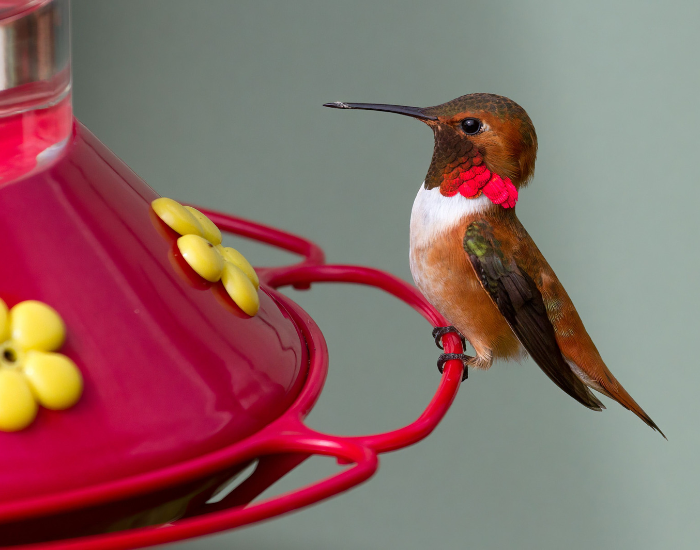
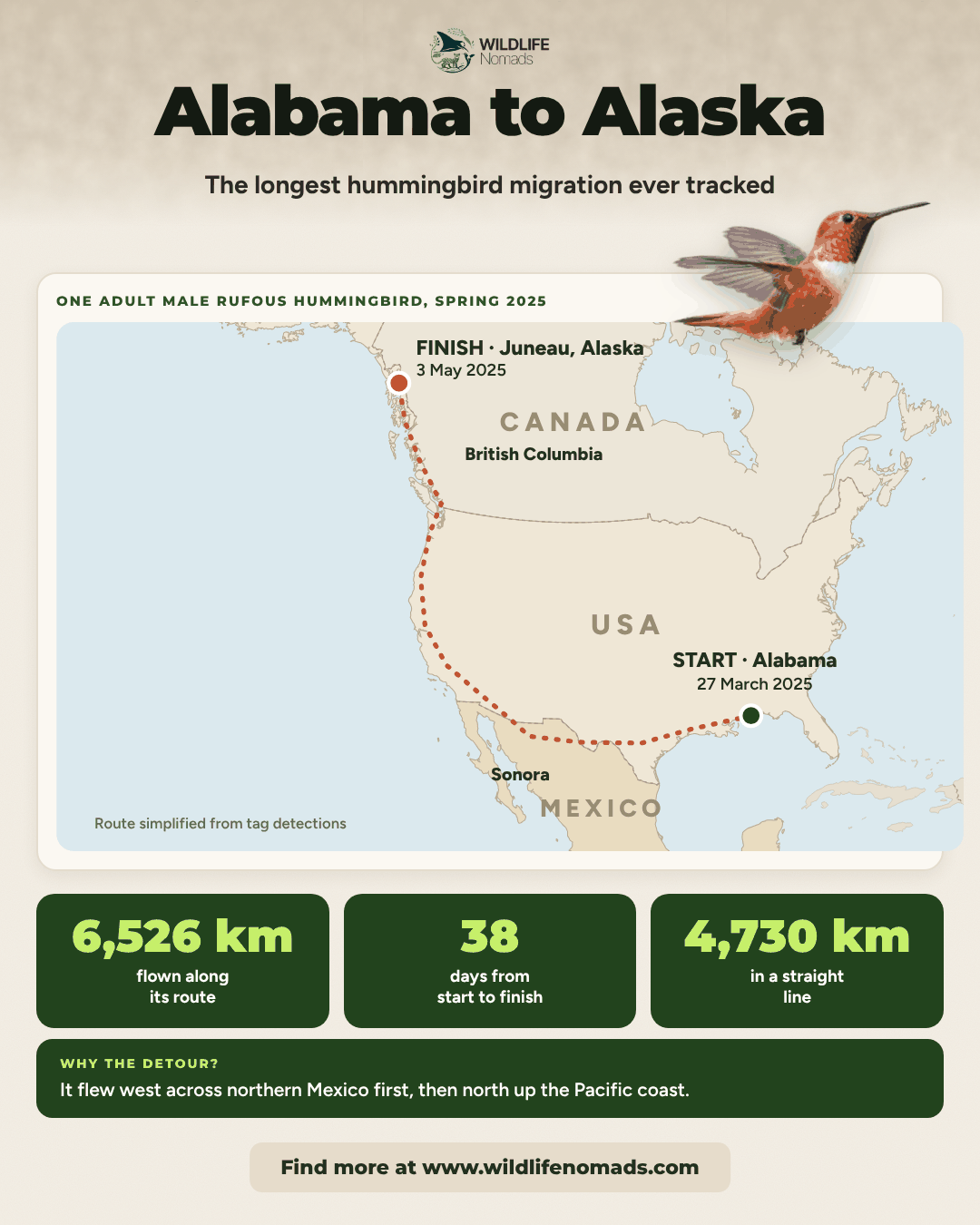
A bird weighing less than four grams just flew 6,526 km. A male rufous hummingbird travelled from Alabama to Alaska in 38 days. This rufous hummingbird migration is the longest hummingbird route ever tracked.
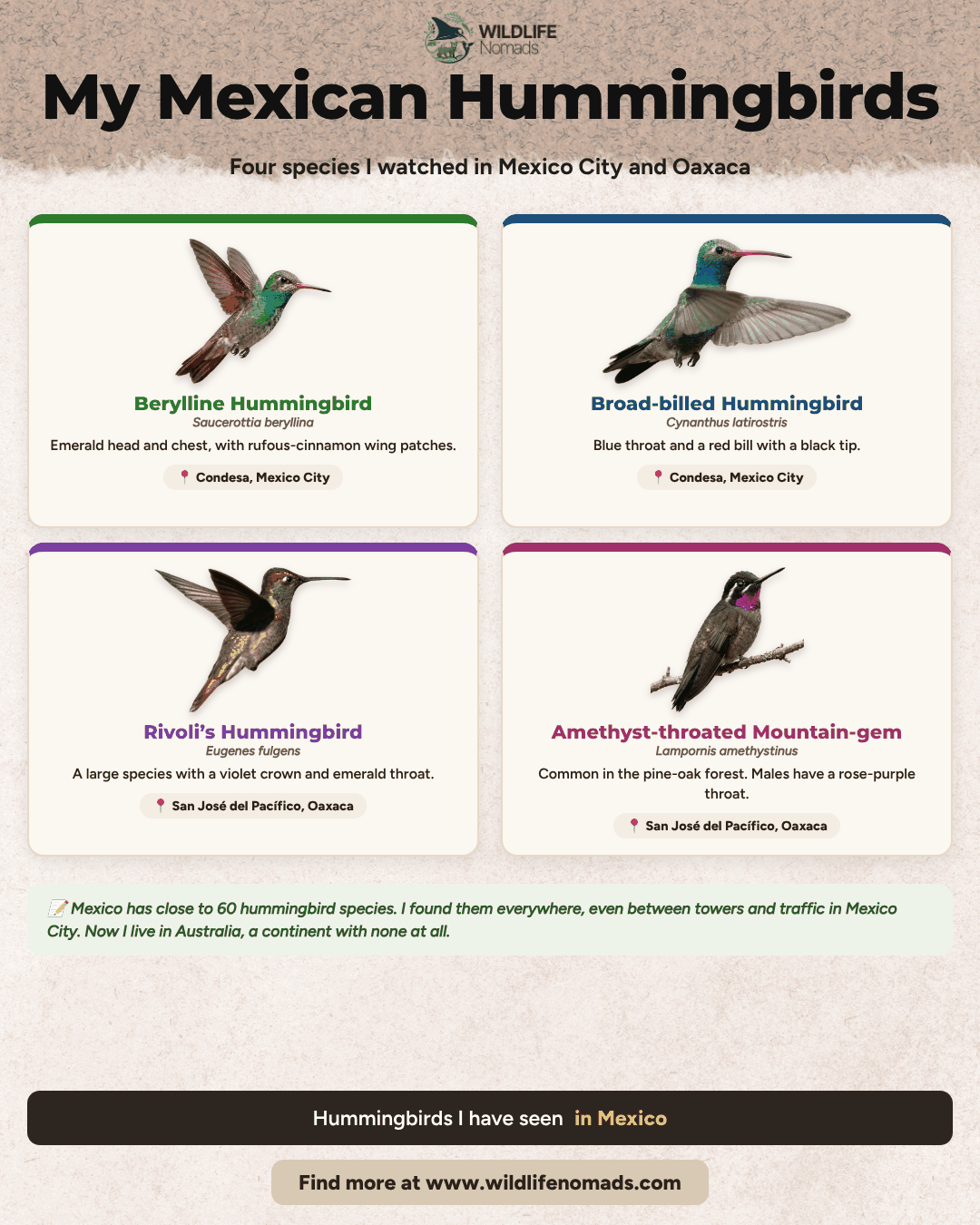
Hummingbirds are what I miss most about the Americas. Australia has none. In Mexico City I saw berylline and broad-billed hummingbirds near my place. In the misty mountains of San José del Pacífico, Oaxaca, I woke to Rivoli’s hummingbirds and amethyst-throated mountain-gems.
A Tag Lighter Than a Grain of Rice
Tracking hummingbirds has always been hard. Most transmitters are too heavy for birds this small. So the record trips we knew about came from banding, which only shows start and end points.
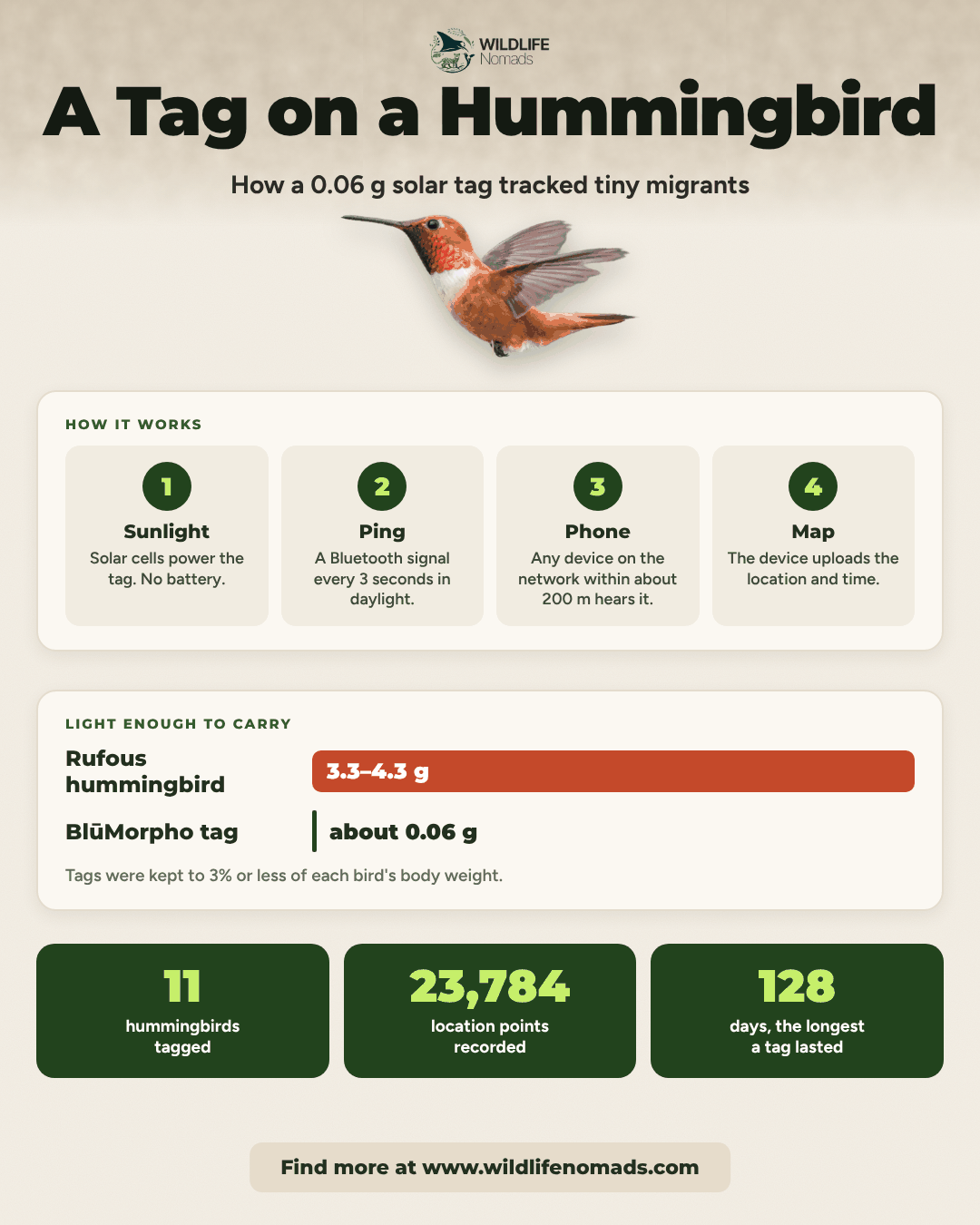
A team led by Emma Rhodes at the University of Memphis tested a new tag, the BlūMorpho. It weighs about 0.06 g and runs on solar power, with no battery. The results came out in Ecology and Evolution in November 2026.
The tag sends a Bluetooth signal every three seconds in daylight. Any nearby phone, tablet or computer on the network can pick it up within about 200 m. That device then uploads the bird’s location.
From Alabama to Alaska in 38 Days
In spring 2025, the team tagged 11 birds on the Gulf Coast of Alabama and Florida. Four were rufous hummingbirds and seven were ruby-throated hummingbirds.
The star was an adult male rufous. He left coastal Alabama on 27 March 2025. First he headed west and crossed northern Mexico, with detections in Sonora.
Then he turned north along the Pacific coast. He passed through British Columbia in Canada. Phones last picked him up in Juneau, Alaska, on 3 May.
His winding route added up to 6,526 km. In a straight line, the trip was 4,730 km.
More Than One Record
The tags logged 23,784 location points across 23 US states, Mexico and Canada. On average, each tag sent data for about 47 days. One lasted 128 days.
Other birds surprised the team too. One rufous made a loop of about 345 km into Tennessee and Missouri. One ruby-throated flew southeast into Florida, where it probably bred.
The tags also showed something new. Birds of the same species took very different routes. Banding alone could never show that.
What the Study Can’t Tell Us Yet
The record needs one caveat. In 2010, a female rufous banded in Florida turned up in Alaska. That was 5,632 km in a straight line, longer than this bird’s straight line. The new record is for the longest tracked route.
The tags have limits too. They only work in daylight. They also depend on people’s devices, so busy towns get more detections than wild places.
Many tags fell off within weeks, probably due to the temporary glue and moulting. The study also didn’t test the tags’ effects on the birds’ health or survival.
Why It Matters for a Declining Bird
Rufous hummingbirds are in trouble. Their numbers have fallen by roughly two-thirds since the early 1970s. The IUCN moved them to Near Threatened in 2018.
Saving a migratory bird means protecting every stop on its route. Until now, we couldn’t see those stops for birds this small. Tags like this could show exactly where rufous hummingbirds refuel.
Hummingbirds have always seemed like messengers to me. The Aztecs linked them to their god Huitzilopochtli. Now a tiny solar tag lets one carry a message across a continent.
FAQs About the Rufous Hummingbird Migration Record
Rufous hummingbirds migrate thousands of kilometres each year. They winter in Mexico or on the US Gulf Coast and breed as far north as Alaska. One tracked male flew 6,526 km from Alabama to Alaska in 38 days.
Most tags are too heavy for hummingbirds. The new BlūMorpho tag weighs about 0.06 g and runs on solar power. Nearby phones and computers relay its Bluetooth signal.
They are not endangered, but the IUCN lists them as Near Threatened. Their numbers have fallen by roughly two-thirds since the early 1970s.
Follow the Flyway
A bird lighter than a coin crossed a continent, and now we can see how. Explore more epic journeys in our animal migrations tool, including the record-holding bar-tailed godwit. Or read about the longest animal migrations on Earth.
References:
Rhodes, E. M., Burcher, S., Johnson, E., Contreras-Martínez, S., La Puma, D. A., Shepard, K., Williams, D., & Lanzone, M. (2026). Ultralight solar transmitter enables fine-scale movement ecology in North American hummingbird migration. Ecology and Evolution, 16(11), e74624. https://doi.org/10.1002/ece3.74624
Bassett, F., & Dietrich, F. (2014). Three long-distance recaptures of rufous hummingbirds that overwintered in the southeastern United States. North American Bird Bander, 39(3), 118–120. sora.unm.edu
Birds Canada. Rufous Hummingbird: Status of Birds in Canada. NatureCounts. naturecounts.ca
BirdLife International. (2024). Species factsheet: Rufous hummingbird Selasphorus rufus. datazone.birdlife.org