The first time I came face to face with emus was nowhere near Australia. I was an intern at a zoo in Mexico, finishing my bachelor of science, and my supervisor pointed me toward an open enclosure of free-roaming emus. “Just walk in,” he said. “They’re harmless.” He smiled. I did not.
Walking into that pen, I was terrified. These birds stood almost my height, with massive beaks and enormous sharp claws. Honestly, scary was the first word that came to mind. But over the following weeks I learned to read them, and within a month I could pet them and even feed them by hand. Peaceful, slow-moving, curious, the emus were nothing like the prehistoric monsters my imagination had built.
Years later I moved to Australia, never imagining I would actually live in the emu’s homeland. Most travelers picture wallabies, wombats, echidnas, or platypus when they think of this country. Few realize Australia is also the only home of one of the largest birds on Earth. So here are 12 things I’ve learned about emus through unforgettable mornings spent watching adult emus stride across the outback.
1. Emus Are the Second-Largest Bird in the World
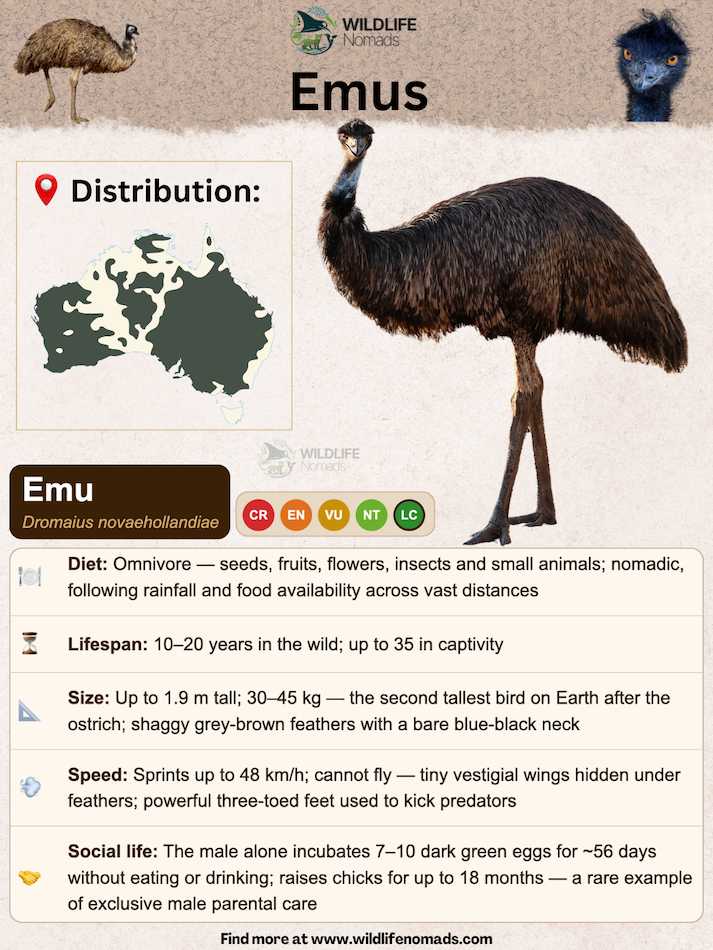
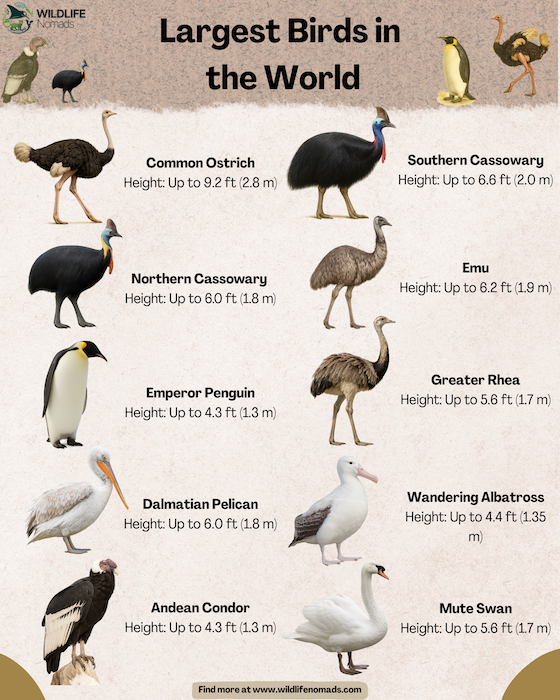
Only the ostrich stands taller. Adult emus reach 1.6 to 1.9 meters in height, and their body mass sits between 30 and 55 kilograms. That body mass makes emus the second-tallest bird in the world after the ostrich, and easily the largest bird native to Australia.
Their emu scientific name is Dromaius novaehollandiae, and they’re the only living member of the dromaius genus today. Three other dromaius species walked this planet once, but every island subspecies went extinct after European arrival.
When you stand beside an adult emu, you understand why I was nervous as an intern. Most birds barely reach your knee. Emus look at you eye to eye, with the same body weight as a small adult human.
2. They’re Flightless, But Built to Run
Like the ostrich, the kiwi, the rhea, and the cassowary, emus belong to a family of large flightless birds called ratites. Other ratites also share this trait, they evolved from flying ancestors but lost flight as their body mass increased. Among flightless birds, emus are second only to the ostrich in size.
Their small wings — barely 20 centimeters long — sit hidden beneath shaggy plumage. Despite being useless for lift, those small wings still serve a purpose. Emus hold them slightly out from the body to help shed heat as they run. That tiny aerodynamic detail matters when you live in Australia’s outback.
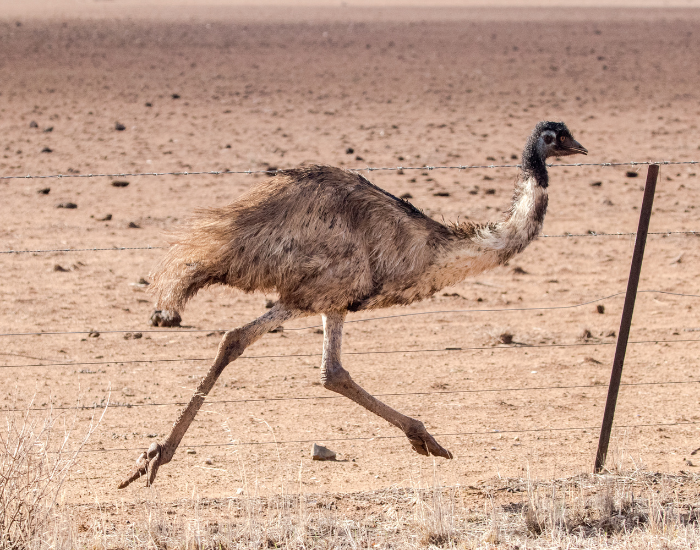
What they lack in flight, emus make up for with legs. Emus have powerful calf muscles unique among birds. The structure of those calf muscles, combined with three toes tipped with claws, lets them sprint at 50 km/h.
3. The Male Incubates the Eggs Alone
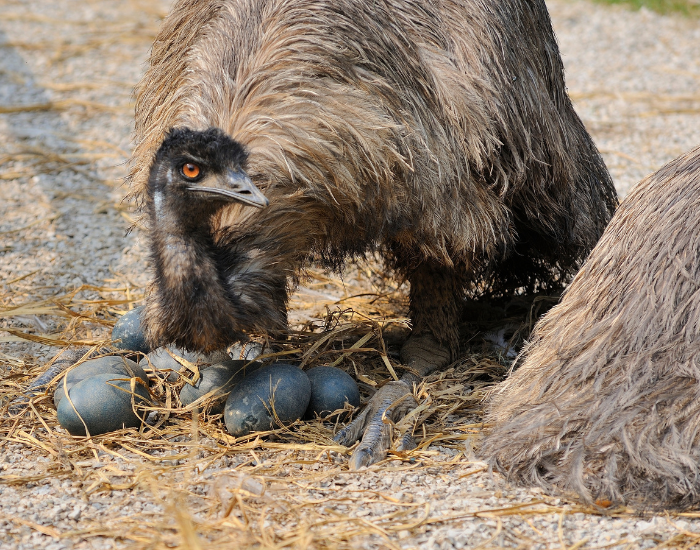
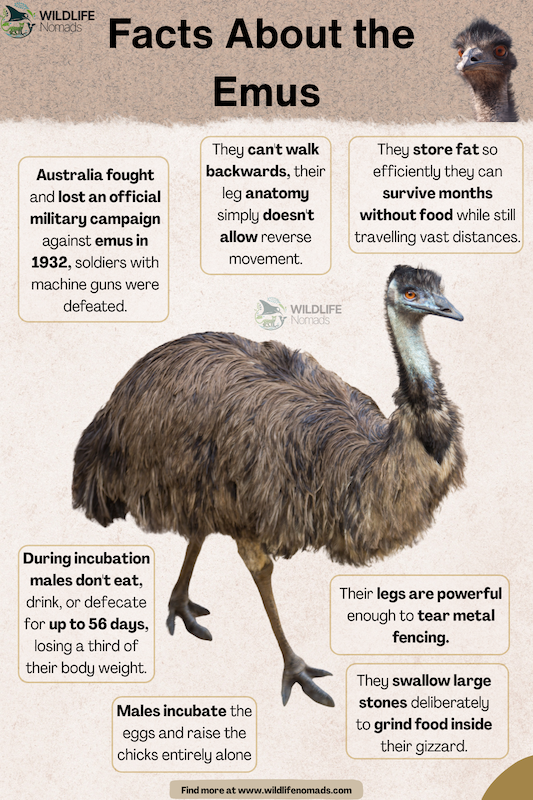
Here’s the fact that surprises everyone. Once emus form breeding pairs in autumn and the female lays her clutch, she walks away. The male incubates the eggs alone for roughly 56 days. The male incubates without eating, drinking, or even leaving the nest more than briefly each day.
To survive that fast, the male relies on stored body fat built up before the breeding season. By the time the chicks hatch, the male loses up to a third of his total body weight. He then raises the brood for another 18 months, defending the emu chicks against wild dogs and other males that might harm them. The male loses so much condition during this period that some researchers consider it one of the most extreme parental investments in the bird world.
4. Their Eggs Are a Bizarre Dark Green
One emu egg is the size of about ten or twelve chicken eggs and weighs around 600 grams. But the truly odd part is the color. Fresh emu eggs are a deep, dark green, almost teal, that fades to grayish brown as incubation progresses. Some old eggs eventually turn nearly grayish brown to black after weeks under the male’s body.
Why green eggs? The dark green pigmentation likely evolved as camouflage. In the dense forests, scrubby grasslands, and shaded woodlands where emus build a rough nest of grass shoots, branches, and leaves, those green eggs become almost invisible to predators. Inside dense forests, the dark green and grayish brown shell tones blend into shadow and leaf litter.

5. Emus Live Across Almost All of Mainland Australia
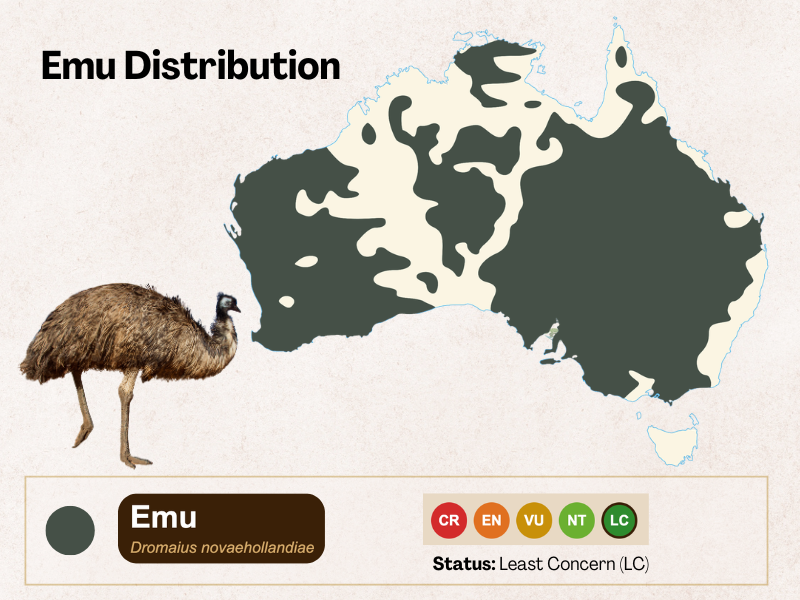
Where do emus live? Almost everywhere on the continent. The emus range covers nearly the entirety of mainland Australia, from the wet eucalyptus forests near Australia’s east coast to the arid heart of Australia’s outback. Emus live in savanna woodland, sclerophyll forest, sand plains, and semi-arid scrubland.
Historically, three smaller subspecies lived on Tasmania, King Island, and Kangaroo Island. The Kangaroo Island emu and its island relatives all went extinct shortly after European settlement, hunted out within decades. Today, only the mainland emu remains, with a few isolated populations from Western Australia to Queensland.
Emus avoid heavily populated areas and dense forests, but they readily cross into farmland. Ironically, emus have benefited from agricultural development. Stock dams and bores in heavily populated areas of pastoral land give them reliable water in regions that were once too dry. Even some heavily populated areas of agricultural settlement now host stable emu groups around their margins.
6. Their Diet Is Far More Varied Than You’d Think
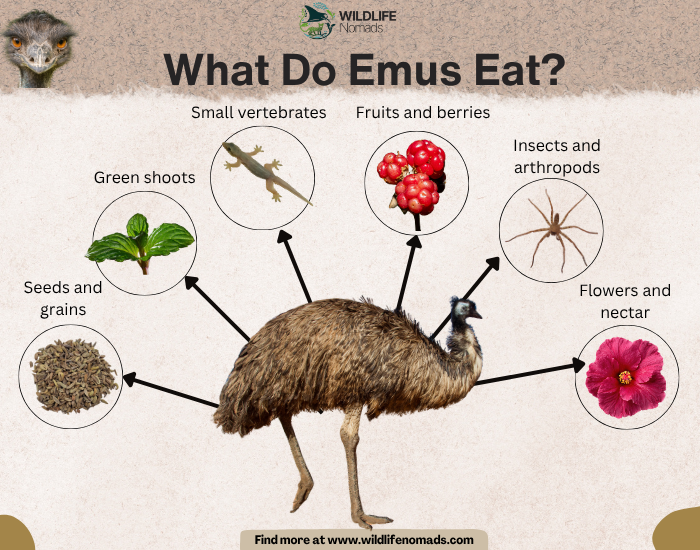
What does an emu eat? Almost anything. Emus are omnivores, switching between native fruits, seeds, flowers, fresh grass shoots, and the leaves of acacia and casuarina trees. They also gulp down beetles, crickets, moth larvae, spiders, small animals like lizards, and even animal droppings to scavenge undigested seeds. Animal droppings, in particular, are a surprisingly important seed source during droughts.
To find food in arid country, emus will travel hundreds of kilometers in a single year. They follow rainfall and seasonal vegetation. They drink rarely but voraciously, and during dry spells they lap morning dew from grass shoots and shrubs to top up their water budget. Morning dew can supply much of their daily water during the hottest months.
7. Sharp Claws and a Defensive Kick
Each foot carries three toes tipped with sharp claws up to 12 centimeters long. Combined with those powerful calf muscles, an emu’s forward kick can break the bones of careless humans, and those sharp claws can disembowel wild dogs. The three toes leave distinctive tracks across red sand, once you learn to spot them, you’ll see them everywhere in the outback.
That said, attacks are extremely rare. Emus prefer to escape predators rather than fight. Adult emus sprint away from danger, jump fences up to two meters tall, and even swim across rivers when needed. Their main natural threats are the wedge tailed eagle, which targets small chicks, and dingoes that catch unwary juveniles. A single wedge tailed eagle has been documented carrying off newly hatched emu chicks in central Australia.
8. Emus Pant Like a Dog to Cool Down
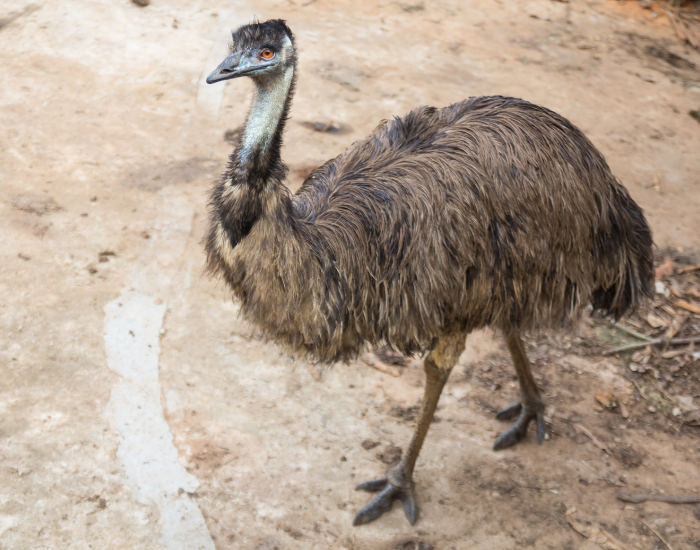
Emus pant rather than sweat. On hot days, emus pant rapidly, opening their beaks wide and fluttering their throats to evaporate moisture from their respiratory tract. That panting cools the blood passing through, working much like a dog cooling itself in summer.
Their feathers also help. The double-shafted, hair-like emu feathers act as insulation against both heat and cold, reflecting solar radiation away from the skin. Emu feathers are unique because two shafts grow from a single quill, a feature shared with very few other birds. As old plumage wears down, new feathers grow in to maintain that protective layer. New feathers come in roughly twice a year and gradually shift in color through the seasons.

9. Emus Are on the Australian Coat of Arms
The Australian Coat of Arms features two species: the kangaroo on one side, and the emu on the other. The Australian government chose them in 1908 as a symbol of forward progress, because, according to popular belief, neither animal can walk backwards. Whether that “no walking backwards” claim is fully accurate is debated — biologists have observed both species shuffle in reverse under stress — but symbolically it stuck. The Australian Coat of Arms remains one of the most recognized national symbols in the southern hemisphere.
The emu is the only bird to appear on Australia’s national heraldry, and one of the only bird species to feature prominently on any national coat of arms outside of eagles. The emu also appears on Australia’s 50-cent coin and countless military badges. As a symbol, it’s hard to think of another only bird so closely tied to a single nation’s identity.

10. They Communicate With Deep Booming Sounds
Females, not males, are the loud ones. During breeding season, a female emu produces deep booming calls that can carry up to two kilometers across open country. The deep booming sound comes from an inflatable throat sac unique to this species. Male emus contribute lower grunting sounds and softer drumming, mostly when defending the nest or guiding chicks.
Together, those vocalizations form one of the strangest soundscapes I’ve heard in Australia. The first time I heard the deep booming of a female, I thought a generator was malfunctioning somewhere in the bush. The grunting sounds of nearby males filled in the lower register like a bassline.
If you ever camp near a population during the cooler months, listen at dawn. The booming of the female emu and the grunting sounds of the male emu are unmistakable once you know them.
11. Their Closest Relatives Are Cassowaries — and the Name Came From Portuguese Explorers
Within the dromaius genus, only Dromaius novaehollandiae survives today. Three island dromaius genus (the King Island emu, the Tasmanian emu, and the Kangaroo Island emu) were all driven to extinction by hunting and habitat clearing within decades of European arrival. Portuguese explorers were among the first Europeans to record sightings, and the name “emu” likely derives from the Portuguese ema, a generic term for any large flightless bird. Some historians argue Portuguese explorers first applied ema to large flightless birds in the Solomon Islands or nearby tropical Pacific waters before extending it to the Australian species.
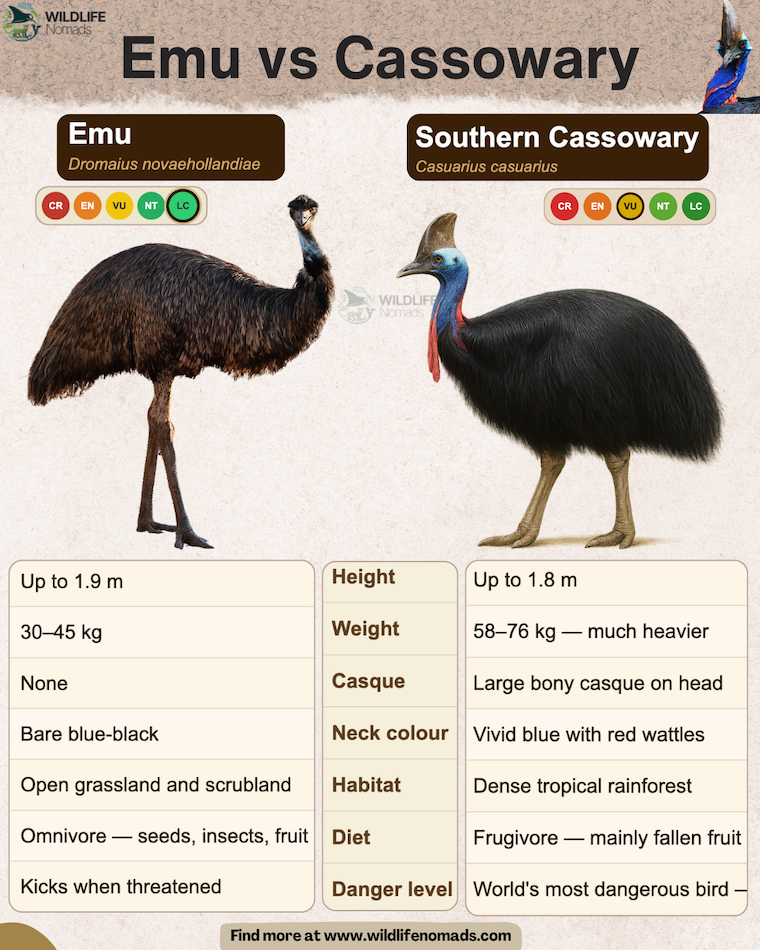
The emu’s closest living cousin is the southern cassowary, another Australian icon. Both belong to the ratite group, which also includes the ostrich, the rhea, the kiwi, and the extinct moa of New Zealand. Where the cassowary stays in dense forests of north Queensland, the emu prefers open country, a textbook case of two close relatives splitting habitats to avoid competition.
12. From the Emu War to Modern Emu Farming
The emu population today is healthy. The IUCN lists their conservation status as Least Concern, and current estimates put the wild emu population around 700,000 birds. Recent assessments of conservation status across the entire emus range suggest the species remains stable, despite ongoing pressure from agricultural development. But the relationship between emus and humans hasn’t always been peaceful, and emu population numbers have fluctuated dramatically in different regions.
In 1932, after thousands of emus migrated into Western Australia’s wheat belt and damaged crops, the Australian government deployed soldiers with machine guns in what became known as the Great Emu War. The emus won. Western Australia troops scattered across paddocks, the birds outmaneuvered them, and the campaign was called off after the birds refused to die in useful numbers. To this day in Western Australia, emus retain a place in local folklore.
Today, emu farming is a small but established industry across Australia, North America, and parts of Asia. Emu farming operations produce emu meat, which is lean and red and roughly the same weight per serving as beef but with less fat. Their oil is valued in cosmetics and traditional medicine for its anti-inflammatory properties. Emu oil rendered from a single bird can yield up to five liters of usable product. Emu farming also supplies leather and emu feathers used in craft, fashion, and dusters. A small family group of farmed birds — typically one male and several females — can be highly productive over many years.
FAQs About Emus
Emus are omnivores. Their diet includes grass shoots, leaves, seeds, native fruit, flowers, insects like moth larvae and beetles, spiders, and small animals such as lizards. They also eat animal droppings to recover undigested seeds and drink morning dew when surface water is scarce. This varied diet is one of the main reasons emus live successfully across nearly all of mainland Australia.
Adult emus can jump up to 2.1 meters from a standing position, easily clearing most farm fences. Combined with their ability to sprint at 50 km/h and swim across rivers, that jumping power makes them remarkably mobile. It also explains why emu farming requires fences at least 1.8 meters tall to keep adult emus contained.
Emus live across nearly all of mainland Australia, from Australia’s east coast woodlands to the deep interior of Australia’s outback. They prefer open savanna, scrubland, and sclerophyll forest, and they avoid dense forests and heavily populated areas. Historically, emus also lived on Tasmania, King Island, and Kangaroo Island, but those subspecies are now extinct.
The Outback’s Great Survivor
Standing in that Mexican zoo as a nervous intern, I never imagined I’d one day live in the country these massive birds call home. Emus taught me one of the most important lessons of my career as a field biologist: scary at first sight rarely means dangerous in reality. Emus are gentle, curious, and astonishingly well adapted to a continent that breaks most other large animals.
If emus have caught your imagination, I think you’ll enjoy my deep dives on the southern cassowary, the broader native birds of Australia, and the top 10 largest birds in the world. For a wider tour of this continent’s wildlife, browse my guide to the animals of Australia or my profile of wombats, another oddly endearing local. If you want a primer on bird groups in general, my types of birds guide is the place to start. Better still — book a trip, head west of the Great Divide, and watch these incredible birds yourself.
References:
Davies, S. J. J. F. (2002). Ratites and Tinamous: Tinamidae, Rheidae, Dromaiidae, Casuariidae, Apterygidae, Struthionidae. Oxford University Press.
Mitchell, K. J., Llamas, B., Soubrier, J., Rawlence, N. J., Worthy, T. H., Wood, J., Lee, M. S. Y., & Cooper, A. (2014). Ancient DNA reveals elephant birds and kiwi are sister taxa and clarifies ratite bird evolution. Science, 344(6186), 898–900. https://doi.org/10.1126/science.1251981
Patak, A. E., & Baldwin, J. (1998). Pelvic limb musculature in the emu Dromaius novaehollandiae (Aves: Struthioniformes: Dromaiidae): Adaptations to high-speed running. Journal of Morphology, 238(1), 23–37. https://doi.org/10.1002/(SICI)1097-4687(199810)238:1<23::AID-JMOR2>3.0.CO;2-O
Maloney, S. K., & Dawson, T. J. (1995). The heat load from solar radiation on a large, diurnally active bird, the emu (Dromaius novaehollandiae). Journal of Thermal Biology, 20(5), 381–387. https://doi.org/10.1016/0306-4565(94)00073-R
Taylor, E. L., Blache, D., Groth, D., Wetherall, J. D., & Martin, G. B. (2000). Genetic evidence for mixed parentage in nests of the emu (Dromaius novaehollandiae). Behavioral Ecology and Sociobiology, 47(5), 359–364. https://doi.org/10.1007/s002650050677
BirdLife International. (2018). Dromaius novaehollandiae. The IUCN Red List of Threatened Species 2018: e.T22678117A131902466. https://dx.doi.org/10.2305/IUCN.UK.2018-2.RLTS.T22678117A131902466.en
Heupink, T. H., Huynen, L., & Lambert, D. M. (2011). Ancient DNA suggests dwarf and ‘giant’ emu are conspecific. PLoS ONE, 6(4), e18728. https://doi.org/10.1371/journal.pone.0018728
Nagai, H., Mak, S. S., Weng, W., Nakaya, Y., Ladher, R., & Sheng, G. (2011). Embryonic development of the emu, Dromaius novaehollandiae. Developmental dynamics : an official publication of the American Association of Anatomists, 240(1), 162–175. https://doi.org/10.1002/dvdy.22520