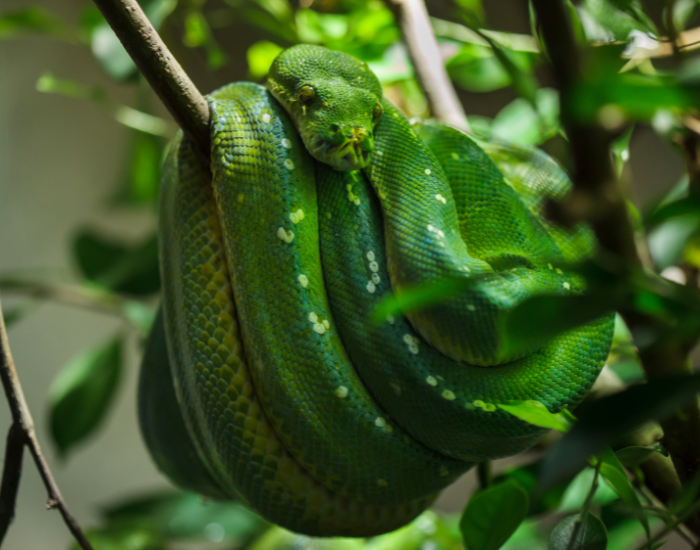

In my years working in a zoo, we kept a female snake boomslang on quiet display in the herpetology hall. As part of the reptile team, my job was to look after a strange and wonderful cast of animals, including poison dart frogs, crocodiles, boa constrictors, tarantulas, and of course, snakes like this one. That herpetology section was the classic dark, humid, cave-looking corner of every zoo. She lived there behind the glass, glowing like a moss-colored ribbon strung through a branch.
Visitors usually walked past her enclosure looking for the cobra or the rattler. Most never realized one of Africa’s most lethal serpents was inches from their face. So today, I want to share twelve things every nature lover should know about the boomslang snake, the science, the field stories from across sub Saharan Africa, and the small but important conservation fight playing out in the trees of South Africa and beyond.
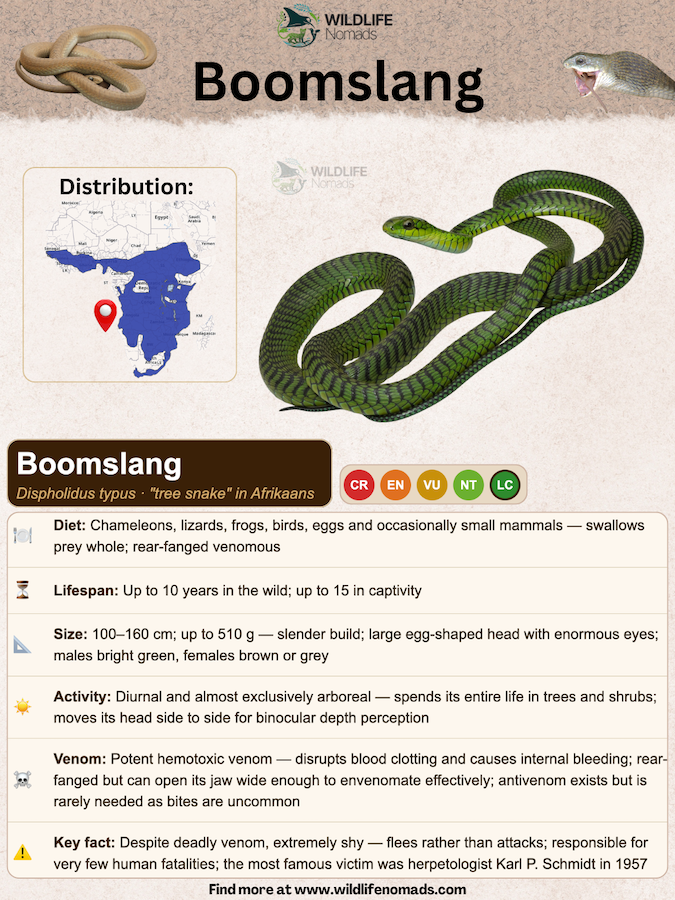
1. The Name “Boomslang” Literally Means “Tree Snake”
The word “boom slang” comes straight from Afrikaans: boom meaning tree, slang meaning snake. People in Cape Town and across the Western Cape still use the term in everyday conversation when warning hikers about a green serpent overhead. The scientific name, Dispholidus typus, only confirms what the common name suggests: this animal is built for life among trees.
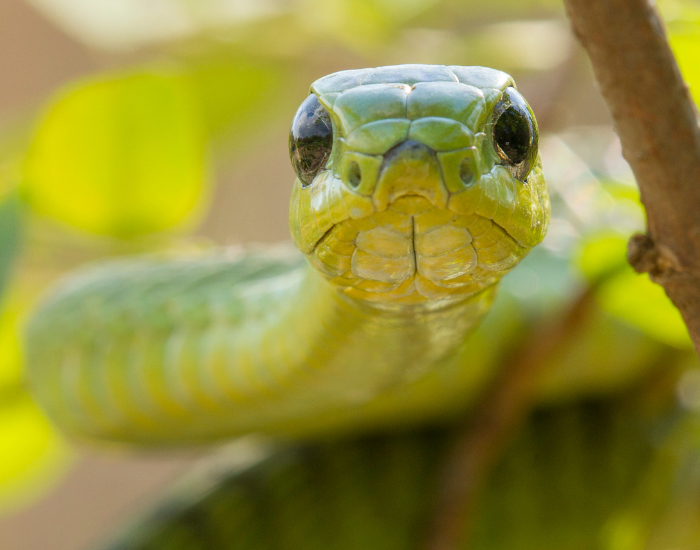
2. Boomslangs Have the Largest Eyes of Almost Any African Snake
The genus Dispholidus is famous for its huge, forward-facing eyes. Those large eyes give the boomslang excellent depth perception, which it needs to strike at moving birds and chameleons among swaying branches. Most other snakes rely on heat pits or chemical signals collected by the tongue. The boomslang, by contrast, hunts visually, almost like a feathered predator with scales.
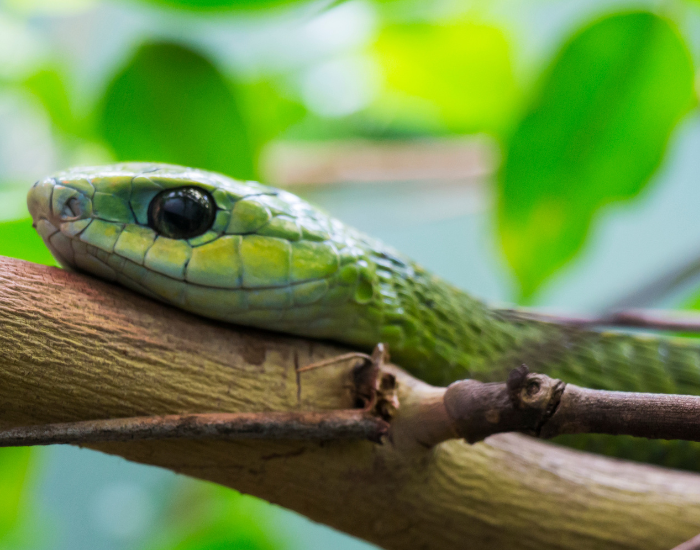
3. The Venom Is One of the Most Potent Hemotoxins on Earth
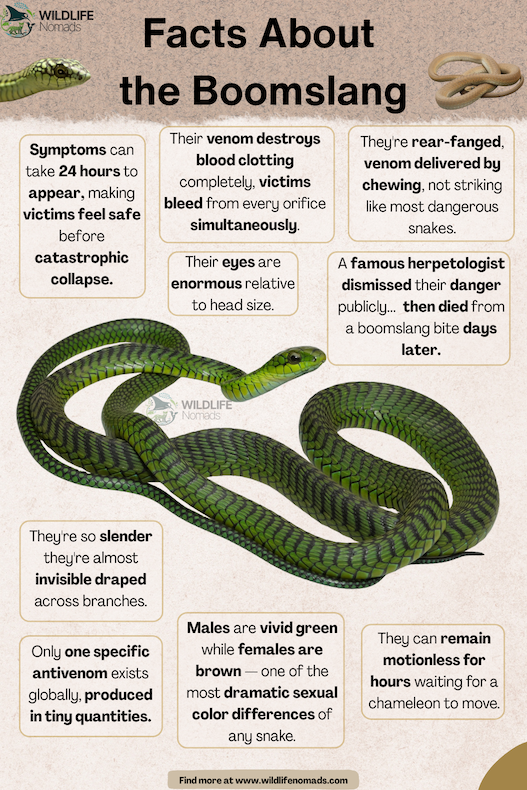
Boomslang venom is a highly potent hemotoxin. It destroys the body’s ability to clot blood. A victim of a fatal bite can suffer internal and external bleeding from the gums, eyes, nose, and old scratches that suddenly reopen. Even a scratch from those rear fangs can deliver enough venom to kill an adult human if it is left untreated.
The venom is slow acting. Symptoms often do not appear for hours, which is part of what makes the bite so deadly. A landmark case in the South African Medical Journal documented victims who felt fine for half a day before collapsing into hemorrhagic shock. The herpetological association in southern Africa now treats every boomslang bite as a medical emergency, no matter how minor the wound looks.

4. They Are Rear-Fanged: But Don’t Let That Fool You
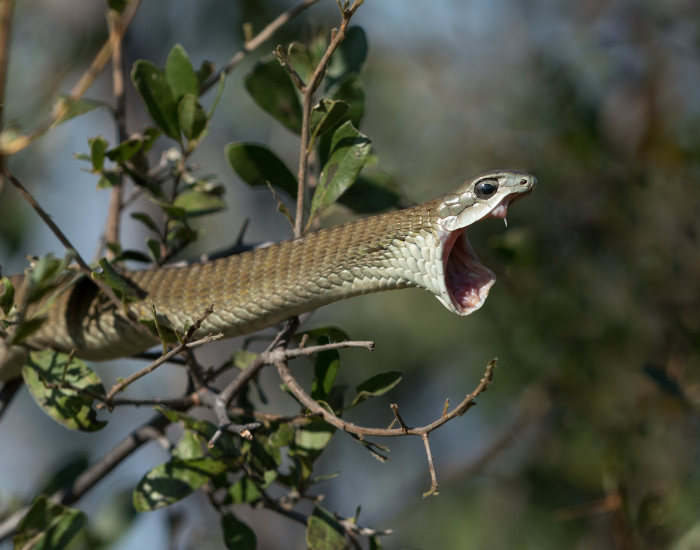
Boomslangs are rear fanged snakes, meaning the fangs sit toward the back of the upper jaws rather than the front. For decades, scientists assumed rear fanged species were harmless to humans. The boomslang shattered that assumption with one famous death.
The fangs are large, grooved, and angled to catch prey already partway down the mouth. When a boomslang bites, it can rotate its jaws nearly 170 degrees to drive those rear fangs deep into the victim. I have watched captive specimens chew a feeder mouse with deliberate, side to side motions, working the venom into the wound. Bites generally occur on a finger or hand because the snake has to grab and chew rather than strike-and-release.
5. Males and Females Look Like Different Species
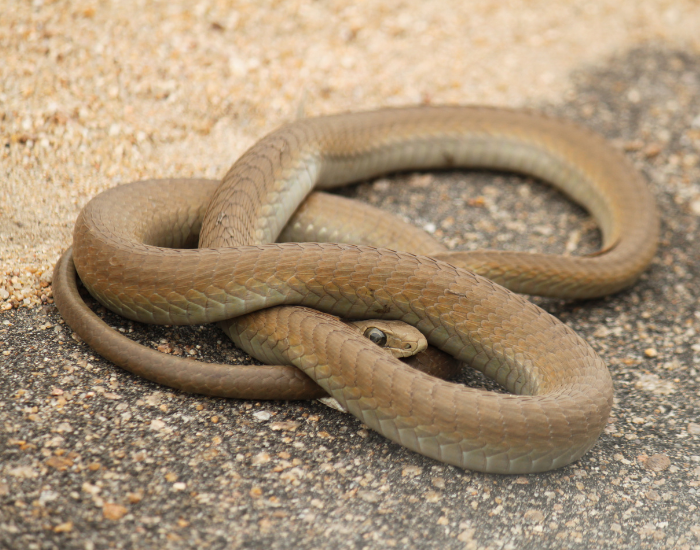
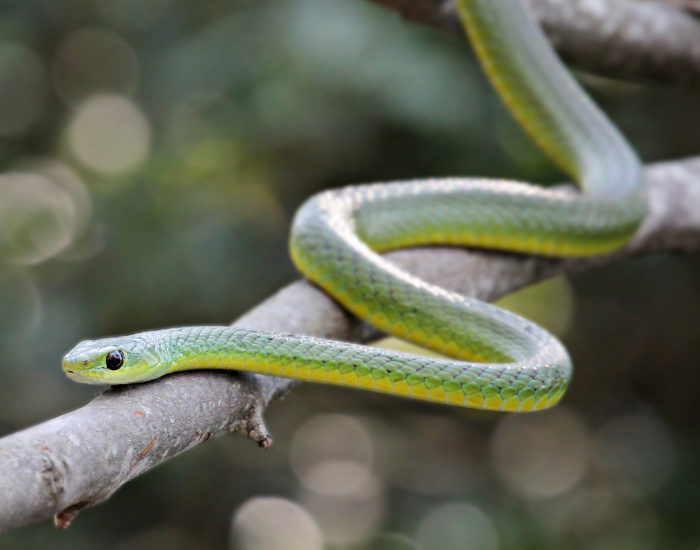
Sexual dimorphism in the boomslang is dramatic. Males are usually bright green with black-edged scales, sometimes flecked with blue or yellow. Females, by contrast, tend to be a dull olive or dusty brown. A black boomslang color phase also exists in some southern regions. New volunteers at the zoo often refused to believe the two animals belonged to the same species, until I lined up the skulls and showed them the identical jaws and dentition.
The color split serves a clear ecological purpose. The flashy males advertise fitness during the breeding season. The cryptic females rely on excellent camouflage while guarding eggs in tree cavities. By contrast, in many other reptiles the difference between males and females is far more subtle.
6. A Highly Arboreal Lifestyle Most Snakes Could Never Match
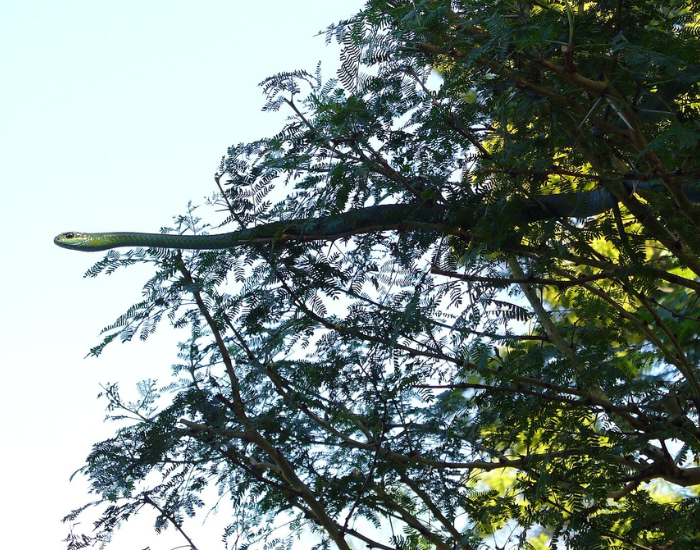
Boomslangs are highly arboreal. The canopy is not a hunting perch for them, it is the entire world. Their slender bodies and prehensile tail make them extraordinary climbers, and their lightweight build lets them stretch across gaps in the trees that would snap a heavier python in half.
I once watched in a documentary a male African boomslang snake cross between two acacias in the Kruger lowlands. He extended nearly two thirds of his body into open air with no support. It looked impossible. Then he caught a thin branch with his neck and simply pulled himself across, vanishing back into the trees on the other side.
7. Their Diet Reads Like an African Wildlife Catalog
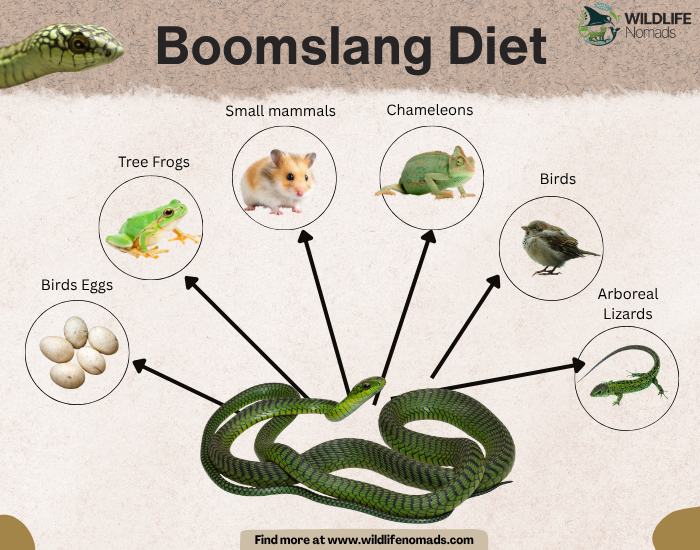
Boomslangs are opportunistic predators. They eat chameleons, birds of many species, bird eggs, lizards, amphibians including frogs, and small mammals like voles and tree-dwelling rodents. Field studies show frogs make up a real share of the diet during the wet season, when frogs are calling from every puddle and the trees are humid with rain. Tree frogs in particular climb right into striking range.
Frogs end up on the menu more often than the textbooks suggest. Some studies even document boomslangs eating other reptiles and the occasional bat. The boomslang swallows prey whole. Its slender snake body and flexible jaws expand to accommodate animals significantly wider than its head, and a single big meal of eggs or frogs can keep an adult fueled for days.
8. Boomslang Snakes are Native to Africa
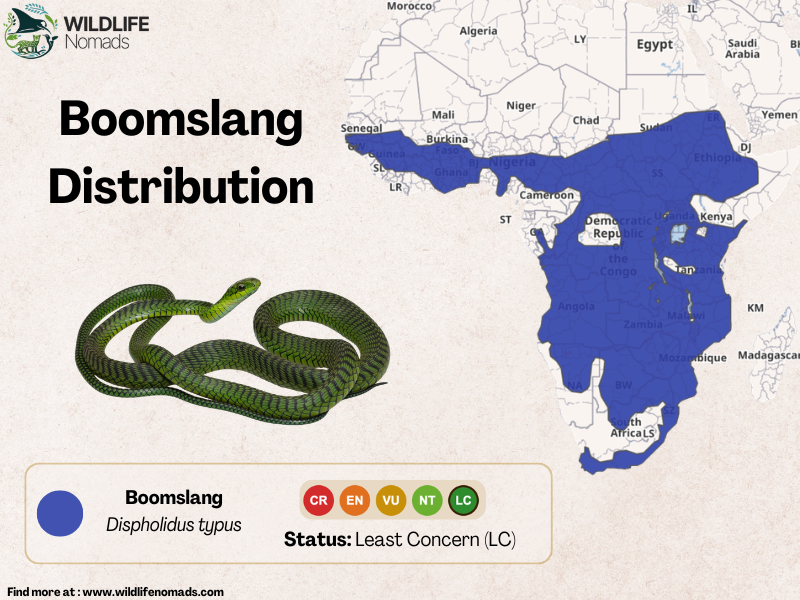
Where are boomslang snake found in the wild? They are native to sub Saharan Africa, commonly found across the central and southern regions of the continent — from the savanna woodlands of Botswana to the coastal forests near Cape Town. In South Africa, they show up in suburban gardens, riverine forests, and any tree cover dense enough to hide a slender snake.
The boomslang habitat shifts with prey availability. In the western cape, you can find boomslangs in fynbos shrubland next to vineyards. In Zambia, they hunt the canopy of miombo woodland, ambushing weaver birds at their hanging nests. The species adapts to almost any African landscape that offers trees, sun, and steady prey, which is why it remains commonly found despite habitat pressure.
9. The Famous Death of Karl Patterson Schmidt
In 1957, the world-renowned herpetologist Karl Patterson Schmidt was bitten on the thumb by a juvenile boomslang. He assumed the bite was minor; at the time, science still viewed venomous tree snakes that were rear-fanged as harmless to humans. Schmidt kept detailed notes on his symptoms instead of seeking treatment. He died about 24 hours later from massive internal and external bleeding.
Schmidt’s notebook became one of the most famous documents in herpetology. His meticulous death log proved beyond any doubt that the boomslang snake’s firm grip on the thumb of a small juvenile was capable of killing a grown man. Every reptile keeper I trained alongside studied Schmidt’s notes during venomous training. His death still saves lives today, because it taught the medical world that “rear fanged” does not mean “safe.”

10. Camouflage Worthy of a Magic Trick
Boomslangs are masters of disappearance. Their excellent camouflage matches the dappled green-and-yellow light of tree canopies almost perfectly. A motionless coil can sit three feet from your face and remain invisible. Field biologists call this “vanishing in plain sight,” and it is the boomslang’s first and best defense against any predator.
11. Reproduction in Late Spring
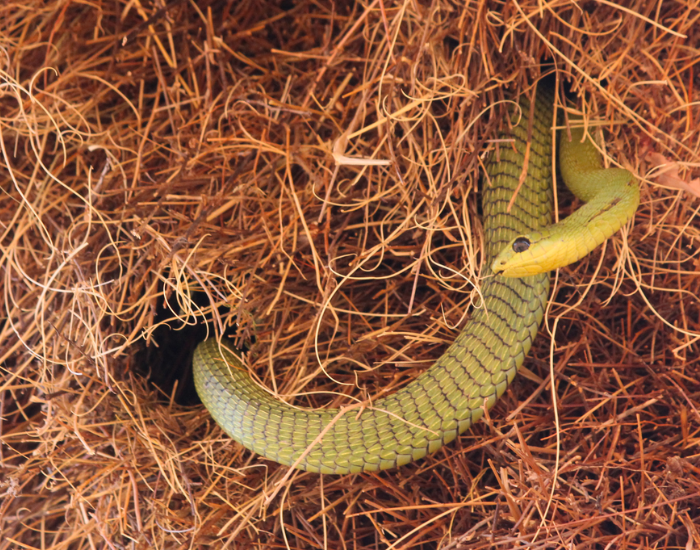
Female boomslangs lay clutches of eight to twenty-seven leathery eggs in tree hollows, leaf litter, or rotting logs. Mating happens in late spring, and bites generally occur more often during this period as territorial males become bold and visible. Young snakes hatch fully venomous, ready to hunt small lizards, frogs, and tree-dwelling insects from day one.
Juveniles look nothing like the adults. Hatchlings are gray-brown with bright green eyes that seem too large for the head. Their venom yield is small but plenty lethal for the small mammals, frogs, and lizards they target. These young snakes are vulnerable to many predators, however, and only a fraction will survive their first year in the trees.
12. Threats, Predators, and Conservation Status
The boomslang’s conservation status is currently Least Concern, but local populations face real pressure. Habitat loss from agriculture and urbanization threatens many southern Africa populations, especially in the western cape where vineyards have replaced fynbos shrubland. Road mortality is a major killer. Snakes that look threatened by humans are still routinely killed on sight, despite being one of the most timid snake species on the continent. A boomslang would rather flee through the trees than confront a human, and most bites happen only when someone tries to handle one.
Boomslangs themselves fall prey to a long list of predators. Hawks, eagles, and other birds of prey snatch them straight off branches. Even fish-eating raptors like ospreys occasionally kill snakes near water. Larger snakes, sometimes members of their own species; will eat smaller boomslangs. Mongooses, monitor lizards, and the occasional baboon round out the list. Despite that gauntlet, the species persists across most of its native range.
Frequently Asked Questions
Yes. Boomslangs are highly venomous and considered one of Africa’s deadliest snakes. Their hemotoxic boomslang venom prevents blood clotting and causes internal and external bleeding from any wound, scratch, or mucous membrane. A specific antivenom exists but is rare and species-specific. Even a scratch from a boomslang’s rear fangs warrants immediate hospital care.
The boomslang is native to sub Saharan Africa. It ranges across the central and southern regions of the continent — including South Africa, Botswana, Namibia, Zimbabwe, Zambia, Mozambique, Eswatini, and parts of East Africa. The species favors wooded savanna, forest edges, suburban gardens, and any habitat with abundant trees. They are commonly found wherever birds and chameleons are plentiful.
A fatal bite from a boomslang can kill an adult human within 24 to 48 hours if untreated. The venom is slow acting, so victims often feel fine for hours before symptoms hit. Death typically results from uncontrolled hemorrhaging in the brain, gut, and other organs. The specific antivenom from the South African Vaccine Producers is the only effective treatment for a lethal bite.
Boomslangs eat chameleons, birds, bird eggs, lizards, frogs, and small mammals. Chameleons and tree-nesting birds are their favorites in the western cape. Their highly arboreal lifestyle means most prey is captured in the trees. The boomslang swallows prey whole using flexible jaws that rotate to drive the rear fangs in deep.
Protecting the Arboreal Resident
The snake boomslang rewards anyone willing to slow down and look up. Learn its biology, respect its venom, and you start seeing a creature far more interesting than the killer of campfire stories; a tree-dwelling, sharp-eyed predator quietly running the canopy across half a continent. If you have spotted a green serpent in the African trees, or have a question about field herpetology, drop a comment below and tell me about it. To keep exploring, check out our complete guide to chameleons, eagles, and birds of prey on Wildlife Nomads, then go outside, look up, and see what the trees are hiding.
References:
Krüger, H. J., & Lemke, F. G. (2019). Fatal Boomslang bite in the Northern Cape. African journal of emergency medicine : Revue africaine de la medecine d’urgence, 9(1), 53–55. https://doi.org/10.1016/j.afjem.2018.12.006
Tambwe, M. J., Lalloo, V., Engelbrecht, A., & Pelle, P. (2021). A case report of detecting subclinical coagulopathy in a patient with boomslang (Dipholidus typus) bite. South African family practice : official journal of the South African Academy of Family Practice/Primary Care, 63(1), e1–e5. https://doi.org/10.4102/safp.v63i1.5299
Pla, D., Sanz, L., Whiteley, G., Wagstaff, S. C., Harrison, R. A., Casewell, N. R., & Calvete, J. J. (2017). What killed Karl Patterson Schmidt? Combined venom gland transcriptomic, venomic and antivenomic analysis of the South African green tree snake (the boomslang), Dispholidus typus. Biochimica et biophysica acta. General subjects, 1861(4), 814–823. https://doi.org/10.1016/j.bbagen.2017.01.020
Pyron, R. A., Burbrink, F. T., & Wiens, J. J. (2013). A phylogeny and revised classification of Squamata, including 4161 species of lizards and snakes. BMC Evolutionary Biology, 13(1), 93. https://doi.org/10.1186/1471-2148-13-93
Pook, C. E., Joger, U., Stümpel, N., & Wüster, W. (2009). When continents collide: Phylogeny, historical biogeography and systematics of the medically important viper genus Echis. Molecular Phylogenetics and Evolution, 53(3), 792–807. https://doi.org/10.1016/j.ympev.2009.08.002
Weinstein, S. A., White, J., Keyler, D. E., & Warrell, D. A. (2013). Non-front-fanged colubroid snakes: A current evidence-based analysis of medical significance. Toxicon, 69, 103–113. https://doi.org/10.1016/j.toxicon.2013.02.003