If you’ve spent any time following my work, you might know I recently took a deep dive into the world Animals of Africa for my new ebook, and I found cute and strange animals like the fennec fox and the sand cat. Writing about those tiny desert dwellers was a joy, but it actually sent me down a bit of a biological rabbit hole. While working on my book about the complex ecosystems of Africa, I kept coming across another creature that is, quite frankly, even weirder and more specialized.
I’m talking about bat-eared foxes.
As a biologist I’m rarely surprised by “more teeth” or “big ears.” However, these guys are a legitimate evolutionary anomaly. They are the only truly insectivorous canids, and they have a social structure that would make many human parents jealous.
So, let’s get into it. From their enormous ears to their bizarre dental records, here is everything you need to know about the bat-eared fox.
1. The Name is a Literal Translation
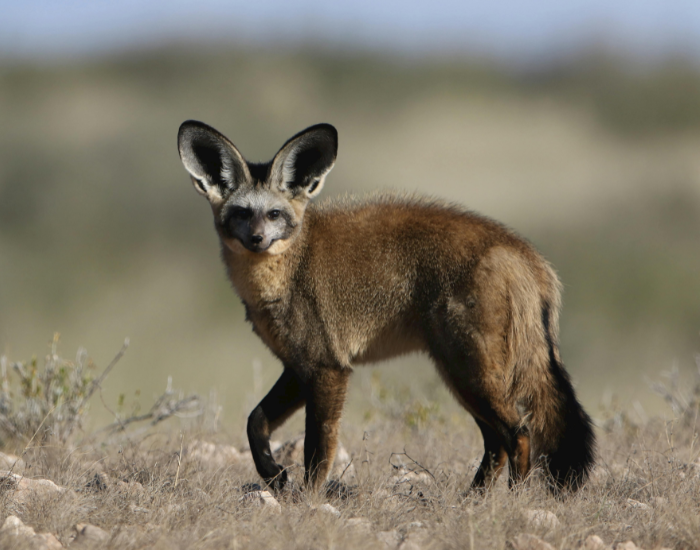
The bat-eared fox scientific name is Otocyon megalotis. If you break down those Greek words, otus means ear and kyon means dFog, while megalotis translates to large eared. Essentially, scientists called them “the big-eared eared dog.”
They belong to the family Canidae, which includes all wild dogs and domestic dogs. However, they are placed in their own genus, Otocyon, making them distinct from other foxes like the Red Fox or even the fennec fox.
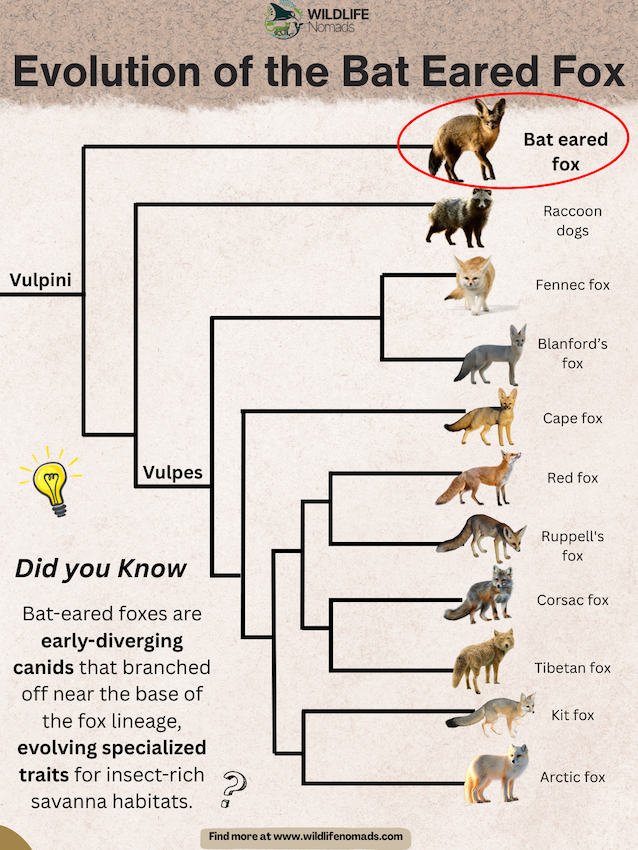
In fact, bat-eared foxes are a basal lineage. This means they branched off the canidae family tree millions of years ago, long before other fox species evolved. Therefore, despite the name, they aren’t closely related to other canids you might recognize.
2. Those Enormous Ears Aren’t Just for Show
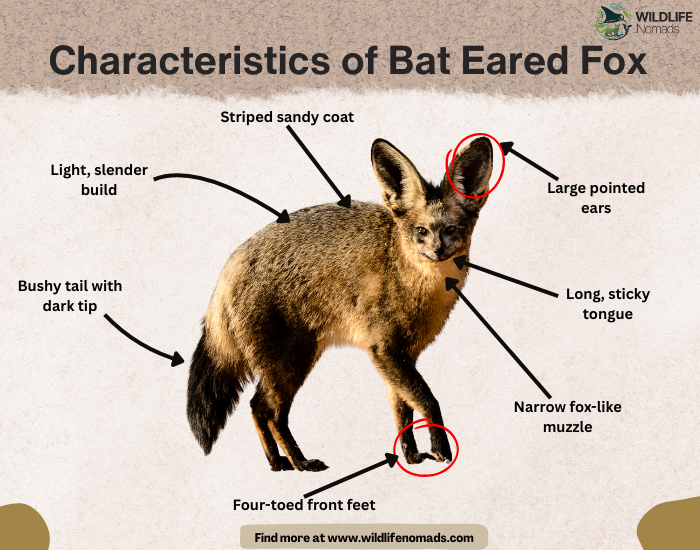
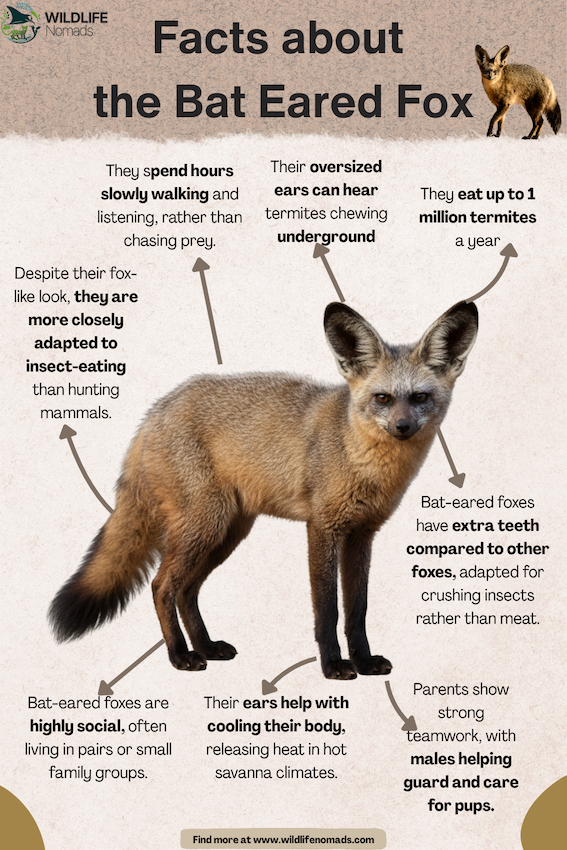
The most striking feature of the bat-eared fox is, unsurprisingly, its large ears. These massive appendages can reach over 5 inches in height, making them some of the biggest ears relative to body size in the animal kingdom. But they aren’t just for looking cute in photos.
Bat-eared foxes use these satellite dishes for two primary reasons. First, thermoregulation plays a critical role. In the scorching heat of eastern and southern Africa, these ears act as radiators, dissipating body temperature to keep the animal cool during the day.
Second, acoustic hunting is their superpower. They can hear beetle larvae chewing underground or a harvester termite moving beneath the surface. They literally “listen” to the earth to find their dinner, which makes them exceptionally skilled insect hunters.
3. A Dental Records Mystery: More Teeth Than Most
Most mammalian species in the carnivora family follow a standard dental formula. However, the bat-eared fox teeth count is an outlier. While other canids usually have 42 teeth, bat-eared foxes have between 46 and 50 teeth.
They have more teeth than almost any other non-marsupial land mammal. These extra molars aren’t for tearing meat like those of wild canids. Instead, they are specialized for rapid chewing. They can crunch through the hard chitin of dung beetles and other insects with incredible speed, processing prey before it has a chance to crawl away.
This dental adaptation is crucial for their survival. Because they consume such large quantities of insects daily, they need to process food quickly and efficiently.
4. Where Do Bat-Eared Foxes Live?
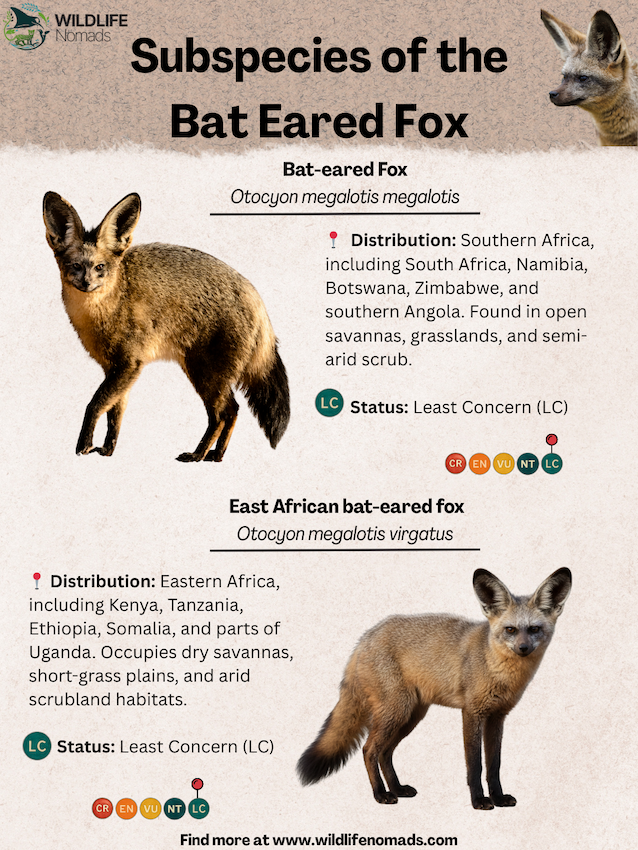
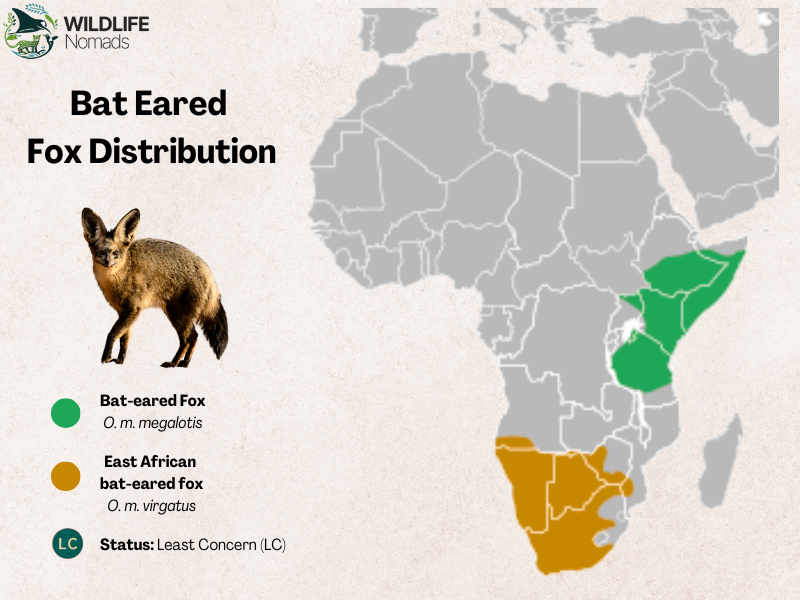
If you’re looking to spot one in the wild, you need to know where bat-eared foxes live. There are actually two populations that are geographically separated by approximately 1,000 kilometers.
The first population inhabits eastern Africa, stretching from southern Sudan and Ethiopia down to Tanzania. The second population is found in southern Africa, including South Africa, Namibia, and Botswana.
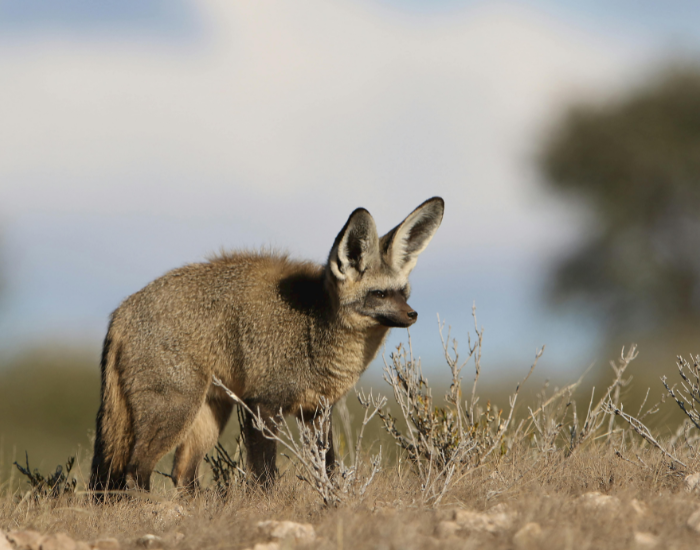
Their preferred bat eared fox habitat consists of arid grasslands, short grass plains, and short grass savannas. They love bare ground because it makes it easier to hear the movement of insects below the surface. You won’t often find them in tall grasses because it interferes with their acoustic hunting abilities.
In addition, bat-eared foxes prefer open landscapes where they can detect predators from a distance. This habitat preference also overlaps with areas where large herbivores roam, providing them with plenty of dung balls to search through for beetle larvae.
5. They Are the Ultimate Pest Control
While other fox species might hunt small mammals, birds, or scavenge carrion, the bat-eared fox is primarily an insectivore. About 80% of their diet consists of the harvester termite (Hodotermes mossambicus), which thrives in the same arid grasslands.
A single bat-eared fox can eat over a million termites per year. When they aren’t snacking on termites, they are searching for insect prey like dung beetles, beetle larvae, and other arthropods. In fact, they have even been known to follow large herbivores such as buffalo or zebras, not to hunt them, but to pick through the dung balls they leave behind.
This dietary specialization makes them incredibly important for ecosystem balance. By consuming millions of termites annually, bat-eared foxes prevent the over-grazing of arid grasslands. Therefore, their presence supports the survival of large herbivores that depend on these same plant resources.

6. Social Structures and Self-Dug Dens
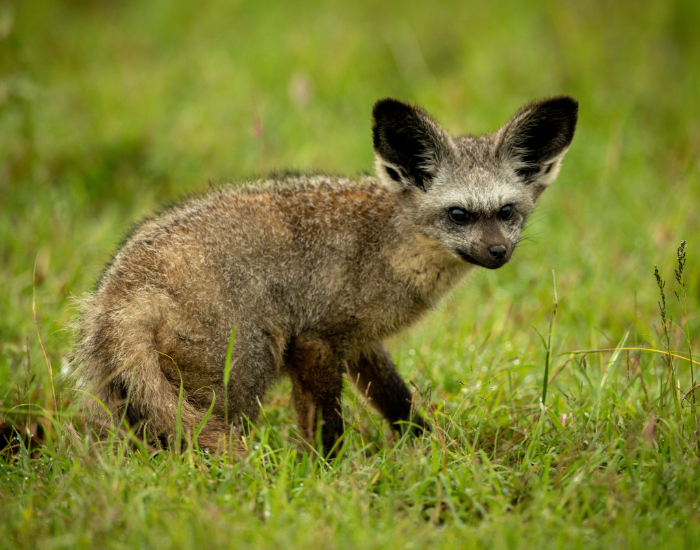
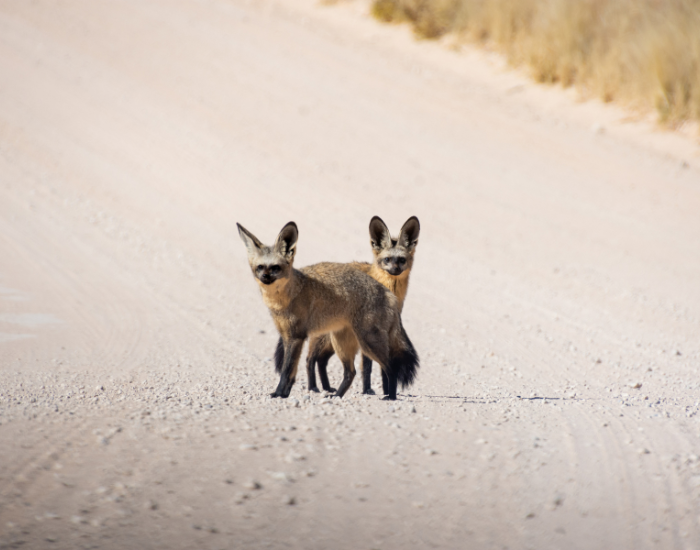
Bat-eared foxes live in tight-knit family groups. Unlike many other canids, they are primarily monogamous, forming lifelong pair bonds. A mated pair will share the same burrow, which is often a complex system with multiple entrances and tunnels.
While they are capable of digging self dug dens, they are also opportunistic. They will move into abandoned termite mounds or burrows left by wild dogs or aardvarks. In these safe spaces, young bat eared foxes, usually one to six pups, are protected from the elements and predators.
Moreover, these dens serve as communal hubs for family groups. During the day, when temperatures soar, the entire family will retreat underground. At night or during the cooler hours of dawn and dusk, they emerge to forage together across the short grass plains.
7. The Doting Father: Males Participate Heavily
In the world of bat-eared fox populations, the males are the MVP parents. Once the female has finished nursing to maintain milk production, the male takes over almost all parental duties.
Males participate in grooming, huddling, and playing with the pups. They guard the den while the female goes out to forage and replenish her energy. This high level of male investment is rare among fox species and is one of the reasons their survival rate is so high in the harsh wild.
In fact, studies have shown that pups raised with active fathers have significantly higher survival rates. This paternal care extends for several months, ensuring that young bat-eared foxes learn essential hunting and social skills before becoming independent.
8. Unique Physical Traits: The Face Mask and Tail
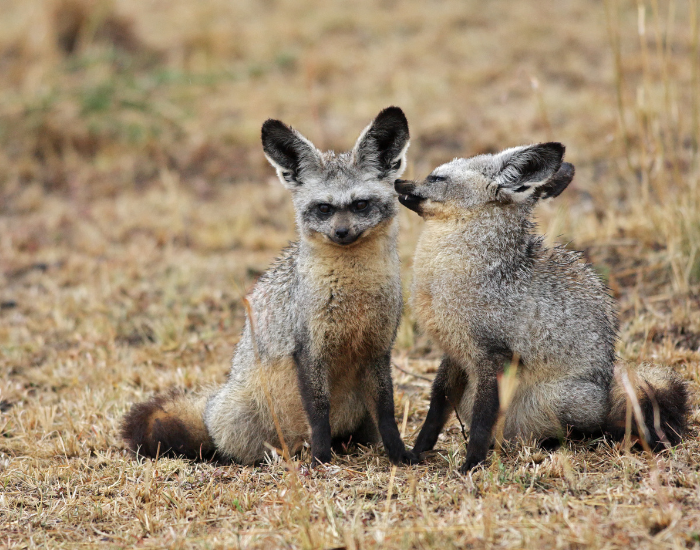
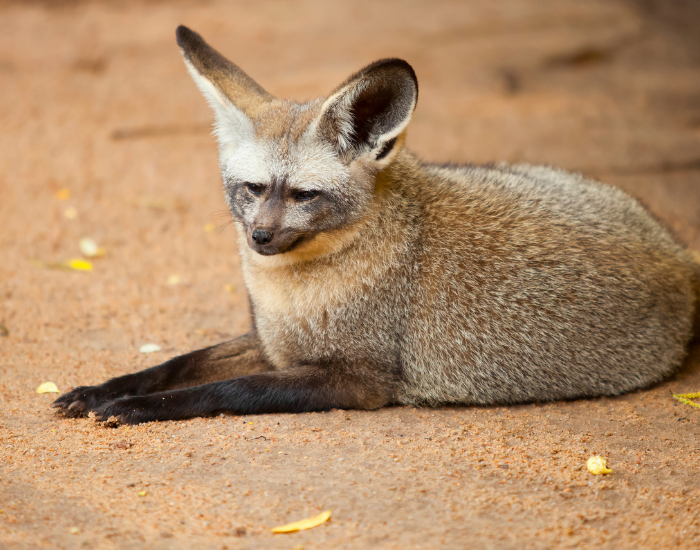
The bat-eared fox size is relatively small, with adults weighing between 3 and 5 kg. They have a generally yellow brown coat that provides excellent camouflage in the arid grasslands. Key identification features include a distinctive face mask, a dark, raccoon-like marking around the eyes.
Additionally, their lower legs are usually black or dark brown, creating a striking contrast with their lighter body fur. The bat eared fox tail is particularly noteworthy. The tail length measures about 25 to 35 cm and ends in a prominent black tail tip.
When a fox is threatened or playing, it will arch its back and fluff up its tail, making itself appear much larger. This display helps deter potential bat-eared fox predators such as hyenas, eagles, and caracals.
9. Communication: More Than Just Barks
If you were to stand in the southern Africa savanna at night, you might hear soft whistles. These are the primary contact calls between family members. Unlike wild canids or domestic dogs that use loud, aggressive barking, bat-eared foxes communicate subtly.
Their communication is designed to keep the family together without alerting major threats to their location. In addition to whistles, they use body language, including ear positioning and tail movements, to convey information.
Walking slowly and maintaining close proximity, family groups coordinate their foraging activities. This cooperative behavior increases their efficiency when hunting for termites and other insects across the bare ground.
10. Conservation Status: A Success Story (For Now)
Currently, the bat-eared fox is listed as Least Concern by the IUCN Red List. They are fairly common throughout their range in both eastern and southern Africa. However, they aren’t without threats.
Habitat loss remains the greatest threat as agriculture expands into short grass savannas. Furthermore, disease poses a significant risk. Bat-eared foxes are susceptible to rabies and canine distemper, often caught from domestic dog family members near human settlements.
Predation by large birds of prey, jackals, and caracals also impacts bat-eared fox populations, particularly young pups. Despite these challenges, their adaptability and wide distribution have helped maintain stable population numbers.
Conservation efforts focus on protecting their natural habitat and monitoring disease outbreaks. Organizations such as the African Wildlife Foundation and local conservation groups work to preserve the arid grasslands essential for their survival.
11. Bat-Eared Foxes Represent an Ancient Fox Lineage
Bat-eared foxes are among the most evolutionarily distinct foxes alive today, branching off near the base of the fox family tree millions of years ago. Unlike true foxes in the Vulpes genus—such as the kit fox, fennec fox, and Arctic fox—the bat-eared fox evolved along a separate path, developing specialized traits for insect-rich savannas. Their massive ears, reduced teeth for crushing insects, and social foraging behavior reflect this early divergence. This makes bat-eared foxes a living reminder that fox evolution didn’t follow a single trajectory, but split into multiple adaptive experiments shaped by habitat, diet, and climate.
Bat-Eared Fox vs. Fennec Fox: What’s the Difference?
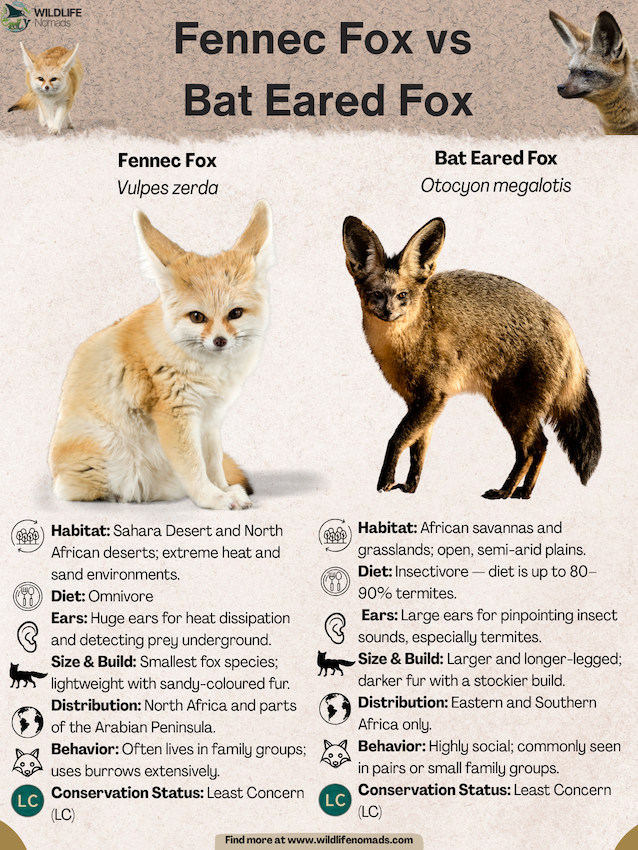
Since I mentioned my “rabbit hole” started with the fennec fox, let’s clear up the confusion. Many people see a large eared fox and assume they are the same species.
The fennec fox lives in the Sahara Desert of North Africa, while bat-eared foxes inhabit the savannas of eastern and southern Africa. In terms of diet, fennec foxes are omnivores, eating rodents, plants, and insects. In contrast, bat-eared foxes are primarily insectivores, with termites making up 80% of their diet.
Regarding physical differences, fennec foxes weigh only 1 to 1.5 kg and have pale cream or white fur. Bat-eared foxes are larger at 3 to 5 kg and sport a generally yellow brown coat with a distinctive face mask.
Finally, the dental formula differs significantly. Fennec foxes have the standard 42 teeth found in most canids, whereas bat-eared foxes have 46 to 50 teeth specialized for rapid chewing of insect exoskeletons.
Frequently Asked Questions
Absolutely not. While they might look like a member of the domestic dog family, they are wild animals with highly specific social and dietary needs. In many places, keeping a bat-eared fox as a pet is illegal.
They have enormous ears primarily for two reasons. First, to hear insects moving underground, particularly beetle larvae and harvester termites. Second, to help regulate body temperature in the extreme heat of African arid grasslands.
No. They are generally shy and will choose “flight” over “fight” every time. They use losing speed and zig-zagging maneuvers to escape predators rather than confrontation. This behavior helps them avoid unnecessary injuries in the wild.
A “fox bat” or “flying fox” is actually a type of large fruit bat, not a fox at all. Despite the similar name, flying foxes belong to the order Chiroptera (bats), while bat-eared foxes are in the order Carnivora. Don’t let the names confuse you.
The Critical Lens: Why They Matter
In my time studying the ecosystems of Africa, I’ve realized that we often focus on the “Big Five”, lions, elephants, rhinos, leopards, and buffalo. However, the bat-eared fox is a keystone species in its own right. By consuming millions of termites annually, they prevent the over-grazing of arid grasslands, which in turn supports large herbivores.
When we look at the fossil record, we see that these foxes have remained relatively unchanged for thousands of years. They are a perfect example of “if it ain’t broke, don’t fix it” evolution. Their specialized adaptations, from their enormous ears to their extra teeth, have proven so effective that natural selection has preserved them over millennia.
Moreover, bat-eared foxes serve as indicators of ecosystem health. Their presence suggests a thriving insect population, particularly harvester termites, which are essential decomposers in arid environments. Therefore, monitoring bat-eared fox populations helps scientists understand broader ecological changes.
If you ever find yourself in a self dug den area of the Kalahari, Maasai Mara, or the Serengeti, keep your eyes on the bare ground at dawn or dusk. You might just see those enormous ears popping up from the grass, followed by a family group working together to hunt for dung beetles and termites.
Find a Safari to see Bat Eared Foxes in the Wild
Here is a list of our recommended Safari tours with trusted partners so you can spot a cheetah and many other animals in the wild:
This blog is reader-supported. When you buy experiences through links listed on this site, we may earn an affiliate commission.