At first glance, you might mistake the soft cooing for a distant woodland murmur. Then you spot it, a delicate bird with a blue grey head, and wings that shimmer with cinnamon tones in the sunlight. This is the European turtle dove (Streptopelia turtur), one of the most culturally significant and ecologically vulnerable birds in Europe. Once a common sight across farmland and hedgerows, this species now faces a precarious future, declining by nearly 78 percent across Europe between 1980 and 2013. If this decline continues, the turtle dove could face extinction, much like other extinct bird such as the Dodo and Passenger Pigeon, bird species that have already disappeared due to human activities.
While often celebrated in poetry and Christmas songs, the turtle dove is far more than a symbol of love. In the wild, it’s a story of epic migration, ground-feeding adaptation, and conservation urgency. This small dove travels thousands of miles between Europe and Africa, navigating deserts, seas, and human pressures that threaten its very existence. Let’s explore ten compelling facts about this extraordinary species.
1. The Name “Turtle Dove” Has Nothing to Do With Turtles
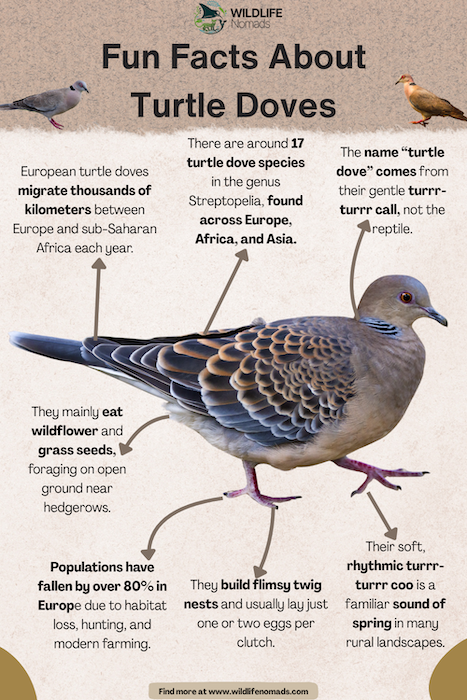
The European turtle dove carries a name that puzzles many people. The word ‘turtle‘ in ‘turtle dove’ is derived from the bird’s call and is unrelated to the reptile, with the word itself having an onomatopoeic origin that mimics the bird’s song. However, “turtle” has no connection to the reptile. Instead, the term comes from Middle English “turtel,” which echoes the Latin “turtur”, an onomatopoeic reference to the bird’s distinctive “turrr-turrr” cooing sound.
Latin speakers captured this vocalization centuries ago, and the name evolved into “turtle-dove” in English. Therefore, when you hear someone mention turtle doves, they’re referring to the bird’s melodic call, not any reptilian features. This linguistic heritage extends into cultural meanings, where the turtledove meaning often symbolizes devotion and true love in poetry, art, and religious texts.

2. Turtle Doves Are Ground-Feeding Specialists With Specific Habitat Needs
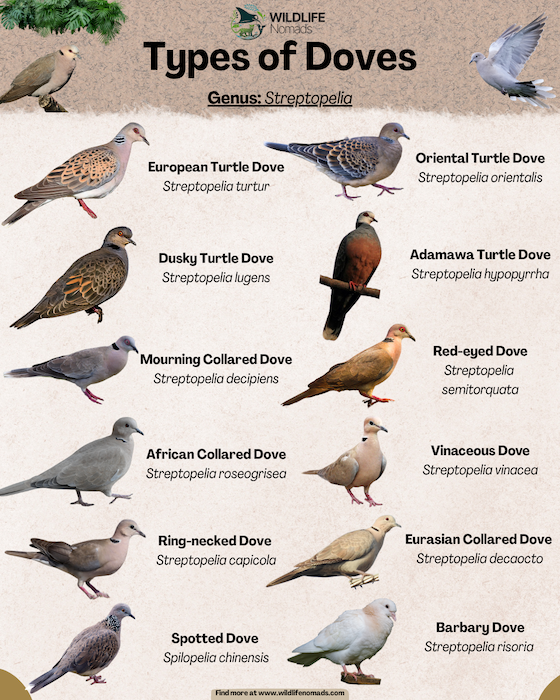
The turtle dove isn’t just one species, there are actually 17 known species of turtle doves across the world, all belonging to the dove family (Columbidae). This breeding species inhabits farmland, hedgerows, and woodland edges across Europe, parts of Africa, and Asia. Unlike collared doves that adapt to urban environments, turtle doves require a specific mosaic of habitats.
These birds favor open ground for foraging combined with shrubs or trees for shelter and nesting. Their diet consists mostly of seeds, wildflower seeds, cereal grains, and weed seeds foraged directly from the ground. Therefore, they are primarily granivorous birds. Occasionally, they take small fruits or invertebrates, but seeds remain their staple food.
Because the turtle dove feeds on the ground, it is vulnerable to changes in farmland practices. Loss of seed banks, herbicide use, and removal of hedgerows devastate their foraging habitat. Studies have shown that creating seed-rich margins and maintaining vegetation structure provides essential habitat for breeding grounds and supports declining populations.
3. Their Distinctive Appearance Sets Them Apart From Other Doves
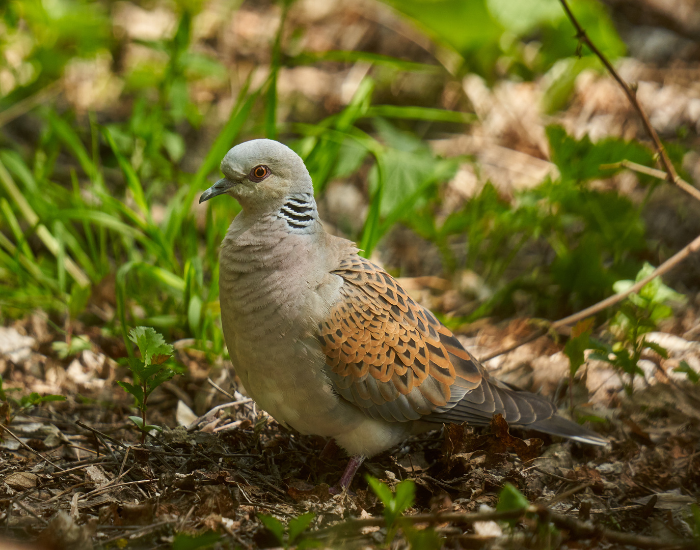
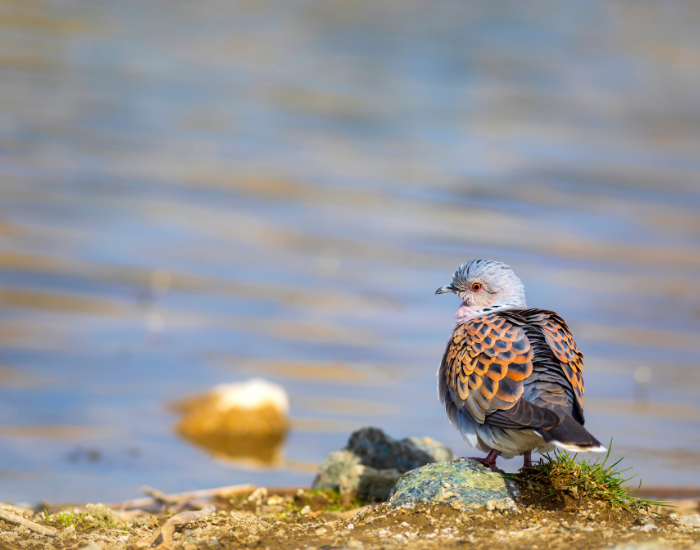
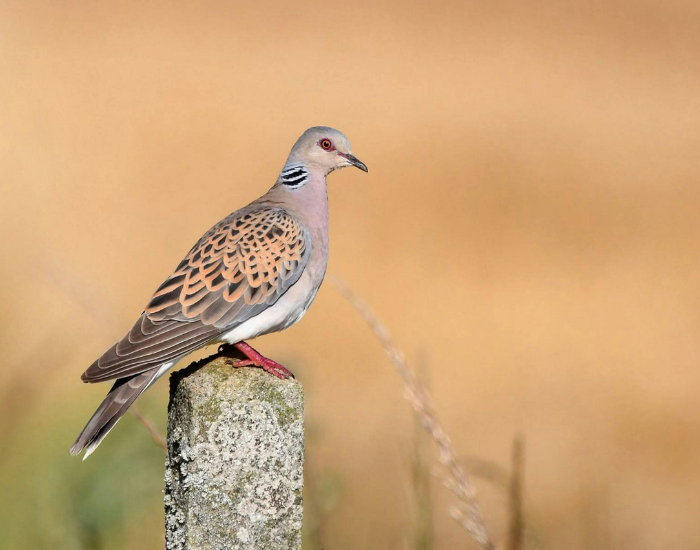
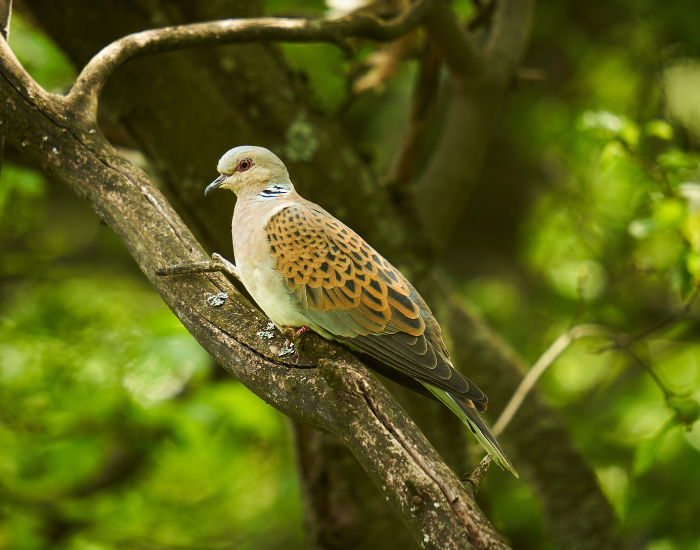
When you encounter a turtle dove, you will immediately notice its graceful appearance. The species features a blue grey head that contrasts beautifully with a striking black and white patch on the side of the neck. The wings display a cinnamon-mottled pattern with darker centers, creating a scaled appearance in certain light. In flight, you will spot a wedge-shaped tail tipped in white.
Compared to the collared dove or common wood pigeons, the turtle dove appears slimmer and more delicate. These ground-feeding doves have a slender build that distinguishes them from other pigeons in the dove family. Moreover, this species prefers specific habitat types such as hedgerows, woodland edges, and farmland mosaics, while many regular doves tolerate more urban settings.
4. They Undertake Epic Migrations Between Europe and Africa
If you live in North American countries and wonder “Are there turtle doves in the US?” the answer is no, not naturally. The European turtle dove breeds primarily in Europe, migrates through the Mediterranean, including key stopover countries such as Spain, and winters in the Sahel zone of sub-Saharan Africa. This long-distance migration makes the species vulnerable to numerous threats along the way. Turtle doves mainly migrate at night, which helps them avoid predators and harsh weather.
The breeding population spans most of Europe (except the extreme north), parts of Asia, and North Africa. During spring migration, these wild birds travel north across the Mediterranean Sea and desert regions, passing through countries like Spain. In the UK, a national survey conducted in 2021 estimated approximately 2,092 territories of breeding turtle doves, reflecting the species’ precarious status in England.
Migration itself poses significant risks. Individuals arrive at breeding grounds with low body mass and require stopover sites to replenish their energy. One recent study found that approximately 16 percent of the population passes through Greece in spring, with some birds staying for weeks to rebuild their strength. Protecting both breeding grounds and wintering grounds is essential for the species’ future, as turtle doves spend the winter in sub-Saharan Africa, including countries such as Senegal.
5. Turtle Doves Have Declined Catastrophically Across Their Range
If you have heard that turtle doves are rare, you have heard correctly. This species faces multiple threats, and their numbers have dropped severely across many parts of Europe and beyond. In the UK, numbers have collapsed dramatically, with some estimates showing a 96 percent decline between 1970 and 2012 in certain regions. Across Europe, the species declined approximately 78 percent between 1980 and 2013.
Several key factors drive the decline. First, habitat loss and agricultural intensification have simplified farmland. Removal of hedgerows and reduction of seed-bearing weeds erode the foraging habitat these birds depend on. Second, hunting pressure during migration and on wintering grounds reduces population numbers significantly. In the Mediterranean, many turtle doves are shot during spring migration, preventing them from reaching breeding grounds. Also, some birds are illegally trapped during migration, further reducing their numbers.
Third, the species has low annual productivity. Because turtle doves lay relatively few eggs—typically one or two per nest, and may have limited nesting attempts, declines in breeding success rapidly translate into population loss. In Europe, the population is classified as Vulnerable, with the global mature population estimated between 12.8 million and 47.6 million individuals.

6. The Breeding Season Reveals Complex Territorial and Nesting Behaviors
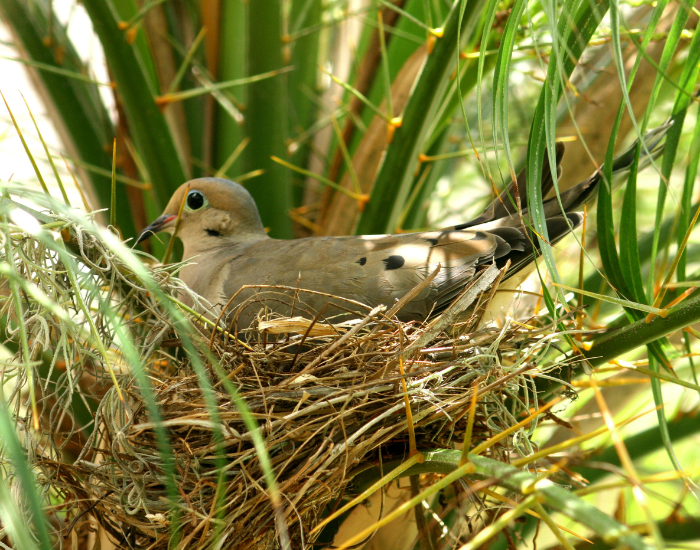
During the breeding season, which in Europe runs from April through September, turtle doves establish territories and form pairs. These birds are often monogamous for the season. They build simple nests, typically flimsy platforms of twigs in a tree or hedge, where they lay one or two eggs.
Nest survival and post-fledging habitat use are critical factors for conservation. Research on farmland in the UK found that post-fledging habitat selection directly links to survival rates. Young birds need suitable cover and food sources after leaving the nest. The journey from egg to fledgling to independence is precarious in today’s changed landscape, with fewer seed supplies, habitat simplification, predation risk, and hunting along migration routes all threatening survival. Predators such as birds of prey and mammals pose a significant threat to turtle dove nests and fledglings, making dense cover and well-chosen nest sites essential for minimizing predation.
Researchers studying breeding populations have found that microhabitat and edge effects strongly govern nest-site selection. Therefore, maintaining hedgerows, shrubs, and woodland edges adjacent to open ground creates the mosaic landscapes these birds require for successful reproduction.
7. Major Conservation Efforts Are Underway to Save the Species
Fortunately, this is not a hopeless story. Major conservation initiatives are underway to halt the decline of the turtle dove. Key actions include the International Single Species Action Plan for the Conservation of the European Turtle Dove (2018–2028), adopted by the European Commission. This detailed plan addresses habitat restoration, monitoring, research, and hunting regulation across the species’ range.
Targeted habitat management shows promise. Studies demonstrate that creating seed-rich margins, retaining hedgerows, and maintaining open foraging ground can boost turtle dove productivity. For example, a UK study on sown seed-mix strips produced positive results for breeding populations. Monitoring programs provide essential data, the 2021 UK survey estimated 2,092 territories, giving a baseline for tracking whether declines can be reversed.
Migration-route work identifies key stopover sites. Researchers study stopover sites in Greece and other Mediterranean countries, working with international partners to protect these critical areas. Engaging stakeholders is also crucial, with recent papers highlighting the role of habitat management by hunter groups and landowners across Europe, Africa, and Asia.
There is hope for the turtle dove’s recovery, as ongoing tracking of individual birds and the positive impact of conservation efforts continue to inspire optimism for the species’ future.

8. Turtle Doves Symbolize Devoted Love in Culture and Religion
One reason the turtle dove holds a special place in human culture is its prominent role in symbolism and language. The phrase “turtledove meaning” often refers to devoted, faithful love. This association arises because turtle doves were long thought to form strong pair bonds and appear in pairs throughout the breeding season. In ancient mythology, the turtle dove was also associated with goddesses such as Demeter and Fides, symbolizing trust, love, and faith.
In the Bible, there is mention of “two turtle doves” as a sacrifice in the Gospel of Luke. Therefore, the bird symbolizes purity, offering, and the use of humble creatures in sacrificial rituals. The turtle dove also represents good faith in religious and folk traditions. The term extends into poetry, art, and even songs, think of “two turtle doves” in the famous Christmas song “The Twelve Days of Christmas.”
Because of this cultural heritage, many people wonder “Do turtle doves mean love?” Yes, in symbolic terms they do. They have become emblematic of devoted love or “true love” in vernacular speech. The idiom “turtledove” in slang can connote sweethearts or “turtledoves” in love. This symbolism reminds us why protecting these birds matters, they represent not just ecological health but also enduring human values.
9. You Can Help Turtle Doves Through Practical Land Management
If you are a landowner, farmer, volunteer, or simply someone who cares about wild birds, you can take several practical steps to support turtle doves. First, maintain or create seed-rich margins and patches of bare ground under sparse vegetation. Second, retain hedgerows, shrubs, and woodland edges adjacent to open ground,these features create the mosaic landscapes turtle doves require.
Third, monitor your land for turtle dove presence each spring and summer. Even a few calling birds are important and deserve protection. Fourth, if you live along migration routes or wintering grounds in Africa or Europe, support international habitat initiatives. Conservation actions are needed in every country along the turtle dove’s migration route to ensure their survival. Campaign for regulation of hunting during spring migration, when birds are traveling to breeding grounds.
Fifth, in your garden or local nature reserve, avoid removing every seed-bearing weed. Small seeds from wildflower species matter significantly to doves. Finally, stay updated on regional conservation plans and contribute citizen science data. Photos and records help track turtle dove trends and inform conservation strategies across countries.
10. Their Gentle Cooing Is a Sign of Spring Across Europe
One of the most distinctive traits of the turtle dove is its soft, rhythmic “turrr-turrr” cooing, a sound so characteristic that it inspired the bird’s very name. In much of Europe, the return of this call marks the arrival of spring and the start of the breeding season. Males often perch high in hedgerows or trees to deliver their song, advertising both territory and devotion to their mate.
Sadly, this once-familiar sound has become rarer in many parts of the UK and Western Europe. Conservationists now use acoustic monitoring and citizen-science recordings to track where the turtle dove’s call can still be heard, making each sighting and sound an important sign of hope for the species’ recovery.
Understanding Common Questions Helps Spread Awareness
Because the name comes from the bird’s “turrr-turrr” cooing (Latin turtur), not turtles.
Not the European turtle dove in any widespread sense. There are other similar-looking doves in the U.S., but if you see “turtle dove” it’s likely a mis-identification.
They combine migration drama, vulnerability, and cultural significance. Their decline reflects farmland and migration problems globally.
“Dove” is a general term; “turtle dove” is a specific species (or group of species) within that family. In Britain/Europe the European Turtle-Dove is the classic example.
Devoted love, fidelity, offering/sacrifice (in biblical terms), peace.
They are not yet “extinct” but are rare in many parts of their range and have suffered huge declines (e.g., ~78% across Europe 1980–2013).
The impact of factors such as drought and climate change on turtle dove populations remains largely unknown, making ongoing research essential.
A Call to Action for Conservation
The European turtle dove is more than a symbol in poetry or a line in a Christmas song. It’s an environmental indicator that reveals the health of farmland, hedgerows, and migration routes across Europe, Africa, and Asia. When farmland is simplified, when seeds vanish, when hedgerows are removed, and when hunting and migration become risky, the turtle dove pays the price.
This species occupies that critical space where humans and wild lands meet, serving as a messenger for conservation. The soft coo of the turtle dove is a fragile sound in a changing world, yet it remains a hopeful one. Here is what you can do right now to support this declining species.
First, if you manage land or visit farmland and hedgerows, look out for turtle doves in spring and summer. Record what you see and support local monitoring efforts. In the UK, East Anglia is a stronghold for turtle doves, offering the best chance to observe them and serving as a key focus for conservation efforts. Second, support agricultural policies and conservation schemes that maintain seed-rich margins, hedgerows, and mosaic landscapes. These practices benefit not only turtle doves but also countless other wild birds and species.
Third, spread the story. Next time someone asks “What is a turtle dove?” or “Why are turtle doves so rare?” you will have credible, engaging answers. Encourage others to take action for this vulnerable species. Fourth, consider supporting conservation organizations working on the International Single Species Action Plan. These groups coordinate efforts across continents to protect breeding grounds, wintering grounds, and migration routes.
Let us make sure that the gentle “turrr-turrr” call continues to echo across fields and skies for generations to come. The future of the turtle dove depends on actions we take today.
Further Reading
- The Best Spots for Whale Watching UK
- Rare & Unique Animals That Live in Iceland
- The 10 Most Fascinating Extinct Birds