
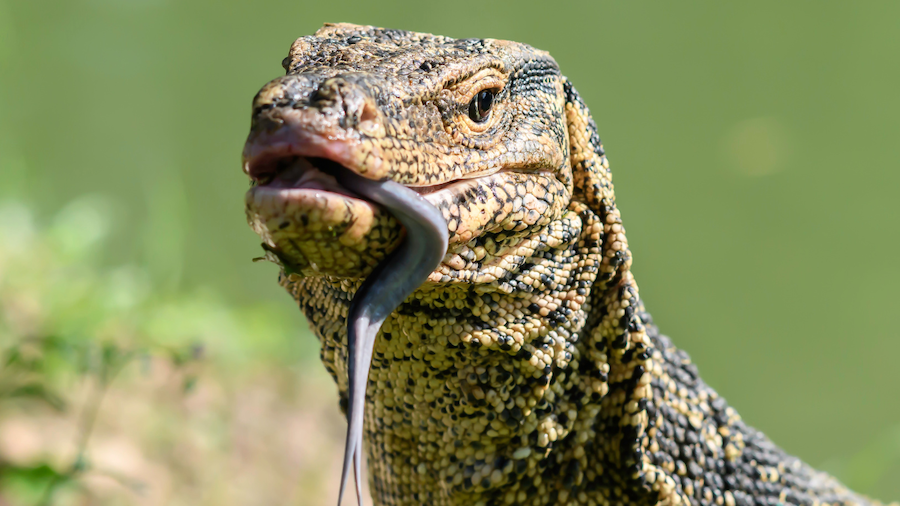
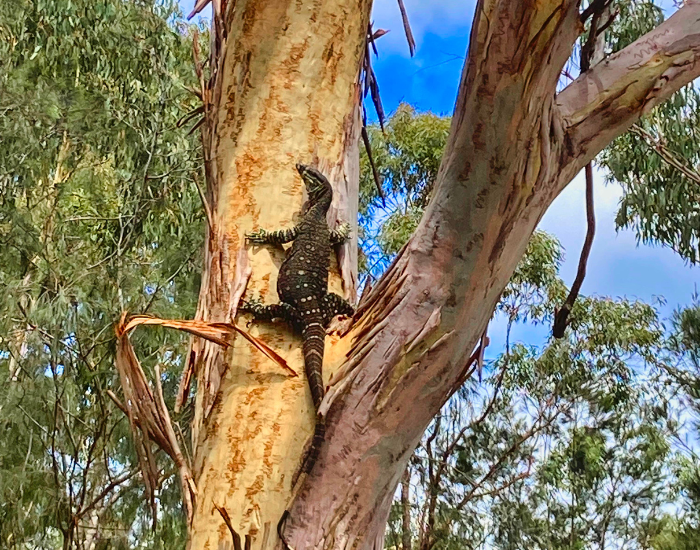
The first monitor lizard I saw properly was in Noosa, Queensland, from the deck of a cottage Airbnb: a large lace monitor (Varanus varius) flat against a tree trunk, forked tongue working the air. I saw several more that week. On South Stradbroke Island I watched them wander a conservation area beside a beachside restaurant, unbothered by people eating three metres away. Later travels added water monitors along the rivers of Bukit Lawang in Sumatra, and Komodo dragons on their own islands in Indonesia.
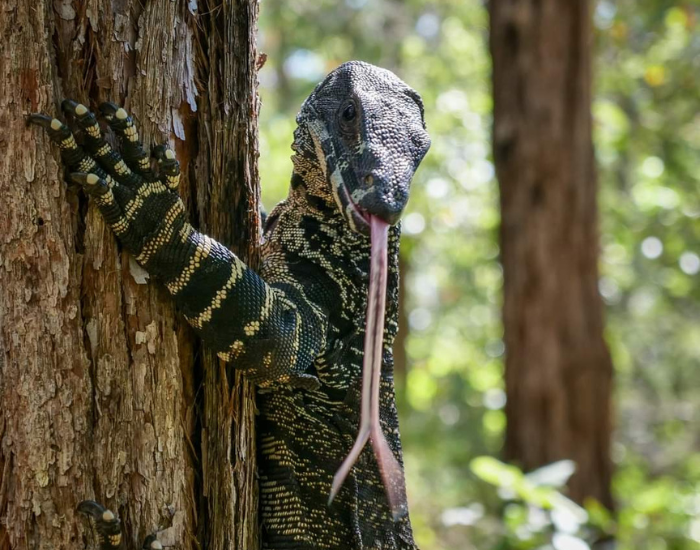
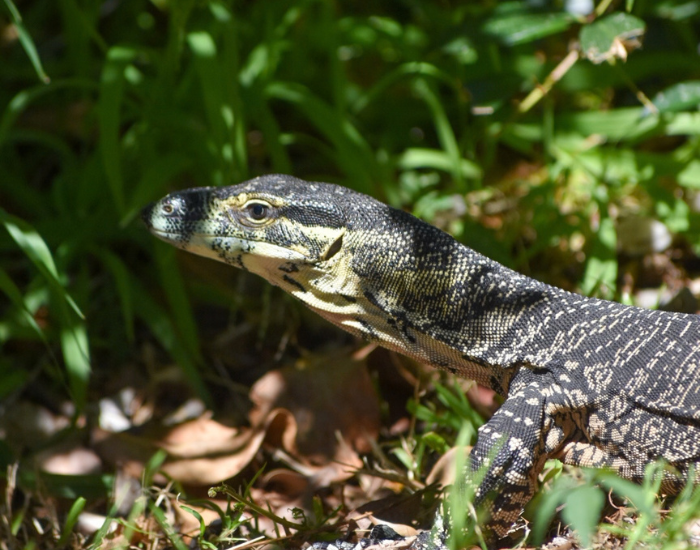
The most recent one found me. On my lap around Australia our first site at Illaroo campground, number 5, sat next to the camp managers. Lovely people, though you always feel slightly watched. The real bonus was the bush patch behind us, and a lace monitor walked straight out of it into our camp.
Hours later a bigger one came in from the front, looking for all the world like a juvenile Komodo dragon, crossing over from another site. It stopped right beside a woman holding her baby and she got a real fright. The goanna carried on without altering its pace.
The lace monitor is Australia’s second-largest goanna after the perentie and can approach two metres. Guarino found its diet broad and opportunistic, dominated by carrion and supplemented with nestling birds, rabbits and eggs in spring and early summer, which fits a September visitor exactly.
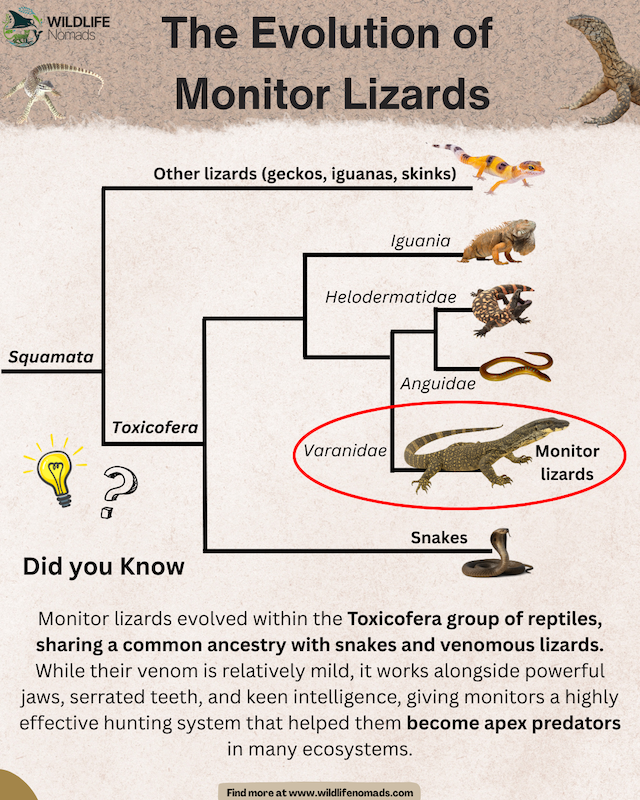
1. Monitors Belong to an Ancient Reptile Lineage
Monitor lizards (family Varanidae, genus Varanus) sit inside the Toxicofera lineage alongside snakes and Gila monsters, a branch that went down the road of active predation while iguanas and their relatives went herbivorous. The genus name comes from an Arabic word meaning lizard beast, and Varanus is the only surviving genus in the family.
They were already widespread by the Miocene epoch. Their extinct relative Varanus priscus, usually called Megalania, is the largest lizard known to have walked the Earth: older estimates put it near 7 metres, though current work favours something closer to 5. It vanished in the late Pleistocene. What remains is one of the clearest cases of adaptive radiation among reptiles, from arboreal species barely longer than your hand to the Komodo dragon.
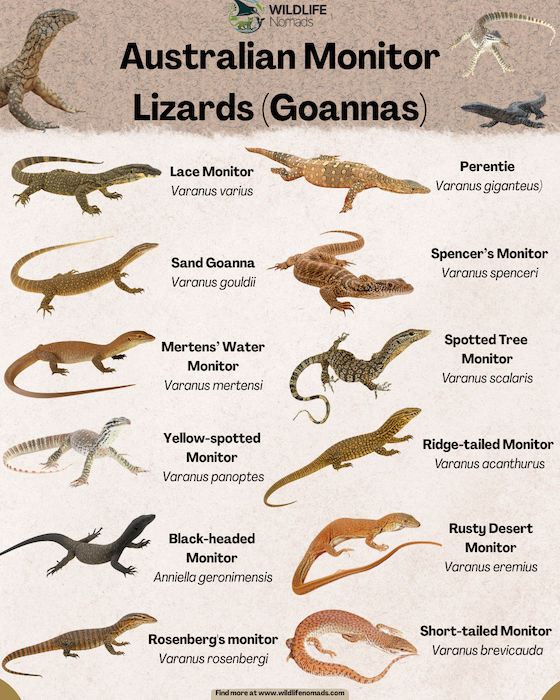
2. Goannas: Australia’s Monitor Lizards
In Australia, monitor lizards are goannas. They are monitors: lizards of the genus Varanus, and roughly 30 of the world’s 80 or so species live here, across nearly every habitat type. That is why varanid lizards are the reptile group most Australians can actually name.
The rusty desert monitor works the arid deserts of central Australia where ground temperatures pass 40°C. The sand goanna (Varanus gouldii), also called the sand monitor, is among the most widespread species, digging burrows to escape the heat. The heath monitor holds to heathlands and coastal forests down the eastern seaboard, and Rosenberg’s goanna (Varanus rosenbergi) covers similar country into South Australia.
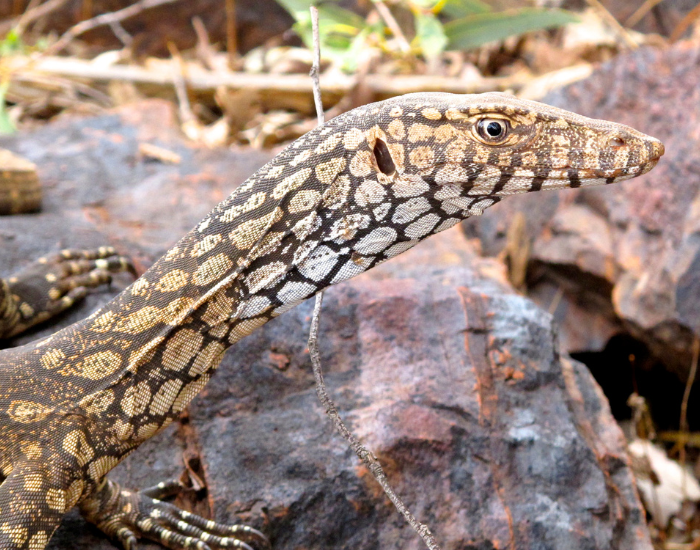
The yellow spotted monitor takes semi-arid zones and woodlands, the spotted tree monitor is an arboreal species in northern rainforests that rarely comes down, and Mertens water monitor (Varanus mertensi) hunts fish and crustaceans as a semi aquatic predator. The ridge tailed monitor (Varanus acanthurus) prefers rocky outcrops in the north, and the lace monitor climbs eucalypts through the forests of New South Wales.
3. Masters of Diverse Habitats
Monitors occupy diverse habitats across Africa, Asia and Australia, sea level to mountain, rainforest to arid deserts. Most species concentrate in Australia and Southeast Asia, with several species in Africa including the Nile monitor.
Lace monitors climb tall eucalypts through New South Wales and southern Australia, raiding nests in the canopy. Water monitors bask on logs and dive to hunt. Some species have moved onto urban fringes, and even those you would not expect to tolerate people have managed it, which puts them among the more reliable animals of Australia to actually encounter.
4. Monitors Use Forked Tongues to Hunt
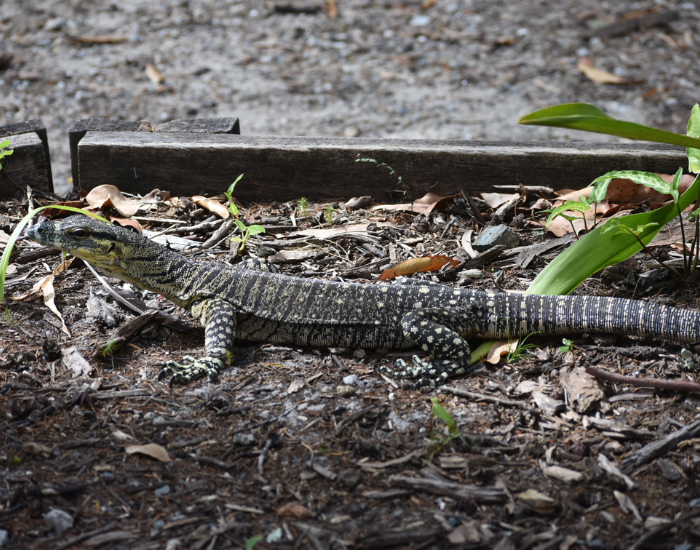
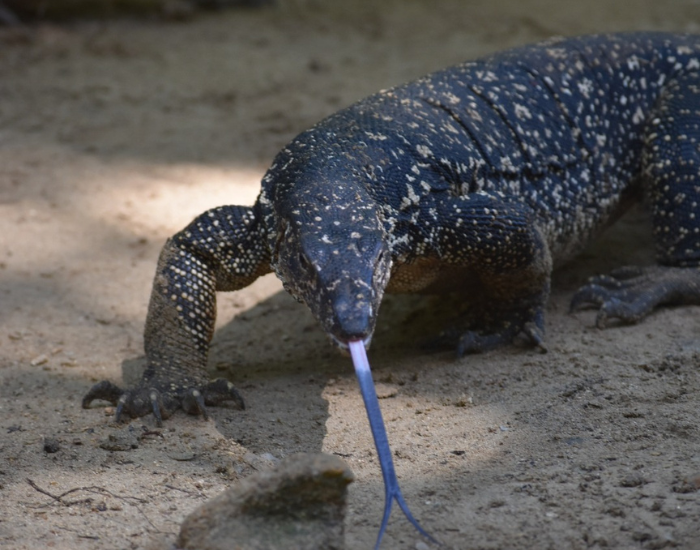
Like snakes, monitors have a deeply forked tongue that works as a chemical sampling device. They flick it to collect particles from air and ground, then press them to the Jacobson’s organ in the roof of the mouth. The fork gives directional information, which is effectively stereo smell.
At Illaroo you could watch the whole process. The second goanna crossed our site tongue-flicking every second step, reading the ground where people had been cooking, then moved on without breaking stride once it had what it needed. That system is how monitors track small mammals, smaller reptiles, birds and insects in country where there is nothing to see. Water monitors use the same equipment underwater.
5. Equipped With Sharp Tools for Survival
Monitors have well developed limbs and sharp claws that support running, climbing and digging. Arboreal species grip bark with them, desert species excavate with them. Their mouths carry sharp teeth built for gripping and tearing.
Research led by Fry established that varanids produce venom rather than relying on bacterial infection, as was long assumed, though this mild venom poses little threat to humans. Their tails do several jobs at once: a whip in defence, a counterweight when the animal rises on its hind legs, and, in the laterally compressed tails of semi aquatic species, a paddle. A slender tail on a tree-climbing species is doing something different from the heavy tail of a sand goanna. Unlike snakes, and unlike many other lizards, monitors have movable eyelids and cannot shed their tails, useful in dust and a problem in a fight. Together these traits produce predators that can take larger prey when it presents itself while living mostly on insects and smaller reptiles.
6. A Wide Array of Diets Across Species
Monitors are opportunistic carnivores and highly active hunters, and the wide array of diets across the genus tracks body size and environment. Smaller species and juveniles live largely on insects: termites, beetles, grasshoppers. Many species take smaller reptiles, snakes and amphibians. Arboreal monitors raid nests for eggs and nestlings. Larger species manage mammals from rodents to small marsupials, and Gray’s monitor in the Philippines went the other way entirely and eats mostly fruit.
They are also serious scavengers, which is the part people miss. Carrion dominated the lace monitor diet in Guarino’s study, and monitors do real work clearing dead animals out of a landscape. Some raid termite mounds with their claws. I watched the endemic Palawan monitor take this to its logical end on Black Island in the Philippines: it had positioned itself beside a local fisherman cleaning his catch and was eating fish scraps straight off the sand, close enough to touch, entirely calm about it. Opportunistic is not a euphemism with these animals.

7. They Stand on Hind Legs Like Ancient Dinosaurs
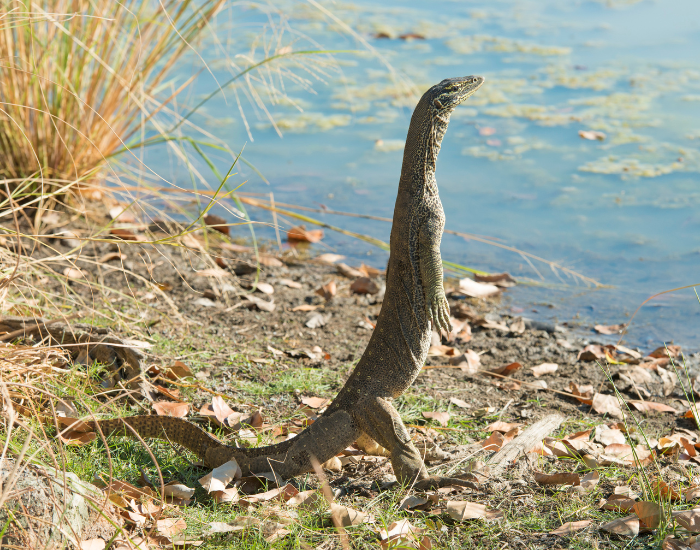
Monitors rise onto their hind legs, tail braced behind them, to see over cover. It gives an elevated view for spotting prey, predators or rivals, and it is the single most dinosaur-like thing a living lizard does.
The sand goanna and argus monitor rear up readily when curious or disturbed, and across open arid deserts and rocky outcrops that extra height is worth a lot. Males adopt the same posture during the breeding season when wrestling rivals, standing chest to chest like something out of a nature documentary. Some Aboriginal peoples read the stance as the animal monitoring its surroundings. The name more likely traces to the Latin monere, to warn, and to Linnaeus, who in 1758 described the Nile monitor as Lacerta monitor before replacing the name eight years later.
8. From Tiny to Giant: Remarkable Size Diversity
Few genera cover this much ground physically. The short tailed monitor long held the record as the smallest species at about 20 cm in total length, but Doughty and colleagues described the Dampier Peninsula monitor (Varanus sparnus) in 2014 and took the title: 23 cm total length and just 16 grams. It fits in a cupped hand.
At the other end, the perentie (Varanus giganteus) is Australia’s largest at up to 2.5 metres, with the lace monitor second at about 2.1. The Komodo dragon (Varanus komodoensis) is the largest living lizard anywhere, past 3 metres and over 70 kg in exceptional animals. Most species sit between 40 cm and 1.5 metres, which is the practical size for hunting varied prey. Smaller species live on insects and smaller reptiles; larger species take larger prey that would be impossible for the rest.
9. Breeding, Incubation, and Sexual Maturity
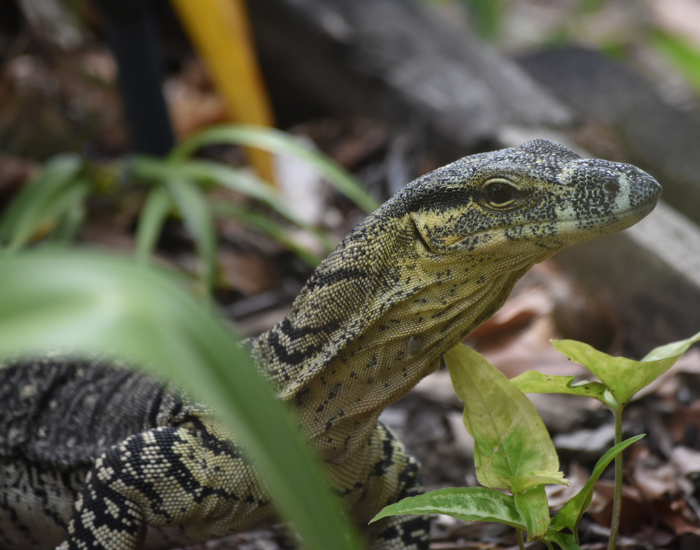
Varanids are oviparous. The breeding season falls in spring and summer for most species, with males wrestling upright for dominance, and clutch size scales directly with the female’s body length: 2 to 8 eggs in smaller species, up to 20 or more in the largest.
Females of several species, including the lace monitor and Rosenberg’s goanna, lay inside active termite mounds. The termites seal the breach and the mound becomes a temperature-stable incubator that predators cannot easily open. Incubation time runs anywhere from 90 to 265 days depending on species and conditions, and female lace monitors are known to return and help their young dig out, which is rare behaviour in reptiles. Sexual maturity arrives between 2 and 5 years, later in the larger species. In the wild most monitors breed once a year.
10. Role in Aboriginal Culture and Human History
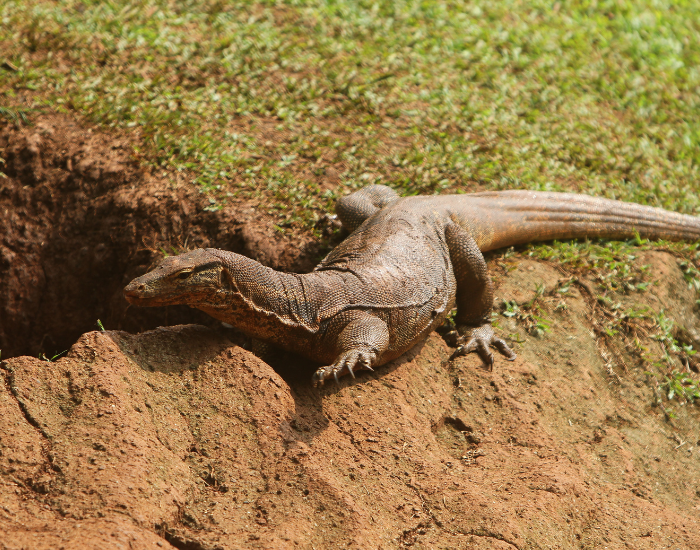
Goannas appear throughout Dreamtime stories and in rock art across Australia going back thousands of years, and their cultural significance runs well past their value as food. Historically they provided meat, fat for cooking and ceremony, and skins, with different species hunted seasonally when they were fattest.
The traditional ecological knowledge built up around them covers behaviour, habitat and breeding season timing in detail Western science took a long time to match. Many communities still hunt goannas sustainably using traditional methods. Humans and monitors have shared this continent for tens of thousands of years, and for most of that time the arrangement worked.
11. Conservation Challenges Facing Monitor Species
Many populations are stable; plenty are not. Globally, most monitor lizard species are in decline. Habitat destruction from urban development, agriculture and mining removes breeding sites and hunting ground, and in developing nations industrial pollution adds to it.
In Australia all varanids are protected species under state, federal and international law, and there is no permitted commercial hunting. Internationally, all but five species sit on CITES Appendix II, which regulates trade; the remaining five are on Appendix I, which bans commercial trade outright.
The illegal pet trade still targets smaller species like the black headed monitor and ridge tailed monitor, and climate change is an emerging problem for animals whose eggs incubate at the mercy of soil temperature. Human conflict is the everyday version: monitors raid chicken coops and bins and get killed for it. The Komodo dragon has roughly 3,500 animals left and was reclassified as Endangered by the IUCN in 2021, up from Vulnerable, which is worth knowing alongside the rest of the most threatened animals in Australia and the region.
12. Monitors and Humans: Living Together Safely
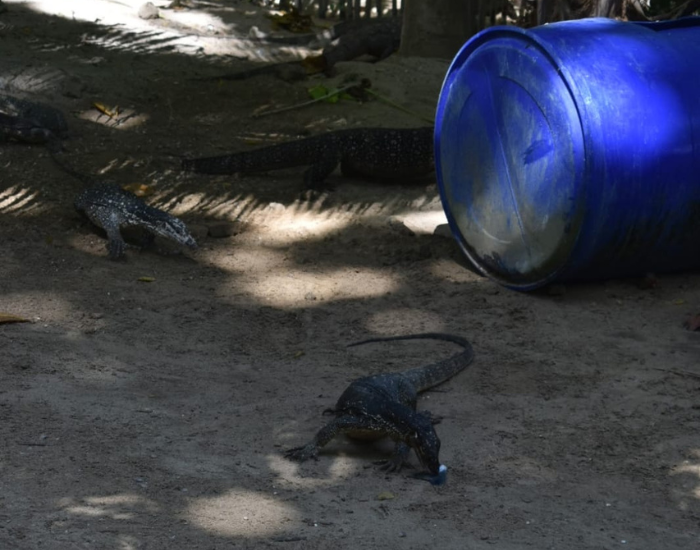
Most species are shy and will leave if you let them. Stay calm, give them room, and never corner, catch or harass one. Do not feed them, which is the rule people break most often at campsites and the one that creates problems later.
If a goanna runs at you in Australia, it is not attacking. It is looking for something vertical to climb and you are the nearest tree. Step aside. That woman at Illaroo had a genuine fright and the animal never so much as glanced at her. Are they dangerous? They carry mild venom, strong claws and sharp teeth, and a bite or scratch needs cleaning and a doctor because of infection risk, but fatalities are essentially unheard of. The Komodo dragon is the real exception, where size and stronger venom make it genuinely dangerous, though attacks remain rare. If you keep reptiles, the same respect applies at home, as anyone working through the types of pet reptiles will tell you.
Recent Discoveries & Research
A 2025 study led by Ebel micro-CT scanned nearly 2,000 specimens and found osteoderms, small bony plates embedded in the skin, in 29 Australo-Papuan monitor species where none had been recorded. That is a fivefold increase in known cases, and it suggests roughly half of all lizard species carry them. The plates may serve protection, thermoregulation and calcium storage during reproduction, and they may be part of why goannas radiated across Australia so successfully.
Separately, Doody and colleagues showed that Varanus panoptes and Varanus gouldii function as ecosystem engineers through communal nesting burrows that spiral several metres underground. Those burrows shift soil structure, move nutrients and create microhabitat that other species use. Monitors are not only predators and apex-adjacent scavengers; they rebuild the ground they live on.
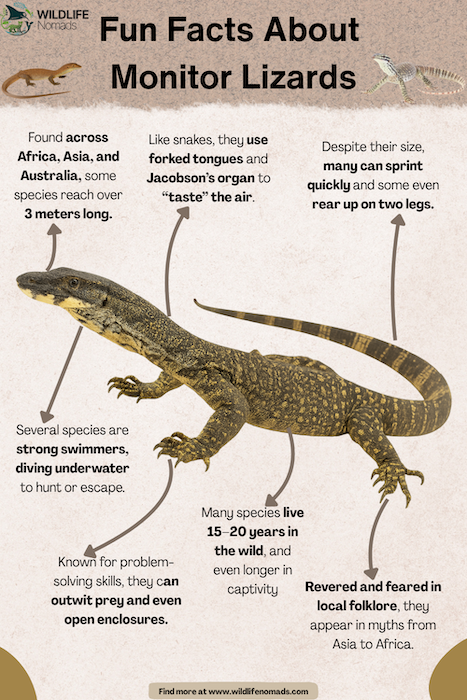
FAQs About Monitor Lizards You May Have
Yes. Around 30 species live here, known locally as goannas, spread across the continent from arid deserts to coastal heathlands.
The perentie (Varanus giganteus), reaching about 2.5 metres. The lace monitor is second at roughly 2.1 metres.
Yes. Varanus komodoensis is the largest living monitor lizard, and it sits in the same genus as every Australian goanna.
None. Goanna is the Australian common name for monitor lizards.
They produce mild venom, not deadly to people. Clean any bite thoroughly and see a doctor, since infection is the real risk.
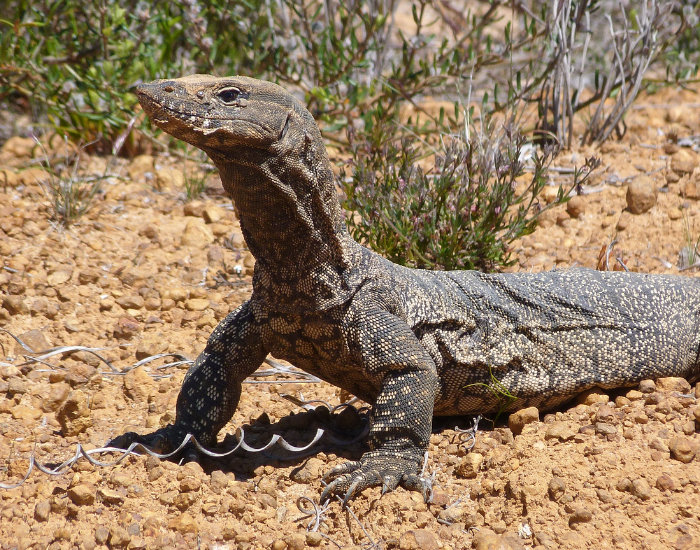
Guardians of the Wild
These varanid lizards run from a 16-gram animal in the Kimberley to a 70-kilogram predator in Indonesia, all inside one genus, with an evolutionary history reaching back past the Miocene epoch. That range is unusual enough that biologists treat it as a puzzle in its own right.
Resilience is not a guarantee, though. Habitat loss, climate change, the pet trade and everyday conflict keep pressure on species that mostly cannot absorb it. Every time I see a goanna, whether basking on rocky outcrops or walking into a campsite in northern New South Wales like it owns the lease, I get the same feeling I had on that deck in Noosa. They have been doing this a very long time. The least we can do is step aside and let them pass.
Monitor Lizard & Goanna Science Quiz
Ten fun True/False and Multiple Choice questions testing your knowledge of Varanid evolution, venom discoveries, termite mound nesting, and species size extremes!
Multiple Choice
References:
Doody, J. S., Soennichsen, K. F., James, H., McHenry, C., & Clulow, S. (2021). Ecosystem engineering by deep-nesting monitor lizards. Ecology, 102(4), e03271. https://doi.org/10.1002/ecy.3271
Ebel, R., Broeckhoven, C., Stanley, E. L., Ramm, T., & Keogh, J. S. (2025). Dermal armour in lizards: Osteoderms more common than presumed. Zoological Journal of the Linnean Society, 204(3), zlaf070. https://doi.org/10.1093/zoolinnean/zlaf070
Fry, B. G., Vidal, N., Norman, J. A., Vonk, F. J., Scheib, H., Ramjan, S. F. R., Kuruppu, S., Fung, K., Hedges, S. B., Richardson, M. K., Hodgson, W. C., Ignjatovic, V., Summerhayes, R., & Kochva, E. (2006). Early evolution of the venom system in lizards and snakes. Nature, 439(7076), 584–588. https://doi.org/10.1038/nature04328
Guarino, F. (2001). Diet of a large carnivorous lizard, Varanus varius. Wildlife Research, 28(6), 627–630. https://doi.org/10.1071/WR01001
Lei, J., & Booth, D. T. (2018). Intraspecific variation in space use of a coastal population of lace monitors (Varanus varius). Australian Journal of Zoology, 65(6), 398–407. https://doi.org/10.1071/ZO17078