

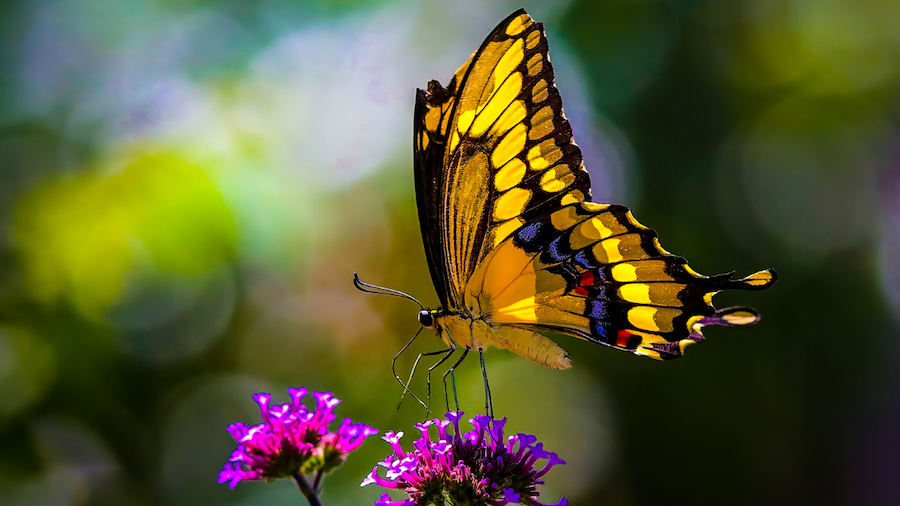
I was working from a camp chair at Woody Head campground, in northern New South Wales. A kangaroo had already grazed past my table that morning. A brush turkey had made a serious attempt on my unattended bin. The blue-faced honeyeater came back for the third day running, hunting the milk left in my breakfast bowl.
Then a yellow butterfly landed on the arm of my chair and simply stayed.
It stayed long enough for me to stop typing and actually look. I have chased insects through Mexican cloud forest and Southeast Asian rice terraces. Even so, I could not name this one. That bothered me, in the good way.
This guide is the answer I went looking for. You get 15 species from North America, Europe and Australia, plus the field marks that separate them. You also get the clouded yellow migration story and the life cycle most people never see. Small creatures deserve the same attention we hand the big ones.
What Makes a Yellow Butterfly Yellow?
Most yellow butterflies belong to the family Pieridae, the whites and sulphurs. Their colour comes from pterin pigments, metabolic waste recycled into wing scales. Blue butterflies cheat with structural colour. Yellows use actual chemistry.
That chemistry does more than look pretty. In Colias eurytheme, pterins sit beneath the wing surface and amplify an iridescent ultraviolet signal. Males flash it at females. We see a plain golden yellow butterfly. She sees a billboard.
A 2024 phylogeny of over 600 pierid species tied their diversification closely to global temperature. Warm periods produced more species. That history matters now, as temperatures rise under climate change. Work on Colias shows the catch: year-to-year climate variability can slow adaptation rather than speed it.
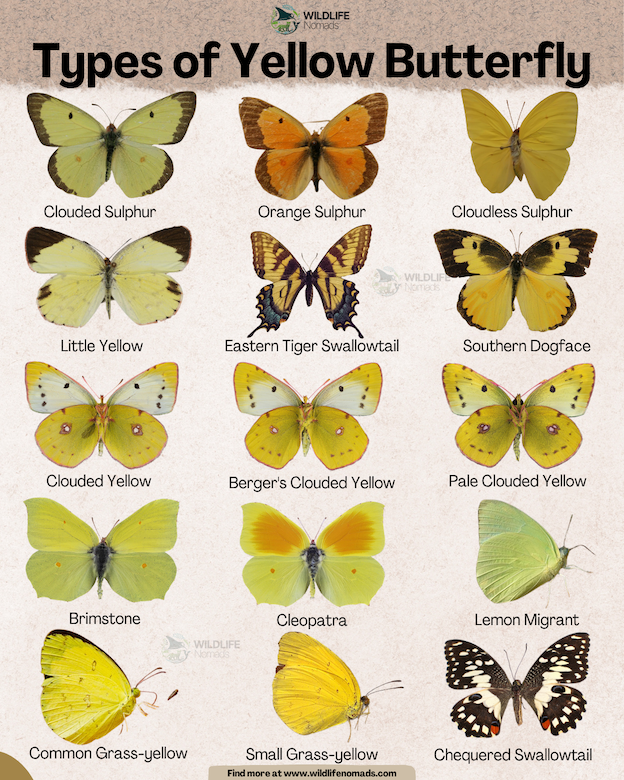
15 Types of Yellow Butterfly, From Prairie to Rainforest
1. Clouded Sulphur (Colias philodice)
If you live in the United States and picture a yellow butterfly, this is probably it. The clouded sulphur ranges from Alaska to Mexico, skipping only the deep southwest. Males are lemon yellow with clean black borders. Females come in yellow or a pale, greenish-white form.
Caterpillars feed on clovers, alfalfa and other leguminous plants. That preference turns farmland into an accidental nursery.
2. Orange Sulphur (Colias eurytheme)
Also called the alfalfa butterfly, and yes, it hybridises with the clouded sulphur. Expect orange flushing across a yellow ground, framed by broad black borders. Females again show a pale form.
Medicago sativa — lucerne, or alfalfa — is its favourite larval host plant. That crop is commonly cultivated across North America, so the species boomed alongside agriculture. The catch is brutal. Every alfalfa harvest kills larvae in enormous numbers.
3. Cloudless Sulphur (Phoebis sennae)
A big, unbroken sheet of yellow green, and a joy to watch in flight. Males are clear lemon with no dark edges at all. Females carry faint black markings and a scatter of dots.
The species pushes north through summer, then streams south each autumn along the Gulf coast. Caterpillars eat Senna and Cassia. With wings closed, that yellowy green underside erases the butterfly against foliage. I lost the same individual three times in a Texas garden.
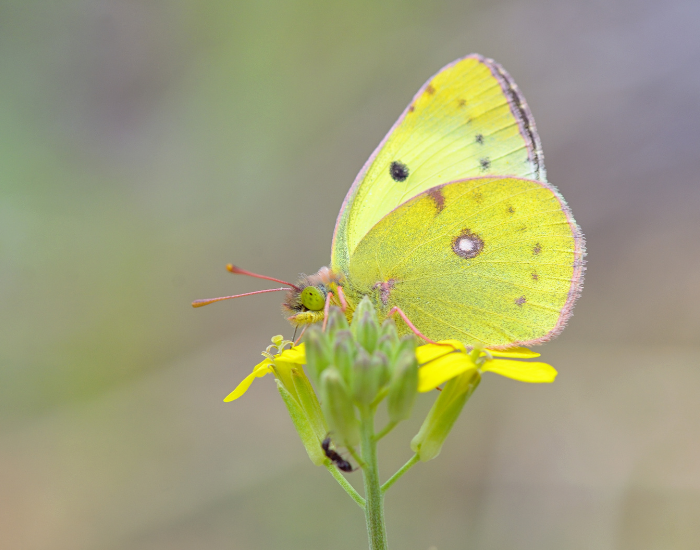
4. Little Yellow (Pyrisitia lisa)
Small, fast and low, this one bounces along road verges like a scrap of paper. The wingspan rarely passes 40 mm. Males are bright yellow with a black border, while females run paler.
Partridge pea is the main larval foodplant. The little yellow cannot survive winter in the north. It recolonises each year from southern populations, a reset you will meet repeatedly here. In warm years it reaches New England before frost ends the run.
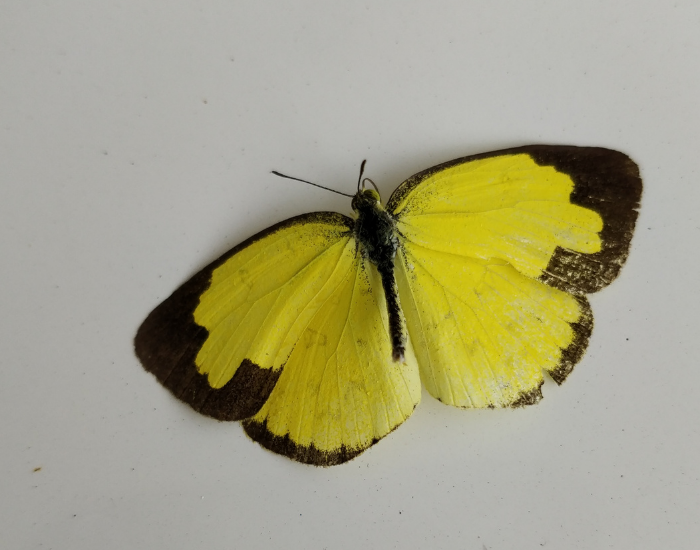
5. Southern Dogface (Zerene cesonia)
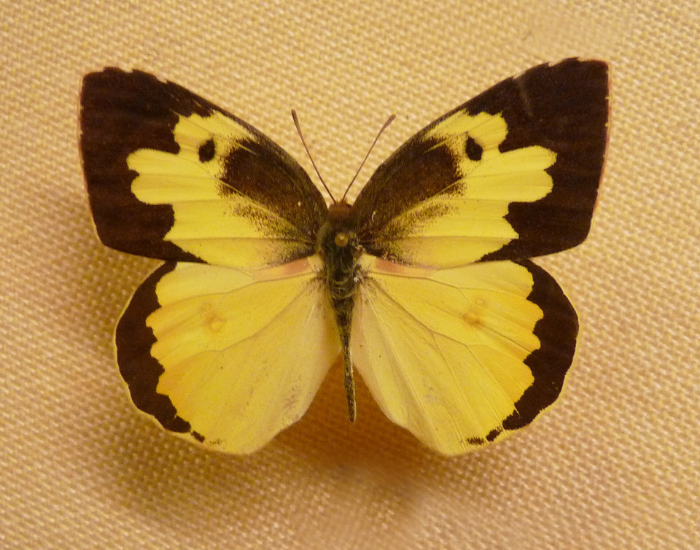
Look at the forewing and you will see it, a poodle’s head in profile, drawn in black markings around a yellow eye spot. Once you see the dog, you cannot unsee it. It is the easiest identification on this list.
This species prefers open habitats: prairie, desert scrub and dry hillsides from Argentina northward. Caterpillars feed on false indigo and other legumes. It flies fast and lands rarely, so a decent photograph takes real patience.
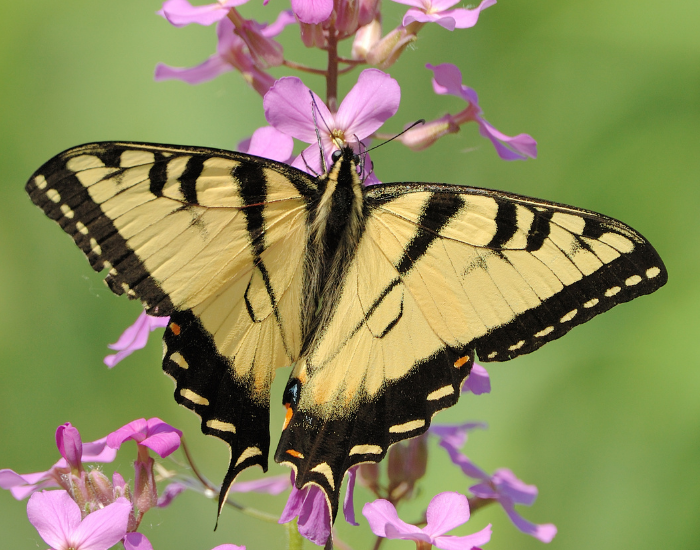
6. Eastern Tiger Swallowtail (Papilio glaucus)
Not a pierid at all, but the largest yellow butterfly most Americans will ever see. The wingspan reaches 140 mm, with four black tiger stripes cutting each forewing.
Females come in two forms. One is yellow, like the male. The other is nearly black, mimicking the toxic pipevine swallowtail. One species, two survival strategies. Caterpillars feed on tulip tree and wild cherry, and young larvae impersonate bird droppings.
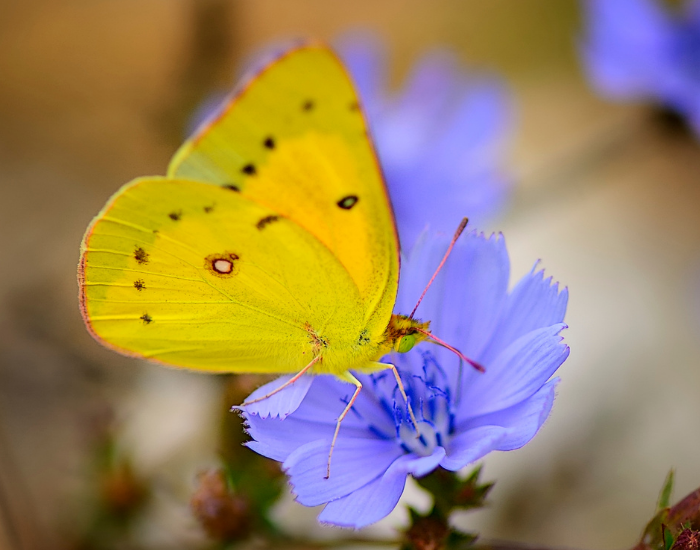
7. Clouded Yellow (Colias croceus)
Here is the star. Colias croceus is one of the truly migratory European butterflies and a regular visitor to Britain and Ireland. It breeds year-round in southern Europe and North Africa, then pushes north as temperatures rise.
Adults are deep golden yellow above, edged with broad black borders. Close the wings and a yellowy green underside appears. It carries two silver white spots fused into a figure of eight. Roughly one female in twenty emerges in the pale form helice, which fools almost everyone.
This medium sized migrant cannot survive winter in the UK. Every British clouded yellow butterfly is therefore an immigrant, or the child of one.
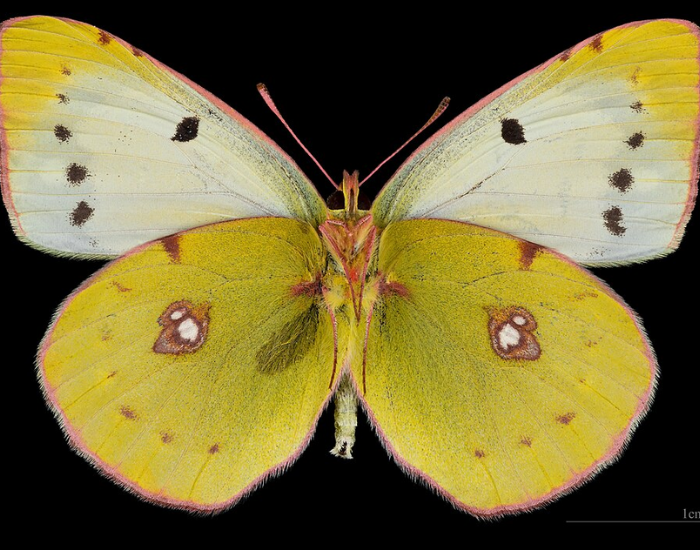
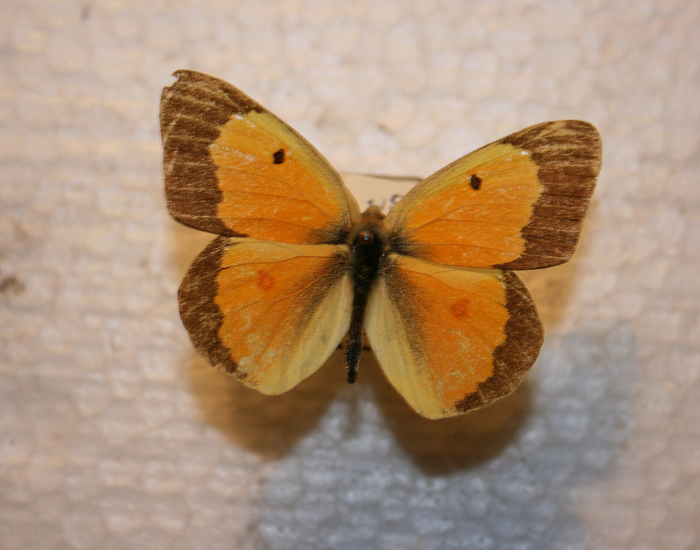
8. Pale Clouded Yellow (Colias hyale)
A scarcer migrant that reaches southern England only occasionally. The ground colour is pale, close to lemon cream in males, with dark edges and a small orange hindwing spot. Females run greener still.
Its larval foodplants are lucerne and clovers, so it favours the same modern farmed countryside as its golden cousin. British recorders have real difficulty locating breeding habitat, because sightings stay scattered and brief. Treat any confident British record with caution.
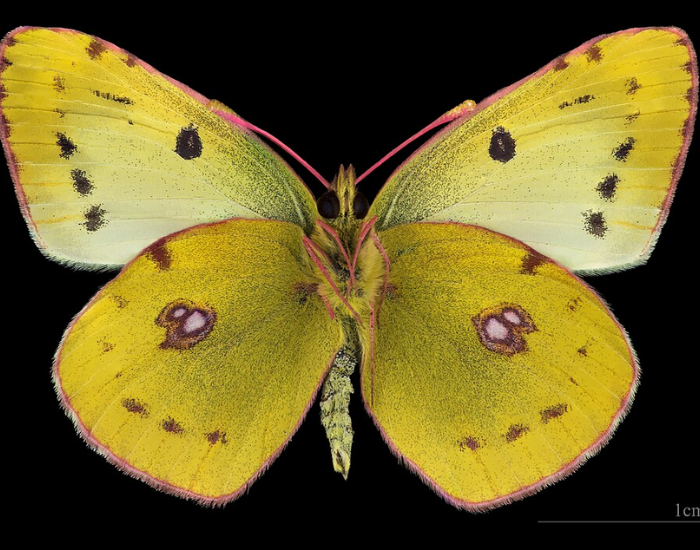
9. Berger’s Clouded Yellow (Colias alfacariensis)
Berger’s clouded yellow is the identification problem that refuses to go away. Adults are effectively inseparable from the pale clouded yellow in the field.
The caterpillars settle it instantly. Berger’s larvae carry four bright yellow lines studded with black dots. Pale clouded yellow larvae show only two thin lines. Berger’s also uses horseshoe vetch and crown vetch, tying its breeding habitat to chalk grassland. Find the foodplant, then find the larva.
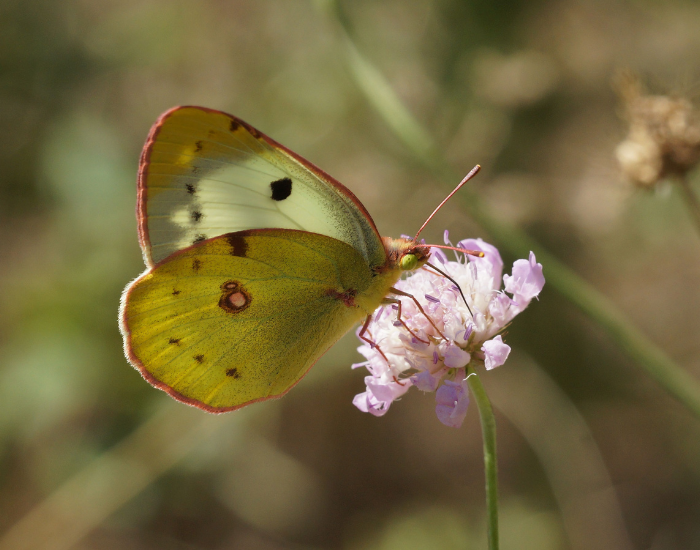
10. Brimstone (Gonepteryx rhamni)
Many British naturalists credit the brimstone with the word butterfly itself: butter-coloured fly. Males glow sulphur yellow. Females are pale greenish white and get dismissed as cabbage whites.
Unlike the clouded yellows, brimstones do survive winter as adults. They hibernate in ivy and holly, then fly on the first warm days of spring. The wing shape mimics a leaf, veins included. Caterpillars eat buckthorn, so the range maps onto its two host shrubs.
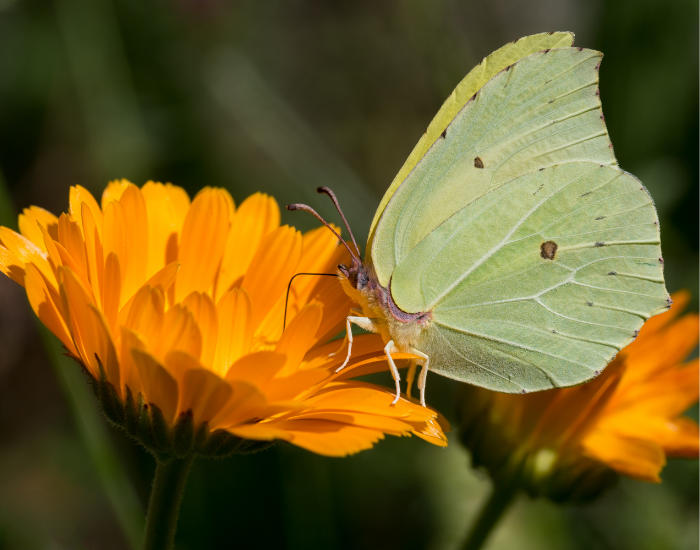
11. Cleopatra (Gonepteryx cleopatra)
The Mediterranean answer to the brimstone, and showier. Males carry a burning orange patch across the forewing, set into lemon yellow.
You will find it through southern Europe and North Africa. It turns up frequently in scrub, open woodland and gardens from spring into October. Females resemble brimstones and cause endless confusion.
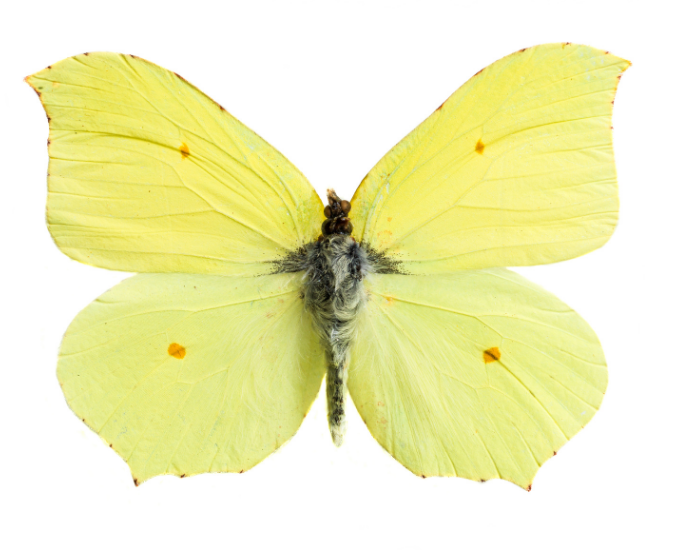
12. Lemon Migrant (Catopsilia pomona)
The lemon migrant spans about 70 mm and shifts between lemon yellow and creamy white. Some individuals add silvered spots and dark wing margins.
It behaves exactly as the name promises. Individuals stream in one direction, two or three metres above the ground, sometimes for days. Caterpillars feed on Cassia and Senna, including golden rain trees planted in suburban gardens. That explains why it turns up at campsites and backyards.
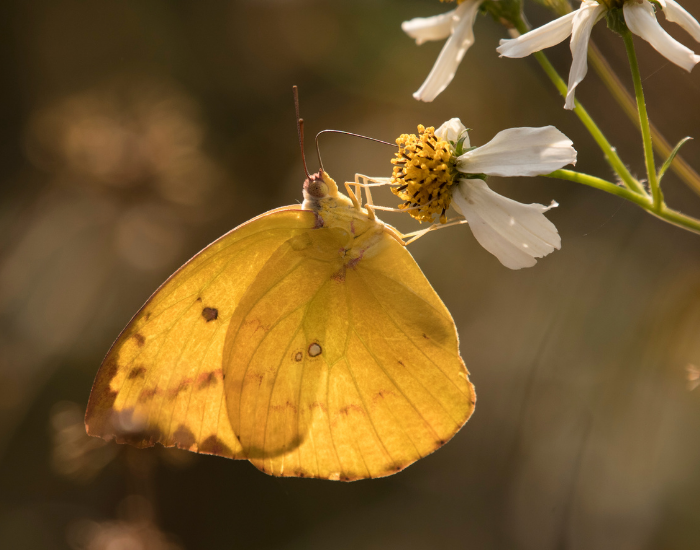
13. Common Grass-yellow (Eurema hecabe)
The default small yellow butterfly across northern and eastern Australia. The wingspan sits near 40 mm, with irregular black borders above.
Its underside carries fine reddish-brown speckling and small dark dots. Caterpillars use Senna, Albizia and related legumes. Wet-season and dry-season adults differ enough in border width to look like separate species. This was my main alternative identification at Woody Head.
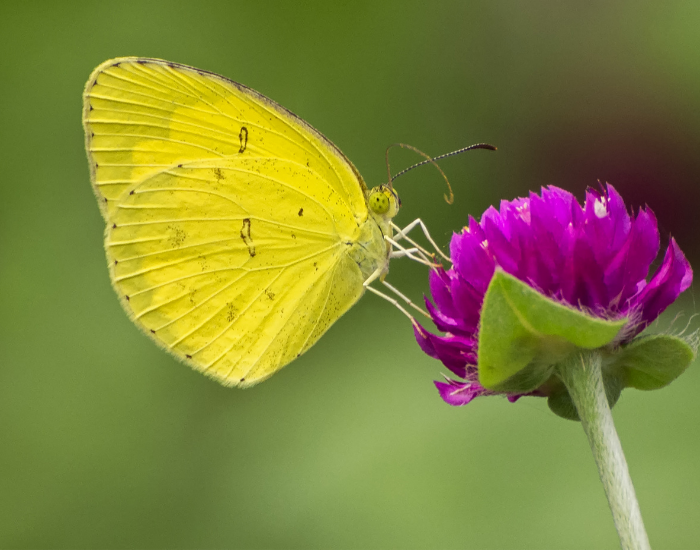
14. Small Grass-yellow (Eurema smilax)
This is almost certainly my Woody Head visitor. Australia’s great opportunist. The small grass-yellow occupies the arid interior and erupts after rain, appearing far outside its usual range.
Caterpillars feed on native Senna shrubs, which flush green fast once the desert wets. Adults are bright yellow with narrow black borders, cleaner-looking than the common grass-yellow. These irruptions are brief and unpredictable.
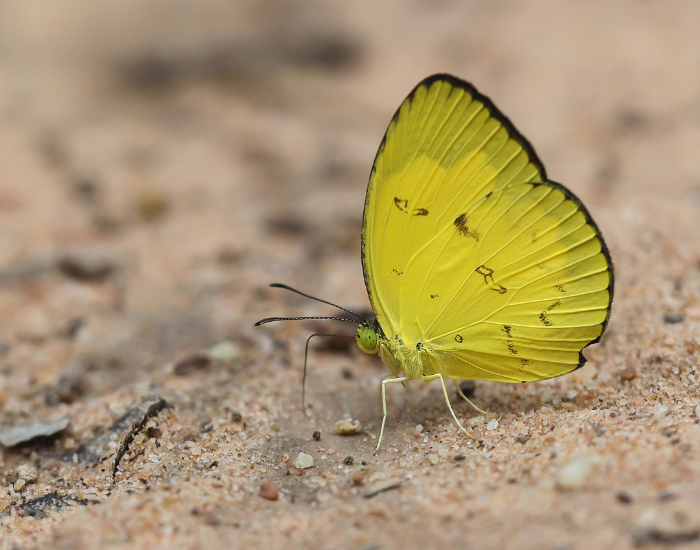
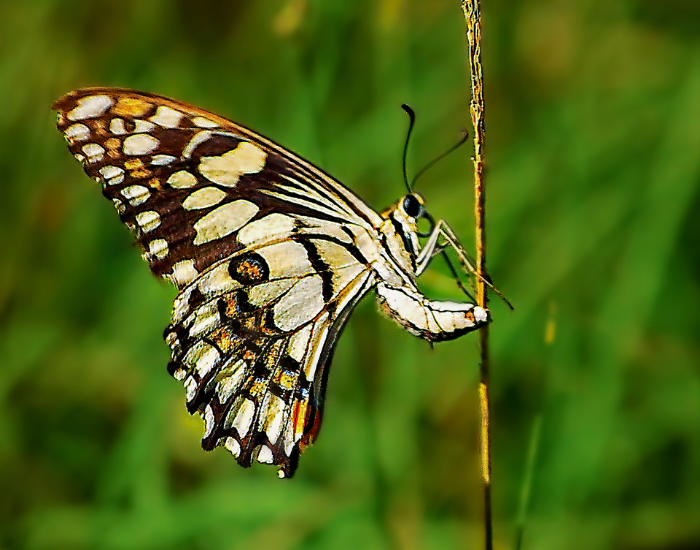
15. Chequered Swallowtail (Papilio demoleus)
A cream and yellow swallowtail chequered with black, and the largest on this Australian list. Despite the family name, it carries no tails.
It ranges across most of mainland Australia and into Asia, where growers treat it as a citrus pest. Caterpillars feed on native Cullen species and cultivated citrus. Adults are restless nectar feeders that rarely settle. I watched one work a lantana thicket for ten minutes, wings never still.
What a Yellow Butterfly Means, Depending on Who You Ask
It is common to spot a creature and wonder what is the meaning of it. Human’s brain are meaning making machines. And if you search online and you will be told that yellow butterflies universally symbolise joy, hope and new beginnings. The reality is more interesting than the slogan.
Ancient Greek gave us psyche, a word meaning both soul and butterfly. Psyche herself appears in art with butterfly wings. Christian tradition reads emergence from the pupa as resurrection. Celtic folklore treats yellow butterflies as the souls of departed loved ones. Several Native American traditions frame them as messengers of guidance. Mesoamerican cultures saw them as divine messengers, something I read about properly in a Mexican oyamel forest.
Chinese tradition links them instead to love and marital harmony. Many cultures agree, independently, that harming a butterfly brings bad luck.
The real through-line is transformation, not joy. That distinction matters, because sweeping claims about universal symbolism flatten the cultures they borrow from.
So as you can see, meaning depends on tradition and culture, the main meaning is that there is probably none, it is whatever meaning you want to create. Thats the power of our mind.
Yellow Butterfly FAQ
The clouded sulphur (Colias philodice) is the most widespread yellow butterfly in the United States. It occurs across nearly the whole country and breeds on clovers and other leguminous plants. The orange sulphur and cloudless sulphur run a close second. In the southeast, the cloudless sulphur is often more visible.
Clouded yellow butterflies are migratory pierids in the genus Colias, most famously Colias croceus. They breed in southern Europe and North Africa, then migrate north each year. Adults are golden yellow with dark edges and a yellowy green underside. They cannot survive winter in Britain, so every UK population restarts from immigrants.
Caterpillars feed on wild and cultivated clovers (Trifolium species) and lucerne (Medicago sativa). Common bird’s-foot-trefoil is a less frequent foodplant. Because clover is commonly cultivated for fodder, the species breeds well in modern farmed countryside. Larvae are green with a pale side stripe.
Go Sit Still and Watch One
That yellow butterfly stayed on my chair for eleven minutes. I know, because I stopped working and timed it. Proper looking turned a background insect into a species with a migration route and a life cycle. You do not need a rainforest for that. A clover verge or a roadside patch of Senna will do.
I catalogued every species from that trip in my guide to Woody Head campground. That list includes the Eastern Yellow Robin hunting insects beside my tent. My guide to the types of blue butterfly covers the structural-colour side. To bring more of them to you, start with the pollinators already visiting your garden.
Log what you see, too. Platforms like Butterflies Australia turn casual sightings into real distribution data.
Which yellow butterfly landed near you? Tell me in the comments — species, place, and what it was doing.
Can You Name That Yellow Butterfly? 🦋
A 15-photo identification challenge — the wrong answers are deliberately tricky look-alikes from a similar group. Go back and change any answer before you score.
Which yellow butterfly is this?
References:
Carvalho, A. P. S., Owens, H. L., St Laurent, R. A., Earl, C., Dexter, K. M., Messcher, R. L., Willmott, K. R., Aduse-Poku, K., Collins, S. C., Homziak, N. T., & Kawahara, A. Y. (2024). Comprehensive phylogeny of Pieridae butterflies reveals strong correlation between diversification and temperature. iScience, 27(4), 109336. https://doi.org/10.1016/j.isci.2024.109336
Edwards, C. B., Zipkin, E. F., Henry, E. H., Haddad, N. M., Forister, M. L., Burls, K. J., Campbell, S. P., Crone, E. E., Diffendorfer, J., Douglas, M. R., Drum, R. G., Swengel, A. B., Taron, D., Wepprich, T., & Grames, E. M. (2025). Rapid butterfly declines across the United States during the 21st century. Science, 387(6738). https://doi.org/10.1126/science.adp4671
Chowdhury, S., Fuller, R. A., Dingle, H., Chapman, J. W., & Zalucki, M. P. (2021). Migration in butterflies: A global overview. Biological Reviews, 96(4), 1462–1483. https://doi.org/10.1111/brv.12714
Geyle, H. M., Braby, M. F., Andren, M., Beaver, E. P., Bell, P., Byrne, C., Castles, M., Douglas, F., Glatz, R. V., Haywood, B., Hendry, P., Kitching, R. L., Lambkin, T. A., Meyer, C. E., Moore, M. D., Moss, J. T., Nally, S., New, T. R., Palmer, C. M., … Garnett, S. T. (2021). Butterflies on the brink: Identifying the Australian butterflies (Lepidoptera) most at risk of extinction. Austral Entomology, 60(1), 98–110. https://doi.org/10.1111/aen.12525
Sanderson, C., Braby, M. F., & Bourne, S. (2021). Butterflies Australia: A national citizen science database for monitoring changes in the distribution and abundance of Australian butterflies. Austral Entomology, 60(1), 111–127. https://doi.org/10.1111/aen.12513






_Colias_croceus_f._helice_-_Wyzyna,_Okolice_Polska_-_female_ventral.jpg)
_Colias_hyale_-_Novy_Jicin_Moravie_Czech_Republic_-_male_ventral.jpg)