

The first bird that greeted me at Woody Head campground wasn’t a kookaburra. It was a small grey bird gripping a paperbark trunk sideways, head cocked, watching my boots turn over leaf litter. An eastern yellow robin had figured out that I was useful. Every step flushed insects, and it dropped to the ground behind me to collect them.
Most visitors assume Australian robins are cousins of the European robin. They aren’t. Our robins belong to the family Petroicidae, a completely different branch of the songbird tree. Homesick settlers saw a red chest, reached for a familiar word, and the name stuck for two centuries.
I’ve hiked for robins from Ku-ring-gai Chase and Royal National Park up through Jervis Bay and Coffs Harbour. The trail continued through Lamington and Springbrook to Noosa and K’gari. This guide covers 15 species: how to identify each one, where it lives, and what it does that surprises people. I’ll also tell you which ones I’ve actually had in front of me.
Why Australia’s Robins Aren’t Related to European Robins
The Australasian robin family holds 51 species, spread across 16 genera in most treatments and up to 19 in others. English ornithologist Alfred Newton introduced the group in 1888. Before that, taxonomists filed these birds as flycatchers inside the enormous family Muscicapidae. That was a catch-all bin for small insect eating birds nobody could place.
Molecular work has since moved the Petroicidae family close to Eupetidae and Chaetopidae, two obscure Old World lineages. European robins and American robins are only distantly related to ours. Same word, different families.
Australasian robins are endemic to Australasia. They occur across Australia, New Guinea, New Zealand, Norfolk Island and numerous Pacific islands out to Samoa. Their habitats span wooded habitats from subalpine scrub to tropical rainforest, and from mangrove swamps to semi arid scrubland.
Most species are primarily insectivorous. A favoured tactic is perch-and-pounce: the bird holds a low perch, scans the ground visually, then drops on prey. Some cling sideways to bark on a trunk. That lets them watch the litter below without moving a feather. It also makes them quietly useful, since robins help regulate insect populations across the understorey. Robins are prey themselves, of course, for hawks, owls, currawongs and goannas.
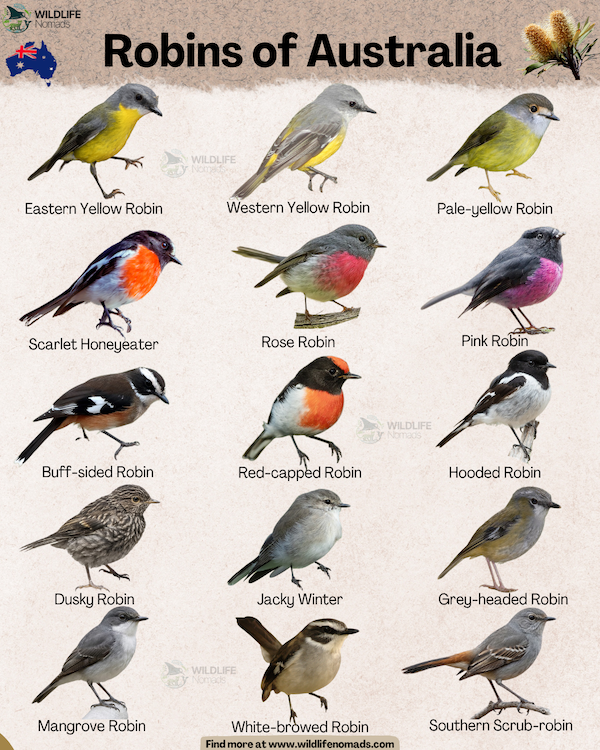
The 15 Robins of Australia Worth Chasing
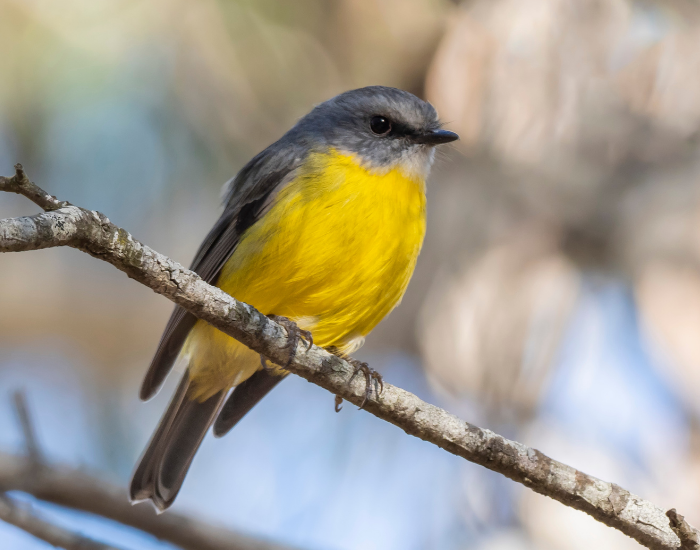
1. Eastern Yellow Robin (Eopsaltria australis)
The eastern yellow robin is the one you’ll meet first. Grey above, egg-yolk yellow below, and almost fearless around walkers. I’ve had them follow me at Woody Head and at Booderee near Jervis Bay. One shadowed me down the Ku-ring-gai sandstone tracks in New South Wales, all the way to Bobbin Head.
Genomics has made this bird stranger than its tame manner suggests. Coastal and inland lineages carry sharply divergent mitogenomes tied to a mitonuclear gene cluster. Two birds that look identical to us may not share one story.
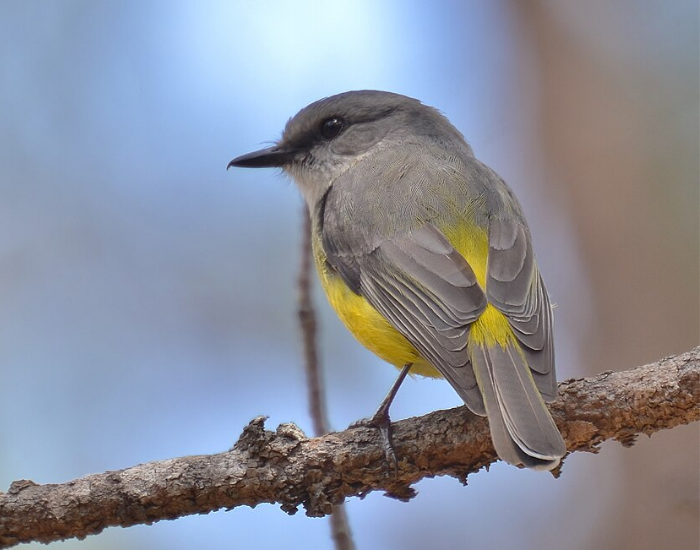
2. Western Yellow Robin (Eopsaltria griseogularis)
Swap the eastern bird’s yellow throat for a clean grey breast band. That gives you its western counterpart, which holds the wandoo and jarrah woodland of south-western Western Australia. Its range runs east through mallee country to the Eyre Peninsula.
Behaviourally the two are near twins. Both cling to trunk bases, both nest low, and both raise young with helpers.
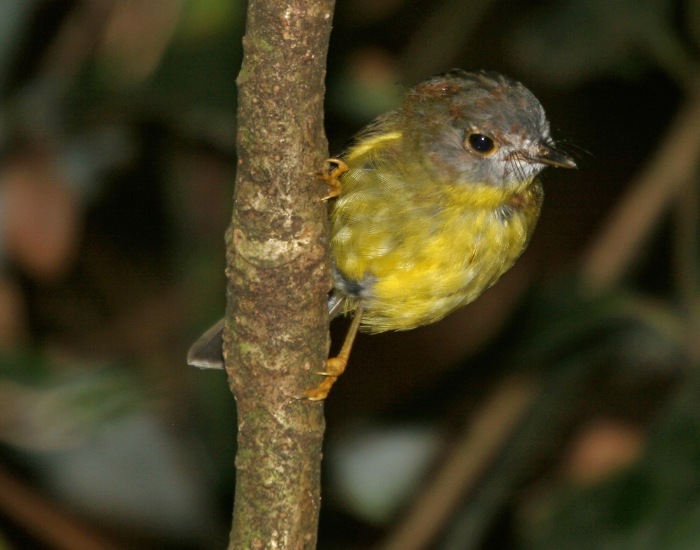
3. Pale-yellow Robin (Tregellasia capito)
Here is the rainforest specialist, and it is tiny, roughly 12 centimetres of olive-green and lemon. The giveaway is the face patch: white in southern birds, buff in the northern subspecies.
I found my first one on the Border Track at Lamington, perched on a lawyer vine at knee height. It sat dead still while I fumbled with my camera. Then it dropped, grabbed something off a wet log, and returned to the same stem.
4. Scarlet Robin (Petroica boodang)
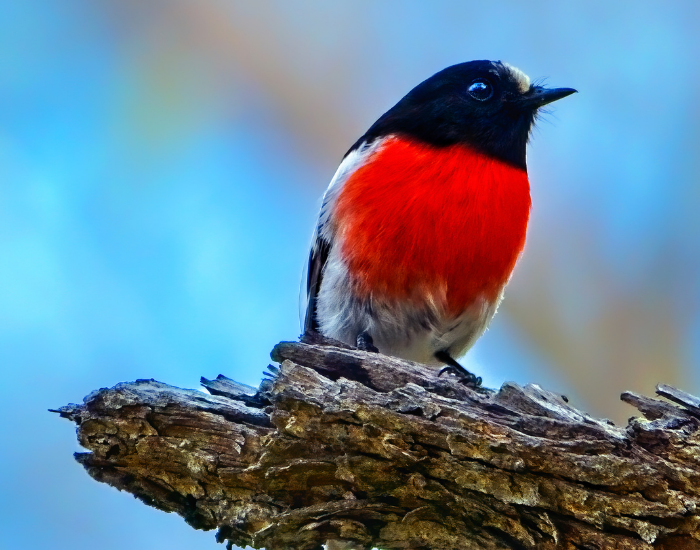
This is the bird that started the naming confusion. The male wears a black hood, a bold white forehead spot, a scarlet breast and white underparts. Females are soft brown with a rusty wash and a smaller brow mark.
Scarlet robins hold drier eucalypt forest. I’ve had my best luck around Blackheath in the upper Blue Mountains. After breeding, many drift downhill into open woodland for winter, which is when suburban gardens get a visit.
5. Flame Robin (Petroica phoenicea)
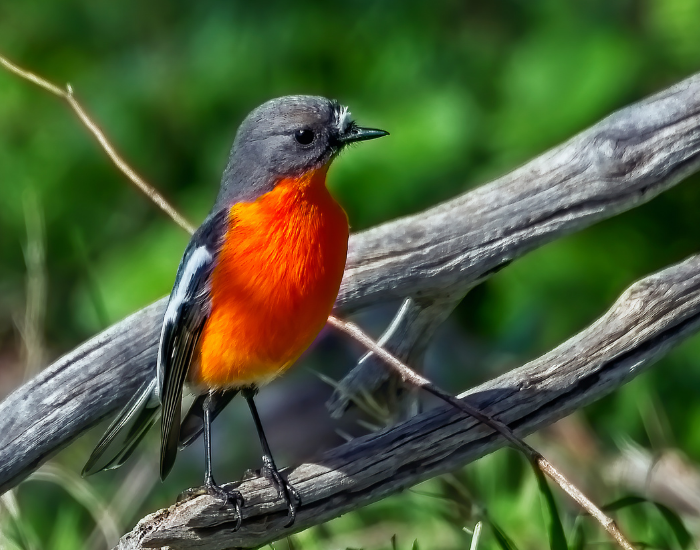
Flame robins run the same colour scheme with more ambition. The orange starts at the chin and floods the breast and belly, so the bird looks lit from inside. Scarlet robins, by contrast, keep the throat black.
They breed in alpine and subalpine country, then descend in autumn. On a frosty morning above Megalong Valley I watched a loose group working a cleared paddock. They dropped onto insects from fence wire, one after another. Winter flocking like that is a genuinely different behaviour from their territorial breeding season.
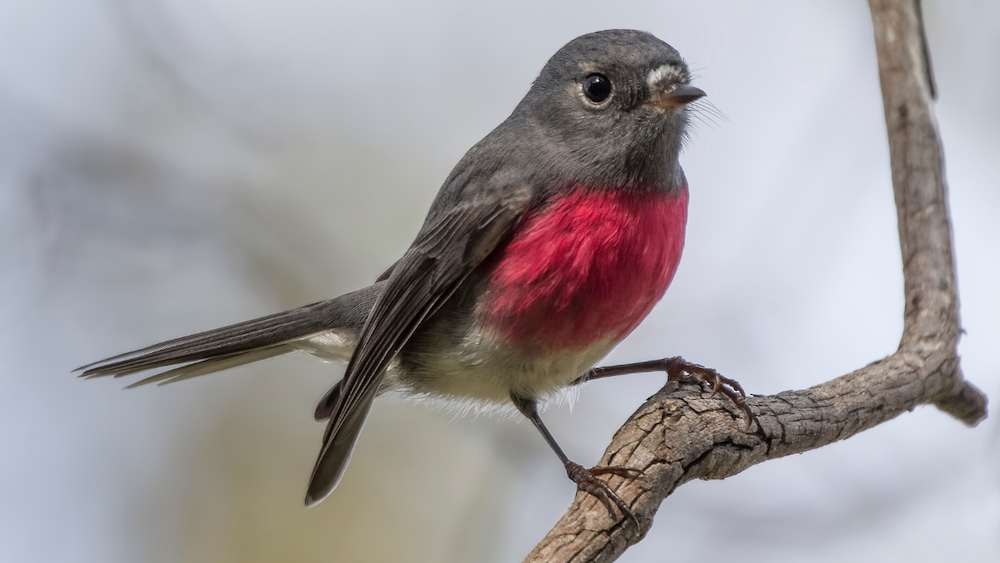
6. Rose Robin (Petroica rosea)
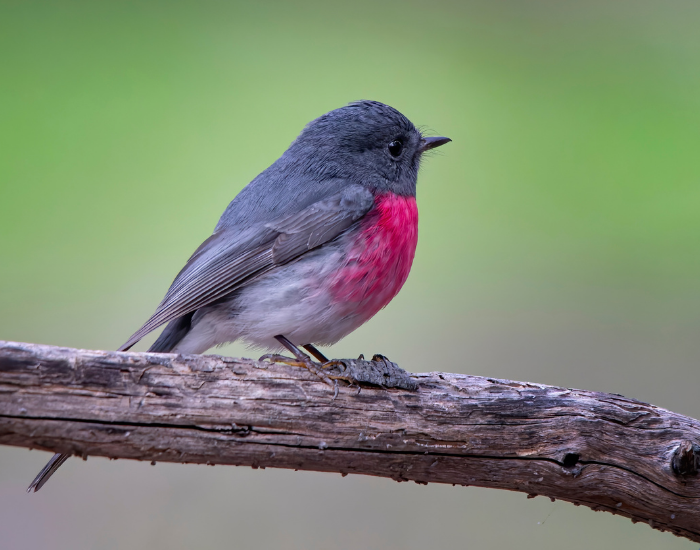
At about 11 centimetres, the rose robin ranks among the smallest birds in wet forest. The male has dark grey upperparts, a rose-pink breast and a white belly. White tips on the outer tail flash every time he turns.
Rose robins hunt higher in the canopy than most relatives, which makes them frustrating to photograph. I’ve had them in the Springbrook gullies in spring. I found one near Nambucca, when altitudinal movement pushes birds toward the coast.
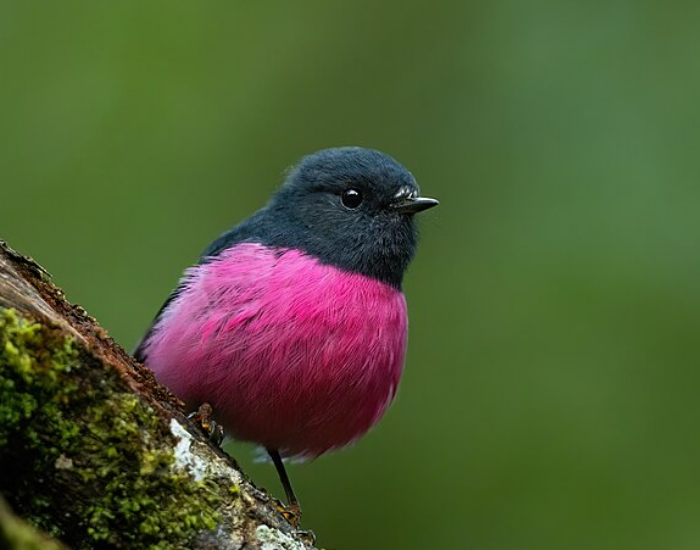
7. Pink Robin (Petroica rodinogaster)
The pink robin is the southern equivalent, sootier above, with a deeper magenta breast and no white belly. It haunts dense, dripping gullies of tree ferns in Tasmania and far south-eastern Victoria.
I’ll be straight with you. This is the one on the list I still haven’t seen, because it sits outside every patch of coast I’ve worked.
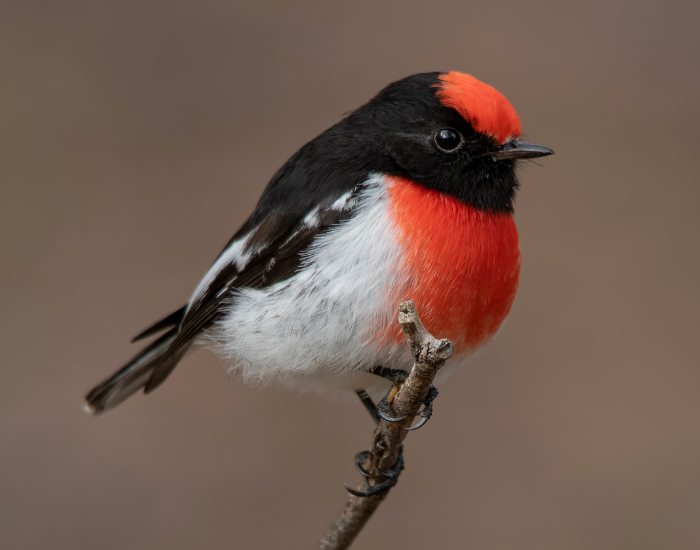
8. Red-capped Robin (Petroica goodenovii)
The red capped robin is the smallest of the group, around 10 to 12 centimetres. Its male is unmistakable, because the scarlet runs over the crown as well as the breast. No other Australian species does that.
You won’t find red capped robins on the east coast. They are rare on the immediate eastern coastline, preferring acacia scrub and semi-arid country woodland. Their range expands during good rainfall years, then contracts hard in drought.
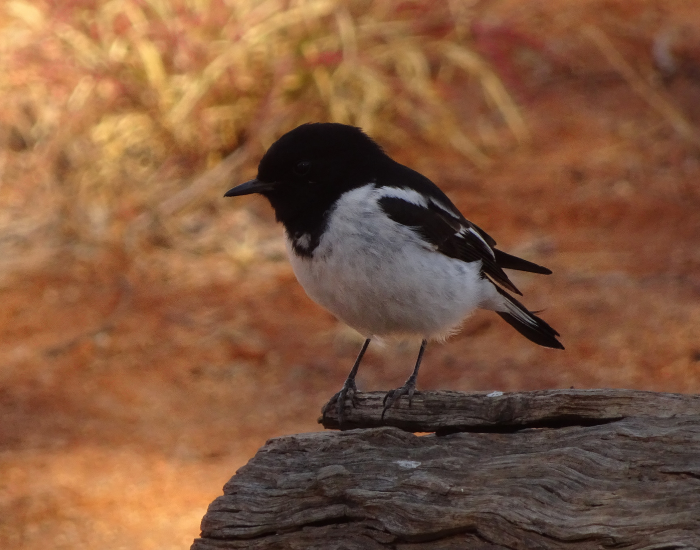
9. Hooded Robin (Melanodryas cucullata)
Crisp black and white, no red at all, and a bird in trouble. The hooded robin needs fallen timber, standing dead trees and a patchy understorey. Tidy grazing and firewood collection strip out exactly those features.
It lives in small family groups holding large territories. Reviews of temperate woodland declines link losses in this guild to shrinking insect prey and habitat simplification. No single cause explains it.
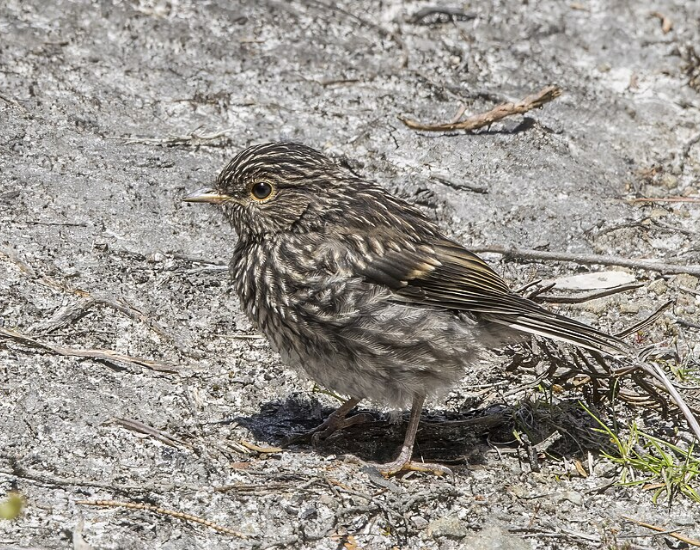
10. Dusky Robin (Melanodryas vittata)
Tasmania’s endemic robin is plain brown, faintly streaked, and utterly overlooked. Locals call it the stump robin for good reason, because it perches low on posts, stumps and fence lines.
Drabness has an upside. Female robins across the family are cryptic for nest safety. In this species, both sexes kept the camouflage.
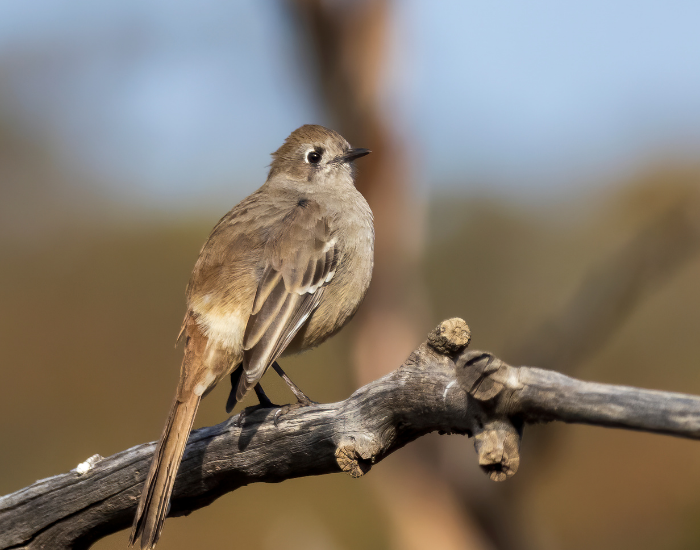
11. Jacky Winter (Microeca fascinans)
The name gives nothing away. “Brown flycatcher” was the older and arguably more accurate common name. Either way, this grey-brown bird is a true member of the family Petroicidae.
Watch the tail. A Jacky Winter swings it side to side almost constantly, flashing white outer feathers. Its nest is absurd: a cup barely wider than a matchbox, saddled onto a bare horizontal branch and bound with cobweb.
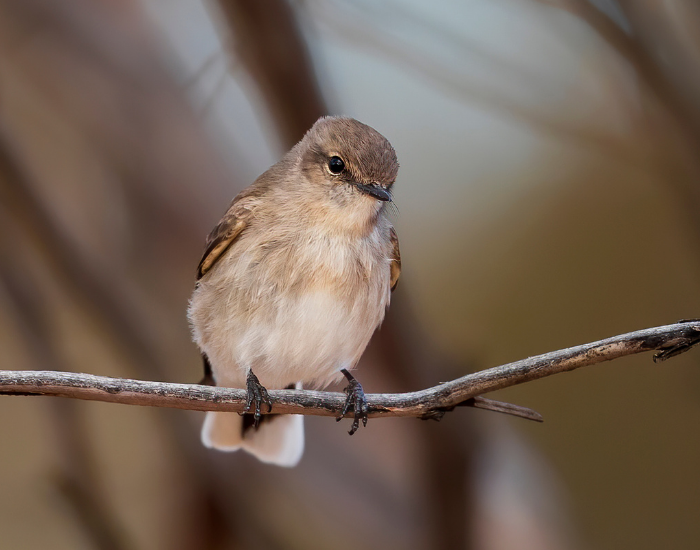
12. Grey-headed Robin (Heteromyias cinereifrons)
Restricted to upland tropical rainforest in the Wet Tropics, this is a big, long-legged robin. Look for a grey head, rufous back and white throat. It works the forest floor far more than other species sharing that forest.
Its range is essentially a set of mountain islands above 600 metres. Warming climates squeeze that habitat, and upslope is the only direction left.
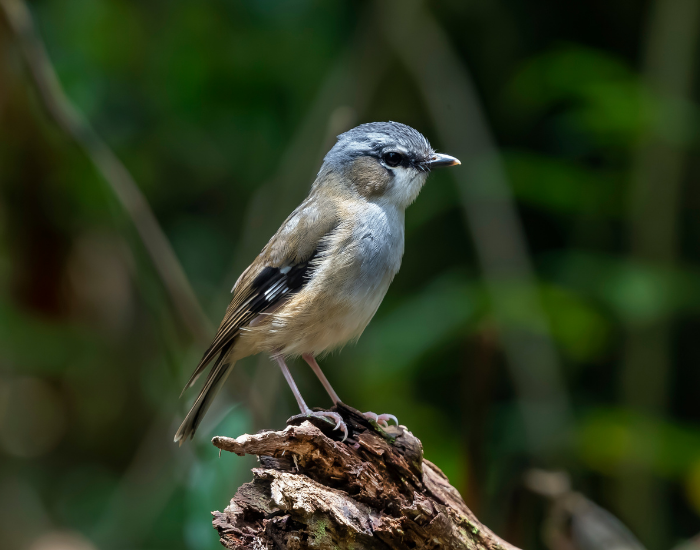
13. Mangrove Robin (Peneoenanthe pulverulenta)
Grey-brown above, white below, with a dark eye-line and white outer tail feathers. This species lives exactly where its name says, occupying mangrove swamps around northern Australia and southern New Guinea.
Tidal mudflats are a hard place to be a small insectivore. Birds drop onto exposed mud at low tide, feeding fast, then retreat upward as water covers the roots.
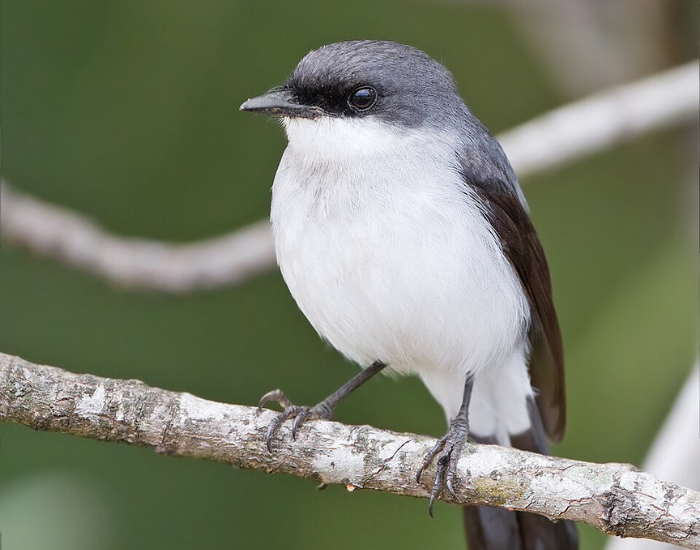
14. White-browed Robin (Poecilodryas superciliosa)
A thick white eyebrow over brown upperparts makes this one easily identified. It sticks to dense riverside thickets and vine scrub across northern Queensland and the Northern Territory.
Pairs stay together year-round and duet, which is worth listening for. Clear the vegetation along a creek and the species simply disappears from that stretch.
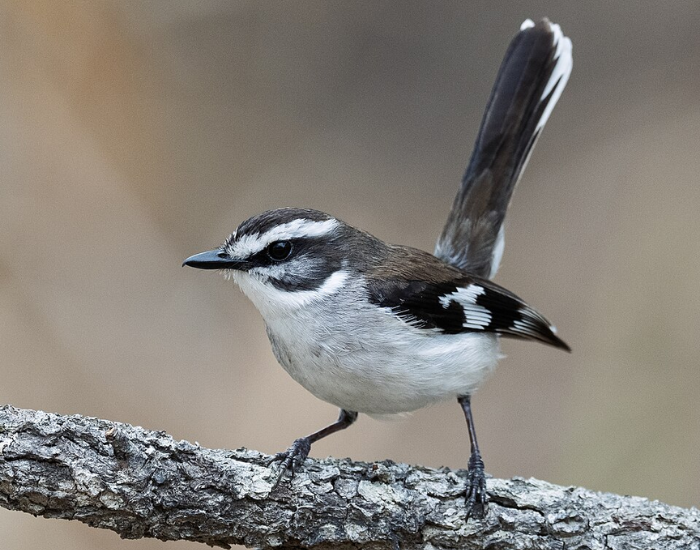
15. Southern Scrub-robin (Drymodes brunneopygia)
Scrub robins break the family mould. This one reaches roughly 22 centimetres, with long legs and a long tail. It runs across the ground far more than it flies.
Mallee and heath across southern Australia hold the population, and it depends on long-unburnt vegetation. Frequent fire can strip a site of scrub robins entirely, because the dense litter layer never rebuilds.
Robins on Other Continents, and One Island That Nearly Lost Its Own
The American Robin (Turdus migratorius) is a common North American songbird and a thrush, not a relative of ours. It inhabits open woodlands, fields and suburban areas. Its diet shifts from insects in warmer months to fruit in winter, which makes it an effective seed disperser.
American Robins are highly social in winter and gather in large flocks. Some roosts hold up to a quarter-million birds. The female lays distinctive bright blue eggs. Because these birds probe soil and eat earthworms in cities, researchers treat them as a bioindicator of soil health and chemical exposure.
European robins earned their own scientific fame. They navigate using the Earth’s magnetic field, and a cryptochrome protein in the eye appears to be the sensor.
Closer to home, the endangered Black Robin is endemic to the Chatham Islands. Every living bird descends from a single female. Genome sequencing across 150 years shows a three to four-fold rise in inbreeding after that bottleneck. Norfolk Island holds its own scarlet-breasted robin, another reminder of how island populations concentrate risk.
Frequently Asked Questions
Yes — five species, none related to the European robin. The scarlet robin, flame robin and red capped robin form the classic red-breasted trio. Rose and pink robins add pink instead of scarlet. All five sit in the genus Petroica within the Australasian robin family.
Plenty of them. The eastern yellow robin, western yellow robin and pale-yellow robin swap red for yellow. Hooded and dusky robins carry no colour at all, and the Jacky Winter is plain grey-brown. Overseas, the American Robin looks the part but is a thrush.
Male scarlet, flame and red capped robins keep their colour year-round, though it dulls after moult. Young males need a season or more to develop full plumage, so a washed-out bird is often simply immature. Females stay brown for life.
Where to Point Your Boots Next
Australia’s robins show how a borrowed name can hide 51 species worth of independent evolution. Think cooperative breeding, camouflaged nests, altitudinal migration, and a family tree with no European ancestry.
You don’t need a remote trip to start. Try a quiet track in Royal National Park at dawn, a rainforest edge at Springbrook, or a shaded gully at Noosa. Watch low trunks, not the canopy.
If you enjoyed this, I’ve written about the other birds I keep meeting on the same walks. That includes the honeyeaters working the flowering banksias, and the wonga pigeons that ghost across the track at Woody Head. There’s plenty more Australian wildlife in the archive.
Which robin have you managed to photograph? Tell me in the comments — I’m still chasing that pink robin.
Can You Name That Australian Robin? 🐦
A 15-photo identification challenge, the wrong answers are deliberately tricky look-alikes from a similar group. Go back and change any answer before you score.
Which robin is this?
References:
Braby, M. F., Yeates, D. K., & Joseph, L. (2023). Woodland birds and insect decline. Emu — Austral Ornithology, 123(3), 255–257. https://doi.org/10.1080/01584197.2023.2233758
Morales, H. E., Pavlova, A., Amos, N., Major, R., Kilian, A., Greening, C., & Sunnucks, P. (2018). Concordant divergence of mitogenomes and a mitonuclear gene cluster in bird lineages inhabiting different climates. Nature Ecology & Evolution, 2(8), 1258–1267. https://doi.org/10.1038/s41559-018-0606-3
Ohrberg, M. L., Becker, D. J., Filippelli, G. M., Ketterson, E. D., Rader, S. T., Reed, S. M., Williams, E. J., & Jahn, A. E. (2026). Region- and season-specific exposure to lead in a common North American songbird. Ecotoxicology, 35, Article 90. https://doi.org/10.1007/s10646-026-03070-3
von Seth, J., et al., (2022). Genomic trajectories of a near-extinction event in the Chatham Island black robin. BMC Genomics, 23, Article 747. https://doi.org/10.1186/s12864-022-08963-1
Xu, J., Jarocha, et al., (2021). Magnetic sensitivity of cryptochrome 4 from a migratory songbird. Nature, 594, 535–540. https://doi.org/10.1038/s41586-021-03618-9







_juvenile_South_Bruny.jpg)

