

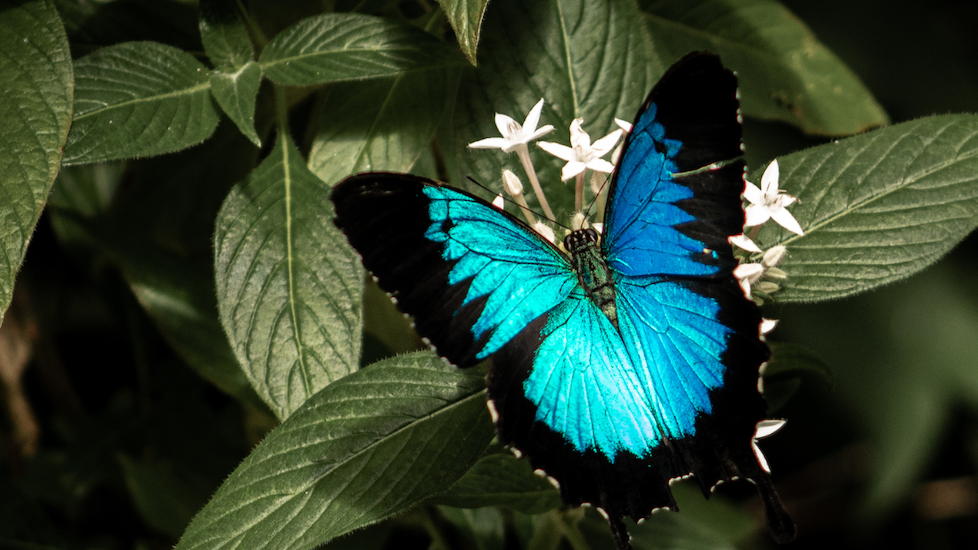
As a biologist, I’ve spent a good chunk of my life trekking through mud, dodging thorns, and waiting in silence just to catch a glimpse of a specific species. Currently, I call Queensland, Australia home. Not long ago, while hiking a trail near the Gold Coast, a flash of electric sapphire darted past me. It was a Ulysses butterfly.
Even though I’ve seen thousands of insects, that specific blue butterfly stopped me in my tracks. It immediately triggered a memory of a bright blue butterfly I used to see back in Mexico during my early career days.
I started questioning: just how many types of blue butterflies are there? While there are thousands of species in the Lycaenidae family (the “Blues”), a few stand out as true icons. If you’ve ever wondered what is a blue butterfly called or why they look so magical, here are 15 of the most iconic blue butterflies species you should know.
First… What Exactly Is a Blue Butterfly?
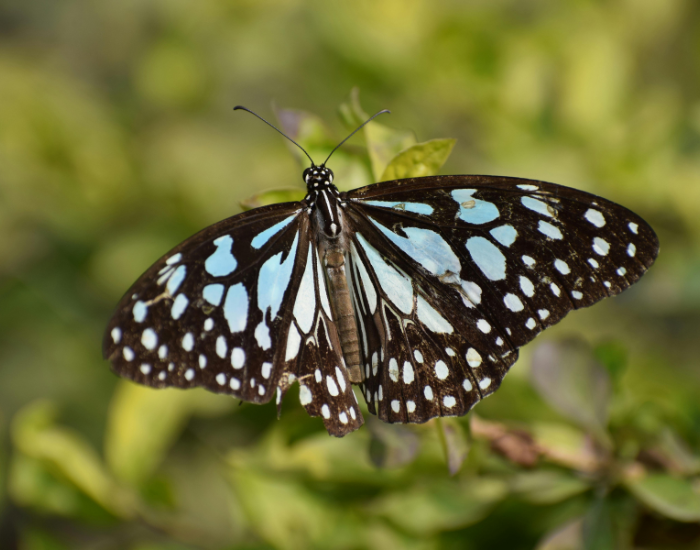
Before we dive into the list, let’s look at the science. When we talk about a blue butterfly name, we are usually referring to members of the family Lycaenidae. These are generally small butterfly species, but “blue” as a color appears in several families.
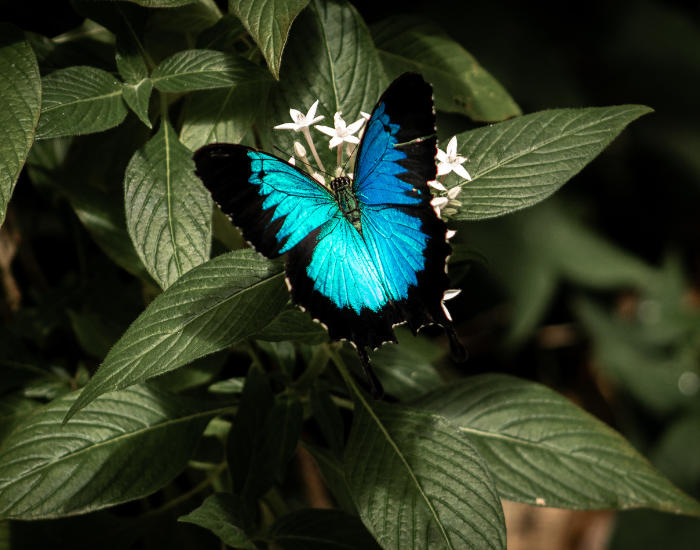
Interestingly, the blue coloring is rarely a pigment. In most common blue butterflies, the color is “structural.” Their wing scales are shaped like tiny prisms that reflect blue light and absorb others. This is why a royal blue butterfly can look dull gray if you change the viewing angle!
1. Blue Morpho (Morpho peleides)
Region: Central and South America
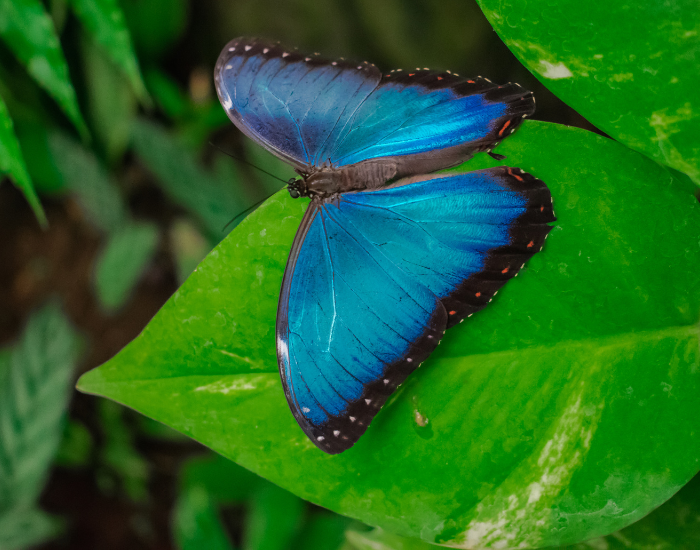
The Blue Morpho is arguably the most famous blue butterfly in the world. With bright blue wings that can span up to eight inches, they are giants compared to the rest of this list. You can see them in the tropical forests of Brazil; they don’t just fly, they “flash.” Because the underside of their wings is brown with black spots (eyespots), they seem to disappear and reappear against the canopy.
2. Ulysses Butterfly (Papilio ulysses)
Region: Australia (Queensland), Papua New Guinea
This is the “emperor” of the Australian rainforest. Its bright blue wings are bordered by narrow black margins. In the Gold Coast hinterlands, seeing one is considered lucky. It’s a fast flyer, usually sticking to the canopy, but it is often attracted to the color blue—I’ve seen them dive-bomb tourists wearing blue hats!

3. Miami Blue Butterfly (Cyclargus thomasi bethunebakeri)
Region: Florida, USA
The Miami Blue butterfly is one of the rarest insects in North America. Once common across coastal areas, it is now a critically endangered species protected under the Endangered Species Act. Their caterpillars feed on specific host plants like the nickerbean. Seeing a Miami blue in the wild today is a rare privilege for any biologist.
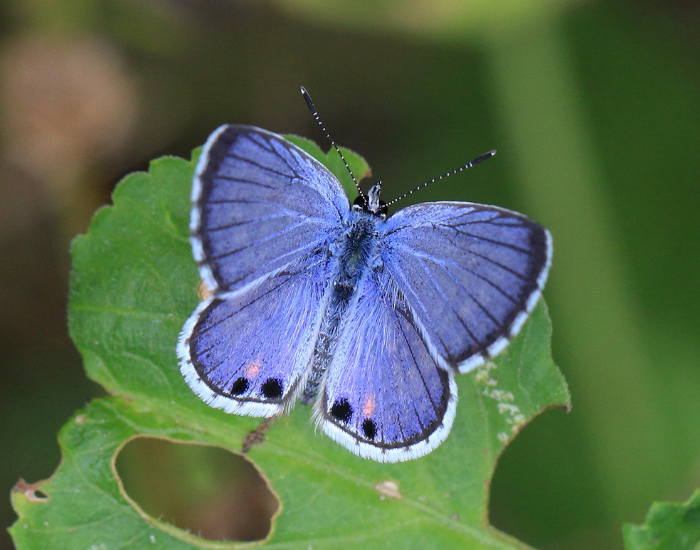
4. Common Blue (Polyommatus icarus)
Region: Europe, North Africa, and temperate Asia
The common blue is exactly what it sounds like—the most common blue butterfly found in the UK and Europe. The males wings are a vibrant lilac-blue, while females are often brown with orange spots along the edges. They love woodland rides and sunny meadows where birds foot trefoil grows.
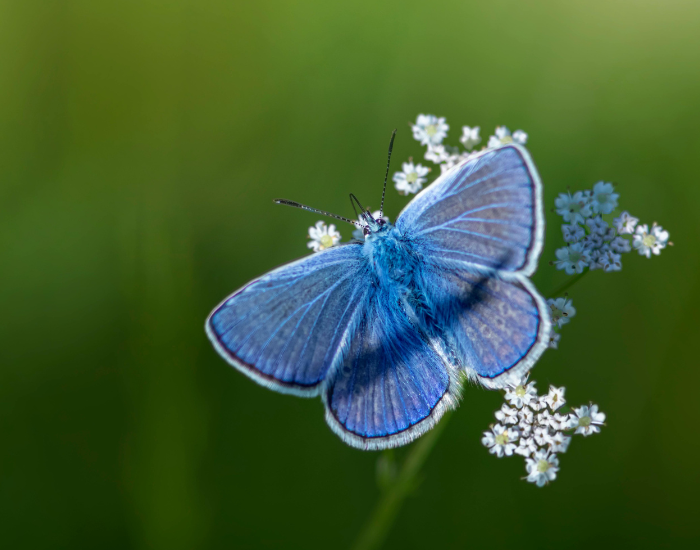
5. Adonis Blue (Lysandra bellargus)
Region: Europe (Southern England to the Mediterranean)
The Adonis blue is famous for having a shade of blue so bright it almost looks artificial. You can tell them apart from a common blue by the white fringe on their wing edges, which is intersected by thin black lines. They are very picky, requiring short-turf chalk grasslands to survive.
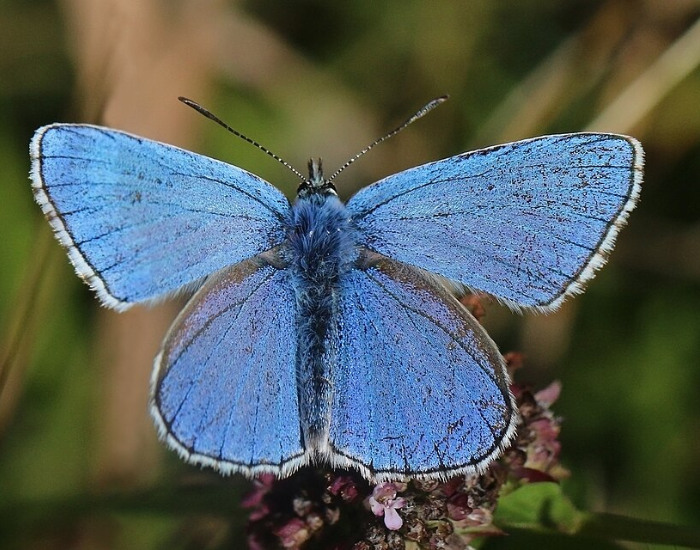
6. Fender’s Blue Butterfly (Icaricia icarioides fenderi)
Region: Willamette Valley, Oregon, USA
This is another high-stakes conservation story. Fender’s blue butterfly was actually thought to be extinct until it was rediscovered in 1989. It has a strict dependency on wild lupine plants (specifically Kincaid’s lupine) for its life cycle. This endangered species is a flagship for habitat restoration in the Pacific Northwest.
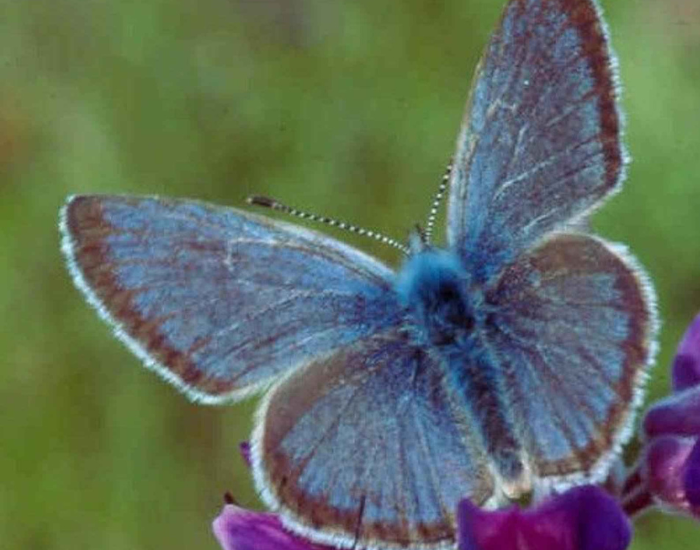
7. Cassius Blue (Leptotes cassius)
Region: Florida, Texas, and the Caribbean
Small but mighty, the Cassius blue is often found in beachside scrub and gardens. It has a beautiful “zebra” pattern on its underside and a soft, pale blue coloring on the top. Its larvae are known to feed on plants in the pea family.
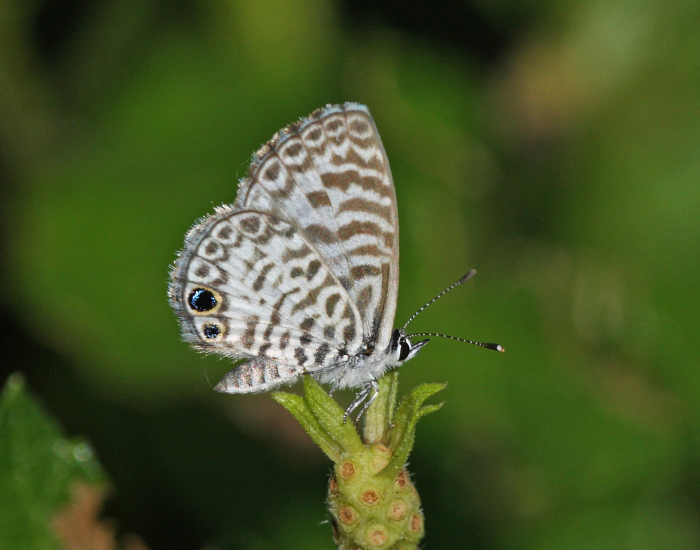
8. Ceraunus Blue (Hemiargus ceraunus)
Region: Southern USA, Mexico, and Central America
A similar species to the Cassius Blue, the Ceraunus blue is a hardy little survivor. You’ll find them in open fields and tropical pine rocklands. They are quite small—usually about one inch in wingspan—and are distinguished by two prominent black spots on the hind wings.
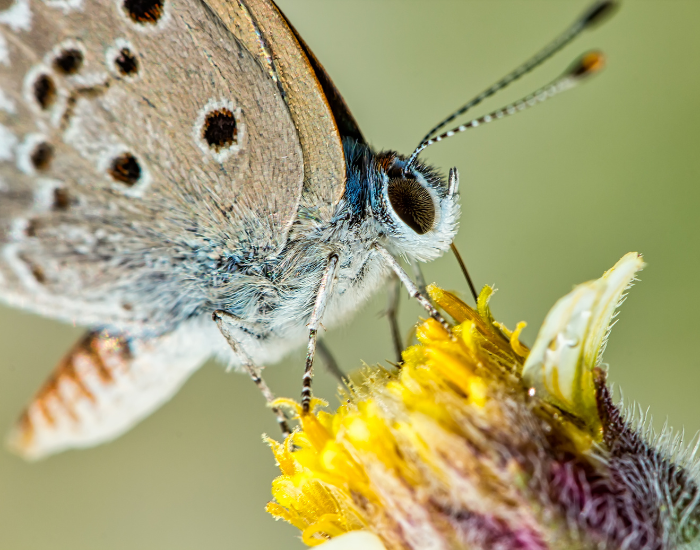
9. Chalkhill Blue (Polyommatus coridon)
Region: Europe
The Chalkhill blue gets its name because it thrives on chalk downs. The males have a unique, pale, almost silvery-blue color. This species is a great indicator of ecosystem health; they rely on traditional sheep grazing to keep the grass short enough for their host plants to grow.
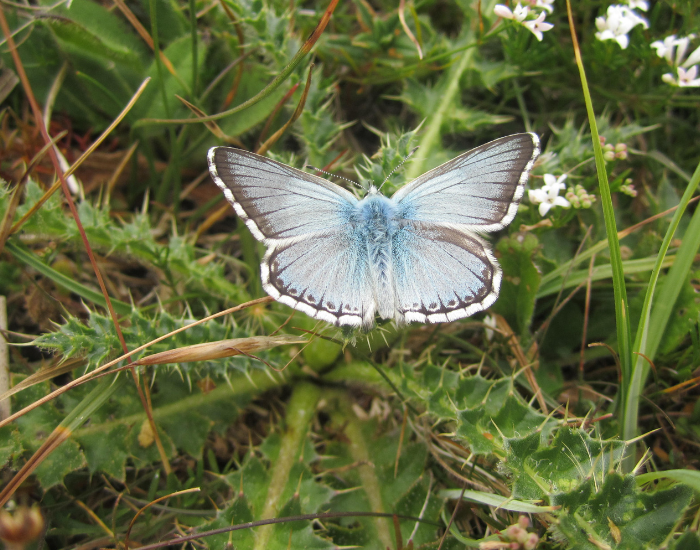
10. Silver-Studded Blue (Plebejus argus)
Region: Europe and Asia
Look closely at the underside of a silver studded blue, and you’ll see tiny metallic “studs” that glint in the sun. This species has a fascinating relationship with ants; the caterpillars produce a sugary liquid that the ants drink, and in return, the ants protect the larvae from predators.
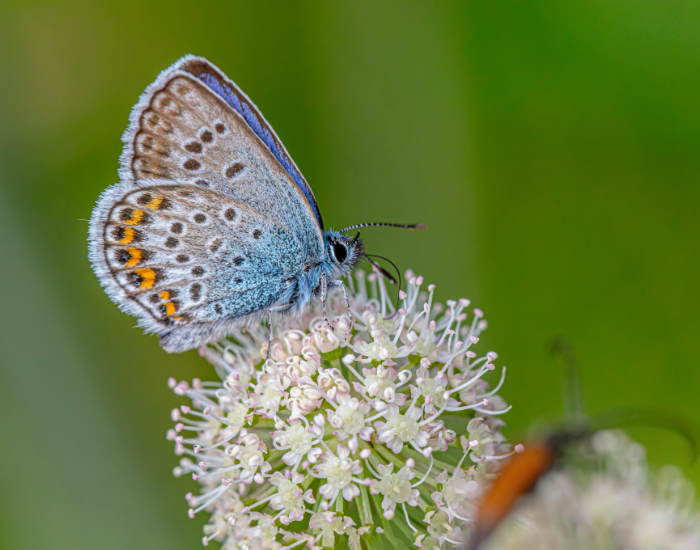
11. Karner Blue (Lycaeides melissa samuelis)
Region: Northern USA
The Karner blue is the poster child for the Nature Conservancy. Like Fender’s Blue, it depends entirely on wild lupine. This small butterfly has been hit hard by habitat loss and habitat fragmentation, but intensive recovery plan efforts are helping to bring them back in states like New Hampshire and Ohio.
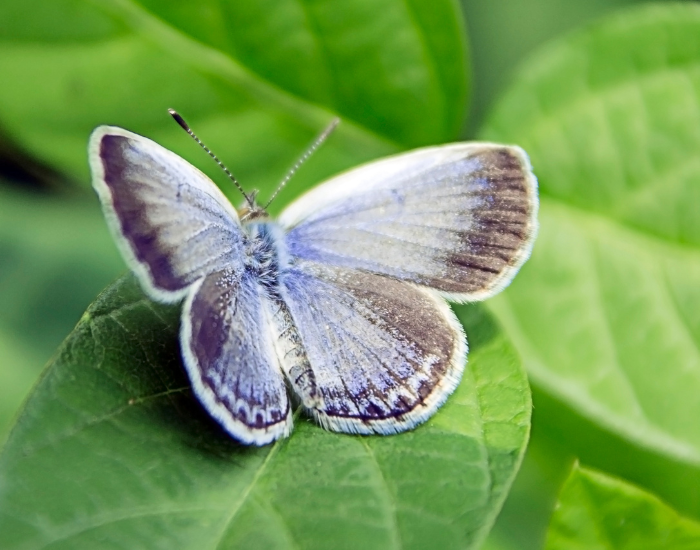
12. Mission Blue (Icaricia icarioides missionensis)
Region: San Francisco Bay Area, USA
Found only in a few spots around the Golden Gate, the Mission blue is a true California native. It’s a royal blue butterfly that struggles with invasive species (like non-native grasses) that choke out its lupine food source. I’ve always found it poetic that such a delicate creature lives so close to such a massive city.
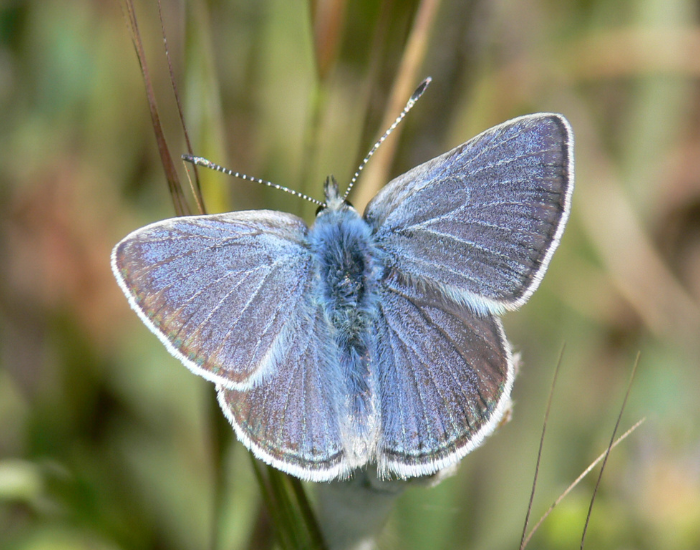
13. Spring Azure (Celastrina ladon)
Region: North America
This is often the first blue butterfly people see in the spring. They don’t have the intense iridescence of a Morpho; instead, they are a delicate, powdery blue. They are generalists, meaning their caterpillars feed on a wide variety of plants, which helps them remain one of the more common blue butterflies.
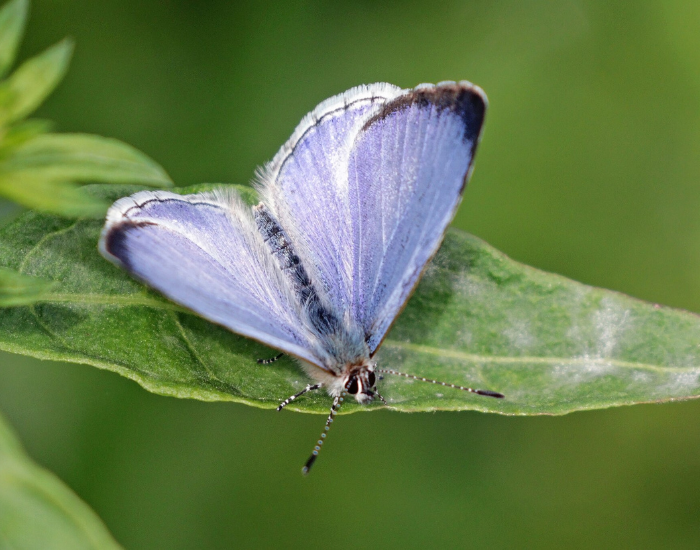
14. Holly Blue (Celastrina argiolus)
Region: Northern Hemisphere
The Holly Blue is unique because it typically has two generations per year. The first brood in spring usually lays eggs on Holly, while the summer brood uses Ivy. They fly much higher than other “blues,” often hovering around shrubs and trees rather than low-growing flowers.
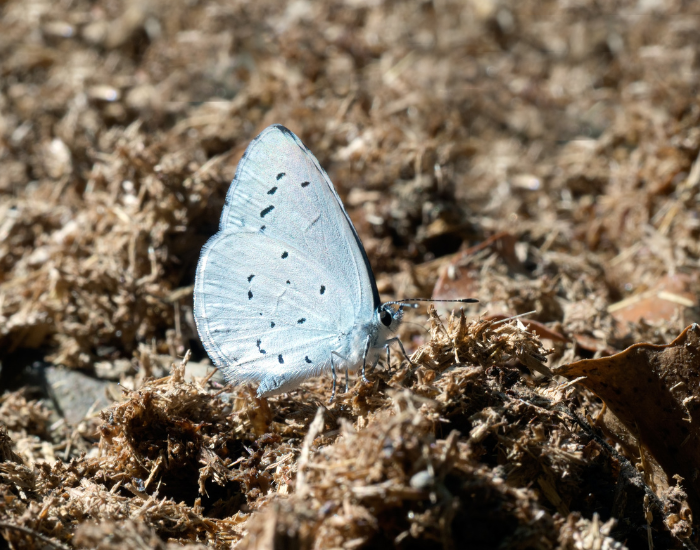
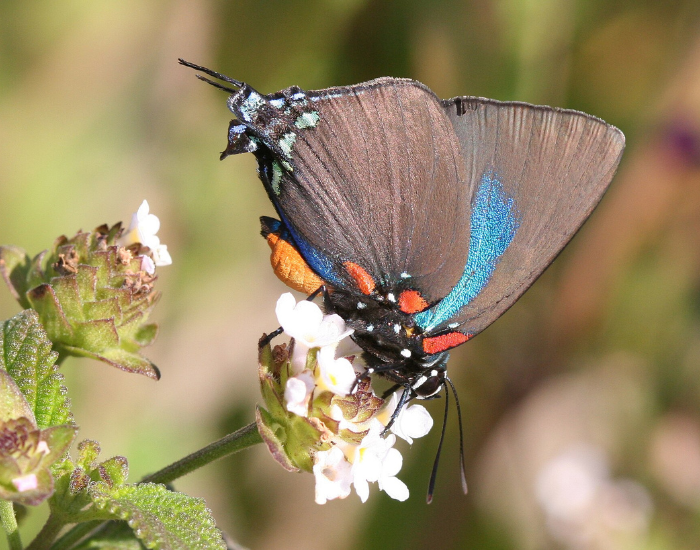
15. Great Purple Hairstreak (Atlides halesus)
Region: USA and Mexico
Don’t let the name fool you—while it’s called “purple,” its upper wings are a stunning, iridescent bright blue. It’s the largest hairstreak in North America. Interestingly, its caterpillars feed on mistletoe, a parasitic plant. This adds a layer of complexity to its habitat requirements.
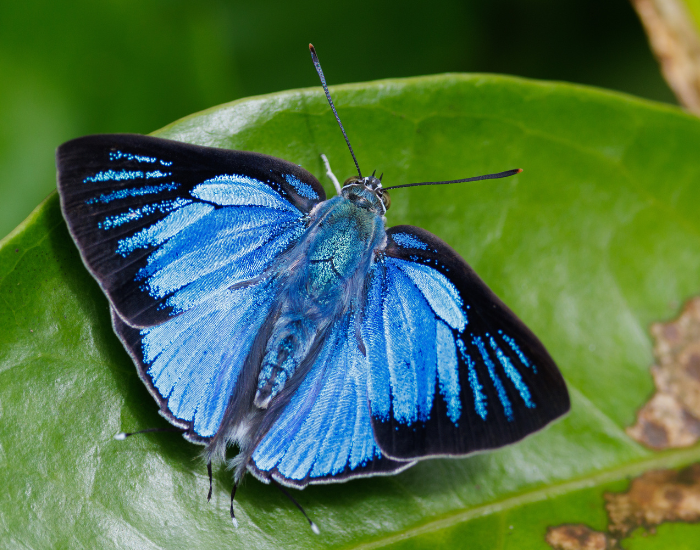
16. Silver Royal (Ancema blanka)
Region: South & Southeast Asia
The Silver Royal is a stunning member of the Theclinae subfamily. The males wings are a brilliant, shining blue, while the underside is a distinctive silvery-grey (hence the name). They are treetop dwellers, often basking in the sun on hilltops—a behavior biologists call “hill-topping.”
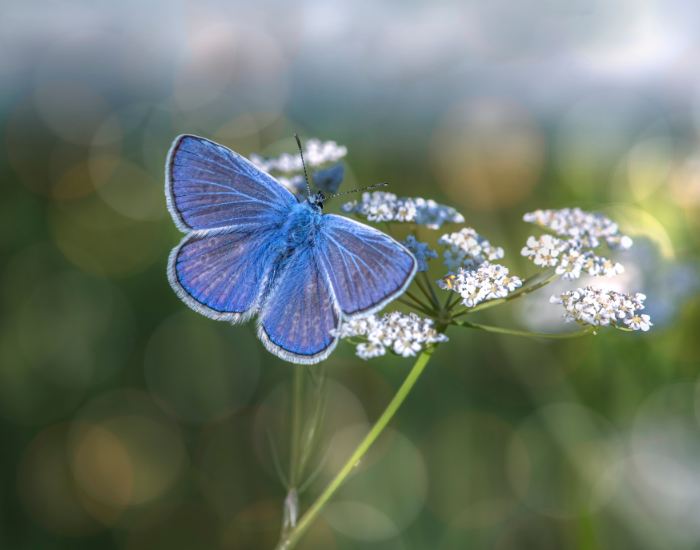
17. Mazarine Blue (Cyaniris semiargus)
Region: Europe, North Africa, and Northern Asia
The Mazarine Blue is a bit of an enigma. Unlike the common blue or the Adonis blue, the male Mazarine doesn’t sport a sky-blue coat. Instead, it has a deep, dusky royal blue—almost violet—color that feels much more “moody” and elegant. The females, as is common with many types of blue butterflies, are a humble chocolate brown.
Conservation: Why So Many Blue Butterflies Are Endangered
Several blue butterfly species face serious threats. Habitat loss, climate change, and invasive plants are the three biggest drivers of decline. Many blues have highly specialised life cycles — they depend on a single host plant, a specific ant species, or a precise grassland structure. When suitable habitat disappears, populations collapse rapidly.
Organisations including the IUCN, the US Fish and Wildlife Service, and the Nature Conservancy lead recovery programs for endangered species like the Karner Blue, Miami Blue, and Fender’s Blue. You can support these efforts by planting native wildflowers, reducing pesticide use, and supporting local conservation groups.
Comparison Table: Similar Species at a Glance
| Species | Primary Region | Key Field Mark | Habitat |
| Miami Blue | Florida | Two large spots on hind wing underside | Coastal scrub |
| Cassius Blue | Caribbean/FL | Striated “zebra” underside pattern | Gardens/Beaches |
| Common Blue | Europe/Asia | No black spots in the center of forewing | Meadows |
| Adonis Blue | Europe | Black lines through white wing fringe | Chalk grassland |

FAQ: Everything You Want to Know About the Blue Butterfly
Across many cultures, a blue butterfly represents transformation, hope, and rebirth. In some traditions, seeing one is a sign of good luck or a message from a loved one.
True blue is actually one of the rarest colors in nature. Because blue pigment is difficult for animals to produce, most blue in nature is a result of light refraction.
While many are called “blue,” the Blue Morpho is often cited as the most “pure” example of iridescent blue, though technically, even its color is structural, not pigment-based.
Protecting the Future of the Blue Butterfly
Whether it’s the massive Blue Morpho in the tropical rainforests of Mexico or the tiny Miami blue clinging to survival in Florida, these insects are more than just pretty wings. They are indicators of the health of our planet. Climate change and habitat loss are real threats to these delicate flyers.
If you want to help, consider building a wildlife-friendly garden with native host plants. By protecting the small things, we protect the entire ecosystem.
Can You Name That Blue Butterfly? 🦋
A 17-photo identification challenge — the wrong answers are deliberately tricky look-alikes from a similar group. Go back and change any answer before you score.
Which blue butterfly is this?
References:
Hall, D. W. (2021). Great purple hairstreak; great blue hairstreak Atlides halesus (Cramer) (Insecta: Lepidoptera: Lycaenidae): EENY110/IN1268. EDIS, 2021(2). https://doi.org/10.32473/edis-in267-2020
Khyade, V. B., Pawar, R. S., & Khilare, A. D. (2018). Describtion of Lycaenidae Butterflies. International Academic Journal of Innovative Research, 5(2), 9-25. https://doi.org/10.9756/IAJIR/V5I1/1810012
Piszter, G., Kertész, K., Bálint, Z., & Biró, L. P. (2016). Variability of the Structural Coloration in Two Butterfly Species with Different Prezygotic Mating Strategies. PloS one, 11(11), e0165857. https://doi.org/10.1371/journal.pone.0165857
Schultz, C. B., & Hammond, P. C. (2003). Using Population Viability Analysis to Develop Recovery Criteria for Endangered Insects: Case Study of the Fender’s Blue Butterfly. Conservation Biology, 17(5), 1372–1385. http://www.jstor.org/stable/3588961


_male.JPG)


_female.jpg)
