I was editing photos in a camp chair in Woody Head, NSW. A shadow crossed the laptop screen. It was not a fly. A jumping spider, maybe five millimetres long, had walked onto the glass and turned to face me.
That keeps happening on this lap around Australia. One appeared on the mesh of my roof tent at six in the morning. Another walked the rim of my dinner plate while I ate.
These are the only spiders I have watched people greet instead of flinch at. I have found them in almost every country I have worked in, from Mexico to Sweden to Indonesia.
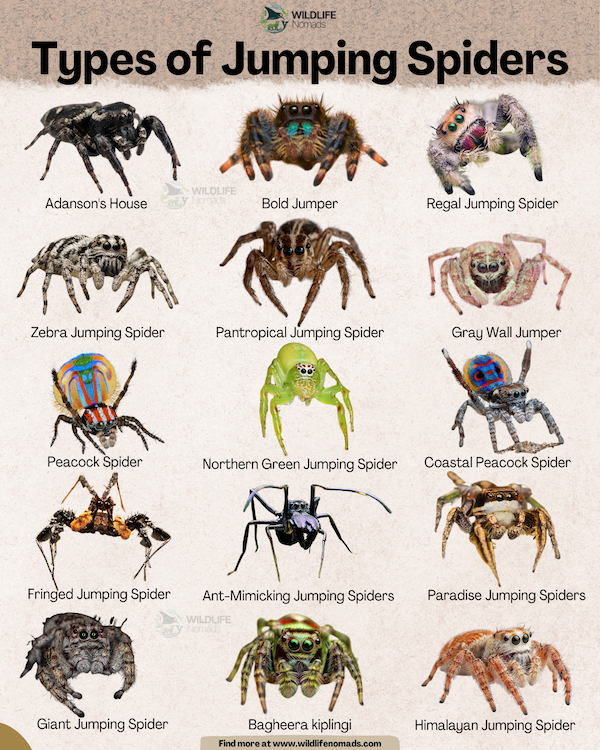
Below are 15 species and groups worth recognising. Each entry covers looks, range, and what the science actually says.
What Jumping Spiders Do That Other Spiders Cannot
They belong to the family Salticidae, the largest family of spiders on Earth. The World Spider Catalog accepts close over 6,600 species across roughly 600 genera. That is about one spider in eight.
Here is what sets them apart. Most spiders are nearly blind and read the world through vibration. Salticids hunt by sight instead.
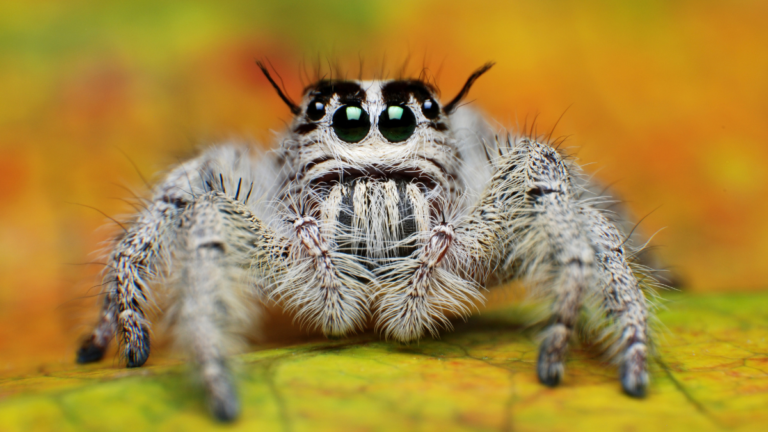
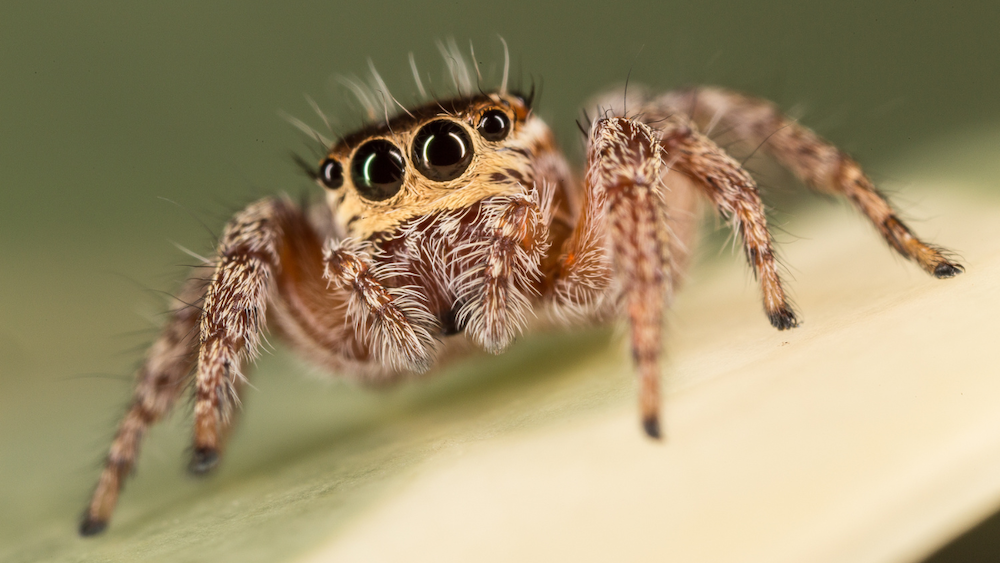
Eight eyes sit in four pairs, arranged in two rows when seen from above. The huge forward-facing pair works like a telescope, with a second lens behind the cornea. Nagata and colleagues showed the image lands on a layered retina, one layer deliberately out of focus. The spider reads depth from that blur.
They see colour too. Zurek and co-authors found a red filter over part of the retina in Habronattus. That filter delivers true three-colour vision.
The jump runs on hydraulics, not muscle alone. Back legs extend under a surge of internal fluid pressure. A silk dragline trails behind as a safety line. A large Phidippus clears about six inches, and Nabawy’s team measured leaps of six body lengths.
The 15 Jumping Spiders
1. Adanson’s House Jumper (Hasarius adansoni)
This is the one on your kitchen wall in the tropics. Females reach 8 mm, males 6 mm. Males are near-black with a red mask and a pale crescent at the rear of the abdomen.
It travels with people. Greenhouses, nurseries and shipping have carried it worldwide, including Australia, Japan, Brazil and Tanzania. If a tiny spider watches you from the bathroom tiles in Cairns, start here.
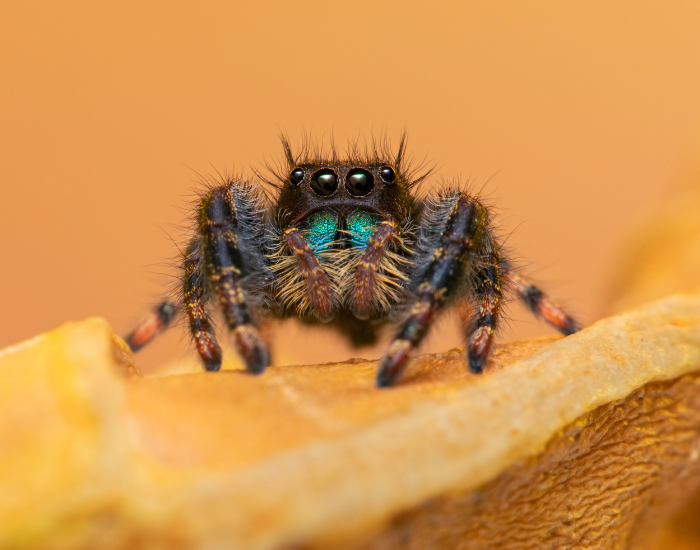
2. Bold or Daring Jumping Spider (Phidippus audax)
The daring jumping spider is North America’s household classic. Females run 8 to 15 mm, males 6 to 13 mm. A large triangular white spot sits on the abdomen with two smaller ones behind it. The fangs flash iridescent green.
I met my first on a barn door in the Mexico, years before I could name it. Audax means bold, and Hentz named it for jumping at the hand that threatened it. New Hampshire made it the state spider in 2021.
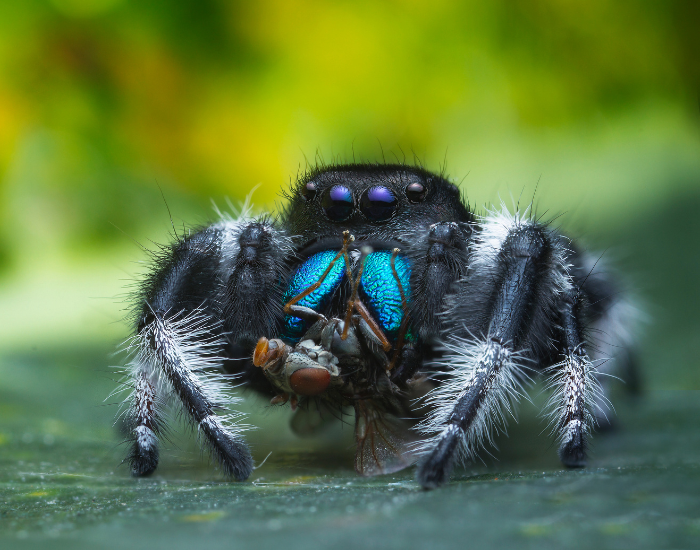
3. Regal Jumping Spider (Phidippus regius)
This is the largest jumping spider in eastern North America. Females average 15 mm and reach 22 mm. That is a genuinely chunky animal on your thumb, though still far from the biggest spiders in the world.
Males are black and white with a banded fringe on the front legs. Females go the other way, wearing brown, orange, tan or grey scales. Both sexes carry iridescent chelicerae in green, blue or violet. Florida is the stronghold, along with the Bahamas, Bermuda and the Greater Antilles.
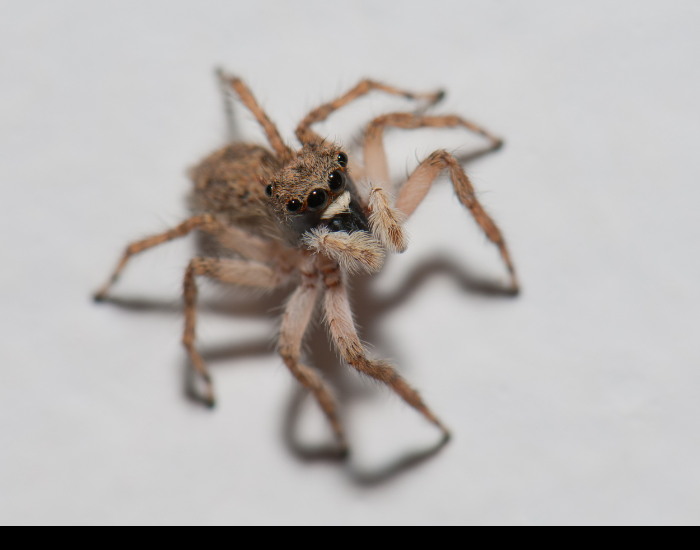
4. Zebra Jumping Spider (Salticus scenicus)
If you grew up in Europe or North America, this was your childhood spider. It is black with white hair stripes, 5 to 9 mm long, and almost always on a sunlit vertical surface. Garden fences, brick walls and rock faces all suit it.
I spent much of a Swedish summer watching these on a stone wall between lectures. They creep, freeze, then cover the gap in a blink. Measured jump speeds sit near 0.7 metres per second, and the silk thread goes down first every time.
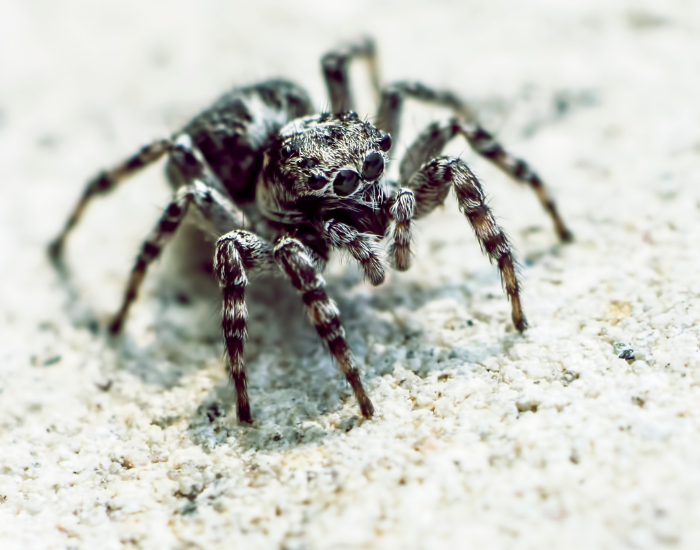
5. Pantropical Jumping Spider (Plexippus paykulli)
A big, robust spider species of walls and porch lights. Females reach 12 mm, males 11 mm. Males are black with a broad white stripe running forward onto the face.
It works the insect traffic around lights, which makes it easy to find after dark. The range covers tropical Africa and Asia, the Americas, the Maldives and northern Australia. It strikes prey from up to 50 mm away.
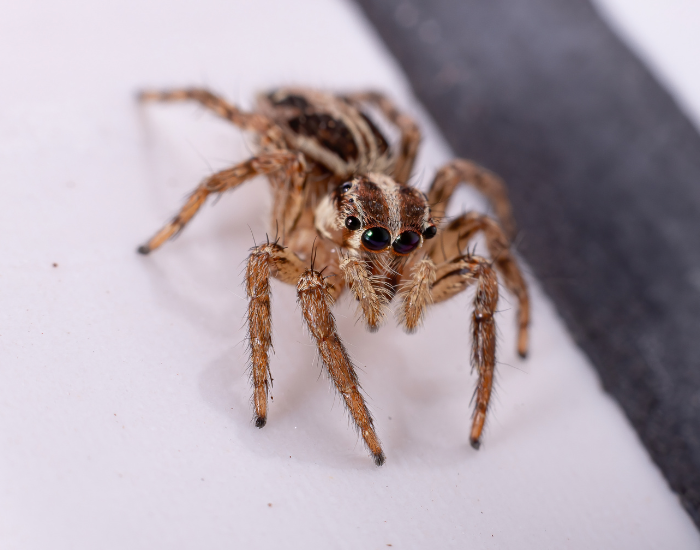
6. Gray Wall Jumper (Menemerus bivittatus)
Flattened, fast and dressed in short greyish-white hair, this one is built for vertical surfaces. It runs about 9 mm, with tufts of dark bristles above the big front eyes. Sub-Saharan Africa is home, but it now turns up across the Caribbean, Florida, Texas and India.
It hunts small flies landing on sunlit walls. It will also take crane flies twice its own size.
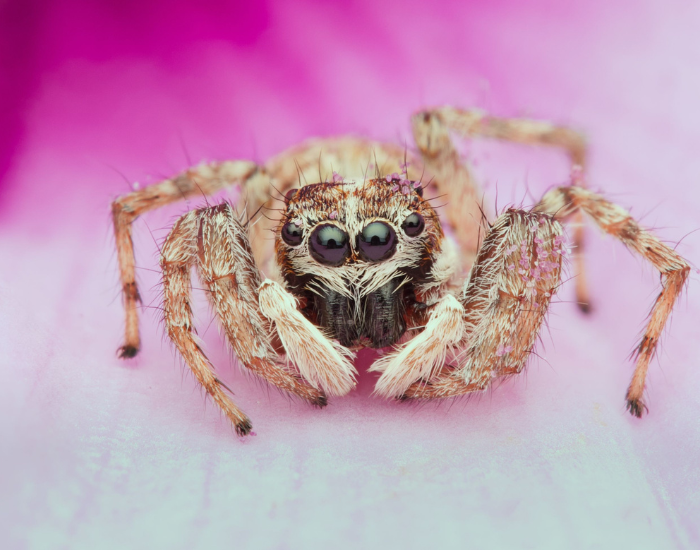
7. Northern Green Jumping Spider (Mopsus mormon)
Queensland’s showpiece, and the largest jumper most Australians will meet. It lives across eastern Australia and New Guinea, usually on broad green leaves. Males wear long white side whiskers rising to a peak, topped with a black topknot.
Females skip the whiskers and wear a red-and-white mask instead. I have found them at head height on lantana in the wet tropics. They do not run when you approach. They rotate to face you, which is unnerving and completely harmless.
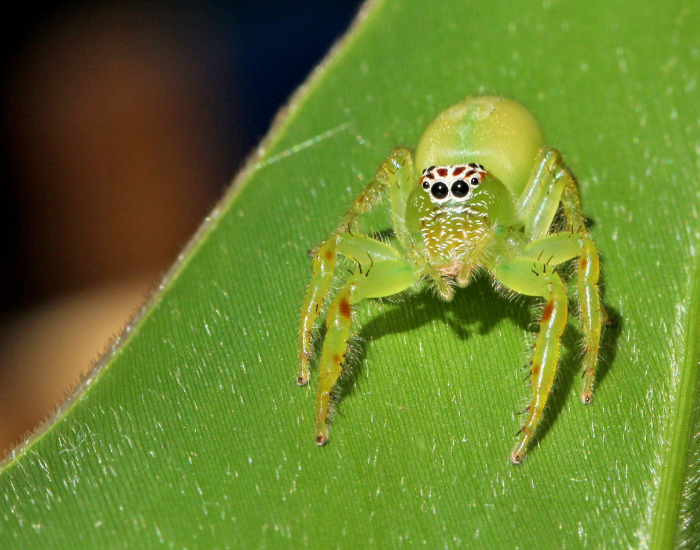
8. Peacock Spider (Maratus volans)
Four millimetres of pure display. Males lift a flap-edged abdomen like a fan, raise the third pair of legs, and dance. Girard and colleagues recorded the full performance and found it runs on two channels at once.
The visual half uses colourful, iridescent hairs in blue, red and cream. The other half is vibration. He slides sideways and drums the leaf to attract females. She watches, and if she is receptive she settles into a passive stance.
Mating ends with the male transferring sperm using his palps. Get the timing wrong and she may eat him. Australia now has well over a hundred described Maratus, and new ones appear most years.
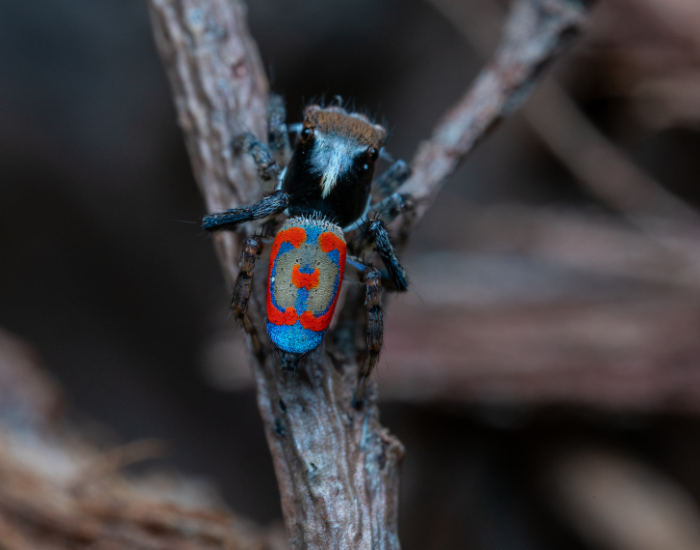
9. Coastal Peacock Spider (Maratus speciosus)
I spent three months in the south of Western Australia in 2024. A lot of it was within walking distance of this spider’s only known habitat. I never found one, and that is the honest version.
It lives solely in the vegetation of coastal sand dunes in southwestern Western Australia. Adults reach about 5 mm. Males are unique among peacock spiders for the bright orange hairs fringing both edges of the abdomen. Those hairs stay hidden until the display opens them out.
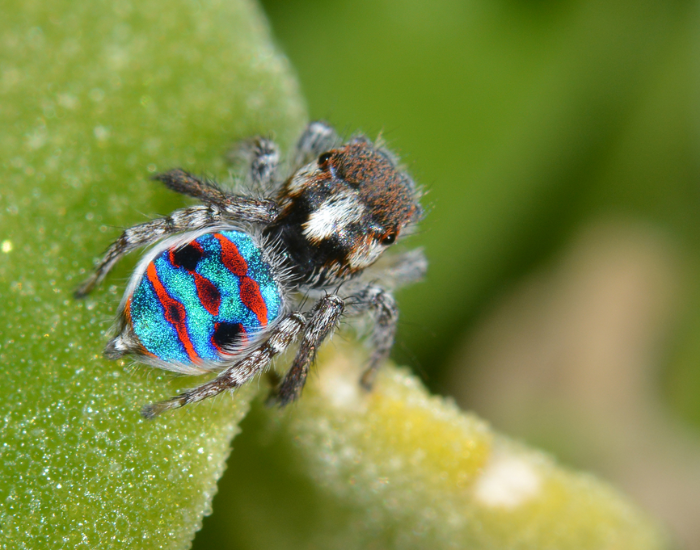
10. Ant-Mimicking Jumping Spiders (Myrmarachne spp.)
I have walked past hundreds of these and counted them as ants. That is the entire strategy. The genus holds 188 species, running from Africa through Asia to Australia.
The body is drawn out with a pinched waist, and males carry long forward-projecting jaws. High-speed cameras settled an old argument here. They walk on all eight legs, and raise the front pair like antennae only when stationary.
Looking like an ant buys protection, because many predators avoid ants. Some species go further and hunt the ants they imitate.
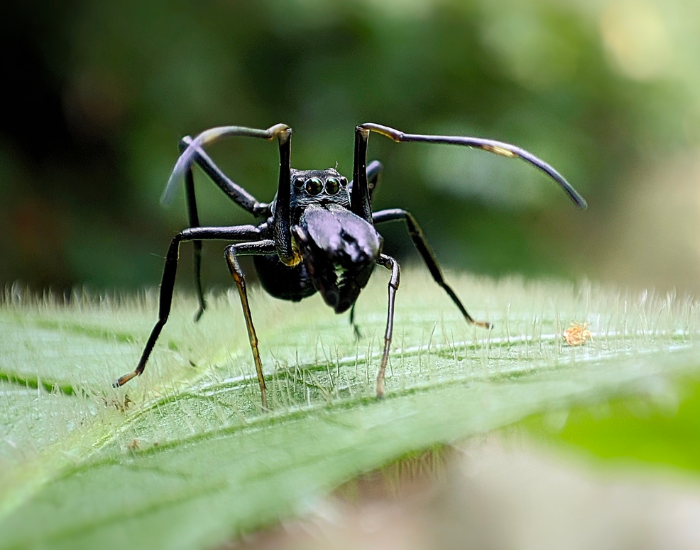
11. Fringed Jumping Spider (Portia fimbriata)
Queensland’s Portia is the most studied predator in the family, and it eats other spiders. Females run 6.8 to 10.5 mm. Researchers call them eight-legged cats, which undersells them.
Against dangerous prey, Portia takes a detour that breaks visual contact entirely. It plans the route, walks out of sight, then abseils in from behind. Some detours take a full hour.
Queensland animals also use cryptic stalking. They move so oddly that salticid prey fails to register them as an animal. In trials they succeeded against other jumping spiders 93 per cent of the time.
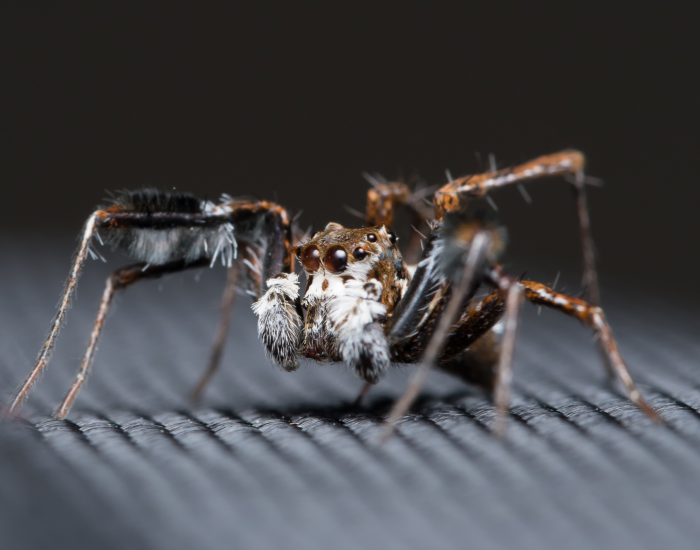
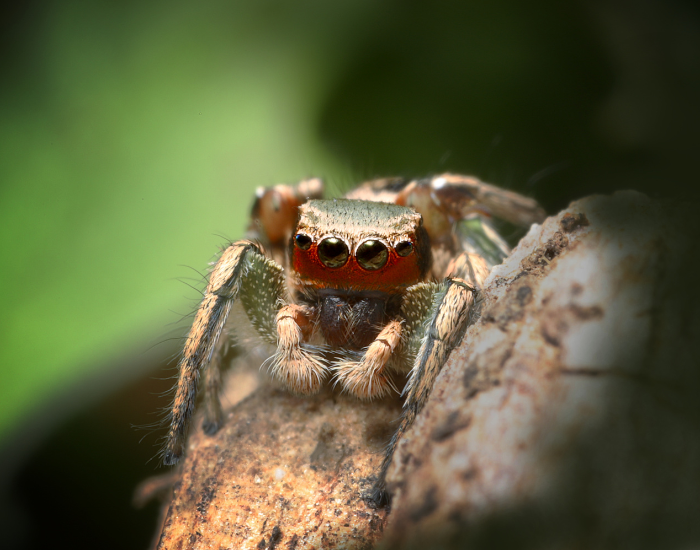
12. Paradise Jumping Spiders (Habronattus spp.)
Around 105 species and subspecies live across North America and into Central America. The nickname comes from the courtship, which invites comparison with birds-of-paradise. Males are extravagantly ornamented, females cryptic and plain.
This is the group behind the colour-vision work. The red retinal filter Zurek’s team described turns up here. It lines up neatly with the red faces and red legs the males wave about. Bright ornaments are only worth growing if someone can see them.
13. Giant Jumping Spider (Hyllus giganteus)
One of the largest jumping spiders in the world, and easily the most photographed. Adults run 18 to 25 mm in body length, which reads as enormous on a leaf.
It lives across Southeast Asia, with the type specimens from Sumatra. Females wear pale stripes around the face, a black band across the carapace and a mottled brown abdomen. Males mature darker, with fewer hairs and long chelicerae angling apart.
I have travelled through its range without ever putting a name to one. At that size you would not mistake it for anything else, so I assume I was simply unlucky.
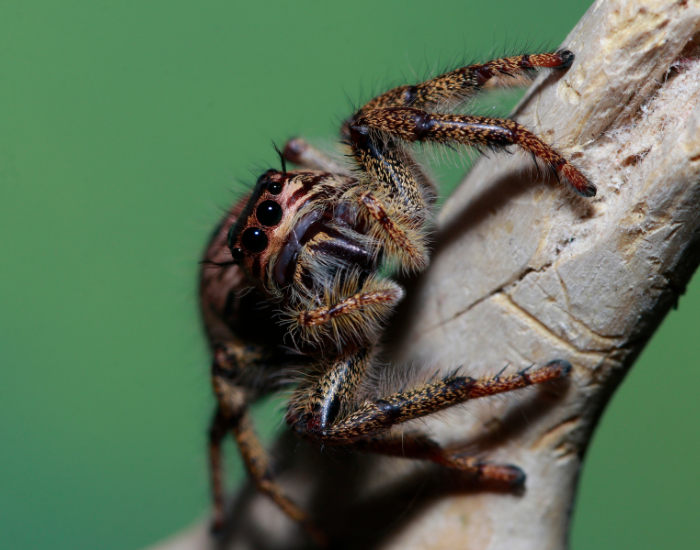
14. The Mostly Vegetarian Jumping Spider (Bagheera kiplingi)
Kipling gave this one its name, and it broke a rule everyone assumed was fixed. All spiders are predators. This one is not, or barely.
It lives on acacias in Mexico, Guatemala and Costa Rica, guarded by aggressive ants. Meehan and colleagues found that Beltian bodies make up over 90 per cent of its diet in Mexican populations, while Central American populations supplement them more heavily with nectar and ant larvae. Those are the protein-rich nubs the tree grows to feed its ants. Tissue chemistry reads like a herbivore’s.
It steals from the ants by dodging them, on speed and vision alone.
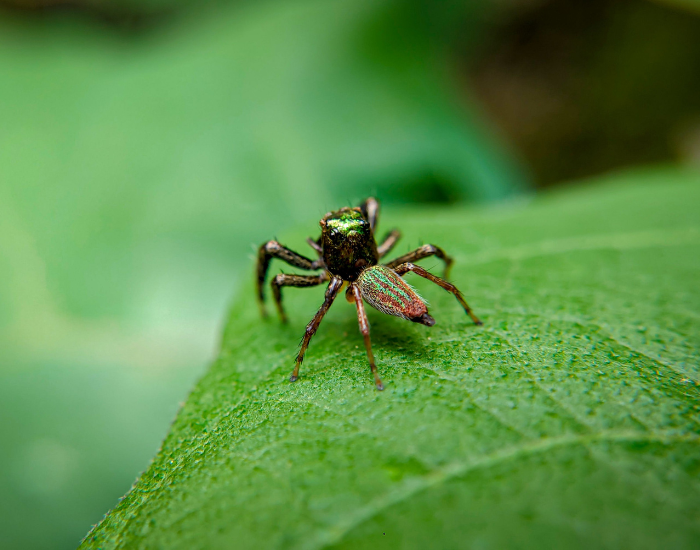
15. Himalayan Jumping Spider (Euophrys omnisuperstes)
The name means standing above all, and it earns it. This species lives at the highest confirmed elevation of any permanent resident animal on Everest. Wanless described it in 1975 from specimens collected at 5,900 metres.
Swan confirmed permanent residence from 5,500 to above 6,100 metres, though specimens observed near 6,700 metres likely survive on wind-blown organic debris and stray insects carried up the mountain by updrafts. Treat that higher figure as an extreme upper limit supported by wind-transported prey.
Females are about 5 mm, males smaller. Nothing grows up there. They survive on stray springtails and small flies blown up the mountain.
Frequently Asked Questions
Almost certainly jumping spiders, family Salticidae. They are small, stocky and fast, with two huge forward-facing eyes in a front row of four. Unlike most spiders, they do not build webs to catch food. They hunt in the open, in daylight, and turn to look at you.
You are seeing baby spiders after an egg sac hatched nearby. One egg sac holds 25 to 60 eggs, and spiderlings disperse two to four weeks later. They stay in the same area while food lasts. That usually means your house is supplying plenty of small insects, such as fruit flies near the bin.
No. A jumping spider bite is not medically significant, and most people rate it below a bee sting. Venom exists, but it is dosed for small insects and is not rapid acting in humans. Genuinely dangerous spiders are a short list, and this family is nowhere near it. Unlike black widows or an Australian funnel-web, they pose no medical concern. Medical attention is only warranted if symptoms worsen. Many of the smallest species cannot pierce human skin at all.
I would not. They are harmless, they do not infest, and they hunt the household insects you actually mind. That includes flies, small cockroaches, mosquitoes and the moths chewing your wardrobe. Free pest control with eight legs is a poor thing to spray. If one bothers you, cup it under a glass and put it on a plant outside.
Next Time, You Will know
Cute is doing real work here. Most people never look closely at a spider, but they will look at a jumping spider. Once they look, they ask questions. That is the whole conservation argument in miniature.
These are the most watchable spider species on the planet, and they cost nothing to find. Sit still in the sun at a campsite. Watch a warm wall, a fence rail, a leaf at chest height. One will turn up, and it will turn to face you.
Try your own garden first, then a rainforest or a desert, because they live in both. Tell me in the comments which ones you have found, especially anything I have missed.
Can You Name That Jumping Spider?
A 15-photo identification challenge — test your ability to spot jumping spider species by color, pattern, and form. Go back and change any answer before you score.
Which jumping spider species is this?
References:
Maddison, W. P. (2015). A phylogenetic classification of jumping spiders (Araneae: Salticidae). The Journal of Arachnology, 43(3), 231–292. https://doi.org/10.1636/arac-43-03-231-292
Meehan, C. J., Olson, E. J., Reudink, M. W., Kyser, T. K., & Curry, R. L. (2009). Herbivory in a spider through exploitation of an ant–plant mutualism. Current Biology, 19(19), R892–R893. https://doi.org/10.1016/j.cub.2009.08.049
Nabawy, M. R. A., Sivalingam, G., Garwood, R. J., Crowther, W. J., & Sellers, W. I. (2018). Energy and time optimal trajectories in exploratory jumps of the spider Phidippus regius. Scientific Reports, 8, 7142. https://doi.org/10.1038/s41598-018-25227-9
Nagata, T., Koyanagi, M., Tsukamoto, H., Saeki, S., Isono, K., Shichida, Y., Tokunaga, F., Kinoshita, M., Arikawa, K., & Terakita, A. (2012). Depth perception from image defocus in a jumping spider. Science, 335(6067), 469–471. https://doi.org/10.1126/science.1211667
Zurek, D. B., Cronin, T. W., Taylor, L. A., Byrne, K., Sullivan, M. L. G., & Morehouse, N. I. (2015). Spectral filtering enables trichromatic vision in colorful jumping spiders. Current Biology, 25(10), R403–R404. https://doi.org/10.1016/j.cub.2015.03.033