In 2019, on the Great Barrier Reef, I saw two things for the first time. One was a clownfish weaving through the tentacles of its anemone. The other was a patch of bleached coral, white as bone. Both scenes starred animals from the same group: the phyla Cnidaria.
Strictly speaking, Cnidaria is one phylum, though most people search for it in the plural. I studied cnidarians in my biology courses. Later, I met them diving and snorkelling in Southeast Asia, the Caribbean and the Red Sea. They range from coral polyps a few millimetres wide to sea jellies with tentacles longer than a blue whale. Some build reefs you can see from space, while others live as microscopic parasites inside fish.
Below, I explain what makes a cnidarian a cnidarian and how their two body plans work. Then I walk through 15 types worth knowing, class by class. If you’ve played with my Tree of Life explorer, this is the deeper dive into one of its strangest branches.
🪼 Can you name them on sight? Fifteen cnidarians, fifteen photos. Read on, then take the ID quiz at the end and see if you’re a Reef Architect or still stuck on the planula stage. Jump to the quiz ↓What Defines the Phyla Cnidaria?
Cnidaria takes its name from the Greek knidē, meaning nettle. Its defining feature is a set of specialized cells: stinging cells called cnidocytes. Each one holds a capsule, the nematocyst, with a coiled thread folded inside under enormous pressure. No other animal group builds them, so biologists use them to define the phylum.
Cnidarians also show radial symmetry, with body parts arranged around a central axis like slices of a pie. Echinoderms such as sea stars look radial too. However, their larvae are bilateral, so the resemblance is convergence rather than kinship.
Two Tissue Layers and a Jelly Middle
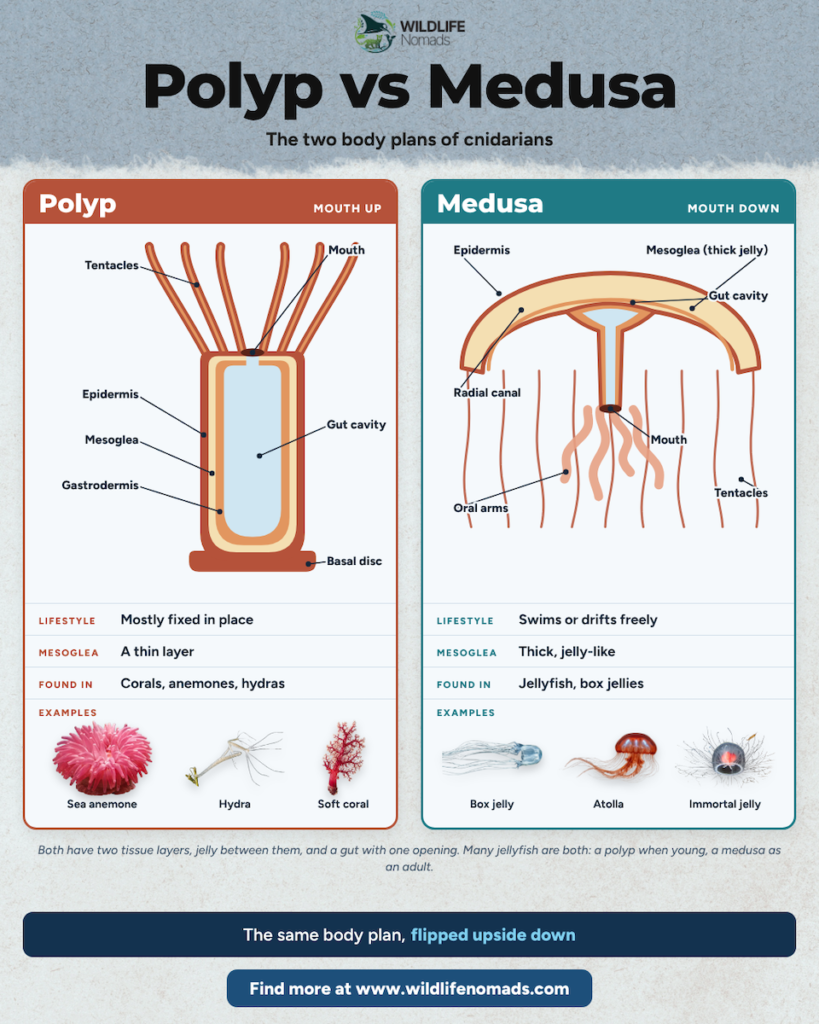
Cnidarians have only two tissue layers, which makes them diploblastic. The outer layer, the epidermis, protects the animal and carries most of the cnidocytes. The inner layer, the gastrodermis, lines the digestive cavity and absorbs nutrients. Between them sits the mesoglea, a jelly-like middle layer that gives a jellyfish its wobble.
Together, those three layers form the body wall. The gut is a gastrovascular cavity with only one opening, used for both eating and excreting. The mouth leads into a sac where enzymes break down prey. In jellyfish, radial canals then carry food particles from the stomach to the edge of the bell.
A Nervous System Without a Brain
Cnidarians have no centralized brain. Instead, a nerve net of nerve cells spreads through the body wall, linking sensory neurons to muscle cells. This simple nervous system still coordinates feeding and swimming movements. Many jellyfish also carry rhopalia, small sensory clubs that detect gravity and light intensity.
Two Body Plans: Polyp and Medusa
The polyp form is a tube with its oral end, mouth and tentacles, facing upward. It usually lives as a sessile polyp fixed to rock, coral or the ocean floor.
The medusa flips that design upside down: a free-floating, umbrella-shaped bell with tentacles hanging around the mouth. Corals and anemones stay polyps all their lives, whereas most jellyfish pass through both shapes. A polyp and a medusa can look like different animals, yet they are the same organism at different ages. Genomic evidence suggests the polyp came first, with medusa forms evolving later in Medusozoa.
How the Jellyfish Life Cycle Works
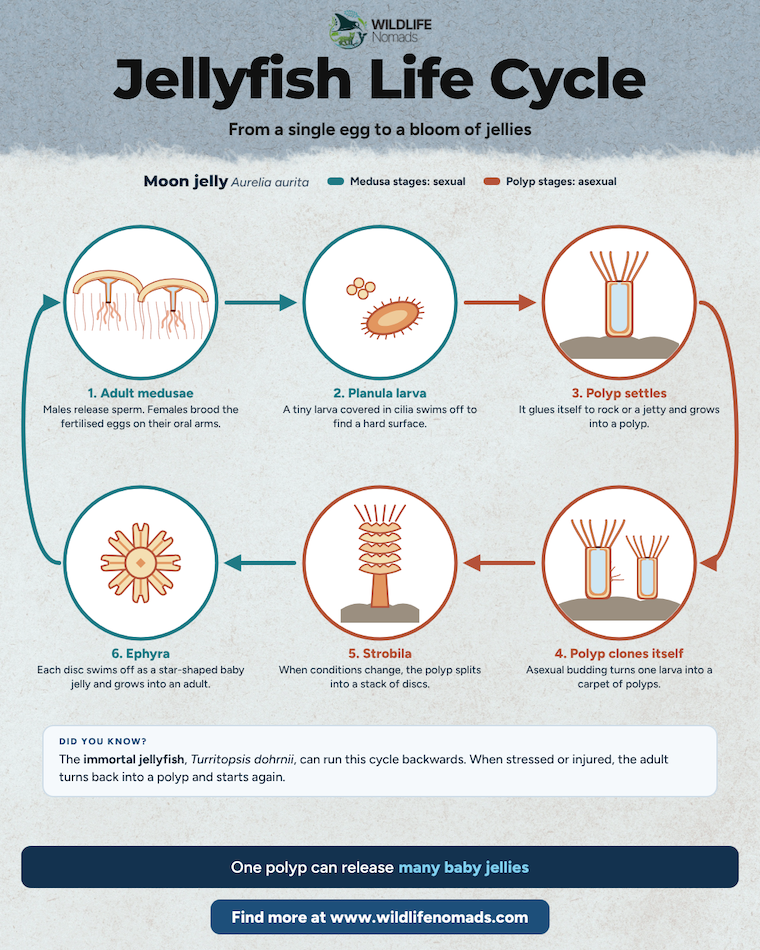
The classic jellyfish life cycle runs egg, planula, polyp, medusa. Adult medusae handle sexual reproduction, and many species spawn regularly whenever food is abundant. Each fertilized egg becomes a planula larva, a tiny ciliated swimmer that eventually attaches to a hard surface.
During the polyp stage, it can reproduce asexually, cloning new polyps from its sides. This asexual budding lets one larva carpet a jetty. Each polyp later stacks off juvenile jellies called ephyrae, which grow into the adult medusa stage. So cnidarians mix sexual and asexual phases, depending on the species and conditions.
Where Cnidarians Live and What They Eat
Most cnidarians are marine species, found from rock pools to deep trenches. A few, like Hydra and the freshwater jellyfish Craspedacusta sowerbyi, live in lakes and rivers. Jellyfish are carnivores that capture prey such as plankton, fish eggs, larvae and small fish.
Many cnidarians also farm sunlight. Reef corals, some anemones and the upside-down jellyfish Cassiopea host dinoflagellate algae called zooxanthellae inside their cells. In this symbiotic relationship, the algae use the host’s carbon dioxide and waste for photosynthesis. In return, the host receives sugars that can cover most of a reef coral’s energy needs.
15 Types of Cnidarians, Class by Class
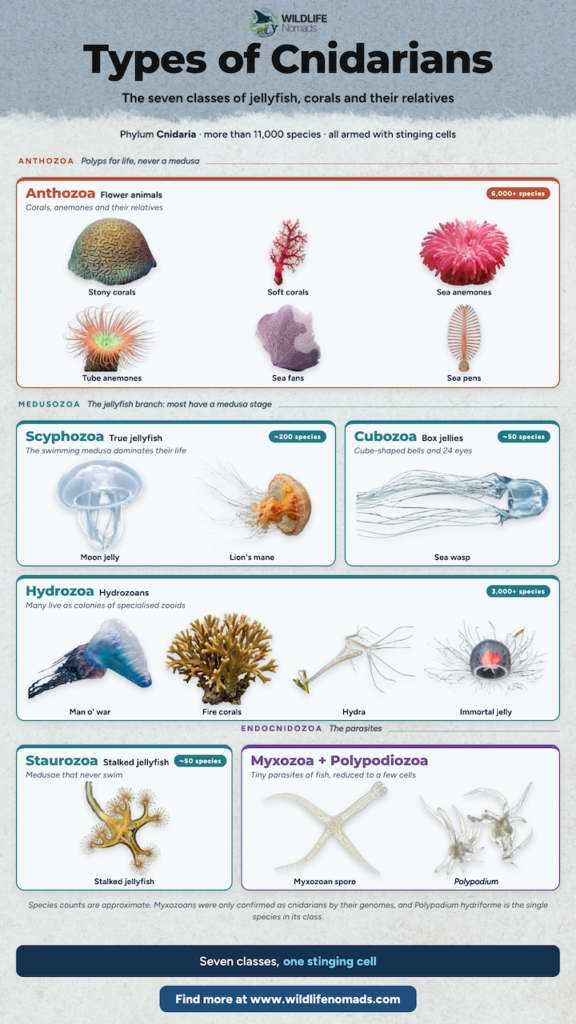
Older textbooks list four major classes: Anthozoa, Scyphozoa, Cubozoa and Hydrozoa. Today, most researchers add Staurozoa and the parasitic Myxozoa, plus one odd species, Polypodium. Together they form a diverse group of more than 11,000 described species.
Class Anthozoa: The Flower Animals
The class Anthozoa, Greek for “flower animals,” holds more than 6,000 described species. All are marine, and all live as polyps with no medusa phase.
1. Stony Corals (Scleractinia)
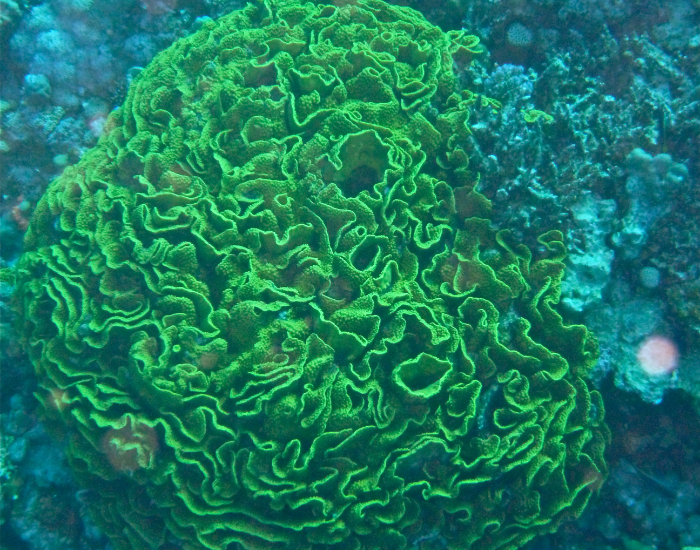
Stony corals are the reef builders. Each polyp secretes a cup of calcium carbonate beneath itself, and a colony can hold thousands of identical polyps. Over centuries, those skeletons pile up into coral reefs. Reefs cover well under 1% of the seafloor, yet they shelter roughly a quarter of known marine life.
In 2025, Wildlife Nomads joined a coral restoration project in Pemuteran, Bali, with the non-profit Metamorfosa Bali. We planted coral and met co-founder Ketut Totok. Seeing a broken fragment get a second chance changed how I think about reefs.
2. Soft Corals (Octocorals)
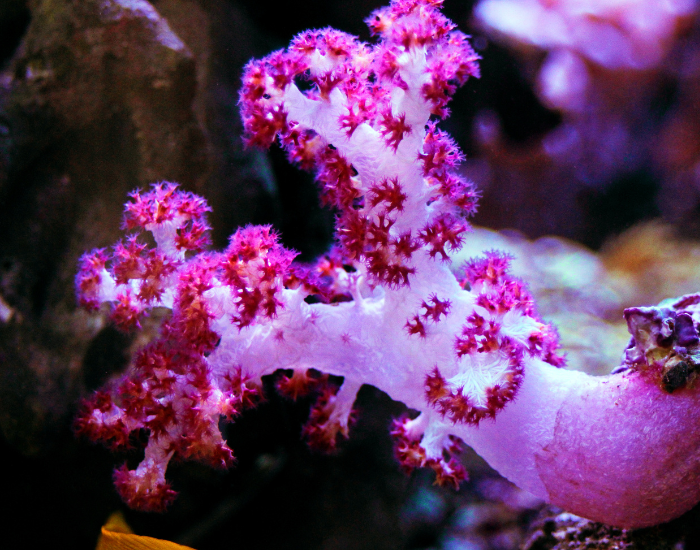
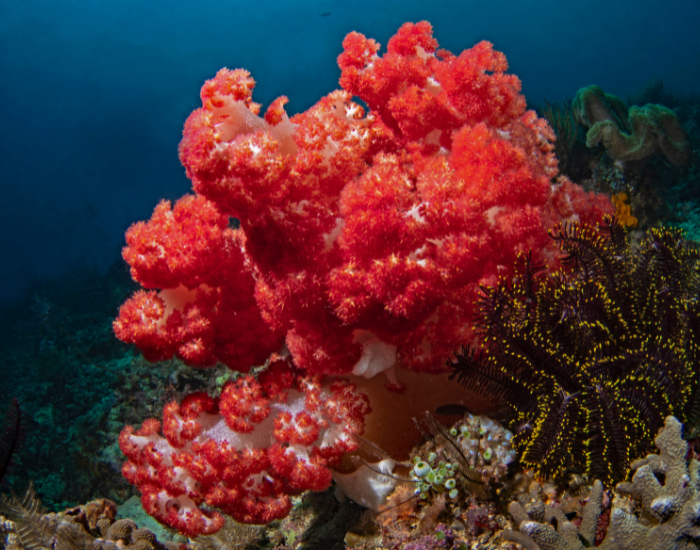
Soft corals lack a solid skeleton. Instead, tiny mineral spicules called sclerites stiffen their fleshy bodies, so colonies bend with the current. Each polyp has eight feathery tentacles, the mark of an octocoral. Some of the most beautiful coral I’ve seen grew around Coron, in Palawan, where the reef felt like another planet.
3. Sea Anemones and Tube Anemones
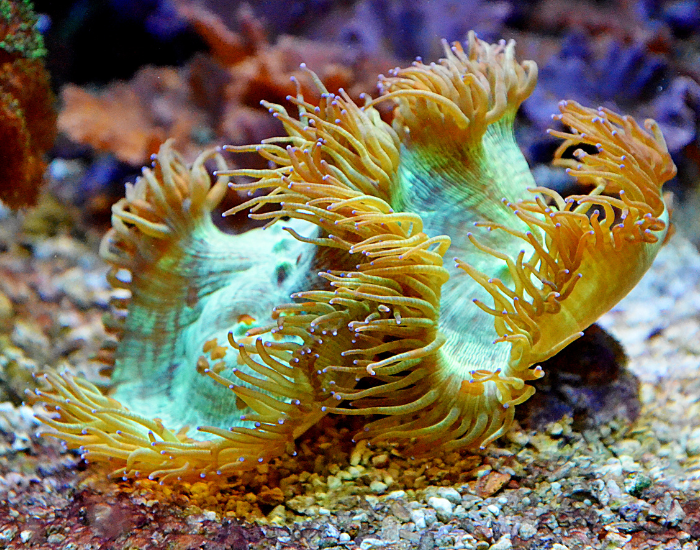
Sea anemones are solitary polyps, with more than 1,000 species worldwide. A muscular foot anchors them, though many can glide slowly or let go. They also reproduce asexually by splitting in two or leaving torn fragments that regrow. Clownfish survive among the tentacles thanks to a mucus coat that dampens the stinging response.
Tube-dwelling anemones belong to a separate order, Ceriantharia. They live inside felt-like tubes woven from mucus and a special type of cnida.
4. Gorgonians: Sea Fans and Sea Whips
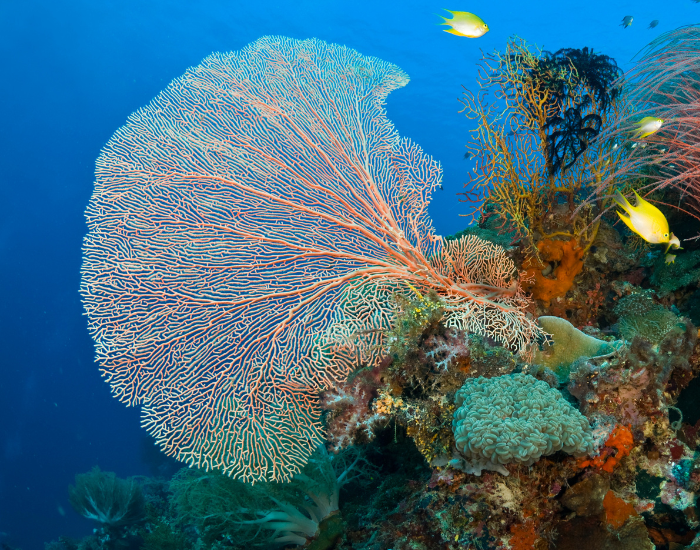
Gorgonians are octocorals with a flexible protein skeleton called gorgonin. Sea fans grow as flat lattices set across the current, a shape that maximizes surface area for catching plankton. Sea whips, meanwhile, grow as long single rods. Cozumel’s reef walls, where I’ve dived, are famous for sea fans taller than a person.
5. Sea Pens
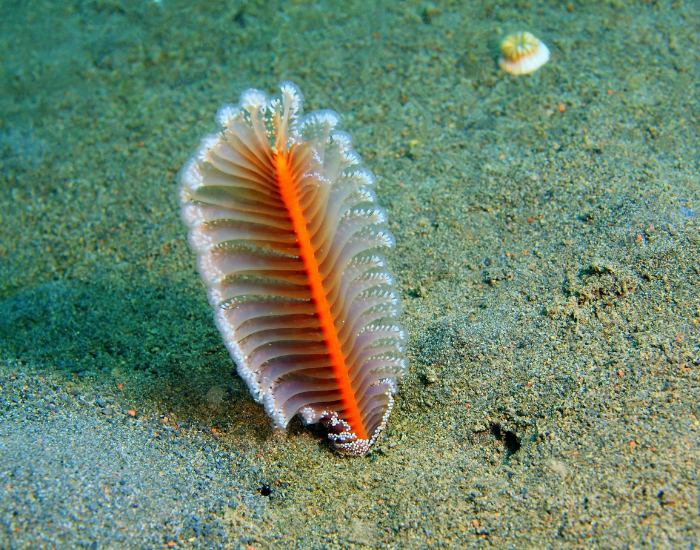
Sea pens are colonial octocorals that resemble old quill pens planted in sand or mud. One primary polyp forms the anchoring stalk, while smaller polyps feed or pump water. Many live far below sunlight, alongside the animals in my deep-sea dive.
Class Scyphozoa: The True Jellyfish
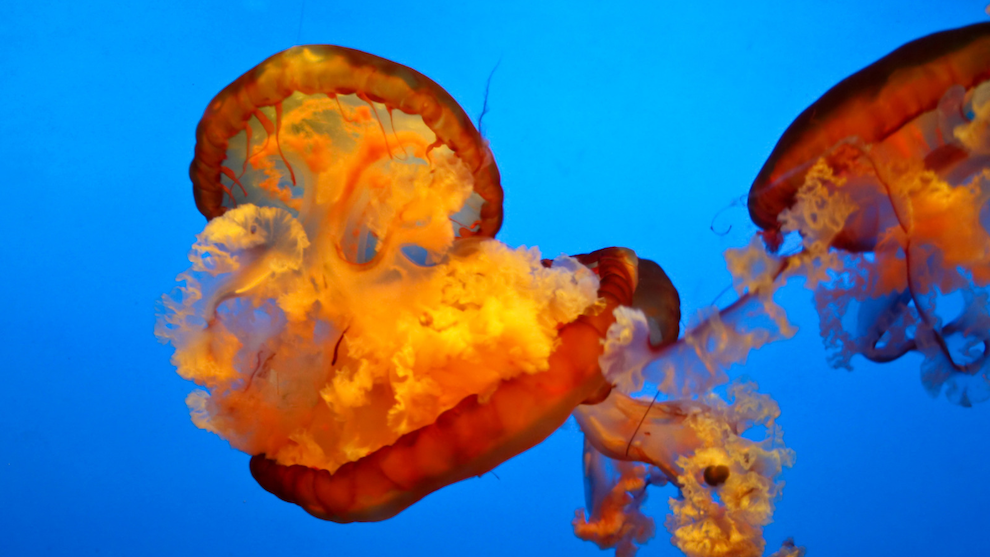
Scyphozoa contains around 200 species. These are the animals most people picture when they hear “jellyfish,” because the free-swimming medusa dominates their lives.
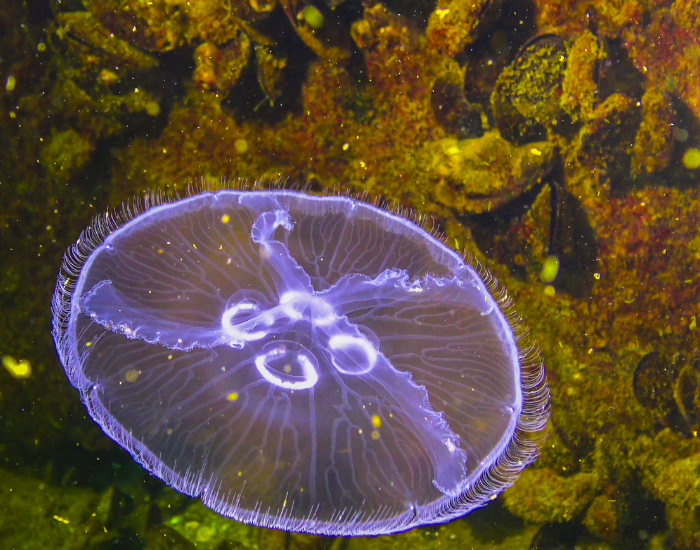
6. Moon Jelly (Aurelia aurita)
The moon jelly is the textbook jellyfish, recognizable by four horseshoe-shaped gonads inside a clear bell. Rather than lunging, it traps plankton in mucus on its bell and short tentacles. Cilia then sweep the food to four oral arms.
7. Lion’s Mane Jellyfish (Cyanea capillata)
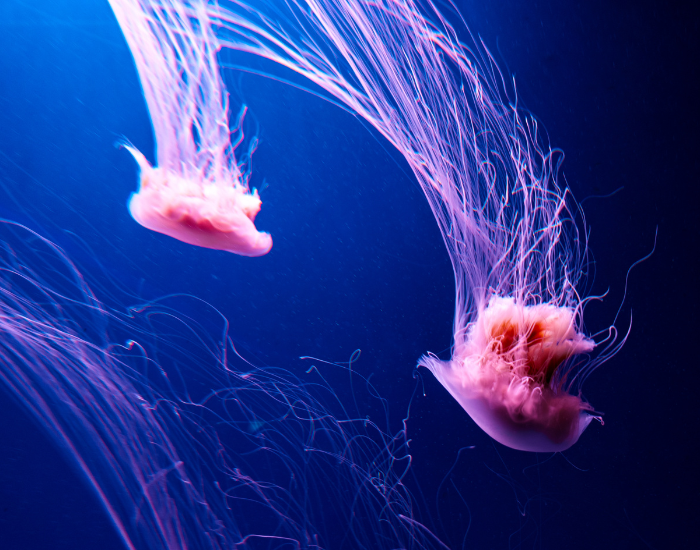
The lion’s mane ranks among the biggest jellyfish in the world. A specimen measured in 1870 had a bell about 2.3 metres wide and tentacles around 36 metres long. It drifts through cold northern waters, sweeping up plankton, comb jellies and other cnidarians.
Class Cubozoa: Box Jellyfish
Cubozoa holds roughly 50 species with cube-shaped bells. Box jellies are active hunters rather than passive drifters, and they carry the most sophisticated eyes in the phylum.
8. Sea Wasp (Chironex fleckeri)
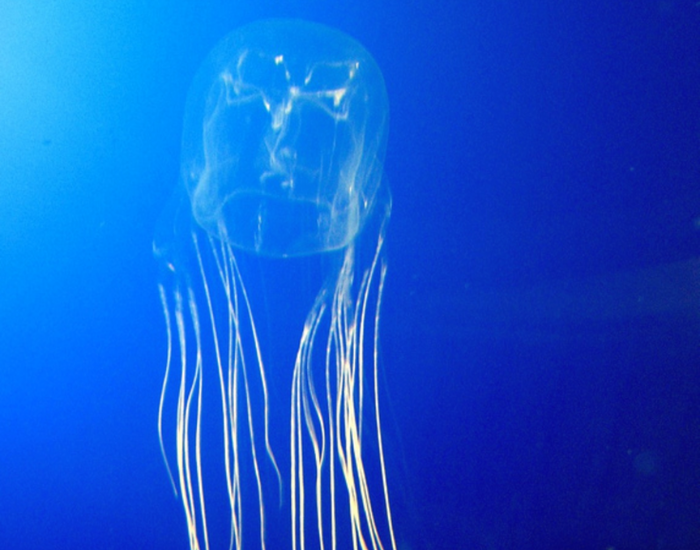
The sea wasp lives in northern Australian waters and is the largest box jellyfish. Its bell reaches about 30 cm, with up to 15 tentacles trailing from each corner. It carries 24 eyes on four sensory clubs, and some of those eyes have lenses that form images. A related species uses them to steer by the mangrove canopy above the water (Garm et al., 2011).
In tropical Queensland, stinger season runs roughly from November to May, when lycra stinger suits appear on every beach. My box jellyfish facts post covers its venom and first aid.
9. Irukandji Jellyfish (Carukia barnesi)
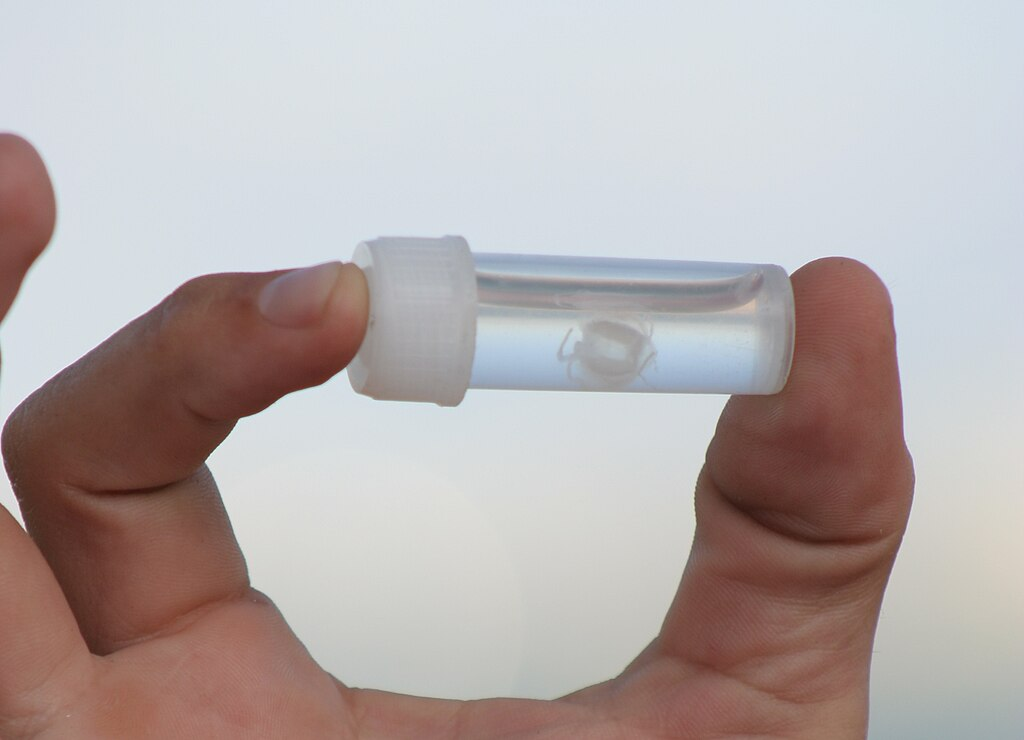
The Irukandji jellyfish has a bell only about a fingernail wide. Unusually, it carries nematocysts on its bell as well as its tentacles. The sting feels mild at first. Then, 20 to 40 minutes later, Irukandji syndrome can bring severe back pain, vomiting and soaring blood pressure. Compare it with other stingers in my venomous animals index.
GondwanaGirl | via Wikimedia Commons
Class Hydrozoa: Hydroids, Siphonophores and More
Hydrozoa is the most varied class, with more than 3,000 species in salt and fresh water. Many form colonies where specialized zooids divide the work.
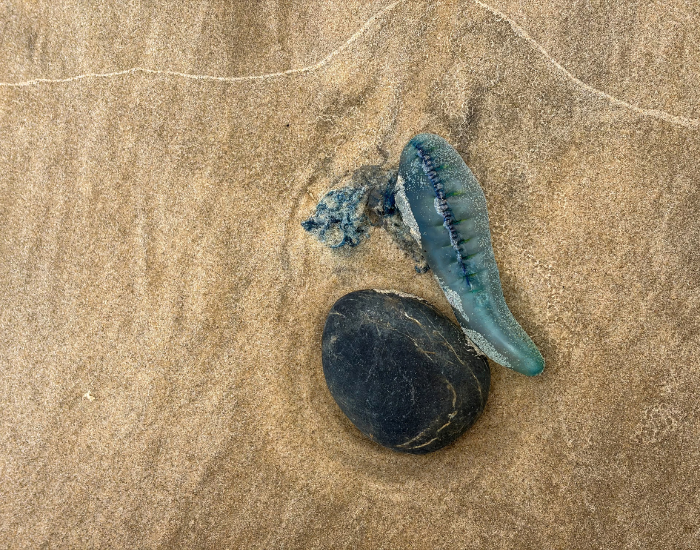
10. Portuguese Man o’ War (Physalia physalis)
The Portuguese man o’ war isn’t one jellyfish but a siphonophore, a colony of zooids. One forms the gas float, while others feed, sting or reproduce. None can survive alone. Its tentacles usually stretch about 10 metres, and occasionally far longer.
Australians know its Pacific relative as the bluebottle. Remarkably, young blanket octopuses carry torn man o’ war tentacles as weapons, one of my favourite octopus facts.
11. Fire Corals (Millepora)
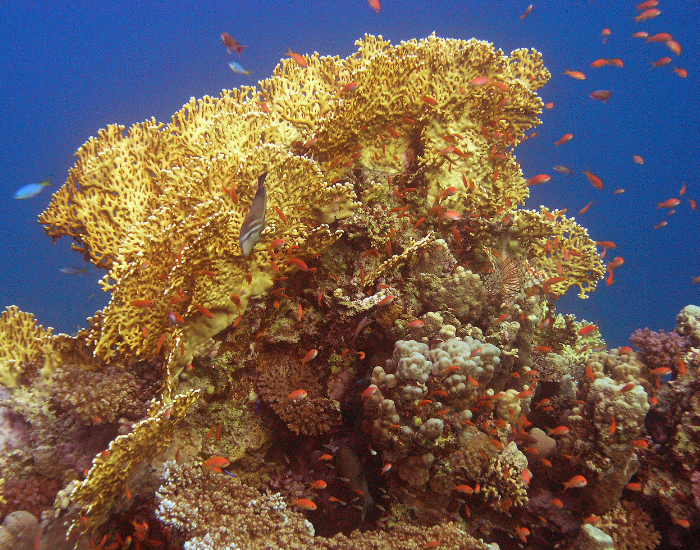
Fire corals aren’t true corals at all. They are hydrozoans that lay down calcium carbonate skeletons, often mustard-yellow with pale tips. Tiny hair-like stinging polyps poke out through pores and deliver a burning sting. They’re common on the Red Sea reefs I snorkelled off Marsa Alam, so I gave them space.
12. Hydra and Hydroids
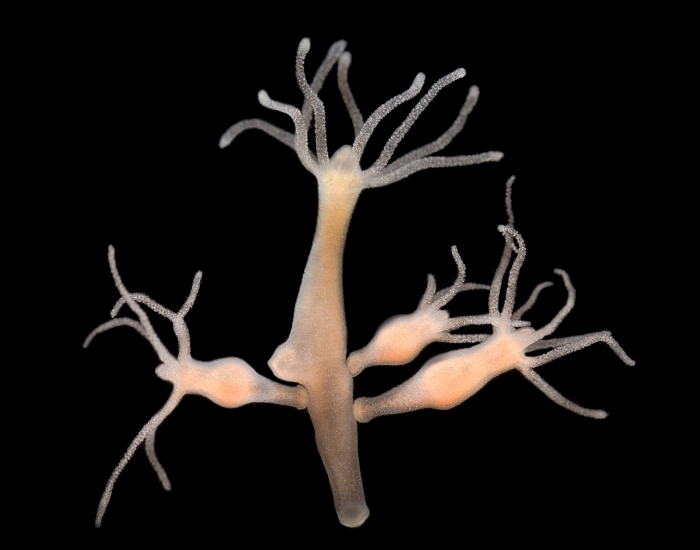
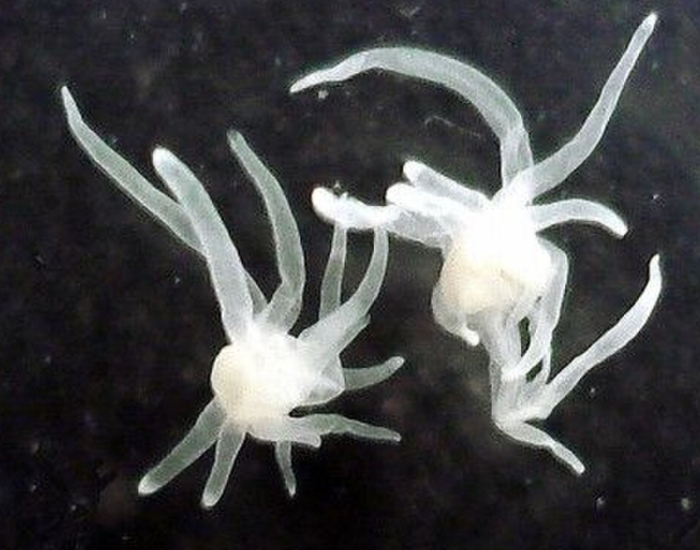
Hydra is a freshwater polyp about a centimetre long that never makes a medusa. It mostly reproduces by budding, and it can replace lost body parts with ease. Even a scrambled clump of its cells can reassemble into the original shape.
Marine hydroids are its colonial relatives, often mistaken for seaweed on wharf pilings. Nudibranchs graze on them. Some even store the hydroids’ unfired stinging cells for their own defence.
13. Immortal Jellyfish (Turritopsis dohrnii)
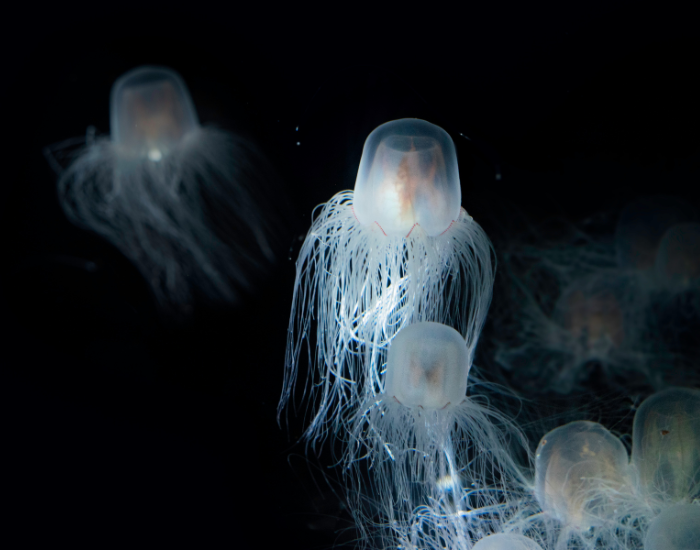
This hydrozoan medusa is only about 4.5 mm wide, yet it can reverse its own ageing. When stressed or injured, it turns back into a polyp by converting specialized cells into other cells. A 2022 genome study linked this trick to extra copies of DNA repair and protection genes (Pascual-Torner et al., 2022). See how it compares in my animal lifespan tool.
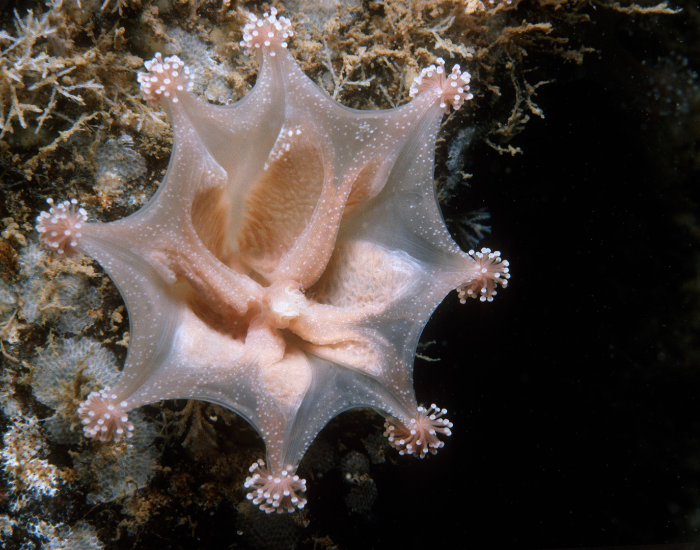
14. Stalked Jellyfish (Lucernaria, Class Staurozoa)
Stalked jellyfish are medusae that never swim. Each one clings to seaweed or rock by a stalk, holding eight arms tipped with clusters of knobbed tentacles. Around 50 sessile species live mostly in cold, shallow waters.
15. Myxozoa and Polypodium hydriforme
Myxozoans are tiny animals reduced to a few cells that parasitize fish and invertebrates. Their polar capsules turned out to be modified nematocysts. Genomes then confirmed them as highly derived cnidarians (Chang et al., 2015). One species, Henneguya salminicola, has even lost the genes for oxygen-based respiration.
Polypodium hydriforme is the only species in Polypodiozoa. It grows inside the eggs of sturgeons and paddlefish, then escapes when the fish spawn. These two lineages show how far cnidarians range from the reef-builders we know.
What Cnidarians Teach Us About Venom, Reefs and Blooms
Nematocysts Fire in Nanoseconds
Each cnidocyte responds to touch and chemical signals from prey. When triggered, the capsule fires in about 700 nanoseconds, accelerating at over five million g (Nüchter et al., 2006). The thread turns inside out, pierces the target and injects venom. Most nematocysts sit on tentacles and around the mouth, and each fires only once.
Sting strength varies enormously between species. Most cnidarians can’t push a thread through human skin, while box jellies can kill. Comb jellies look similar but belong to a separate phylum, Ctenophora. They catch prey with sticky cells instead of stinging cells.
Bleaching and Acidification Hit Reefs Hard
When water stays too warm, corals expel their zooxanthellae and turn white. Repeated marine heatwaves have triggered mass bleaching on the Great Barrier Reef since 2016 (Hughes et al., 2017). Meanwhile, the ocean absorbs carbon dioxide, which lowers the carbonate corals need to build skeletons. You can watch heat stress unfold in my coral reef bleaching simulator.
Jelly Blooms Are More Complicated Than Headlines Suggest
Are jellyfish taking over the oceans? A global analysis found no clear long-term rise, only roughly 20-year oscillations (Condon et al., 2013). Local blooms still matter, because they eat fish eggs and juvenile fish. When a bloom dies, carcasses sink through the water column, carrying nutrients and carbon to the deep.
FAQ About Phylum Cnidaria
Jellyfish belong to the phylum Cnidaria. So yes, a jellyfish is a cnidarian, alongside corals, sea anemones and hydroids. True jellyfish sit in the class Scyphozoa, while box jellyfish form Cubozoa.
Common examples include stony corals, soft corals, sea anemones, sea pens and gorgonians. Jellyfish examples include the moon jelly, lion’s mane and box jellyfish. Hydrozoans add the Portuguese man o’ war, fire corals and freshwater Hydra.
It’s Turritopsis dohrnii, nicknamed the immortal jellyfish. When stressed, the adult medusa transforms back into a polyp and restarts its life cycle. It can still die from predators or disease.
Explore More Cnidarians
The phyla Cnidaria proves that a simple body plan can produce astonishing variety. From reef architects to oxygen-free parasites, one stinging cell has powered them for over 500 million years.
Next time you snorkel a reef or walk a windy beach, count how many types you can spot. Then dive into my deep-sea species explorer or read about sea slugs that steal cnidarian stings. Which cnidarian have you met in the wild? Tell me in the comments.
Name That Cnidarian 🪼
Fifteen photos from this post. Look closely, pick a name, and build a streak before the stingers get you.
Want more? Dive into the Coral Reef Explorer, meet the biggest jellyfish in the world, or explore the Tree of Life.
References:
Chang, E. S., Neuhof, M., Rubinstein, N. D., Diamant, A., Philippe, H., Huchon, D., & Cartwright, P. (2015). Genomic insights into the evolutionary origin of Myxozoa within Cnidaria. Proceedings of the National Academy of Sciences, 112(48), 14912–14917. https://doi.org/10.1073/pnas.1511468112
Condon, R. H., Duarte, C. M., Pitt, K. A., Robinson, K. L., Lucas, C. H., Sutherland, K. R., et al. (2013). Recurrent jellyfish blooms are a consequence of global oscillations. Proceedings of the National Academy of Sciences, 110(3), 1000–1005. https://doi.org/10.1073/pnas.1210920110
Garm, A., Oskarsson, M., & Nilsson, D.-E. (2011). Box jellyfish use terrestrial visual cues for navigation. Current Biology, 21(9), 798–803. https://doi.org/10.1016/j.cub.2011.03.054
Hughes, T. P., Kerry, J. T., Álvarez-Noriega, M., Álvarez-Romero, J. G., Anderson, K. D., Baird, A. H., et al. (2017). Global warming and recurrent mass bleaching of corals. Nature, 543(7645), 373–377. https://doi.org/10.1038/nature21707
Kayal, E., Bentlage, B., Pankey, M. S., Ohdera, A. H., Medina, M., Plachetzki, D. C., Collins, A. G., & Ryan, J. F. (2018). Phylogenomics provides a robust topology of the major cnidarian lineages and insights on the origins of key organismal traits. BMC Evolutionary Biology, 18, 68. https://doi.org/10.1186/s12862-018-1142-0
Nüchter, T., Benoit, M., Engel, U., Özbek, S., & Holstein, T. W. (2006). Nanosecond-scale kinetics of nematocyst discharge. Current Biology, 16(9), R316–R318. https://doi.org/10.1016/j.cub.2006.03.089
Pascual-Torner, M., Carrero, D., Pérez-Silva, J. G., Álvarez-Puente, D., Roiz-Valle, D., Bretones, G., et al. (2022). Comparative genomics of mortal and immortal cnidarians unveils novel keys behind rejuvenation. Proceedings of the National Academy of Sciences, 119(36), e2118763119. https://doi.org/10.1073/pnas.2118763119