
The first time I heard someone in Louisiana call an animal a “nutria,” I assumed we were talking about an otter. As a Spanish-speaking biologist, “nutria” was always the word my family used for the sleek otters that flip rocks in cold rivers. So when a local pointed at a stocky, orange-toothed creature waddling out of a canal, my brain short-circuited. That confused moment is exactly why I am writing about coypus today.
Coypus are not otters. They are not beavers. They are not capybaras. And they are not muskrats. Yet I have watched seasoned naturalists tangle these names together, often with real consequences for conservation work. The coypu story is messy, fascinating, and tangled across three continents and several languages.
In this guide I will share 12 coypus facts that cleared up my own confusion, drawn from peer-reviewed science and from years of watching this animal in the wild. By the end you will know exactly what a coypu is, why nutria is its other name, and how a single South American rodent became one of France’s most stubborn wildlife problems.
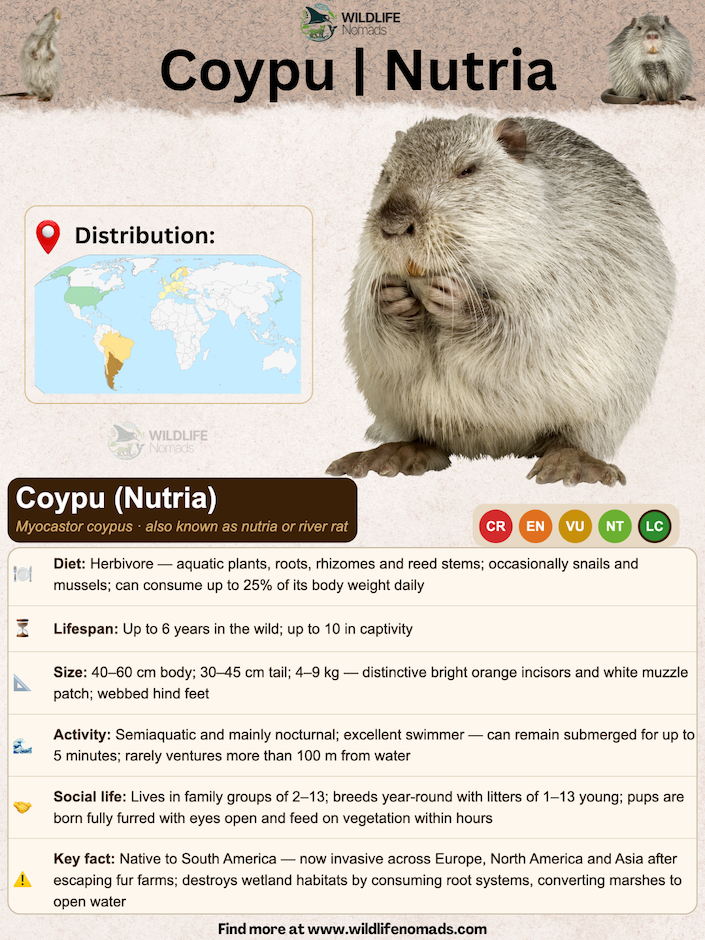
1. Coypus are a Kind of a Rodent, Not an Otter
Despite the Spanish word “nutria” meaning otter across most of Latin America, the coypu is a large rodent in the family Myocastoridae. In English, “nutria” refers exclusively to this species. The confusion runs both ways, especially when bilingual field biologists like me cross paths with North American hunters or French wildlife managers.
Coypus share the order Rodentia with rats, beavers, capybaras, and guinea pigs. Its closest living relatives sit in the same suborder as porcupines and chinchillas, which surprised me when I first compared their skulls. So the next time you hear someone mention nutria in Louisiana, picture a rodent the size of a house cat, not a sleek otter slipping through the rivers.
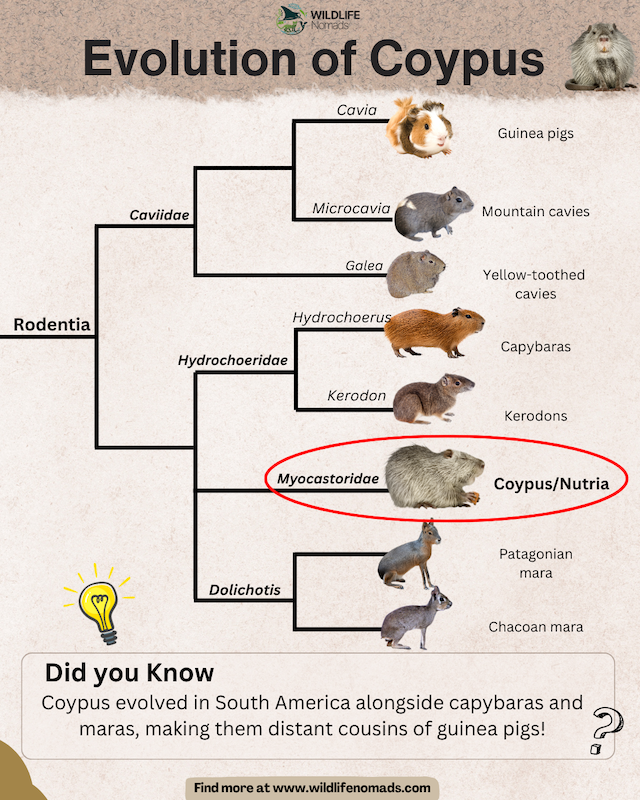
2. A Beaver-Capybara Lookalike, But Neither
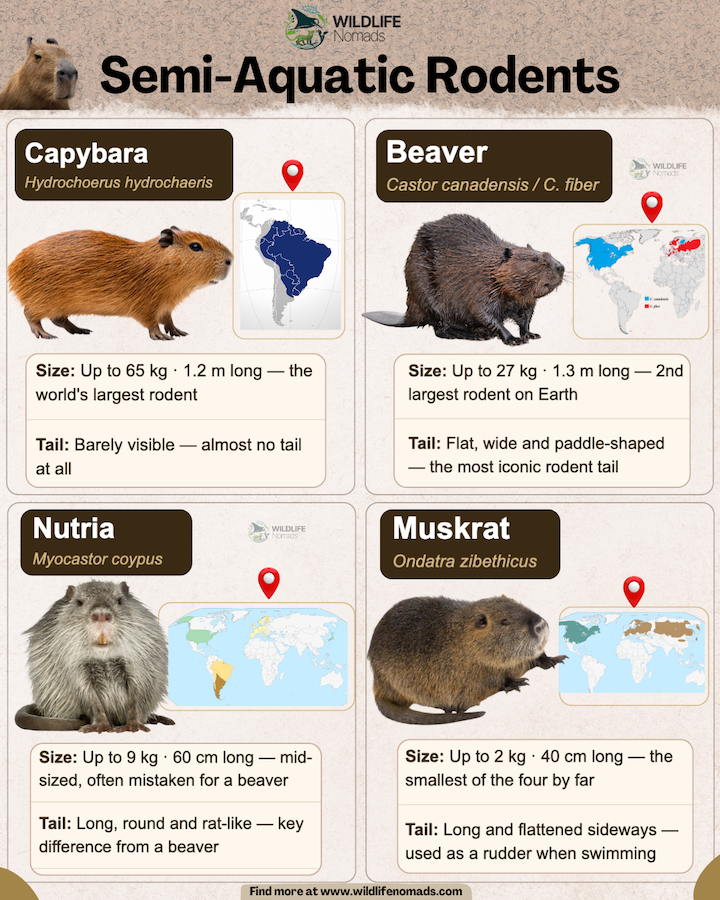
When I first saw a photograph of a coypu in the wild, I sent the image to a colleague and asked, “Beaver or capybara?” Her answer was a laugh and a single word: “Neither.” Adults look like a chunky brown rodent with a beaver’s body weight, a capybara’s face, and a long, rope-like rat tail. That tail is one of its most distinguishing features.
A beaver has a flat, paddle-shaped tail. A capybara has almost no tail at all. The coypu tail is round, scaly, and surprisingly rat-like. Once you spot the tail, you will never confuse coypus with a beaver again.
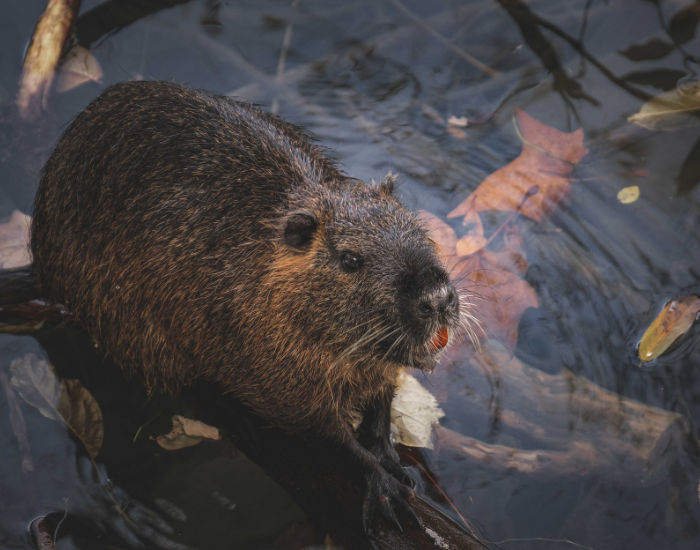
3. Coypu Size and Body Weight Surprised Me
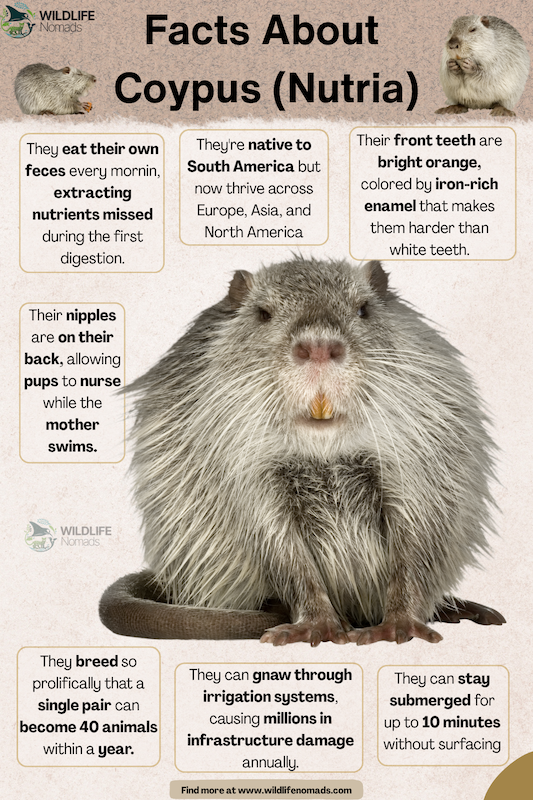
In the field, fully grown coypus measure about 90 to 100 centimeters in body length, including the tail. The body weight of healthy adults runs between 5 and 9 kilograms, with some males pushing 10 kilos. That puts them well above any rabbit and far heavier than most rats.
Coypu size matters because casual observers underestimate them. From a boat at dusk, a coypu can look harmless. Up close, those orange incisors and that body weight tell a different story. I once helped a friend pull a small dog out of a coypu’s territorial dispute, and the rodent stood its ground with impressive confidence.
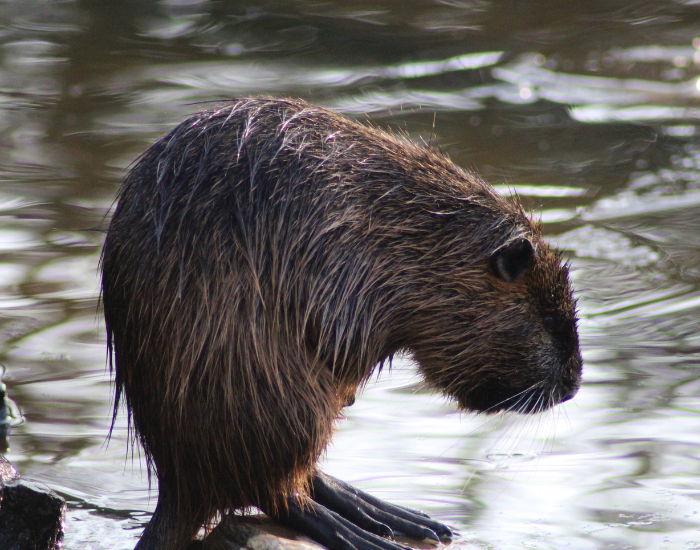
4. Native to Southern South America
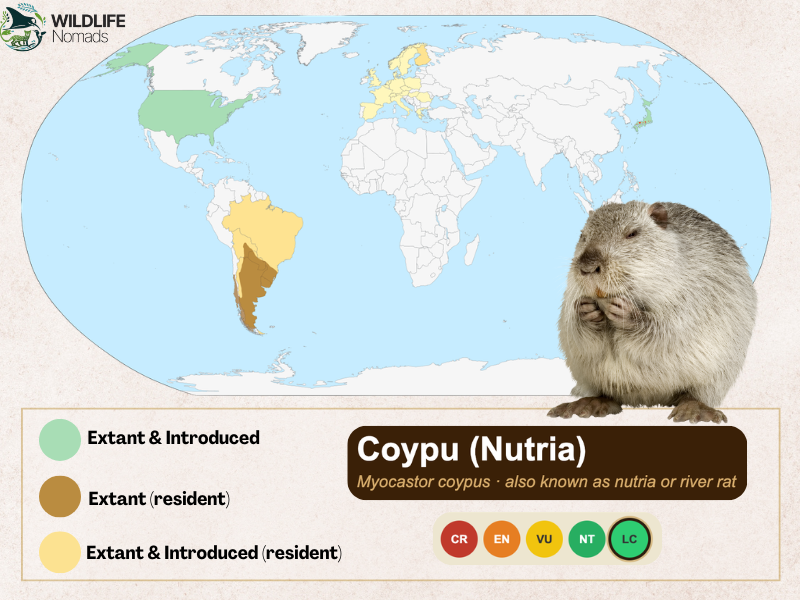
Coypus are native to the rivers, lakes, and marshes of southern South America. Wild populations live across Argentina, Uruguay, Chile, Paraguay, and parts of Brazil and Bolivia. In its native range, the coypu is a normal piece of the environment, not a pest.
Local predators keep coypus populations in check. Jaguars, caimans, birds of prey, pumas, and large foxes all hunt coypus across Brazil’s wetland regions. I once tracked coypus signs along a marsh in northern Argentina and found jaguar prints nearby on the same muddy ground. That kind of natural balance simply does not exist where the coypu has been introduced.
5. Webbed Rear Feet Built for Swimming
Coypus are built for water. Their webbed rear feet propel them through canals, marshes, and slow rivers with surprising speed. The front feet are not webbed and look almost hand-like, perfect for grasping plants and roots while feeding.
I have watched a coypu dive, hold its breath for nearly two minutes, and surface 15 meters away. The webbed rear feet do most of the work while the long tail trails behind like a rudder. Swimming, not running, is what this animal does best. On land, coypus are awkward and slow, which is why most predators catch them on the river banks rather than in the water.
6. Soft Dense Grey Underfur Launched the Fur Trade
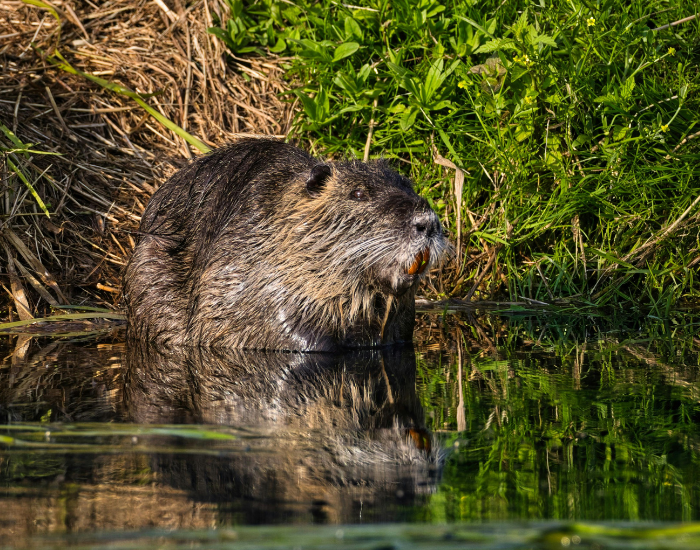
Beneath the coarse outer hair, coypus carry a layer of soft dense grey underfur. That underfur is what launched the global fur trade for this species in the early 1900s. Fur farming operations sprang up across Europe, North America, and parts of Asia, and coypus fur was marketed as a cheaper alternative to beaver pelts.
Fur farms in France, Louisiana, Oregon, and the United Kingdom imported thousands of breeding animals. When the fur trade collapsed mid-century, owners released coypus into the wild rather than pay to feed them. That single decision is the root of nearly every invasive coypus population alive today. Fur farming created the problem we are still cleaning up.

7. Coypus in France Became a National Headache
Few countries have struggled with coypus the way France has. After the collapse of French fur farms in the 1930s, escaped and released coypus colonized rivers, marshes, and canal networks across the country. Today, the silhouette of a coypu swimming a French river is a familiar sight in Brittany, Normandy, and the Camargue.
France now spends millions of euros annually on control efforts. In some French départements, hunters and trappers receive bounties for each coypus removed. I spent a season helping a French research team monitor coypus in a marsh near Nantes, and the scale of the problem in France genuinely shocked me. Rodents in France do not get more controversial than this one.
French farmers blame coypus for damage to rice fields, sugar beet farms, and irrigation canals. French wildlife agencies, meanwhile, document coypus impacts on native species, including ground-nesting birds and aquatic vegetation. Ask anyone working in French wetland conservation and you will get a long, frustrated answer about coypus.
8. Born Fully Furred With Open Eyes
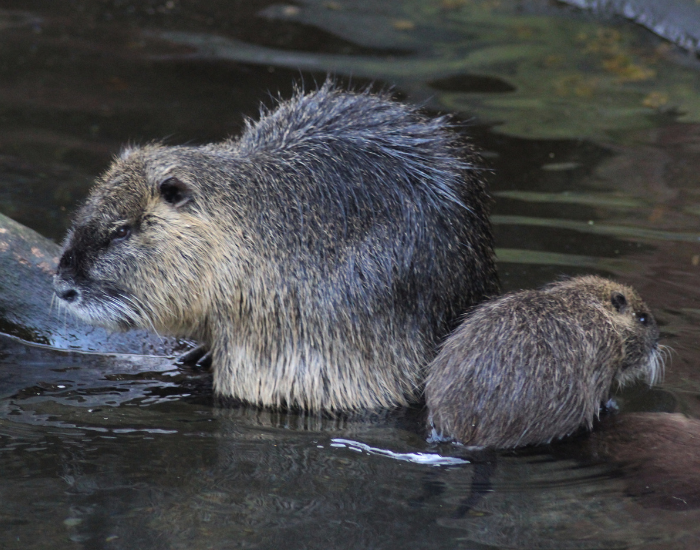
Young are born remarkably advanced. Newborns arrive fully furred, with open eyes, fully formed teeth, and the ability to swim within hours. Within a day, the young will eat vegetation alongside the mother. Compare that to a newborn rat, which is pink, blind, and helpless for two weeks.
A female can produce two or three litters per year, with four to six young per litter. That reproductive speed, combined with precocial young, explains why introduced populations explode. Once a few dozen coypus escape into a new environment, the math gets ugly fast. By the end of a single warm winter, that founding group can balloon into hundreds of adults.
9. Feeding Habits That Cause Serious Damage
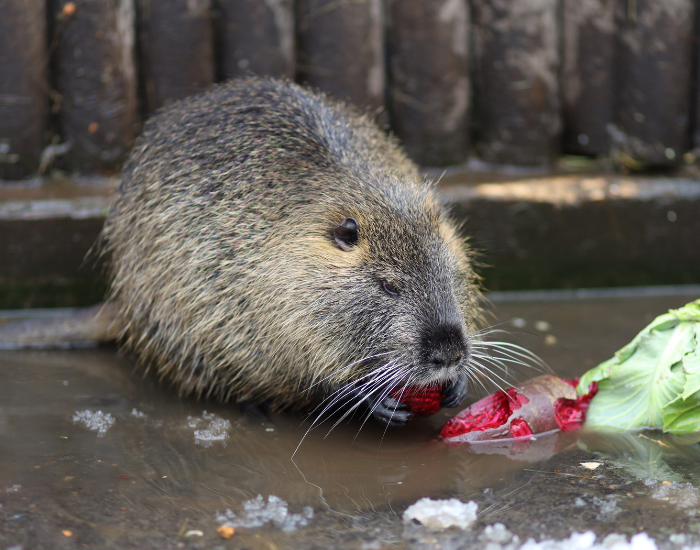
They eat vegetation almost exclusively. Their feeding habits center on aquatic vegetation, roots, sedges, and the soft tissue at the base of marsh plants. A single adult can consume up to 25 percent of its body weight in plants every day. They will also eat agricultural crops, including corn, rice, sugarcane, and the produce growing on small farms near water.
That appetite causes serious damage to wetland habitats. By chewing through the root systems that hold marshes together, coypus accelerate erosion of river banks and convert vegetated wetlands into open mud flats. Louisiana has lost tens of thousands of acres of coastal marshes partly because of nutria feeding pressure. Around New Orleans, wildlife managers run an active bounty program to slow the loss.
The damage is not abstract. I have walked stretches of Louisiana marsh where the soil had been undermined so thoroughly by coypus that the ground gave way under my boots. Wetlands that took centuries to build can collapse in a few seasons of heavy coypus feeding.
10. Are Coypu Dangerous? Mostly to Ecosystems
People often ask me if coypus are dangerous to humans. The honest answer is rarely. A cornered coypus can bite, and those orange incisors can do real damage to a curious dog or an unwary cat. But unprovoked attacks on humans are extremely rare.
The bigger danger is what coypus do to native species and shared environments. They compete with muskrats, displace nesting birds, and damage farms, levees, and irrigation canals. Coypus burrows can compromise the structural integrity of a flood-control canal. That is the real threat: not the animal itself, but the cumulative impact of dense populations on rivers and wetlands.
Coypus can also carry leptospirosis and other pathogens dangerous to humans, dogs, and livestock. If your dog flushes a coypus from a canal, get the dog vaccinated and keep your distance.
11. Confused With Muskrat, Beaver, and the Brown Rat
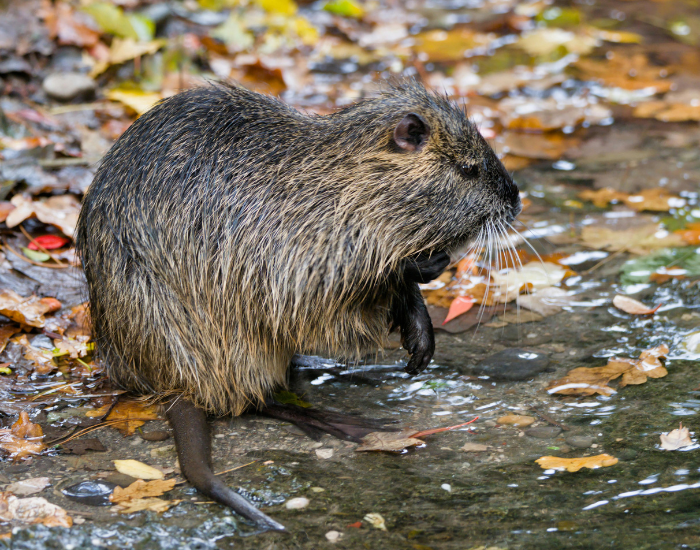
The muskrat is the lookalike that catches most people. A muskrat is smaller, has a flattened tail, and lacks the distinctive orange teeth. Coypus are also confused with the common brown rat, especially in poor light along a canal at night. The size difference settles it: a coypu is many times heavier than any rat.
Beaver confusion is more common in North America. The flat beaver tail is the giveaway. If the tail looks like a thick scaly rope rather than a paddle, you are looking at a coypu. Hunters who target the wrong species can accidentally remove protected wildlife, which is one reason wildlife agencies push hard on coypus identification training. Muskrat trappers in Oregon, for example, have to know the difference cold.
In Spanish-speaking countries, the muskrat-coypus confusion is doubled by the otter problem. I have watched Spanish-speaking visitors to Louisiana point at a muskrat, call it “nutria,” and mean otter. Three different animals collapsed into one word.
12. Coypus Meat, Pets, and the Nutria Cookbook
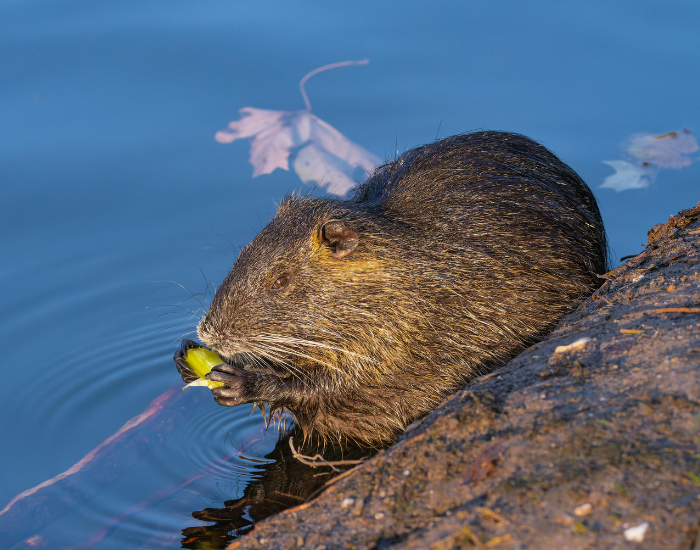
Here is where it gets weird. Coypus meat is lean, mild, and surprisingly close to rabbit in flavor. Louisiana has run public campaigns encouraging hunters to harvest and eat nutria meat, framing it as both pest control and a sustainable food source. New Orleans chefs have featured nutria sausage on tasting menus, and food writers have called it the most ethical wild meat in the American South.
A small subculture even keeps coypus as pets, though I would not recommend it. Coypus need water, space, and constant access to fresh plants. They are not house animals, no matter how cute the babies look in viral videos. If you want a small rodent companion, stick with a guinea pig.
FAQs About Coypus
There is no biological difference. Coypu and nutria refer to the same species, Myocastor coypus. “Coypu” is more common in scientific literature and Europe, while “nutria” dominates in North America. The Spanish word “nutria” actually means otter in many Latin American countries, which causes endless confusion for bilingual readers and field biologists.
Coypus rarely attack humans. However, a cornered adult can bite, and the large orange incisors can injure dogs, cats, or small children. The greater danger lies in the diseases they can carry, including leptospirosis, and in the structural damage their burrows cause to levees and canals. Treat coypus as wild animals and give them space.
Native coypus live in southern South America, particularly Argentina, Uruguay, Chile, and parts of Brazil. Introduced populations now occupy France, Louisiana, Oregon, parts of the Netherlands, Italy, and East Asia. They prefer slow-moving rivers, lakes, marshes, and canal systems with abundant aquatic vegetation. The coypu is a true wetland specialist.
Muskrats are much smaller, with a flattened, vertically compressed tail. Coypus are larger, with a round, rat-like tail and bright orange front teeth. Both are aquatic rodents, but they belong to different families. Muskrat fur was historically more valuable, which is one reason coypus fur farms struggled to compete in the long run.
What the Coypus Story Really Tells Us
Names matter. A single mistranslation between Spanish and English can blur the line between an otter and a swamp rodent, and a single business decision to release coypus from failing fur farms reshaped wetlands across three continents. Understanding what coypus actually are—rodents, not otters; ecosystem members in their native range, ecological problems when introduced—is the first step to thinking clearly about how we manage them.
If you want to dive deeper into related species, I have written about the beaver as an ecosystem engineer, whether capybaras are really rodents, and the actual giant river otter that I once mistook for a nutria. For more on the role rodents and other species play in shaping wetlands, see my piece on keystone species and the wildlife of Ecuador. Drop a comment below with your own coypus or nutria encounter—I read every one.
For more on global invasive species management, the IUCN Invasive Species Specialist Group maintains an excellent profile on Myocastor coypus.
References:
Ahrens, K. D., Hallas, J. M., Piaggio, A. J., Carrothers, K. L., Cook, V. K., & Buchalski, M. R. (2025). Population Genomic Insights Into Recent Nutria (Myocastor coypus) Invasion Dynamics. Evolutionary applications, 18(11), e70168. https://doi.org/10.1111/eva.70168
Delaney, M. A., Treuting, P. M., & Rothenburger, J. L. (2018). Rodentia. Pathology of Wildlife and Zoo Animals, 499–515. https://doi.org/10.1016/B978-0-12-805306-5.00020-1
Dondina, O., Orioli, V., Tirozzi, P., & Bani, L. (2024). Estimating risk to prevent damage: predicting and preventing coypu (Myocastor coypus) damage to transport infrastructure. Pest management science, 80(11), 5564–5573. https://doi.org/10.1002/ps.8128
Carter, J., & Leonard, B. P. (2002). A review of the literature on the worldwide distribution, spread of, and efforts to eradicate the coypu (Myocastor coypus). Wildlife Society Bulletin, 30(1), 162–175. https://www.jstor.org/stable/3784650
Guichón, M. L., Borgnia, M., Righi, C. F., Cassini, G. H., & Cassini, M. H. (2003). Social behavior and group formation in the coypu (Myocastor coypus) in the Argentinean pampas. Journal of Mammalogy, 84(1), 254–262. https://doi.org/10.1644/1545-1542(2003)084<0254:SBAGFI>2.0.CO;2
Panzacchi, M., Cocchi, R., Genovesi, P., & Bertolino, S. (2007). Population control of coypu Myocastor coypus in Italy compared to eradication in UK: A cost-benefit analysis. Wildlife Biology, 13(2), 159–171. https://doi.org/10.2981/0909-6396(2007)13[159:PCOCMC]2.0.CO;2
Michel, V., Ruvoen-Clouet, N., Menard, A., Sonrier, C., Fillonneau, C., Rakotovao, F., Ganière, J. P., & André-Fontaine, G. (2001). Role of the coypu (Myocastor coypus) in the epidemiology of leptospirosis in domestic animals and humans in France. European journal of epidemiology, 17(2), 111–121. https://doi.org/10.1023/a:1017931607318