Marine ecologist Enric Sala is one of my inspirations. He often points to Cabo Pulmo as proof that the ocean can heal. I’ve also written about other comebacks, like the California condor and Rwanda’s mountain gorillas.
I have scuba dived at Cabo Pulmo myself. It sits off the beaten path on the East Cape of Mexico’s Baja California Peninsula, in Baja California Sur. Getting there feels like an adventure. If you can, rent a car and make it part of a Baja road trip.
Below, I tell how a tiny fishing village turned an overfished reef into a world-famous recovery. I also share what you’ll see, and how to plan your visit.
🐠 How well do you know Cabo Pulmo?
Twelve questions on fish tornadoes, bull sharks and a reef that came back. Read on, then test yourself at the end.
Jump to the quiz ↓A Fishing Village on the Brink
Cabo Pulmo wasn’t always the thriving reef it is today. For decades, local families fished its waters. Meanwhile, commercial fishing pressure grew across the Gulf of California.
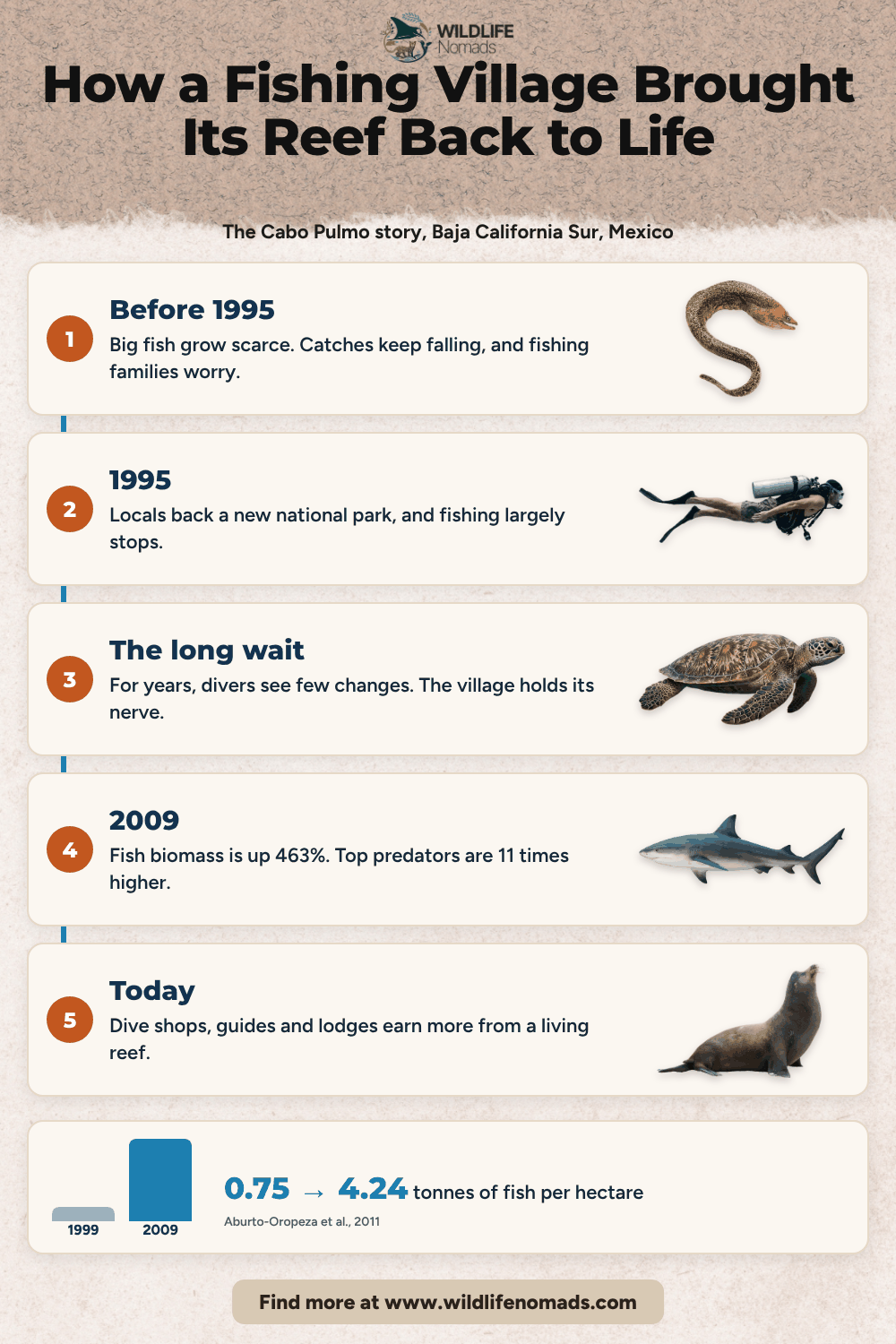
By the late 20th century, the reef was in trouble. Big fish had become scarce, and catches kept falling. As a result, the fishers’ own livelihoods were at risk.
So, instead, the community did something remarkable. Rather than fishing harder, they pushed to stop fishing altogether.
1995: The Year Fishing Stopped
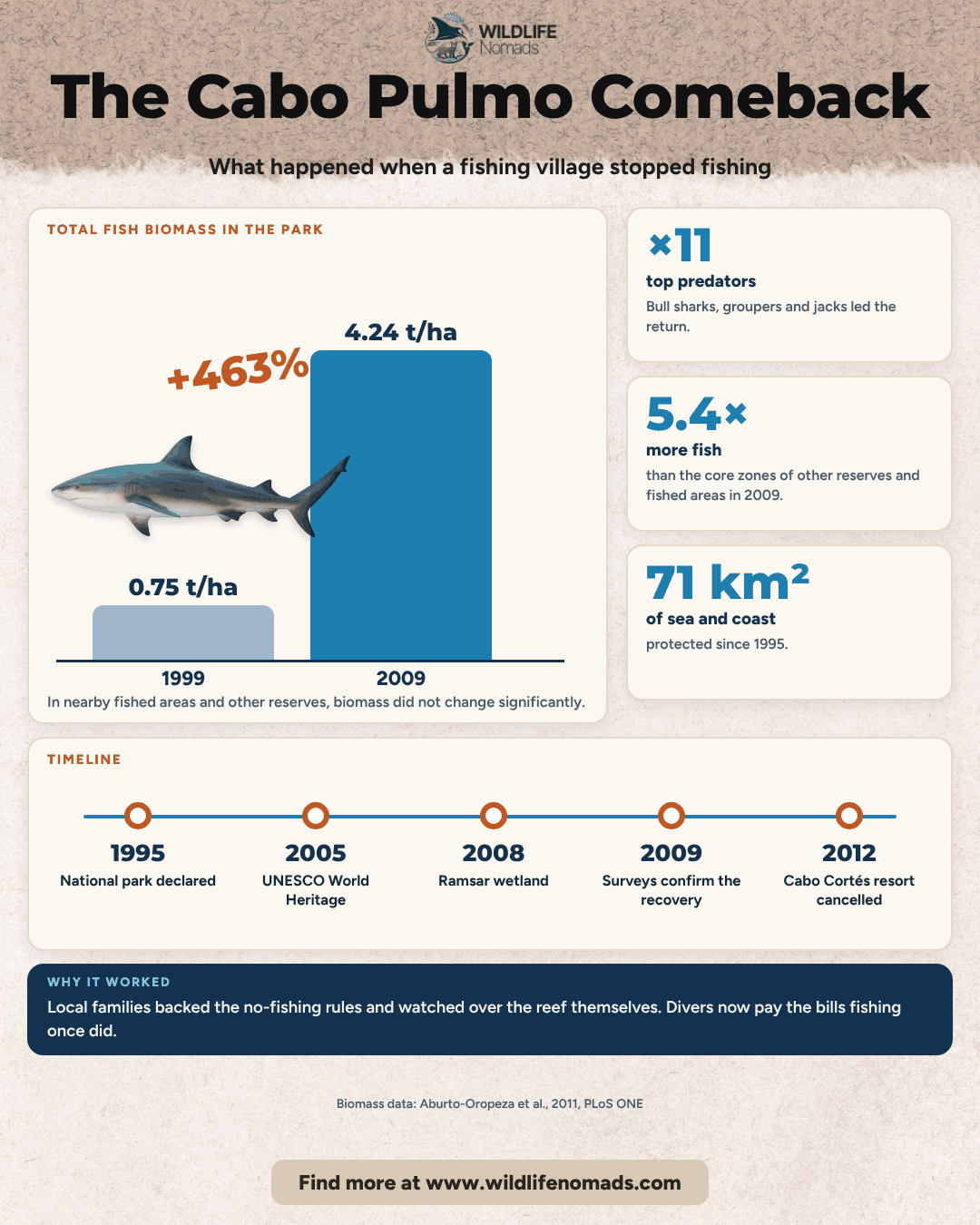
On 5 June 1995, the Mexican government declared Cabo Pulmo National Park. The protected area covers about 71 km² of sea and coast.
Crucially, the park became largely no-take. That means no fishing, and it had widespread support from local people. Many former fishers later became guides, instead.
Recovery didn’t happen overnight. For years, divers saw few changes. Still, the community stayed committed, and the ocean slowly began to heal.
From Depletion to Abundance
Then, finally, the numbers came in. Between 1999 and 2009, total fish biomass in the park rose by 463%. Meanwhile, nearby areas showed no real change.
In fact, top predators recovered even faster. Their biomass grew about 11 times, as bull sharks, groupers and jacks returned. By 2009, the park held 5.4 times more fish than other protected areas in the region.
Enric Sala co-authored that study. The authors credited local leadership, a close-knit community and self-enforcement for the success.
Why Is Cabo Pulmo Famous?
Above all, Cabo Pulmo is famous for that recovery, especially among divers. Scientists have even called it the world’s most robust marine reserve.
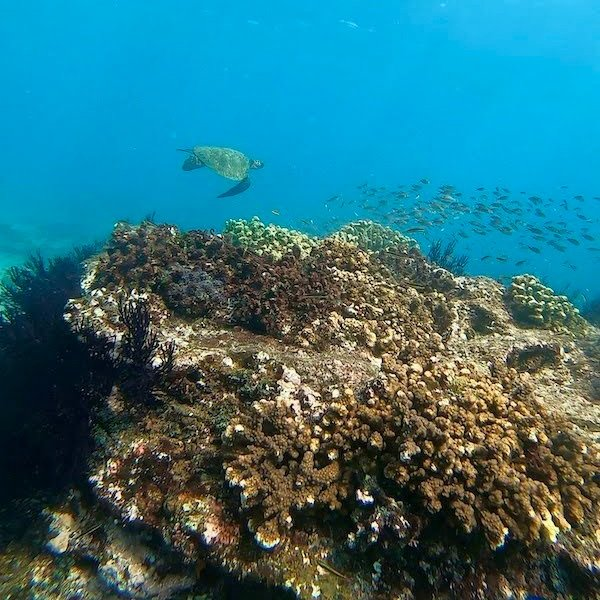
It also protects one of the northernmost coral reefs in the eastern Pacific. The living coral reef is often described as about 20,000 years old.
In 2005, it joined a UNESCO World Heritage Site: the Islands and Protected Areas of the Gulf of California. That wider site has been on the In Danger list since 2019, because of the near-extinct vaquita porpoise.
What Marine Life Is in Cabo Pulmo?
The marine life here is astonishing. Cabo Pulmo is one of the best places to see animals in Mexico, and these are the highlights.
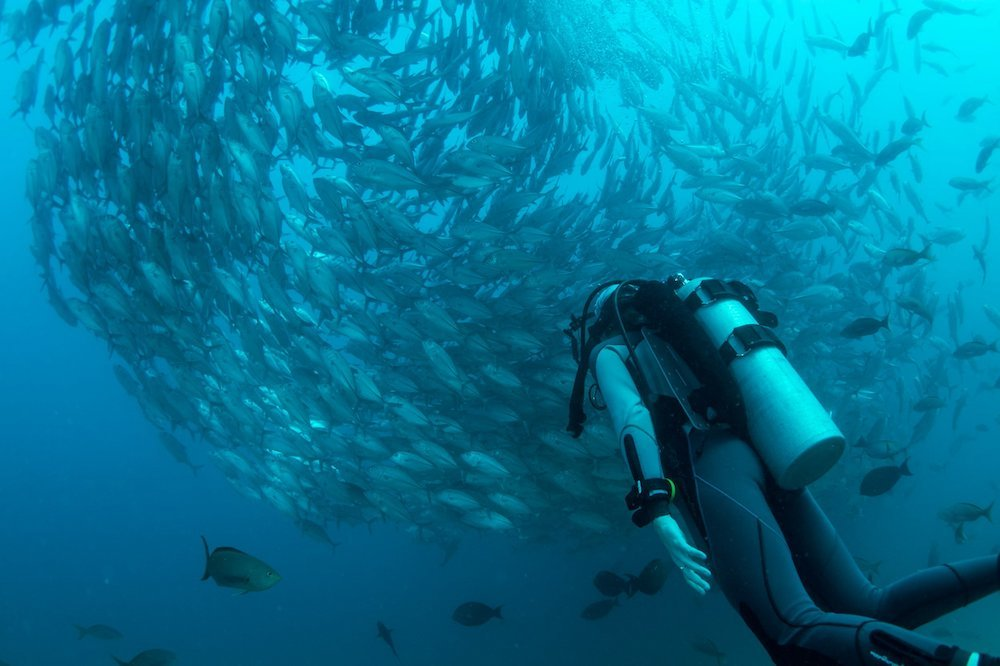
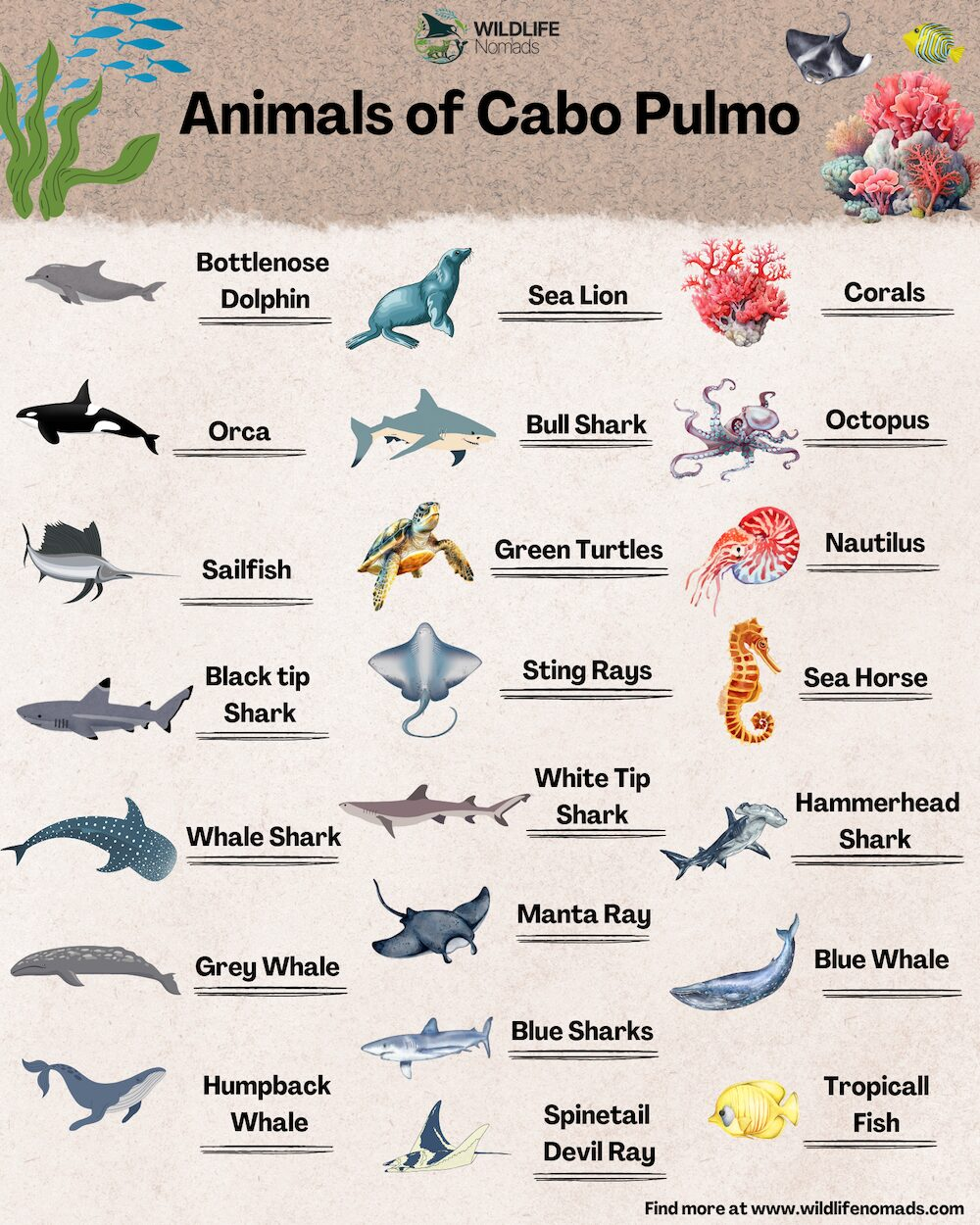
- Massive schools: bigeye jacks swirl in a living “fish tornado” that divers come from around the world to see.
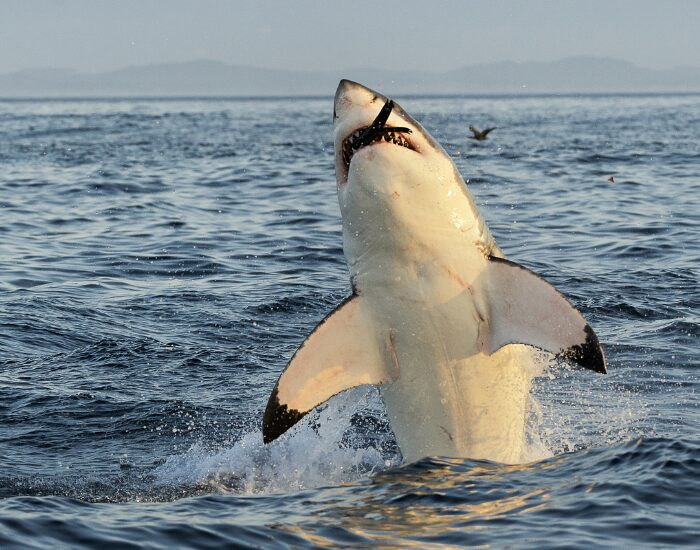
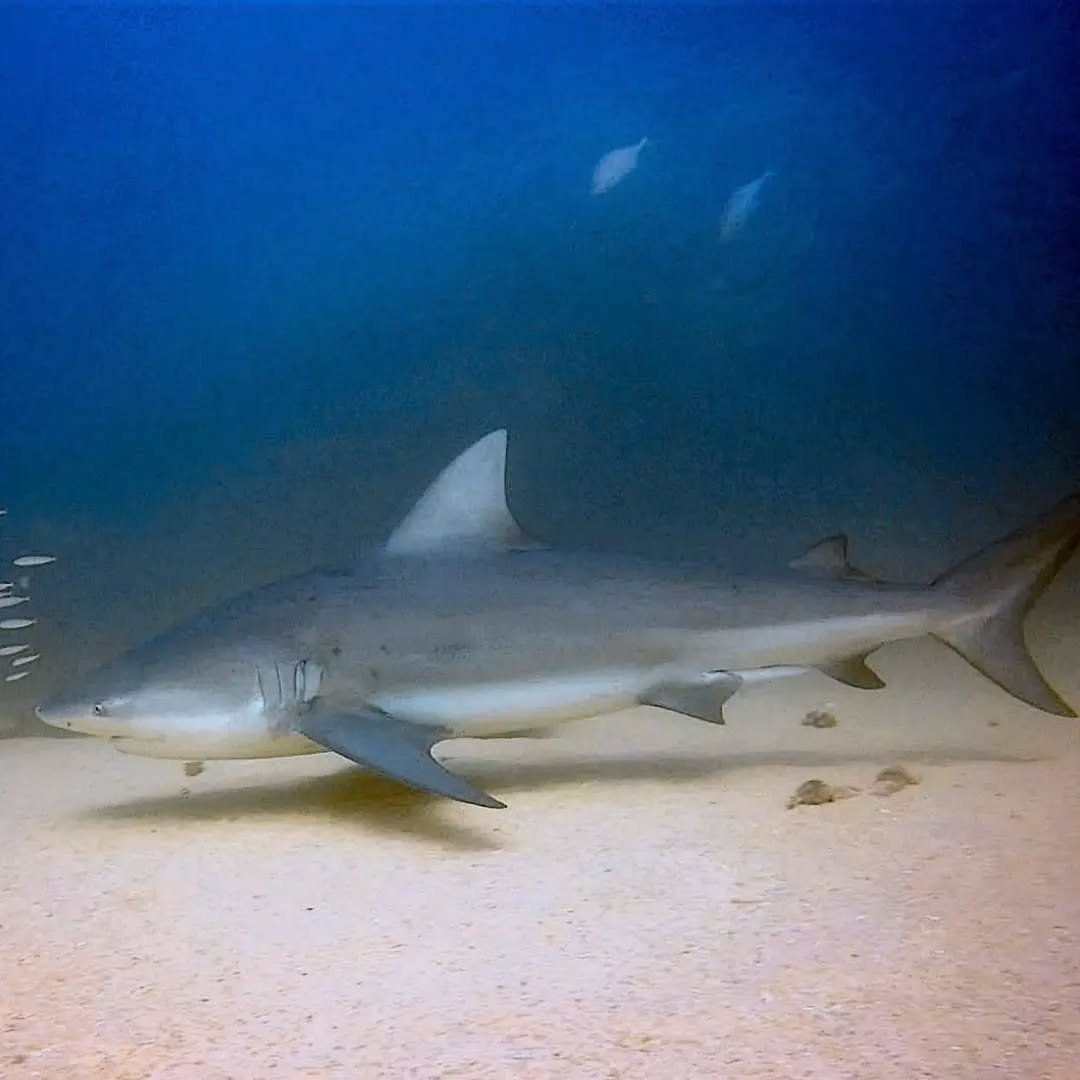
- Sharks: bull sharks, plus blacktip and whitetip reef sharks. Hammerhead sharks are sometimes seen too.
- Sea turtles: five of the world’s seven sea turtle species visit the area.
- Rays: mobula rays, eagle rays and cownose rays, with manta rays passing in autumn.
- Sea lions: a small colony of playful sea lions, the California sea lion, lives inside the park.
- Whales and whale sharks: humpback whales pass in winter. Whale sharks sometimes visit in late spring and autumn.
Explore how this marine ecosystem connects in our food web tool. Then compare the sharks in our shark size comparison.
Diving in Cabo Pulmo
Diving in Cabo Pulmo feels like visiting the ocean of the past. Find more spots in my guide to scuba diving in Mexico.
Cabo Pulmo diving rules are strict, and that’s a good thing. Only certified divers can dive, and a local guide is required. Also, groups are small, and the park rotates dive sites to avoid crowding.
Top Cabo Pulmo Dive Sites
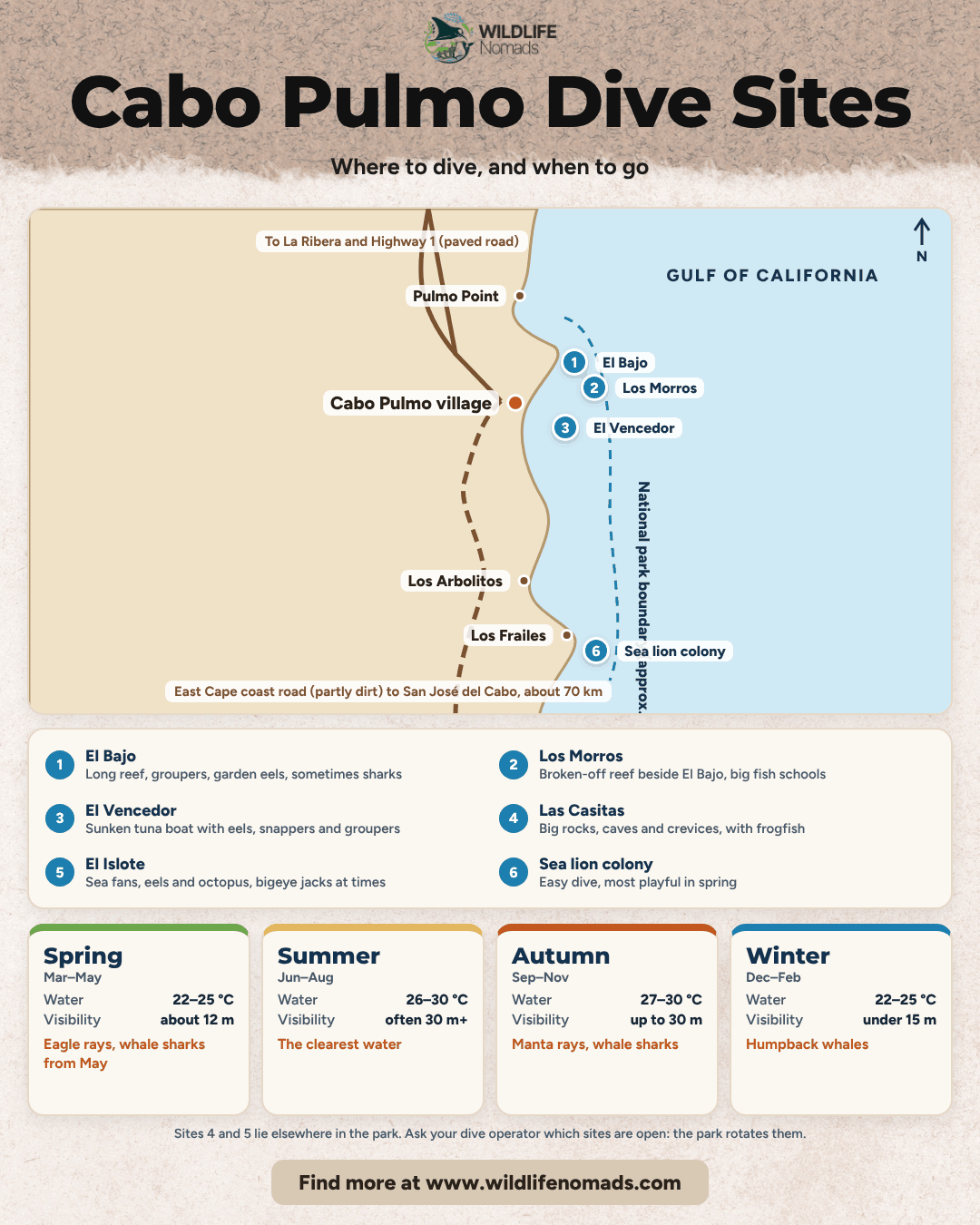
- El Bajo: a long reef with coral formations, groupers, garden eels and, at times, sharks.
- Los Morros: a broken-off reef near El Bajo, with large concentrations of fish too.
- El Vencedor: a sunken tuna boat, now home to eels, snappers and giant groupers.
- Las Casitas: big rocks, caves and crevices hiding frogfish and cup corals.
- El Islote: sea fans, eels and octopus, plus bigeye jacks at certain times.
- Sea lion colony: an easy dive with sea lions, which are most playful in spring.
When to Visit Cabo Pulmo
However, water temperatures and visibility change a lot through the year. Summer and autumn bring warm waters and the best visibility, although hurricanes can affect visibility.
| Season | Water temperature | Visibility | Highlights |
|---|---|---|---|
| Spring (Mar–May) | About 22–25 °C | About 12 m | Eagle rays, whale sharks from May |
| Summer (Jun–Aug) | About 29 °C | Often 30 m or more | Crystal clear waters, best for photos |
| Autumn (Sep–Nov) | About 28 °C | Up to 30 m | Manta rays, whale sharks, sailfish |
| Winter (Dec–Feb) | About 23 °C | Under 15 m | Humpback whales and other whales |
How to Get to Cabo Pulmo
First, most visitors fly into Los Cabos International Airport, near San José del Cabo. From there, Cabo Pulmo is about 70 km away along the rugged East Cape coast road.
Alternatively, take Highway 1 to La Ribera, which is longer but has better roads. The dirt sections suit a four-wheel-drive car. There is no public transport, so many people book a day trip from Cabo San Lucas instead.
Meanwhile, snorkellers can join a snorkel tour with a local operator, so no experience is needed. Compare it with other world-class snorkelling spots too.
The Role of the Community
Above all, Cabo Pulmo’s success depends on its people. The same fishers who once relied on the reef became its fiercest protectors.
Today, therefore, the village earns its living from sustainable tourism. Dive shops, guides, small lodges and every local restaurant depend on a healthy reef. In turn, residents watch over the park and report illegal fishing.
Similarly, the same idea helped save Baja’s gray whales. Read how gray whale ecotourism turned fishers into guides further north.
Battles to Protect Cabo Pulmo
Even success needs defending. In 2008, developers proposed Cabo Cortés, a huge resort right next to the park. It included thousands of hotel rooms, golf courses and a marina.
As a result, scientists, locals and activists campaigned against it. In June 2012, President Felipe Calderón cancelled the project’s environmental permits.
Later versions, such as Cabo Dorado, also failed to move forward. Mexico’s environment ministry has since rejected Cabo Cortés again. Meanwhile, park managers keep reviewing diver limits, so tourism doesn’t harm the reef it depends on.
Lessons From Cabo Pulmo
Since then, Cabo Pulmo’s story has inspired marine protected areas worldwide. A 2014 global study found that the most effective reserves share five features. They are no-take, well enforced, old, large and isolated.
- Local action matters: communities that support a reserve help enforce it.
- No-take zones work: strict protection can bring dramatic recovery within about a decade.
- Conservation can pay: a living reef can earn more from tourism than a fished one.
Learn more in my posts on what marine protected areas are and whether protected areas work. Similar stories come from the Galápagos and Zanzibar’s Chumbe Island.
FAQs About Cabo Pulmo
Cabo Pulmo is famous for one of the world’s greatest marine recoveries. After fishing stopped in 1995, fish biomass rose by 463% between 1999 and 2009. Its reef is also one of the northernmost coral reefs in the eastern Pacific.
Cabo Pulmo is about 70 km from San José del Cabo along the East Cape coast road, which includes dirt sections. Many visitors join a day trip from San José del Cabo or Cabo San Lucas.
Yes. Local operators run snorkel tours to shallow reefs inside the park. Snorkellers can see tropical fish, sea turtles and sometimes rays. Always go with an authorised operator and follow park rules.
Yes. Divers must be certified and dive with a local guide from an authorised operator. Groups are small, and park managers rotate dive sites to protect the reef.
Summer and autumn bring the warmest water and the best visibility, often around 30 m. Winter brings humpback whales, while late spring and autumn can bring whale sharks and manta rays.
Fishing is not allowed inside Cabo Pulmo National Park. Its no-take rules, supported by the local community, are the main reason its fish populations recovered.
Give the Ocean a Chance
Cabo Pulmo, a true national marine park success, proves that the ocean can bounce back when we let it. A small village made a brave choice, and the fish came back.
If its story inspires you, here are a few ways to help:
- Visit responsibly: choose authorised, eco-friendly operators for your Cabo Pulmo tour.
- Support marine conservation: donate to trusted groups that protect reefs and fight overfishing.
- Back marine protected areas: support no-take zones in your own region.
- Share the story: stories like Cabo Pulmo’s show people that recovery is possible. Explore reefs with our Coral Reef Explorer.
Have you dived or snorkelled at Cabo Pulmo? Tell me what you saw in the comments.
Experience Cabo Pulmo’s Marine Life
This blog is reader-supported. When you book through links on this site, we may earn an affiliate commission.
References:
Aburto-Oropeza, O., Erisman, B., Galland, G. R., Mascareñas-Osorio, I., Sala, E., & Ezcurra, E. (2011). Large recovery of fish biomass in a no-take marine reserve. PLoS ONE, 6(8), e23601. https://doi.org/10.1371/journal.pone.0023601
Edgar, G. J., Stuart-Smith, R. D., Willis, T. J., Kininmonth, S., Baker, S. C., Banks, S., Barrett, N. S., Becerro, M. A., Bernard, A. T. F., Berkhout, J., Buxton, C. D., Campbell, S. J., Cooper, A. T., Davey, M., Edgar, S. C., Försterra, G., Galván, D. E., Irigoyen, A. J., Kushner, D. J., … Thomson, R. J. (2014). Global conservation outcomes depend on marine protected areas with five key features. Nature, 506(7487), 216–220. https://doi.org/10.1038/nature13022
Sala, E. (2020). The nature of nature: Why we need the wild. National Geographic.
Sala, E., Mayorga, J., Bradley, D., Cabral, R. B., Atwood, T. B., Auber, A., Cheung, W., Costello, C., Ferretti, F., Friedlander, A. M., Gaines, S. D., Garilao, C., Goodell, W., Halpern, B. S., Hinson, A., Kaschner, K., Kesner-Reyes, K., Leprieur, F., McGowan, J., … Lubchenco, J. (2021). Protecting the global ocean for biodiversity, food and climate. Nature, 592(7854), 397–402. https://doi.org/10.1038/s41586-021-03371-z