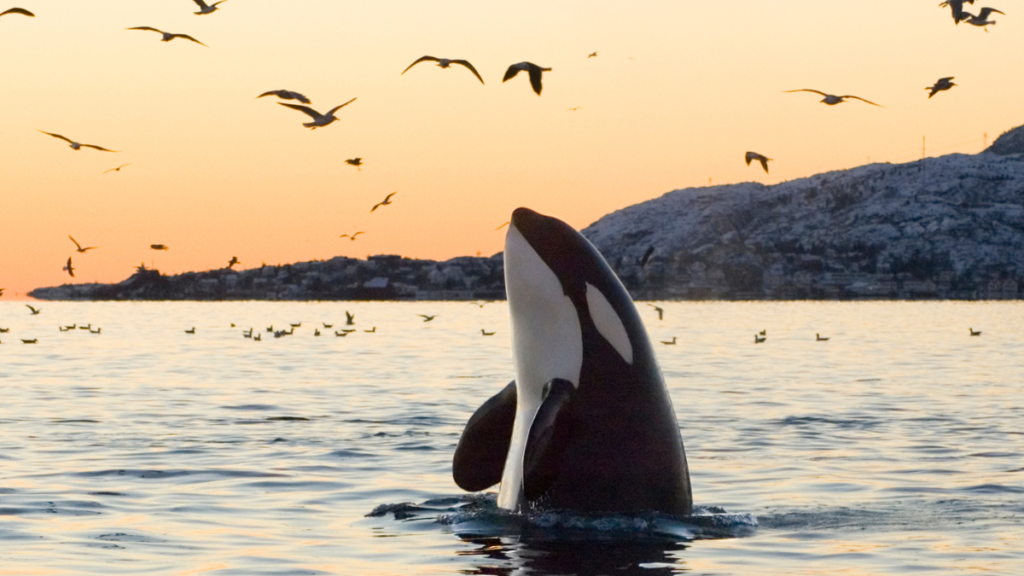
I have swum with reef sharks in the Coral Triangle and glided beside manta rays with wingspans wider than my kayak. Yet orcas remain the one animal that still lives on my bucket list. There is something humbling about a predator that hunts in coordinated families, teaches its young, and greets you with a curiosity you can feel. My Wildlife Nomads teammates spotted killer whales off Ecuador last year, just the dorsal fins slicing the swell, no swimming involved. That single sighting rewired how I think about these animals.
If you are anything like me, you do not just want to read about orcas. You want to meet one. So before you book that trip to Norway or the Salish Sea, here are 12 fascinating facts about orcas that blend hard science with what I have learned chasing wildlife across the planet. We will dig into killer whale biology, their startling intelligence, where killer whales are found, and why one small population is fighting for survival right now.
1. Orcas Are the Largest Dolphins in the Ocean
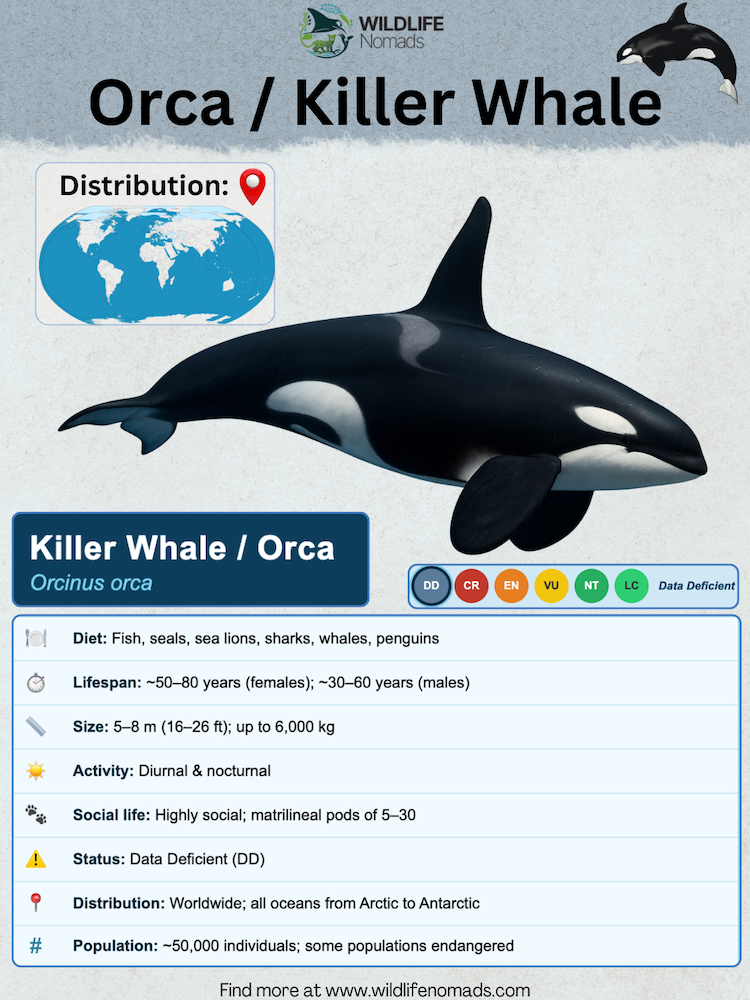
Here is the fact that surprises people over coffee: an orca is not a whale in the strict sense. Orcinus orca is the largest member of the dolphin family, Delphinidae. The name “killer whale” likely came from old sailors who called them “whale killers” and got the words flipped. Today most biologists happily use both names, and these animals are just as often simply called orcas.
How Big Do Orcas Get?
Their size is staggering for any marine mammal. Adult males range from 6 to 8 metres long and can weigh 3.5 to 6 tonnes (roughly 4 to 6 metric tons). By contrast, female orcas are smaller, generally 5 to 7 metres and around 7.5 tonnes. That crisp black and white coloration is unmistakable in every population. In the wild, orcas often live 50 to 80 years, and their lineage traces back more than 50 million years to land mammals that returned to the sea, but specifically the family Delphinidae and genus Orcinus diverged much more recently (roughly 11 million and 5 million years ago, respectively).
Yu can explore the size comparison with other whales sin our interactive tool!
Interactive · free Whale size comparison Fourteen whales at true scale, from a 4 m beluga to a 30 m blue whale, each beside a 2 m diver, with how deep each one dives. Pit any two head to head, or play the guessing game. Compare the whales →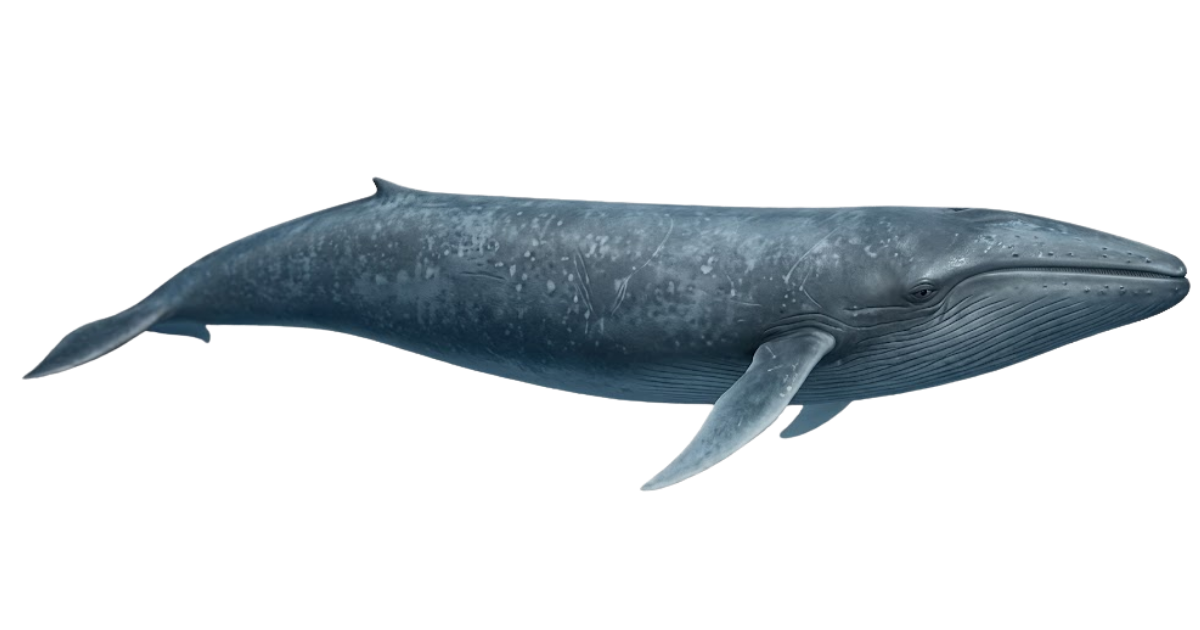

Reading a Dorsal Fin
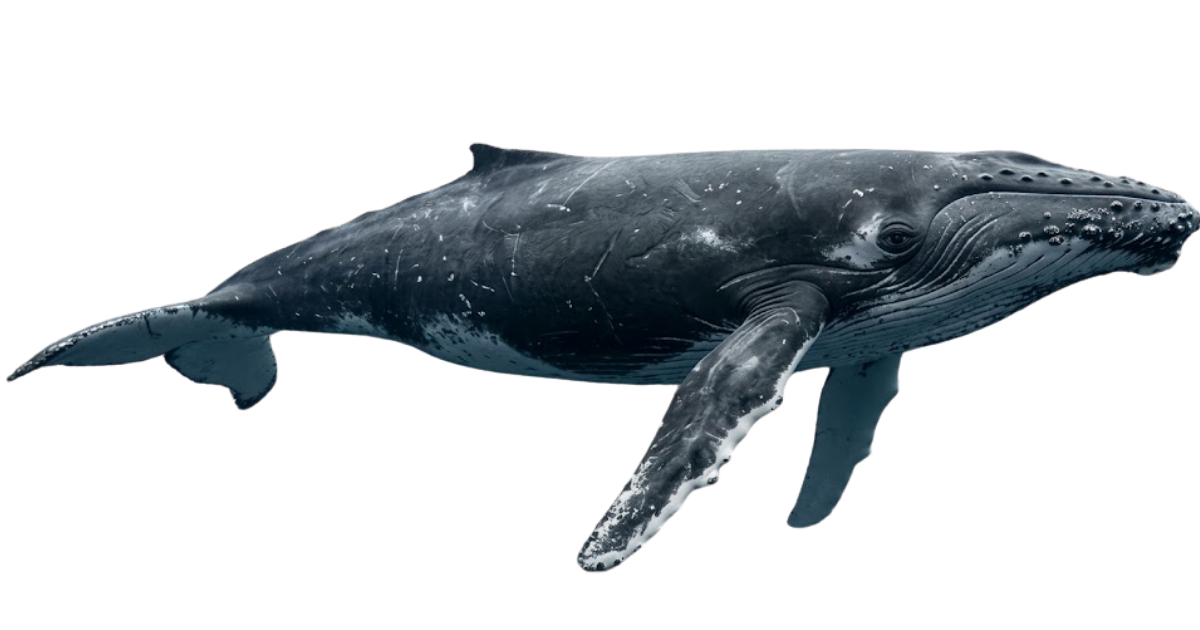
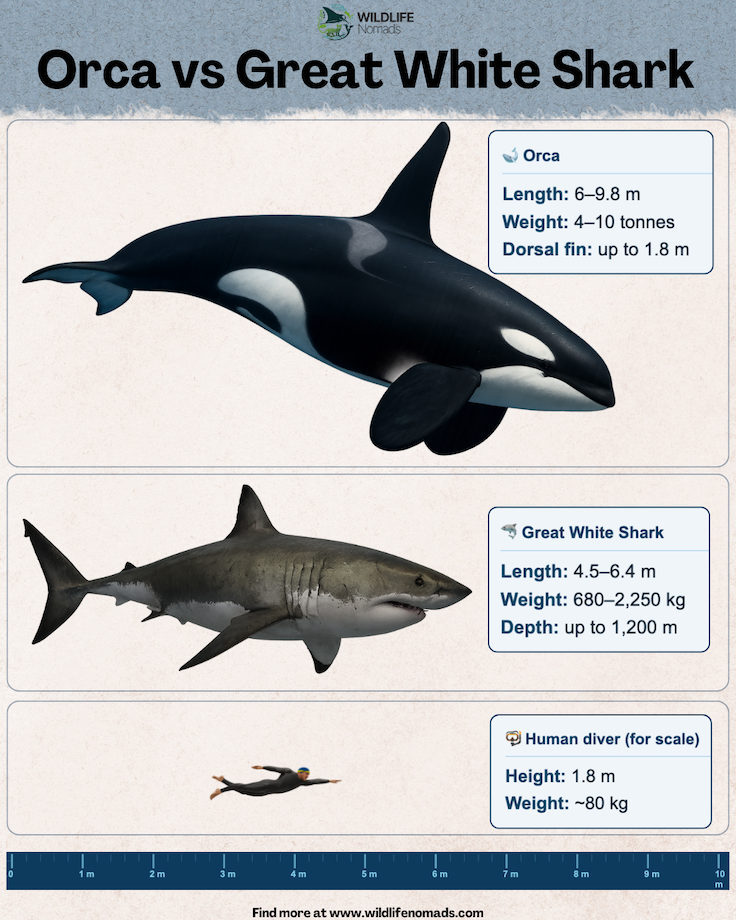
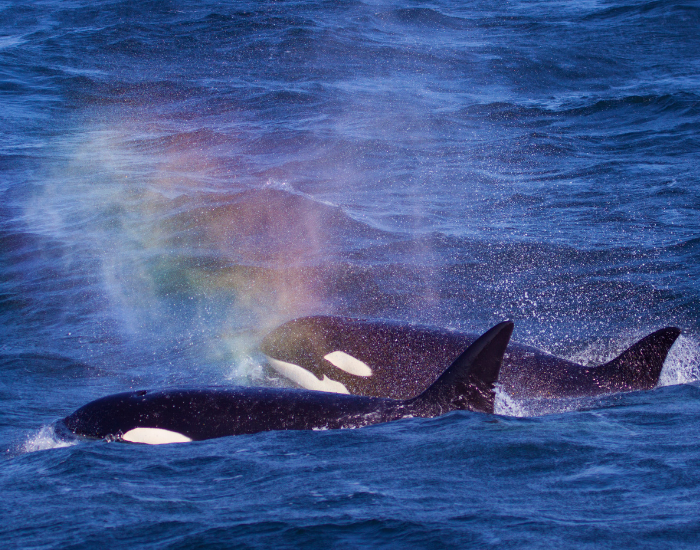
The dorsal fin tells you a lot at a glance. A male orca’s dorsal fin can stand 1.8 metres tall, as high as a person, and rises straight and dagger-like above the water. Adult males carry these towering fins, while females and juveniles show shorter, more rounded dorsal fins that curve gently backward. Field researchers use the exact shape, along with the grey “saddle patch” behind it, to identify individual animals for years.
2. Yes, an Orca Is Bigger Than a Great White Shark
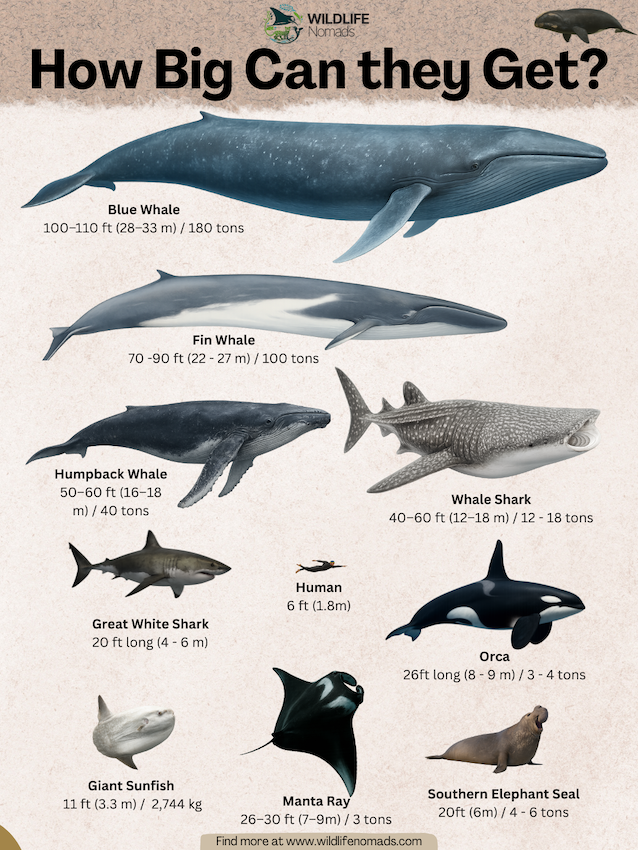
I get this question constantly, usually right after someone has watched a shark documentary. The answer is not close. The largest orca on record was a male stretching 9.8 metres and weighing roughly 10 tonnes. The heaviest great white ever verified topped out near 2,268 kilograms.
Do the math and the largest killer whale outweighs the biggest great white by more than four to one. This size gap is exactly why orcas hunt great whites and not the other way around. Off the coast of South Africa, white sharks have abandoned entire regions after orcas moved in, a rare case of the ocean’s most feared predator becoming prey itself.
3. There Are Three Main Types, and They Barely Mix
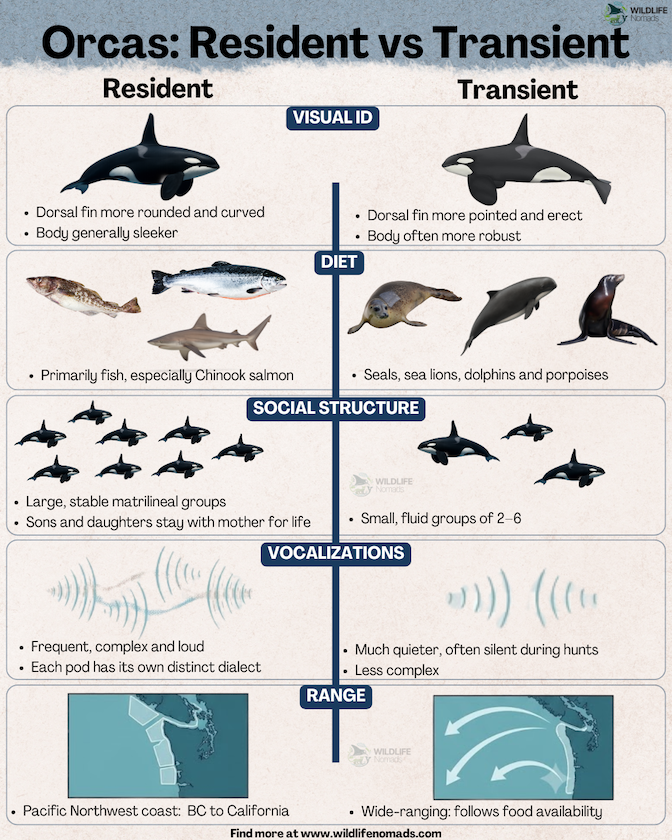
One of the most fascinating facts about orcas is that they are not a single, uniform animal. In the eastern North Pacific, scientists recognize three main types of killer whales: Resident, Transient, and Offshore. These groups look slightly different, sound different, and eat completely different diets.
Residents, Transients, and Offshores
Resident killer whales primarily eat salmon and travel in large, stable groups; the resident killer whale population of the Pacific coast is the best studied on Earth. Transient killer whales (also called Bigg’s killer whales) have a varied diet built around marine mammals like seals, sea lions, and porpoises. Offshore killer whales are generally smaller, roam far into coastal waters and the open sea, and consume fish species, including sharks.
Different Diets, Different Cultures
Different populations of orcas have specialized diets so distinct that resident whales and transient orcas sharing the same water will actively avoid one another. Residents chase fish; Transients hunt other marine mammals in near silence. Each ecotype specializes in its own prey species, and that dietary split has shaped their bodies, their voices, and their entire way of life, a reminder that “orca” describes many animals, not one.
4. You Can Find Orcas in Every Ocean on Earth
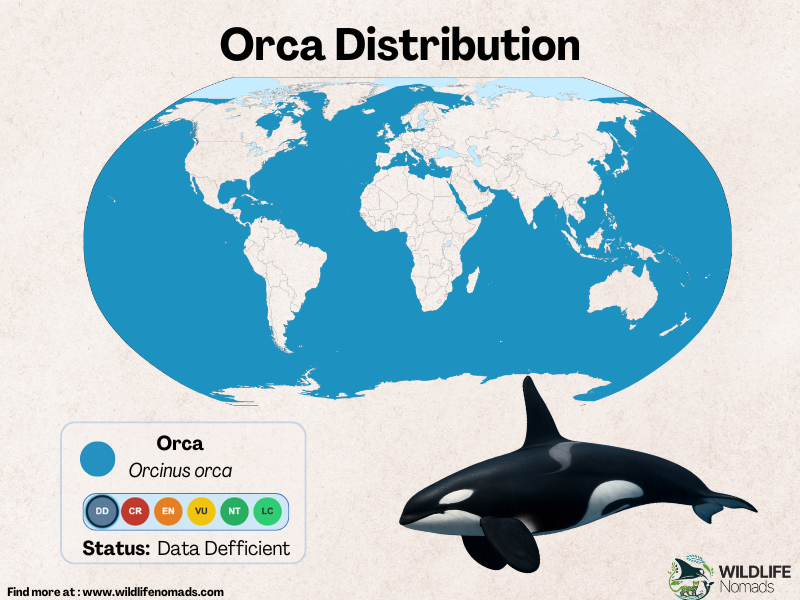
When people ask me where killer whales live, I tell them the short answer: everywhere. Orcas are found in all of the world’s oceans, making them one of the most widely distributed mammals on the planet, second only to humans.
The orca swims in the sunlight zone of my deep sea dive.
From Ice Floes to the Tropics
Their habitat runs from the ice floes of the Antarctic to warm equatorial seas, though they reach their highest densities in cold, productive waters. You will spot them across the eastern North Pacific Ocean, the Northeast Atlantic, and the fjords of southern Alaska and Norway. Along North America’s west coast, pods travel from central California and southern California up through Washington State and into southeast Alaska, following the prey.
A Home in the Salish Sea
That said, some populations stay loyal to a single home range. The Southern Resident community, for instance, is unique to the Pacific Northwest and haunts the Salish Sea and San Juan Island each summer. These southern resident orcas return to the same channels their grandmothers used, a pattern of place-based knowledge that few other whale species can match.
5. They Eat Up to 500 Pounds a Day… Together
A single orca can eat up to 227 kilograms, or roughly 500 pounds, of food in a day. Fueling a body that large takes serious teamwork, and that is where orcas truly shine.
Coordinated Hunting
Orcas hunt in groups using coordinated strategies passed down through generations. In Norway, pods herd herring and other schooling fish into tight balls, then slap them with their tail flukes to stun dozens at once. In Antarctica, they generate waves to wash seals off ice floes. The killer whales’ ability to plan and communicate mid-hunt rivals anything I have seen in the animal world.
Picky About Prey
Prey choice defines each group. For fish-eaters, salmon species are the primary prey, and their foraging behavior tracks the seasonal salmon runs almost perfectly. Transients, by contrast, treat seals and sea lions as their primary prey and shadow haul-outs along the coast. Watching either strategy unfold is a masterclass in how prey availability shapes an apex predator.
6. Every Pod Speaks Its Own Dialect
Orcas communicate using clicks, whistles, and pulsed calls. The clicks are for echolocation, mapping the dark water with sound. The whistles and pulsed calls are social, and this is where it gets remarkable.
Each pod has a distinct vocal dialect that is learned and passed down, not inherited in their genes. A researcher who knows these calls can identify which family is passing by without ever seeing a fin. This is culture in the truest sense. Orcas pass down travel routes, hunting techniques, and even play behaviors across generations, and a calf learns to “speak” from its mother and grandmother, the same way I learned to read the ocean from mentors who came before me.
7. Their Families Are Led by Grandmothers
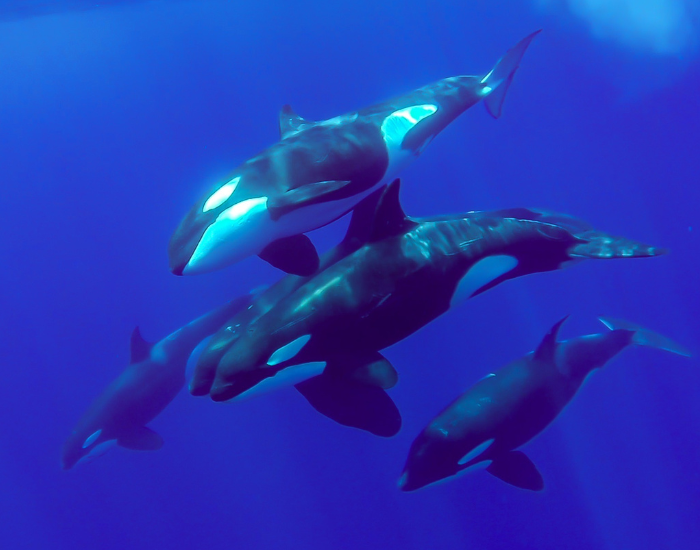
Southern Resident killer whales live in matrilineal family groups, and the bonds are astonishing. Orcas often stay with their mother’s pod for their entire lives, sons and daughters alike, decade after decade. A matriline averages about 5.5 animals, and pods typically consist of two to 15 killer whales.
J, K, and L Pods
The Southern Resident pods are known simply as J, K, and L pods, each with its own dialect. When food is plentiful, pods band together into larger gatherings called superpods, and the water fills with breaching and social chatter. Adult males, easy to pick out by their tall fins, often travel at their mother’s side for life.
Grandmothers as Guides
Older females frequently lead the group to feeding grounds, drawing on decades of ecological knowledge. In a very real way, the grandmother is the family’s living map. Orcas are one of only a few species where females live long past their reproductive years, and science suggests those elders survive precisely because the family needs their memory.
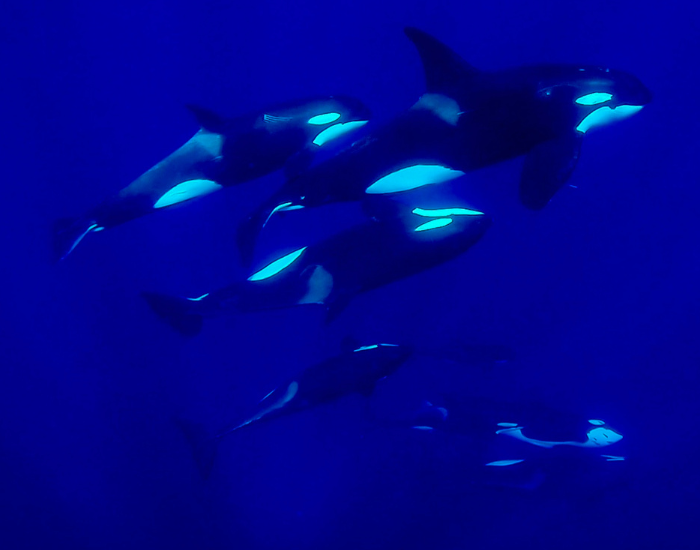
8. Orcas Are Among the Smartest Animals Alive
Orcas are among the most intelligent marine mammals, and spend time near them and you feel it. They show exceptional emotional intelligence and empathy, and demonstrate cultural transmission of hunting strategies that scientists once thought unique to humans or other primates.
The most heartbreaking example came in 2018, when a Southern Resident mother named Tahlequah carried her dead calf for 17 days and over 1,000 miles. It was grief, plainly visible, from an animal many people assume cannot feel it. Interestingly, that intelligence is also why marine parks have fallen out of favor. A brain built for open-ocean navigation and lifelong family bonds does not belong in a concrete tank.
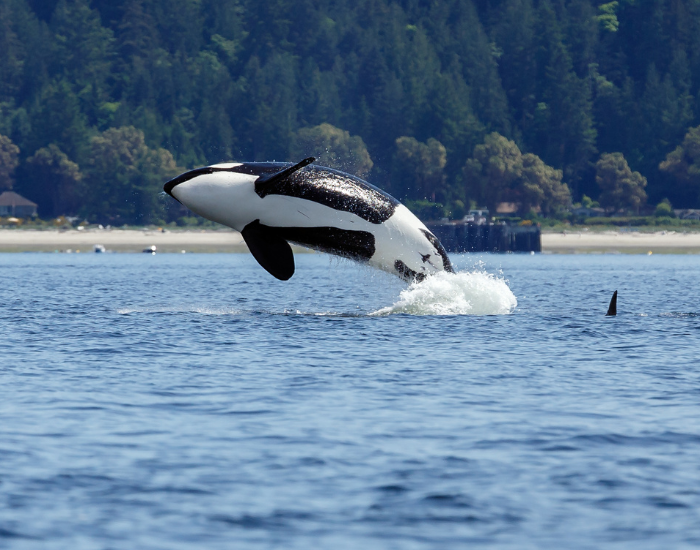
9. Nothing in the Ocean Hunts an Adult Orca
Orcas are apex predators and have no natural predators. Adult orcas sit at the very top of the marine food web, a position they have held for millions of years.
As apex predators, orcas shape entire ecosystems. When they hunt seals, they influence how many fish those seals eat, which ripples down to the smallest schooling fish. Even other giants respond to them: humpback whales have been filmed charging in to disrupt orca hunts and protect calves and seals. Remove the orca and the whole web wobbles. It is a reminder that the biggest, most iconic species often hold the system together , which makes the next fact so sobering.
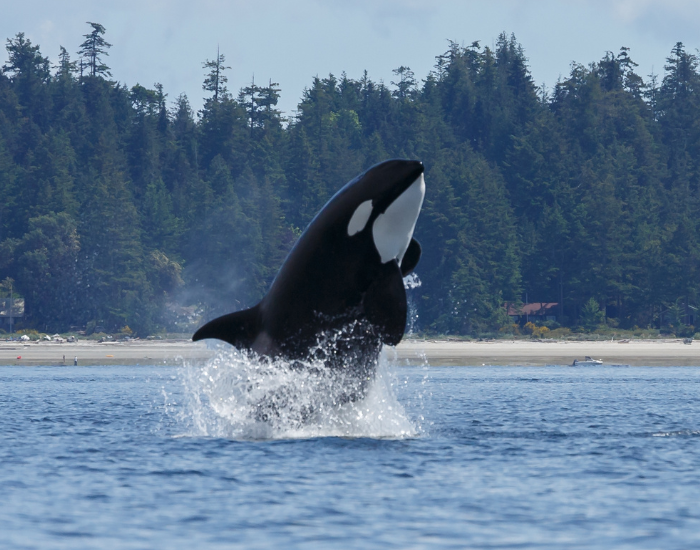
10. One Population Is Slipping Toward the Edge
Not all orcas are thriving. The Southern Resident killer whales, the famous fish-eating community of the Pacific Northwest, are the only endangered population of orcas in U.S. waters, and their story is a slow-motion emergency.
The Numbers Tell the Story
Much of what we know comes from decades of patient whale research. The Center for Whale Research ran the first official count of Southern Residents and found only 71 in 1974, after captures for marine parks had already gutted the population. Numbers recovered and peaked at 98 whales in 1995. Then the decline began. They were listed as endangered in 2005 under the Endangered Species Act. Only 72 were counted in 2020, and as of July 2025, the population stands at 74 whales.
More Than One Population at Risk
The decline is broad. The Southern Resident population has dropped more than 10 percent since 2005. The story is even starker elsewhere: the AT1 Transient pod in Alaska declined to just 7 individuals by 2009 and can no longer reproduce. When a resident killer whale population this well-studied keeps shrinking, it is a warning the whole ecosystem is straining.
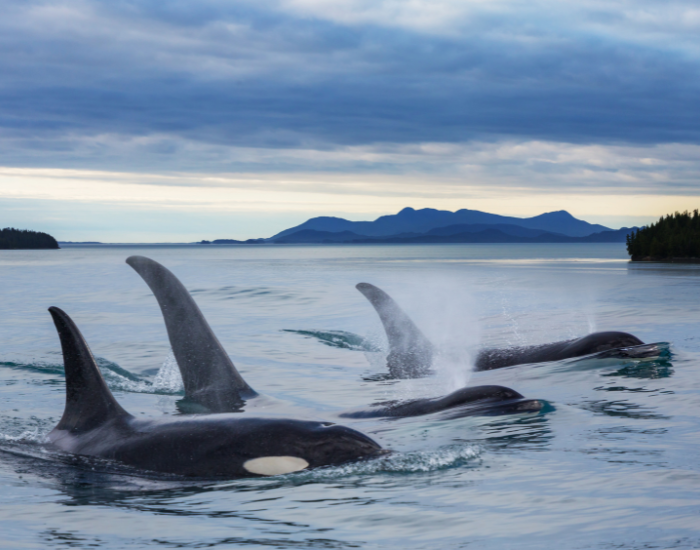
11. Salmon, Noise, and a Race Against Time
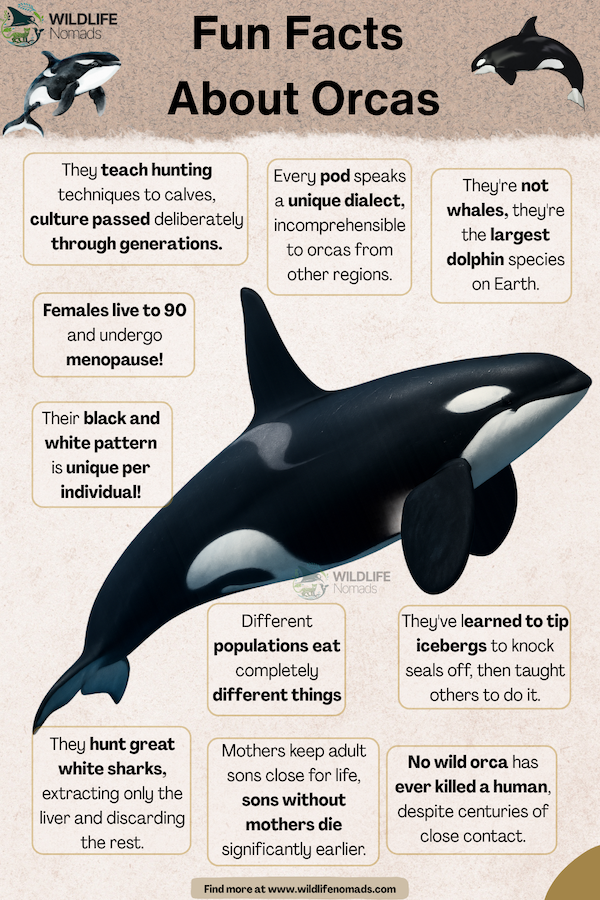
Why are these orcas struggling? As seen on the infographic above, the Southern Residents are picky eaters, they primarily eat Chinook salmon, and Chinook runs have collapsed across much of the west coast. When Chinook is scarce, the whales lean on coho salmon and chum salmon, but neither packs the same calories. Less prey means fewer calves survive.
The Trouble With Noise
On top of hunger, underwater noise from vessels drowns out the sound orcas use to hunt. Every passing ferry and cargo ship makes it harder for a pod to find scattered fish. The link between humans and orcas has never been more direct: our traffic literally competes with their hearing.
What Is Being Done
The response has been serious. NOAA Fisheries designated critical habitat for Southern Residents in 2006 and implemented vessel regulations in 2011 to give the whales quieter water. In 2018, Washington State established the Southern Resident Killer Whale Task Force, with a goal of adding 10 orcas in 10 years. Conservation efforts now center on restoring salmon abundance, because you cannot save the predator without feeding it. Protections under the Marine Mammal Protection Act and the Endangered Species Act give the work legal teeth.
12. Meeting an Orca Will Change You
This is the fact I hold onto. For all their power, orcas have never killed a person in the wild, not once on record. The famous incidents all happened in marine parks, not the open sea.
That is why I would rather see a wild orca’s fin from a respectful distance than a captive one up close. Responsible whale watching in the Salish Sea, southeast Alaska, or the Norwegian fjords lets you witness these animals on their terms. My team caught only the fins in Ecuador, and I have not managed to swim with orcas yet. But the day I finally slip into cold Norwegian water beside a wild pod, you had better believe I will write about it.
Frequently Asked Questions
Yes, by a wide margin. The largest orca on record weighed around 10 tonnes, while the heaviest great white ever verified reached about 2,268 kilograms. An adult male killer whale can outweigh the biggest great white by more than four to one, which is why orcas prey on white sharks rather than the reverse.
That number refers only to the Southern Resident killer whales of the Pacific Northwest, not orcas worldwide. As of July 2025, this endangered population stands at 74 whales across J, K, and L pods. Globally, orcas number in the tens of thousands and are found in every ocean — it is this one salmon-dependent, resident killer whale population that is critically low.
The largest killer whale ever recorded was a male measuring 9.8 metres, or about 32 feet, and weighing over 10 tonnes. For comparison, typical adult males run 6 to 8 metres, and a male orca’s dorsal fin alone can reach 1.8 metres tall.
Orcas are found in every ocean, from polar ice floes to tropical coasts. In North America they range along the west coast from central California and southern California to Washington State, southeast Alaska, and beyond into the eastern North Pacific Ocean and the Northeast Atlantic. The endangered southern resident orcas concentrate in the Salish Sea near San Juan Island.
Despite the nickname “killer whale,” orcas have never killed a human in the wild. Every fatal incident on record involved captive animals in marine parks, not wild pods. In their natural habitat, orcas show curiosity toward humans, not aggression, making the “deadly” reputation more myth than biology.
Why Orcas Deserve Our Attention
Orcas are proof that intelligence, culture, and family are not uniquely human, they are woven through the ocean’s greatest predator, and one iconic species is running out of time. The science is clear: protect the salmon, quiet the water, and the killer whales have a fighting chance.
So here is my challenge to you. If you have ever dreamed of seeing an orca, start planning, check out our guide to the best destinations to see killer whales, and go witness one responsibly in the wild. While you are at it, dive into the sharks orcas hunt, the seals that fuel Transient pods, and the wider world of water mammals these giants share the sea with. Then come back and tell me in the comments: which orca encounter is on your bucket list?
Find Incredible Experiences with Orcas!
This blog is reader-supported. When you buy experiences through links listed on this site, we may earn an affiliate commission.
Orcas: Fact or Fiction? 🐋
Twelve statements about the ocean’s smartest predator — six true, six myths. Can you tell them apart?
Fact or Fiction?
References:
Brent, L. J. N., Franks, D. W., Foster, E. A., Balcomb, K. C., Cant, M. A., & Croft, D. P. (2015). Ecological knowledge, leadership, and the evolution of menopause in killer whales. Current Biology, 25(6), 746–750. https://doi.org/10.1016/j.cub.2015.01.037
Foote, A. D., Vijay, N., Ávila-Arcos, M. C., Baird, R. W., Durban, J. W., Fumagalli, M., Wolf, J. B. W. (2016). Genome-culture coevolution promotes rapid divergence of killer whale ecotypes. Nature Communications, 7, 11693. https://doi.org/10.1038/ncomms11693
Ford, J. K. B., Ellis, G. M., Olesiuk, P. F., & Balcomb, K. C. (2010). Linking killer whale survival and prey abundance: Food limitation in the oceans’ apex predator? Biology Letters, 6(1), 139–142. https://doi.org/10.1098/rsbl.2009.0468
Lacy, R. C., Williams, R., Ashe, E., Balcomb, K. C., Brent, L. J. N., Clark, C. W., Paquet, P. C. (2017). Evaluating anthropogenic threats to endangered killer whales to inform effective recovery plans. Scientific Reports, 7, 14119. https://doi.org/10.1038/s41598-017-14471-0
Riesch, R., Barrett-Lennard, L. G., Ellis, G. M., Ford, J. K. B., & Deecke, V. B. (2012). Cultural traditions and the evolution of reproductive isolation: Ecological speciation in killer whales? Biological Journal of the Linnean Society, 106(1), 1–17. https://doi.org/10.1111/j.1095-8312.2012.01872.x
Wasser, S. K., Lundin, J. I., Ayres, K., Seely, E., Giles, D., Balcomb, K., Booth, R. (2017). Population growth is limited by nutritional impacts on pregnancy success in endangered Southern Resident killer whales (Orcinus orca). PLoS ONE, 12(6), e0179824. https://doi.org/10.1371/journal.pone.0179824