I have a confession. I am a field biologist who has tracked wildlife across more than 30 countries, and I have never set foot in Africa. Next year that finally changes. Until then, my window into African lions comes from two places: colleagues who have spent years working with these cats in the field, and the same first encounter almost all of us share. A zoo.
You have seen a lion too. Behind glass, over a moat, maybe on a school trip. That golden bulk, the flick of a tail, and then, if you were lucky, the roar. Lions have gripped the human imagination for as long as we have told stories. Ancient Egyptians carved them into thrones. Medieval kings stamped them on shields. We still call people “lion-hearted.”
So before I chase them across the savannah myself, I want to share what the science actually says. Here are 11 facts about African lions that go past the postcard image, drawn from peer-reviewed research and the field notes of people I trust.
1. Africa Has Just One Lion Species, Split Into Two Subspecies
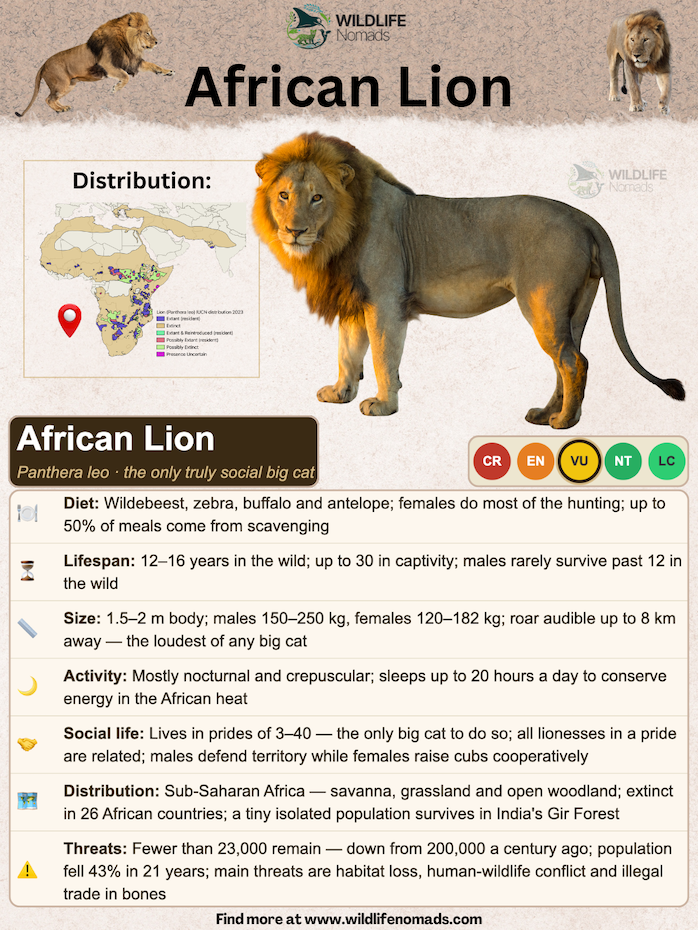
People often ask how many species of African lions there are. The answer surprises them: only one. Every lion on the continent belongs to a single species, Panthera leo, in the genus Panthera alongside tigers, leopards, and jaguars.
The nuance sits below the species level. In 2017, the IUCN Cat Specialist Group reorganized lions into two subspecies. Panthera leo leo covers West and Central Africa plus the last Asiatic lions population in India’s Gir Forest. Panthera leo melanochaita covers Southern and East Africa. Curiously, West African lions are genetically closer to the Indian population than to the lions of the Kalahari Desert. That single fact rewired how scientists think about lion evolution.

2. Lions Are the Only Truly Social Cats
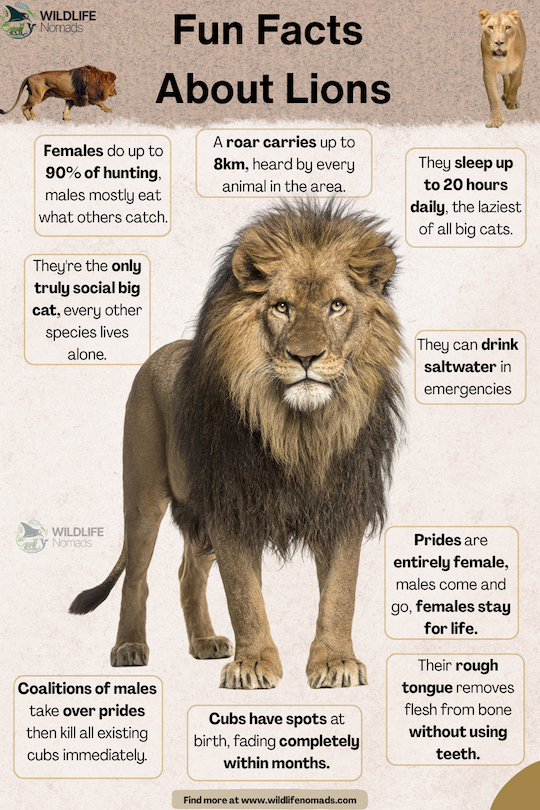
Here is what still amazes me. Of every wild cat on Earth, lions are the only cats that live in permanent social groups. Cheetahs form loose bands, leopards patrol alone, but no other of the big cats, or the small ones, builds a lasting society. Lions do, and they call it a pride.
A lion pride is built around related females, mothers, sisters, daughters, and aunts, who stay together for life. An average pride holds around 15 lions, though numbers swing with prey and territory. Pride life runs on stability, and lions tend to remain within the range where they were born. That stable core of related females is the beating heart of lion society, and it makes them one of the most studied social animals in the cat family.
3. The Lionesses Do the Hunting
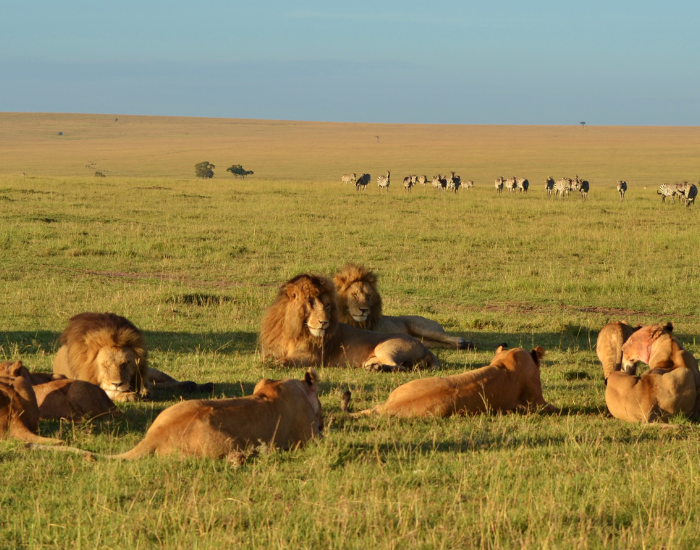
The lazy male sprawled in the shade is a real image, but it hides the truth. Female lions are the primary hunters and, in day-to-day terms, the leaders of the pride. Lion hunting is a team sport: they coordinate, they flank, and they drive prey toward waiting teammates in some of the most sophisticated cooperative hunting known among mammals.
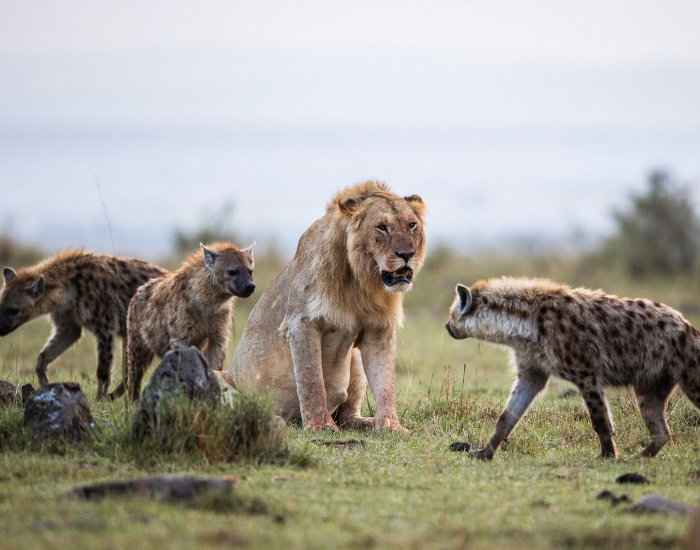
That teamwork lets lions punch far above their weight. Alone, a lioness struggles with a healthy zebra. Together, a pride brings down large animals like wildebeest, zebra in the Savanna or during the great migration, and even Cape buffalo, prey many times heavier than a single cat. When large prey grows scarce, they will take smaller antelope or scavenge from hyenas.
4. A Lion’s Roar Travels Five Miles
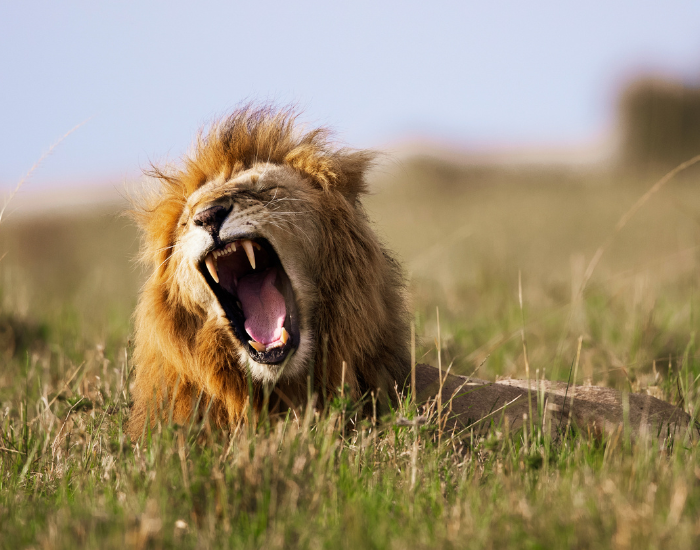
Stand near a roaring lion and you feel it in your chest before your ears catch up. That roar can carry more than five miles across open savannah. It is not showing off. It is infrastructure.
Males roar to advertise ownership of territory and to warn rivals to stay away. They reinforce the message by scent-marking with urine along the edges of their range. A pride’s territory can stretch up to 100 square miles depending on how much prey the land holds. For an animal that cannot post a “keep out” sign, sound and scent do the work, projecting the pride’s claim across the lion’s landscape in a way no fence could cover.
5. Young Males Leave Home and Form Coalitions
Life inside the pride is comfortable for females. For young males, it comes with an eviction notice. Young males eventually leave their birth pride as they mature, pushed out before they challenge their own fathers.
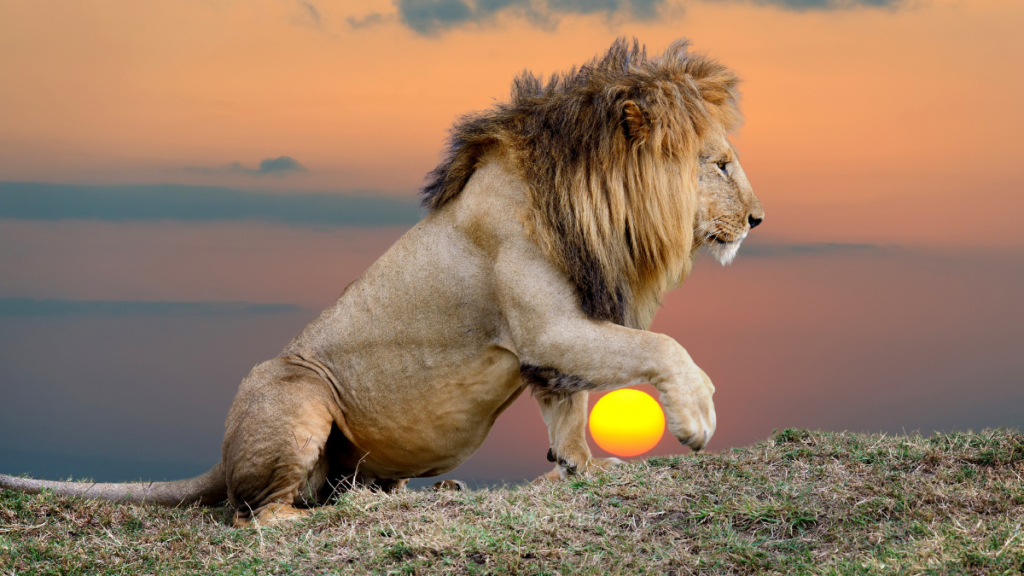
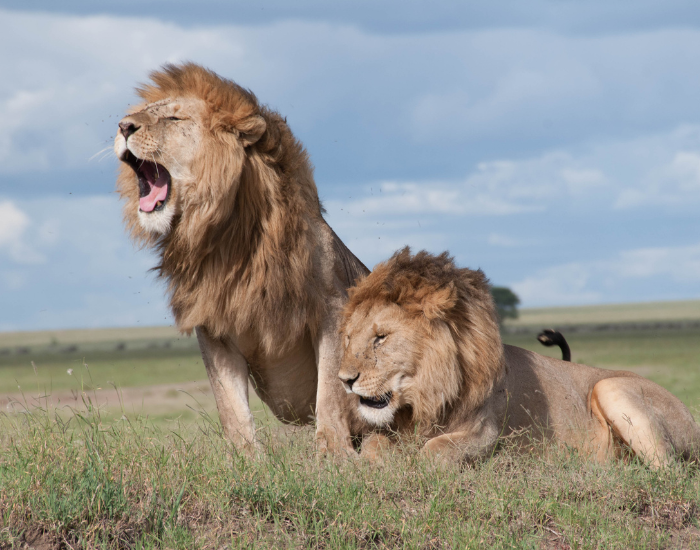
What happens next reads like a survival drama. These young lions band together, often with brothers, into a coalition of several lions. Together they roam as nomadic males until they are strong enough to challenge the dominant males of another pride and take it over. The prize is the right to father cubs. This is also where the male lion’s mane earns its keep: a fuller, darker lion’s mane signals strength and testosterone, and rivals read it before a single claw is drawn.
6. How Big Is a Lion, Really?
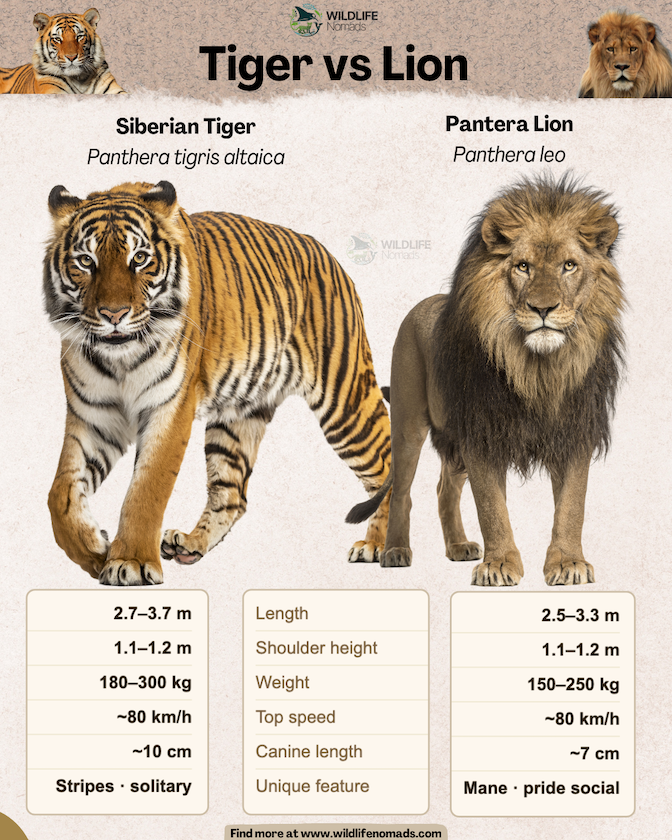
People love comparing tigers vs lions, so let me put real numbers on it. African lion weight lands between 150 and 250 kilograms (330 to 550 pounds) for an adult male, with females noticeably lighter. So how long is a lion? Head to tail, a large male can stretch around 3 meters (nearly 10 feet).
On the question of size of lion vs tiger, the tiger (Panthera tigris) edges ahead. The largest tiger subspecies outweigh lions, so in a pure body-weight contest the tiger usually wins the record. But the two rarely meet in the wild, since tigers roam Asia and lions rule Africa. What lions lack in individual bulk they make up for in numbers, because a coordinated pride is a force no solitary tiger can match. That social advantage, not raw body weight, is the lion’s real weapon.
7. Lions Roam Far Beyond the Postcard Savannah
The classic image is a lion on golden grassland, and that is fair. Lions prefer grassy plains, savannahs, and open woodlands where prey gathers and sightlines stay long. Today they live in scattered populations across sub-Saharan Africa, with around 95 percent concentrated in East and Southern Africa.
But they are more adaptable than the postcard suggests. Lions turn up in the semi-arid Kalahari Desert and, remarkably, have been recorded at elevations up to 3,600 meters (about 11,800 feet) on East African mountains. As Africa’s iconic apex predator, they shape whole ecosystems, keeping herbivore numbers in check across the natural habitats they still hold. Much of that remaining lion habitat now sits inside national parks and protected areas, which have become the last strongholds for wild lions.
8. Fewer Than 25,000 African Lions Remain
This is the fact that stops people cold. Fewer than 25,000 African lions remain in the wild today, with recent estimates landing somewhere between 20,000 and 25,000. African lion numbers have roughly halved in just three decades, and the IUCN lists the species as Vulnerable.
Lion numbers have declined by more than 40 percent over three generations. Worse, wild lions have vanished from an estimated 94 percent of their historic range, hemmed into fragments of the continent they once ruled. In 2015, the entire West African lion population was estimated at just 400 individuals, a subpopulation clinging to survival but with ongoing conservation programs. For an animal this famous, the wild reality is far more fragile than the zoo enclosure ever lets on.

9. The Biggest Threats Are Human, Not Natural
Lions have no real natural predators. Their decline is almost entirely our doing. The primary threats are habitat loss, prey depletion, poaching, and retaliatory killings, and they reinforce one another.
Human-wildlife conflict sits at the center. As farms and livestock push into lion country, lions occasionally take cattle, and ranchers respond by shooting or poisoning them. Poisoning is especially devastating because it kills entire prides at once, along with the vultures, wild dogs, and other animals that feed on the carcass. Poaching adds pressure too, driven partly by demand for lion bones in some traditional Asian medicine markets, where they are sold as a substitute for even rarer tiger bones.
The results are stark on the ground: lion populations in Uganda alone have fallen by an estimated 30 to 60 percent. Curbing the illegal wildlife trade and easing human-lion conflict are now central to lion conservation. Conservation efforts that reward local communities for tolerating lions ultimately benefit wildlife far beyond the prides themselves.
10. Cubs Are Raised by the Whole Pride
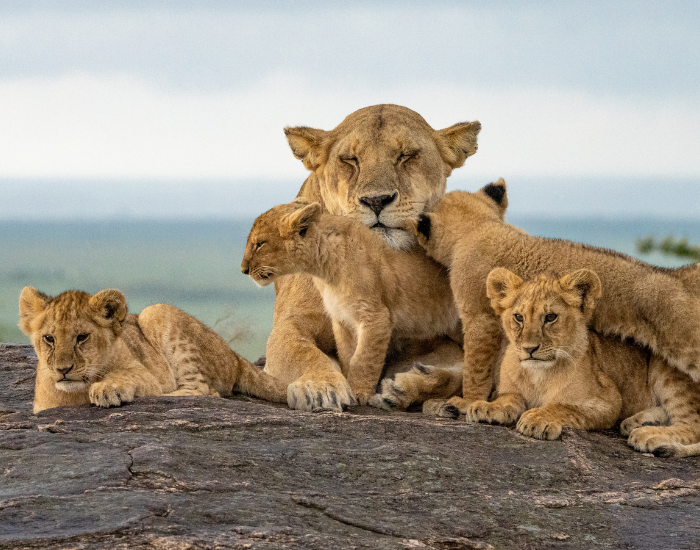
Lion motherhood is a group project, and it is one of the most endearing things about them. Cubs are raised together within the pride by cooperative mothers who will nurse one another’s young, a system called communal rearing. Lionesses often synchronize births so the cubs grow up as a single rowdy cohort.
That cooperation runs on affection you can actually watch. Pride members maintain social bonds through grooming, head rubbing, and constant vocal communication. The cub cohort grows into the next generation of female and male lions together, spending its early months play-fighting, stalking tails, and clumsily climbing trees, rehearsals for skills they will need within a year. Adult females, meanwhile, keep the whole social web stitched together, which is exactly why the loss of a single lioness ripples through an entire pride.
11. We Have Been Obsessed With Lions for Millennia
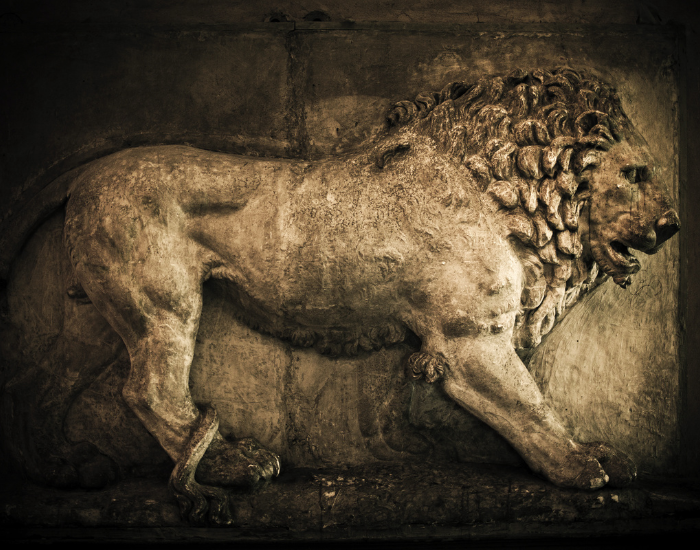
Come back to that zoo memory. There is a reason nearly every human culture reached for the lion. The lion appears on flags, crests, and coins from ancient civilizations to the modern Middle East and across North and South America, standing for strength, courage, and royalty even on continents like South America where wild lions never lived.
That fascination cuts both ways. It funds conservation and ecotourism, yet it also fed centuries of trophy hunting and captive breeding. The story runs deep in specific lineages too, from the spiritual weight of white lions in South African tradition to the tragic history of the Barbary lion, the great maned lion of North Africa now gone from the wild. Understanding that pull, the roar in our collective memory, may be exactly what convinces us to keep real lions on the real savannah.
Frequently Asked Questions About African Lions
There is only one lion species, Panthera leo. Africa’s lions divide into two subspecies: Panthera leo leo in West and Central Africa, and Panthera leo melanochaita in Southern and East Africa. So while people speak of different “African lion species,” biologically they are all one species with regional subspecies.
Africa is home to the African lion, Panthera leo, split across the two subspecies above. This is distinct from the Asiatic lion (historically labeled Panthera leo persica), which survives only in India’s Gir National Park. Genetically, West African lions are surprisingly close to that Indian population.
The seven levels of scientific classification for a lion are: Kingdom Animalia, Phylum Chordata, Class Mammalia, Order Carnivora, Family Felidae, Genus Panthera, and Species Panthera leo. These ranks place the lion firmly within the cat family and alongside tigers, leopards, and jaguars in the genus Panthera.
Not the way humans do. Lionesses have an estrous cycle rather than a menstrual cycle, so they do not shed a uterine lining as a visible period. They come into heat roughly every couple of weeks when not pregnant, and any bleeding is minimal and reabsorbed internally. Their cycles often synchronize across the pride, which helps mothers raise cubs together.
Not as a wild animal. The “tiger lion” people mean is a hybrid: a liger (male lion crossed with a tigress) or a tigon (male tiger crossed with a lioness). These animal tiger-lion crosses occur only in captivity, because lions and tigers do not share territory in the wild. Ligers can grow enormous, but they carry serious health problems and hold no conservation value.
Why Lions Still Need Us
Strip away the myth and the zoo glass, and the African lion is something rarer than any legend: the only cat that built a society, and a species now holding on across less than a tenth of the land it once ruled. That combination, social genius and steep decline, is exactly what makes their story urgent.
I will send back real field notes once I finally reach the savannah next year. Until then, go look closer yourself. Watch a pride documentary with fresh eyes, support a lion conservation group, or read up on the other predators that share their world, from the cheetah and leopard to the misunderstood hyena. And if this changed how you see lions, drop a comment with the fact that surprised you most. I read every one.
African Lions: Fact or Fiction? 🦁
Twelve statements about the king of the savannah — six true, six myths. Can you tell them apart?
Fact or Fiction?
References:
Bauer, H., Packer, C., Funston, P. F., Henschel, P., & Nowell, K. (2016). Panthera leo (errata version published in 2017). The IUCN Red List of Threatened Species, e.T15951A115130419. https://doi.org/10.2305/IUCN.UK.2016-3.RLTS.T15951A107265605.en
Bertola, L. D., Vermaat, M., Lesilau, F., Chege, M., Tumenta, P. N., Sogbohossou, E. A., & de Iongh, H. H. (2022). Whole genome sequencing and the application of a SNP panel reveal primary evolutionary lineages and genomic variation in the lion (Panthera leo). BMC Genomics, 23, 321. https://doi.org/10.1186/s12864-022-08510-y
Kitchener, A. C., Breitenmoser-Würsten, C., Eizirik, E., Gentry, A., Werdelin, L., Wilting, A., & Tobe, S. (2017). A revised taxonomy of the Felidae: The final report of the Cat Classification Task Force of the IUCN Cat Specialist Group. Cat News, Special Issue 11, 71–73. https://repository.si.edu/handle/10088/32616
Bauer, H., Chapron, G., Nowell, K., Henschel, P., Funston, P., Hunter, L. T. B., & Packer, C. (2015). Lion (Panthera leo) populations are declining rapidly across Africa, except in intensively managed areas. Proceedings of the National Academy of Sciences, 112(48), 14894–14899. https://doi.org/10.1073/pnas.1500664112
Riggio, J., Jacobson, A., Dollar, L., Bauer, H., Becker, M., Dickman, A., & Pimm, S. (2013). The size of savannah Africa: A lion’s (Panthera leo) view. Biodiversity and Conservation, 22(1), 17–35. https://doi.org/10.1007/s10531-012-0381-4
Packer, C., Loveridge, A., Canney, S., Caro, T., Garnett, S. T., Pfeifer, M., & Polasky, S. (2013). Conserving large carnivores: Dollars and fence. Ecology Letters, 16(5), 635–641. https://doi.org/10.1111/ele.12091
Everatt, K. T., Kokes, R., & Lopez Pereira, C. (2019). Evidence of a further emerging threat to lion conservation: Targeted poaching for body parts. Biodiversity and Conservation, 28, 4099–4114. https://doi.org/10.1007/s10531-019-01866-w