
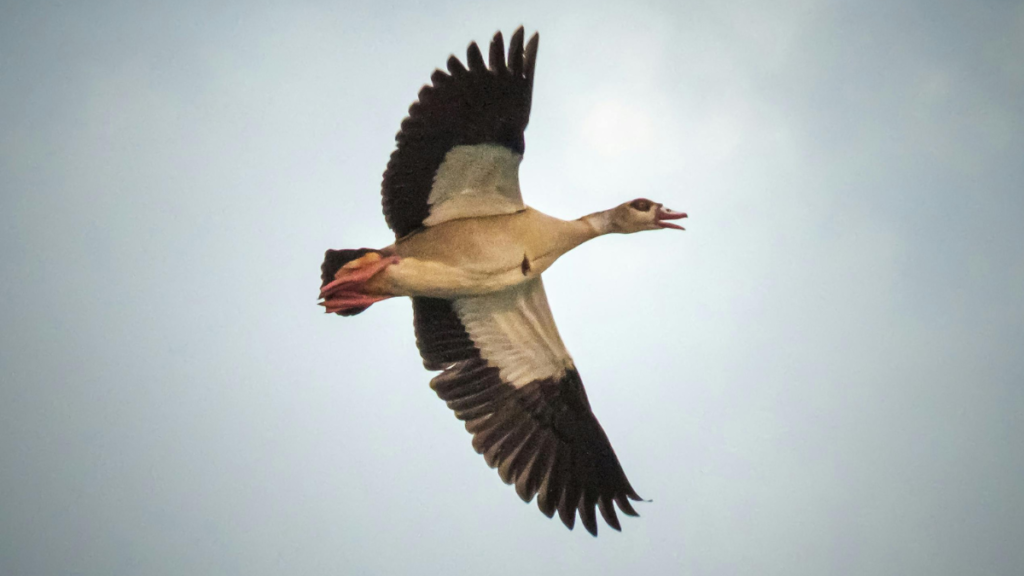
The sun was sliding behind the dunes near Aswan when I first watched an Egyptian goose closely. I sat on a felucca, gliding along the Nile. A pair lifted off the bank together. That bandit mask caught the last orange light. Our captain had ferried travelers for over thirty years. He smiled and said I had come at the right hour. I have spent a month in Egypt chasing wildlife between temples, and ancient cities.
Beside the Egyptian vultures circling Abu Simbel and the hoopoes hopping near the temple walls, this striking waterfowl was the species I most wanted to see. We also spotted kingfishers and grey herons gliding low across the water. The captain was no scientist, but he knew the birds of his river by heart. After watching dozens of these geese up close on several felucca trips and asking every ranger I met, here are twelve things I learned about the Egyptian goose. Each surprised me. I think most of them will surprise you too.
1. The Egyptian Goose Isn’t Really a Goose
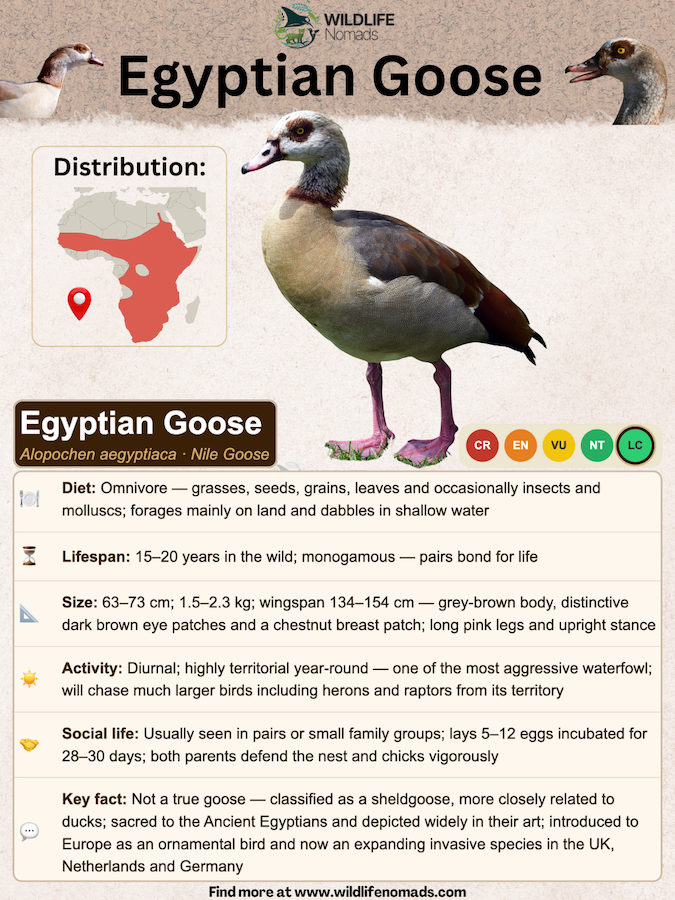
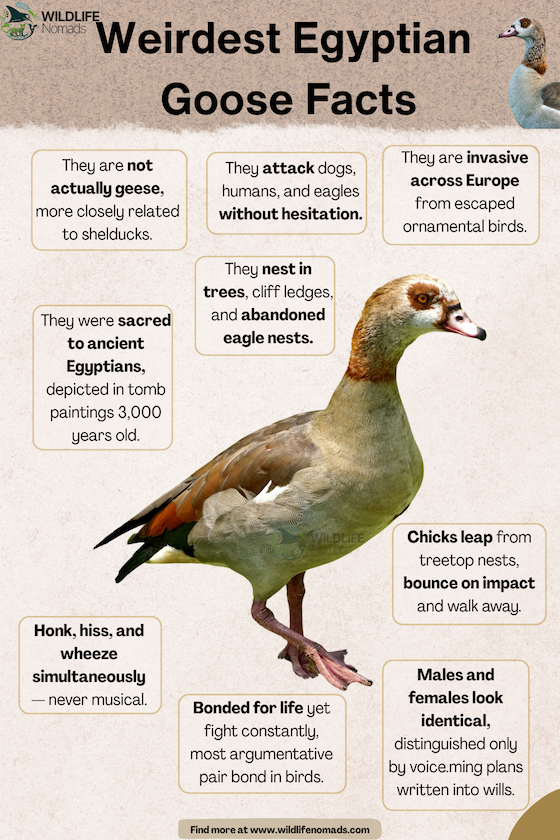
This is the first thing I tell anyone curious about this bird, the Alopochen aegyptiaca. Despite the name and the silhouette, this bird belongs to the Anseriformes family but sits within the shelduck branch. It is not a true goose, like the snow goose.
That makes it more closely related to a duck than to a Canada goose. Taxonomists place Alopochen aegyptiaca in its own genus because of this oddity. So when you point at one and call it a goose, you are only half right. The Egyptian goose has confused naturalists for centuries.
2. That Bandit Mask Is Impossible to Miss
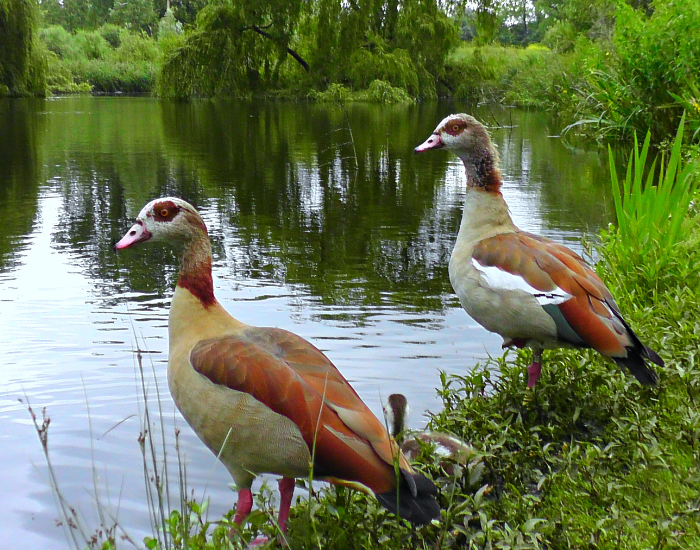
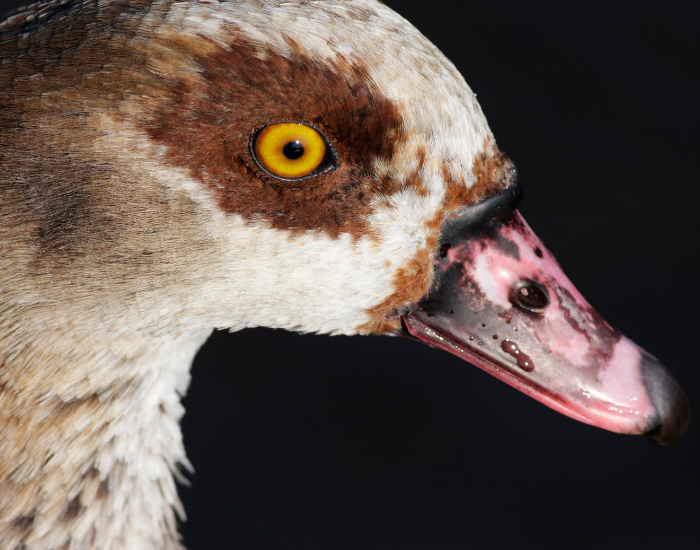
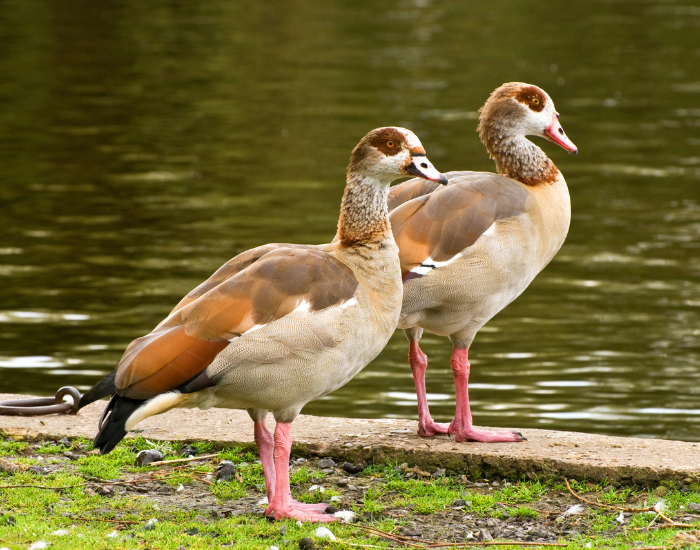
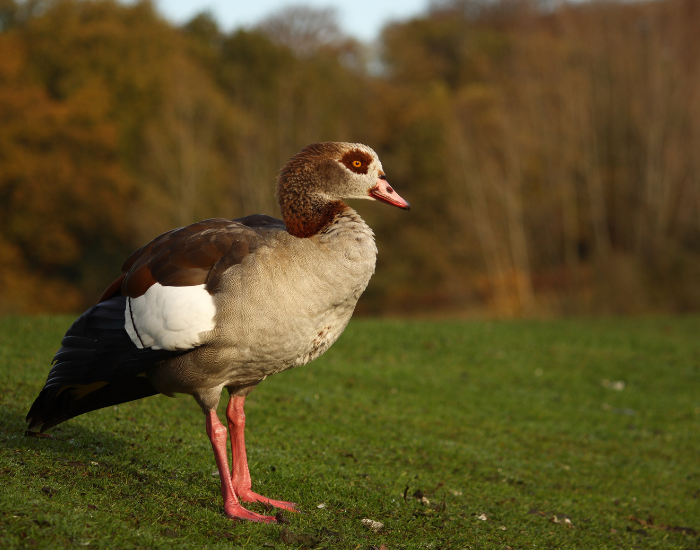
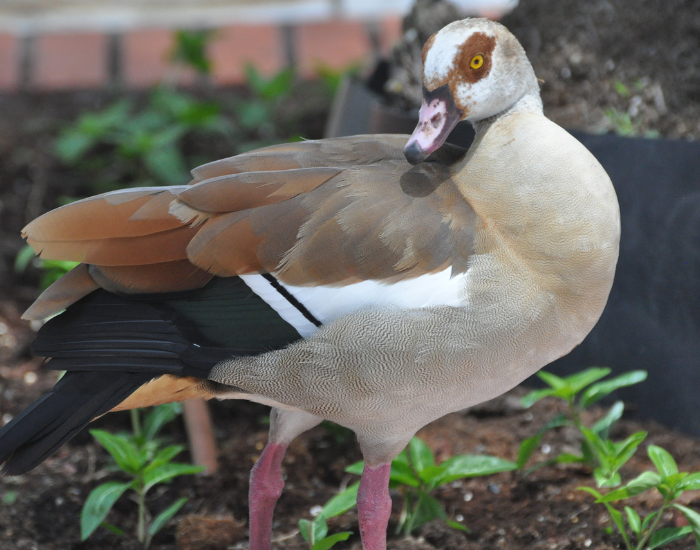
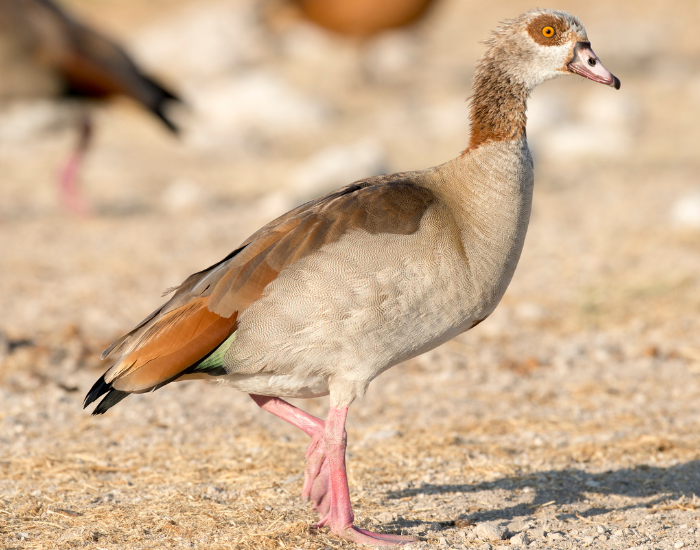
The Egyptian goose has one of the most recognizable faces in the bird world. A dark brown patch wraps each eye like a mask. Another dark chestnut ring sits on the breast like a medallion. The head shades into pale beige along the neck. The pink beak carries a small black tip, and the bill itself is short and stout.
The legs are the same bright pink as the beak. Some birders call it the red eyed goose because of the prominent eye-ring, though the eye itself is not actually red. Males and females look nearly identical. When the wings open in flight, a brilliant white patch flashes against the brown wing coverts. That flash serves as a built-in warning signal during aggressive displays.
3. Sacred in Ancient Egypt, Common on the Nile Today
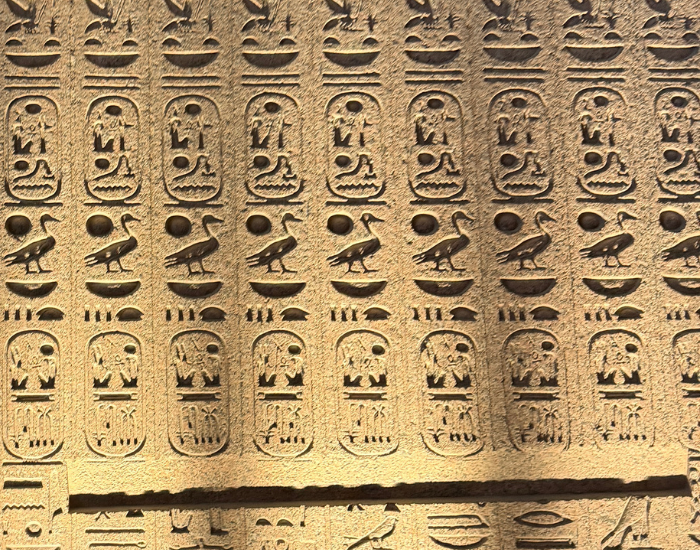
Egyptian art is full of this bird. In the Nile Valley, ancient Egyptians revered the species as a symbol of creation, fertility, and abundance. You see it carved into tomb paintings, hieroglyphics, and temple reliefs. The famous Meidum Geese fresco was painted more than four thousand years ago.
Scholars now identify three of the six birds shown as Egyptian geese. Walking past those reliefs and then watching the same species feed on the riverbank an hour later was the kind of moment that keeps me doing this work. That continuity is rare in the modern world.
4. They Mostly Mate for Life
People always ask me, “Do Egyptian geese mate for life?” The short answer is mostly yes. Pairs form strong bonds and usually stay together year after year. During the breeding season, the male and female perform synchronized calls. The female produces a loud, harsh honk. The male answers with a quieter hiss. That pair bond is part of what makes the species so successful. Both birds defend the territory. Both incubate the eggs. And both protect the young.
5. Their Nesting Choices Are Wildly Unpredictable
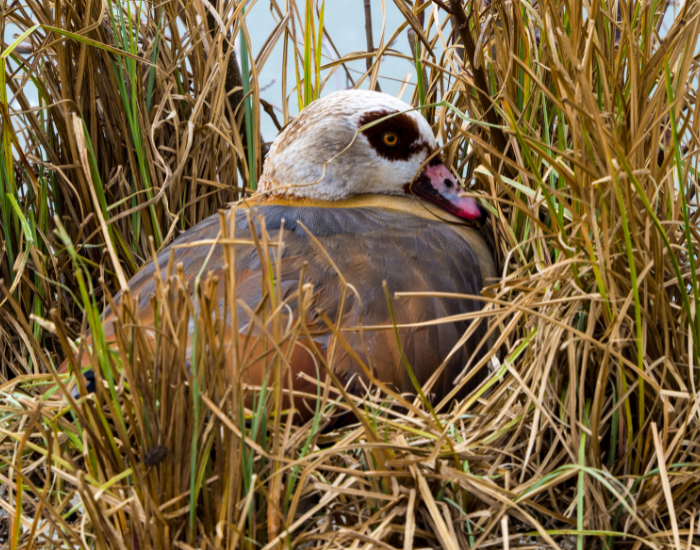
This was the fact that made my felucca captain laugh. Egyptian geese will nest almost anywhere they can. I have seen records of nests in old trees, in tree cavities, on bare ground, in dense grass, on cliff ledges, on building rooftops, and inside the abandoned nests of large raptors. Each clutch usually holds between 5 and 11 eggs. The eggs are creamy white and slightly glossy.
Both parents take turns incubating those eggs for 28 to 30 days. After hatching, the goslings hop, fall, or flutter down to follow their parents to water. A nest fifteen meters up an acacia is not unusual. Neither is a nest tucked into a flowerpot on a Cairo balcony.
6. The Goslings Are Tough From Day One
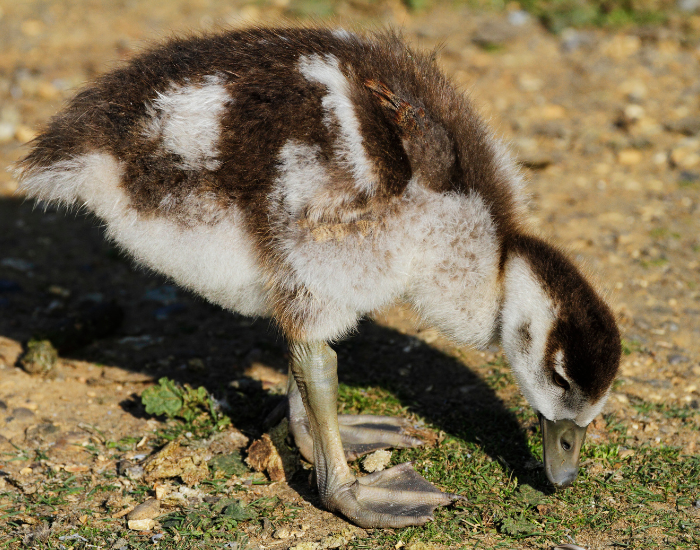
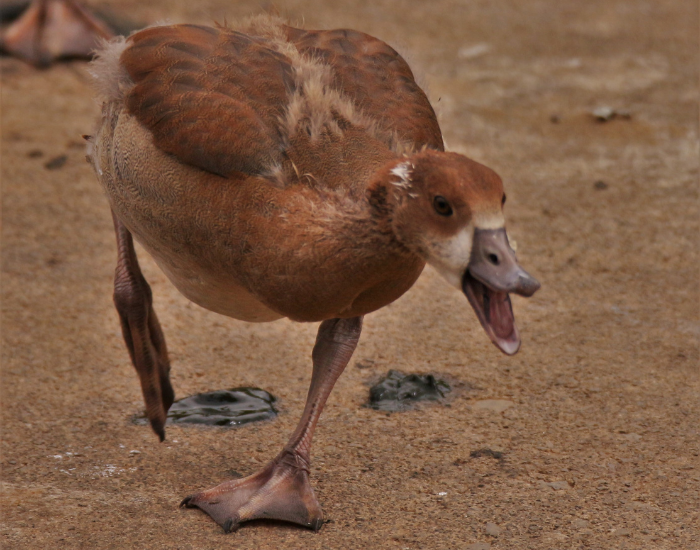
Egyptian goslings are about the size of a tennis ball at hatching. They are covered in pale yellow and dark brown down. Within a day they can swim and feed themselves. The parents stay close for protection, but the goslings forage on their own from the start. I observed a brood of seven follow their mother across a side channel near Kom Ombo.
The father stood on the bank with his neck stretched high, scanning for threats. While the young swam in formation, the rest of the family kept a careful watch. Predators take a heavy toll on the goslings. Crows, eagles, hawks, monitor lizards, and even large fish will pick off the young. Clutches are large to compensate.
7. They Are Aggressive, Sometimes Brutally So
The Egyptian goose has a reputation among biologists for being one of the most aggressive waterfowl in the wild. Pairs fiercely defend the nest and territory against intruders. They will chase off ducks, herons, and other geese twice their size. In some cases, an Egyptian goose pair will kill another’s offspring to claim contested territory.
This aggressive behavior is a key reason the species displaces native wildlife where it has been introduced. On the Nile, native predators keep that behavior in balance. In suburban Europe, the balance breaks.
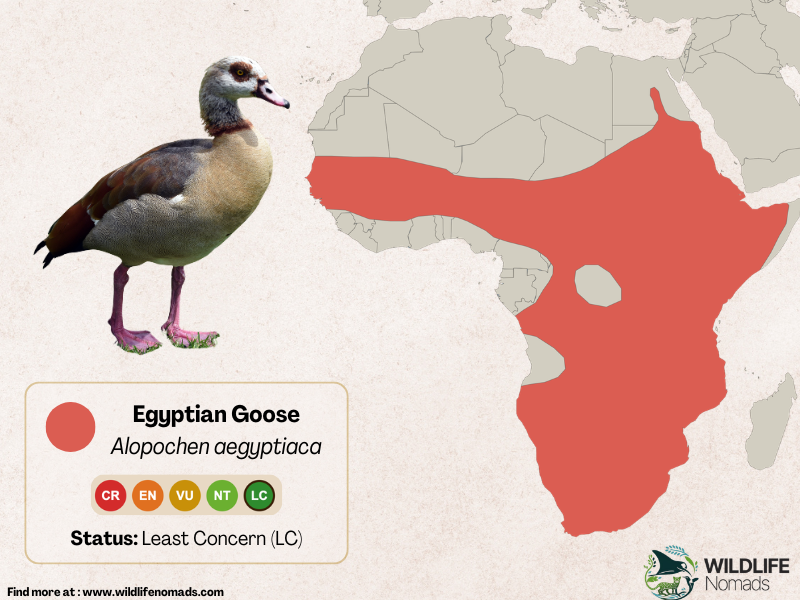
8. The Native Range Is the Nile Valley and Sub-Saharan Africa
The Egyptian goose is widely distributed across Africa. Its native range covers the Nile Valley and most of Sub-Saharan Africa. Populations are abundant in wetlands, river systems, and floodplains. The species favors open areas near freshwater such as rivers, ponds, lakes, marshes, and urban parks. Within these ecosystems, it acts as a primary consumer in the wetland food web.
The diet is mostly plant-based. The birds graze on grass, seeds, shoots, and agricultural grain. They occasionally take worms and other small invertebrates. In other parts of their range they switch to more aquatic vegetation. Their foraging aerates the soil and accelerates the decomposition of dead plant matter. In turn, the geese feed apex predators like Nile crocodiles, lions at waterholes, and large birds of prey.
9. They Have Conquered Europe in Sixty Years
Egyptian geese were first introduced to the Netherlands in 1967. Most arrived through escapes from ornamental waterfowl collections. Belgium followed in 1982. By the mid-1980s, feral populations were spreading into Germany and France. Today the species is widespread across Western Europe.
It is rapidly colonizing parts of Great Britain, including offshore islands in the Thames estuary. Breeding populations in Britain are now firmly established. In these introduced ranges, Egyptian geese favor the same kind of open freshwater habitats they use at home. The same flexible behavior that helps them thrive in Africa makes them hard to stop abroad.
10. Yes, There Are Egyptian Geese in the United States
This one surprises American birders. In the United States, breeding populations of Egyptian geese are now established in Florida, California, Texas, Arkansas, Nebraska, and Oklahoma. Occasional sightings turn up elsewhere. Florida and Texas hold the largest populations.
Thousands of individuals live in suburban ponds, golf courses, and city parks. Most descend from escaped ornamental birds released decades ago. Several state wildlife agencies are watching it closely. Florida has begun studying interactions with native ducks and waterbirds.
11. The EU Declared Them Invasive in 2017
Since 2017, the Egyptian goose has been listed as an invasive alien species of Union concern in the European Union. The designation prohibits importation, breeding, transport, and intentional release into the environment. In suburban areas, the species can cause significant damage.
The birds graze on crops, foul lawns and waterways, and aggressively displace native ducks and geese. The large amounts of feces they produce affect water quality and can spread disease. Managing the established population is now a genuine challenge across the continent.
12. Smaller Than a Swan, Larger Than a Muscovy Duck
Adults of this species average 63 to 73 centimeters long. They stand close to 15 – 20 cm tall. They weigh roughly 3 to 6.5 pounds, and sometimes reaching up to 8.8 lbs (4 kg).. That makes them smaller than a swan but larger than a Muscovy duck, and noticeably bigger than a mallard duck. Males are slightly larger than females, but the sexes look nearly identical.
That is a real challenge when you are trying to identify pairs in the field. The species is a strong flier despite its bulk. It is also a surprisingly agile swimmer, capable of swimming long distances while feeding. In the air they look almost gull-like thanks to those flashing white wing patches. On the water they sit high and ride flat. Watching a pair lift off the Nile at dawn is one of the better reasons to set an early alarm in Egypt.
Frequently Asked Questions
Egyptian geese babies are called goslings, the same term used for any goose-like waterfowl chick. The goslings are precocial. They hatch ready to walk, swim, and feed themselves within hours. Both parents guard the young goslings until they fledge at around 10 weeks. Predators take a significant share, which is why each clutch is large.
Yes. Egyptian geese have established self-sustaining feral breeding populations in Florida, California, and Texas. Smaller populations live in Arkansas. Most descend from escaped ornamental birds released by private collectors decades ago. Florida and Texas now host thousands of individuals in suburban parks, ponds, and golf courses, with the population still expanding.
Egyptian geese typically breed once per year. The breeding season is timed to local rainfall patterns. In Africa, breeding can occur year-round depending on water availability. A single clutch is the norm. If a clutch fails early, a pair will sometimes attempt a second nest in the same season.
Goose Facts | credit: Wildlife Nomads
They are Sacred and Invasive
After a month watching this striking waterfowl along the Nile, I see the Egyptian goose differently. It is sacred and invasive. It is beautiful and brutally aggressive. And it is native to one continent and a growing problem on three others. If you find yourself near freshwater in the Nile Valley, take a felucca at sunset and watch them yourself. The felucca rides I shared with herons and kingfishers, including the regal grey heron, were among my best fieldwork hours in years. For more on the birds of the river, the broader waterfowl family, or the specific herons I met, those guides are a great next stop. If you are heading toward Abu Simbel, also watch for the hoopoe and the Egyptian snakes I spotted along the way.
References:
Sutherland, W. J., & Allport, G. (1991). The distribution and ecology of naturalized Egyptian Geese Alopochen aegyptiacus in Britain. Bird Study, 38(2), 128–134. https://doi.org/10.1080/00063659109477080
European Commission. (2017). Commission Implementing Regulation (EU) 2017/1263 updating the list of invasive alien species of Union concern. Official Journal of the European Union, L 182, 37–39. https://eur-lex.europa.eu/eli/reg_impl/2017/1263/oj