
I’ve always loved trekking and hiking, especially when it leads me into wetlands and swamps. They’re some of the most familiar landscapes wherever you travel, and they almost always come with many types of bird, you know, the usual residents. Depending on where you are, it might be a heron standing motionless at the water’s edge, a wood duck slipping between reeds, ibises probing the mud, These places feel predictable at first, but they’re also where birds love to blur the lines and keep you guessing.
If you’ve ever looked up at a shimmering white cloud of birds and wondered, “Is that a snow goose or a swan?” you aren’t alone. Sometimes, even experts have to make an educated guess when identifying distant white birds in the sky, as distance and light can turn a simple ID into a bit of a detective mission.
Whether you are exploring the Summer Lake Wildlife Area or looking for waterfowl in British Columbia, this guide will help you distinguish these iconic birds from their lookalikes.

1. The Anatomy of a Snow Goose: Beyond the White
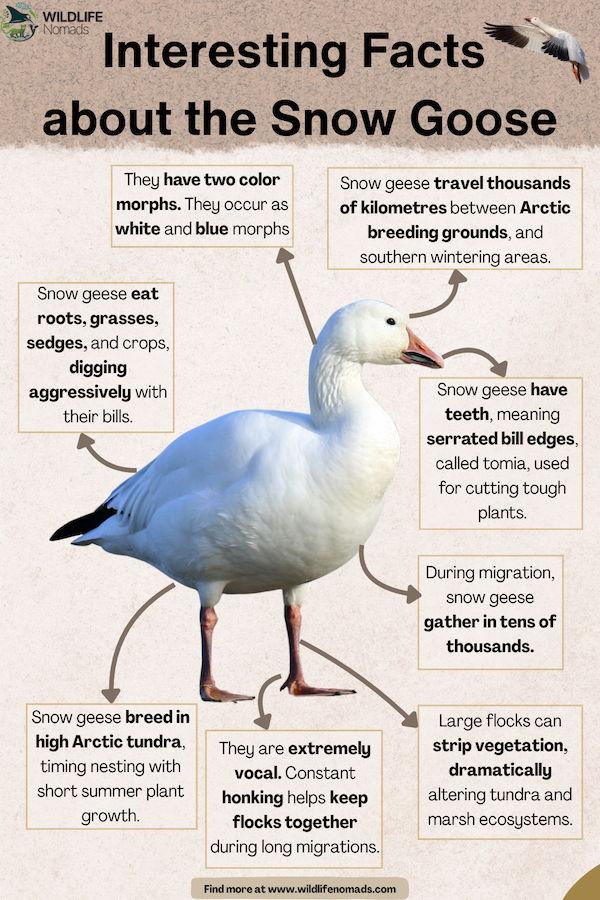
To identify a snow goose, you first have to realize they aren’t always white. They come in two “morphs”:
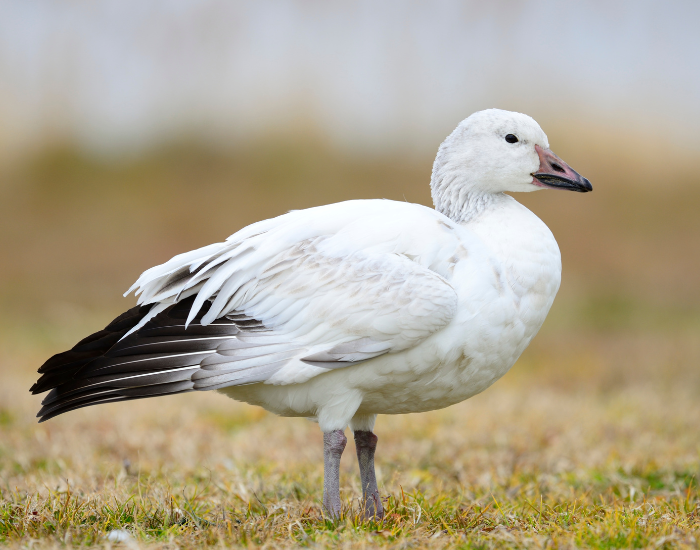
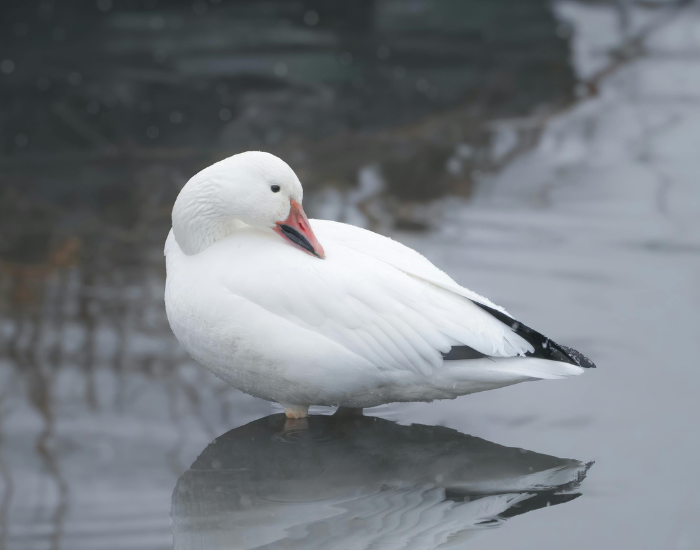
- White Morph: The classic look. Adult snow geese are pure white with black wing tips, a white belly, and white tail feathers. The black wing tips (primary feathers) are only visible when the wings are spread or in flight.
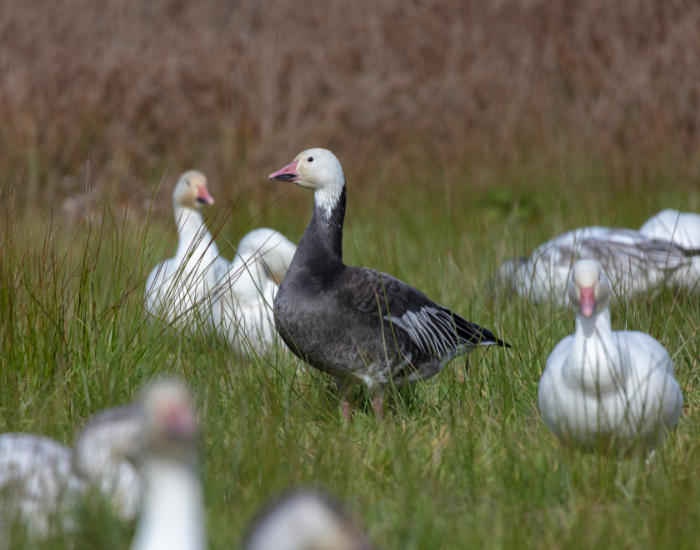
- Blue Morph: Once thought to be a separate species, “Blue Geese” have a dark body with a white head. These features help distinguish adults from juveniles, which have different plumage.
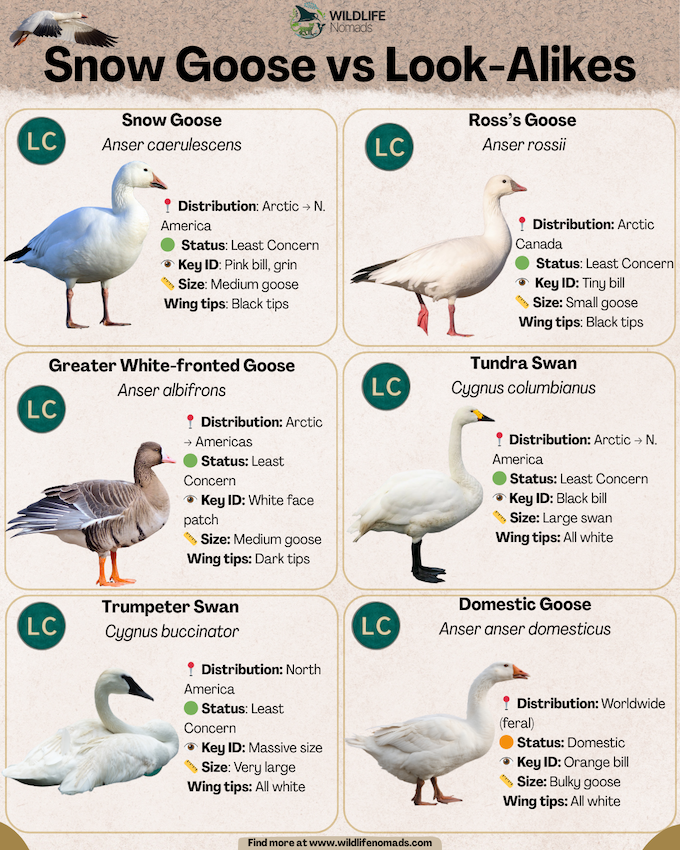
The most “scientific” way I tell them apart from a distance is the bill. A snow goose has a “grin patch”, a black serrated edge on the side of the pink bill that makes it look like it’s perpetually smirking at a private joke.
2. Snow Goose vs. Swan: The Neck is the Give-Away
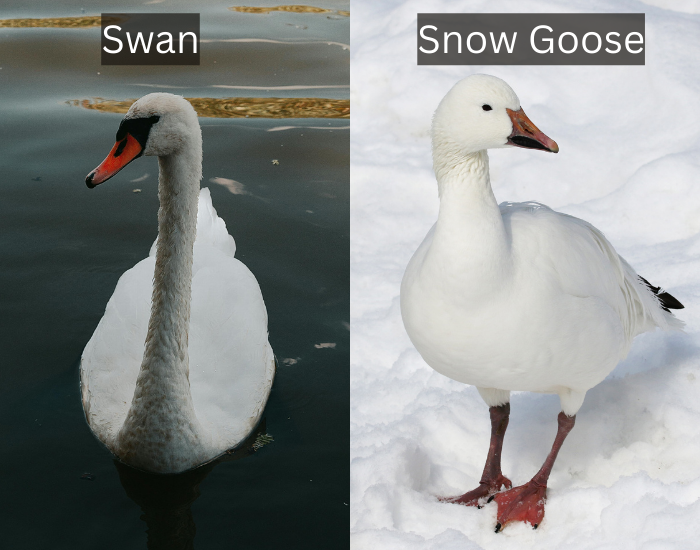
One of the most frequent questions I get is: What is the difference between a snow goose and a swan? At a glance, a tundra swan vs. snow goose debate is easy to settle if you look at the silhouette.
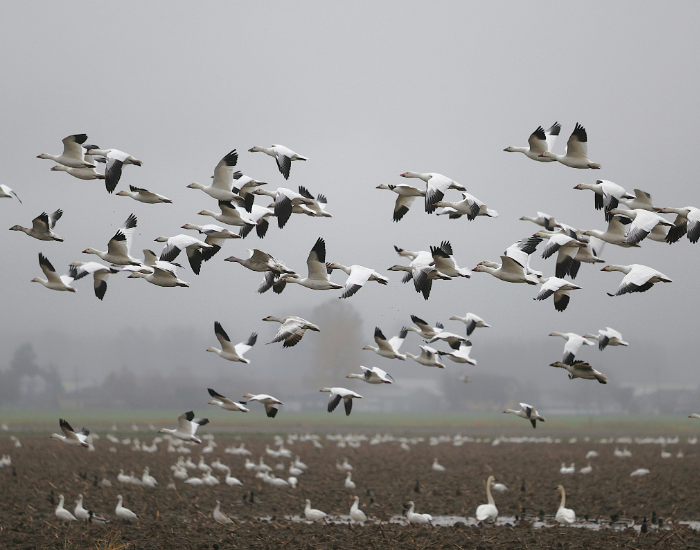
When observing a group of birds, comparing the one in the middle of the flock or pond can help highlight the differences in neck length and body size between snow geese and swans.
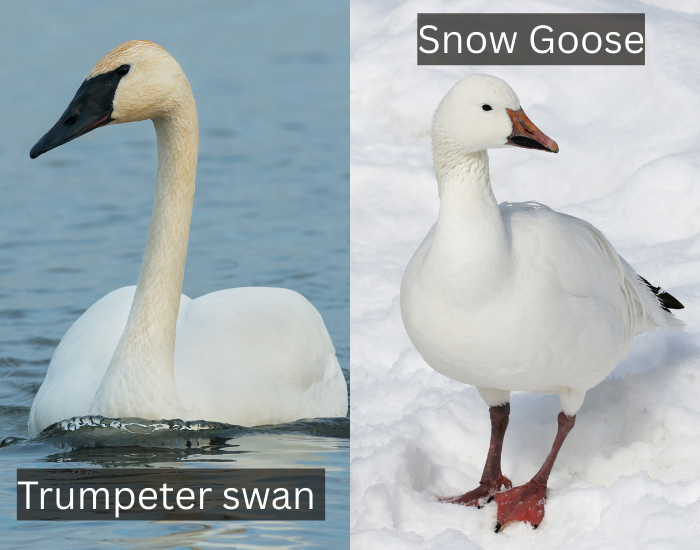
A snow goose has a much shorter neck relative to its body. If the bird looks like it’s been hitting the gym and skipped “neck day,” it’s probably a goose. Swans, including the Trumpeter and Tundra, have an elegant, long neck that often exceeds the length of their body.
3. The “Black Wing Tip” Rule
If you see birds that look like swans but they have jet-black wing tips, stop right there. You are looking at a snow goose. Trumpeter swans and tundra swans are pure white from tip to tail as adults.
In hunting situations, swans have sometimes been mistakenly shot when hunters failed to notice the absence of black wing tips, which are unique to snow geese.
4. Size Matters: The Trumpeter Swan Comparison
If we are looking at swans vs. snow geese, size is the most obvious factor, provided they are standing next to each other. A Trumpeter swan is a behemoth, weighing up to 25-30 pounds. A snow goose is a featherweight by comparison, usually topping out at 5-7 pounds.
In British Columbia or the Pacific Flyway, you might see them feeding in the same shallow wetlands, but the swan will always look like the “king” of the pond.
5. The Tundra Swan vs. Snow Goose Face-Off
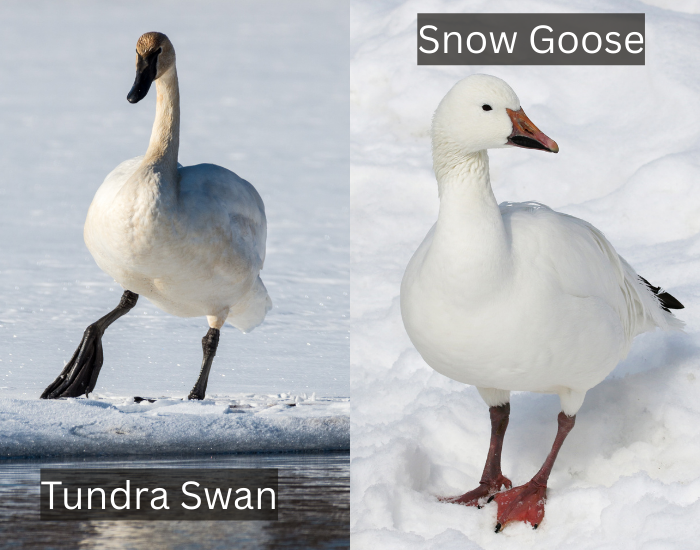
The Tundra swan is closer in size to a goose than the Trumpeter, making it a common source of confusion. However, look at the bill.
- Snow Goose: Pink bill with a black “grin patch.”
- Tundra Swan: Solid black bill, often with a small yellow spot near the eye.
6. Meet the “Mini-Me”: Ross’s Goose
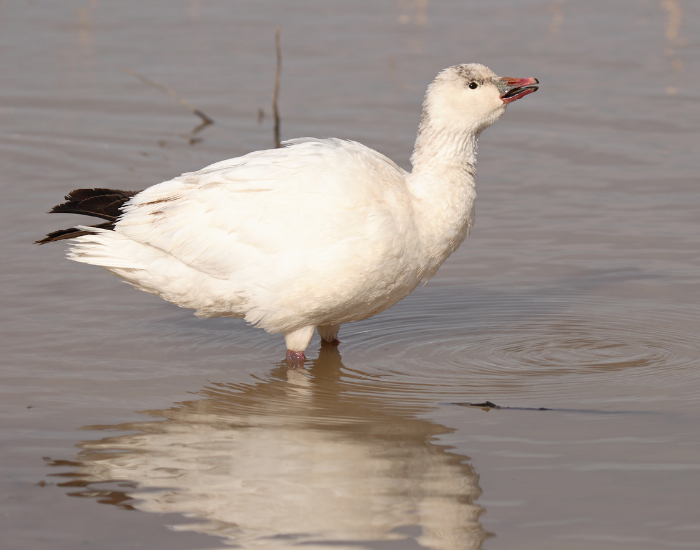
If you think you’ve found a small snow goose, you might actually be looking at a Ross’s goose. To the untrained eye, they are identical. But as a biologist, I look for the neck and the bill profile. The Ross’s goose has a much shorter neck and a tiny, stubby bill without the prominent “grin patch.”
Think of the Ross’s goose as the “cute” version of the snow goose. They often travel in large flocks together, so it takes a photo and some patience to distinguish them.
7. The Sound of the Tundra
The voice of these birds is a dead giveaway, a higher pitched, nasal honk-honk-honk that is more frequent than the calls of swans, sounding like a frantic crowd at a sporting event. You will usually hear the flock long before you see it. Swans, in contrast, produce a deeper, melodic bugling call (Trumpeters especially, whose call sounds like a French horn).
The distinctive higher pitched notes of the snow goose’s call help distinguish it from the deeper, melodic bugle of swans.
8. They Travel in Massive Flocks
Snow geese are the extroverts of the waterfowl world. They migrate in enormous, undulating flocks numbering in the tens of thousands. That behaviour isn’t random, it’s a survival strategy. Thousands of eyes are more effective than two when a bald eagle is circling overhead.
Swans, by contrast, are family-oriented birds typically seen in small groups or pairs. Therefore, if the sky is literally turning white with birds, you’re almost certainly watching snow geese.
9. Feeding Habits: The “Grubbers”
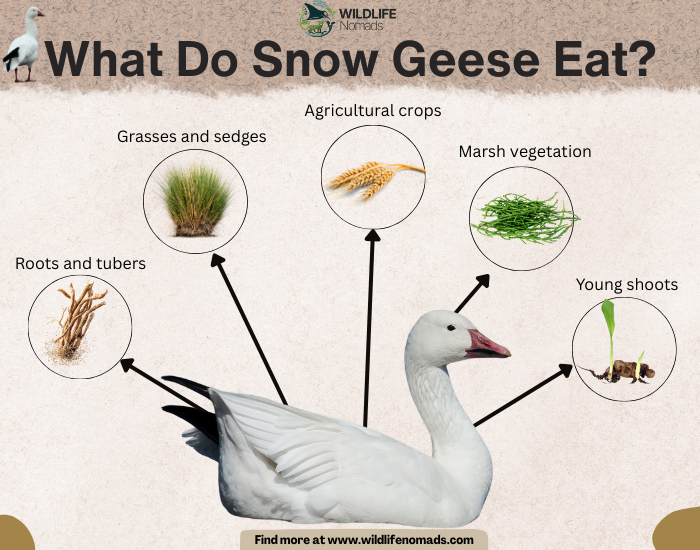
Unlike Canada geese (probably one of the most iconic birds in Canada), which primarily graze on grass, snow geese are aggressive root-diggers. They use those sturdy, serrated bills to excavate the roots and rhizomes of marsh grasses and aquatic plants. This feeding behaviour is efficient, but at scale, it becomes destructive.
In their Arctic breeding grounds, overgrazing by large flocks strips the landscape down to bare mud, creating what biologists call “eat-outs.” These degraded areas recover slowly, if at all, affecting dozens of other species that depend on the same habitat.
10. Regional Hotspots: Where to See Them
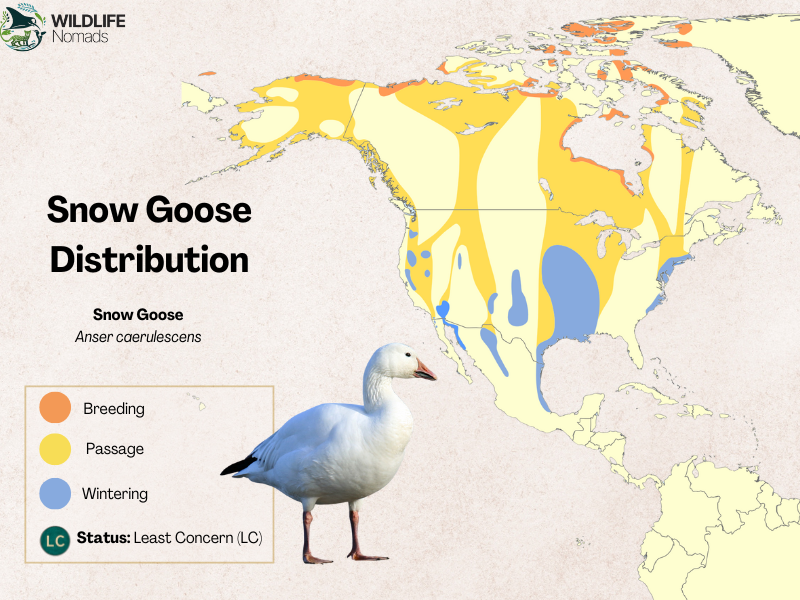
Snow geese follow four major flyways during migration. Here are the top regional hotspots:
- Pacific Flyway: California’s Central Valley, Oregon, and British Columbia’s Fraser River Delta, with snow geese found as far north as Alaska
- Central Flyway: The Midwest, including prairie potholes and agricultural fields from Texas to the Dakotas
- Mississippi Flyway: The Gulf Coast and Mississippi Alluvial Valley
- Atlantic Flyway: The mid-Atlantic coast from Massachusetts to North Carolina; New Jersey and Delaware are prime winter spots
March and October are peak viewing months at almost any major wetland along these routes.
11. Is it Rare to See Snow Geese?
Actually, quite the opposite, though the story is changing. After a massive population explosion in the late 20th century, snow geese are still officially labeled as “overabundant” by managers. However, we are currently seeing a tale of two geese: while the Greater Snow Goose in the Atlantic and the Lesser in the West remain numerous, the massive Mid-continent population has actually seen a sharp decline recently due to habitat loss in the Arctic.
Despite these shifts, they remain incredibly easy to find. If you are near a major wetland in March or October, you aren’t just looking for one bird; you’re looking for a white horizon. They are still among the most abundant waterfowl on the continent, making them a “sure bet” for your birding checklist.
12. Identifying Juveniles
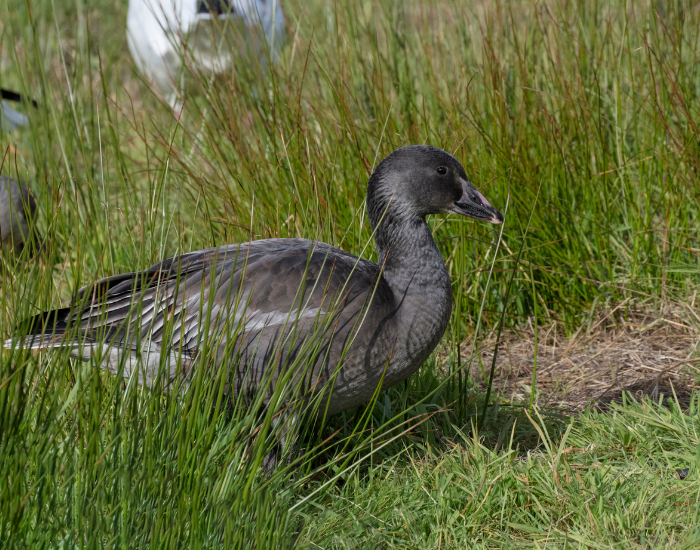
Don’t let the gray birds confuse you. Juvenile snow geese are a dusky, gray-brown color. They don’t get that crisp white head and body until their second year. I’ve seen many a bird watcher get confused thinking they’ve found a new species when they’ve just found a teenager.
Quick Comparison Table: Snow Goose vs. Swan
| Feature | Snow Goose | Tundra/Trumpeter Swan |
| Neck Length | Shorter, stocky | Very long neck |
| Wing Tips | Black wing tips | Pure white (adults) |
| Bill Color | Pink with black “grin” | Solid black bill |
| Weight | 5–7 lbs | 15–30 lbs |
| Vocalization | High-pitched “honk” | Low, melodic bugle |
FAQ: Your Snow Goose Questions Answered
They are not rare at all. In fact, their population is so high that they are a hunted species in many areas to protect the Arctic tundra from overgrazing.
They are sometimes called “White Geese” or “Blue Geese” (for the dark morph). In some scientific circles, they are referred to by their status as a “lesser” or “greater” snow goose depending on their size and nesting location.
In a territorial dispute, the swan almost always wins. They are significantly larger and very protective of their rest areas. In fact, some farmers use swans to keep Canada geese away from their ponds.
A white goose with a black beak is likely a juvenile snow goose or a Ross’s goose. Remember, swans are much larger with much longer necks. If the bird has black wing tips, it’s a goose.
Why This Matters to a Biologist
In my career, whether I’m writing about the behavior of a woodpecker or the migration of waterfowl, I look for the “why.” Why do snow geese fly in such large flocks? It’s for protection. Thousands of eyes are better than two when a bald eagle is circling.
Identifying these birds isn’t just about ticking a box on a list; it’s about understanding the rhythm of our planet. When you see that “V” formation in January or February, you’re witnessing a journey that has been happening for millennia.