The first time I held a wild skink, I was an intern at a Mexican zoo, cleaning enclosures for tarantulas and these chunky, polished little lizards. My supervisor scooped a five-lined skink from beneath a piece of driftwood and dropped it in my hand. The instant those shiny scales slid across my palm, I was hooked.
Years later, on my first field job in Sydney, I was walking a nature reserve when a slow-moving lizard crossed the path near a tree. My first thought was water dragon, but my coworkers grinned and told me it was a blue tongue skink. I crouched for nearly ten minutes before it flicked out that cobalt warning. Unforgettable.
This guide walks through 15 of the most extraordinary types of skink on Earth, from tiny ground dwellers in Louisiana flower beds to a prehensile-tailed giant the size of a house cat. Family Scincidae is wildly diverse — over 1,500 species across nearly every continent — and I’ve been lucky enough to track quite a few in the wild.
North American Skinks
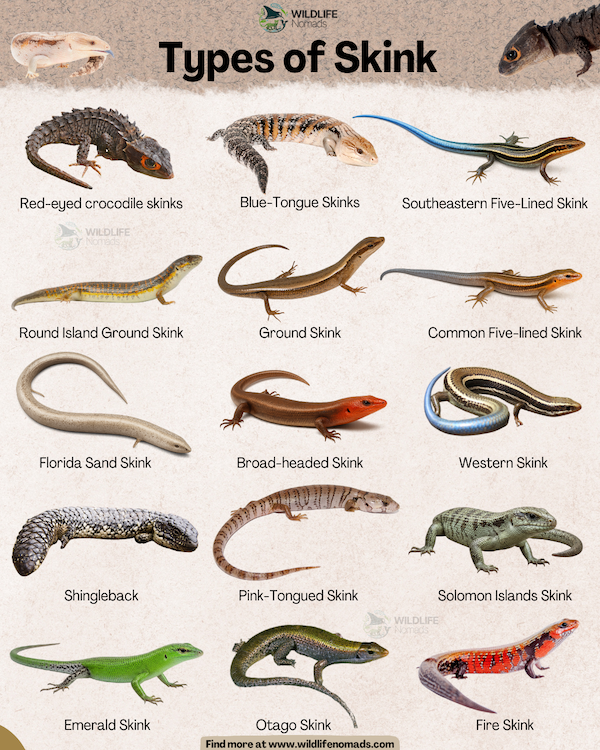
1. Common Five-Lined Skink (Plestiodon fasciatus)
The common five-lined skink is the lizard most North Americans accidentally meet first. As a juvenile, this five-lined skink sports a brilliant bright blue tail that fades to a duller brown as adult males mature. Plestiodon fasciatus thrives in leaf litter, rotting stumps, and rock piles across the eastern US and into southern Canada.
Females of the common five-lined skink lay 5–11 eggs in soil-lined nests under bark, then guard them, rare behavior for a lizard. You can watch the common five-lined skink dart across hiking trails, the bright blue tail flashing like a tiny lure for predators. The five-lined skink remains the most common skink in eastern yards.
2. Broad-Headed Skink (Plestiodon laticeps)
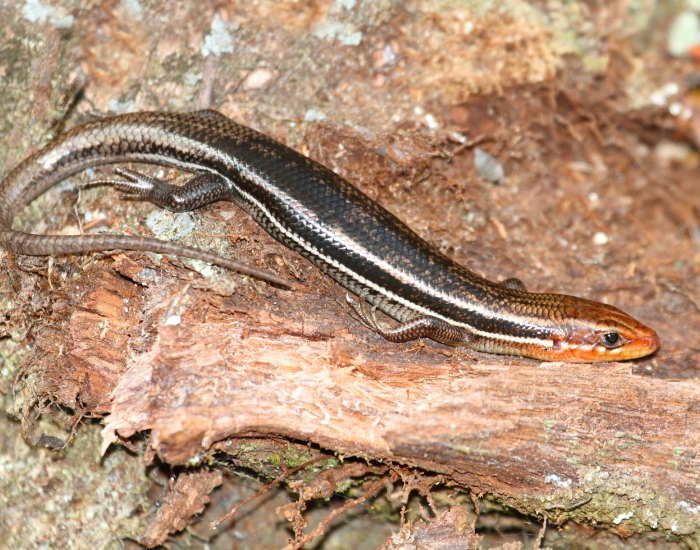
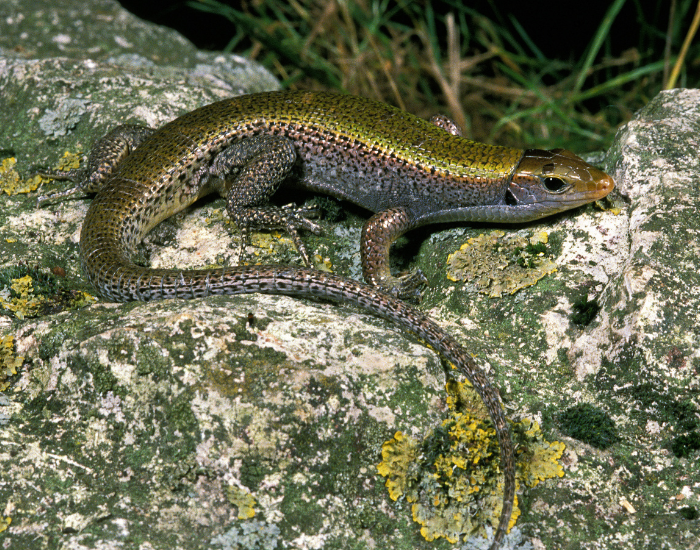
The broad headed skink is one of the largest species in eastern North America, with adult males developing massive orange-red heads during breeding season. They climb high into oak trees and chase prey like spiders, beetles, and grasshoppers across rough bark.
Their tapering tails and shiny scales help them slip through tight crevices when threatened by snakes or other reptiles.

3. Ground Skink (Scincella lateralis)
If you live in the southeast, especially among the skinks of Louisiana, you’ve probably seen this little brown ribbon flick across your patio. The ground skink is one of the smallest small lizards in North America, barely four inches long.
These ground dwelling skinks eat insects, slugs, snails, and tiny invertebrates among leaf litter and pine straw. I once caught a dozen in a single morning surveying a bayou, they pop out of damp soil like wind-up toys.
4. Western Skink (Plestiodon skiltonianus)
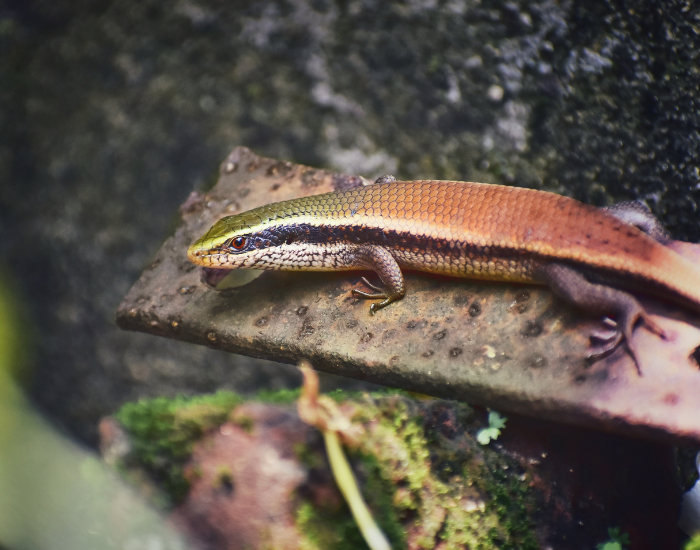
Out west, the Western skink takes over. Its juveniles also flash a blue tailed skink display, though paler than its eastern cousin. Found from British Columbia down through California, these ground dwellers prefer sun-warmed rocks near streams.
They feed on spiders, beetles, snails, and even small animals like newborn pinkies if they can catch them. Watch closely in early spring and you’ll spot adult males developing orange flanks during breeding season.
5. Mole Skink (Plestiodon egregius)
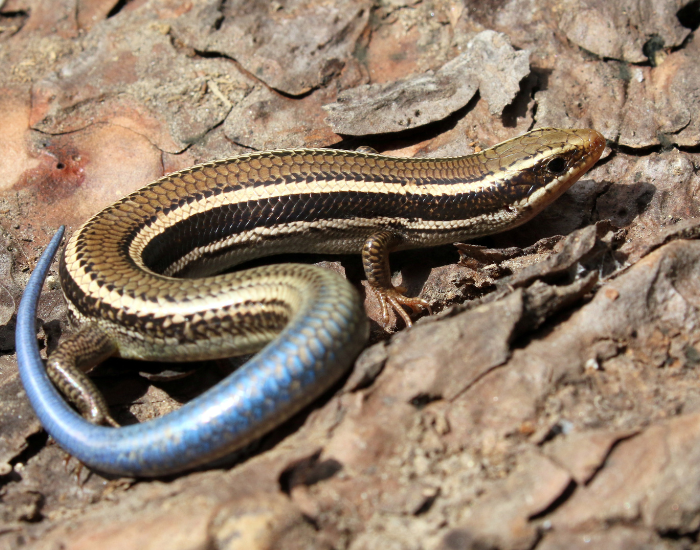
Florida’s mole skink lives almost entirely underground in sandy scrub habitat. With reduced legs and a body built for burrowing, it’s one of the strangest skinks I’ve ever handled. The bright orange tail of the bluetail subspecies is genuinely startling against the dark background of leaf litter.
Mole skinks are among the rarest reptiles in the southeastern US. Habitat loss has pushed several subspecies onto state watch lists, and predators like introduced fire ants haven’t helped.
Australian Skinks
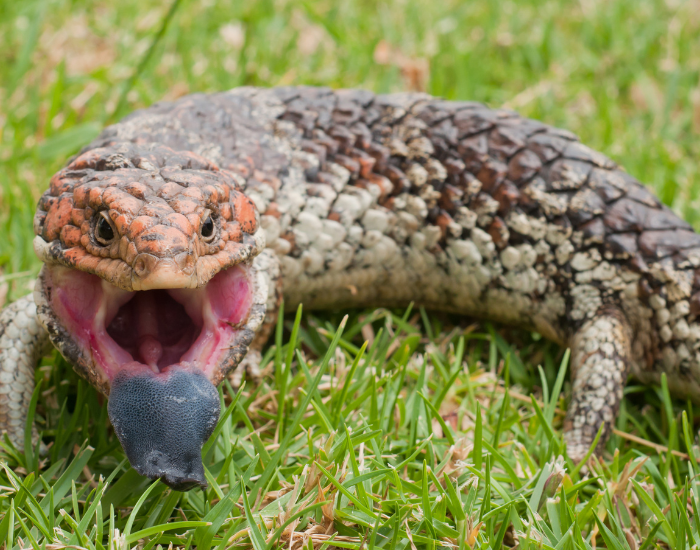
6. Blue-Tongued Skink (Tiliqua scincoides)
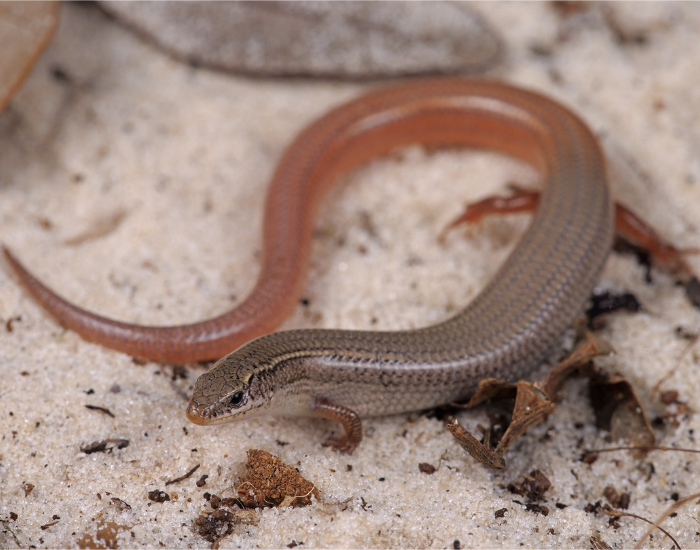
The blue-tongued skink is a classic Australian icon. Walk through almost any suburban yard in Sydney and you might spot one of these chunky, slow-moving giants munching snails. When threatened, they puff up, hiss, and flash that famous blue tongue at predators like cats and birds of prey.
They’re surprisingly common around flower beds and compost heaps. I saw one during a field trip near Sydney in my first month in the country. Many species of blue-tongues exist across Australia, but the eastern blue-tongue is the one most people recognize.
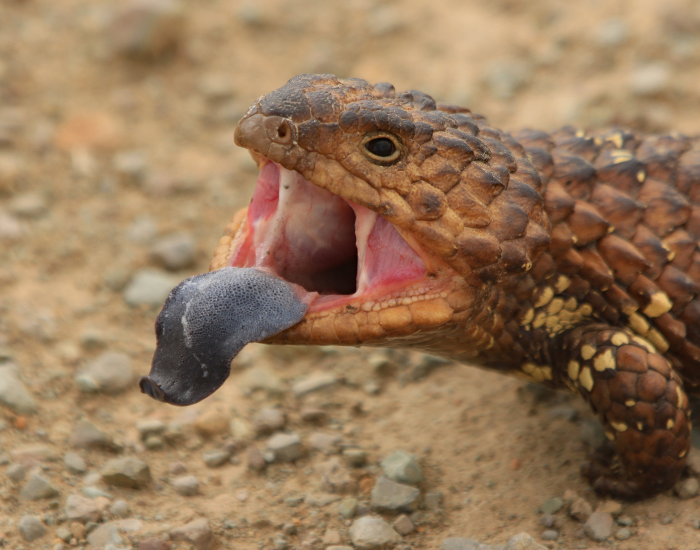
7. Shingleback Skink (Tiliqua rugosa)
The shingleback is a tank. Its rough, pinecone-shaped armor of shiny scales and stubby tapering tails make it look like a walking pinecone. They form lifelong monogamous pair bonds — one of the only documented cases in lizards.
I once watched a male sit beside his road-killed female for two days in Victoria, refusing to leave. Their natural history is honestly more romantic than most human relationships I’ve witnessed.
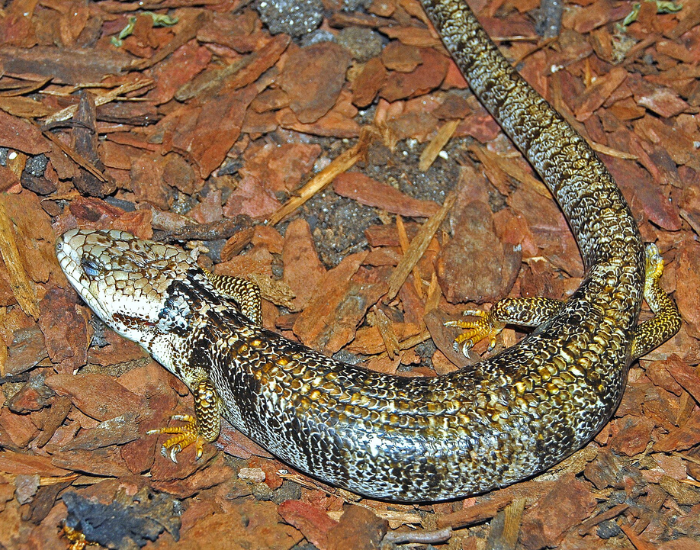
8. Pink-Tongued Skink (Cyclodomorphus gerrardii)
The pink-tongued skink is the moody cousin of the blue-tongue. Found in eastern Australian rainforests, it eats mostly snails — its jaw is specifically built to crush snail shells. The pink tongue is thought to mimic the inside of a snail, possibly luring prey closer.
They’re partially arboreal and surprisingly fast climbers. I watched one shimmy up a strangler fig in Lamington National Park, looking utterly unbothered by my presence.
Asia-Pacific Skinks
9. Red-Eyed Crocodile Skink (Tribolonotus gracilis)
Endemic to New Guinea, the red eyed crocodile skink looks like a miniature dragon. Bright orange rings surround its eyes, and its body is studded with armored, spiked scales.
Females lay only one egg at a time and guard it fiercely. They’re shy ground dwelling forest specialists hiding among rotting stumps in humid tropical forest. I cared for two during my Mexico zoo internship — they only emerged at dusk to eat insects and small spiders.

10. Solomon Islands Skink (Corucia zebrata)
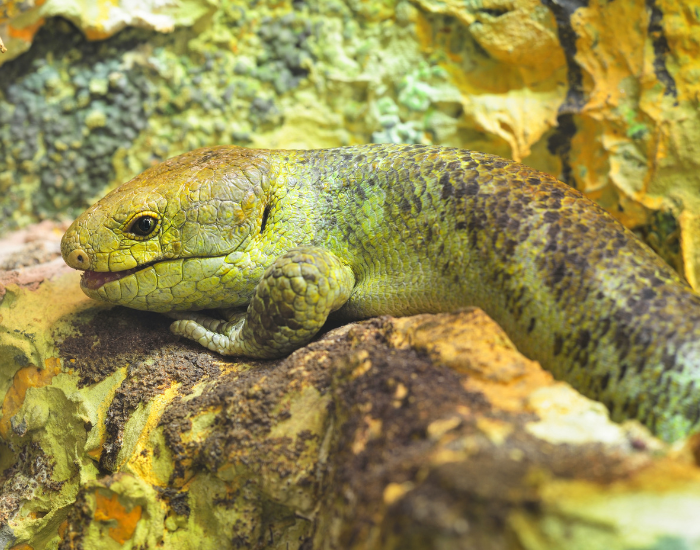
Meet the largest species of skink on Earth. The prehensile-tailed Solomon Islands skink stretches over 30 inches long. They’re entirely arboreal, unique among skinks for using the tail like a fifth limb to climb.
Even stranger, they’re vegetarian and live in family groups called “circuli.” Mothers give birth to a single, enormous live young. Deforestation has pushed this species onto the IUCN watch list.
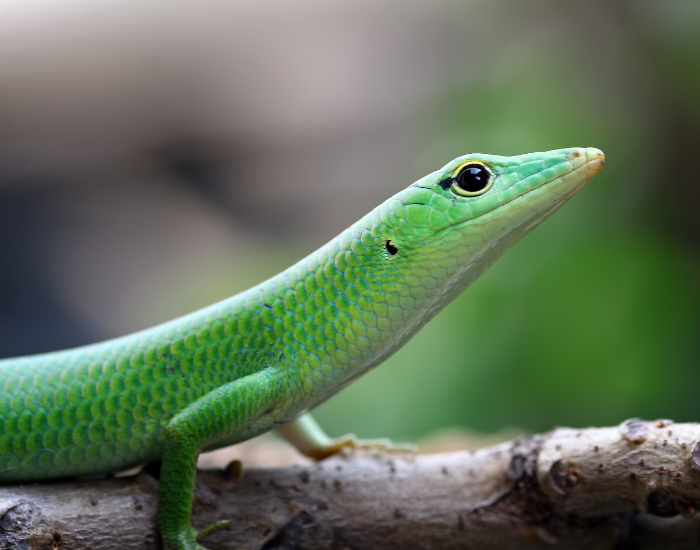
11. Emerald Tree Skink (Lamprolepis smaragdina)
Native to southeast asia and the Philippines, this brilliant green arboreal species is built for the canopy. Adult males defend territories on tree trunks and chase off rival lizards with vibrant displays.
They eat insects, caterpillars, and small invertebrates caught on bark and broad leaves. I spotted my first one on a palm trunk in Palawan — it sat motionless for ten minutes before vanishing in a single emerald flash.
12. Otago Skink (Oligosoma otagense)
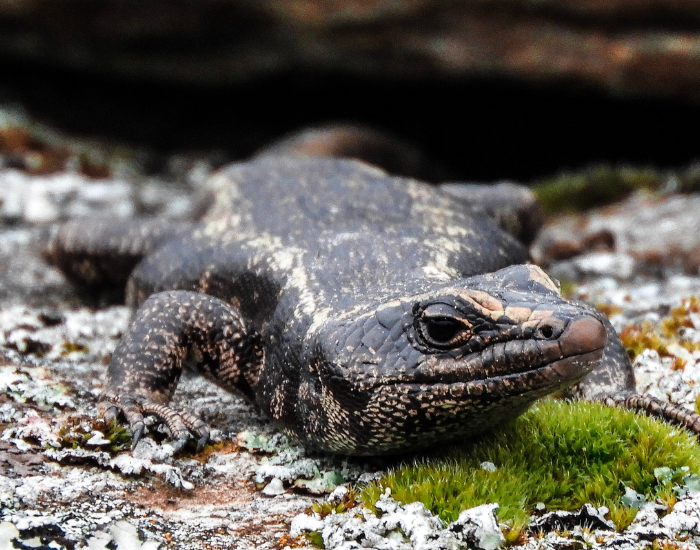
New Zealand’s Otago skink is one of the most endangered reptiles in the country. With dramatic black-and-yellow coloration, it lives only on rock piles in Otago and Southland. Introduced predators like cats, weasels, and rats have devastated populations.
Conservation programs now use predator-proof fencing to protect remaining colonies. Their slow reproductive rate and small range make recovery a long, careful project.
African and Mediterranean Skinks
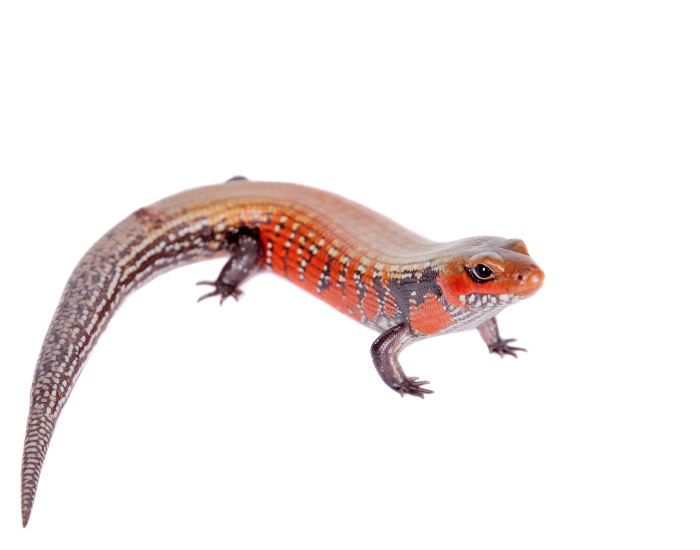
13. Fire Skink (Lepidothyris fernandi)
The fire skink might be the most photogenic lizard on the continent. Its body blazes with fiery red, gold, and black bands — a perfect photo subject. Native to West African forests, they spend most of their time burrowing through soft soil and leaf litter.
They eat crickets, beetles, spiders, and the occasional small snail. Despite the bold colors, they’re surprisingly shy in the wild and dart for cover at any sudden movement.
14. Sandfish Skink (Scincus scincus)
The sandfish skink is one of the strangest reptiles on Earth. Native to North African deserts, it literally “swims” through loose sand by undulating its smooth, polished scales. Their body is wedge-shaped and their nostrils close shut to keep grit out.
They surface only briefly to eat insects, beetles, and grasshoppers caught above the dunes. Watching one dive under sand is genuinely surreal, like watching a fish disappear into water.
15. Ocellated Skink (Chalcides ocellatus)
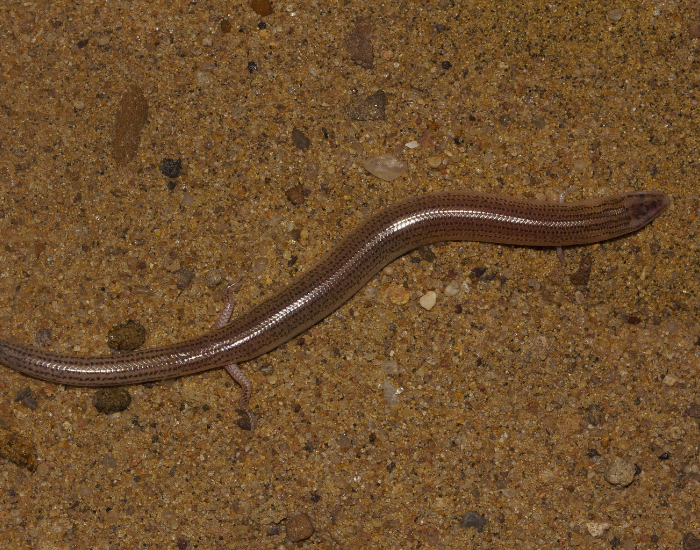
Ranging from Spain through North Africa to Pakistan, the ocellated skink shows off rows of small white spots on a brown body — like little eyes scattered across its back. They give birth to live young instead of laying eggs, a reproductive trick rare among reptiles.
Adults eat small lizards, grasshoppers, and even small snakes when they can catch them. Their habitat ranges from rock walls to dry meadows, where they vanish under the first stone you lift.
FAQs
No, skinks are not poisonous. None of the roughly 1,500 species in the family Scincidae produce venom or toxic skin secretions dangerous to humans. Some, like blue-tongued skinks, will bluff with bright tongue displays, and most species can deliver a painful bite if grabbed. Cats that catch and eat skinks may occasionally show mild stomach upset, though serious illness is extremely rare. According to Encyclopedia Britannica, no skink species is medically significant to humans.
Yes — lizards, including all skinks, can hear airborne sound. They have functional ears with eardrums located just behind the head. Most reptiles hear best in low-frequency ranges, so deep voices register more clearly than high pitches. They won’t recognize words, but they absolutely react to vibration and tone, especially when caught off guard near rocks or leaf litter.
Skinks ARE lizards — they’re a specific family (Scincidae) within the larger lizard order. What sets skinks apart from other lizards is their smooth, overlapping shiny scales, often-reduced limbs, and elongated bodies. Many species look almost snake-like when moving through grass, while typical lizards like geckos or iguanas have rougher skin and more prominent legs.
Absolutely. Skinks are quiet, shy, and beneficial. They control pest populations and rarely enter homes, preferring rotting stumps, rock piles, leaf litter, and flower beds outside. The biggest threat to skinks in a yard is usually domestic cats and birds of prey like hawks and owls. If you’d like to encourage them, leave a few logs or rocks undisturbed in a sunny corner.
Keep Exploring: From Skinks to Tuataras
Skinks are the quiet workhorses of the reptile world. Most people walk right past them — but once you start noticing the flash of a bright blue tail in the leaf litter or the glint of shiny scales on a rotting stump, the skink animal you used to overlook becomes everywhere. From the prehensile-tailed giants of the Solomons to the desert-swimming sandfish, this family is wildly more diverse than its plain reputation suggests.
If you want to keep exploring, check out my pieces on the blue tongue lizard, the bizarre red-eyed crocodile skink, and New Zealand’s last living dinosaur, the tuatara. Then go flip a log in your own backyard — you might be surprised who’s living underneath.
References:
Chapple, D. G., Tingley, R., Mitchell, N. J., Macdonald, S. L., Keogh, J. S., Shea, G. M., Bowles, P., Cox, N. A., & Woinarski, J. C. Z. (2019). The Action Plan for Australian Lizards and Snakes 2017. CSIRO Publishing. https://doi.org/10.1071/9781486309474
Cogger, H. G. (2014). Reptiles and Amphibians of Australia (7th ed.). CSIRO Publishing. https://doi.org/10.1071/9780643109773
Hagey, T. J., Harte, S., Vickers, M., Harmon, L. J., & Schwarzkopf, L. (2017). There’s more than one way to climb a tree: Limb length and microhabitat use in lizards with toe pads. PLOS ONE, 12(9), e0184641. https://doi.org/10.1371/journal.pone.0184641
Hedges, S. B., & Conn, C. E. (2012). A new skink fauna from Caribbean islands (Squamata, Mabuyidae, Mabuyinae). Zootaxa, 3288(1), 1–244. https://doi.org/10.11646/zootaxa.3288.1.1
Reeder, T. W., Townsend, T. M., Mulcahy, D. G., Noonan, B. P., Wood, P. L., Sites, J. W., & Wiens, J. J. (2015). Integrated analyses resolve conflicts over squamate reptile phylogeny and reveal unexpected placements for fossil taxa. PLOS ONE, 10(3), e0118199. https://doi.org/10.1371/journal.pone.0118199
Tingley, R., Macdonald, S. L., Mitchell, N. J., Woinarski, J. C. Z., Meiri, S., Bowles, P., Cox, N. A., Shea, G. M., Böhm, M., Chanson, J., Tognelli, M. F., Harris, J., Walke, C., Harrison, N., Victor, S., Woods, C., Amey, A. P., & Chapple, D. G. (2019). Geographic and taxonomic patterns of extinction risk in Australian squamates. Biological Conservation, 238, 108203. https://doi.org/10.1016/j.biocon.2019.108203
Whiting, A. S., Bauer, A. M., & Sites, J. W. (2003). Phylogenetic relationships and limb loss in sub-Saharan African scincine lizards (Squamata: Scincidae). Molecular Phylogenetics and Evolution, 29(3), 582–598. https://doi.org/10.1016/S1055-7903(03)00142-8