If you follow Wildlife Nomads, you know I have a soft spot for the “engineers” of the animal kingdom. Last week, we broke down the different types of capuchin monkeys. The name ‘capuchin’ actually comes from the Order of Friars Minor Capuchin, whose distinctive brown robes with large hoods resembled the monkeys’ coloration. Today, I want to show you why these primates are — in my professional opinion — the most fascinating monkeys in the Neotropics.
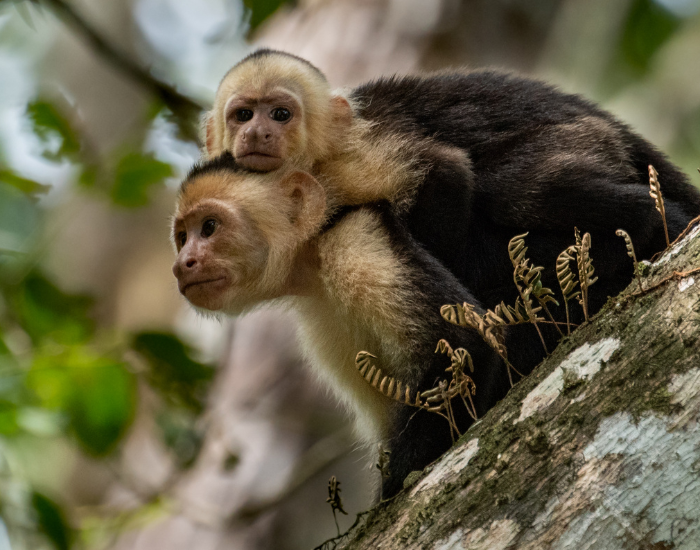
This deep-dive started with a story from a close friend and fellow researcher. He had just returned from a grueling stint in the jungles of Costa Rica studying fruit bat ecology. He was crouched near a cave entrance when a white-faced capuchin (Cebus capucinus) focused on him with such intensity that felt eerily human. It was not playing. It was analyzing.
That story reminded me: we often celebrate bonobos, chimpanzees or gorillas as our closest intellectual peers. These smaller New World monkeys, however, are punching way above their weight class. They easily adapt to new environments, new food sources, and new challenges in ways that genuinely surprise researchers.
Here are 12 weird but true facts that define the capuchin monkey, backed by field observations and the latest primatology research.

1. They Are the Stone-Age Engineers of the Americas
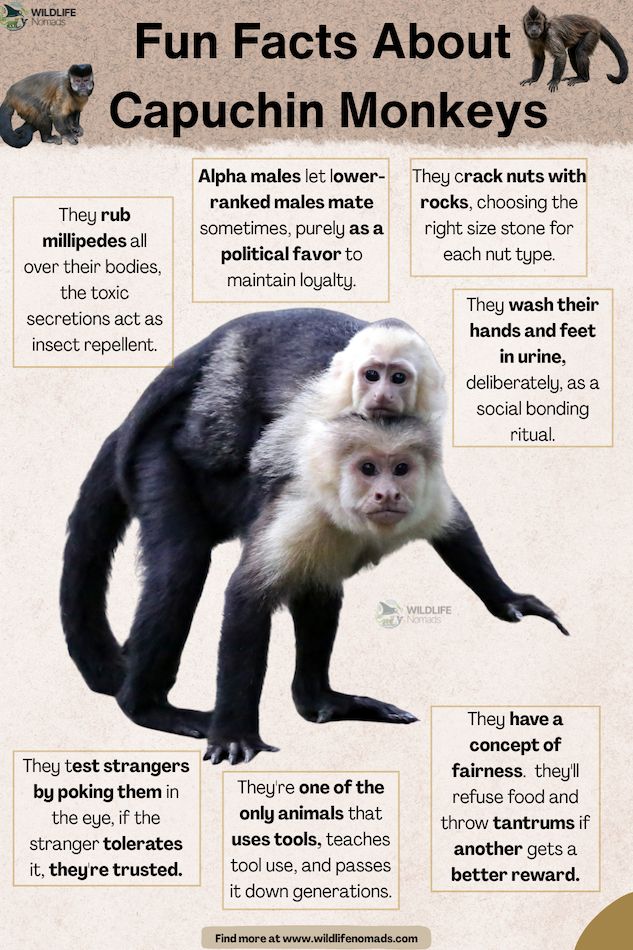
While many other monkeys use basic tools, capuchin monkeys have officially entered their own “Stone Age.” In Brazil’s Serra da Capivara National Park, bearded capuchins (Sapajus libidinosus, sometimes referred to as Cebus apella in older literature) use heavy quartzite stones as hammers and flat stone anvils to crack open hard nuts and seeds.
The precision is staggering. They do not just hit the nut, they select the hammer stone based on weight and durability. Research confirms these monkeys have been using stone tools for at least 3,000 years, adapting their technique across hundreds of generations. Only chimpanzees share a comparable non-human archaeological record, and the capuchin site is the oldest such record outside of Africa.

2. The “Onion Bath” — Natural Medicine in Action
One of the strangest behaviors I have ever researched is “fur rubbing.” When a capuchin finds a pungent substance, an onion, a lime, or certain toxic millipedes, it vigorously rubs the material through its fur.
This is not just a quirk. These substances carry insecticidal or antiseptic properties. By bathing in these scents, capuchins apply a natural repellent against botflies and mosquitoes. In the wet lowland forests and humid montane forests of Costa Rica, where the parasite load is punishing, this behavior is a genuine lifesaver. It is one of the clearest examples of self-medication in any wild animal.
3. Their Brain-to-Body Ratio Rivals That of Apes
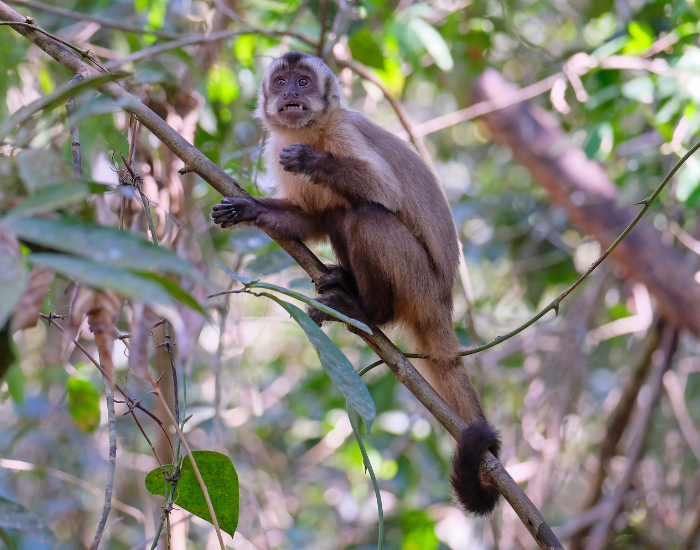
Do not let their size fool you. Adult males typically weigh between 6 and 9 lbs (2.7–4 kg), while females are smaller, usually between 3 and 5 lbs (1.3–2.3 kg). Yet relative to body size, capuchins carry the largest brains of any New World primate.
This high encephalization explains their remarkable problem-solving ability, their rich facial expressions, and the ease with which they learn complex tasks. When you look into the eyes of a capuchin, you are looking at a creature capable of tactical deception, social manipulation, and cultural transmission, skills that rival those of much larger primates.

4. Complex Social Structure: Alpha Males, Females, and Subordinates
Capuchin monkeys live in groups of 6 to 40 individuals, consisting of related females, their offspring, and several males. These groups are primarily matrilineal, with related females typically remaining in their birth groups for life, while males may leave to join other groups.
The alpha male does not rule through brute force alone. Capuchins use a wide range of facial expressions, vocalizations, and body postures to negotiate rank and maintain alliances. Adult males perform dramatic displays to reinforce dominance, while subordinate males may use coalition-building and grooming to improve their position over time.
Interestingly, alpha females also hold significant influence. They often determine where the group forages and play a central role in resolving conflicts among females and juveniles.

5. Social Traditions: The “Eye-Poking” Trust Ritual
Culture is not exclusive to humans, and capuchins prove it. In some populations, researchers have observed a bizarre bond-testing ritual: one monkey sticks a long fingernail into the eye socket or nostril of a trusted social partner.
It looks painful. However, it serves a clear purpose. By allowing another individual to perform such a vulnerable act, the monkey signals profound trust. This is social learning at its most unexpected, a tradition that exists in certain groups but not others, passed down through observation rather than instinct (Perry, 2011).
6. They Are Master Hunters — Not Just Fruit-Eaters
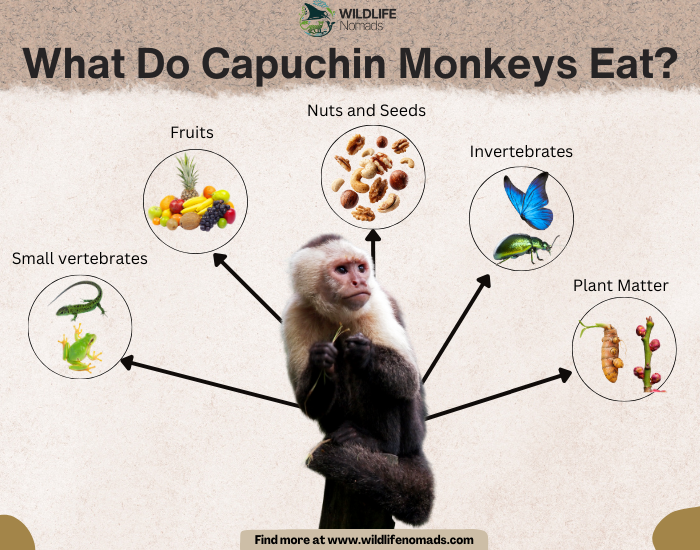
People often picture capuchin monkeys swinging through trees eating fruit. The reality is far more dramatic. These primates are highly opportunistic omnivores, roughly 50 to 80% of their diet is fruit, but the remaining 20 to 30% is animal material: insects, amphibians like green frogs, lizards, crabs, shellfish, small birds, squirrels, and even young coatis.
What makes them remarkable hunters is their method. They crack open crab and shellfish shells using stones, and in some populations, groups of males actively coordinate to flush prey from tree hollows, a level of collaborative hunting we typically associate only with chimpanzees.
7. They Feed the Entire Forest Ecosystem
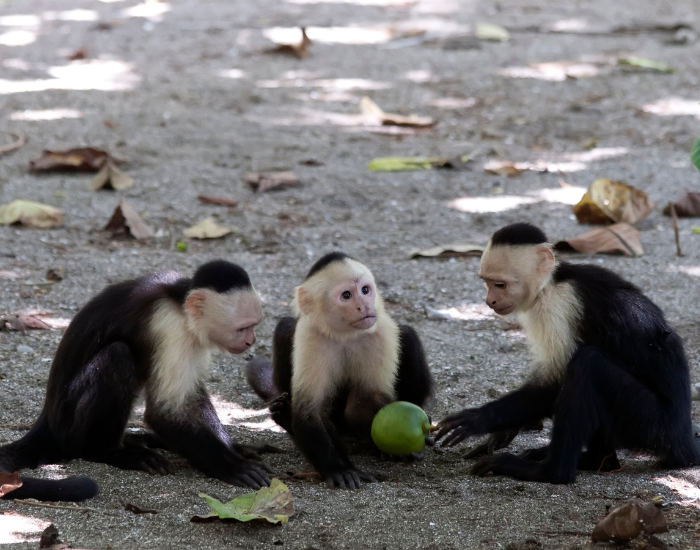
Capuchins are “extractive foragers.” They do not simply pick a berry, they work for their food. They rip bark from trees to expose grubs, smash open hard nuts, and dig into the forest floor for embedded resources.
Because they are messy and thorough, they unintentionally create a buffet for other animals below. Birds and smaller species regularly follow capuchin troops to pick up scraps. In addition, as seed dispersers, capuchins play a vital role in forest regeneration across Central and South America. They are more ecologically important than most people realize.
8. Their Tails Work Like a Safety Line
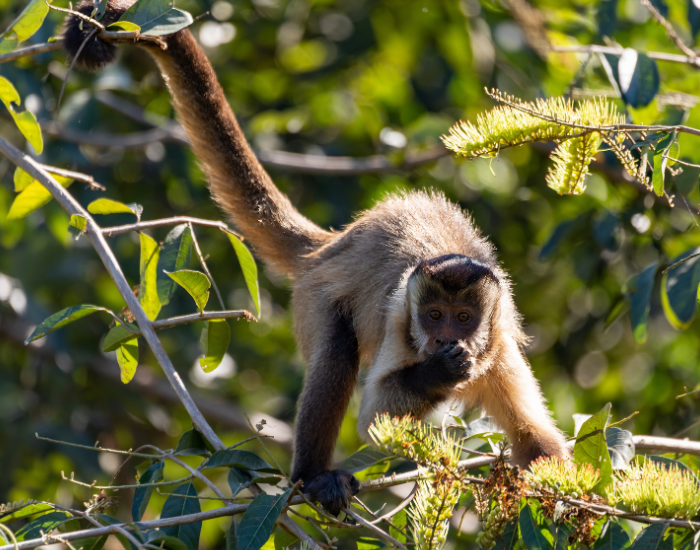
Unlike many other monkeys from Africa or Asia, New World monkeys like capuchins have prehensile tails. Capuchins are unique, however, their tails are “semi-prehensile.”
A spider monkey uses its tail like a full extra arm, capable of supporting its entire body weight. Capuchins, on the other hand, use their tail primarily for stability while both hands manipulate food or tools. In the wind-swept upper canopy of the amazon rainforest and deciduous forests across their range, that extra grip is the difference between a successful meal and a dangerous fall.
9. They Understand Fairness — The Grape and Cucumber Experiment
One of the most famous studies in primatology involved capuchins and a lesson in social justice. Two monkeys performed the same task. One received a grape; the other received a cucumber. The monkey receiving the cucumber, having watched its companion get the better reward, became visibly outraged and threw the cucumber back at the researcher.
This shows a rudimentary but genuine understanding of fairness. Capuchins recognize inequity and react to it emotionally. This trait, once considered uniquely human, is now documented across several primate species, but capuchins were among the first to demonstrate it so clearly.
10. Reproduction: Slow, Careful, and Deeply Social
The mating system of capuchin monkeys is polygynous, the dominant male typically fathers most offspring in a group, though subordinate males occasionally mate when the alpha’s attention is elsewhere. Females become sexually mature at around 4 years of age, though they often don’t give birth until age 6–7. Males reach sexual maturity slightly later.
A single infant is born after a gestation period of approximately 160 – 180 days (about 5 to 6 months). Gestation takes significant energy, and females give birth roughly every two years as a result. The infant clings to its mother’s chest for the first several months of life. This slow reproductive rate means population recovery after habitat loss or hunting is painfully gradual, making conservation status all the more critical for threatened species.

11. Their Alarm Calls Name the Predator
Communication is critical when you live in dense tropical forest. Capuchins produce a wide variety of vocalizations, soft trills to maintain contact within the group, and sharp alarm calls when danger appears.
Crucially, different calls signal different types of predators. An aerial predator like a harpy eagle triggers a completely different alarm than a terrestrial threat like a snake. Other group members respond accordingly, hiding under cover for aerial threats, standing upright to scan the forest floor for ground-level predators. This sophisticated early-warning system protects every individual in the group and reflects a level of referential communication found in very few wild animal species.
12. Conservation Status: Several Species Are in Serious Trouble
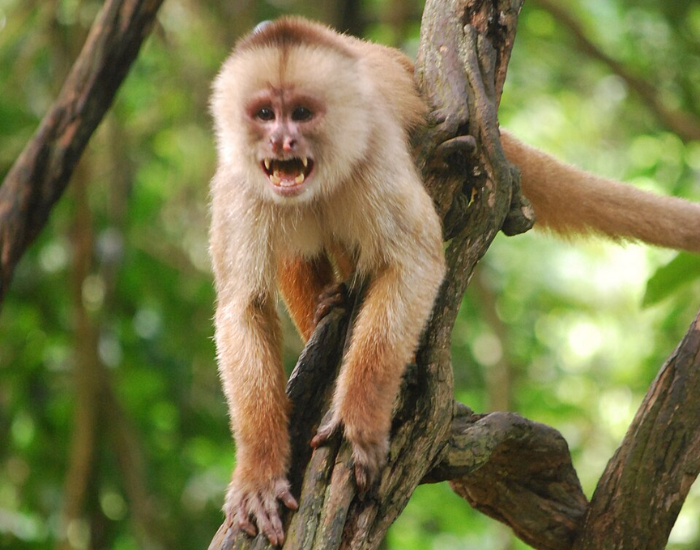
Capuchin monkeys easily adapt to a wide range of natural habitats, from wet lowland forests and amazon rainforest to dry deciduous forests, mountain forests, and secondary forests. However, their ability to adapt has its limits. Habitat loss is pushing several species toward extinction.
The golden-bellied capuchin (Sapajus xanthosternos) is Critically Endangered, having lost roughly 80% of its population in 50 years due to deforestation in Brazil’s Atlantic Forest (IUCN, 2020). The Ka’apor capuchin (Cebus kaapori) is Endangered, with up to 80% of its habitat destroyed across the Amazon. The Ecuadorian capuchin (Cebus aequatorialis) is also Critically Endangered due to commercial deforestation along the Pacific coast.
Most other species — including the white-faced capuchin common in Costa Rica — are currently listed as Least Concern, though habitat loss remains an ongoing threat. The threats to capuchin monkeys include deforestation for agriculture, hunting, the illegal pet trade (they were historically used by organ grinders and are still illegally captured), and increasingly, climate change.

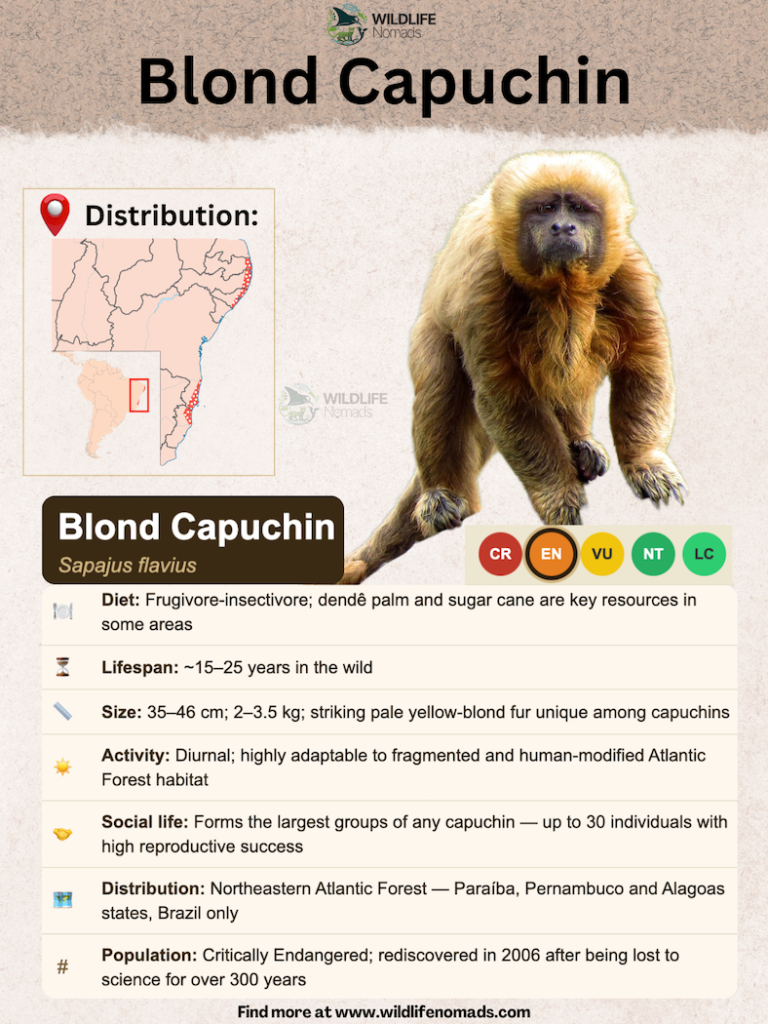
Capuchin Taxonomy: Two Groups, Many Species
If you read my previous post on the types of capuchin monkeys, you know this classification is a hot topic in biology. We split them into two genera:
Gracile Capuchins (Genus Cebus): These are the classic “white-faced capuchins” found across Central America and into northern South America. They are lean, with minimal facial crests. The white-faced capuchins of Costa Rica and Panama are among the most studied primates in the world. The hooded capuchin (also known as Azara’s capuchin) is another notable species in this group, found in specific regions of South America.
Robust Capuchins (Genus Sapajus): Found primarily in South America, including the Atlantic Forest and Cerrado regions. These are stockier monkeys with prominent tufts or crests on their heads. Tufted capuchins are a prominent group within this genus, easily recognized by their distinctive head tufts and widespread presence in the Amazon River Basin. They include the bearded capuchin — the stone-tool specialist. Older texts may refer to some of these species as Cebus apella, but modern taxonomy places them in Sapajus.
Capuchin monkeys are diurnal omnivores, identifiable by their distinct white faces and black bodies.
| Feature | Gracile (Cebus) | Robust (Sapajus) |
|---|---|---|
| Location | Central & North South America | Primarily South America |
| Tool Use | Rare / Simple | Common / Complex (stone tools) |
| Appearance | Lean, no tufts | Stocky, prominent crests |
| Notable Species | White-faced capuchin, hooded capuchin | Bearded capuchin, tufted capuchins |
| Conservation | Some critically endangered | Some critically endangered |

FAQ: Quick Answers for the Curious
Adult males typically weigh between 6 and 9 lbs (2.7–4 kg). Females are smaller, usually 3 to 5 lbs (1.3–2.3 kg). Males can be up to 30% heavier than females.
They are wild animals with powerful jaws and sharp canines. In undisturbed habitats, they avoid humans. In tourist areas where they associate people with food, they can become aggressive. Always keep your distance and never feed wild capuchins.
Yes. Capuchins live in groups of 6 to 20 individuals on average, sometimes larger. Groups are led by a dominant alpha male, with a clear hierarchy of subordinate males and adult females. Group living provides protection from natural predators like harpy eagles and large snakes.
Capuchin monkeys are known for their loud calls, which can help locate them in the wild. Listening for these vocalizations is often one of the best ways to find them in their natural habitat.
The Bottom Line
As a conservation biologist, I see the capuchin monkey as proof that intelligence is not a ladder with humans at the top, it is a bush with many branches. These primates have solved the challenges of life in Central and South America through engineering, self-medication, and complex social politics that would surprise even seasoned researchers.
They also remind us that conservation is urgent. When a species capable of 3,000 years of cultural evolution faces extinction within a generation, that is not just a biological loss. It is a cultural one.
For more primate deep-dives, check out my previous article on the types of capuchin monkeys, or explore how wombats have evolved some of nature’s most unusual biology.
Where to see them in the Wild?
Here is a list of 3 tours where you can see capuchin monkeys in the wild. As a biologist, I only recommend tours that follow strict ethical guidelines to ensure we don’t disturb wildlife. These are the three tours/ partners I trust most based on their conservation records:
This blog is reader-supported. When you buy experiences through links listed on this site, we may earn an affiliate commission.
References
Alfaro, J. W., Silva, J. D., Jr, & Rylands, A. B. (2012). How different are robust and gracile capuchin monkeys? An argument for the use of sapajus and cebus. American journal of primatology, 74(4), 273–286. https://doi.org/10.1002/ajp.22007
Brosnan, S. F., & de Waal, F. B. M. (2003). Monkeys reject unequal pay. Nature, 425(6955), 297–299. https://doi.org/10.1038/nature01963
Falótico, T., Proffitt, T., Ottoni, E. B., Staff, R. A., & Haslam, M. (2019). Three thousand years of wild capuchin stone tool use. Nature Ecology & Evolution, 3(7), 1034–1038. https://doi.org/10.1038/s41559-019-0904-4
Paukner, A., & Suomi, S. J. (2008). The effects of fur rubbing on the social behavior of tufted capuchin monkeys. American journal of primatology, 70(11), 1007–1012. https://doi.org/10.1002/ajp.20595
Perry S. (2011). Social traditions and social learning in capuchin monkeys (Cebus). Philosophical transactions of the Royal Society of London. Series B, Biological sciences, 366(1567), 988–996. https://doi.org/10.1098/rstb.2010.0317
Proffitt, T., Luncz, L. V., Falótico, T., Ottoni, E. B., de la Torre, I., & Haslam, M. (2016). Wild monkeys flake stone tools that resemble the earliest hominin technology. Nature, 539(7627), 85–88. https://doi.org/10.1038/nature20112
Reader, S. M., Hager, Y., & Laland, K. N. (2011). The evolution of primate general and cultural intelligence. Philosophical Transactions of the Royal Society B: Biological Sciences, 366(1567), 1017–1027. https://doi.org/10.1098/rstb.2010.0342