The second-largest animal that has ever lived, and I have never seen one.
That is not for lack of trying. I have watched humpbacks from Queensland headlands through four whale seasons. In April 2019 a gray whale nudged her calf to the side of our boat in a Baja lagoon, close enough to touch, and I wrote that morning up in my piece on ecotourism and gray whales in Mexico. This one has never turned up.
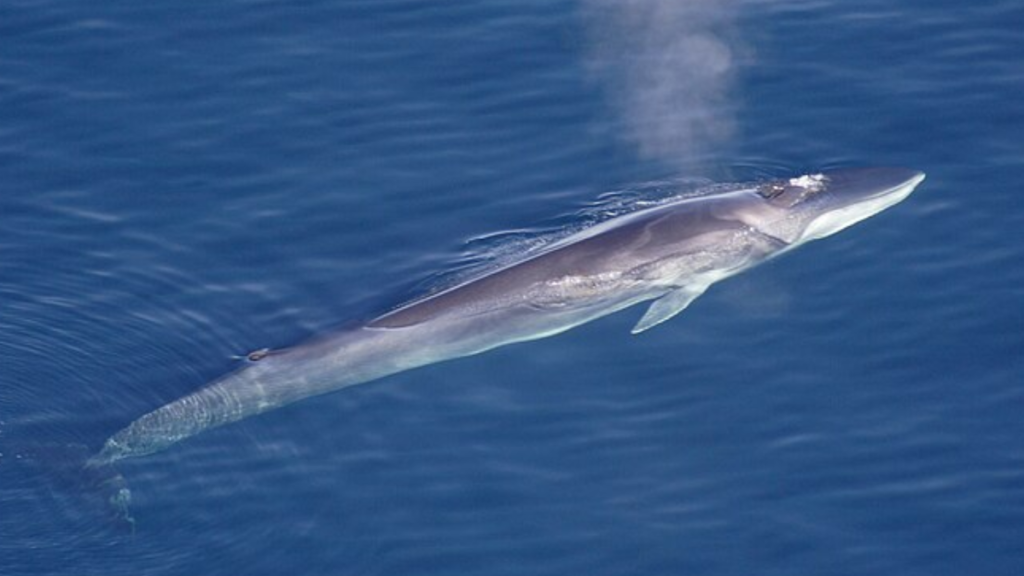
There is a reason, and it is the most useful thing to know about the species. Fin whales live in offshore waters. They do not come into bays to breed, they rarely breach, and the blow is gone before most people have looked up. The whales everyone photographs are the ones that come to us. This one does not.
I built the whale size comparison tool partly out of frustration with that. At one true scale it sits second from the end, just short of the blue whale, and the gap is smaller than people expect.
Below are twelve things worth knowing about Balaenoptera physalus, including two I had to cut from an earlier version of this article because they belonged to a different animal.
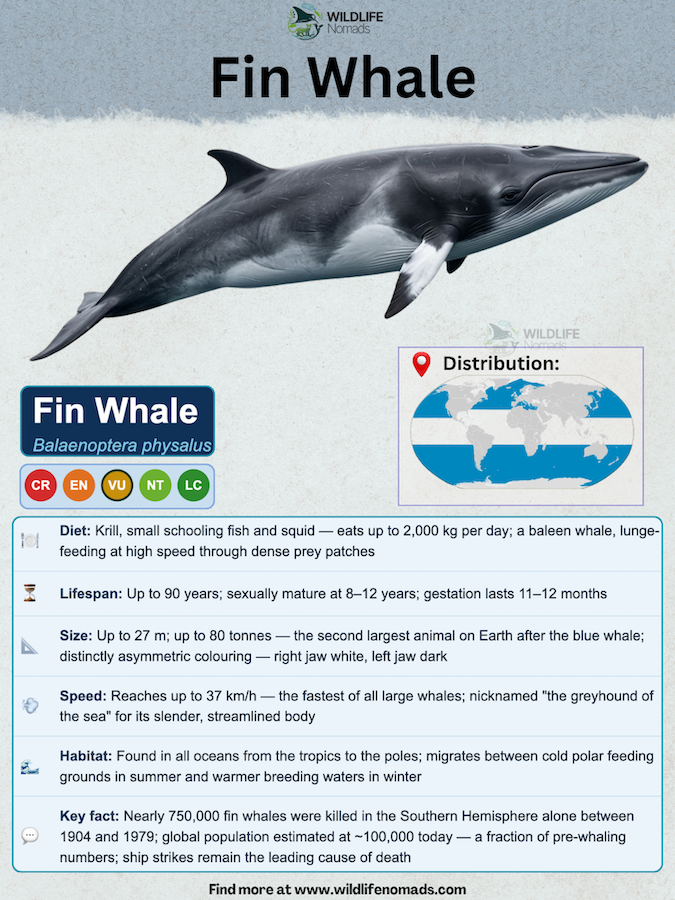
1. The Fastest Large Whale in the Ocean
Recorded fin whale speeds reach 46 to 50 km/h, roughly 29 to 31 mph. No other baleen whale comes close, and few marine animals of any size do. That is where the nickname greyhound of the sea comes from.
It also shaped their history. Nineteenth-century whalers could not catch them under sail. The species was largely spared until steam catchers and explosive harpoons arrived, and then it was not spared at all.
The speed is built into the muscle. Rivero examined fin whale locomotor muscle and found a sprinter’s profile, dominated by fast-twitch fibres with high glycolytic capacity. Deeper layers held more aerobic tissue. That mix suits an animal that cruises for days, then accelerates hard into a lunge.
It is a strange build for a filter feeder. The speed is not for escape or for chasing prey. It exists to drive the mouth through a dense patch of krill before the swarm scatters.
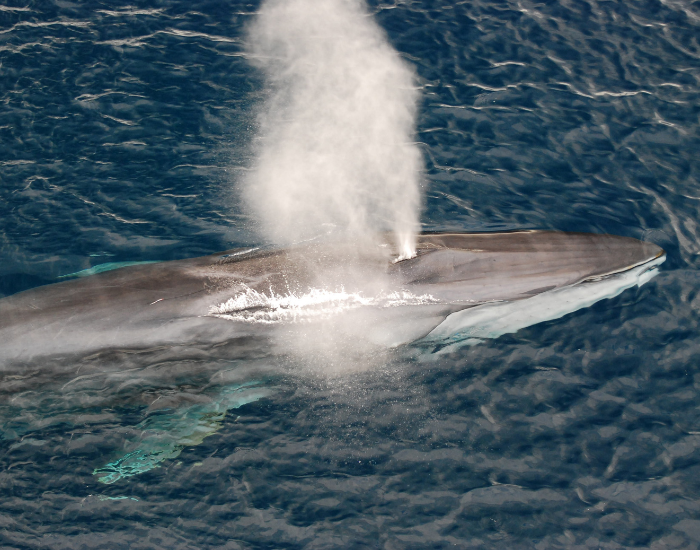
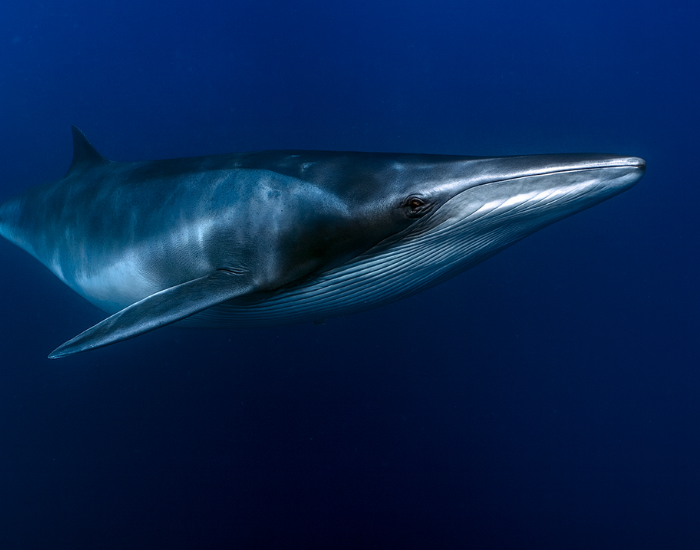
2. The Asymmetrical Head
This is the signature. The left side of the head is dark grey. The right side carries a pale patch on the lower jaw, and the asymmetry continues into the mouth, where the front baleen plates on the right are creamy white and the left stay dark.
No other whale species is pigmented this way, and almost no other animal either. The leading explanation ties it to feeding. Fin whales circle fish at speed, then roll onto the right side to engulf the ball, which puts the pale jaw uppermost and the dark flank against deep water.
Whether that panics the prey, hides the predator, or does nothing at all is still argued. I prefer the honest version. We have a striking, consistent, functional-looking trait, and a century of looking at it has not settled what it does.
3. Second Largest, and Closer to the Blue Whale Than You Think
Adult fin whales reach 75 to 85 feet, around 23 to 26 metres, and weigh between 40 and 80 tons. That is second only to the blue whale among all whale species, and among all animals that have ever lived.
The two are easy to confuse at distance, and the difference is shape rather than scale. Blue whales are broad and barrel-bodied, built around volume. The fin whale is narrow and hydrodynamic, built around speed. Side by side on the size comparison tool, it looks like a blue whale drawn by someone in a hurry.
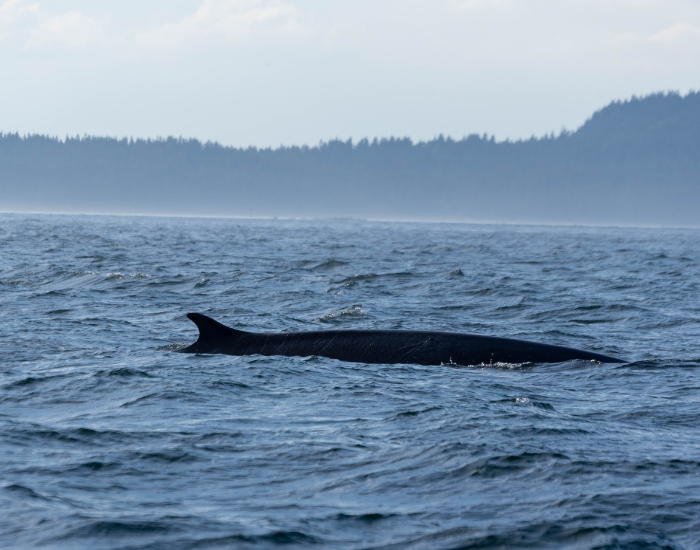
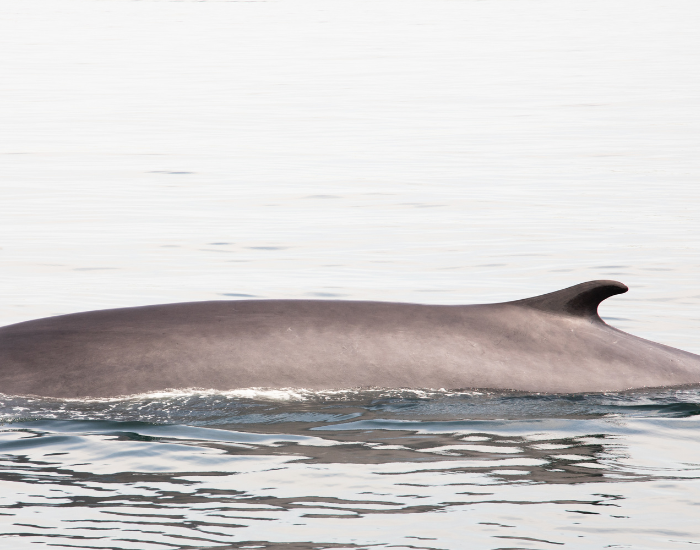
Two field marks separate them. The hooked dorsal fin stands about 61 cm tall and sits two-thirds of the way back, where blue whales carry a much stubbier one. And the surfacing angle is shallower, rolling back and fin into view together, which is often all you get.

4. They Eat Two Tons a Day
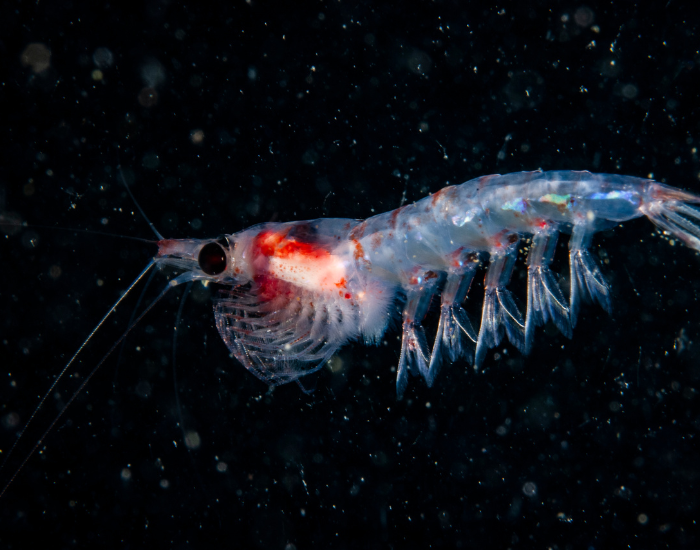
During the feeding season one animal can take up to two tons of food daily. Fin whales eat krill, small schooling fish such as herring, capelin and sand lance, and some squid, varying by ocean basin. That is a broader menu than most other baleen whales work with.
The mechanism is a lunge. The whale accelerates into a patch, opens its mouth to nearly ninety degrees, and the throat pleats balloon outward. A single gulp takes in around 70 cubic metres of water, more than the animal’s own body volume. The pleats then contract and force the water out through 260 to 480 baleen plates on each side, leaving prey behind.
Each lunge is expensive. That is why these whales feed in dense patches or not at all, and why a thin scattering of krill is not worth opening the mouth for.
5. They Talk at Frequencies You Cannot Hear
Fin whale calls run between roughly 16 and 40 hertz, at or below the bottom edge of human hearing. The classic sound is a 20 Hz pulse repeated in long patterned sequences, and it carries across ocean basins.
For decades those pulses were assumed to be male breeding song and nothing more. Romagosa and colleagues, working in the Azores, found the 40 Hz calls behave differently. Their rate rose and fell with prey biomass measured in the same water, which points at feeding rather than mating.
That matters for marine mammals this hard to see. Acoustic monitoring is often the only way to know they are present, and knowing which call means what turns a hydrophone into a tool for finding food patches.
6. Commercial Whaling Took Three Quarters of a Million
Over 725,000 fin whales were killed in the Southern Hemisphere between 1905 and 1976. Tens of thousands more were taken in the North Atlantic and North Pacific. Once steam catchers could outrun them, they became the industry’s main target after the blue whale collapsed.
Rocha and colleagues counted the whales killed across the twentieth century. Global populations fell by an estimated 70 to 90 percent.
Protection came late and in pieces. The International Whaling Commission closed commercial hunting in the North Pacific in 1976 and in the North Atlantic in 1987. It has not stopped entirely: Greenland holds a quota of 19 a year, Iceland has hunted commercially in recent seasons, and Japan resumed taking them in 2019, with 30 killed in 2024. My piece on whether whale hunting still exists covers how those exemptions work.

7. They Are Recovering, and the Evidence Is Spectacular
In 2018 the IUCN moved the species from Endangered to Vulnerable, after fin whale populations roughly doubled since the 1970s. Current estimates run to 100,000–140,000 mature individuals: around 70,000 in the North Atlantic Ocean, 50,000 in the North Pacific and 25,000 in the Southern Ocean.
The clearest evidence arrived in 2022. Herr and colleagues surveyed the water around Elephant Island, off the Antarctic Peninsula, and filmed feeding aggregations of up to 150 animals on historical whaling grounds. Not scattered individuals. Supergroups, feeding together in the exact places the fleets had emptied.
One caution. The United States still lists this as an endangered species under the Endangered Species Act, and the two listings do not conflict. The IUCN assesses global trend, while the Endangered Species Act is a domestic protection that has not been revised. Sources calling it endangered on the IUCN list are out of date; vulnerable species is the current global assessment.
8. Slow Reproduction Is Why Recovery Takes Decades
Female fin whales reach sexual maturity between 7 and 12 years. Males reach sexual maturity at 6 to 10, and physical maturity arrives around 25. Gestation runs 11 to 12 months, and a female gives birth to a single calf every two to three years.
Calves are born at about 18 feet and 4,000 to 6,000 pounds, then stay with the mother six to seven months before weaning. Lifespan runs 80 to 90 years.
Run those numbers and the timeline explains itself. A population cut by 90 percent, breeding once every two to three years, needs generations rather than decades. It also means every avoidable death counts more here than in a fast-breeding species.
9. Ships Are the Main Thing Killing Them Now
Ship strikes are the leading direct human cause of fin whale deaths. These are large whales that feed near the surface in productive offshore water, which is exactly where the lanes run. A loaded vessel cannot stop or turn in time, regardless of who is watching, and vessel strikes are rarely survivable at that mass.
Nisi and colleagues mapped global traffic against whale distribution and found overlap across most of the range. Their headline finding: fewer than seven percent of the highest-risk areas carry any protection measure.
The Mediterranean is the worst-documented case. The Pelagos Sanctuary in the Ligurian Sea holds a resident population year-round, directly beneath one of the busiest shipping corridors in the world. Stranded fin whales recovered there frequently show blunt-force injuries consistent with a ship collision.

10. Entanglement, Noise and a Shifting Food Supply
Fishing gear entanglement is less frequent for fin whales than for right whales or minke whales, but the consequences are severe. Trailing gear adds drag, interferes with feeding, and leads to exhaustion or infection over months.
Ocean noise is subtler. An animal communicating at 20 hertz across ocean basins shares that band with shipping, seismic airguns and sonar. Masking does not kill outright. It degrades the ability to find food and other whales.
Killer whales take calves occasionally, and bite scars turn up on adults, but no natural predator meaningfully limits fin whale populations. Climate change sits behind the rest: krill and small fish are shifting with water temperature, pulling these whales into water they did not previously use, often further from protection and closer to traffic.

11. Where They Actually Are
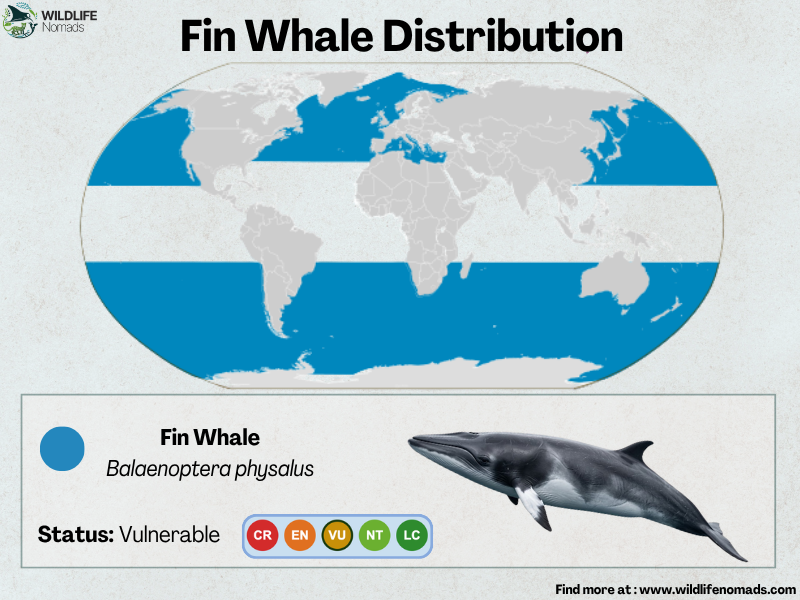
Fin whales live in all the major oceans, from polar latitudes to the subtropics, favouring deep water over coastal shelves. Most populations migrate, using high latitude feeding areas in summer and moving toward lower latitudes in winter. The real picture is messier than the textbook version.
Some populations barely migrate. The Gulf of California holds them year-round, and so does the Mediterranean. Recorders southwest of Svalbard pick them up through winter, which suggests some northern animals are not leaving either.
NOAA Fisheries manages four United States stocks, which is a useful way to see the distribution: Western North Atlantic, Northeast Pacific, Hawaii, and a west coast stock spanning California, Oregon and Washington.
For seeing one: Iceland, the Azores and the Bay of Biscay are the reliable North Atlantic options, the Azores most consistently, and the same trips often turn up sperm whales. Monterey Bay and British Columbia work on the Pacific side. My roundup of the best places to go whale watching covers the practicalities.
11. There Are About 100,000 Left Worldwide
Current global fin whale population estimates range from 100,000-120,000 individuals, with the largest populations in the Southern Hemisphere. The North Atlantic population is estimated at 40,000-56,000 individuals, showing signs of gradual recovery since whaling ended.
12. The Name Is About the Fin
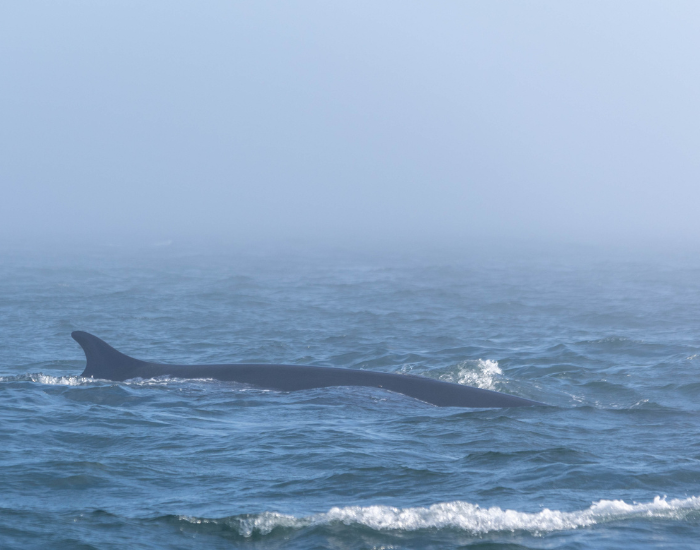
Balaenoptera means winged whale, after that prominent dorsal fin. Physalus comes from the Greek for blowing or inflating, pointing at either the throat pleats or the tall columnar blow, which can reach six metres.
The English names follow the same logic. Finback whale and common rorqual are both in use, and in parts of the North Atlantic they are razorbacks, after the sharp ridge running from fin to tail.
Compared with the humpback, which sings and breaches and shows up in coastal bays, the fin whale has been badly served by its own habits. Faster than any other baleen whale, nearly as large as the largest of the great whales, recovering well, and almost nobody has seen one. For the wider family, see my guide to the types of whale.
Frequently Asked Questions
Between 100,000 and 140,000 mature individuals worldwide, according to the IUCN’s 2018 assessment. Roughly 70,000 are in the North Atlantic, 50,000 in the North Pacific and 25,000 in the Southern Hemisphere. That is about double the 1970s figure, though still well below pre-whaling levels, which were an estimated 70 to 90 percent higher.
Three things. It is the fastest of the baleen whales, recorded at up to 50 km/h. It has asymmetrical head pigmentation, dark on the left side and pale on the right, which almost no other animal has. And it is the second-largest animal that has ever lived. It is also the one great whale most people never see, because it stays offshore.
No. Blue whales reach about 30 metres and up to 150 tons, against roughly 26 metres and 80 tons here. The two are easy to confuse at distance, but this one is narrower, considerably faster, and carries a tall hooked dorsal fin that blue whales lack.
The Azores are the most consistent, with animals present much of the year in deep water close to shore. Iceland and the Bay of Biscay are strong North Atlantic alternatives in summer and during migration. The Ligurian Sea between France, Monaco and Italy holds a year-round population inside the Pelagos Sanctuary. On the Pacific side, Monterey Bay and British Columbia both produce regular sightings

What I Would Look For
If you go to the Azores or Iceland hoping for one, stop watching for a breach. You will not get one.
Watch for the blow. It is tall, narrow and columnar, and it goes up before you hear anything. Then keep your eyes on that same spot. The back rolls up, and the hooked dorsal fin appears a long moment after the blow. That delay is the field mark, and it is the whole animal: 25 metres of it passing under one point on the surface.
I still have not managed it. If you have, tell me in the comments where, and what tipped you off.
Fin Whale Biology & Science Quiz 🐋
Ten study questions covering fin whale anatomy, extreme speeds, feeding mechanics, acoustic calls, and conservation status. Can you score 10/10?
Multiple Choice
References:
Herr, H., Viquerat, S., Devas, F., Lees, A., Wells, L., Gregory, B., Giffords, T., Beecham, D., & Meyer, B. (2022). Return of large fin whale feeding aggregations to historical whaling grounds in the Southern Ocean. Scientific Reports, 12, 9458. https://doi.org/10.1038/s41598-022-13798-7
Nisi, A. C., Welch, H., Brodie, S., Leiphardt, C., Rhodes, R., Hazen, E. L., Redfern, J. V., Branch, T. A., Barreto, A. S., Calambokidis, J., Clavelle, T., Dares, L., de Vos, A., Gero, S., Jackson, J. A., Kenney, R. D., Kroodsma, D., Leaper, R., McCauley, D. J., … Abrahms, B. (2024). Ship collision risk threatens whales across the world’s oceans. Science, 386(6724), 870–875. https://doi.org/10.1126/science.adp1950
Rivero, J.-L. L. (2018). Locomotor muscle fibre heterogeneity and metabolism in the fastest large-bodied rorqual: The fin whale (Balaenoptera physalus). Journal of Experimental Biology, 221(12), jeb177758. https://doi.org/10.1242/jeb.177758
Rocha, R. C., Clapham, P. J., & Ivashchenko, Y. V. (2014). Emptying the oceans: A summary of industrial whaling catches in the 20th century. Marine Fisheries Review, 76(4), 37–47. https://doi.org/10.7755/MFR.76.4.3
Romagosa, M., Pérez-Jorge, S., Cascão, I., Mourinho, H., Lehodey, P., Pereira, A., Marques, T. A., Matias, L., & Silva, M. A. (2021). Food talk: 40-Hz fin whale calls are associated with prey biomass. Proceedings of the Royal Society B, 288(1954), 20211156. https://doi.org/10.1098/rspb.2021.1156