

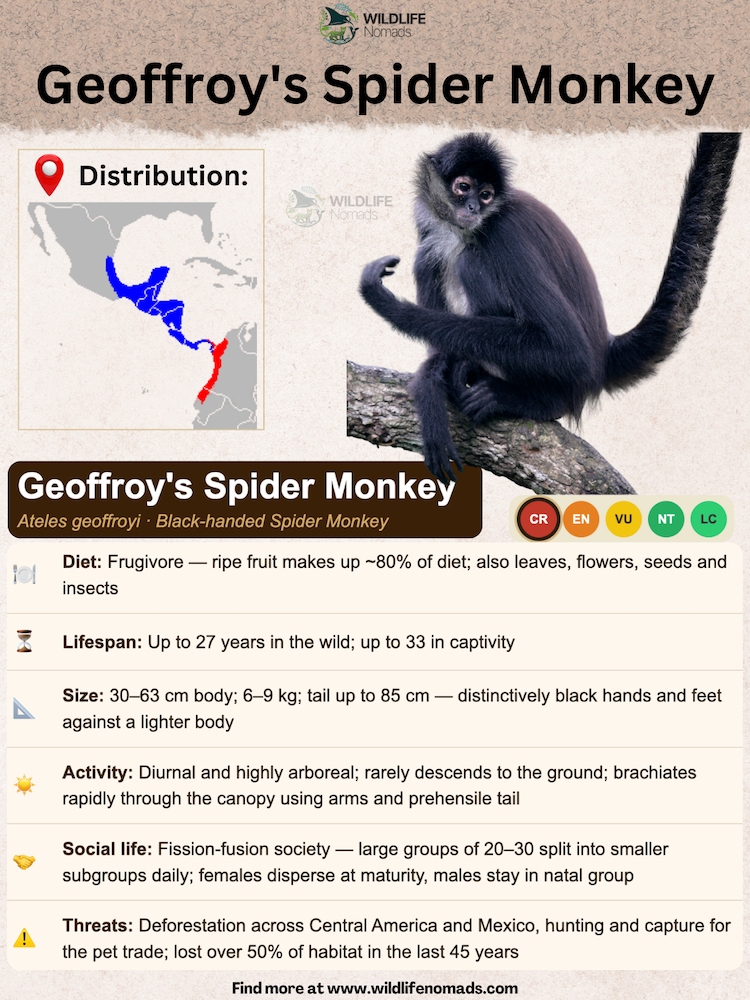
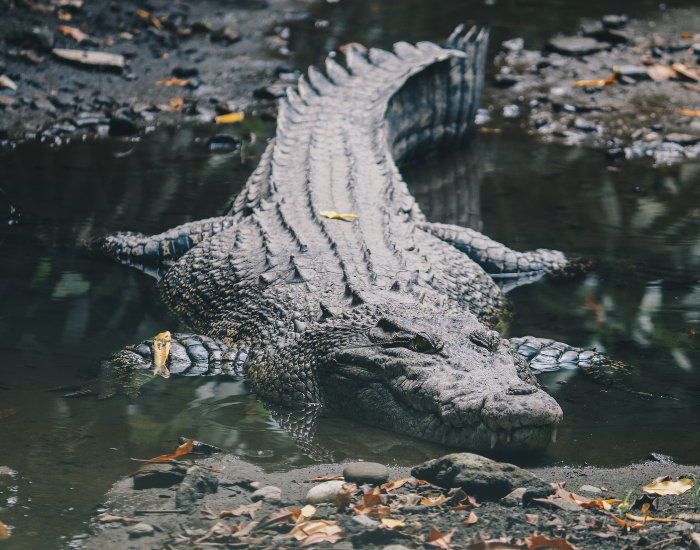
The first time I saw a spider monkey in the wild, I wasn’t even a biologist yet. I was an undergrad on a trip through the Sumidero Canyon in Chiapas, Mexico. You reach the canyon by canoe, and the moment you glide past those towering limestone walls draped in green, it feels like stepping into another universe, like Pandora in Avatar, except it’s real and it smells like damp earth and wild figs. That day I spotted American crocodiles basking on the banks, hawks circling overhead, birds diving between the cliff faces. Then, high on a rock ledge tangled with vines, I caught a flash of long, spindly limbs and a whip-thin tail. A spider monkey (Ateles geoffroyi) watching us from above with dark, intelligent eyes. I had no idea back then that those spider monkeys represent a relict population, one of the northernmost groups of their genus clinging to survival inside that canyon.
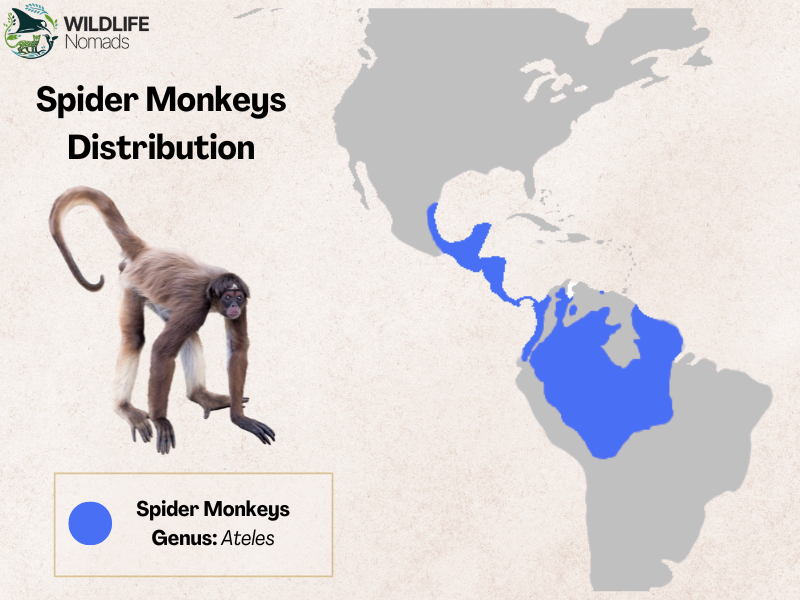
Spider monkeys are not your average primates. They belong to the genus Ateles, a group of new world monkeys that have fascinated scientists and local human populations for centuries. From Mayan artworks, to modern conservation biology, these animals occupy a unique space in both culture and ecology. Here, I’m breaking down 12 facts about spider monkeys that go far beyond the basics.
1. The Genus Name Ateles Literally Means “Incomplete”
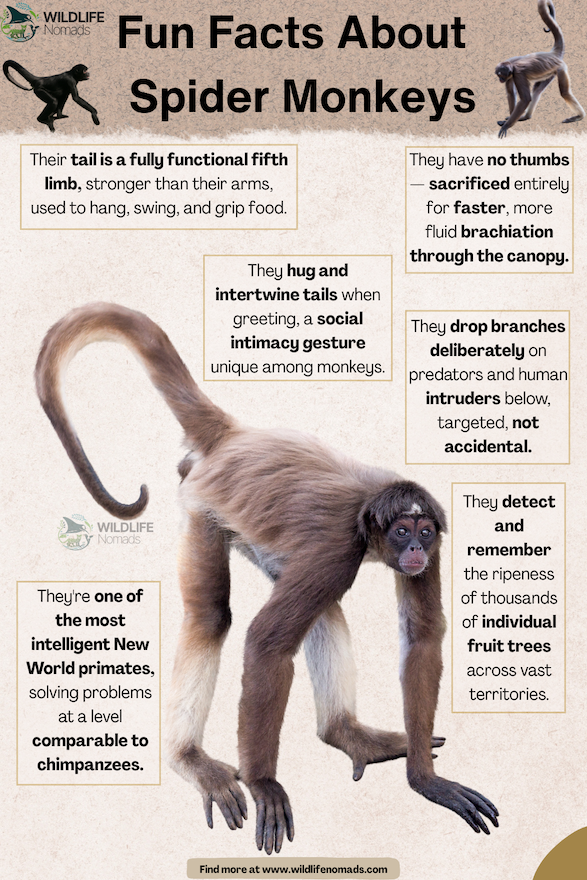
The genus name Ateles comes from the ancient Greek word atelēs, meaning “incomplete” or “imperfect.” French naturalist Étienne Geoffroy Saint-Hilaire coined it in 1806. The reason? Spider monkeys lack a functional thumb. While most primates rely on an opposable thumb for gripping, spider monkeys have reduced theirs to a tiny nub, or lost it entirely. Their hands are essentially hooks: four long, curved fingers with no thumb to oppose them.
This might sound like a design flaw. It’s actually the opposite. By eliminating the thumb, spider monkeys gained a hand perfectly shaped for brachiation, swinging beneath branches at speed. Their elongated fingers wrap around limbs like grappling hooks, and their arms practically drag along the ground when a spider monkey walks upright. Few primates have sacrificed a digit for locomotion this completely. It’s a trade-off that reveals how powerfully natural selection can reshape anatomy when the canopy becomes your entire world. The genus name Ateles is one of those rare cases where taxonomy tells a story.
2. There Are Seven Species… and Most Are in Trouble
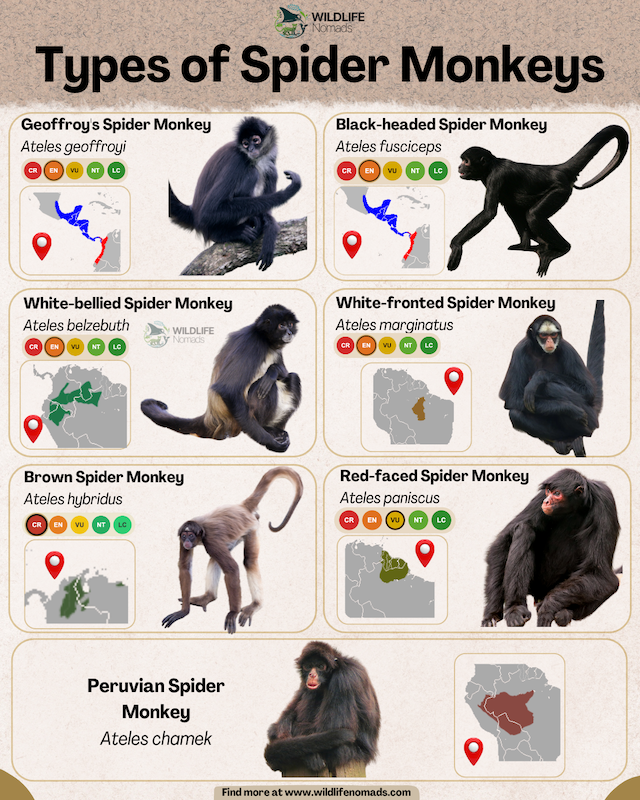
The genus Ateles contains seven recognized species of spider monkeys, each adapted to a different slice of Central and South America. Here’s the full lineup:
Ateles geoffroyi (Geoffroy’s spider monkey), Ateles chamek (Peruvian spider monkey), Ateles paniscus (red-faced spider monkey), Ateles belzebuth (white-bellied spider monkey), Ateles hybridus (brown spider monkey), Ateles fusciceps (the brown-headed spider monkey), and Ateles marginatus (white-cheeked spider monkey). Each represents a distinct lineage within the genus Ateles, and the differences between species of spider monkeys go far beyond geography, they vary in pelage color, body size, and social behavior.
The conservation picture across these seven species is grim. The IUCN lists one species as Vulnerable, five as Endangered, and one, the brown spider monkey, (Ateles hybridus), as Critically Endangered. An estimated 98% of the brown spider monkey’s original habitat has been destroyed. Spider monkey populations across the board are declining, driven by the same devastating combination: hunting and habitat loss. Unlike baboons or macaques, spider monkeys cannot adapt to degraded environments. They need big forest trees, continuous canopy, and large home ranges. When the forest fragments, spider monkey populations collapse.
3. Their Spindly Limbs Inspired Their Common Name
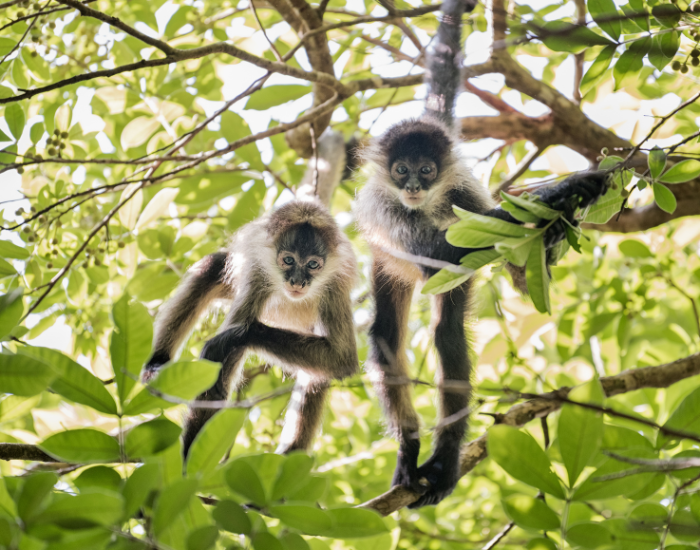
The common name “spider monkey” isn’t random. When a spider monkey hangs from a branch by its tail with all four limbs dangling, it looks remarkably like a spider suspended from a web. Those spindly limbs inspired early European naturalists to name them accordingly.
However, the resemblance is more than cosmetic. Spider monkeys are among the most agile arboreal primates alive. They move through the upper canopy at astonishing speed, wild jumping between gaps in the branches that would give most monkeys pause. Their limb proportions are extreme even by primate standards, their arms are significantly longer than their legs, which is the opposite of what you see in ground-dwelling species. When a spider monkey standing on a branch reaches for fruit, its arm span can exceed its body length. This body plan, long arms, long legs, long prehensile tail, hooklike hands, represents one of the most specialized arboreal designs among all world primates.
4. That Prehensile Tail Functions as a True Fifth Limb
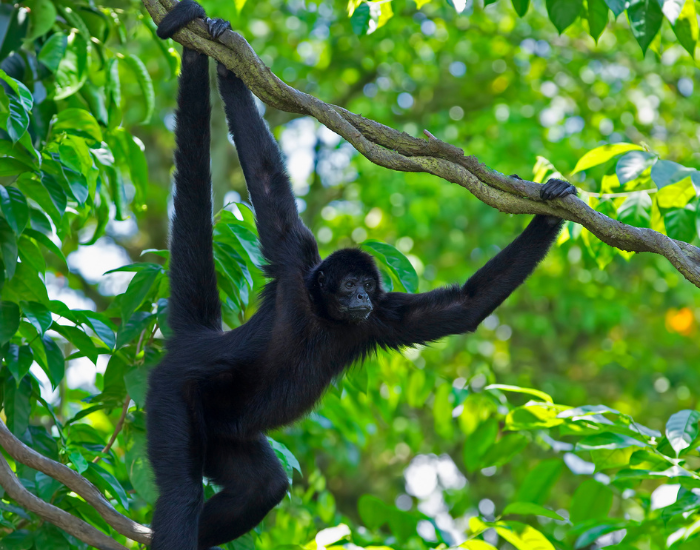
If there’s one thing that separates spider monkeys from most other primates on the planet, it’s the tail. The prehensile tail of a spider monkey can grow longer than the entire body — sometimes exceeding 89 centimeters. The underside of the tail tip is hairless and covered in fine ridges, almost like a fingerprint. This gives spider monkeys an extraordinary grip, strong enough to support their full body weight while they feed, hang, or travel.
I’ve watched wild spider monkeys use their tails in ways that blur the line between “tail” and “hand.” They pluck ripe fruit from thin branches while suspended only by the tail. They anchor themselves during rest, seated monkeys perched on thick limbs with the tail coiled around a nearby branch as a safety line. Infants rely completely on this tail too — young spider monkey individuals cling to their mother’s body while she moves through the canopy, but the mother’s tail acts as an additional safety harness. Spider monkeys are closely related to howler monkeys and woolly monkeys, all of which share prehensile tails within the family Atelidae. However, few primates use theirs with the precision and dexterity of Ateles.
5. Spider Monkeys Are the Einsteins of the New World
Recent meta-analyses of primate cognition studies rank spider monkeys as the most intelligent new world monkeys. That’s a significant claim when you consider the competition, capuchin monkeys, for example, are famous tool users. Yet spider monkeys outperform them on several cognitive measures, particularly spatial memory and social intelligence.
Why? The answer likely comes back to their fission-fusion social structure (more on that next). Living in a society where group composition changes constantly demands sophisticated mental bookkeeping. A spider monkey sees a subgroup form in the morning, breaks off to forage with a different set of individuals by midday, and rejoins the larger community by evening. Tracking who is where, who is dominant, and who is an ally requires a brain built for complexity. This is strikingly similar to what we see in chimpanzees and bonobos, which also live in fission-fusion communities. The cognitive demands of this social system may have driven the evolution of larger brains relative to body size in Ateles compared to other new world primates.
6. They Live in Fission-Fusion Societies… Just Like Chimps
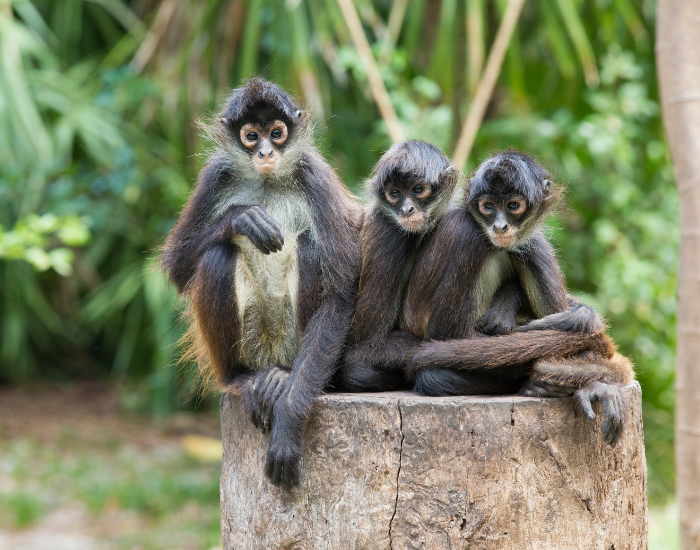
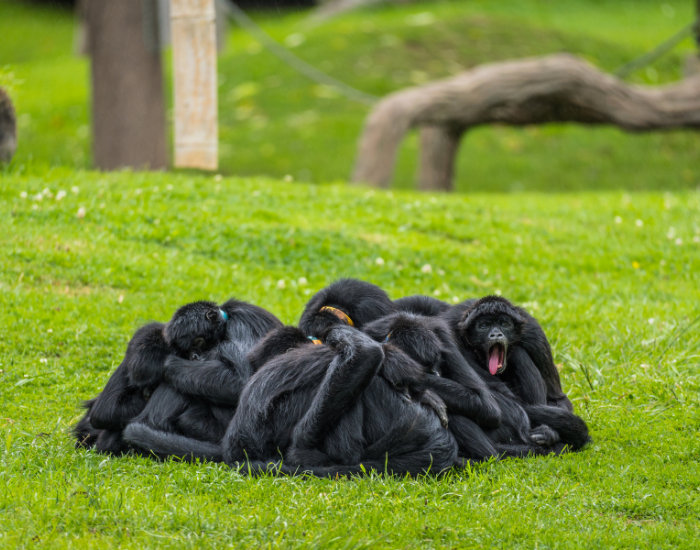
Most people picture monkey troops as tight-knit groups that move together all day. Spider monkeys break that mold entirely. They exhibit a fission-fusion social structure, where a large community of 20 to 40 individuals — sometimes up to 100 — splits into smaller subgroups throughout the day, then merges back together to sleep. The composition of those subgroups shifts constantly. Two spider monkeys foraging together this morning might be in completely different subgroups by afternoon.
This system is rare among primates. Outside of spider monkeys, you really only see full fission-fusion dynamics in chimpanzees, bonobos, and humans. The driver is food. Spider monkeys primarily eat fruits, and fruiting trees don’t produce unlimited bounties. When ripe fruit is scarce, smaller groups reduce competition at each feeding site. When fruit is abundant, larger groups can reassemble. About spider monkeys communicate during these fissions and fusions using a rich vocal repertoire, long whinnying calls, sharp barks, and screams that can travel through the dense canopy. They also embrace, touch, and even “kiss” during reunions, physical behavioral patterns that reinforce social bonds after periods of separation. Spider monkeys are deeply social animals, and their communication reflects that.
7. Female Spider Monkeys Leave Home… Males Stay Put
Here’s a fact that surprises most people: in spider monkey society, females are the ones who disperse. When a young female spider monkey reaches maturity, she leaves the group she was born into and joins a neighboring community. Males tend to stay in their natal group for life. This pattern — called female-biased dispersal — is the opposite of what happens in most primate species, where males leave and females stay.
The consequences are fascinating. Because males in a spider monkey community are often related to each other, they form strong cooperative bonds. They patrol territory together, share food, and collectively defend the group against rivals. Female spider monkeys, by contrast, arrive as immigrants and must build relationships from scratch. Occasionally adult females will compete fiercely with each other for access to the best feeding trees. Males tend to be slightly larger than female spider monkeys, but the size difference is modest compared to what you see in highly dimorphic species like gorillas. The interplay between animal sex, dispersal patterns, and social dynamics in spider monkeys is one of the richest areas of current primate research.
8. They Are Critical Seed Dispersers for Tropical Forests
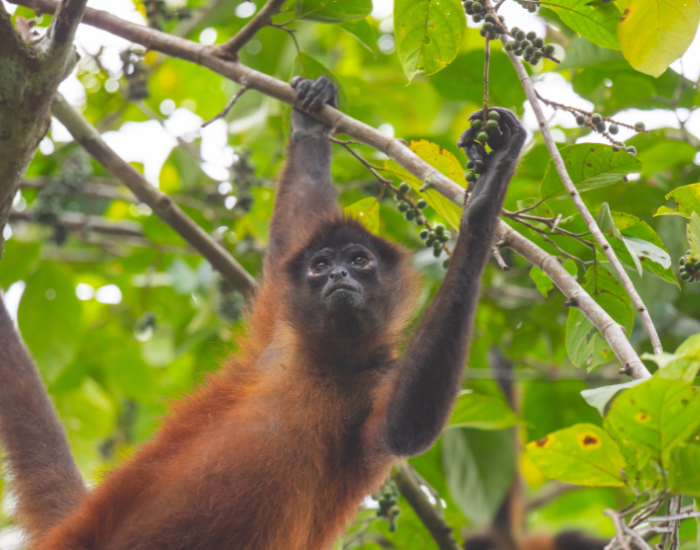
Spider monkeys don’t just live in tropical forests, they actively build them. Research in lowland Ecuador documented that a single spider monkey disperses approximately 195,000 seeds per year. That number is staggering. Because spider monkeys primarily eat fruits and swallow seeds whole, those seeds pass through the digestive tract and get deposited far from the parent tree in nutrient-rich fecal matter. Studies have shown that seeds dispersed by spider monkeys actually germinate at higher rates than undispersed seeds.
This role in seed dispersal makes Ateles a keystone genus. When spider monkey populations disappear from a forest, the tree species that depend on them for dispersal begin to decline. Over decades, the entire composition of the forest shifts. I’ve read studies from fragmented forests in southern Mexico — not far from the Sumidero Canyon where I first saw spider monkeys — that document exactly this process. The loss of spider monkeys doesn’t just mean fewer monkeys. It means a fundamentally different, less diverse forest. Few primates carry this much ecological weight on their shoulders.
9. They Prefer Undisturbed Primary Rainforest
Unlike some adaptable species that thrive in secondary growth or agricultural edges, spider monkeys strongly prefer undisturbed primary rainforest. They need tall, continuous canopy with many big forest trees connected by overlapping branches. Their brachiating locomotion demands it — you can’t swing 10 meters between branches if half the trees have been logged.
Research from across Central and South America consistently shows that wild spider monkeys occur at the highest densities in old-growth forest with intact canopy structure. They especially favor the south American lowland forest biome — the vast, humid expanses of the Amazon and Orinoco basins where big forest trees form a continuous green ceiling. Geoffroy’s spider monkey (Ateles geoffroyi), the species I encountered in Chiapas, ranges from Mexico through Central America and into Colombia, but everywhere it occurs, it gravitates toward the least-disturbed patches. The diet of Geoffroy’s spider monkey relies heavily on fruit from mature canopy trees that simply don’t exist in young or degraded forests.
10. Black Spider Monkeys Are Among the Largest New World Monkeys
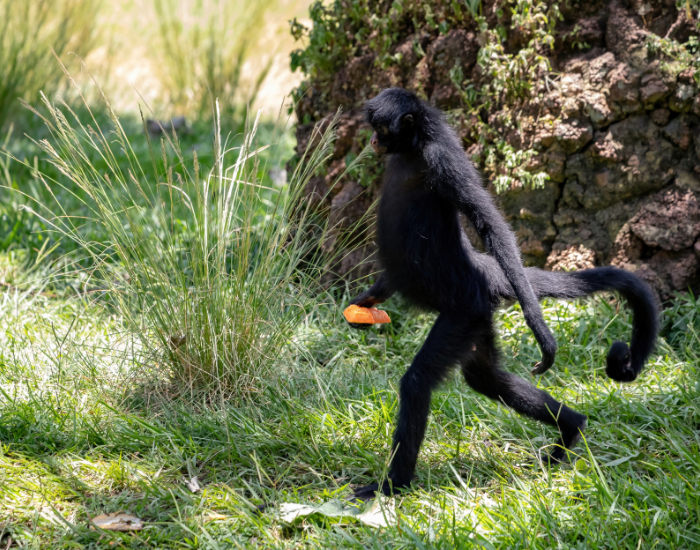
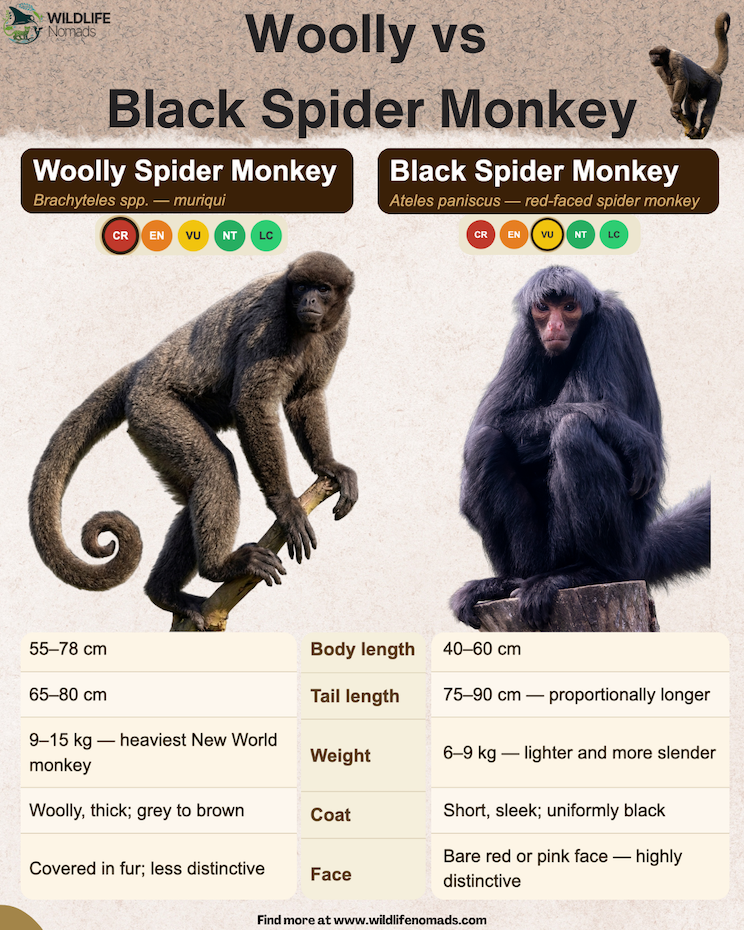
Black spider monkeys (Ateles paniscus) hold the distinction of being among the largest new world monkeys. An adult male can weigh up to 11 kilograms and measure over 60 centimeters in body length, and that’s before you add the tail. They are the largest spider monkey species, and they rank alongside woolly spider monkeys (genus Brachyteles, also called muriquis) and woolly monkeys (genus Lagothrix) as the heaviest primates in the Americas. Woolly spider monkeys are actually even heavier, but black spider monkeys remain the largest within the genus Ateles itself.
Black spider monkeys live in the rainforests of northern South America — Brazil, Guyana, Suriname, French Guiana. These are among the most intact tropical forests left on Earth, and black spider monkeys depend on dead tree limbs weighing down the canopy to create the tangled pathways they use for travel. Their jet-black fur and red facial skin give them a striking, almost theatrical appearance. Evolutionary history theories abound about why black spider monkeys developed such dark pelage, with hypotheses ranging from thermoregulation to camouflage in deeply shaded canopy. What’s clear is that black spider monkeys, like all Ateles species, depend on vast stretches of unbroken forest.
11. Mothers Are Devoted… and Babies Are Helpless
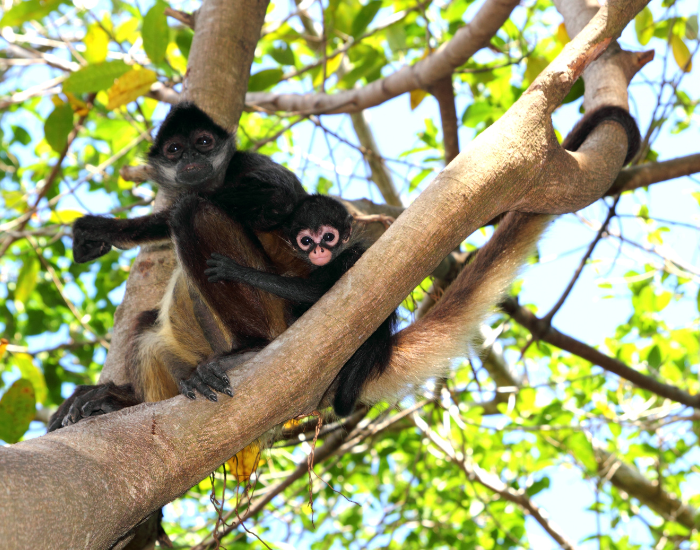
Spider monkeys have one of the slowest life history strategies of any new world monkey. Females typically give birth to a single infant every three to four years. That infant is born almost completely helpless — it cannot grip branches, regulate its own body temperature, or feed itself. For the first several months, infants rely completely on the mother, clinging to her belly and later riding on her back as she navigates the canopy.
Spider monkey mothers are generally attentive mothers, investing years of care into each offspring. They nurse for up to two years and continue to protect and teach the young spider monkey for another year or two after weaning. This extended parental investment means spider monkey populations recover extremely slowly from any population crash. Compare that to, say, a rodent that can produce multiple litters per year. A female spider monkey might produce only five to seven offspring in her entire lifetime. This slow reproductive rate, combined with hunting and habitat loss, is exactly why so many spider monkey species are now endangered species across their range.
12. Spider Monkeys Are Cultural Icons — From Mayan Art to Modern Media
Spider monkeys occupy an outsized place in human culture, especially in Mesoamerica. In ancient Mayan civilization, spider monkeys were associated with the arts, pleasure, and the cacao trade, artworks depict them shown carrying cacao pods, a nod to the monkeys’ well-known love of fruit. The Maya considered them closely linked to the patron gods of writing and artistic creation. Some colonial-era accounts described their exaggerated limbs and dark faces as resembling “demonic clowns”, a characterization that says more about European anxieties than about the monkeys themselves.
In modern media, spider monkeys pop up in surprising places. A spider monkey named Spydor gained internet fame as a meme and character reference, introducing the genus to audiences who might never read a primatology paper. Zoos worldwide keep Ateles geoffroyi and other spider monkey species as ambassadors, and spider monkey impersonators serve as comic relief in various entertainment contexts. However, this cultural visibility has a dark side. The exotic pet trade remains a serious threat, with spider monkeys captured from the wild, often by killing the mother, and sold illegally.

What About Their Diet? Spider Monkeys Are Frugivores With a Twist
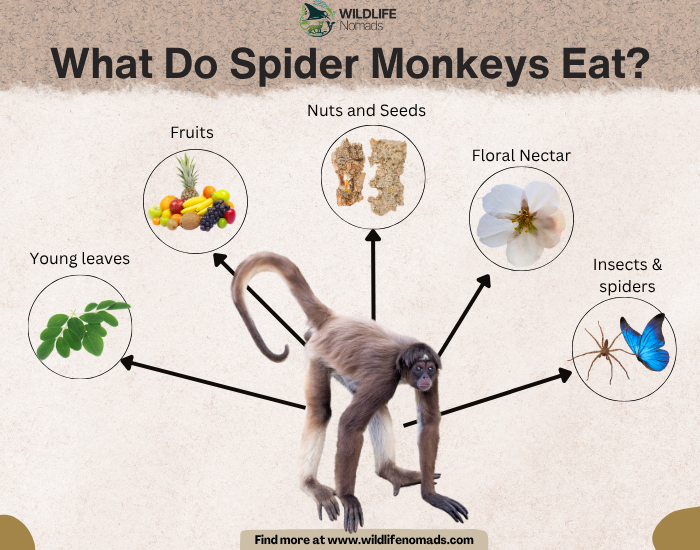
Spider monkeys primarily eat fruits, specifically, ripe fruit from canopy trees. Frugivory accounts for roughly 70 to 85 percent of their diet depending on the species and season. However, they supplement with young leaves, flowers, bark, honey, and occasionally bird eggs. In rare cases, wild spider monkeys have been documented eating insects, they eat insects opportunistically, snapping up caterpillars or larvae found on fruit they’re already consuming. This dietary flexibility is modest compared to omnivorous primates, but it helps during lean seasons when fruiting is sparse.
FAQ
The primary threats are habitat loss and hunting. Deforestation for agriculture, cattle ranching, logging, and mining destroys the continuous forest canopy that spider monkeys need. Hunting by local populations for bushmeat compounds the problem. Their slow reproductive rate means spider monkey populations cannot bounce back quickly. The brown spider monkey (Ateles hybridus) is critically endangered, with an estimated 80% population decline over three generations due to habitat destruction and fragmentation.
Wild spider monkeys are not aggressive toward humans under normal circumstances. They typically flee when they detect people. However, captive or habituated spider monkeys can bite, and their long canine teeth can inflict serious wounds. They are strong, fast, and unpredictable in captivity. Spider monkeys are wild animals and should never be kept as pets.
The Bigger Picture
Spider monkeys are more than charismatic canopy acrobats. They are ecological engineers whose disappearance reshapes entire forests. They are cognitive powerhouses navigating one of the most complex social systems in the primate order. And they are living archives of primate evolution stretching back nearly seven million years. And they are disappearing.
All seven species of spider monkeys within Ateles are threatened. The window for effective conservation is narrowing, and it requires protecting large, connected tracts of primary forest — not just isolated reserves. If you want to help, support organizations working on habitat corridors in Central and South America. Talk about these animals. Share what you’ve learned.
If you found this article useful, check out my guides on types of primates, types of monkeys, and the monkeys of Costa Rica. And if you’ve ever seen spider monkeys in the wild — whether in Mexico, Costa Rica, or deep in the Amazon, drop a comment. I’d love to hear your story.
References:
Campbell, C. J., Aureli, F., Chapman, C. A., Ramos-Fernández, G., Matthews, K., Russo, S. E., Suarez, S., & Vick, L. (2005). Terrestrial behavior of Ateles spp. International Journal of Primatology, 26(5), 1039–1051. https://doi.org/10.1007/s10764-005-6457-1
Chaves, Ó. M., Stoner, K. E., & Arroyo-Rodríguez, V. (2011). Effectiveness of spider monkeys (Ateles geoffroyi vellerosus) as seed dispersers in continuous and fragmented rain forests in southern Mexico. International Journal of Primatology, 32(1), 177–192. https://doi.org/10.1007/s10764-010-9460-0
Dávalos, L. M., & Ford, S. M. (2014). Revisiting the phylogenetic relationships, biogeography, and taxonomy of spider monkeys (genus Ateles) in light of new molecular data. Molecular Phylogenetics and Evolution, 82, 467–483. https://doi.org/10.1016/j.ympev.2014.09.019
González-Zamora, A., Arroyo-Rodríguez, V., Escobar, F., Rös, M., Oyama, K., Ibarra-Manríquez, G., Stoner, K. E., & Chapman, C. A. (2014). Contagious deposition of seeds in spider monkeys’ sleeping trees limits effective seed dispersal in fragmented landscapes. PloS one, 9(2), e89346. https://doi.org/10.1371/journal.pone.0089346
Link, A., & Di Fiore, A. (2006). Seed dispersal by spider monkeys and its importance in the maintenance of neotropical rain-forest diversity. Journal of Tropical Ecology, 22(3), 235–246. https://doi.org/10.1017/S0266467405003081
Muñóz, D., Estrada, A., & García del Valle, Y. (2008). Survey and conservation of a relict population of spider monkeys (Ateles geoffroyi) in the Sumidero Canyon, Mexico. Tropical Conservation Science, 1(2), 151–162. https://doi.org/10.1177/194008290800100207




_range.png)
