I was maybe ten years old when I first encountered sandhill cranes. My family had flown from northern Mexico to Orlando, and my dad rented a car so we could drive to one of the Disney parks. Somewhere along the highway, standing in a grassy median like they owned the place, two tall gray cranes watched our car roll past. Long necks, red crowns, utterly unbothered. I remember tugging my dad’s sleeve and pointing. He barely glanced.
But I couldn’t look away. They reminded me of the whooping cranes I’d seen in wildlife documentaries, similar silhouette, same deliberate posture, though these cranes wore gray instead of white. Decades later, as a field biologist who has tracked herons, storks, and even the bizarre shoebill in Africa, sandhill cranes still catch me off guard with how ancient and resilient they are.
Here are 12 things you need to know about the sandhill crane.
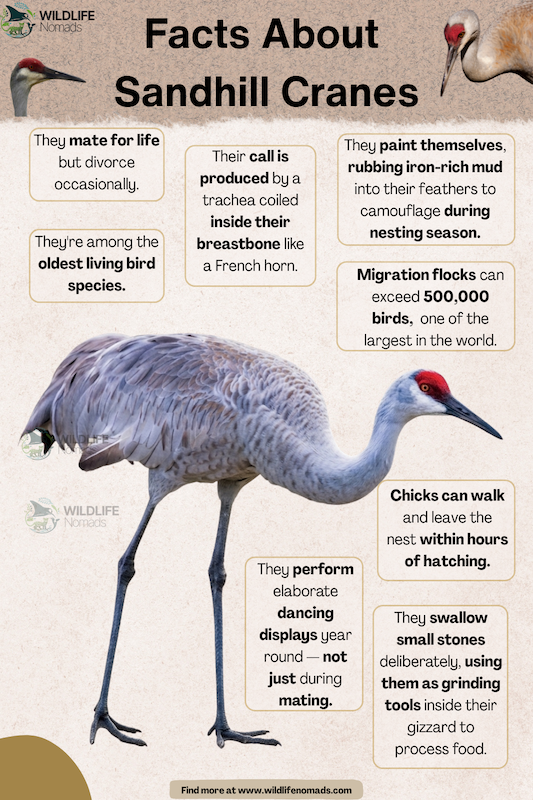
1. Sandhill Cranes Are Among the Oldest Living Species on Earth
The earliest sandhill crane fossil dates back roughly 2.5 million years. Researchers unearthed it from the Macasphalt Shell Pit in Florida, making it older by half than the earliest remains of most living species. Some scientists point to a 10-million-year-old crane fossil from Nebraska’s river valleys as a possible ancestor, though that specimen likely belongs to a prehistoric relative rather than the modern species.
Either way, when you watch sandhill cranes stride across a wetland, you’re witnessing a lineage that predates most of what we consider “modern” wildlife. They walked alongside mastodons. That thought alone changes how I look at them every time I spot one in the field.
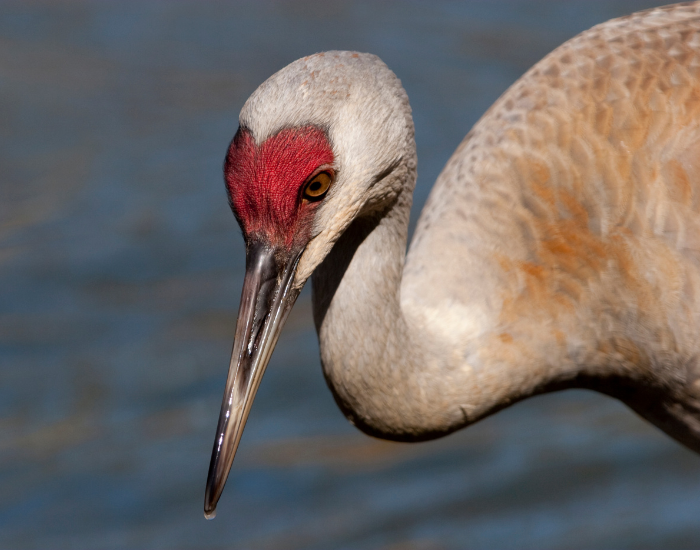
2. There Are More Subspecies Than Most People Realize
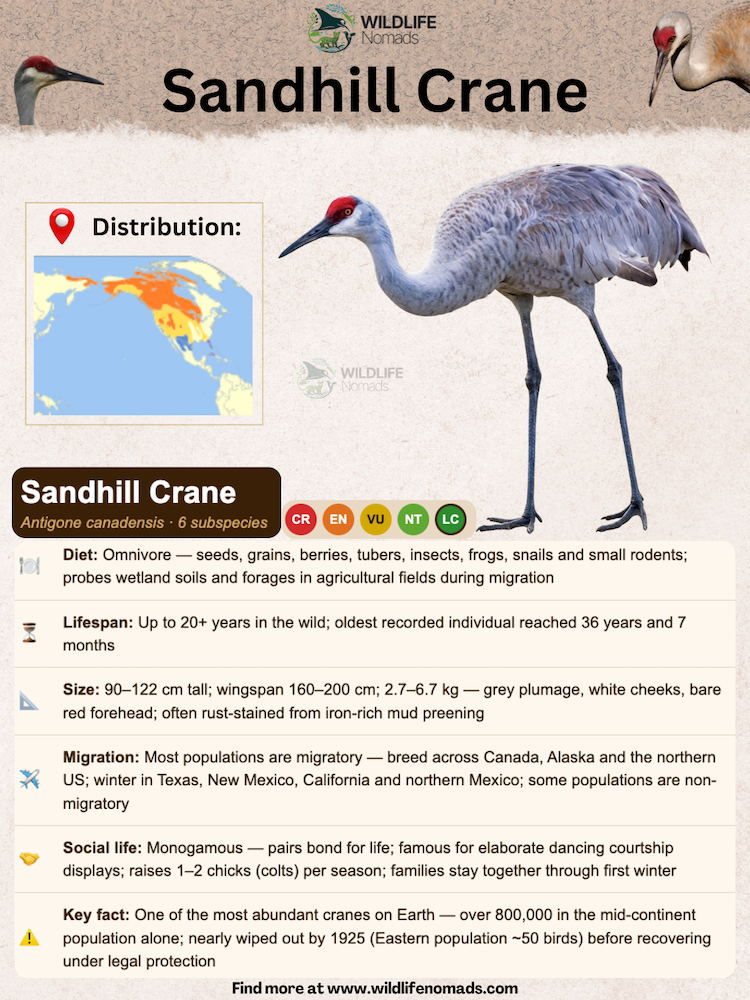
The sandhill crane, formerly classified as Grus canadensis and now Antigone canadensis — isn’t a single, uniform population. Scientists recognize at least five distinct subspecies, split into two subspecies groups: migratory and non-migratory. The two migratory subspecies, greater sandhill cranes (A. c. tabida) and lesser sandhill cranes (A. c. canadensis), account for the vast majority of the population. Greater sandhill cranes breed across the northern United States and southern Canada, while lesser sandhill cranes nest farther north into the Canadian Arctic and even northeast Siberia.
Then there are the non-migratory subspecies. Florida sandhill cranes remain year-round in the Southeast. The Mississippi sandhill crane clings to a tiny range along the Gulf Coast. Cuban sandhill cranes survive in scattered pockets of Cuba’s savannas. A 2025 genetic study in Ecology and Evolution revealed a deep divide between greater and lesser populations — so significant that some researchers now argue they should split Antigone canadensis into two separate species, despite showing insignificant genetic differentiation in some nuclear markers. The old Grus canadensis designation was already revised once; the taxonomy may shift again.
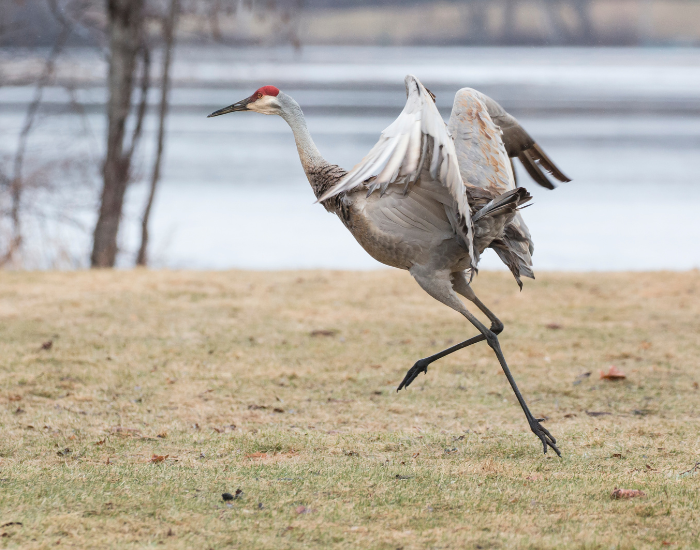
3. Their Dancing Skills Are Legendary!
I’ve watched sandhill cranes dance in early spring along shallow wetlands in central Florida, and it never gets old. These social birds bow, leap two meters into the air, stretch their wings wide, and toss sticks and plant material skyward. The display looks joyful (almost celebratory), but it serves real biological purposes.
Unpaired cranes dance to attract mates. Established pairs dance to strengthen their bond and synchronize reproductive cycles before breeding season. Even immature birds practice their dancing skills, sometimes for years before they’re old enough to breed. Interestingly, cranes also dance to express aggression and territoriality, which means not every dance is a love story.
4. The Nebraska Migration Is One of Nature’s Greatest Spectacles
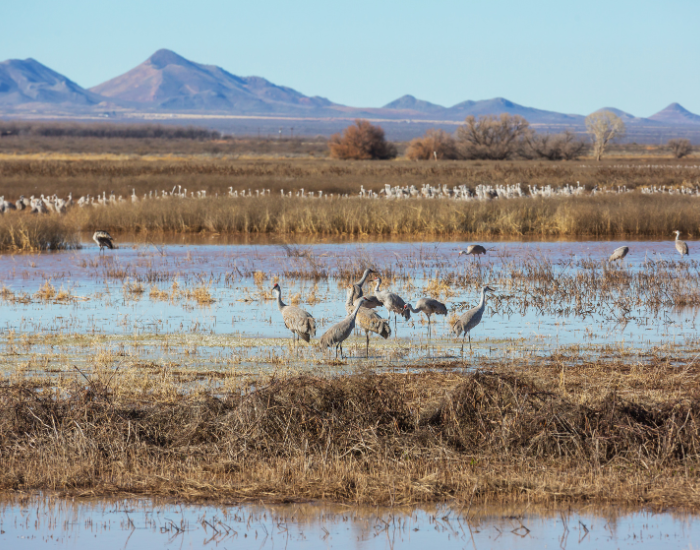
Every March, roughly 80 percent of the world’s sandhill crane populations, large, migratory birds known for their distinct crimson caps and loud rattling calls, funnel into an 80-mile stretch of Nebraska’s Platte River. The numbers are staggering, over 600,000 cranes at peak, sometimes more. They arrive from wintering grounds across the Gulf states, central California, and coastal areas farther south. They roost shoulder-to-shoulder in shallow water at night, then fan out across surrounding croplands and open grasslands to feed during the day.
An individual crane spends about 29 days at this migratory stopover point. As migratory birds, sandhill cranes rely on these critical habitats to rest and refuel during their long journeys. During that window, each crane gains up to a pound of fat, fuel for the remaining journey to nesting areas in Alaska, southern Canada, and beyond. I visited the river one March, arriving before dawn, and the sound alone — hundreds of thousands of cranes calling in the dark — felt prehistoric. The International Crane Foundation has documented this migration extensively, and their work underscores why protecting these river valleys matters for the species’ future.

5. Sandhill Cranes Are Opportunistic Feeders With a Flexible Diet
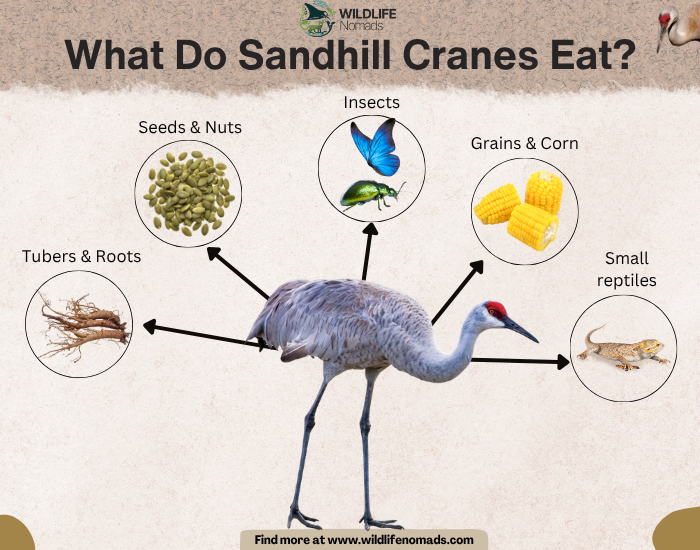
One reason sandhill cranes thrive across such a broad range is their diet. They’re true opportunistic feeders, switching food sources depending on season, location, and availability. During migration and winter, sandhill cranes rely heavily on cultivated foods, especially corn, wheat, cottonseed, and sorghum, consuming waste grain left in harvested fields for essential nutrients. In some areas, these cultivated foods make up 90 percent of their intake during stopover.
On their summer range, the menu shifts dramatically. Cranes probe shallow water and dry ground for insects, crayfish, snails, frogs, and even small mammals like mice and voles. They’ll also take snakes, small mammals, and berries when the opportunity arises.
6. They Build a Nest on the Ground… and Both Parents Share Duties
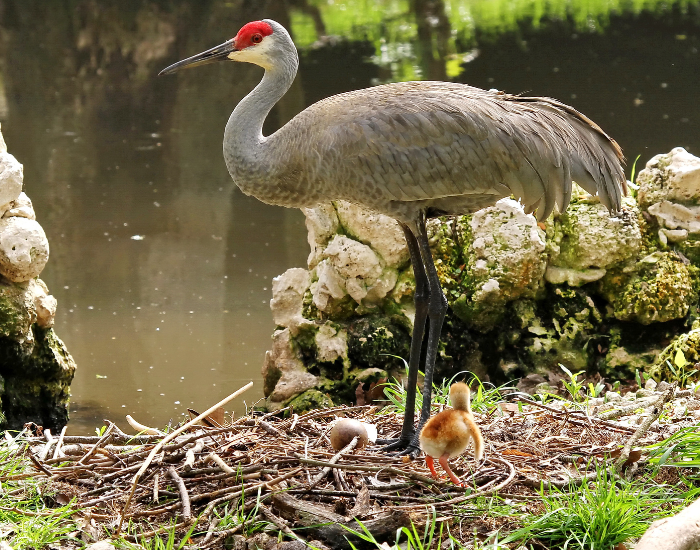
Unlike many species that nest in trees, sandhill cranes build their nest on dry ground or in shallow water within freshwater wetlands. The nest itself is a mound of cattails, sedges, and grasses piled into a platform that can reach a meter across. Cranes favor nest sites surrounded by dense vegetation, which helps conceal the nest from both land predators and aerial predators like birds of prey.
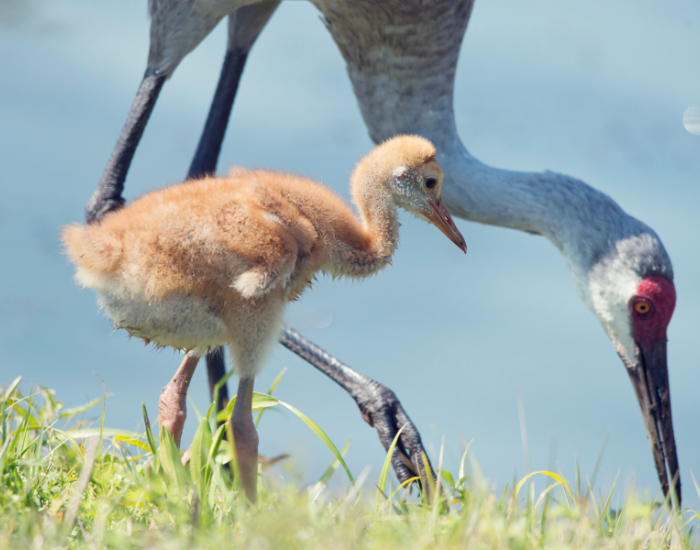
Females lay two eggs per clutch, rarely more. Both parents incubate for roughly 30 days, taking turns so neither exhausts itself. The chicks (called colts) hatch covered in rusty down and can leave the nest within hours. They follow their parents immediately, learning to forage on their own within days. However, despite females laying two eggs, sandhill cranes often raise only one chick to independence. Sibling aggression and predation take a toll. The pair invests heavily in whichever colt survives, guiding it through migration and winter before the young crane strikes out alone.
7. Their Range Spans an Entire Continent!
The sandhill crane range is enormous. Greater sandhill cranes breed from the Great Lakes region west through the Pacific flyway into Oregon and California. Lesser sandhill cranes push into boreal habitats across northern Canada and into the far reaches of Siberia, making them among the northernmost birds in the species’ range and well-adapted to cold climates. The mid-continent population (the largest) follows the central flyway from wintering areas in Texas and the southeastern United States up through Nebraska to nesting territory stretching into the Arctic.
Resident populations occupy far more restricted ranges. Florida sandhill cranes stay within the state year-round. The Mississippi subspecies (Grus canadensis pulla, under the older naming) survives only in and around its National Wildlife Refuge. Cuban populations are confined to a handful of sites. During migration and winter, migratory cranes spread across wintering grounds that include central California, coastal areas of the Gulf states, and the Okefenokee Swamp in Georgia.
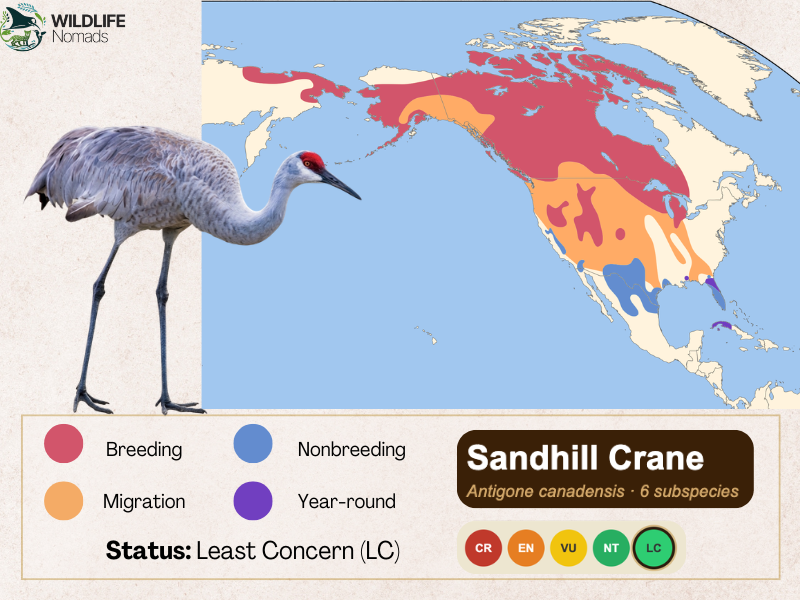
8. Not All Sandhill Cranes Migrate
It’s easy to assume all cranes are migratory, but that’s not the case. The three non-migratory subspecies — Florida sandhill cranes, the Mississippi population, and Cuban cranes, remain in their home territories year-round. These non-migratory populations face unique pressures compared to their migratory relatives. Without the option to shift seasonally between separate ranges, they depend entirely on local habitat quality.
Florida sandhill cranes, for example, rely on the state’s prairies, wetlands, and pastureland. Urbanization and habitat loss threaten them directly. The Mississippi sandhill crane is federally listed as endangered, with fewer than 150 individuals in the wild. Cuban cranes face similar pressures. By contrast, the two subspecies that migrate, greater sandhill cranes and lesser sandhill cranes — number in the hundreds of thousands. The lesser subspecies alone accounts for the bulk of the species’ total population, estimated at over 800,000. The difference in conservation status between migratory and non-migratory populations highlights how migration itself can be a survival strategy, spreading risk across a wider geography.
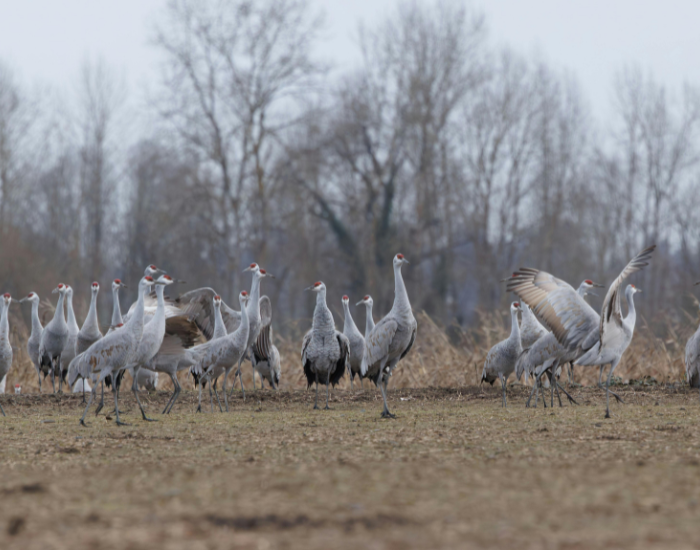
9. They Paint Themselves With Mud
Here’s a detail that surprises almost everyone. Sandhill cranes actively preen iron-rich mud into their feathers, staining their naturally gray plumage a rusty brown. This behavior, called “painting,” is deliberate. They use their bills to spread mud across their body feathers, particularly during breeding season. The result is that adult sandhill crane plumage varies wildly depending on geography, cranes in iron-rich areas look reddish-brown, while cranes in other populations retain their clean gray underparts.
Scientists debate the purpose. Camouflage near the nest is the leading theory, the rusty coloring may help incubating adults blend into marsh vegetation. Adult plumage returns to gray after molting. Immature birds don’t paint as extensively, and their plumage tends to appear browner and more mottled overall. I remember being confused the first time I saw a “brown” sandhill crane in Florida, thinking it might be a different species entirely. It took a mentor explaining the mud-painting behavior for it to click. It’s one of those quirks that makes Antigone canadensis endlessly fascinating.
10. They Use Thermals to Fly With Stunning Efficiency
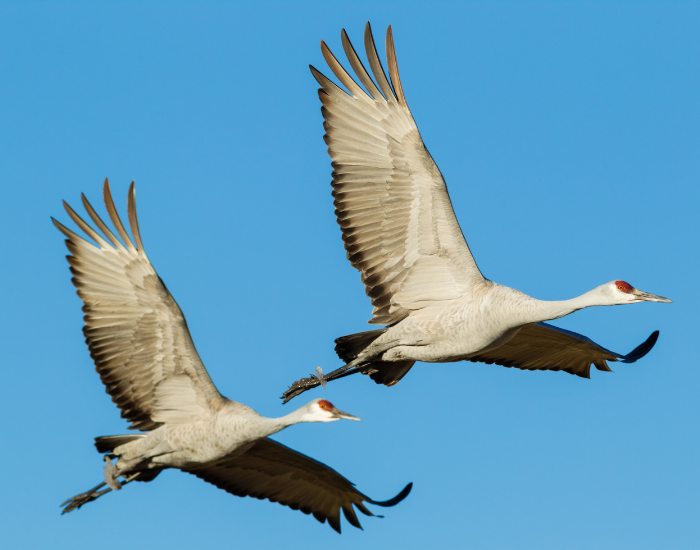
Watching sandhill cranes migrate overhead is a masterclass in energy conservation. They don’t just flap their way across a continent. They obtain lift by circling inside columns of rising warm air — thermals — spiraling upward to altitude before gliding long distances to the next thermal. This technique allows them to cover hundreds of miles per day while barely flapping their wings. With long necks extended and legs trailing behind, a flock of cranes riding a thermal looks like a slow-motion tornado.
The strategy matters because sandhill cranes are heavy. Greater subspecies can weigh over five kilograms. Sustained flapping flight at that body mass burns enormous energy. By exploiting thermals along the central flyway and Pacific flyway, migratory cranes conserve the fat reserves they built at migratory stopover points along river valleys. The U.S. Fish and Wildlife Service monitors these migration corridors closely, and their data confirms that cranes consistently use the same thermal highways year after year.
11. They’re Protected… But Also Hunted in Some States
Sandhill cranes occupy a complicated legal space. All subspecies fall under the Migratory Bird Treaty Act, which provides federal protection. The U.S. Fish and Wildlife Service regulates harvest seasons for abundant migratory populations. Currently, regulated hunting occurs in portions of Texas, Kansas, Arizona, Montana, and several other states. Hunters sometimes call sandhill crane the “ribeye of the sky”, a nod to the dark red breast meat that tastes more like lean beef than poultry.
However, not all populations share that abundance. Endangered subspecies receive protection under both the Endangered Species Act and international agreements. The Florida sandhill crane is state-listed as threatened. Conservation action plan efforts focus on habitat restoration, captive breeding, and predator management. The International Crane Foundation leads much of this work, collaborating with the U.S. Fish and Wildlife Service and state agencies. Habitat loss remains the primary long-term threat, particularly for resident subspecies with restricted ranges.
12. Their Unison Call Strengthens Pair Bonds for Life
Sandhill cranes typically mate for life, and their unison call is the glue that holds the partnership together. A mated pair stands close, throws their heads back, and produces a synchronized duet, the female calling twice for every single call from the male. The sound carries over a mile across open wetlands. It’s haunting, ancient, and unmistakable once you’ve heard it.
The call serves multiple functions: it reinforces pair bonds, advertises territory, and warns neighboring cranes to keep their distance. Unrelated cranes that wander too close often trigger an escalation from calling to physical confrontation. These are social birds, but they’re fiercely territorial when it comes to nest defense.

Frequently Asked Questions
Most sandhill crane populations are not endangered. The species overall numbers well over one million individuals across North America. However, two subspecies are federally listed as endangered: the Mississippi sandhill crane, with fewer than 150 remaining, and the Cuban population, which survives in small, isolated groups. The Florida sandhill crane is state-listed as threatened. Conservation status varies dramatically between migratory and resident subspecies.
Sandhill cranes are legally hunted in several U.S. states where migratory populations are abundant. Hunters often call them the “ribeye of the sky” because their dark breast meat tastes more like lean beef than poultry. Only abundant migratory subspecies — greater sandhill cranes and lesser sandhill cranes — are subject to regulated harvest seasons managed by the U.S. Fish and Wildlife Service. Endangered subspecies are strictly protected.
The Last of the Living Fossils
Sandhill cranes carry 2.5 million years of evolutionary history in every wingbeat. From the massive congregations along Nebraska’s river corridor to the quiet, year-round residents of Florida’s wetlands, these cranes reveal how a single species can occupy wildly different ecological niches across an entire continent. Whether you’re watching greater sandhill cranes spiral into a thermal over a Wisconsin marsh or spotting Florida sandhill cranes strolling through a suburban parking lot, the experience connects you to something genuinely ancient.
If you’re exploring birds of Florida, sandhill cranes are among the most rewarding species to observe. Compare them to their rarer cousin, the whooping crane, and the similarities in body plan become obvious, but the differences in conservation trajectory tell a far more complex story. Get outside, find a wetland, and listen. That rattling call carries across centuries.
References:
Donnelly, J. P., King, S. L., Silverman, N. L., Collins, D. P., Carrera-Gonzalez, E. M., Lafón-Terrazas, A., & Moore, J. N. (2021). Migration efficiency sustains connectivity across agroecological networks supporting sandhill crane migration. Ecosphere, 12(4), e03543. https://doi.org/10.1002/ecs2.3543
Fronczak, D. L. (2025). Status and harvests of sandhill cranes: Mid-continent, Rocky Mountain, Lower Colorado River Valley, and Eastern populations, 2025. U.S. Fish and Wildlife Service. https://www.fws.gov/sites/default/files/documents/2025-09/status-and-harvests-of-sandhill-cranes-2025.pdf
Gerber, B. D., Dwyer, J. F., Nesbitt, S. A., Drewien, R. C., Littlefield, C. D., Tacha, T. C., & Vohs, P. A. (2020). Sandhill Crane (Antigone canadensis), version 1.0. In Birds of the World (A. F. Poole, Editor). Cornell Lab of Ornithology. https://doi.org/10.2173/bow.sancra.01
Joy, M. R., Miller, M. P., Talbot, S. L., Sage, G. K., Crane, K., & Wilson, R. E. (2025). Deciphering cryptic population structure in western sandhill crane subspecies (Antigone canadensis) of the Pacific Flyway. Ecology and Evolution, 15, e71475. https://doi.org/10.1002/ece3.71475
Krapu, G. L., Brandt, D. A., Jones, K. L., & Johnson, D. H. (2011). Geographic distribution of the mid-continent population of sandhill cranes and related management applications. Wildlife Monographs, 175(1), 1–38. https://doi.org/10.1002/wmon.1
Pekarsky, S., Shohami, D., Horvitz, N., Bowie, R. C. K., Kamath, P. L., Markin, Y., Getz, W. M., & Nathan, R. (2024). Cranes soar on thermal updrafts behind cold fronts as they migrate across the sea. Proceedings. Biological sciences, 291(2015), 20231243. https://doi.org/10.1098/rspb.2023.1243