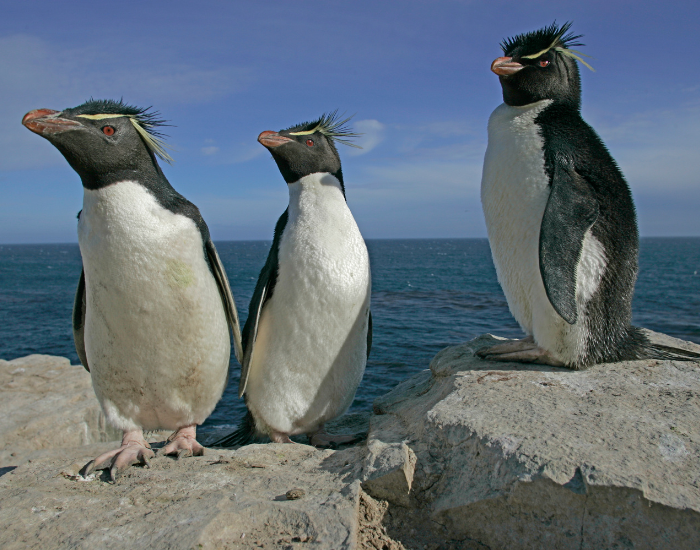
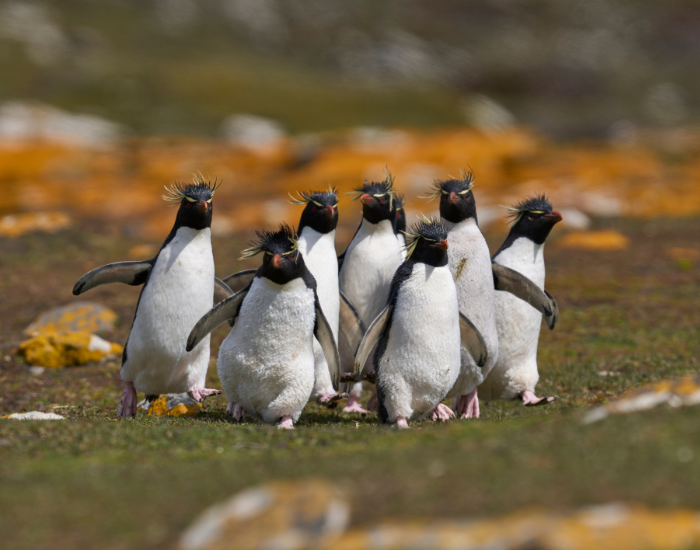
If there were an award for the most “rebellious” looking bird in the animal kingdom, the rockhopper penguin would take the trophy, hands down. With those chaotic spiky black feathers and dramatic long yellow plumes that end in distinctive spiked black feathers, they look less like a flightless bird and more like a lead singer in a 90s garage band. An icon among penguins.
While my partner Jackie (the other half of the Wildlife Nomads team) and I have been lucky enough to spot the little penguin in Australia and the Galapagos penguin in South America, there is something uniquely magnetic about the rockhopper penguin.
Maybe it’s because they’re the underdogs, or maybe it’s because they choose to live on jagged, vertical cliffs that would make a mountain goat nervous. Most people recognize the emperor penguin from documentaries, but today, we’re diving into the world of the “rock penguins.”
Whether you’re a fan of the movie Surf’s Up (like us) or just a curious nature lover, here are 10 things you need to know about the most charismatic types of birds in the Southern Ocean.

1. Their Scientific Name is a Bit of a Mouthful
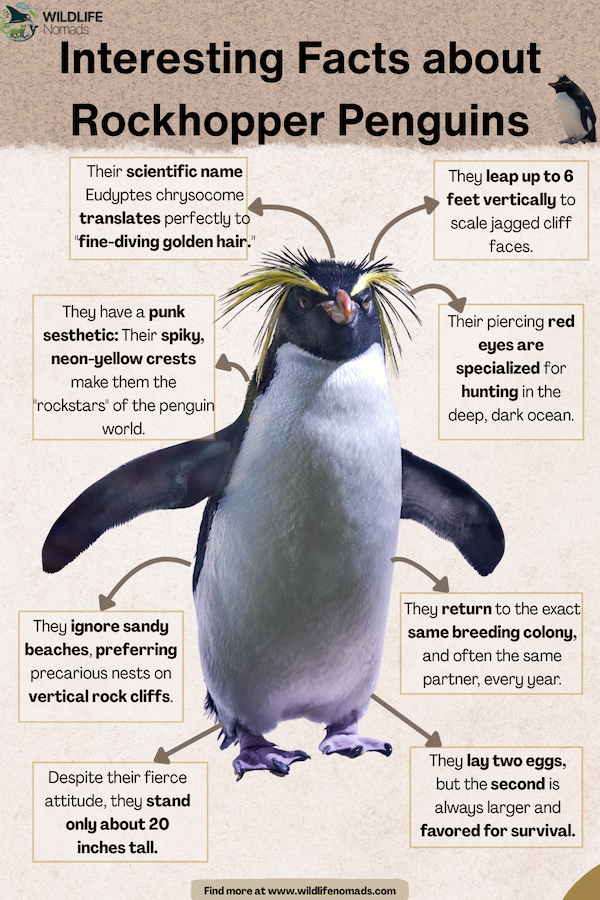
The rockhopper penguin scientific name depends on which specific “flavor” of penguin you’re looking at. Generally, they belong to the genus Eudyptes, which translates to “fine diver.” The most common species is Eudyptes chrysocome.
In the world of ornithology, names usually tell a story. Chrysocome means “golden hair,” a nod to those signature yellow eyebrows that make them so easy to spot in a crowd of thousands.
2. They Don’t Waddle, They Jump
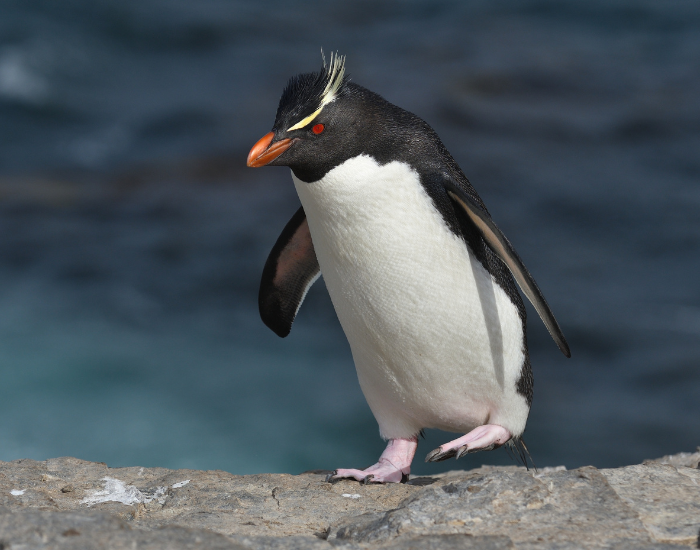
Most penguins have a classic, clumsy waddle on land. Not the rock hopping penguin. To navigate their rocky shorelines, they use both feet to launch themselves over cracks and boulders.
I’ve seen similar adaptations in other island species where the terrain is unforgiving. They can jump up to 6 feet (almost 2 meters) in a single bound!
3. There Are Actually Three (or Two) Different Species
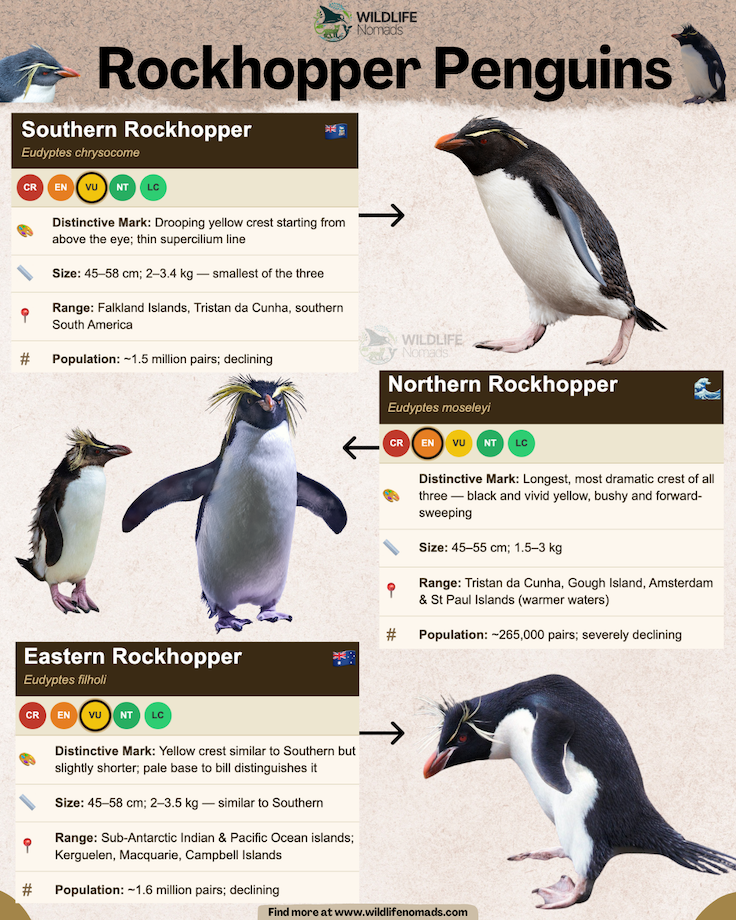
For a long time, scientists classified rockhoppers as a single species. However, research published in 2006 identified significant morphological, vocal, and genetic differences between two main populations. Today, most taxonomists recognise two species:
• Northern Rockhopper Penguin (Eudyptes moseleyi)
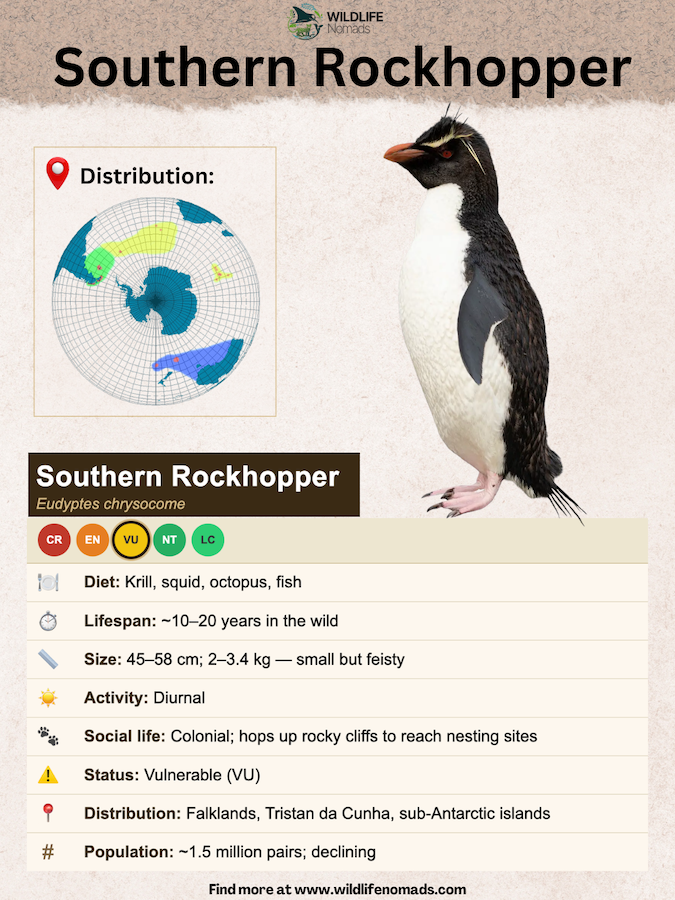
• Southern Rockhopper Penguin (Eudyptes chrysocome)
Some classifications also recognise an Eastern Rockhopper Penguin (Eudyptes filholi), though many authorities treat it as a subspecies of the southern form.
The northern rockhopper penguin is the rarest of the three. Around 90% of its global population breeds on Tristan da Cunha and Gough Island in the South Atlantic, with additional colonies on Amsterdam Island and St Paul Island in the southern Indian Ocean. Northern rockhoppers are also slightly larger, with longer and more flamboyant crests than their southern cousins.
4. They Have Intense “Red Eyes”
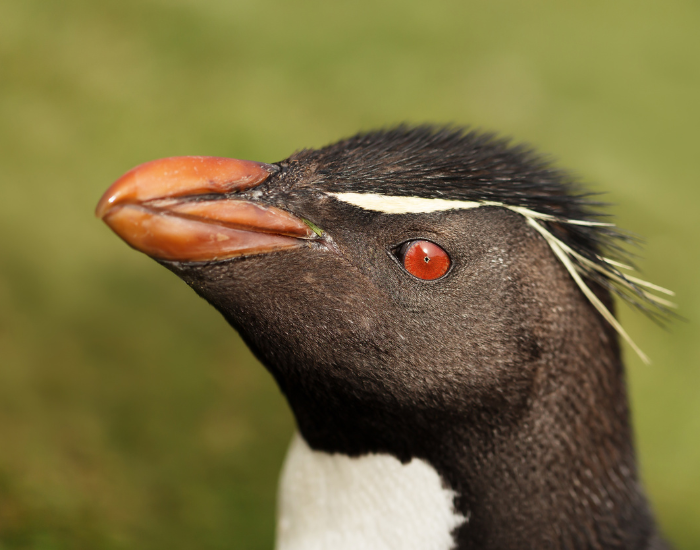
One of the first things you notice about a red eye penguin (as they are often searched for on Google) is their piercing, ruby-red irises. While it looks a bit intimidating, it’s a functional adaptation.
These eyes are designed for high-contrast vision underwater. When they are diving deep into the Southern Ocean, those red eyes help them pick out the shimmer of prey like krill and other crustaceans against the dark blue depths.
5. They Are Surprisingly Small
Despite their big personalities, the rockhopper penguin height is quite modest. They are among the smallest types of penguins in the world, standing only about 20 inches (50 cm) tall. Among crested penguins, such as macaroni and royal penguins, rockhoppers are generally smaller and have unique crest shapes and breeding timings.
When you compare them to their larger Antarctic neighbors, the difference is striking. A gentoo penguin, for instance, can reach nearly 30 inches (75 cm) in height, and even the chinstrap penguin, which shares some of the same rocky shoreline habitats—tends to be both taller and more robust than the rockhopper. This compact size, however, is a huge advantage. In the chaotic, surf-heavy environments they call home, being smaller and more agile allows them to navigate jagged rockfalls with ease and helps them outmaneuver a leopard seal in the water much more effectively than a bulkier bird could.
6. Home is a Rocky Fortress
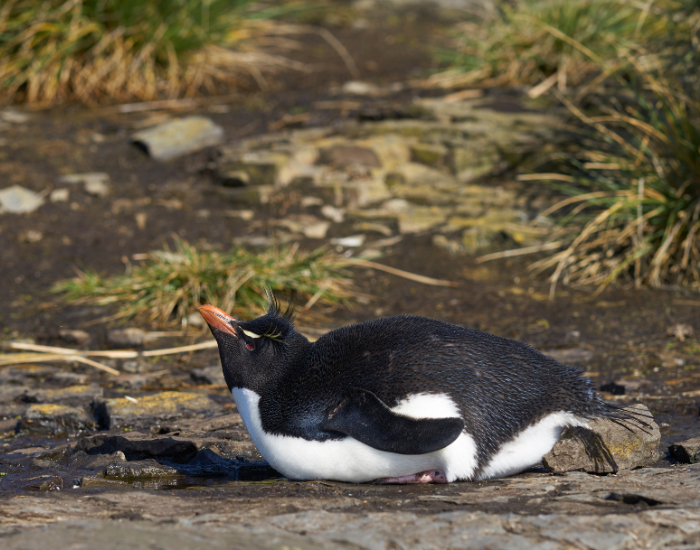
If you’re wondering where does rockhopper penguins live, look toward the sub-Antarctic islands. Their rockhopper penguin habitat consists of wind-swept, jagged islands like the Falkland Islands, Heard Island, Macquarie Island, and the Antipodes Islands.
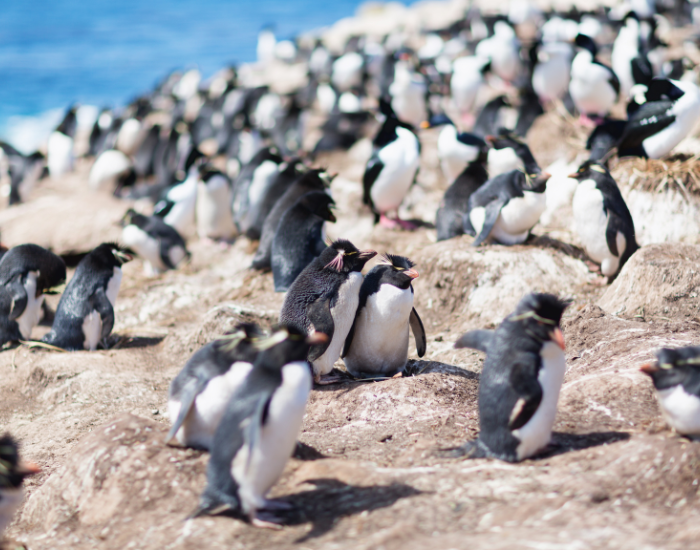
They prefer a rocky habitat covered in high grasses called tussocks. They use these grasses to hide their nests from the wind and aerial predators like skuas. Unlike the African penguin, which often burrows in guano, rockhoppers are all about the vertical climb.
7. The “Two Egg” Dilemma
Nature can be harsh, and the breeding season for rockhoppers is no exception. Rockhopper penguins usually breed in early spring or late summer in vast colonies. The start of the breeding season depends upon where southern rockhopper penguins live and can vary by as much as 6 weeks. A female will typically lay two eggs within 4 to 5 days of each other in November in a nest made of pebbles and grass. The eggs are incubated for 32 to 34 days.
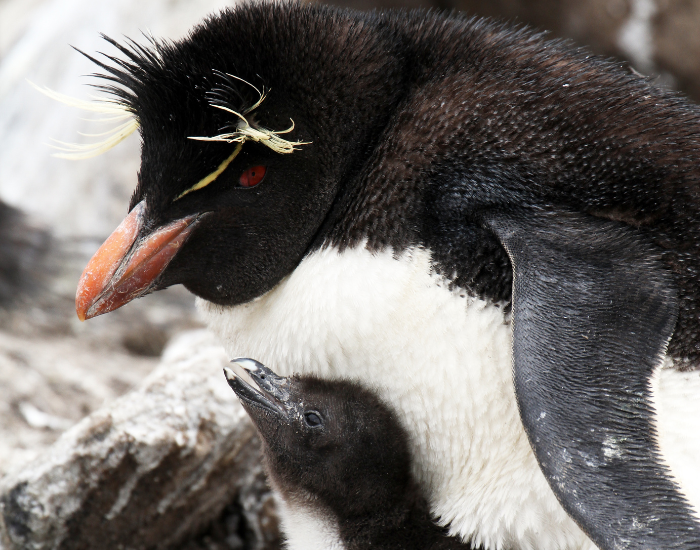
However, the first egg is almost always significantly smaller than the second. In most cases, the smaller egg doesn’t survive, or the parents prioritize the larger, stronger chicks. Once the chicks hatch, the male guards them for about 3 weeks while the female feeds the chicks. Chicks are usually ready to leave the colony in mid-February, depending on when the breeding season started. It’s a “biological insurance policy”, a strategy I’ve studied in various Antarctic seabirds where resources are limited and only the fittest can survive.
8. Their Diet is a Seafood Buffet
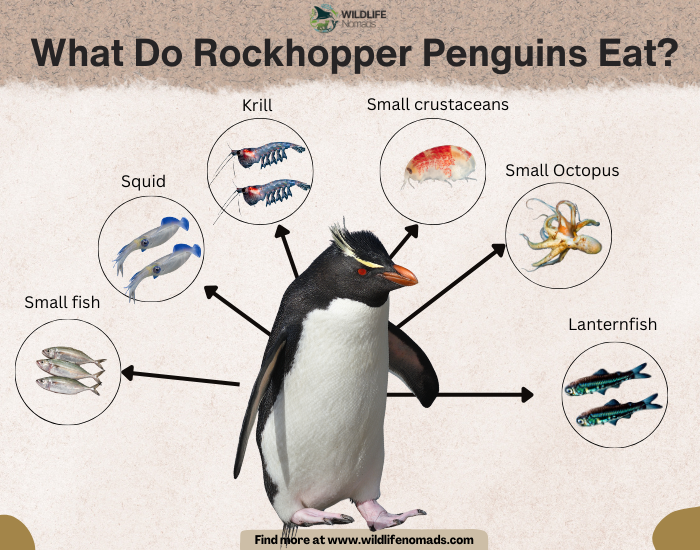
So, what’s on the menu? Rockhopper penguin food is primarily pelagic (open ocean). They are opportunistic feeders that eat squid, fish, and krill.
- Main Staples: Euphausiids (krill) and other crustaceans.
- Dive Depth: They are incredible divers, often reaching a dive depth of 100 meters (330 feet) to find a meal.
- Foraging: During the breeding season, parents will take turns traveling long distances into the Indian Oceans or the South Atlantic to bring back food for the adult penguins and their young.
9. They Are Extremely Loyal (To a Spot)
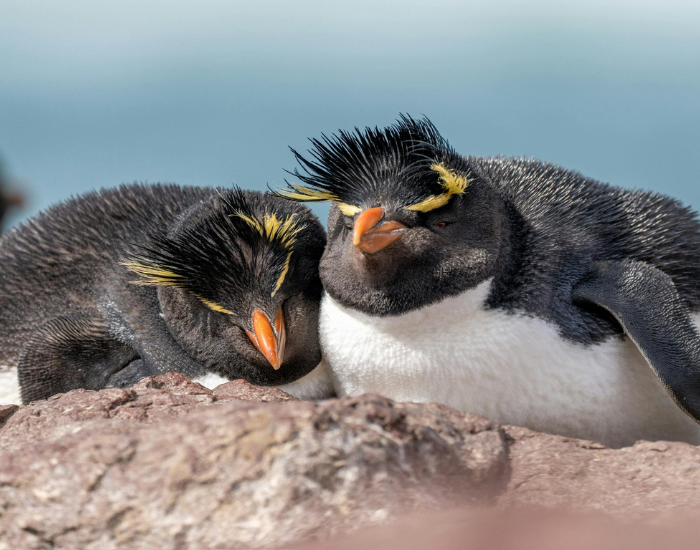
While they spend the winter months alone at sea, when the early spring arrives, they return to the exact same breeding colony. Most partners remain together for years, finding each other among thousands of other birds.
They also tend to use the same nest year after year. There is something deeply human about that, coming back to your “home base” after a long, hard journey. In my own life, whether I’m in Mexico or Australia, having that home base is what keeps you grounded.
10. They are Facing Modern Threats
Unfortunately, rockhopper penguin populations have significantly decreased over the past few decades. The IUCN lists the Northern species as Endangered and the Southern as Vulnerable.
The biggest threats include:
- Oil Pollution: Even small oil spills can destroy the waterproofing of their feathers, leading to hypothermia.
- Climate Change: Rising temperatures in the South Atlantic and Southern Indian Ocean affect the availability of prey.
- Overfishing: Humans competing for the same crustaceans and fish makes it harder for parents to feed their chicks.
- Introduced Predators and Disease: Invasive species and avian cholera outbreaks have caused catastrophic breeding failures, particularly on Amsterdam Island.
FAQ: Your Top Rockhopper Questions Answered
The Falkland Islands and Macquarie Island are world-class spots. However, because their location is so remote, most people see them via specialized expedition cruises.
In the wild, they live for about 10 to 15 years, though some have been known to reach 20 in protected environments.
They have a thick layer of fat and tightly packed feathers that they coat with oil from a special gland. This is why oil pollution is so deadly—it breaks down that vital waterproof barrier.
Yes! Both are part of the genus Eudyptes. You can tell the difference by the crest—Macaroni penguins have orange-yellow plumes that start between their eyes, while rockhoppers have distinct “eyebrows.”
At sea, they must watch out for leopard seals and killer whales. On land, their eggs and chicks are targeted by skuas and giant petrels.
Protecting the Rebels: The Future of the Rockhopper Penguin
The rockhopper penguin is a reminder that resilience comes in small packages. These birds survive in some of the most “unlivable” conditions on Earth, leaping up cliffs and diving into freezing, predator-filled waters just to keep their lineage going.
It’s our responsibility to ensure these rocky shorelines remain protected. Whether it’s supporting marine protected areas or reducing our plastic footprint to help the ocean pollution crisis, every action counts.
What’s your favorite type of penguin? Let us know in the comments, and don’t forget to check out our guide on how to save endangered animals to see how you can help!
Where to See Rockhopper Penguins in the Wild?
Here is a list of 6 wildlife safari tours where you can see Penguins, including Rockhopper penguins in the wild. As a biologist, I only recommend tours that follow strict ethical guidelines to ensure we don’t disturb wildlife. These are the three tours/ partners I trust most based on their conservation records:
This blog is reader-supported. When you buy experiences through links listed on this site, we may earn an affiliate commission.
References:
Jouventin, P., Cuthbert, R. J., & Ottvall, R. (2006). Genetic isolation and divergence in sexual traits: evidence for the northern rockhopper penguin Eudyptes moseleyi being a separate species. Molecular Ecology, 15(11), 3413–3423. https://doi.org/10.1111/j.1365-294X.2006.03028.x
Dehnhard, N., Poisbleau, M., Demongin, L., Ludynia, K., Lecoq, M., Masello, J. F., & Quillfeldt, P. (2013). Survival of rockhopper penguins in times of global climate change. Aquatic Conservation: Marine and Freshwater Ecosystems, 23(5), 777–789. https://doi.org/10.1002/aqc.2331
Raya Rey, A., Pütz, K., Luna-Jorquera, G., Lüthi, B., & Schiavini, A. (2009). Diving patterns of breeding female rockhopper penguins (Eudyptes chrysocome): Noir Island, Chile. Polar Biology, 32, 561–568. https://doi.org/10.1007/s00300-008-0550-9
Pütz, K., Raya Rey, A., Schiavini, A., Clausen, A. P., & Lüthi, B. H. (2006). Winter migration of rockhopper penguins (Eudyptes c. chrysocome) breeding in the Southwest Atlantic: Is utilisation of different foraging areas reflected in opposing population trends? Polar Biology, 29(9), 735–744. https://doi.org/10.1007/s00300-006-0118-5
Ludynia, K., Dehnhard, N., Poisbleau, M., Demongin, L., Masello, J. F., & Quillfeldt, P. (2012). Evaluating the impact of handling and logger attachment on foraging parameters and physiology in southern rockhopper penguins. PLOS ONE, 7(11), e50429. https://doi.org/10.1371/journal.pone.0050429
Dodino, S., Borboroglu, P. G., Rodríguez-Malagón, M. A., Raya Rey, A., & Sutton, L. J. (2023). Phenology and reproductive biology of the southern rockhopper penguin (Eudyptes chrysocome chrysocome) at Isla Pingüino (Santa Cruz Province, Argentina). Polar Biology, 46, 797–810. https://doi.org/10.1007/s00300-023-03163-3
Ritchie-Parker, H., Ball, A., Glass, T., Costanzi, J.-M., Boulinier, T., Gamble, A., Ghazali, M., Keegan, K., Barbraud, C., Bost, C., Bost, C., Cleeland, J., Clessin, A., Connan, M., Delord, K., Dilley, B., Glass, T., Jones, C. W., Moore, P., … Steinfurth, A. (2026). Uncovering genetic population structure in the Endangered northern rockhopper penguin (Eudyptes moseleyi) across islands in the Southern Atlantic and Indian oceans. BMC Genomics, 27(1), Article 134. https://doi.org/10.1186/s12864-025-09854-w