
A friend of mine is an ornithologist. He was the first person to pull me into the world of birds. Now, on the Australia lap, I scan the trees at every stop. Yet some birds have gone years without a single photo or recording. In 2025, five of these lost birds were rediscovered.
Each one turned up on an island in Southeast Asia or New Guinea. Most were found by birdwatchers and local guides, not big expeditions. Together, these lost birds rediscovered in 2025 show how much one good photo can change.
Below, I cover what makes a bird “lost” and the five species found again. Then I look at the 2026 additions and how your sightings could help.
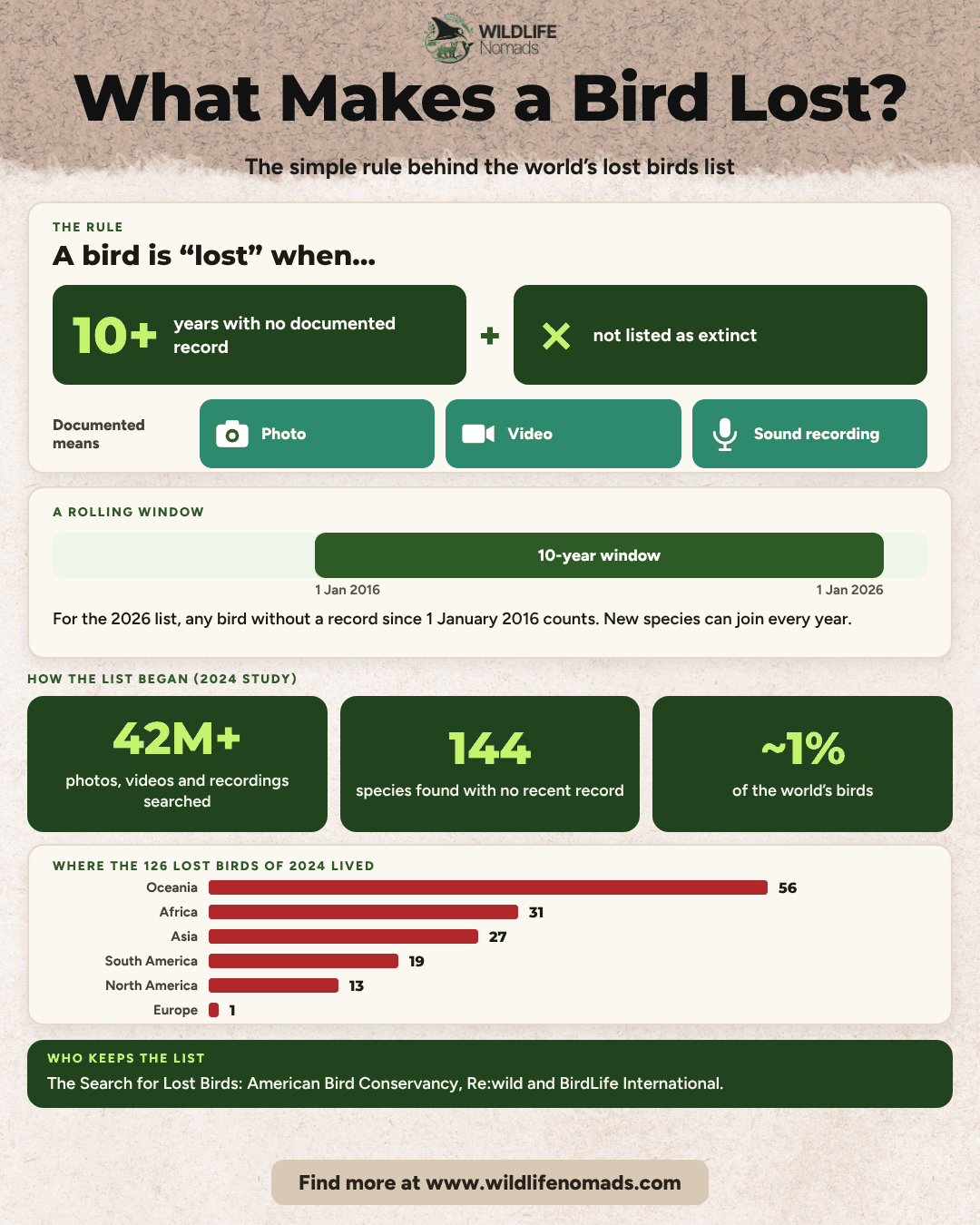
What makes a bird ‘lost’?
The Search for Lost Birds keeps the list. It is a partnership between American Bird Conservancy, Re:wild and BirdLife International. A bird counts as lost when it has no documented record for at least 10 years. It must also not be listed as extinct.
Documented means a photo, a video or a sound recording. For the 2026 list, any species without one since 1 January 2016 qualifies. Because the window rolls forward, new species can join the list every year.
The list grew out of a 2024 study in Frontiers in Ecology and the Environment. Its authors searched more than 42 million photos, videos and recordings from the Macaulay Library, iNaturalist and xeno-canto. They found 144 species, about 1% of the world’s birds, with no recent documentation.
The five lost birds rediscovered in 2025
Here are the five species that came back into view, in order of how long each had been missing.
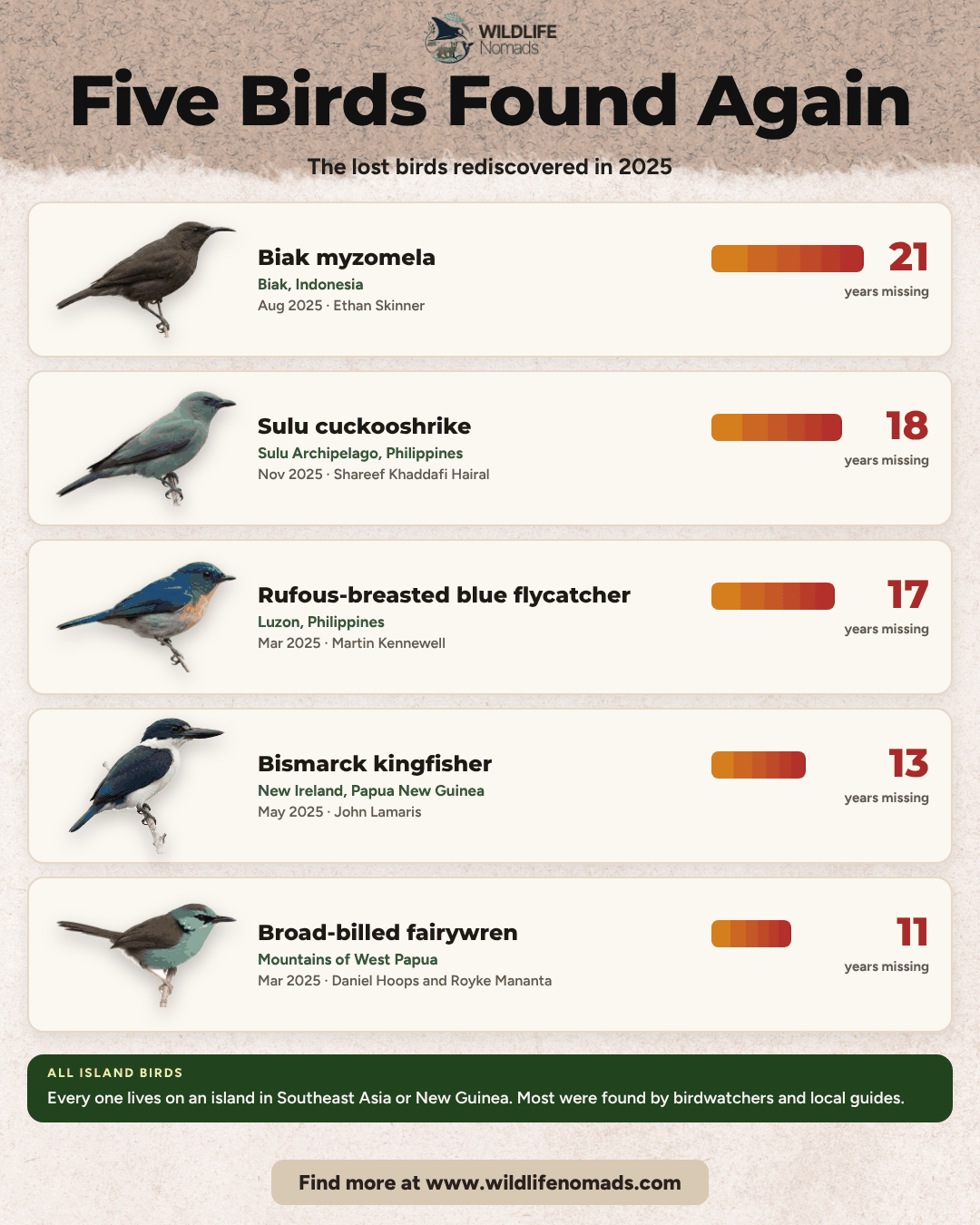
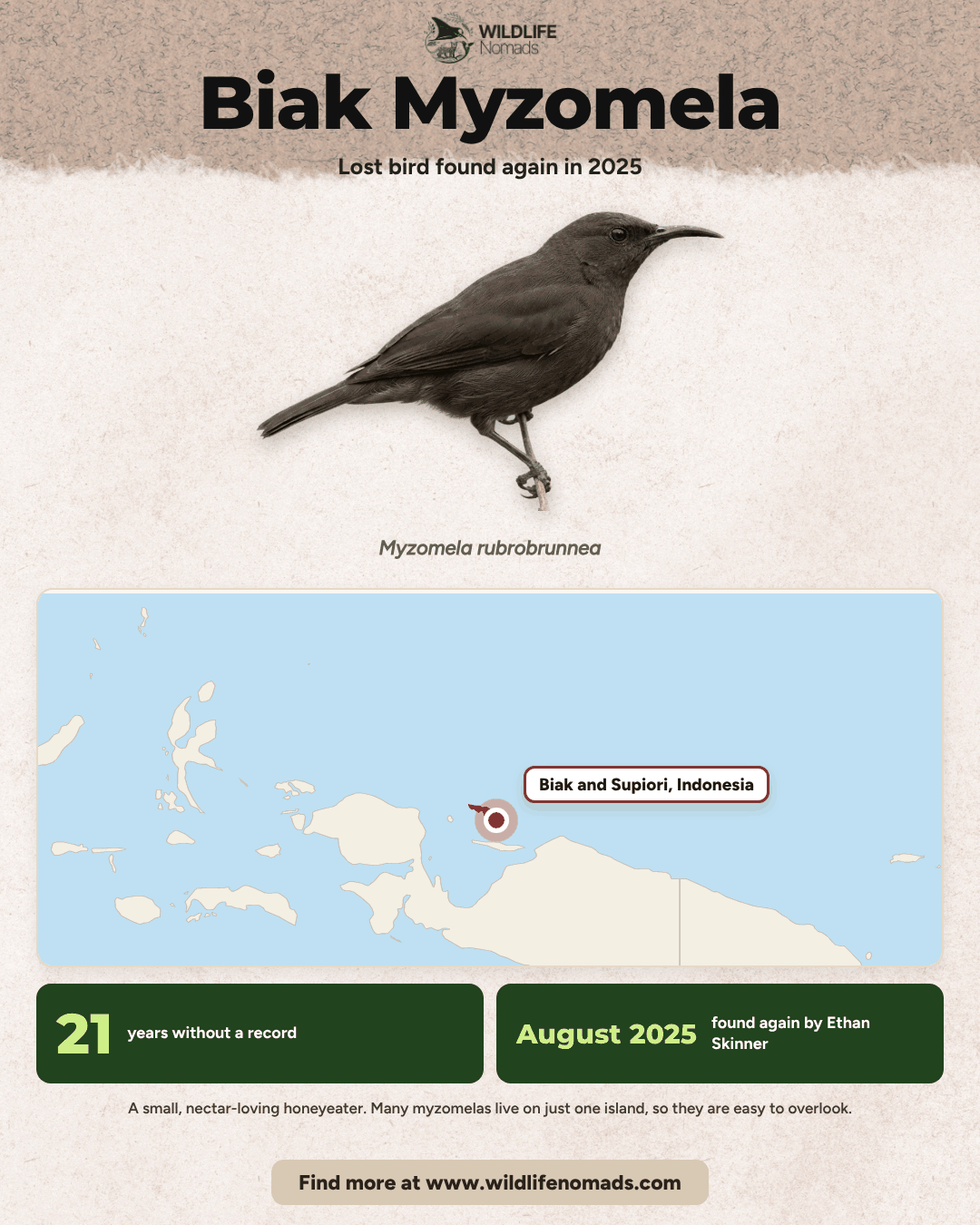
Biak myzomela: missing for 21 years
The Biak myzomela (Myzomela rubrobrunnea) is a small honeyeater from Biak and nearby Supiori, off Indonesian Papua. It had no documented record for 21 years. Then Ethan Skinner photographed one in August 2025.
Myzomelas are small, nectar-loving honeyeaters. Many species are restricted to single islands, which makes them easy to overlook and quick to lose.
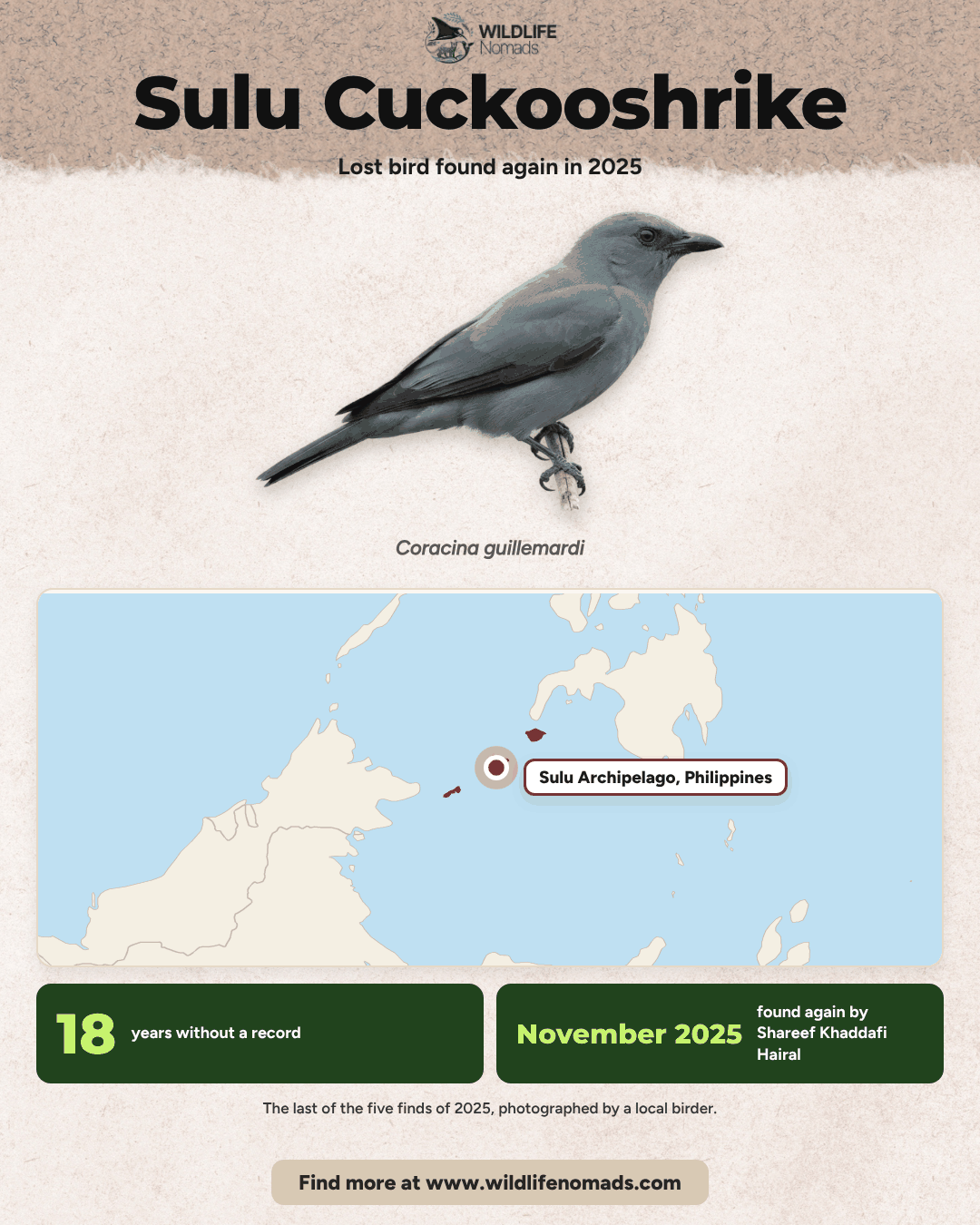
Sulu cuckooshrike: missing for 18 years
The Sulu cuckooshrike (Coracina guillemardi) lives in the Sulu Archipelago of the southern Philippines. Nobody had documented it for 18 years. In November 2025, Shareef Khaddafi Hairal took the first image in nearly two decades.
It was the last of the five finds of the year. It also showed how much local birders can add in regions that visiting scientists rarely reach.
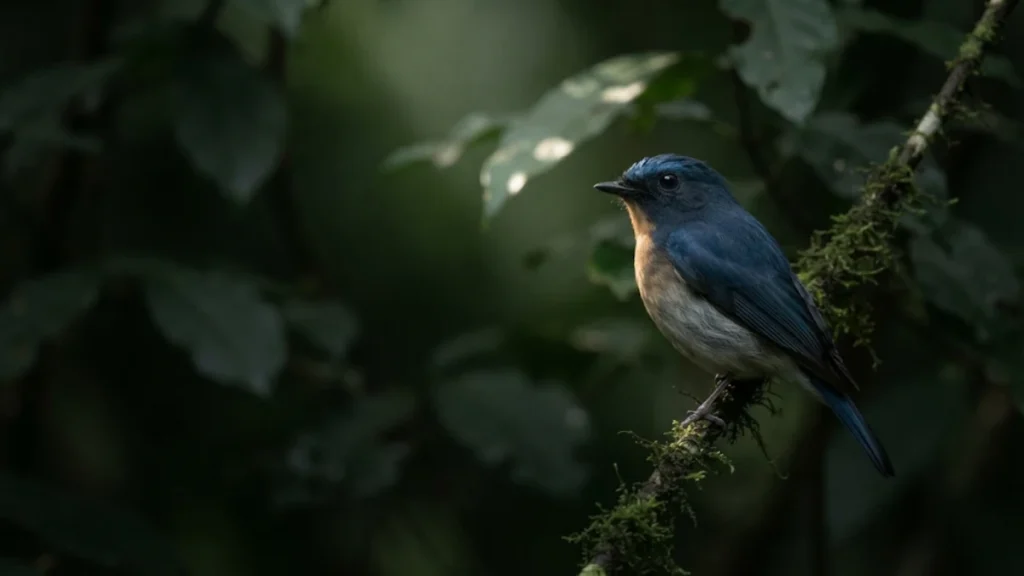
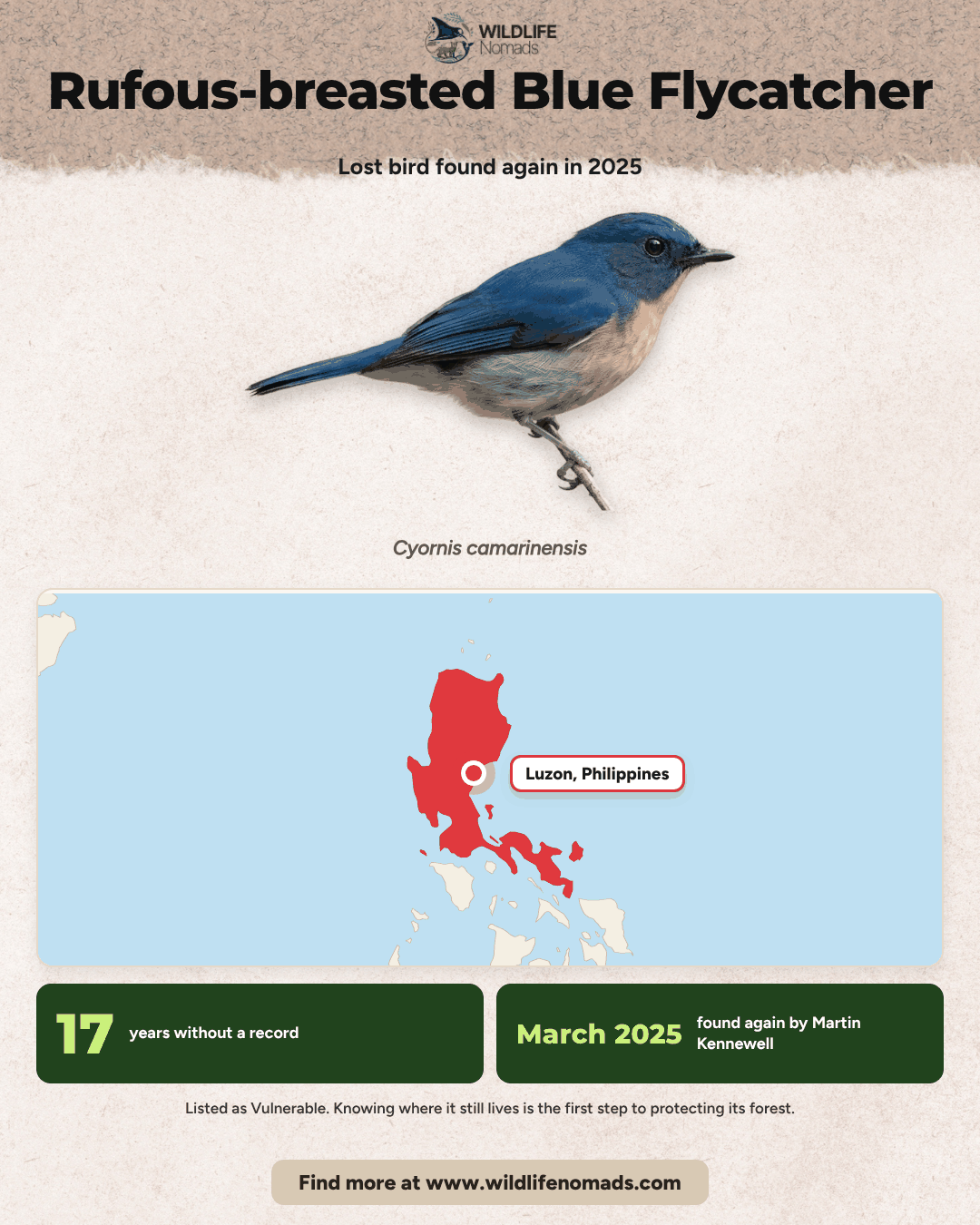
Rufous-breasted blue flycatcher: missing for 17 years
The rufous-breasted blue flycatcher (Cyornis camarinensis) lives in the tropical lowlands of Luzon, in the Philippines. Its last record dated to 2008. In March 2025, birding guide Martin Kennewell photographed it.
The species is listed as Vulnerable. For a threatened bird, confirming exactly where it still lives is the first step towards protecting that forest.
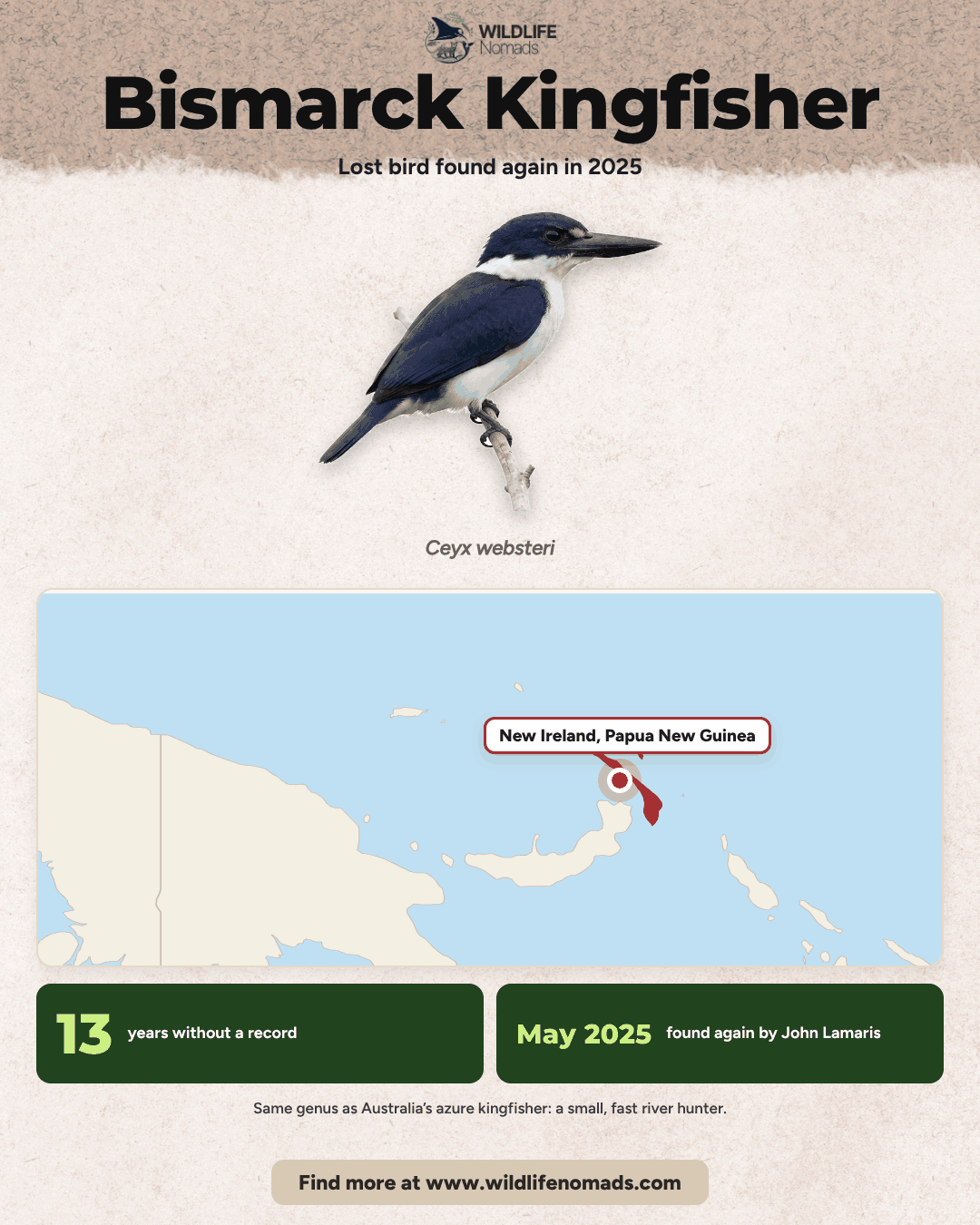
Bismarck kingfisher: missing for 13 years
The Bismarck kingfisher (Ceyx websteri) lives in the Bismarck Archipelago, off the northeast coast of Papua New Guinea. Papua New Guinean ornithologist John Lamaris photographed it on New Ireland in May 2025. It had been missing for 13 years.
It shares a genus with the azure kingfisher, one of the kingfishers of Australia I see on the lap. That family link helped me picture it: a small, fast river hunter.
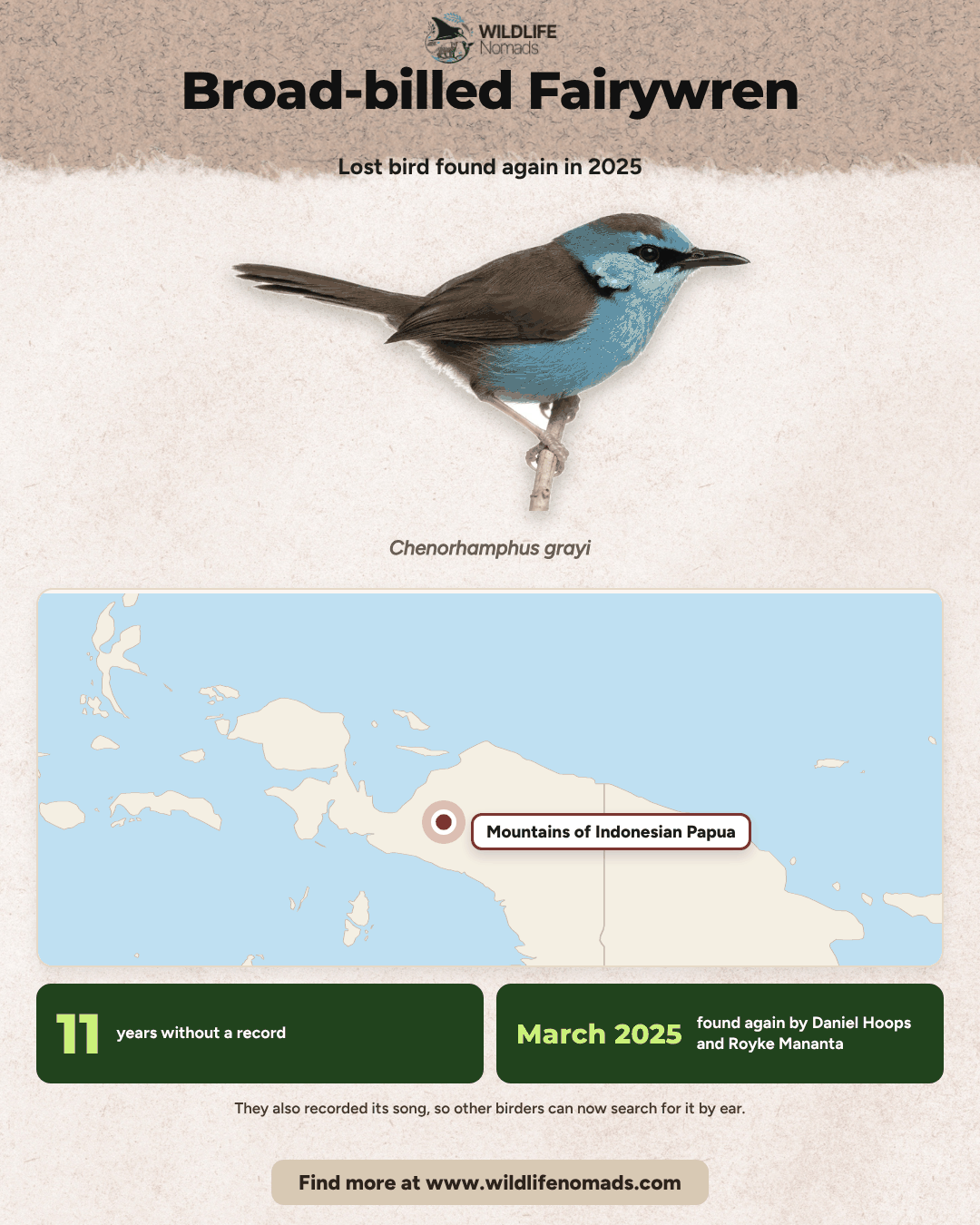
Broad-billed fairywren: missing for 11 years
The broad-billed fairywren (Chenorhamphus grayi) lives in the mountains of Indonesian Papua. It had been missing for 11 years. In March 2025, Daniel Hoops and his guide, Royke Mananta, photographed it and recorded its song.
That recording matters. A song lets other birders search by ear, which is often easier than spotting a small bird in dense forest. It belongs to the same family as the splendid fairy-wren of Australia.
Why some birds left the list for other reasons
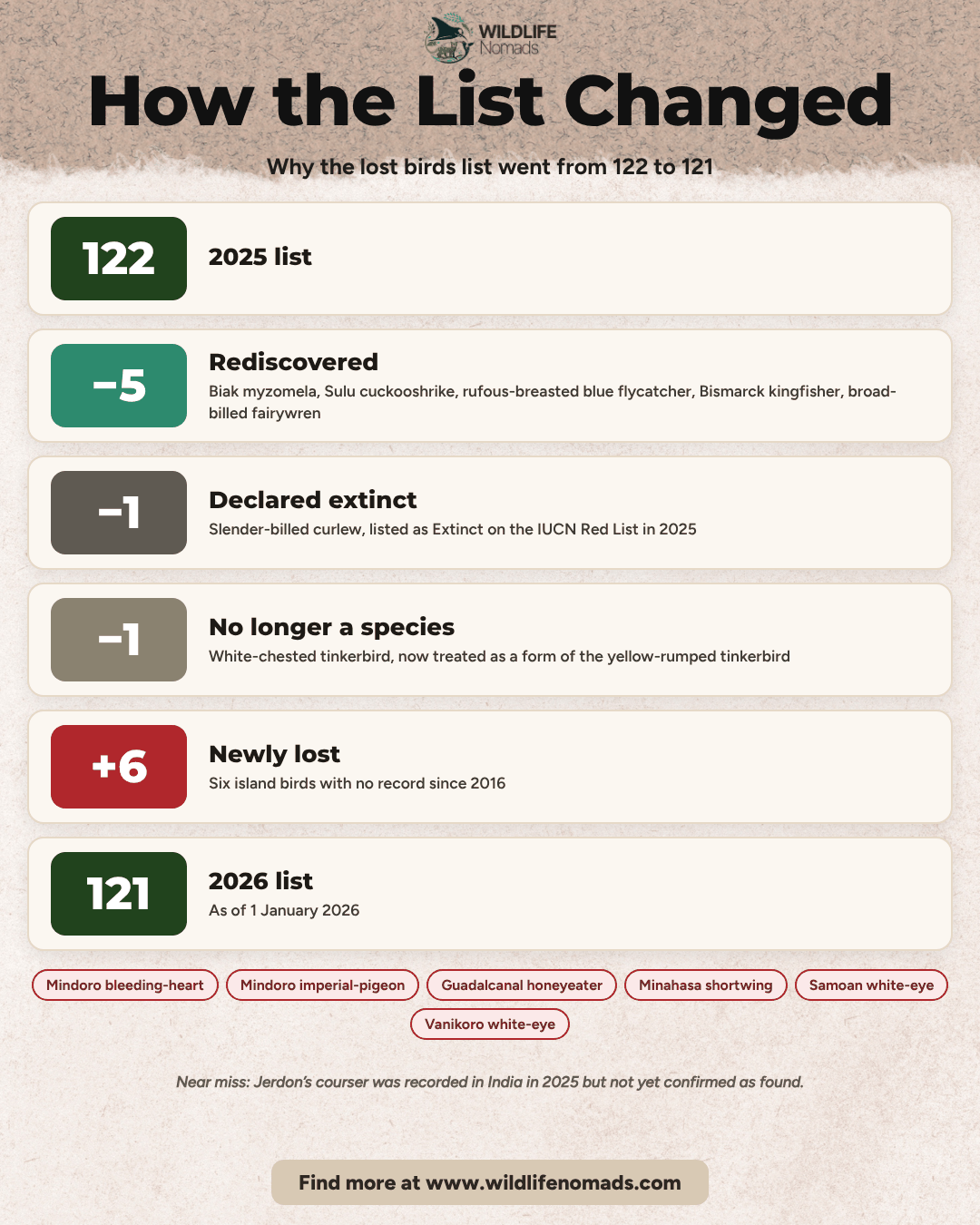
Rediscoveries were not the only changes. In total, seven birds moved off the list in 2025.
The slender-billed curlew was declared Extinct on the IUCN Red List in 2025, after a 2024 study. Meanwhile, the white-chested tinkerbird, known from a single 1964 specimen from Zambia, lost its species status. Molecular work now treats it as a form of the yellow-rumped tinkerbird.
There was also a near miss. In August 2025, Harish Thangaraj made a sound recording of Jerdon’s courser in India. As of the 2026 update, however, the species had not yet been officially declared found.
Six new lost birds for 2026
While five birds came back, six others crossed the 10-year line. Every one of them is an island species:
- Mindoro bleeding-heart, Mindoro, Philippines. Last definitive record: 2005 photos of a trapped bird.
- Mindoro imperial-pigeon, montane forest on Mindoro, Philippines. Last records: 2015 photos.
- Guadalcanal honeyeater, highlands of Guadalcanal, Solomon Islands. Last record: a 2015 sound recording.
- Minahasa shortwing, Sulawesi, Indonesia. Last record: a 2015 recording. It has never been photographed.
- Samoan white-eye, highlands of Savai’i, Samoa. Last records: 2015 recordings.
- Vanikoro white-eye, Vanikoro Island, Solomon Islands. Last record: a 2015 recording.
After seven removals and six additions, the Search for Lost Birds counted 121 lost birds as of 1 January 2026. That is down from 122 a year earlier. The list keeps moving as new records come in.
Why these finds matter
You can’t protect a bird if nobody knows it still exists. A single photo puts a species back on the map. Scientists can then look for more birds, map the habitat and check what threatens them.
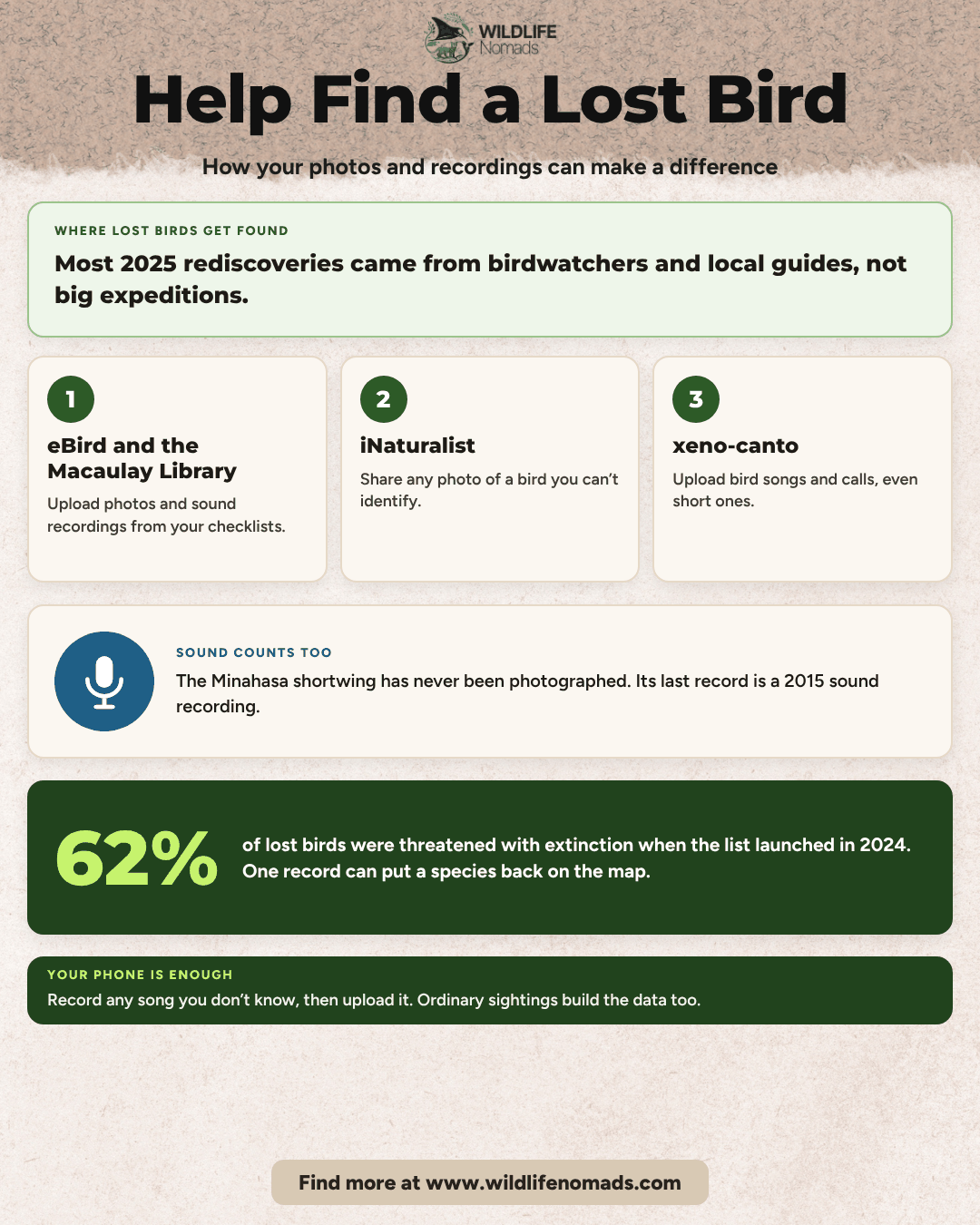
The stakes are high. When the list launched, BirdLife reported that 62% of lost birds are threatened with extinction. Many of them also appear among the endangered birds conservationists worry about most.
John Mittermeier, who directs the project, calls the list an early warning system. A confirmed extinction is tragic, yet it still helps. It stops people spending scarce money searching for a bird that is gone.
Islands that still hide birds
All five birds live on islands in Southeast Asia and New Guinea. I know how easy it is to misread birds there. In April 2024, my first hornbill sat on a beach sign beside me in Langkawi, Malaysia: an Oriental pied hornbill.
A year later, I drove north across Palawan in a rental car. On the way, I saw what I took to be the same species. Later, I learned that Oriental pied hornbills don’t reach the Philippines. I had actually seen a Palawan hornbill, a Vulnerable endemic. I tell that story in my types of hornbills guide.
That mix-up taught me something. Islands evolve their own versions of familiar birds, and many get little attention. Indonesia and the Philippines rank among the best bird watching destinations for exactly this reason.
How you can help find lost birds
Most of these finds came from birdwatchers and local guides, not big expeditions. If you photograph or record a bird, upload it. The Search for Lost Birds built its list from the Macaulay Library (which includes eBird), iNaturalist and xeno-canto.
Sound counts as much as photos. For example, the Minahasa shortwing is known only from recordings. A phone can capture a song clearly enough to confirm a species.
New to birding? Start with our birding for beginners guide. Then browse the jungle birds of tropical forests to see what island species can look like.
FAQs About Lost Birds
Five species were rediscovered in 2025: the Biak myzomela, Sulu cuckooshrike, rufous-breasted blue flycatcher, Bismarck kingfisher and broad-billed fairywren. All live on islands in Southeast Asia and New Guinea.
A bird is lost when it has no documented photo, video or sound recording for at least 10 years and is not listed as extinct. For the 2026 list, that means no record since 1 January 2016.
The Search for Lost Birds counted 121 lost birds as of 1 January 2026. Seven species left the list in 2025 and six new island species joined it.
The Biak myzomela had been missing the longest, at 21 years. Ethan Skinner photographed it on Biak in August 2025.
The Search for Lost Birds is a partnership between American Bird Conservancy, Re:wild and BirdLife International. It updates the lost birds list every year.
Upload your photos and sound recordings to eBird and the Macaulay Library, iNaturalist or xeno-canto. The lost birds list is built from these platforms, so every record helps.
Look Up, Then Hit Record
The lost birds rediscovered in 2025 were not found by luck alone. They were found by people who looked closely, took a photo and shared it. That simple habit now shapes where conservation money goes.
So next time you hear an unfamiliar song, record it. Upload your sightings, even the ordinary ones. Then tell me in the comments which lost bird you would most love to find.
12 questions, all drawn from the article above. Ready?
Your score
References:
Mittermeier, J. C., Berryman, A. J., & Hanks, C. (2026, March 6). Updating the lost birds list to 2026. Search for Lost Birds. https://searchforlostbirds.org/news/updating-the-lost-birds-list-to-2026
Rutt, C. L., Miller, E. T., Berryman, A. J., Safford, R. J., Biggs, C., & Mittermeier, J. C. (2024). Global gaps in citizen-science data reveal the world's "lost" birds. Frontiers in Ecology and the Environment. https://doi.org/10.1002/fee.2778
Raman, S. (2026, April 4). Once lost, now found: Five missing bird species rediscovered in 2025, offering hope. Mongabay.
BirdLife International. (2024, June 17). New analysis reveals 126 birds are lost to science, without a confirmed sighting in at least a decade.