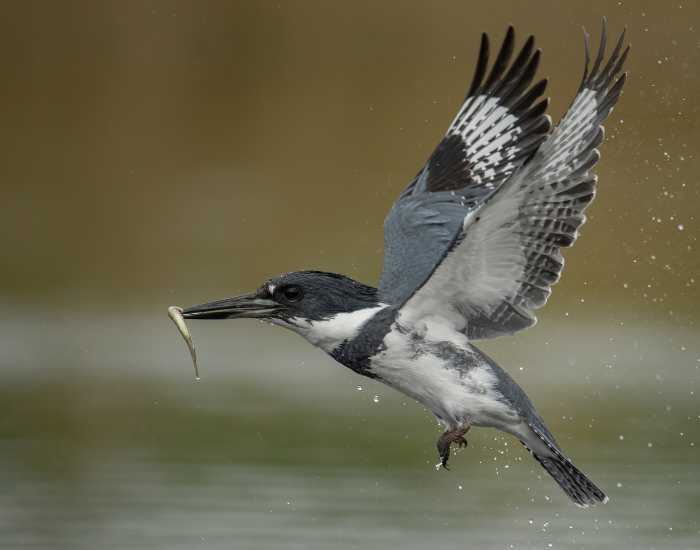
Kingfishers are found on every continent except Antarctica, these birds are instantly recognizable by their large heads, long, straight bills, and strikingly bright plumage. In North America, the belted kingfisher stands as the most familiar member, commonly spotted along rivers, lakes, and coastal shorelines.
These birds are deeply connected to freshwater habitats, where clear water and plentiful prey define their territories. Their presence is often a sign of a healthy ecosystem, clean rivers and lakes that support thriving aquatic life. Beyond their ecological importance, kingfishers have long inspired art, folklore, and conservation awareness for their beauty and independence.
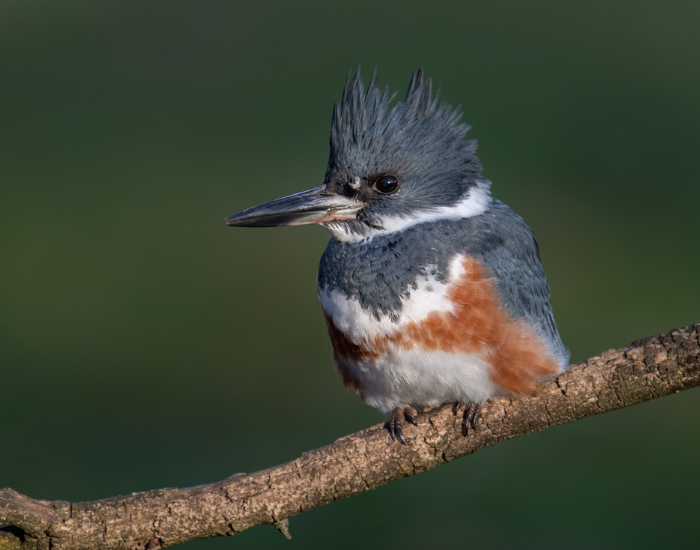
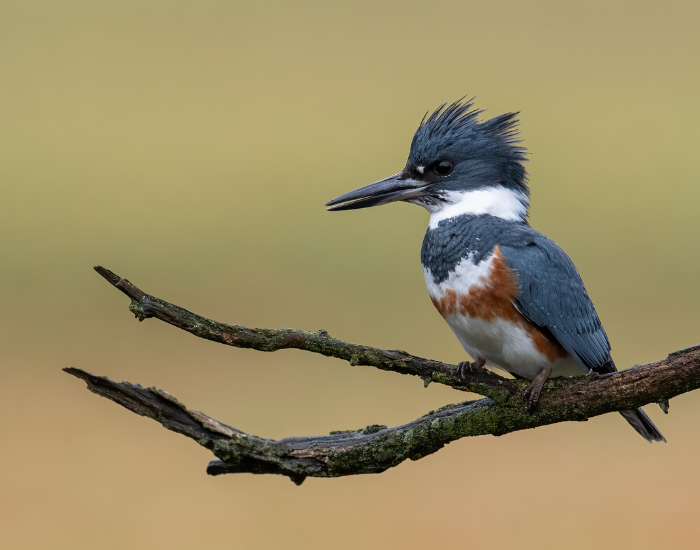
Male and female belted kingfishers are easy to distinguish, with males sporting a single blue band across the chest and females displaying an additional rust-colored belly band. This reversal of typical bird coloration makes observing both sexes especially intriguing.
Their rattling call is another signature trait, often echoing across a lake or river long before the bird comes into view. For many birdwatchers, that sound alone signals one of nature’s wild beauty.
Scientific Classification
The belted kingfisher, known scientifically as Megaceryle alcyon, belongs to the family Alcedinidae, a group that includes more than 90 kingfisher species worldwide. This family is part of the order Coraciiformes, which also encompasses bee-eaters and rollers. Among its relatives, the belted kingfisher shares the spotlight with the ringed kingfisher, another impressive fisher found in parts of the Americas.
The scientific name Megaceryle alcyon reflects distinctive features and ancient lineage. “Megaceryle” combines Greek words for “large” and “kingfisher,” while “alcyon” is a classical term for kingfisher. This nomenclature highlights the bird’s robust build, long bill, and commanding presence along waterways.
Here are 12 facts about the belted Kingfisher that you will love:
1. An Unmistakable Silhouette
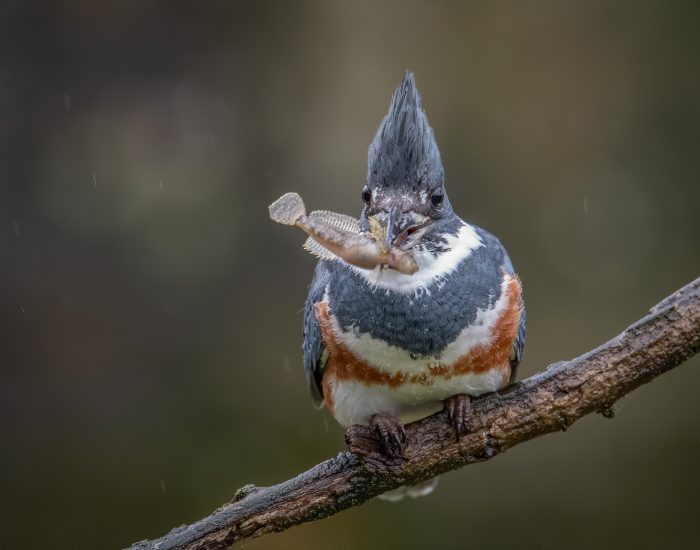
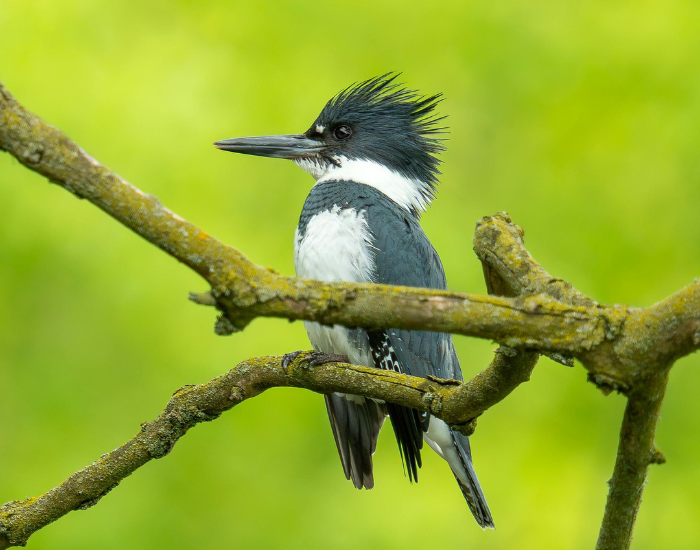
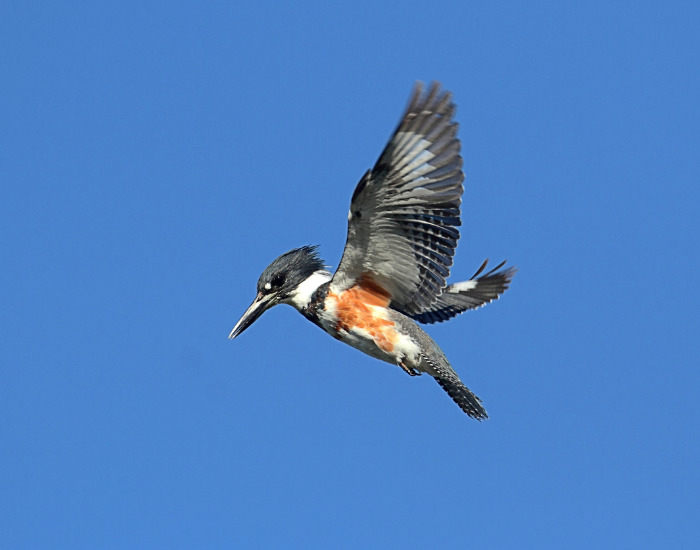
At 11 to 14 inches in length, with a stocky build and large head, the belted kingfisher cuts an unmistakable profile. Male belted kingfisher individuals show a single slate-blue chest band, while female belted kingfisher birds, unusually among birds, are more colorful, with a rusty-orange belly band and flanks. This reversal makes females stand out.
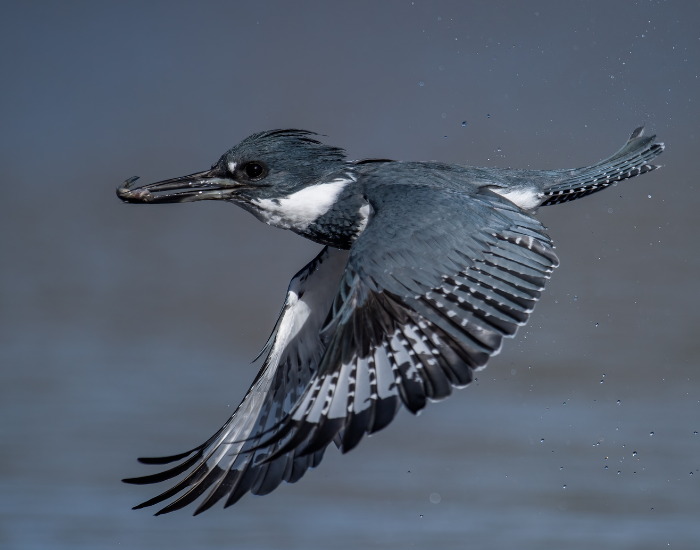
The dagger-like bill, perfect for snatching fish, and the ragged crest that gives a perpetually alert look, complete its striking appearance. In flight, quick wingbeats and white wing patches make identification even easier.
2. Habitat Across North America
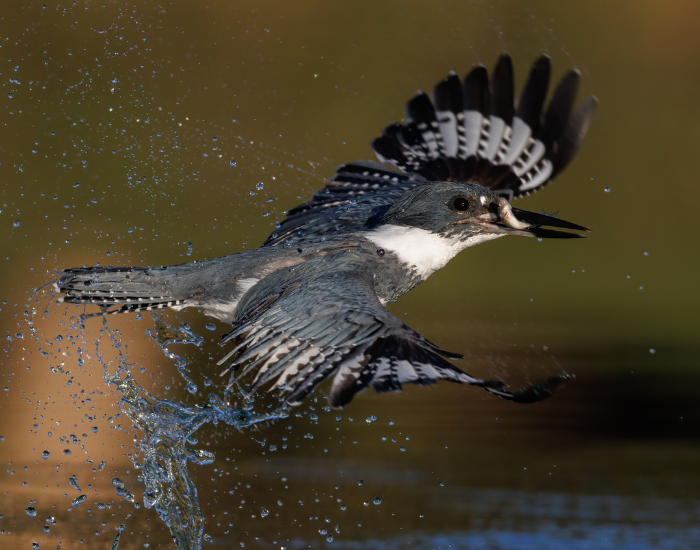
The belted kingfisher thrives along waterways from Alaska and Canada down to Mexico. You can find them perched over rivers, lakes, ponds, marshes, and estuaries. They’re especially common in Alaska and northern Canada. Their presence is strongly tied to clear water, since they hunt by sight, and they avoid heavily silted or polluted areas.
Beaver ponds, reservoirs, and tidal creeks also attract them, showing adaptability as long as prey is abundant. During winter, many migrate south into Central America and even northern South America, but others remain near ice-free waters in the U.S.
3. Seasonal Movement Patterns
Migration patterns for belted kingfishers are not uniform. Northern populations, especially in Canada, often travel south when waters freeze, while birds in warmer climates stay put year-round. This flexibility allows them to exploit diverse habitats. Range maps show their breeding grounds stretch across much of Canada and the northern U.S., while wintering grounds extend through Mexico, Central America, and parts of Colombia and Venezuela.
4. They Have Extraordinary Nesting Behavior
Unlike most birds that build nests of sticks or grasses, belted kingfishers dig burrows into sandy or loamy banks, with banks containing high sand content preferred for easier excavation. In addition to natural banks, gravel pits created by human activity can provide suitable nesting sites.
These tunnels, often three to seven feet long, slope upward to prevent flooding. At the end lies a chamber where the female lays her eggs directly on bare soil. Over time, discarded fish scales and bones from regurgitated pellets accumulate, creating a natural lining.
Clutches usually contain five to eight eggs, incubated for three weeks by both parents. Chicks remain underground for almost a month, emerging as capable young hunters. In some cases, older siblings even help feed the youngest, a rare example of cooperative breeding.
5. They are Masters of the Plunge Dive!
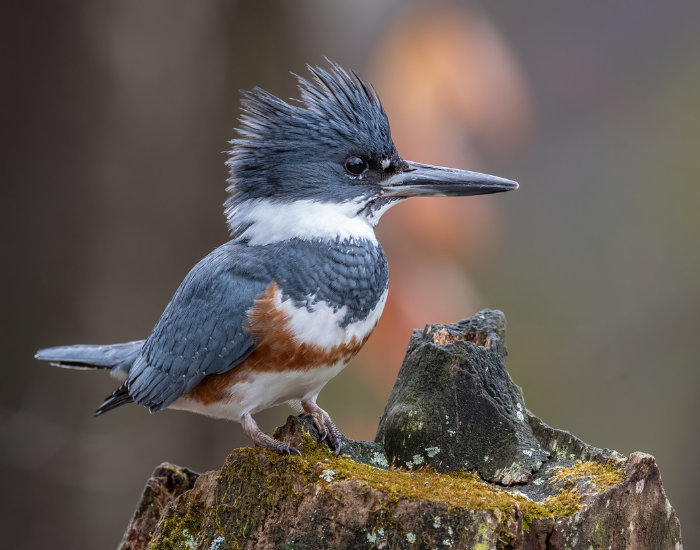
The belted kingfisher’s hunting style is as dramatic as it is effective. From roosting perches such as a branch, dock piling, or telephone wire, perching allows the bird to watch intently for movement in the water below. Once prey is spotted, it launches into a headfirst dive, wings tucked, striking the surface with precision. Protective membranes cover its eyes at the moment of impact.
If successful, it carries the catch back to a perch, often beating larger fish against the branch to subdue them before swallowing headfirst. When perches are scarce, kingfishers switch to hovering, burning extra energy but retaining their sharp edge as fishers.
6. A Broader Diet Than Expected
While small fish make up the majority of the belted kingfisher diet, these birds are opportunistic hunters. They also consume crayfish, frogs, aquatic insects, and even small mammals or reptiles near shorelines. In coastal habitats, they readily catch shrimp and crabs.
During winter, when aquatic prey is scarce, they may even eat berries, demonstrating adaptability. Nestling belted kingfishers have highly acidic stomachs, which help them digest bones, fish scales, and arthropod shells during early development. Like owls, they regurgitate pellets made of indigestible parts, a useful way for scientists to study their local diets.
7. The Piercing Rattle Call
One of the easiest ways to detect a belted kingfisher is by sound, as this bird is often heard before it’s seen. Their call is a loud, rattling chatter that carries far across water. This piercing rattle functions as a territorial warning, a pair-bonding call, and an alarm.
During breeding season, pairs sometimes overlap their calls in duet-like exchanges, reinforcing their partnership. Even young birds begin practicing rattles while still in the nest chamber, though their calls sound higher-pitched and less harsh than adults.
8. Fierce Territorial Defenders
Belted kingfishers defend their fishing stretches aggressively. A single bird may guard a half-mile or more of shoreline, depending on prey abundance. Encounters with rivals can escalate into mid-air chases and even physical grappling.
Their territorial nature extends beyond the breeding season, ensuring consistent access to food-rich waters. Watching one patrol its range, with rattling calls and sudden dives, is one of the great joys of observing this hunter.
9. There are Emerging Conservation Challenges
Although currently listed as Least Concern, belted kingfishers face growing challenges. Development along rivers eliminates suitable nesting banks. Human activity, such as construction and recreational use near waterways, can disturb nesting sites and negatively impact populations by causing habitat loss and increased disturbances.
Stream channelization and erosion control reduce natural earthen cliffs needed for burrows. Pollution and pesticide runoff harm aquatic prey, while mercury contamination in fish can impair reproduction. Climate change brings new threats, including flooding of burrows and shifts in fish populations.
Protecting riparian buffers, improving water quality, and minimizing disturbance during the breeding season are all key strategies for ensuring stable populations.
10. They are Always a Reliable Sight for Birdwatchers
While not rare, spotting a belted kingfisher takes patience. The best places are clear rivers, beaver ponds, marsh edges, and estuaries. Listen first, often you’ll hear the rattling call before you see the bird darting low over water. Early morning and late afternoon are prime times, when feeding is most active.
Where to Spot Belted Kingfishers
Finding belted kingfishers requires knowing where to look. These birds favor specific habitat features that improve hunting success. Targeting the right locations dramatically increases your chances.
Start by visiting streams and rivers with clear water. Look for areas where overhanging trees provide natural perches. Kingfishers often hunt from the same spots repeatedly, so finding a favored perch may yield multiple sightings.
Beaver ponds attract kingfishers year-round. These wetlands provide abundant small fish in relatively shallow water. Additionally, standing dead trees create perfect hunting perches. The open water allows kingfishers to spot prey easily.
Coastal estuaries and tidal creeks support winter populations. During migration and winter months, northern kingfishers concentrate along southern coastlines. Salt marshes and protected bays offer productive hunting grounds. Scan pilings, docks, and exposed snags for perched birds.
Lakes and reservoirs with wooded shorelines provide excellent habitat. Focus your search on coves and inlets rather than open water. Kingfishers prefer edges where they can perch close to fishing spots. Early morning and late afternoon offer the best viewing opportunities.
Listen for the distinctive rattling call. Often, you’ll hear a kingfisher before seeing it. The call carries considerable distances across water. When you hear the rattle, scan the area methodically. The bird may be flying past or perched nearby.
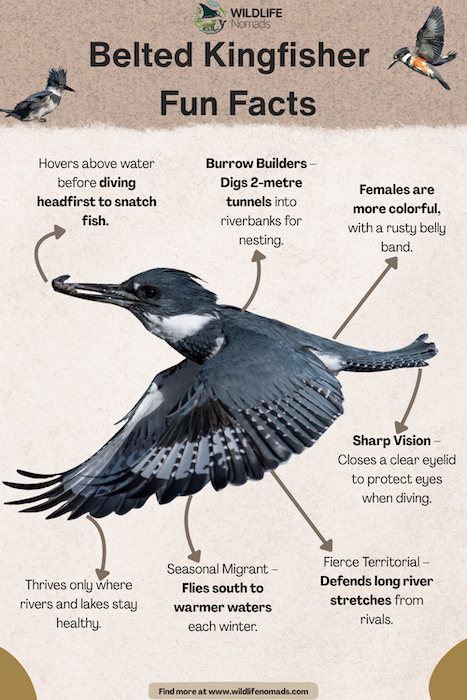
FAQ About Belted Kingfishers
Male belted kingfishers display blue-gray plumage with a single chest band. In contrast, females feature an additional rusty band across the lower breast and belly. Female belted kingfisher birds also show chestnut flanks. The more colorful bird is female—an unusual pattern among North America’s birds.
While small fish dominate their diet, kingfishers consume diverse aquatic prey. They regularly catch crayfish, aquatic insects, and tadpoles. Additionally, they hunt frogs, small salamanders, and young snakes near water. Occasionally, they even catch small mammals like mice and voles.
Belted kingfishers excavate burrow nests for protection from predators. Earthen banks provide the right consistency for digging while remaining stable. The burrow’s depth protects eggs and young from terrestrial predators. Additionally, the dark interior helps regulate temperature and humidity.
Early morning and late afternoon provide optimal viewing opportunities. During these times, fish are most active near the surface. Consequently, kingfishers hunt more frequently. The breeding season from April through July offers increased activity as parents feed nestlings.
Migration patterns vary by latitude. Northern populations migrate southward in fall, traveling to southern United States, Mexico, and Central America. However, some individuals remain year-round wherever open water persists. Southern populations typically remain resident throughout the year.
As nestlings mature, their stomach chemistry changes and they begin regurgitating pellets containing indigestible remains of their prey, similar to adults. This developmental milestone helps them manage the bones and scales they cannot digest.
What’s New in Belted Kingfisher Science?
Recent research is revealing fascinating insights into how Belted Kingfishers adapt to changing environments and human activity. A study examined their feeding behavior in coastal habitats, showing that kingfishers are increasingly using marine shorelines after fledging. The findings suggest these birds can flexibly adjust to shifting prey availability — diving in tidal waters and timing their hunts with changing tides to maximize success.
Meanwhile, another long-term study explored how territory size and behavior vary along river systems. Researchers found that in areas with reduced fish abundance or altered riverbanks, kingfishers expand their territories and spend more time defending them, indicating a sensitive balance between food resources and breeding success. Together, these studies underscore the Belted Kingfisher’s resilience and adaptability, while also highlighting the subtle ways waterway degradation and habitat change may challenge this iconic river sentinel in the future.
Appreciating North America’s Aquatic Hunter
The belted kingfisher exemplifies successful adaptation to aquatic environments. From its powerful hunting techniques to specialized nesting behavior, every aspect reflects millions of years of evolution. These birds enrich our waterways with their presence and distinctive calls.
Whether you encounter a kingfisher rattling across a northern stream or diving into a southern estuary, take time to appreciate this remarkable hunter. Understanding their habits, habitat needs, and challenges deepens our connection to the natural world. Moreover, supporting conservation efforts ensures future generations can enjoy these spectacular birds.
Next time you visit a lake, river, or coastal area, scan the shoreline carefully. That flash of blue-gray with the shaggy crest might be a belted kingfisher, ready to demonstrate its fishing prowess.
Further Reading
- Road Runner Birds: Amazing Facts
- 19 Birds of New York State
- 12 Amazing Jungle Birds
- 12 Amazing Birds from Texas