
Meet The Road Runner Birds
If you grew up watching the cartoon, you probably think you already know what road runner birds are like. Fast? Yes. Quirky? Absolutely. But the real animals are far more fascinating than their pop-culture caricature. Roadrunners belong to the cuckoo family, and while many of their relatives perch high in trees, these birds live mostly on the ground. They are extraordinary hunters, opportunistic feeders, and cultural icons in the desert southwest.
The greater roadrunner stands out as one of the desert’s most remarkable animals. With its long tail, shaggy crest, and lightning-fast stride, it moves across the sand with a precision and personality few creatures can match. Built for speed, survival, and adaptability, the roadrunner embodies everything extraordinary about life in the desert.
But what exactly is a roadrunner? Where do roadrunner birds live? And what does the roadrunner eat to survive in such dry, unforgiving environments?

The Two Species of Roadrunners
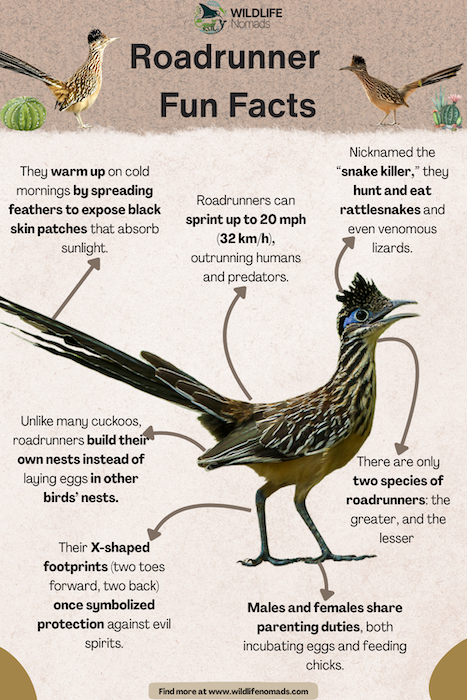
There are two species of roadrunners: the greater roadrunner (Geococcyx californianus) and the lesser roadrunner (Geococcyx velox).
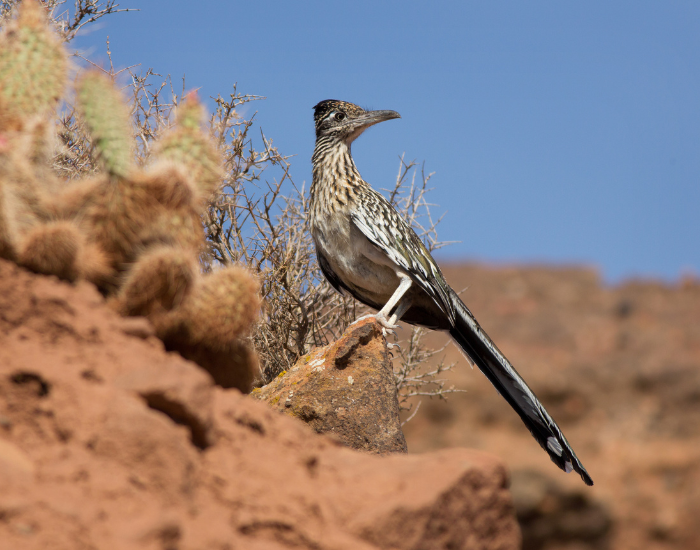
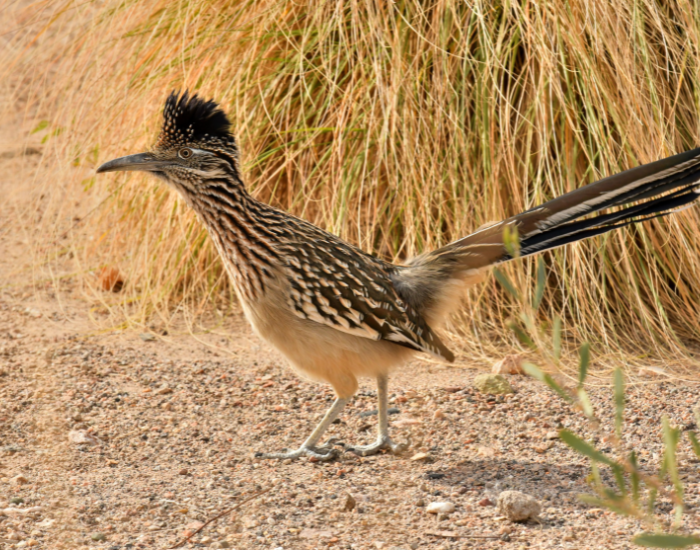
The greater roadrunner is the more famous of the pair, known across the United States as a desert icon. This species is found throughout California, Arizona, New Mexico, and West Texas, extending down into northern Mexico. It’s often called the Californian earth cuckoo or the “snake killer” because of its habit of taking on venomous prey. Measuring about two feet in length, the greater roadrunner has an unmistakable silhouette: a shaggy crest on its head, rounded wings, and a tail that makes up nearly half its body length.
The lesser roadrunner lives farther south, restricted mainly to Mexico and Central America. Slightly smaller and slender, this bird is sometimes called the chaparral cock, a nickname still heard in rural communities. Though not as widely known, it plays a similar ecological role, feeding on insects, reptiles, and small mammals in arid landscapes.
Both species are members of the cuckoo family, but unlike many of their arboreal relatives, roadrunners are adapted to life on the ground. Their evolutionary shift from tree to desert is one of the most striking examples of how diverse the cuckoo lineage can be. Unlike other cuckoos, which often nest in trees and may lay their eggs in the nests of other birds, roadrunners build their own nests close to the ground and do not practice brood parasitism.

Habitat and Distribution
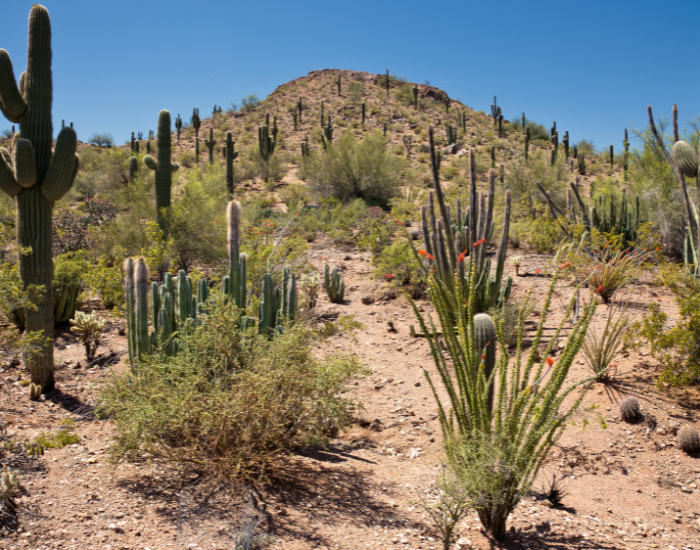
So, where do roadrunner birds live? The answer depends on the species, but both prefer open country where their speed gives them an advantage.
The greater roadrunner (Geococcyx californianus) inhabits the desert southwest, particularly the Sonoran Desert and Chihuahuan Desert, as well as arid scrublands, arid grasslands, and semi-open woodlands. It thrives in New Mexico, where it is celebrated as the state bird, and ranges into West Texas, Arizona, and California. It also lives across northern Mexico, where locals tell stories of its cleverness and snake-killing prowess.
The lesser roadrunner (Geococcyx velox) is confined to hotter, drier parts of Central America and southern Mexico. It is more secretive, often keeping to scrublands and areas with less human disturbance.
In areas of open desert with sparse vegetation, the birds were more efficient hunters, able to spot and chase prey without obstruction. This highlights how closely their survival depends on the shape of their landscapes.
What Does a Roadrunner Bird Look Like?
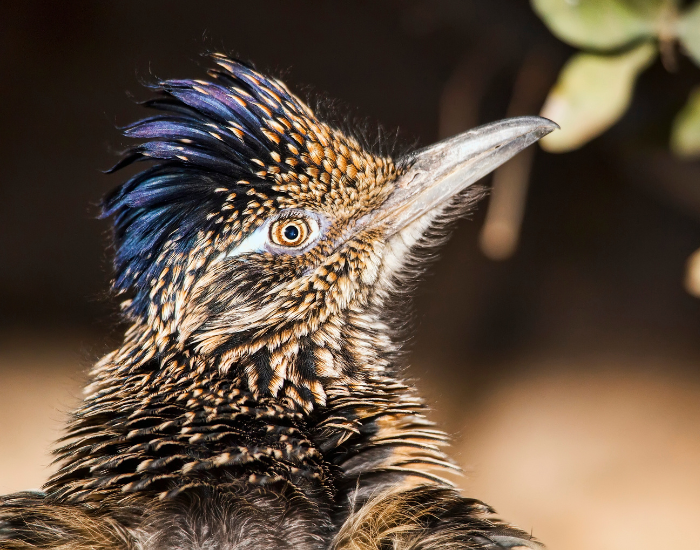
The characteristics of a roadrunner are as distinctive as their behavior. These are slender birds, perfectly engineered for sprinting across hot sand. Their bodies are elongated, supported by strong legs that allow them to run at speeds of up to 20 miles per hour. Their rounded wings are used sparingly, usually for short distances or to reach a low tree for roosting or nesting.
Roadrunners measure about two feet from beak to tail. Their plumage is streaked brown and white, with tail feathers tipped in white that flash during displays or when turning at high speed. Male and female roadrunners have identical plumage, making it difficult to distinguish between the sexes based on appearance alone. They also sport a shaggy crest that rises and falls depending on mood or communication.
Their feet are just as fascinating. With four toes, arranged two pointing forward and two backward, their tracks leave an X-shaped print on the sand. This unique shape was once thought to confuse evil spirits, making the roadrunner’s path spiritually protective in Native American traditions.
One of their more subtle adaptations is in thermoregulation. Roadrunners sometimes spread their back feathers to absorb early morning sunlight after cold desert nights, exposing areas of black skin beneath. They also use gular fluttering, rapid vibrations of the throat, to cool down during extreme heat. These combined strategies allow them to maintain stable body temperature despite living in such variable climates.
What do They Eat? – Diet and Hunting
So, what does the roadrunner eat? The short answer: it eats just about anything it can overpower. The roadrunner diet is one of the most diverse among desert birds.
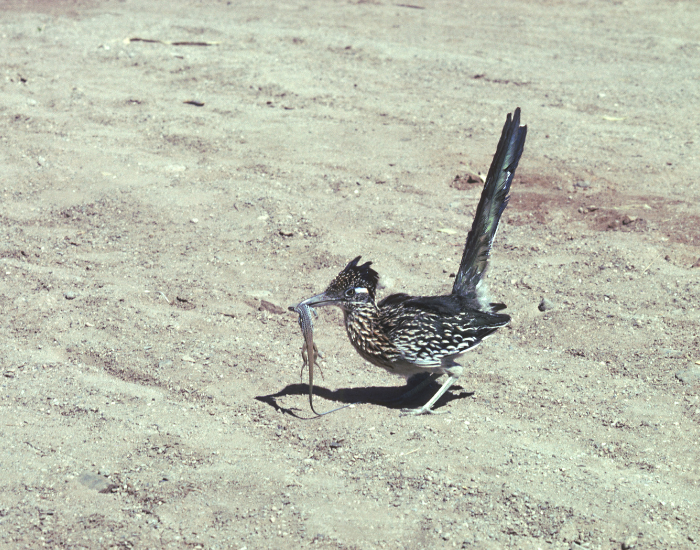
They regularly catch insects such as beetles, grasshoppers, and crickets, snapping them up with lightning-fast beaks. They also pursue small mammals like mice, ground squirrels, and rodents, often ambushing them at burrow entrances. Lizards form another staple, horned lizards are common prey, as are smaller slender species.
Roadrunners are also famous for tackling snakes, including rattlesnakes. I once observed a roadrunner slam a snake against a rock repeatedly before swallowing it whole. This earned them the reputation of snake killer across the desert southwest. They don’t stop there, they’ll also take on venomous lizards, scorpions, and even tarantulas.
Their opportunism extends to other birds. They have been known to raid nests for eggs or nestlings, sometimes preying on hummingbirds, sparrows, and even small birds. During the breeding season, they may also consume more fruits and seeds, taking advantage of cactus fruit or seasonal berries to supplement energy needs.
In essence, the roadrunner’s ability to eat “just about anything,” including small birds and other bird species, is the secret to its survival in arid ecosystems. To cope with the excess salt from eating animal prey, roadrunners have specialized salt glands near their eyes that help them excrete excess salt and maintain hydration.
Foraging Habits of Roadrunners
Roadrunners are masters of survival in the arid landscapes of the Southwest, thanks to their remarkable foraging habits. As agile members of the cuckoo family, these birds are always on the move, scanning the ground for their next meal. The greater roadrunner, in particular, is renowned for its ability to catch prey that many other birds would never attempt, everything from insects and horned lizards to small mammals and even snakes.
Unlike birds that rely on flight to hunt, roadrunners do most of their foraging on the ground. Their powerful legs and keen eyesight allow them to spot and chase down prey with impressive speed and accuracy. Whether it’s darting after a grasshopper, ambushing a horned lizard, or outmaneuvering a venomous snake, the roadrunner’s hunting style is all about quick reflexes and bold tactics. They have even been observed using their beaks to skillfully dispatch dangerous prey, making them one of the few birds in the desert capable of taking on such a wide range of animals.
But roadrunners aren’t just carnivores, they’re opportunists. When animal prey is scarce, they’ll readily eat fruits, seeds, and other plant material, demonstrating a flexibility that helps them thrive in unpredictable environments. One particularly fascinating behavior is gular fluttering, where the bird rapidly vibrates the skin under its chin. This not only helps the roadrunner shed excess heat during the hottest parts of the day, but can also attract insects, giving the bird an extra edge in catching prey.
Behavior and Breeding
Roadrunners are often encountered alone or in pairs, but during the breeding season they reveal a more social side. Male and female roadrunners share nesting duties, and like many other species, these birds build nests of sticks, grasses, and sometimes snakeskin in shrubs or low trees.
Courtship is full of character. During the mating ritual, the male wags his tail and leaps into the air as part of an elaborate display, often accompanied by food presentations, sometimes offering lizards as gifts. In some regions, locals still call the bird the chaparral cock, a reflection of its courtship behaviors in shrubby landscapes.
Though not flocking birds, roadrunners do form long-term bonds. Many pairs are monogamous, returning to the same nesting sites year after year. When not breeding, they spend much of the day foraging, often moving between open country and denser cover to balance hunting with safety from predators like hawks or the occasional coyote.
Social Structure and Communication
The social lives of roadrunners are as intriguing as their hunting skills. As members of the cuckoo family, both male and female roadrunners play active roles in their communities, especially when it comes to nesting and raising young birds. The greater roadrunner is particularly known for its strong pair bonds, with many couples forming long-term monogamous relationships that can last for years.
Communication is at the heart of roadrunner society. These birds use a variety of vocalizations to keep in touch with mates and defend their territories. The greater roadrunner’s signature call is a series of low, dovelike coos that echo across the desert, often heard at dawn or dusk. These calls help pairs coordinate their activities and warn off rivals, ensuring that each bird’s territory remains secure.
Visual signals are just as important. Roadrunners use expressive body language, like tail wagging, crest raising, and feather ruffling, to convey everything from excitement to aggression. During the breeding season, these displays become even more elaborate, with both male and female roadrunners participating in courtship rituals and nest defense. Their synchronized movements and shared responsibilities in nesting highlight the cooperative nature of their relationships.
When it comes to raising young, both parents are deeply involved. They take turns incubating eggs, feeding hatchlings, and protecting the nest from predators. This teamwork ensures that the next generation of roadrunners has the best possible start in life, even in the challenging conditions of the desert.
Cultural Symbolism – Indigenous Beliefs
The roadrunner is more than a desert survivor, it is a cultural figure across the landscapes it inhabits. Many Native American communities considered the X-shaped footprint left by the roadrunner’s two forward and two backward toes sacred. They believed these tracks prevented evil spirits from following a person’s path.
In Mexico, people have long associated the roadrunner with cleverness and protection, treating it as a sacred symbol of agility and strength. The name chaparral cock itself reflects the bird’s embeddedness in local traditions. Today, in New Mexico, the greater roadrunner is celebrated as the state bird, standing as a symbol of resilience and adaptability.
Latest Scientific Insights on Roadrunners
Recent research continues to shed light on the adaptability and survival strategies of roadrunners. A 2018 study used infrared cameras to observe how greater roadrunners defend their nests against predators. Rat snakes accounted for nearly 70% of nest predation, and in more than half of encounters, roadrunners mounted vigorous defenses, delivering rapid bill strikes and intense displays. While not all nests were saved, in over 50% of defended cases at least one egg or chick survived, showing just how determined these birds can be in protecting their young.
At the same time, new science news suggests that climate change may actually be expanding roadrunners’ range. According to the American Bird Conservancy, as reported by The Weather.com, hotter and drier conditions are creating suitable habitats farther north and east. Researchers estimate that the greater roadrunner’s range could grow by nearly 27% over the next four decades if warming trends continue.
Conservation Status – Do not Worry
The greater roadrunner (Geococcyx californianus) is listed as a species of Least Concern by the IUCN. Its populations remain relatively stable across the U.S. and Mexico, though localized declines occur where urban sprawl, highways, and agriculture fragment habitats.
The lesser roadrunner (Geococcyx velox) is considered Near Threatened, largely due to habitat conversion in Central America. Because both species are predators of snakes, rodents, and insects, their ecological role is significant. Without roadrunners, populations of prey animals could grow unchecked, potentially unbalancing desert ecosystems.
Interested in Birds? Have a look at our articles about:
- Birds of Mexico
- Endangered Birds in the US
- 19 Birds of New York State You Must Know
- 12 Amazing Birds from Texas
FAQs about Roadrunners
Thrashers and anis are sometimes mistaken for roadrunners, but they lack the long tail, shaggy crest, and the distinctive running gait.
Yes, but they prefer running. They usually only fly short distances, often up into a low tree to escape danger or to reach a nest.
In their range, no. In states like Arizona, New Mexico, and Texas, roadrunners are fairly common, especially in open country and desert scrub.
Their diet is varied: they catch insects, eat rodents, pursue lizards and snakes, and even take scorpions and eggs from other birds.
They build nests in shrubs, cactus plants, or low trees, often lined with feathers and sometimes snakeskin.
Many pairs do remain together over several breeding seasons, often returning to the same nesting sites year after year.
Why Roadrunners Matter
The road runner birds of North America and Central America embody resilience in its purest form. From the deserts of New Mexico to the plains of northern Mexico, these slender birds survive not by specializing but by adapting, catching insects one moment, tackling snakes the next. They are cultural figures, ecological regulators, and charismatic creatures that connect people to place.
For me, spotting a roadrunner racing across the desert remains one of the highlights of my fieldwork years. Each time I see that streak of feathers and hear the rustle of wings as it leaps into a low tree, I am reminded of just how astonishingly resourceful life in the desert can be.
Protecting their habitats ensures not just the survival of the roadrunner, but also the stability of the ecosystems they represent. If you ever find yourself in the desert southwest or Central America, keep your eyes open, you might just see a flash of movement and realize you’ve encountered one of nature’s most fascinating runners.